
Relativity: The Special and the General Theory
Albert Einstein, Words Power Editors
Paperback
• 176 Pages
• ₹ 229.00
• English
• 9789354990144
No ratings yet
| Publisher | Words Power |
|---|---|
| ISBN13 | 9789354990144 |
| ASIN/SKU | 9354990142 |
| Book Format | Paperback |
| Language | English |
| Pages | 176 |
| List Price | ₹ 229.00 |
| Publishing Date | 18/02/2022 |
| Dimensions | 13.34 x 1.12 x 20.32 cm |
| Weight | 209 g |
| Book Code | BD00080766 |
Buy this Book
Amazon Stores
Ebook Stores
Other Stores
Discover Relativity: The Special and the General Theory by Albert Einstein. This book is published by Words Power in Paperback format, ISBN 9789354990144, ASIN 9354990142, under Science and Math, Astronomy and Astrophysics, Physics.
Book Description
First published in German in 1916, and later translated into English in 1920, ‘Relativity: The Special and the General Theory’ is a short paper and was eventually published as a book by Albert Einstein, German-born, best known for his work on the theory of Relativity, gaining him the title of ‘Father of Modern Physics’. He received the 1921 Nobel Prize in Physics, and his work is attributed as an inspiration for the quantum theory within the field of physics. His hundreds of papers and books are highly original and intelligent, making him one of the most famous and respected intellectual minds of the twentieth century. Einstein’s ‘Theory of Relativity’ is the most significant scientific idea of the modern era. In this book Einstein explains, using the minimum of mathematical terms, the basic ideas, and principles of the theory which has shaped the world we live in today. Unequaled by any subsequent books on relativity, this remains the most popular and beneficial exposition of Einstein’s immense contribution to human knowledge. It is divided into 3 parts, the first dealing with special relativity, the second dealing with general relativity, and the third dealing with considerations on the universe as a whole. In this work Einstein intended, as far as possible, to give an accurate insight into the theory of relativity to those readers who, from a general and scientific-philosophical point of view, are curious in the theory, but who are not conversant with the mathematical apparatus of theoretical physics. The theory of relativity enriched physics and astronomy during the 20th century.
Author Biography
Albert Einstein was a German-born theoretical physicist. He developed the general theory of relativity, one of the two pillars of modern physics. He is best known for his mass–energy equivalence formula E = mc². He received the 1921 Nobel Prize in Physics "for his services to theoretical physics, and especially for his discovery of the law of the photoelectric effect". The latter was pivotal in establishing quantum theory. Near the beginning of his career, Einstein thought that Newtonian mechanics was no longer enough to reconcile the laws of classical mechanics with the laws of the electromagnetic field. This led to the development of his special theory of relativity. He realized, however, that the principle of relativity could also be extended to gravitational fields, and with his subsequent theory of gravitation in 1916, he published a paper on the general theory of relativity. He continued to deal with problems of statistical mechanics and quantum theory, which led to his explanations of particle theory and the motion of molecules. He also investigated the thermal properties of light which laid the foundation of the photon theory of light.
Editorial Reviews
Editorial Reviews will be added soon…
Book Summary
Book Summary will be added soon…
Sample Chapters
Sample Chapters will be added soon…
Reader Reviews
No reviews yet.
Relativity: The Special and the General Theory
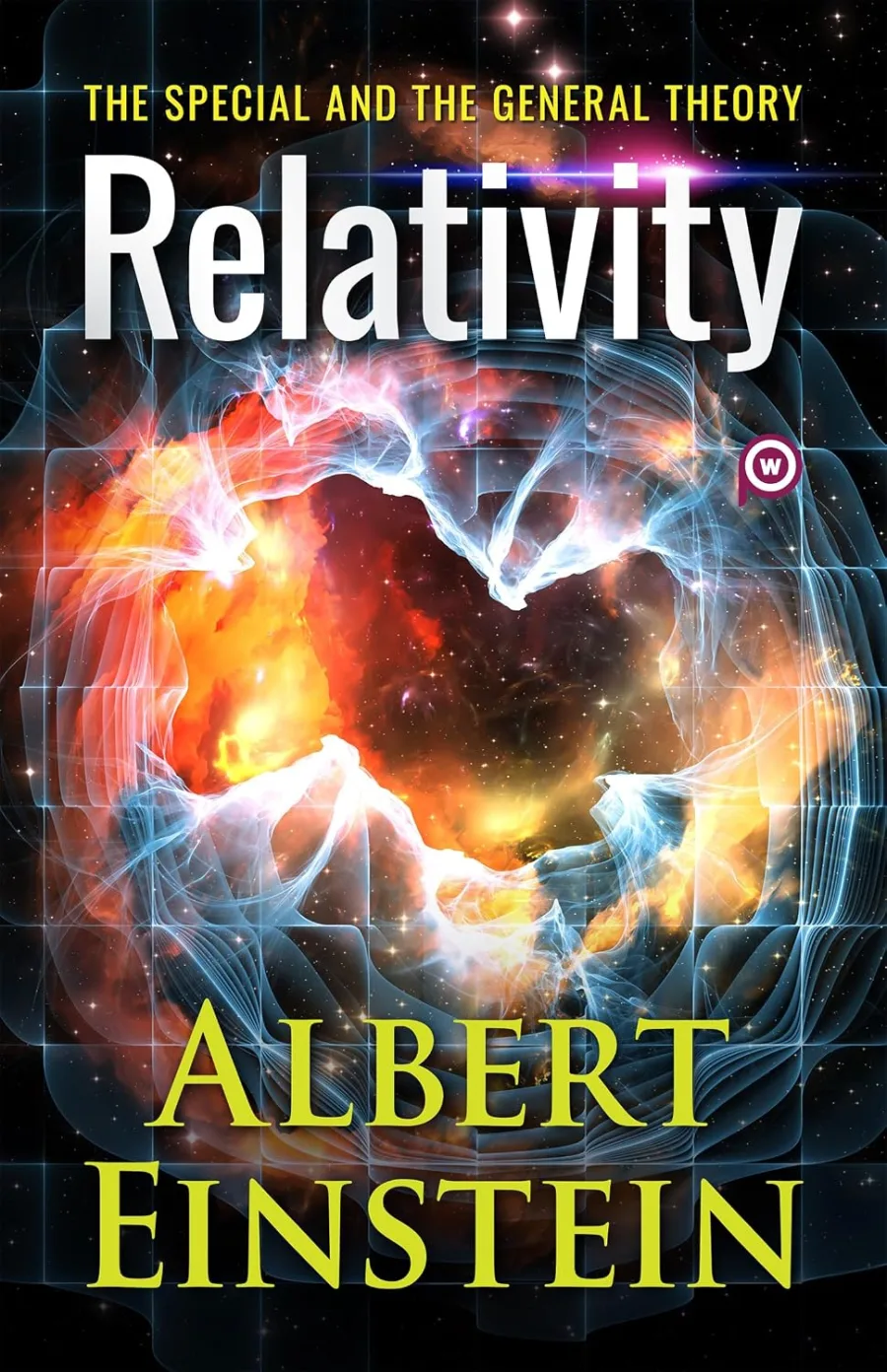
Download Cover Image
Do you want to download the full cover image for Relativity: The Special and the General Theory?