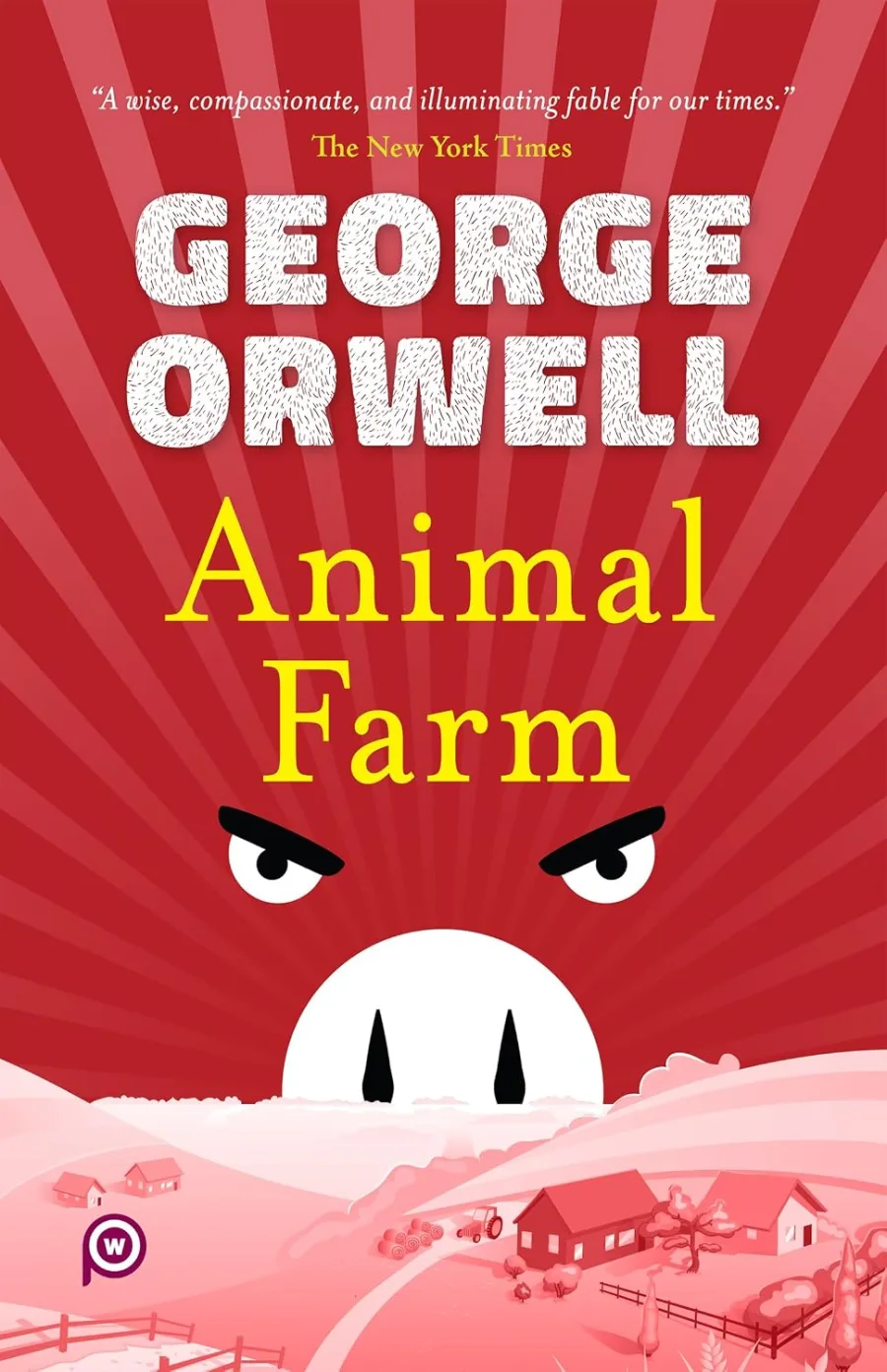
Animal Farm
Paperback
• 128 Pages
• ₹ 229.00
• English
• 9789354993381
No ratings yet
| Publisher | Words Power |
|---|---|
| ISBN13 | 9789354993381 |
| ASIN/SKU | 9354993389 |
| Book Format | Paperback |
| Language | English |
| Pages | 128 |
| List Price | ₹ 229.00 |
| Publishing Date | 18/02/2022 |
| Dimensions | 13.34 x 0.81 x 20.32 cm |
| Weight | 154 g |
| Book Code | BD00080755 |
Buy this Book
Amazon Stores
Ebook Stores
Other Stores
Discover Animal Farm by George Orwell. This book is published by Words Power in Paperback format, ISBN 9789354993381, ASIN 9354993389, under Literature and Fiction, Classic Fiction, Dystopian Fiction.
Book Description
First published in England in August 1945, ‘Animal Farm’ is a classic satire of the Russian Revolution by George Orwell, an English novelist, essayist, journalist, and critic. It is considered one of Orwell’s most remarkable works, and a political fable based on the occurrences of Russia’s Bolshevik Revolution and the betrayal of the cause by Joseph Stalin. Orwell’s work is distinguished by keen brilliance and wit, a deep awareness of social injustice, intense resistance to totalitarianism, a fascination for clarity in language, and a belief in democratic socialism. It is the account of the fierce struggle, initiated by the animals, that alters Mr. Jones's Manor Farm into Animal Farm, a wholly democratic society built on the ideology that “All Animals are Created Equal”. Out of their intelligence, the pigs: Napoleon, Squealer, and Snowball materialize as leaders of the new community in a subtle evolution that proves disastrous. The pigs form a tyranny even more domineering and cruel than that of their former human masters. The characters in the novella resemble significant people that influenced the Russian Revolution. These characters act similarly to the real people and actions that were done in the past. Through this book, George Orwell uncovers Stalin's true disposition and evils using a crooked pig named Napoleon that eventually dictates the farm. It is one of the most momentous political texts ever written.
Author Biography
George Orwell is one of England's most famous writers and social commentators. Among his works are the classic political satire Animal Farm and the dystopian nightmare vision Nineteen Eighty-Four. Orwell was also a prolific essayist, and it is for these works that he was perhaps best known during his lifetime. They include Why I Write and Politics and the English Language. His writing is at once insightful, poignant and entertaining, and continues to be read widely all over the world.
Eric Arthur Blair (George Orwell) was born in 1903 in India, where his father worked for the Civil Service. The family moved to England in 1907 and in 1917 Orwell entered Eton, where he contributed regularly to the various college magazines. From 1922 to 1927 he served with the Indian Imperial Police in Burma, an experience that inspired his first novel, Burmese Days (1934). Several years of poverty followed. He lived in Paris for two years before returning to England, where he worked successively as a private tutor, schoolteacher and bookshop assistant, and contributed reviews and articles to a number of periodicals. Down and Out in Paris and London was published in 1933. In 1936 he was commissioned by Victor Gollancz to visit areas of mass unemployment in Lancashire and Yorkshire, and The Road to Wigan Pier (1937) is a powerful description of the poverty he saw there.
At the end of 1936 Orwell went to Spain to fight for the Republicans and was wounded. Homage to Catalonia is his account of the civil war. He was admitted to a sanatorium in 1938 and from then on was never fully fit. He spent six months in Morocco and there wrote Coming Up for Air. During the Second World War he served in the Home Guard and worked for the BBC Eastern Service from 1941 to 1943. As literary editor of the Tribune he contributed a regular page of political and literary commentary, and he also wrote for the Observer and later for the Manchester Evening News. His unique political allegory, Animal Farm was published in 1945, and it was this novel, together with Nineteen Eighty-Four (1949), which brought him world-wide fame.
It was around this time that Orwell's unique political allegory Animal Farm (1945) was published. The novel is recognised as a classic of modern political satire and is simultaneously an engaging story and convincing allegory. It was this novel, together with Nineteen Eighty-Four (1949), which finally brought him world-wide fame. Nineteen Eighty-Four's ominous depiction of a repressive, totalitarian regime shocked contemporary readers, but ensures that the book remains perhaps the preeminent dystopian novel of modern literature.
Orwell's fiercely moral writing has consistently struck a chord with each passing generation. The intense honesty and insight of his essays and non-fiction made Orwell one of the foremost social commentators of his age. Added to this, his ability to construct elaborately imaginative fictional worlds, which he imbued with this acute sense of morality, has undoubtedly assured his contemporary and future relevance.
George Orwell died in London in January 1950.
Editorial Reviews
Editorial Reviews will be added soon…
Book Summary
Book Summary will be added soon…
Sample Chapters
Sample Chapters will be added soon…
Reader Reviews
No reviews yet.
Animal Farm