
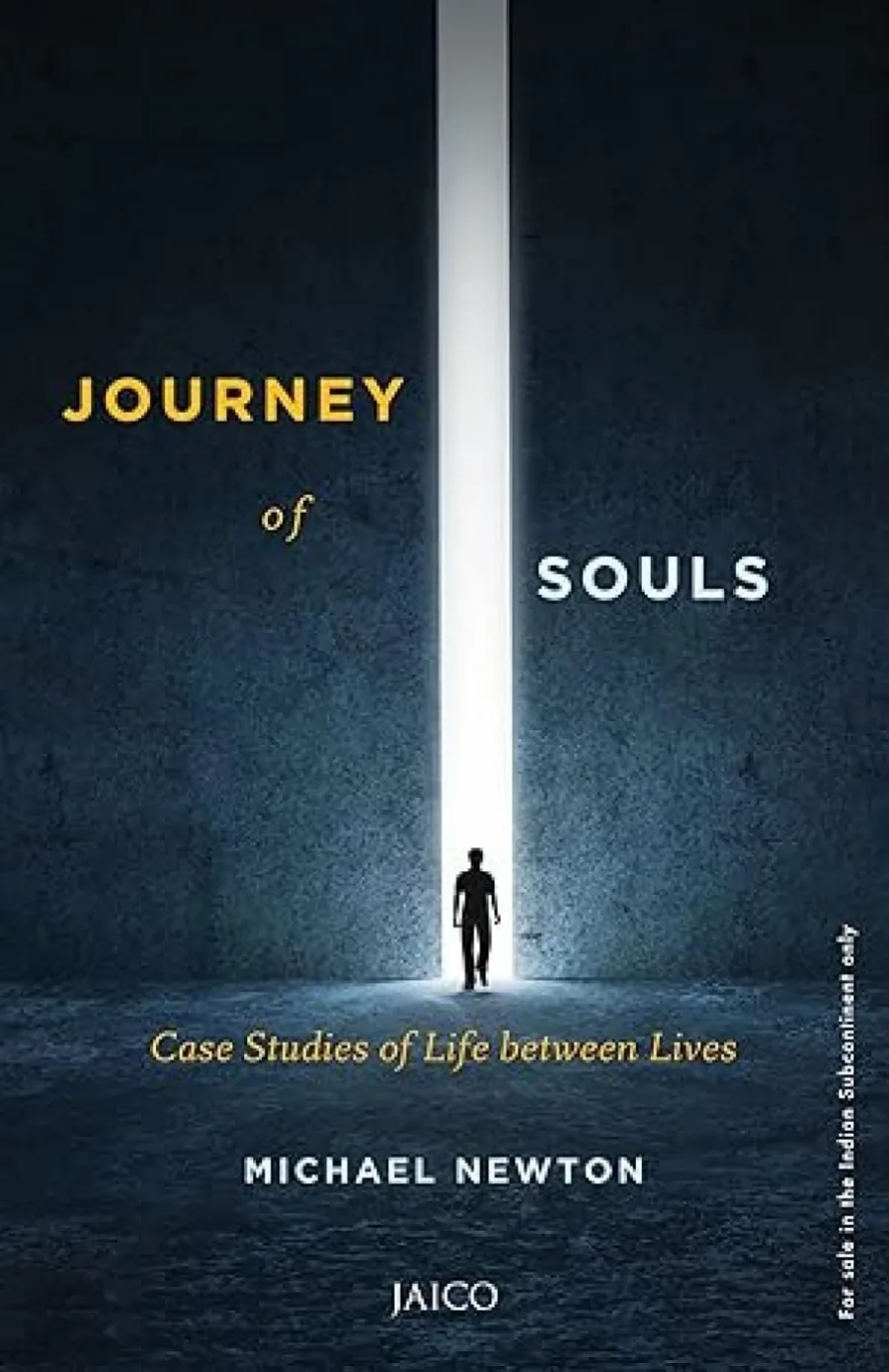
Journey of Souls
Paperback
• 288 Pages
• ₹ 289.00
• English
• 9788184951059
No ratings yet
| Publisher | Jaico Publishing House |
|---|---|
| ISBN13 | 9788184951059 |
| ASIN/SKU | 8184951051 |
| Book Format | Paperback |
| Language | English |
| Pages | 288 |
| List Price | ₹ 289.00 |
| Publishing Date | 01/01/2015 |
| Dimensions | 20 x 5 x 25 cm |
| Weight | 299 g |
| Book Code | BD00070780 |
Buy this Book
Amazon Stores
Ebook Stores
Other Stores
Discover Journey of Souls by Michael Newton. This book is published by Jaico Publishing House in Paperback format, ISBN 9788184951059, ASIN 8184951051, under Religion and Spirituality, History.
Book Description
Journey of Souls
Author Biography
Michael Newton, Ph.D., holds a doctorate in Counseling Psychology, is a certified Master Hypnotherapist, and is a member of the American Counseling Association. He has also been on the faculty of higher educational institutions as a teacher while active in private practice in Los Angeles. Over many years, Dr. Newton developed his own intensive age regression techniques in order to effectively take hypnosis subjects beyond their past life memories to a more meaningful soul experience between lives. He is considered to be a pioneer in uncovering the mysteries about life after death through the use of spiritual hypnotic regression. He now trains other advanced hypnotherapists in his techniques.
Dr. Newton is the author of three best-selling books, Journey of Souls: Case Studies of Life Between Lives (Llewellyn, 1994) , Destiny of Souls: New Case Studies of Life Between Lives (Llewellyn, May 2000), and Life Between Lives: Hypnotherapy for Spiritual Regression (Llewellyn, 2004). Dr. Newton has an international reputation as a spiritual regressionist who has mapped out much of our life between lives experience. He has appeared on numerous national radio and TV talk shows to explain our immortal life in the spirit world.
Dr. Newton is the author of three best-selling books, Journey of Souls: Case Studies of Life Between Lives (Llewellyn, 1994) , Destiny of Souls: New Case Studies of Life Between Lives (Llewellyn, May 2000), and Life Between Lives: Hypnotherapy for Spiritual Regression (Llewellyn, 2004). Dr. Newton has an international reputation as a spiritual regressionist who has mapped out much of our life between lives experience. He has appeared on numerous national radio and TV talk shows to explain our immortal life in the spirit world.
Editorial Reviews
Editorial Reviews will be added soon…
Book Summary
Michael Newton’s Journey of Souls: Case Studies of Life Between Lives is a book about what, according to Newton’s research, happens to the human soul between one physical life and the next. First published in 1994, the book presents itself not as a conventional work of religion or philosophy but as a collection of case studies drawn from Newton’s experiences with clients undergoing hypnotic regression. Newton, a hypnotherapist, became interested in what his subjects described beyond memories of childhood and previous earthly lives. Through what he called “Life Between Lives” regression, he explored accounts of death, the transition into the spiritual realm, encounters with other souls, spiritual guides, learning, preparation for another incarnation, and eventual return to Earth.
The central idea of Journey of Souls is that physical death is not the end of consciousness. Newton’s subjects consistently described death as a transition from the physical world into a nonphysical realm. In their accounts, the soul leaves the body, experiences a period of adjustment, encounters familiar spiritual beings or guides, and eventually enters a larger community of souls. From this perspective, earthly life is only one part of a much longer journey. Human beings are temporarily embodied, while the soul itself is understood as continuing to exist beyond the limits of a single lifetime.
Newton begins by describing the unusual path that led him toward this area of research. Initially, his work involved conventional hypnotherapy, and he was not specifically looking for evidence of reincarnation or an afterlife. However, some clients under hypnosis began describing experiences that appeared to go beyond their current lives. As he explored these experiences more deeply, he noticed recurring patterns in what people reported. Different individuals, often without knowing one another, described remarkably similar stages of existence between incarnations. Newton regarded these similarities as significant and gradually developed a method for guiding clients into what he considered memories of the spiritual state between lives.
One of the most important experiences described in the book is the moment of physical death. Newton’s subjects generally portray death as peaceful rather than frightening. The soul is described as separating from the body and observing the physical world from a different perspective. Some subjects report seeing their own bodies from outside themselves, while others describe a sense of freedom, lightness, or release. Emotional reactions vary, particularly when death is sudden or traumatic, but the larger pattern is one of transition rather than annihilation.
This portrayal of death is one of the book’s most comforting themes. Newton suggests that the fear of death may arise largely from our identification with the physical body. The soul, in the accounts he records, does not experience death in the same way the physical personality does. Instead, it recognizes that it is returning to a familiar spiritual environment. Even people whose earthly lives were difficult are described as receiving guidance and care after death.
After leaving the physical body, the soul is said to move toward a spiritual environment. Newton’s subjects describe guides who assist them during this transition. These guides are often portrayed as compassionate, patient figures who understand the soul more deeply than it understands itself. They do not appear primarily as judges who punish wrongdoing. Instead, they function as teachers, counselors, and companions.
This distinction is central to Newton’s interpretation of the afterlife. His spiritual world is not organized primarily around reward and punishment. Instead, it is organized around learning, growth, responsibility, and understanding. Souls may make mistakes, sometimes serious ones, but those mistakes become opportunities for learning. The soul is encouraged to understand the consequences of its actions rather than simply being condemned for them.
Newton’s subjects also describe encountering other souls after death. These souls may include people they knew during their earthly lives, but the relationships are often presented as much broader than ordinary human relationships. Souls belong to groups or communities in which they learn and develop together. Some relationships may continue across several incarnations, with people appearing in different roles in different lives. A person who is a parent in one lifetime might be a friend, spouse, sibling, teacher, or even adversary in another.
This idea allows Newton to offer an unusual interpretation of human relationships. Difficult relationships, in particular, may have a deeper purpose within the framework described by his subjects. Conflict, disappointment, separation, and emotional pain can become part of a soul’s education. This does not mean that suffering is automatically good or that harmful behavior should be excused. Rather, the book suggests that experiences can acquire meaning when viewed as part of a longer spiritual journey.
A major portion of Journey of Souls concerns the soul’s community. Newton describes different groups of souls as being at different levels of development. Some are relatively inexperienced, while others are more advanced. Souls learn from one another and from spiritual teachers. Progress is not presented as a competition. Instead, development appears gradual and cooperative, with more experienced souls helping those who are still learning.
The book repeatedly returns to the idea that spiritual development is connected with understanding. A soul becomes wiser not simply by accumulating knowledge but by developing qualities such as compassion, patience, responsibility, forgiveness, courage, and love. Earthly life provides opportunities to practice these qualities because physical existence contains uncertainty, limitation, emotional difficulty, and free choice.
One of Newton’s most interesting themes is the concept of life review. After death, the soul is described as examining its previous incarnation. This review is not portrayed as a courtroom in which an external deity announces a verdict. Instead, the soul looks carefully at its choices and their consequences. It may revisit important events and recognize how its behavior affected other people. In this process, the soul develops a deeper understanding of itself.
The life review therefore becomes an exercise in responsibility. A person cannot simply forget harmful actions after death. At the same time, the soul is not defined permanently by its mistakes. The emphasis is on learning from experience. This gives Newton’s account a strongly educational character: life is a classroom, death is a transition, and reflection allows the soul to understand what it has learned.
Another important part of the book concerns the preparation for another incarnation. According to the cases Newton presents, souls eventually begin considering another earthly life. They may work with guides and other souls to examine possible circumstances for their next incarnation. These circumstances can include family relationships, social environments, challenges, opportunities, and significant relationships.
The idea of choosing a life is one of the book’s most challenging concepts. Newton’s subjects sometimes describe selecting difficult circumstances because those circumstances offer opportunities for growth. A challenging family, illness, loss, social limitation, or difficult relationship may therefore be interpreted within the book as part of a broader developmental plan.
However, the book does not suggest that every detail of life is rigidly predetermined. Free will remains important. The circumstances into which someone is born may be selected or anticipated, but how a person responds to them remains open. The soul enters physical life without consciously remembering its spiritual planning. This forgetfulness is itself presented as important because genuine human choice requires living without complete knowledge of the larger picture.
The selection of a new body is also discussed. Newton’s subjects describe preparing for incarnation and gradually becoming connected with a developing physical body. The transition from spiritual existence to physical existence is portrayed as profound because the soul moves from a state of broad awareness into the limitations of human consciousness.
This loss of memory creates one of the book’s most important philosophical tensions. If souls have lived before and understand their larger purpose, why do human beings usually remember nothing of it? Newton’s answer, based on his subjects’ accounts, is that forgetting makes earthly life meaningful. If people remembered every previous incarnation and knew exactly why every event was happening, their choices might become mechanical. The uncertainty of human existence creates genuine opportunities for growth.
The book also places great emphasis on spiritual guides. These guides are not necessarily described as traditional religious figures. They are individualized beings who seem to understand a soul’s development and provide advice without forcing decisions. Their role resembles that of a mentor. They help souls recognize patterns, understand mistakes, and consider future challenges.
Underlying nearly every case is the theme of personal growth. Newton’s spiritual universe is less concerned with institutional religion than with the development of consciousness. The soul is encouraged to become more loving, responsible, patient, and aware. Earthly success—wealth, status, fame, or power—is not presented as the ultimate measure of a successful life. Instead, what matters is how a person relates to others and what they learn through their experiences.
One of the book’s most appealing qualities is its treatment of ordinary human struggles. Newton’s cases repeatedly suggest that people should not judge the value of their lives solely by external circumstances. A seemingly ordinary life may involve profound spiritual learning. Someone who experiences loss, loneliness, failure, or hardship may nevertheless be developing qualities that are invisible to society.
At the same time, Journey of Souls should be understood as a presentation of Newton’s regression-based research and interpretation, not as scientifically established evidence of an afterlife or reincarnation. The experiences described in hypnotic regression can be interpreted in different ways, and memories produced under hypnosis are not generally regarded as reliable historical records. Readers may therefore approach the book as a spiritual account, a collection of extraordinary subjective experiences, or a philosophical exploration of death and meaning rather than as definitive proof of what happens after death.
What makes the book enduring is not simply its claims about the afterlife but the emotional questions it asks about human existence. Why do we suffer? Why do certain relationships affect us so deeply? Can painful experiences have meaning? What does it mean to grow as a person? Is death an ending or a transition? And if our lives are part of something larger, how should we live now?
Newton’s answer is ultimately gentle. He presents existence as a long journey in which the soul gradually learns through experience. Earthly life is difficult precisely because it involves limitation, uncertainty, separation, and choice. Yet those same difficulties create the conditions for compassion, courage, forgiveness, and love.
The deepest message of Journey of Souls is therefore not simply that there is life after death. It is that life itself may be understood as an opportunity for growth. Death, in Newton’s framework, does not erase what has been lived; it provides an opportunity to understand it. Relationships become lessons, mistakes become sources of wisdom, suffering can become a catalyst for transformation, and love becomes the thread connecting different stages of existence.
Whether one accepts Newton’s interpretation literally or reads it symbolically, the book encourages a more reflective attitude toward life. It asks readers to look beyond immediate success and failure and consider the character they are developing through their experiences. Its vision of the soul is patient rather than judgmental: human beings are imperfect learners, repeatedly given opportunities to understand themselves and one another more deeply.
In this sense, Journey of Souls is ultimately a book about hope. It imagines consciousness as something larger than one lifetime and portrays death not as disappearance but as a passage into another stage of existence. Its spiritual message is that we are not merely defined by what happens to us. We are also shaped by how we respond, what we learn, how we treat others, and how much compassion we develop along the way. For readers drawn to questions of reincarnation, consciousness, spirituality, death, and the meaning of human life, Newton’s work offers a detailed and deeply personal vision of existence as an ongoing journey of learning, relationship, and transformation.
The central idea of Journey of Souls is that physical death is not the end of consciousness. Newton’s subjects consistently described death as a transition from the physical world into a nonphysical realm. In their accounts, the soul leaves the body, experiences a period of adjustment, encounters familiar spiritual beings or guides, and eventually enters a larger community of souls. From this perspective, earthly life is only one part of a much longer journey. Human beings are temporarily embodied, while the soul itself is understood as continuing to exist beyond the limits of a single lifetime.
Newton begins by describing the unusual path that led him toward this area of research. Initially, his work involved conventional hypnotherapy, and he was not specifically looking for evidence of reincarnation or an afterlife. However, some clients under hypnosis began describing experiences that appeared to go beyond their current lives. As he explored these experiences more deeply, he noticed recurring patterns in what people reported. Different individuals, often without knowing one another, described remarkably similar stages of existence between incarnations. Newton regarded these similarities as significant and gradually developed a method for guiding clients into what he considered memories of the spiritual state between lives.
One of the most important experiences described in the book is the moment of physical death. Newton’s subjects generally portray death as peaceful rather than frightening. The soul is described as separating from the body and observing the physical world from a different perspective. Some subjects report seeing their own bodies from outside themselves, while others describe a sense of freedom, lightness, or release. Emotional reactions vary, particularly when death is sudden or traumatic, but the larger pattern is one of transition rather than annihilation.
This portrayal of death is one of the book’s most comforting themes. Newton suggests that the fear of death may arise largely from our identification with the physical body. The soul, in the accounts he records, does not experience death in the same way the physical personality does. Instead, it recognizes that it is returning to a familiar spiritual environment. Even people whose earthly lives were difficult are described as receiving guidance and care after death.
After leaving the physical body, the soul is said to move toward a spiritual environment. Newton’s subjects describe guides who assist them during this transition. These guides are often portrayed as compassionate, patient figures who understand the soul more deeply than it understands itself. They do not appear primarily as judges who punish wrongdoing. Instead, they function as teachers, counselors, and companions.
This distinction is central to Newton’s interpretation of the afterlife. His spiritual world is not organized primarily around reward and punishment. Instead, it is organized around learning, growth, responsibility, and understanding. Souls may make mistakes, sometimes serious ones, but those mistakes become opportunities for learning. The soul is encouraged to understand the consequences of its actions rather than simply being condemned for them.
Newton’s subjects also describe encountering other souls after death. These souls may include people they knew during their earthly lives, but the relationships are often presented as much broader than ordinary human relationships. Souls belong to groups or communities in which they learn and develop together. Some relationships may continue across several incarnations, with people appearing in different roles in different lives. A person who is a parent in one lifetime might be a friend, spouse, sibling, teacher, or even adversary in another.
This idea allows Newton to offer an unusual interpretation of human relationships. Difficult relationships, in particular, may have a deeper purpose within the framework described by his subjects. Conflict, disappointment, separation, and emotional pain can become part of a soul’s education. This does not mean that suffering is automatically good or that harmful behavior should be excused. Rather, the book suggests that experiences can acquire meaning when viewed as part of a longer spiritual journey.
A major portion of Journey of Souls concerns the soul’s community. Newton describes different groups of souls as being at different levels of development. Some are relatively inexperienced, while others are more advanced. Souls learn from one another and from spiritual teachers. Progress is not presented as a competition. Instead, development appears gradual and cooperative, with more experienced souls helping those who are still learning.
The book repeatedly returns to the idea that spiritual development is connected with understanding. A soul becomes wiser not simply by accumulating knowledge but by developing qualities such as compassion, patience, responsibility, forgiveness, courage, and love. Earthly life provides opportunities to practice these qualities because physical existence contains uncertainty, limitation, emotional difficulty, and free choice.
One of Newton’s most interesting themes is the concept of life review. After death, the soul is described as examining its previous incarnation. This review is not portrayed as a courtroom in which an external deity announces a verdict. Instead, the soul looks carefully at its choices and their consequences. It may revisit important events and recognize how its behavior affected other people. In this process, the soul develops a deeper understanding of itself.
The life review therefore becomes an exercise in responsibility. A person cannot simply forget harmful actions after death. At the same time, the soul is not defined permanently by its mistakes. The emphasis is on learning from experience. This gives Newton’s account a strongly educational character: life is a classroom, death is a transition, and reflection allows the soul to understand what it has learned.
Another important part of the book concerns the preparation for another incarnation. According to the cases Newton presents, souls eventually begin considering another earthly life. They may work with guides and other souls to examine possible circumstances for their next incarnation. These circumstances can include family relationships, social environments, challenges, opportunities, and significant relationships.
The idea of choosing a life is one of the book’s most challenging concepts. Newton’s subjects sometimes describe selecting difficult circumstances because those circumstances offer opportunities for growth. A challenging family, illness, loss, social limitation, or difficult relationship may therefore be interpreted within the book as part of a broader developmental plan.
However, the book does not suggest that every detail of life is rigidly predetermined. Free will remains important. The circumstances into which someone is born may be selected or anticipated, but how a person responds to them remains open. The soul enters physical life without consciously remembering its spiritual planning. This forgetfulness is itself presented as important because genuine human choice requires living without complete knowledge of the larger picture.
The selection of a new body is also discussed. Newton’s subjects describe preparing for incarnation and gradually becoming connected with a developing physical body. The transition from spiritual existence to physical existence is portrayed as profound because the soul moves from a state of broad awareness into the limitations of human consciousness.
This loss of memory creates one of the book’s most important philosophical tensions. If souls have lived before and understand their larger purpose, why do human beings usually remember nothing of it? Newton’s answer, based on his subjects’ accounts, is that forgetting makes earthly life meaningful. If people remembered every previous incarnation and knew exactly why every event was happening, their choices might become mechanical. The uncertainty of human existence creates genuine opportunities for growth.
The book also places great emphasis on spiritual guides. These guides are not necessarily described as traditional religious figures. They are individualized beings who seem to understand a soul’s development and provide advice without forcing decisions. Their role resembles that of a mentor. They help souls recognize patterns, understand mistakes, and consider future challenges.
Underlying nearly every case is the theme of personal growth. Newton’s spiritual universe is less concerned with institutional religion than with the development of consciousness. The soul is encouraged to become more loving, responsible, patient, and aware. Earthly success—wealth, status, fame, or power—is not presented as the ultimate measure of a successful life. Instead, what matters is how a person relates to others and what they learn through their experiences.
One of the book’s most appealing qualities is its treatment of ordinary human struggles. Newton’s cases repeatedly suggest that people should not judge the value of their lives solely by external circumstances. A seemingly ordinary life may involve profound spiritual learning. Someone who experiences loss, loneliness, failure, or hardship may nevertheless be developing qualities that are invisible to society.
At the same time, Journey of Souls should be understood as a presentation of Newton’s regression-based research and interpretation, not as scientifically established evidence of an afterlife or reincarnation. The experiences described in hypnotic regression can be interpreted in different ways, and memories produced under hypnosis are not generally regarded as reliable historical records. Readers may therefore approach the book as a spiritual account, a collection of extraordinary subjective experiences, or a philosophical exploration of death and meaning rather than as definitive proof of what happens after death.
What makes the book enduring is not simply its claims about the afterlife but the emotional questions it asks about human existence. Why do we suffer? Why do certain relationships affect us so deeply? Can painful experiences have meaning? What does it mean to grow as a person? Is death an ending or a transition? And if our lives are part of something larger, how should we live now?
Newton’s answer is ultimately gentle. He presents existence as a long journey in which the soul gradually learns through experience. Earthly life is difficult precisely because it involves limitation, uncertainty, separation, and choice. Yet those same difficulties create the conditions for compassion, courage, forgiveness, and love.
The deepest message of Journey of Souls is therefore not simply that there is life after death. It is that life itself may be understood as an opportunity for growth. Death, in Newton’s framework, does not erase what has been lived; it provides an opportunity to understand it. Relationships become lessons, mistakes become sources of wisdom, suffering can become a catalyst for transformation, and love becomes the thread connecting different stages of existence.
Whether one accepts Newton’s interpretation literally or reads it symbolically, the book encourages a more reflective attitude toward life. It asks readers to look beyond immediate success and failure and consider the character they are developing through their experiences. Its vision of the soul is patient rather than judgmental: human beings are imperfect learners, repeatedly given opportunities to understand themselves and one another more deeply.
In this sense, Journey of Souls is ultimately a book about hope. It imagines consciousness as something larger than one lifetime and portrays death not as disappearance but as a passage into another stage of existence. Its spiritual message is that we are not merely defined by what happens to us. We are also shaped by how we respond, what we learn, how we treat others, and how much compassion we develop along the way. For readers drawn to questions of reincarnation, consciousness, spirituality, death, and the meaning of human life, Newton’s work offers a detailed and deeply personal vision of existence as an ongoing journey of learning, relationship, and transformation.
Sample Chapters
Sample Chapters will be added soon…
Reader Reviews
No reviews yet.
Journey of Souls
Download Cover Image
Do you want to download the full cover image for Journey of Souls?