
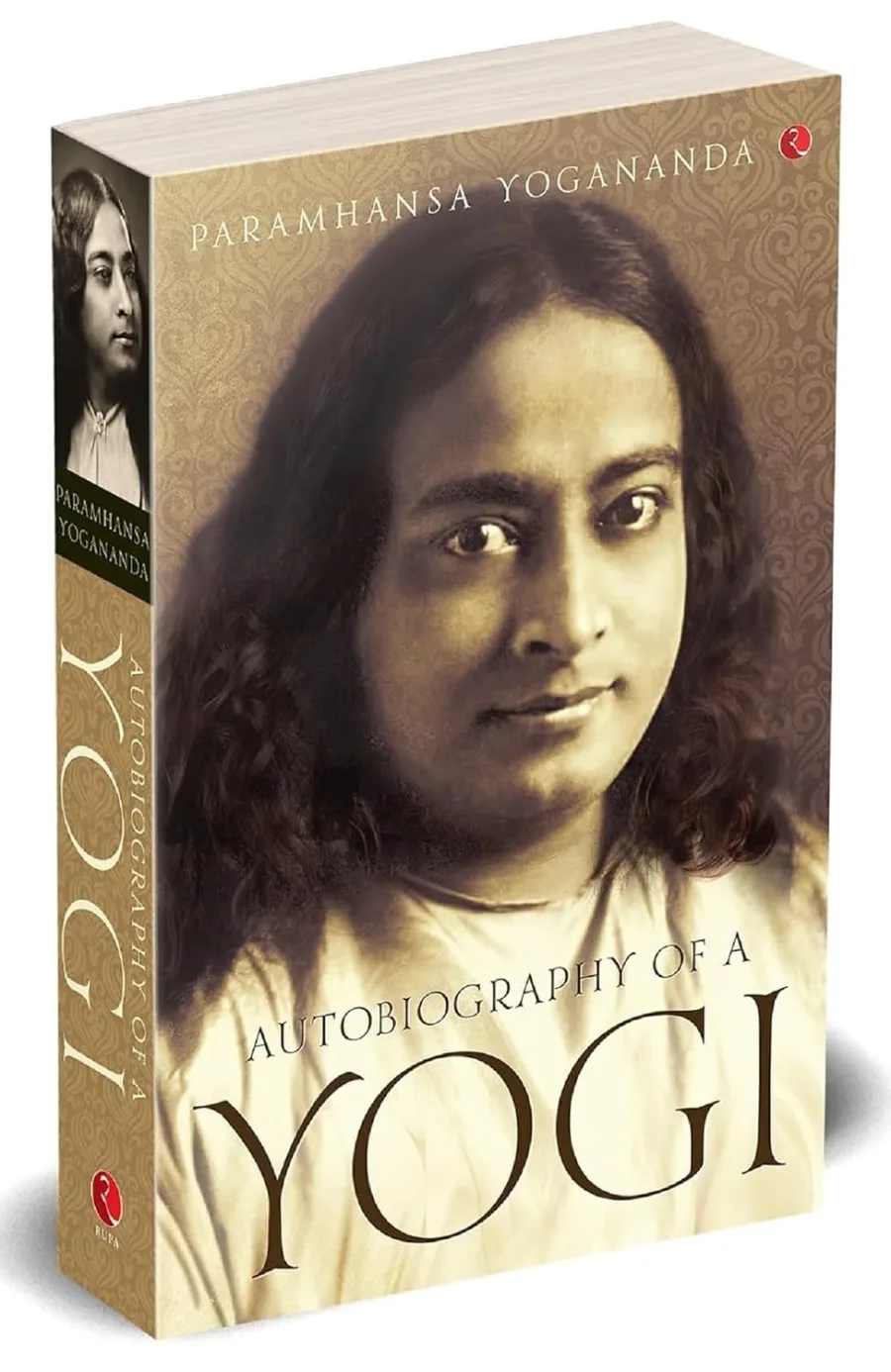
Autobiography of a Yogi
Paperback
• 521 Pages
• ₹ 295.00
• English
• 9788129145369
No ratings yet
| Publisher | Rupa Publications India |
|---|---|
| ISBN13 | 9788129145369 |
| ASIN/SKU | 8129145367 |
| Book Format | Paperback |
| Language | English |
| Pages | 521 |
| List Price | ₹ 295.00 |
| Publishing Date | 10/03/2017 |
| Dimensions | 20.32 x 3.3 x 25.4 cm |
| Weight | 520 g |
| Book Code | BD00070779 |
Buy this Book
Amazon Stores
Ebook Stores
Other Stores
Discover Autobiography of a Yogi by Paramahansa Yogananda. This book is published by Rupa Publications India in Paperback format, ISBN 9788129145369, ASIN 8129145367, under Biographies and Memoirs, Diaries and Journals, Biographies and Autobiographies.
Book Description
Autobiography of a Yogi is the story of the life of Paramahansa Yogananda (January 5, 1893?March 7, 1952) first published in 1946. Born as Mukunda Lal Ghosh in Gorakhpur, India, into a Bengali family, this book takes the reader on a journey into the life of Paramahansa Yogananda and his encounters with spiritual figures of both the East and West. Beginning from his childhood, his family life, to finding his guru and becoming a monk and establishing his teachings of Kriya Yoga meditation, this book allows the reader to see the spiritual yearning of the man and how he realizes that over the years. It draws on both his personal experiences?anecdotes and meetings with eminent spiritual personalities, his association with nineteenth-century master Lahiri Mahasaya who had prophesized the writing of this book?as well as how he travels across America lecturing and establishing his teachings in Los Angeles, California.Autobiography of a Yogi is an introduction to the methods of attaining God-realization and emphasizes the value of Kriya Yoga and a life of self-respect, calmness, determination, simple diet and regular exercise. It has been in print for the last seventy years and has been translated into over forty languages. It has been highly acclaimed as a spiritual classic and is designated as one of the ?100 Most Important Spiritual Books of the 20th Century.?
Author Biography
1893 – 1952 Hailed as the “father of Yoga in the West,” Paramahansa Yogananda is regarded as one of the great spiritual figures of our time. Born in northern India, he came to the United States in 1920, where he founded Self-Realization Fellowship, to disseminate his writings and teachings worldwide. Through his best-selling classic, Autobiography of a Yogi, and his numerous other books, he has introduced millions throughout the world to the spiritual principles of yoga meditation and the universal truths underlying all world religions.
Editorial Reviews
Editorial Reviews will be added soon…
Book Summary
Autobiography of a Yogi by Paramahansa Yogananda is much more than the story of one man's life. It is a spiritual journey through the landscape of India, a personal account of the search for God, and an introduction to yoga, meditation, self-realization, and the mysterious possibilities of human consciousness. First published in 1946, the book tells the story of Yogananda's childhood, his search for a true spiritual teacher, his years of disciplined training, and his eventual work of bringing India's spiritual teachings to the West. Written with warmth, wonder, humor, and deep devotion, the autobiography presents spirituality not merely as a matter of belief but as something that, according to Yogananda, can be experienced directly.
The story begins with Yogananda's childhood in India. Born Mukunda Lal Ghosh, he grows up in a deeply religious family. From an early age, he experiences an intense longing for something beyond ordinary worldly existence. While other children are occupied with normal childhood concerns, Mukunda is fascinated by saints, yogis, meditation, and the possibility of finding God. His spiritual curiosity is not presented as a temporary childhood interest. It becomes the central force of his life.
One of the most touching aspects of the early chapters is Yogananda's description of his mother. Her affection, spiritual sensitivity, and early death leave a profound impression on him. Her passing deepens his awareness of the temporary nature of worldly life. He begins to understand that people and possessions can disappear, while the deeper questions of existence remain. His longing for spiritual truth consequently becomes stronger.
As a young boy, Mukunda repeatedly dreams of escaping ordinary life and becoming a monk. He is attracted to the Himalayas, which represent for him the possibility of spiritual freedom. He imagines finding enlightened masters who can show him the way to God. His desire is so intense that he occasionally attempts to run away from home with friends. These adventures are sometimes humorous, but they reveal the seriousness of his inner calling.
Eventually, his search leads him to Swami Sri Yukteswar Giri, the guru who becomes the central spiritual figure of his life. Their first meeting is one of the defining moments of the autobiography. Yogananda recognizes Sri Yukteswar as the teacher he has been searching for, and their relationship becomes the foundation of his spiritual development.
Sri Yukteswar is very different from the romantic image of a mystical master. He is disciplined, intellectually sharp, demanding, and sometimes stern. He does not encourage Mukunda's emotional fascination with spirituality. Instead, he teaches him discipline, discrimination, self-control, and the importance of balancing spiritual aspiration with practical responsibility. Through Sri Yukteswar, Yogananda learns that spiritual growth requires more than enthusiasm. It demands sustained effort and the transformation of one's entire way of living.
The guru-disciple relationship is one of the deepest themes of the book. Yogananda presents the guru not simply as a teacher who provides information but as someone who helps awaken a disciple's dormant spiritual potential. Sri Yukteswar challenges Yogananda's assumptions and gradually prepares him for the larger mission that awaits him. Their relationship combines affection, discipline, humor, and spiritual instruction.
Yogananda's education takes place alongside his spiritual training. Although he longs to devote himself completely to spiritual life, he is required to continue his studies. This tension teaches him an important lesson: spiritual life does not necessarily mean escaping all worldly responsibilities. One can pursue inner realization while still fulfilling necessary duties.
The autobiography introduces the reader to numerous saints and spiritual personalities whom Yogananda encounters during his journey. Each meeting adds another dimension to his understanding of consciousness. Some saints are portrayed as deeply meditative, some as extraordinarily compassionate, and others as possessing abilities that appear impossible from an ordinary perspective.
Among the most memorable figures is Lahiri Mahasaya, a revered yogi who becomes an important link in Yogananda's spiritual lineage. Through the story of Lahiri Mahasaya, Yogananda introduces the ancient practice of Kriya Yoga. According to the book, Kriya Yoga is a scientific and systematic method of meditation designed to accelerate spiritual evolution by helping practitioners control and refine their life energy.
Yogananda places enormous importance on Kriya Yoga. He presents it not as a religion competing with Christianity, Hinduism, or other traditions, but as a practical spiritual technique. In his view, religious traditions may differ in language and customs, but the underlying spiritual experience can be universal. Meditation provides a way for an individual to move beyond intellectual belief toward direct inner experience.
Another important aspect of the book is its attempt to connect spirituality with science. Yogananda frequently uses scientific language when explaining consciousness, energy, vibration, and the relationship between body and mind. His purpose is to suggest that spiritual laws can be approached systematically rather than being treated simply as matters of blind faith.
His ideas about miracles are similarly distinctive. Throughout the autobiography, readers encounter stories of extraordinary events: saints who appear to possess unusual powers, healings that seem inexplicable, advanced forms of meditation, materializations, visions, and unusual experiences involving time and space. Yogananda presents these events as evidence of deeper laws of consciousness rather than as violations of nature.
This is one of the book's most fascinating but also most challenging features for modern readers. Yogananda does not treat miracles as entertainment. He uses them to argue that human beings understand only a small portion of reality. From his perspective, what appears miraculous may simply be the result of laws that humanity has not yet discovered or mastered.
Yet the book repeatedly returns to a central principle: spiritual powers are not the ultimate goal. Yogananda warns against becoming fascinated by supernatural abilities. The purpose of yoga is self-realization, not the acquisition of extraordinary powers. Powers can become another form of ego if they are pursued for personal glory. True spiritual development means moving beyond ego and realizing one's deeper identity.
The concept of self-realization is therefore at the heart of the autobiography. Yogananda teaches that human beings ordinarily identify themselves with the body, personality, desires, fears, and social roles. Yoga offers a path toward recognizing a deeper spiritual identity. The individual soul, in his understanding, is connected with the divine reality that lies behind the universe.
This vision changes the meaning of ordinary human suffering. Fear, attachment, anger, jealousy, and insecurity arise partly because people believe themselves to be isolated individuals struggling against an external world. Through meditation and spiritual awareness, Yogananda argues, this sense of separation can gradually dissolve.
His travels through India introduce readers to a rich spiritual culture. The book contains descriptions of monasteries, temples, ashrams, holy places, saints, scholars, and ordinary people whose lives are shaped by religious traditions. Yogananda portrays India as a civilization in which spiritual questions have historically occupied a central place.
At the same time, he does not romanticize every aspect of religious life. He distinguishes genuine spirituality from superstition, empty ritual, and mechanical belief. His admiration is directed toward people who embody spiritual principles in their lives rather than merely discussing them.
A major turning point occurs when Yogananda travels to the United States. His guru has prepared him for this mission, and Yogananda eventually establishes himself as a teacher of yoga and meditation in the West. This part of the autobiography is particularly significant because it shows his attempt to create a bridge between Eastern spirituality and Western culture.
He speaks to audiences who are curious about meditation but may have little familiarity with Indian philosophy. He presents yoga in a form intended to emphasize universal spiritual principles rather than cultural differences. He also develops institutions dedicated to teaching meditation and spiritual living.
Yogananda's message in America centers on the possibility of direct spiritual experience. He encourages people not to accept religious ideas merely because they have been inherited. Instead, he asks them to investigate their inner life through meditation and disciplined practice. Religion, in this sense, becomes experiential.
The book also contains Yogananda's reflections on Jesus Christ and Christianity. He sees deep parallels between the teachings of Jesus and the teachings of yoga. Rather than presenting Christianity and Hinduism as mutually exclusive, he searches for a common spiritual foundation. He believes that the mystical dimension of Christianity can be understood alongside the mystical traditions of India.
This universalism is one of the autobiography's most enduring qualities. Yogananda repeatedly suggests that different religions are diverse paths toward the same ultimate truth. Their languages, rituals, symbols, and philosophical frameworks may differ, but the spiritual realization toward which they point can be fundamentally similar.
The later portions of the autobiography return to Yogananda's relationship with his guru and the continuation of his mission. Sri Yukteswar's death becomes a deeply emotional moment. Yet Yogananda portrays the guru-disciple relationship as something that transcends physical presence. The teachings and inner transformation received from the guru continue to influence the disciple.
Throughout the book, death itself is treated differently from the ordinary human understanding of it. Yogananda does not deny the pain of losing loved ones, but he presents death as a transition rather than absolute annihilation. The soul, in his understanding, continues its journey according to the laws of karma and spiritual evolution.
Karma is another important idea in the book. Human experiences are not presented as random events but as part of a larger moral and spiritual order. Actions have consequences, and individuals gradually learn through their experiences. Yet Yogananda's emphasis is not fatalistic. Through spiritual practice, self-awareness, and devotion, people can transform their relationship with karma and move toward liberation.
Ultimately, Autobiography of a Yogi is a story about seeking. The young Mukunda begins with a powerful desire to find God, but his search gradually develops into a mature spiritual mission. He learns from his guru, encounters saints, practices meditation, travels across continents, and eventually shares his understanding with thousands of people.
The book's lasting appeal comes from the humanity beneath its extraordinary stories. Yogananda speaks about longing, loneliness, discipline, love, loss, friendship, failure, faith, and the desire to understand why we are here. His saints may appear extraordinary, but the emotional questions are deeply ordinary and universal.
At its deepest level, Autobiography of a Yogi invites readers to look inward. Yogananda's central message is that spiritual truth should not remain an abstract idea. It can become a living experience through meditation, ethical living, devotion, self-discipline, and sincere inquiry. He encourages readers to move beyond fear and limitation and discover a deeper dimension of consciousness.
The autobiography therefore works simultaneously as memoir, spiritual teaching, cultural history, and philosophical exploration. Its world is filled with yogis, gurus, miracles, meditation, reincarnation, and mystical experiences, yet its central invitation is remarkably simple: seek truth sincerely, observe the mind, cultivate inner stillness, and discover what lies beyond the narrow identity of the ego.
For Yogananda, the ultimate goal is self-realization—the recognition that the deepest self is not merely the changing body or personality but a spiritual consciousness connected with the divine. The journey toward that realization is not reserved for a special class of saints. It is a possibility available, in different ways, to every sincere seeker.
In this sense, Autobiography of a Yogi is not simply a record of what Paramahansa Yogananda experienced. It is an invitation to undertake one's own inner journey. Its enduring message is that beneath the noise of ordinary life there is a quieter dimension of awareness, and that through sincere spiritual practice, human beings can begin to discover it for themselves.
The story begins with Yogananda's childhood in India. Born Mukunda Lal Ghosh, he grows up in a deeply religious family. From an early age, he experiences an intense longing for something beyond ordinary worldly existence. While other children are occupied with normal childhood concerns, Mukunda is fascinated by saints, yogis, meditation, and the possibility of finding God. His spiritual curiosity is not presented as a temporary childhood interest. It becomes the central force of his life.
One of the most touching aspects of the early chapters is Yogananda's description of his mother. Her affection, spiritual sensitivity, and early death leave a profound impression on him. Her passing deepens his awareness of the temporary nature of worldly life. He begins to understand that people and possessions can disappear, while the deeper questions of existence remain. His longing for spiritual truth consequently becomes stronger.
As a young boy, Mukunda repeatedly dreams of escaping ordinary life and becoming a monk. He is attracted to the Himalayas, which represent for him the possibility of spiritual freedom. He imagines finding enlightened masters who can show him the way to God. His desire is so intense that he occasionally attempts to run away from home with friends. These adventures are sometimes humorous, but they reveal the seriousness of his inner calling.
Eventually, his search leads him to Swami Sri Yukteswar Giri, the guru who becomes the central spiritual figure of his life. Their first meeting is one of the defining moments of the autobiography. Yogananda recognizes Sri Yukteswar as the teacher he has been searching for, and their relationship becomes the foundation of his spiritual development.
Sri Yukteswar is very different from the romantic image of a mystical master. He is disciplined, intellectually sharp, demanding, and sometimes stern. He does not encourage Mukunda's emotional fascination with spirituality. Instead, he teaches him discipline, discrimination, self-control, and the importance of balancing spiritual aspiration with practical responsibility. Through Sri Yukteswar, Yogananda learns that spiritual growth requires more than enthusiasm. It demands sustained effort and the transformation of one's entire way of living.
The guru-disciple relationship is one of the deepest themes of the book. Yogananda presents the guru not simply as a teacher who provides information but as someone who helps awaken a disciple's dormant spiritual potential. Sri Yukteswar challenges Yogananda's assumptions and gradually prepares him for the larger mission that awaits him. Their relationship combines affection, discipline, humor, and spiritual instruction.
Yogananda's education takes place alongside his spiritual training. Although he longs to devote himself completely to spiritual life, he is required to continue his studies. This tension teaches him an important lesson: spiritual life does not necessarily mean escaping all worldly responsibilities. One can pursue inner realization while still fulfilling necessary duties.
The autobiography introduces the reader to numerous saints and spiritual personalities whom Yogananda encounters during his journey. Each meeting adds another dimension to his understanding of consciousness. Some saints are portrayed as deeply meditative, some as extraordinarily compassionate, and others as possessing abilities that appear impossible from an ordinary perspective.
Among the most memorable figures is Lahiri Mahasaya, a revered yogi who becomes an important link in Yogananda's spiritual lineage. Through the story of Lahiri Mahasaya, Yogananda introduces the ancient practice of Kriya Yoga. According to the book, Kriya Yoga is a scientific and systematic method of meditation designed to accelerate spiritual evolution by helping practitioners control and refine their life energy.
Yogananda places enormous importance on Kriya Yoga. He presents it not as a religion competing with Christianity, Hinduism, or other traditions, but as a practical spiritual technique. In his view, religious traditions may differ in language and customs, but the underlying spiritual experience can be universal. Meditation provides a way for an individual to move beyond intellectual belief toward direct inner experience.
Another important aspect of the book is its attempt to connect spirituality with science. Yogananda frequently uses scientific language when explaining consciousness, energy, vibration, and the relationship between body and mind. His purpose is to suggest that spiritual laws can be approached systematically rather than being treated simply as matters of blind faith.
His ideas about miracles are similarly distinctive. Throughout the autobiography, readers encounter stories of extraordinary events: saints who appear to possess unusual powers, healings that seem inexplicable, advanced forms of meditation, materializations, visions, and unusual experiences involving time and space. Yogananda presents these events as evidence of deeper laws of consciousness rather than as violations of nature.
This is one of the book's most fascinating but also most challenging features for modern readers. Yogananda does not treat miracles as entertainment. He uses them to argue that human beings understand only a small portion of reality. From his perspective, what appears miraculous may simply be the result of laws that humanity has not yet discovered or mastered.
Yet the book repeatedly returns to a central principle: spiritual powers are not the ultimate goal. Yogananda warns against becoming fascinated by supernatural abilities. The purpose of yoga is self-realization, not the acquisition of extraordinary powers. Powers can become another form of ego if they are pursued for personal glory. True spiritual development means moving beyond ego and realizing one's deeper identity.
The concept of self-realization is therefore at the heart of the autobiography. Yogananda teaches that human beings ordinarily identify themselves with the body, personality, desires, fears, and social roles. Yoga offers a path toward recognizing a deeper spiritual identity. The individual soul, in his understanding, is connected with the divine reality that lies behind the universe.
This vision changes the meaning of ordinary human suffering. Fear, attachment, anger, jealousy, and insecurity arise partly because people believe themselves to be isolated individuals struggling against an external world. Through meditation and spiritual awareness, Yogananda argues, this sense of separation can gradually dissolve.
His travels through India introduce readers to a rich spiritual culture. The book contains descriptions of monasteries, temples, ashrams, holy places, saints, scholars, and ordinary people whose lives are shaped by religious traditions. Yogananda portrays India as a civilization in which spiritual questions have historically occupied a central place.
At the same time, he does not romanticize every aspect of religious life. He distinguishes genuine spirituality from superstition, empty ritual, and mechanical belief. His admiration is directed toward people who embody spiritual principles in their lives rather than merely discussing them.
A major turning point occurs when Yogananda travels to the United States. His guru has prepared him for this mission, and Yogananda eventually establishes himself as a teacher of yoga and meditation in the West. This part of the autobiography is particularly significant because it shows his attempt to create a bridge between Eastern spirituality and Western culture.
He speaks to audiences who are curious about meditation but may have little familiarity with Indian philosophy. He presents yoga in a form intended to emphasize universal spiritual principles rather than cultural differences. He also develops institutions dedicated to teaching meditation and spiritual living.
Yogananda's message in America centers on the possibility of direct spiritual experience. He encourages people not to accept religious ideas merely because they have been inherited. Instead, he asks them to investigate their inner life through meditation and disciplined practice. Religion, in this sense, becomes experiential.
The book also contains Yogananda's reflections on Jesus Christ and Christianity. He sees deep parallels between the teachings of Jesus and the teachings of yoga. Rather than presenting Christianity and Hinduism as mutually exclusive, he searches for a common spiritual foundation. He believes that the mystical dimension of Christianity can be understood alongside the mystical traditions of India.
This universalism is one of the autobiography's most enduring qualities. Yogananda repeatedly suggests that different religions are diverse paths toward the same ultimate truth. Their languages, rituals, symbols, and philosophical frameworks may differ, but the spiritual realization toward which they point can be fundamentally similar.
The later portions of the autobiography return to Yogananda's relationship with his guru and the continuation of his mission. Sri Yukteswar's death becomes a deeply emotional moment. Yet Yogananda portrays the guru-disciple relationship as something that transcends physical presence. The teachings and inner transformation received from the guru continue to influence the disciple.
Throughout the book, death itself is treated differently from the ordinary human understanding of it. Yogananda does not deny the pain of losing loved ones, but he presents death as a transition rather than absolute annihilation. The soul, in his understanding, continues its journey according to the laws of karma and spiritual evolution.
Karma is another important idea in the book. Human experiences are not presented as random events but as part of a larger moral and spiritual order. Actions have consequences, and individuals gradually learn through their experiences. Yet Yogananda's emphasis is not fatalistic. Through spiritual practice, self-awareness, and devotion, people can transform their relationship with karma and move toward liberation.
Ultimately, Autobiography of a Yogi is a story about seeking. The young Mukunda begins with a powerful desire to find God, but his search gradually develops into a mature spiritual mission. He learns from his guru, encounters saints, practices meditation, travels across continents, and eventually shares his understanding with thousands of people.
The book's lasting appeal comes from the humanity beneath its extraordinary stories. Yogananda speaks about longing, loneliness, discipline, love, loss, friendship, failure, faith, and the desire to understand why we are here. His saints may appear extraordinary, but the emotional questions are deeply ordinary and universal.
At its deepest level, Autobiography of a Yogi invites readers to look inward. Yogananda's central message is that spiritual truth should not remain an abstract idea. It can become a living experience through meditation, ethical living, devotion, self-discipline, and sincere inquiry. He encourages readers to move beyond fear and limitation and discover a deeper dimension of consciousness.
The autobiography therefore works simultaneously as memoir, spiritual teaching, cultural history, and philosophical exploration. Its world is filled with yogis, gurus, miracles, meditation, reincarnation, and mystical experiences, yet its central invitation is remarkably simple: seek truth sincerely, observe the mind, cultivate inner stillness, and discover what lies beyond the narrow identity of the ego.
For Yogananda, the ultimate goal is self-realization—the recognition that the deepest self is not merely the changing body or personality but a spiritual consciousness connected with the divine. The journey toward that realization is not reserved for a special class of saints. It is a possibility available, in different ways, to every sincere seeker.
In this sense, Autobiography of a Yogi is not simply a record of what Paramahansa Yogananda experienced. It is an invitation to undertake one's own inner journey. Its enduring message is that beneath the noise of ordinary life there is a quieter dimension of awareness, and that through sincere spiritual practice, human beings can begin to discover it for themselves.
Sample Chapters
Sample Chapters will be added soon…
Reader Reviews
No reviews yet.
Autobiography of a Yogi
Download Cover Image
Do you want to download the full cover image for Autobiography of a Yogi?