
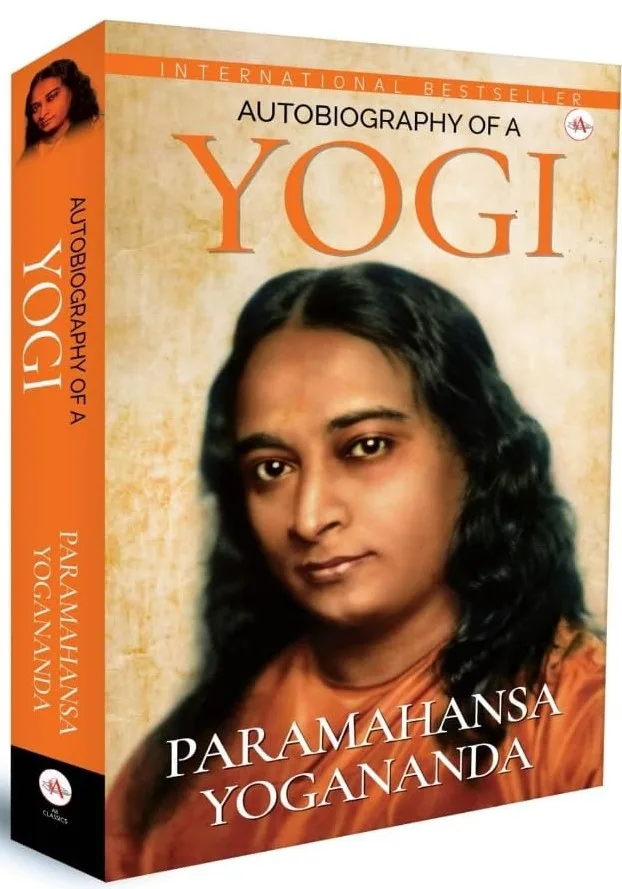
Autobiography of a Yogi
Hardcover
• 416 Pages
• ₹ 399.00
• English
• 9788196198824
No ratings yet
| Publisher | Arushi book enterprises |
|---|---|
| ISBN13 | 9788196198824 |
| ASIN/SKU | 8196198825 |
| Book Format | Hardcover |
| Language | English |
| Pages | 416 |
| List Price | ₹ 399.00 |
| Publishing Date | 01/01/2023 |
| Dimensions | 21 x 15 x 3 cm |
| Weight | 470 g |
| Book Code | BD00070777 |
Buy this Book
Amazon Stores
Ebook Stores
Other Stores
Discover Autobiography of a Yogi by Paramahansa Yogananda. This book is published by Arushi book enterprises in Hardcover format, ISBN 9788196198824, ASIN 8196198825, under Biographies and Memoirs.
Book Description
1893 – 1952 Hailed as the “father of Yoga in the West,” Paramahansa Yogananda is regarded as one of the great spiritual figures of our time. Born in northern India, he came to the United States in 1920, where he founded Self-Realization Fellowship, to disseminate his writings and teachings worldwide. Through his best-selling classic, Autobiography of a Yogi, and his numerous other books, he has introduced millions throughout the world to the spiritual principles of yoga meditation and the
Author Biography
Author Biography will be added soon…
Editorial Reviews
Editorial Reviews will be added soon…
Book Summary
Autobiography of a Yogi by Paramahansa Yogananda is much more than a record of one man's life. It is a spiritual journey through India, a personal account of a lifelong search for God, and an invitation to look beyond the visible world toward the deeper possibilities of human consciousness. First published in 1946, the book tells the story of Paramahansa Yogananda, from his childhood in India to his spiritual training under great teachers, his encounters with saints and yogis, and his eventual work of bringing the teachings of yoga and meditation to the West. Written with warmth, wonder, devotion, and a remarkable sense of personal intimacy, the autobiography has become one of the best-known spiritual classics of the twentieth century.
Yogananda's spiritual search begins in childhood. Born Mukunda Lal Ghosh in Gorakhpur, India, he describes himself as a child with an unusually strong desire to discover God. While ordinary childhood interests surround him, his mind repeatedly turns toward saints, meditation, and the possibility of direct experience of the Divine. He does not want to accept spiritual truths merely because religious authorities have taught them. Even at a young age, he longs to experience God personally. This desire becomes the central force of his life.
His childhood is marked by several experiences that he interprets as evidence of a spiritual reality beyond ordinary perception. The death of his mother becomes a particularly important turning point. Her absence creates a deep emotional wound, but it also strengthens his determination to understand the nature of life and death. Yogananda gradually comes to see that physical existence is temporary and that human beings possess a deeper spiritual identity.
As a young man, Mukunda becomes increasingly determined to find a true guru. His search is not casual. He visits holy men, spiritual teachers, and places associated with India's religious traditions. He is fascinated by the possibility that advanced spiritual masters may possess extraordinary insight and control over their consciousness. At times, his enthusiasm leads him into adventures and attempts to escape the conventional path expected of him. Yet beneath these youthful adventures is a serious question: Can a human being actually know God through direct spiritual experience?
The answer begins to emerge when Mukunda meets Sri Yukteswar Giri. Their meeting becomes the decisive event of his life. Sri Yukteswar is not presented as a conventional teacher who simply provides comforting religious ideas. He is disciplined, demanding, rational, and deeply compassionate. He expects his disciple to overcome self-deception, emotional weakness, laziness, and attachment. Through him, Yogananda learns that genuine spirituality requires transformation of the whole person.
The relationship between guru and disciple is one of the emotional centers of the autobiography. Yogananda's love for Sri Yukteswar is profound, but the guru does not indulge his disciple. Instead, he constantly pushes him toward greater maturity. The lessons Yogananda receives are sometimes difficult because Sri Yukteswar insists that spiritual progress cannot be separated from disciplined living. Meditation alone is not enough if the mind remains ruled by ego, desire, anger, or attachment.
Sri Yukteswar introduces Yogananda more deeply to the science of yoga, especially the practice of Kriya Yoga. In Yogananda's presentation, yoga is not merely physical exercise. It is a systematic spiritual discipline intended to help human beings control their life force, calm the mind, and gradually awaken their awareness of the divine consciousness within. Meditation becomes the practical foundation of this path.
One of the book's recurring ideas is that human beings ordinarily live in a state of spiritual forgetfulness. We identify ourselves with the body, possessions, social status, fears, and changing emotions. Yoga seeks to reverse this identification. Instead of constantly looking outward for satisfaction, the seeker turns inward and discovers a deeper source of peace.
Yogananda's spiritual education takes place within the larger landscape of Indian spirituality. He introduces readers to numerous saints, monks, householders, teachers, and yogis. Some of these figures are remembered for their wisdom and compassion; others are described as possessing unusual spiritual abilities. Stories of levitation, bilocation, healing, telepathy, extraordinary longevity, and other phenomena appear throughout the book.
These accounts are among its most distinctive features, but their deeper purpose is not simply to entertain the reader with miracles. Yogananda uses them to challenge the assumption that ordinary human experience represents the full range of reality. For him, consciousness is far more mysterious and powerful than modern materialistic assumptions might suggest. At the same time, the book repeatedly emphasizes that supernatural abilities are not the ultimate goal of yoga. Spiritual realization, love of God, freedom from ego, and union with divine consciousness are more important than miracles.
One of the most memorable figures Yogananda encounters is Lahiri Mahasaya, the great nineteenth-century yogi who helped revive Kriya Yoga for the modern age. Although Lahiri Mahasaya lived as a householder rather than withdrawing permanently into a monastery, Yogananda presents him as a deeply realized spiritual master. His life demonstrates one of the autobiography's important themes: spiritual realization is not necessarily dependent on abandoning ordinary responsibilities. A person can pursue inner realization while living within society.
Yogananda also writes about Mahavatar Babaji, whom the Kriya Yoga tradition regards as an extraordinary Himalayan master. In the book, Babaji represents the timeless continuity of India's yogic tradition. He is described as a spiritually advanced being who remains beyond ordinary historical limitations. Whether readers interpret these accounts literally, symbolically, or through the lens of faith, Babaji serves an important role in Yogananda's understanding of an ancient spiritual lineage.
Another major theme is the relationship between science and spirituality. Yogananda does not portray religion as something that must exist in opposition to reason. He repeatedly describes yoga as a kind of spiritual science: a discipline based on practice and direct experience. Just as physical science investigates the external universe, yoga, in his view, investigates consciousness itself.
This idea gives the book a distinctive character. Yogananda does not simply tell readers to believe. He encourages them to practice meditation and discover something through personal experience. His argument is that intellectual knowledge about God is not the same as knowing God. Reading about sweetness does not give someone the taste of sugar; similarly, reading religious scriptures cannot substitute for direct spiritual experience.
The autobiography also presents an expansive understanding of religion. Yogananda respects different religious traditions and sees underlying unity among them. He frequently draws connections between Hindu philosophy, Christianity, and other spiritual traditions. Rather than insisting that one religious culture possesses the entire truth, he emphasizes the possibility of a universal spiritual reality expressed through different teachings.
His eventual journey to the United States becomes another major stage in his life. In 1920, Yogananda travels to America to participate in an international religious gathering. He later establishes the Self-Realization Fellowship and spends many years teaching meditation, yoga, and spiritual philosophy to Western audiences.
This part of the story is historically significant because Yogananda becomes one of the important figures responsible for introducing Indian yoga philosophy to a broad American audience. He encounters a culture very different from the India of his youth, yet he finds that people everywhere share fundamental questions about happiness, meaning, suffering, love, and God.
His teachings emphasize that spiritual life does not require hatred of the world. Instead, the world should be understood properly. Material success, relationships, work, and ordinary responsibilities can all have a place in life, provided that they do not become substitutes for the deeper search for truth. Yogananda encourages balance: outwardly active, inwardly centered.
The book repeatedly returns to the problem of desire and attachment. Human beings often believe that obtaining a particular object, relationship, achievement, or social position will finally make them happy. Yet once the desired thing is obtained, satisfaction is usually temporary and another desire takes its place. Yogananda sees this endless cycle as one of the major causes of human restlessness.
Meditation offers another possibility. By turning the mind inward, the seeker begins to experience a form of peace that does not depend entirely on external circumstances. This does not mean rejecting life; rather, it means discovering a deeper center from which life can be lived with greater freedom.
Yogananda also discusses death with unusual openness. Because he sees the soul as fundamentally spiritual rather than merely physical, death is not presented as absolute annihilation. The body changes and eventually disappears, but consciousness continues according to the laws of karma and spiritual evolution. This perspective allows him to approach death with less fear and encourages readers to think of human existence as part of a much larger journey.
Karma is another important concept in the autobiography. Actions have consequences, not only in the external world but also within consciousness. Habits, desires, attitudes, and choices shape the person we become. Yet Yogananda does not present karma as an excuse for fatalism. Spiritual practice can transform the individual. Through self-discipline, meditation, devotion, and right action, a person can gradually free himself from destructive patterns.
Perhaps the deepest lesson of the book is that the search for God is ultimately a search for one's true identity. Yogananda teaches that the ordinary ego is not the complete self. Beneath personality and physical identity lies a deeper spiritual consciousness. To discover it is to experience greater freedom, love, peace, and unity.
The final sections of the autobiography return to the relationship between Yogananda and his guru and to the continuation of his spiritual mission. His memories of Sri Yukteswar carry both tenderness and grief. The guru's physical departure does not end the relationship; rather, Yogananda portrays spiritual love as something that transcends physical separation.
The book therefore becomes more than an autobiography. It is a meditation on what it means to live a meaningful human life. Yogananda's story suggests that people often spend enormous energy pursuing external achievements while neglecting the inner world that determines how those achievements are experienced. Wealth cannot automatically produce peace. Knowledge cannot automatically produce wisdom. Religious belief cannot automatically produce spiritual realization. Each person must undertake an inner journey.
What makes Autobiography of a Yogi especially enduring is the humanity beneath its extraordinary stories. Yogananda is not presented simply as an untouchable saint. He is also a young man who becomes impatient, makes mistakes, seeks approval, struggles with discipline, misses his family, loves his teacher, experiences grief, and gradually grows through these experiences. His spiritual development is therefore portrayed as a human process rather than an instantaneous transformation.
The book ultimately leaves the reader with a hopeful vision of human potential. According to Yogananda, the deepest reality of a person is not fear, loneliness, ambition, or limitation. It is spiritual consciousness. Through sincere effort, meditation, ethical living, devotion, and self-knowledge, human beings can move toward that deeper reality.
In this sense, Autobiography of a Yogi is both a life story and a spiritual invitation. It asks the reader not merely to admire saints or believe extraordinary stories, but to look inward and ask fundamental questions: Who am I beneath my temporary identity? What is the source of lasting happiness? What happens when the mind becomes still? Is there a reality beyond the changing world? And can that reality be directly experienced?
Yogananda's answer is an emphatic yes. His life, as he tells it, is evidence of that possibility. The autobiography therefore closes the distance between spirituality and everyday human longing. Its central message is simple but profound: the human being is capable of a far deeper experience of life than ordinary circumstances reveal, and the journey toward that experience begins within.
Yogananda's spiritual search begins in childhood. Born Mukunda Lal Ghosh in Gorakhpur, India, he describes himself as a child with an unusually strong desire to discover God. While ordinary childhood interests surround him, his mind repeatedly turns toward saints, meditation, and the possibility of direct experience of the Divine. He does not want to accept spiritual truths merely because religious authorities have taught them. Even at a young age, he longs to experience God personally. This desire becomes the central force of his life.
His childhood is marked by several experiences that he interprets as evidence of a spiritual reality beyond ordinary perception. The death of his mother becomes a particularly important turning point. Her absence creates a deep emotional wound, but it also strengthens his determination to understand the nature of life and death. Yogananda gradually comes to see that physical existence is temporary and that human beings possess a deeper spiritual identity.
As a young man, Mukunda becomes increasingly determined to find a true guru. His search is not casual. He visits holy men, spiritual teachers, and places associated with India's religious traditions. He is fascinated by the possibility that advanced spiritual masters may possess extraordinary insight and control over their consciousness. At times, his enthusiasm leads him into adventures and attempts to escape the conventional path expected of him. Yet beneath these youthful adventures is a serious question: Can a human being actually know God through direct spiritual experience?
The answer begins to emerge when Mukunda meets Sri Yukteswar Giri. Their meeting becomes the decisive event of his life. Sri Yukteswar is not presented as a conventional teacher who simply provides comforting religious ideas. He is disciplined, demanding, rational, and deeply compassionate. He expects his disciple to overcome self-deception, emotional weakness, laziness, and attachment. Through him, Yogananda learns that genuine spirituality requires transformation of the whole person.
The relationship between guru and disciple is one of the emotional centers of the autobiography. Yogananda's love for Sri Yukteswar is profound, but the guru does not indulge his disciple. Instead, he constantly pushes him toward greater maturity. The lessons Yogananda receives are sometimes difficult because Sri Yukteswar insists that spiritual progress cannot be separated from disciplined living. Meditation alone is not enough if the mind remains ruled by ego, desire, anger, or attachment.
Sri Yukteswar introduces Yogananda more deeply to the science of yoga, especially the practice of Kriya Yoga. In Yogananda's presentation, yoga is not merely physical exercise. It is a systematic spiritual discipline intended to help human beings control their life force, calm the mind, and gradually awaken their awareness of the divine consciousness within. Meditation becomes the practical foundation of this path.
One of the book's recurring ideas is that human beings ordinarily live in a state of spiritual forgetfulness. We identify ourselves with the body, possessions, social status, fears, and changing emotions. Yoga seeks to reverse this identification. Instead of constantly looking outward for satisfaction, the seeker turns inward and discovers a deeper source of peace.
Yogananda's spiritual education takes place within the larger landscape of Indian spirituality. He introduces readers to numerous saints, monks, householders, teachers, and yogis. Some of these figures are remembered for their wisdom and compassion; others are described as possessing unusual spiritual abilities. Stories of levitation, bilocation, healing, telepathy, extraordinary longevity, and other phenomena appear throughout the book.
These accounts are among its most distinctive features, but their deeper purpose is not simply to entertain the reader with miracles. Yogananda uses them to challenge the assumption that ordinary human experience represents the full range of reality. For him, consciousness is far more mysterious and powerful than modern materialistic assumptions might suggest. At the same time, the book repeatedly emphasizes that supernatural abilities are not the ultimate goal of yoga. Spiritual realization, love of God, freedom from ego, and union with divine consciousness are more important than miracles.
One of the most memorable figures Yogananda encounters is Lahiri Mahasaya, the great nineteenth-century yogi who helped revive Kriya Yoga for the modern age. Although Lahiri Mahasaya lived as a householder rather than withdrawing permanently into a monastery, Yogananda presents him as a deeply realized spiritual master. His life demonstrates one of the autobiography's important themes: spiritual realization is not necessarily dependent on abandoning ordinary responsibilities. A person can pursue inner realization while living within society.
Yogananda also writes about Mahavatar Babaji, whom the Kriya Yoga tradition regards as an extraordinary Himalayan master. In the book, Babaji represents the timeless continuity of India's yogic tradition. He is described as a spiritually advanced being who remains beyond ordinary historical limitations. Whether readers interpret these accounts literally, symbolically, or through the lens of faith, Babaji serves an important role in Yogananda's understanding of an ancient spiritual lineage.
Another major theme is the relationship between science and spirituality. Yogananda does not portray religion as something that must exist in opposition to reason. He repeatedly describes yoga as a kind of spiritual science: a discipline based on practice and direct experience. Just as physical science investigates the external universe, yoga, in his view, investigates consciousness itself.
This idea gives the book a distinctive character. Yogananda does not simply tell readers to believe. He encourages them to practice meditation and discover something through personal experience. His argument is that intellectual knowledge about God is not the same as knowing God. Reading about sweetness does not give someone the taste of sugar; similarly, reading religious scriptures cannot substitute for direct spiritual experience.
The autobiography also presents an expansive understanding of religion. Yogananda respects different religious traditions and sees underlying unity among them. He frequently draws connections between Hindu philosophy, Christianity, and other spiritual traditions. Rather than insisting that one religious culture possesses the entire truth, he emphasizes the possibility of a universal spiritual reality expressed through different teachings.
His eventual journey to the United States becomes another major stage in his life. In 1920, Yogananda travels to America to participate in an international religious gathering. He later establishes the Self-Realization Fellowship and spends many years teaching meditation, yoga, and spiritual philosophy to Western audiences.
This part of the story is historically significant because Yogananda becomes one of the important figures responsible for introducing Indian yoga philosophy to a broad American audience. He encounters a culture very different from the India of his youth, yet he finds that people everywhere share fundamental questions about happiness, meaning, suffering, love, and God.
His teachings emphasize that spiritual life does not require hatred of the world. Instead, the world should be understood properly. Material success, relationships, work, and ordinary responsibilities can all have a place in life, provided that they do not become substitutes for the deeper search for truth. Yogananda encourages balance: outwardly active, inwardly centered.
The book repeatedly returns to the problem of desire and attachment. Human beings often believe that obtaining a particular object, relationship, achievement, or social position will finally make them happy. Yet once the desired thing is obtained, satisfaction is usually temporary and another desire takes its place. Yogananda sees this endless cycle as one of the major causes of human restlessness.
Meditation offers another possibility. By turning the mind inward, the seeker begins to experience a form of peace that does not depend entirely on external circumstances. This does not mean rejecting life; rather, it means discovering a deeper center from which life can be lived with greater freedom.
Yogananda also discusses death with unusual openness. Because he sees the soul as fundamentally spiritual rather than merely physical, death is not presented as absolute annihilation. The body changes and eventually disappears, but consciousness continues according to the laws of karma and spiritual evolution. This perspective allows him to approach death with less fear and encourages readers to think of human existence as part of a much larger journey.
Karma is another important concept in the autobiography. Actions have consequences, not only in the external world but also within consciousness. Habits, desires, attitudes, and choices shape the person we become. Yet Yogananda does not present karma as an excuse for fatalism. Spiritual practice can transform the individual. Through self-discipline, meditation, devotion, and right action, a person can gradually free himself from destructive patterns.
Perhaps the deepest lesson of the book is that the search for God is ultimately a search for one's true identity. Yogananda teaches that the ordinary ego is not the complete self. Beneath personality and physical identity lies a deeper spiritual consciousness. To discover it is to experience greater freedom, love, peace, and unity.
The final sections of the autobiography return to the relationship between Yogananda and his guru and to the continuation of his spiritual mission. His memories of Sri Yukteswar carry both tenderness and grief. The guru's physical departure does not end the relationship; rather, Yogananda portrays spiritual love as something that transcends physical separation.
The book therefore becomes more than an autobiography. It is a meditation on what it means to live a meaningful human life. Yogananda's story suggests that people often spend enormous energy pursuing external achievements while neglecting the inner world that determines how those achievements are experienced. Wealth cannot automatically produce peace. Knowledge cannot automatically produce wisdom. Religious belief cannot automatically produce spiritual realization. Each person must undertake an inner journey.
What makes Autobiography of a Yogi especially enduring is the humanity beneath its extraordinary stories. Yogananda is not presented simply as an untouchable saint. He is also a young man who becomes impatient, makes mistakes, seeks approval, struggles with discipline, misses his family, loves his teacher, experiences grief, and gradually grows through these experiences. His spiritual development is therefore portrayed as a human process rather than an instantaneous transformation.
The book ultimately leaves the reader with a hopeful vision of human potential. According to Yogananda, the deepest reality of a person is not fear, loneliness, ambition, or limitation. It is spiritual consciousness. Through sincere effort, meditation, ethical living, devotion, and self-knowledge, human beings can move toward that deeper reality.
In this sense, Autobiography of a Yogi is both a life story and a spiritual invitation. It asks the reader not merely to admire saints or believe extraordinary stories, but to look inward and ask fundamental questions: Who am I beneath my temporary identity? What is the source of lasting happiness? What happens when the mind becomes still? Is there a reality beyond the changing world? And can that reality be directly experienced?
Yogananda's answer is an emphatic yes. His life, as he tells it, is evidence of that possibility. The autobiography therefore closes the distance between spirituality and everyday human longing. Its central message is simple but profound: the human being is capable of a far deeper experience of life than ordinary circumstances reveal, and the journey toward that experience begins within.
Sample Chapters
Sample Chapters will be added soon…
Reader Reviews
No reviews yet.
Autobiography of a Yogi
Download Cover Image
Do you want to download the full cover image for Autobiography of a Yogi?