
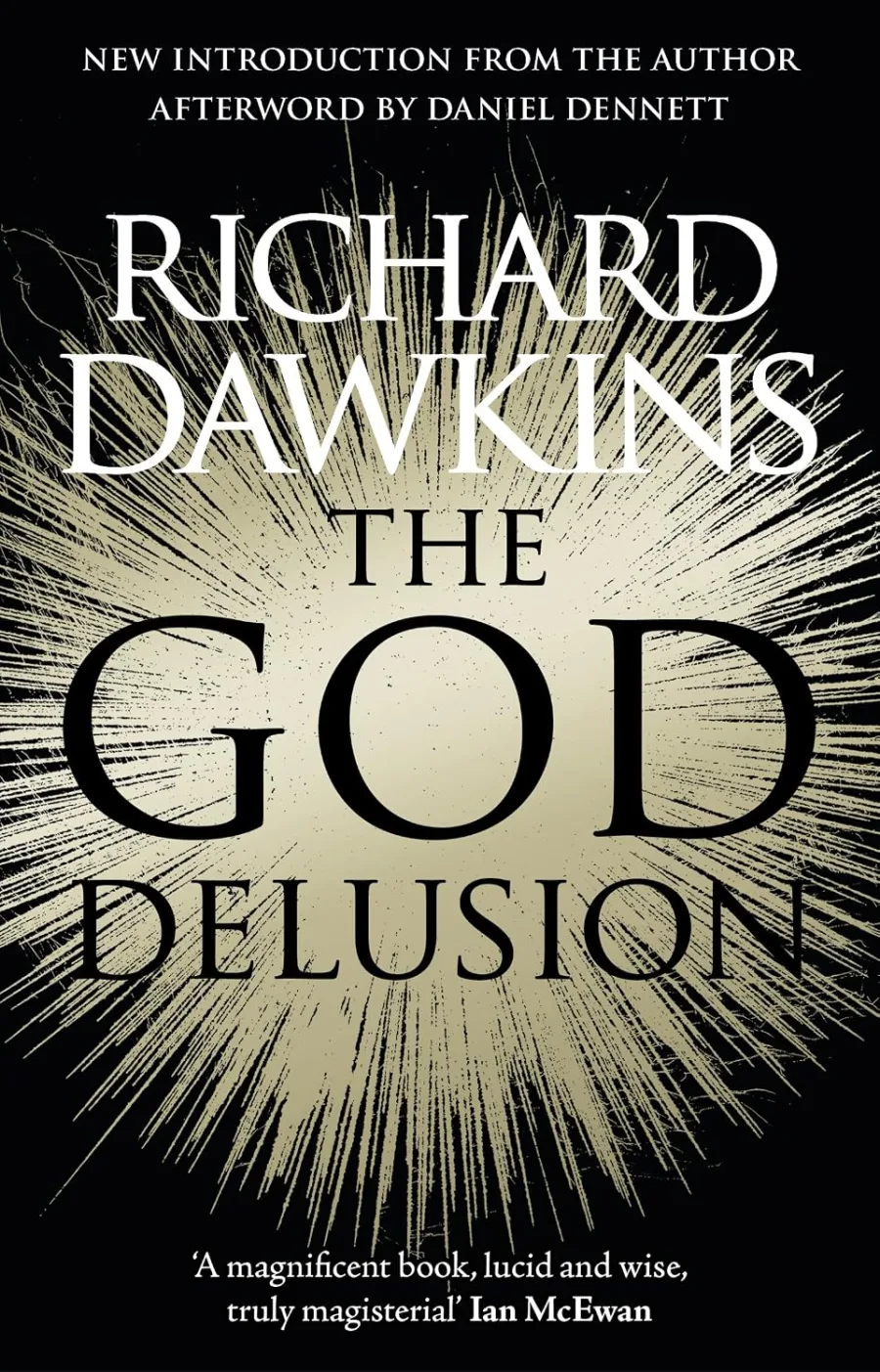
The God Delusion
Paperback
• 464 Pages
• ₹ 639.00
• English
• 9781784161927
No ratings yet
| Publisher | Random House |
|---|---|
| ISBN13 | 9781784161927 |
| ASIN/SKU | 1784161926 |
| Book Format | Paperback |
| Language | English |
| Pages | 464 |
| List Price | ₹ 639.00 |
| Publishing Date | 27/09/2016 |
| Dimensions | 12.7 x 3 x 19.8 cm |
| Weight | 1 kg 50 g |
| Book Code | BD00070771 |
Buy this Book
Amazon Stores
Ebook Stores
Other Stores
Discover The God Delusion by Richard Dawkins. This book is published by Random House in Paperback format, ISBN 9781784161927, ASIN 1784161926, under Religion and Spirituality, Theology and Philosophy of Religion.
Book Description
The God Delusion caused a sensation when it was published in 2006. Within weeks it became the most hotly debated topic, with Dawkins himself branded as either saint or sinner for presenting his hard-hitting, impassioned rebuttal of religion of all types. His argument could hardly be more topical. While Europe is becoming increasingly secularized, the rise of religious fundamentalism, whether in the Middle East or Middle America, is dramatically and dangerously dividing opinion around the world. In America, and elsewhere, a vigorous dispute between 'intelligent design' and Darwinism is seriously undermining and restricting the teaching of science. In many countries religious dogma from medieval times still serves to abuse basic human rights such as women's and gay rights. And all from a belief in a God whose existence lacks evidence of any kind. Dawkins attacks God in all his forms. He eviscerates the major arguments for religion and demonstrates the supreme improbability of a supreme being. He shows how religion fuels war, foments bigotry and abuses children. The God Delusion is a brilliantly argued, fascinating polemic that will be required reading for anyone interested in this most emotional and important subject.
Author Biography
Richard Dawkins taught zoology at the University of California at Berkeley and at Oxford University and is now the Charles Simonyi Professor of the Public Understanding of Science at Oxford, a position he has held since 1995. Among his previous books are The Ancestor's Tale, The Selfish Gene, The Blind Watchmaker, Climbing Mount Improbable, Unweaving the Rainbow, and A Devil's Chaplain. Dawkins lives in Oxford with his wife, the actress and artist Lalla Ward.
Editorial Reviews
Editorial Reviews will be added soon…
Book Summary
Richard Dawkins’s The God Delusion is a provocative and influential work of popular science and secular philosophy that examines religious belief through the lenses of evolutionary biology, probability, psychology, history, and philosophy. First published in 2006, the book asks a fundamental question: why do human beings believe in gods, and is belief in a divine creator necessary to explain the existence of the universe, morality, or human life? Dawkins approaches these questions from an explicitly atheistic perspective. His central argument is that belief in God is not supported by sufficient evidence and that many phenomena traditionally attributed to divine action can be understood more naturally through science, evolution, psychology, and human culture.
The book is not simply an argument against one particular religion. Dawkins discusses Christianity, Judaism, Islam, and other religious traditions, while also examining broader ideas such as supernatural revelation, prayer, miracles, religious faith, and the authority given to sacred texts. At the same time, he distinguishes between ordinary religious belief and the stronger claim that a supernatural creator exists. His primary target is the belief in a personal, interventionist God who created the universe, watches human behavior, answers prayers, and establishes moral rules.
Dawkins begins by explaining why he considers belief in God a hypothesis that can be examined. Traditionally, religious belief has often been placed outside the boundaries of scientific investigation. Dawkins challenges this separation. If God is claimed to have created the universe or intervened in physical reality, then, he argues, such claims should at least be open to rational examination. The existence of God, in his view, is not merely a matter of private preference if believers make claims about what actually exists.
One of the book’s central arguments concerns the improbability of a complex creator being the ultimate explanation for a complex universe. Dawkins focuses particularly on the argument from design. Human beings encounter extraordinarily intricate structures in nature, including the eye, the brain, ecosystems, and living organisms. It can seem intuitive that such complexity must have been deliberately designed. For centuries, this intuition supported theological arguments for an intelligent creator.
Dawkins argues that evolution by natural selection provides a fundamentally different explanation. Organisms can appear designed without having been consciously designed. Natural selection gradually preserves variations that improve survival and reproduction. Over enormous periods of time, this cumulative process can produce remarkable complexity from relatively simple beginnings.
This idea is one of the foundations of The God Delusion. Dawkins emphasizes that evolution does not merely provide one possible explanation for biological complexity. It explains why living organisms can possess the appearance of purposeful design without requiring an intelligent designer. The complexity of life, therefore, does not necessarily point toward God. Instead, it can be understood as the result of a natural process operating across immense stretches of time.
Dawkins then develops what becomes known as the “ultimate Boeing 747” argument. He uses an analogy involving an extremely improbable object arising by chance. If a highly complex object were produced through a single random event, its appearance would seem extraordinarily unlikely. Religious explanations sometimes argue that the universe and life are similarly too complex to have arisen naturally.
Dawkins responds that this reasoning overlooks cumulative selection. Evolution does not construct complex biological structures through one enormous leap. Small variations accumulate over generations, and natural selection preserves those that provide advantages. The key point is that a process capable of accumulating complexity can make outcomes that initially appear wildly improbable much more understandable.
He then turns the argument toward God himself. If complexity requires an explanation, Dawkins asks, why should God be exempt? A powerful creator capable of designing an enormously complex universe would presumably require at least as much explanatory attention as the universe itself. Introducing an even more complex supernatural intelligence does not, in his view, solve the problem of explaining complexity. It simply moves the question one step backward.
This does not constitute a mathematical disproof of every conceivable conception of God. Rather, Dawkins's argument is that invoking God as an explanation for biological complexity does not provide the explanatory advantage that believers often claim. Natural selection offers a mechanism for the appearance of design without requiring an intelligent designer.
Another major theme is the distinction between scientific explanation and religious explanation. Dawkins argues that science has repeatedly replaced supernatural explanations with natural ones. Phenomena once attributed to gods—storms, diseases, planetary motion, biological diversity, and other natural events—can increasingly be understood through physical and biological processes.
He does not claim that science has answered every question. Instead, he argues that unanswered questions should not automatically be filled with supernatural explanations. Ignorance is not evidence for God. The fact that science does not yet explain something does not establish that a divine being caused it.
This is particularly important in discussions of the origin of the universe. Dawkins acknowledges that cosmology contains profound unanswered questions, but he rejects the assumption that God is automatically the appropriate answer. He argues that inserting God into an unexplained gap can create the illusion of explanation without actually providing a testable mechanism.
The book also examines religious arguments based on personal experience. Many people report feeling the presence of God, experiencing answered prayers, having mystical encounters, or undergoing dramatic spiritual transformations. Dawkins does not deny that these experiences can feel extremely real to the people who have them. His question is what causes those experiences.
Human brains are capable of producing powerful emotions, perceptions, intuitions, and altered states of consciousness. Therefore, an intense subjective experience does not necessarily establish that its supernatural interpretation is correct. A person can sincerely experience something without having an accurate explanation for what caused it.
Dawkins also examines the role of religious faith. He is particularly critical of the idea that faith should be treated as a virtue when it means believing something without adequate evidence. From his perspective, intellectual humility requires distinguishing between what we know, what we have strong evidence for, and what remains uncertain.
He contrasts faith-based certainty with the provisional nature of scientific thinking. Scientific conclusions can be revised when new evidence appears. Dawkins considers this willingness to change one's mind a strength rather than a weakness. A scientific worldview does not require certainty about everything. It requires a commitment to evidence and reason.
A substantial part of the book addresses morality, because one of the most common arguments for religion is that without God there would be no objective basis for ethical behavior. Dawkins challenges this assumption. He asks whether people truly need divine commandments in order to understand compassion, fairness, cooperation, honesty, and kindness.
He points to evolutionary explanations for aspects of human morality. Humans are social animals, and cooperation can provide significant survival advantages. Natural selection can therefore help explain why tendencies such as empathy, reciprocity, parental care, and concern for others developed within human societies.
However, Dawkins's discussion does not imply that every moral rule can be directly reduced to evolutionary advantage. Rather, evolution can help explain the origins of moral instincts without necessarily determining the ethical principles that modern societies should adopt. Human beings can use reason and cultural development to reflect upon and modify inherited tendencies.
The book also discusses the idea that religion itself may be an evolutionary by-product. Dawkins explores the possibility that certain characteristics of the human mind—such as our tendency to trust authority, search for patterns, imitate others, and learn from parents—could have evolved for useful reasons but sometimes produce religious belief as a secondary consequence.
Children, for example, are naturally inclined to learn from adults. This is extremely useful for survival. But the same psychological tendency may make people receptive to supernatural ideas transmitted through families and communities. Religious beliefs can therefore spread culturally because human minds possess mechanisms that make certain kinds of beliefs particularly memorable and transmissible.
Dawkins also introduces the concept of the “meme,” using it to describe units of cultural transmission. Just as genes replicate through biological inheritance, cultural ideas can spread through imitation. Religious beliefs, rituals, stories, and traditions can persist because they are transmitted from one generation to another. Some beliefs may survive because they are culturally successful rather than because they are objectively true.
Another important subject is religion and childhood. Dawkins is particularly critical of describing children as members of a religion as though religious identity were inherited in the same way as biological characteristics. He argues that children should have the freedom to develop their own beliefs rather than being treated as religious members from birth.
His discussion of religious education is connected to a broader concern about intellectual freedom. Dawkins believes that children should learn about different religions and philosophical perspectives but should not be discouraged from questioning them. Knowledge of religion, in his view, is important; unquestioned religious obedience is a different matter.
Dawkins also challenges the claim that religion is necessary for social morality. He examines examples of nonreligious societies and argues that atheism does not inherently produce immorality. A person can be compassionate, honest, generous, and deeply committed to justice without believing in God.
This point is important because Dawkins wants readers to separate two different questions: whether a religious belief is true and whether religious people can behave morally. He does not argue that religious people are necessarily immoral. Instead, he questions the assumption that morality requires supernatural authority.
The book also explores the relationship between religion and social conflict. Dawkins argues that religious certainty can sometimes intensify divisions because people may regard their beliefs as sacred and therefore beyond ordinary criticism. When competing groups believe that they possess divine truth, disagreement can become more difficult to resolve.
His discussion of religious violence is deliberately provocative. He argues that religion can contribute to conflict by giving absolute authority to beliefs that cannot easily be challenged through evidence. At the same time, the relationship between religion and violence is historically complicated, and religious traditions have also inspired charitable work, social reform, art, education, and humanitarian movements. Dawkins’s emphasis is primarily on the dangers he associates with religious certainty rather than a comprehensive account of everything religion has produced.
The book's discussion of religious scripture similarly focuses on the consequences of treating ancient texts as unquestionable sources of truth. Dawkins examines passages and stories from religious traditions that he considers morally troubling or incompatible with modern ethical standards. His broader argument is that sacred status should not prevent ideas from being examined critically.
Toward the later sections of The God Delusion, Dawkins turns more directly toward the possibility of living without religious belief. He presents atheism not simply as the rejection of God but as an opportunity to approach existence with wonder without invoking supernatural explanations. For him, the natural world is not less beautiful because it has a scientific explanation. In fact, understanding evolution, astronomy, physics, and biology can deepen one's sense of awe.
This is one of the most constructive elements of the book. Dawkins argues that people do not need supernatural beliefs in order to experience meaning, beauty, morality, or wonder. The universe can be extraordinary precisely because it exists through natural processes that we can investigate and understand.
The title The God Delusion expresses Dawkins's strongest conclusion: he regards belief in God as a mistaken conviction rather than a necessary foundation for human life. His argument rests on several connected ideas—the explanatory power of evolution, the lack of sufficient evidence for supernatural claims, psychological explanations for religious experience, cultural transmission of belief, and the possibility of morality without divine commandments.
Ultimately, the book is an invitation to intellectual skepticism. Dawkins asks readers to examine inherited beliefs rather than accepting them simply because they are ancient, culturally important, or emotionally comforting. He places a high value on evidence, rational inquiry, and the willingness to revise beliefs.
At the same time, the book is deliberately argumentative rather than neutral. Dawkins writes from a clearly stated atheistic position and often uses forceful language when criticizing religion. Readers who approach the book from religious or philosophical perspectives may disagree with some of his assumptions, interpretations, or conclusions. The work is therefore best understood as a sustained atheist argument rather than a detached survey of the philosophy of religion.
The deepest idea running through The God Delusion is that human beings should be willing to distinguish between what they hope is true and what evidence supports. Dawkins believes that accepting uncertainty is preferable to filling uncertainty with unsupported supernatural explanations. For him, intellectual courage means being willing to say, “I do not know,” while continuing to investigate.
The book ultimately presents a vision of human life grounded in curiosity, reason, science, and natural wonder. We are temporary beings living on a small planet within an immense universe, yet we possess the extraordinary ability to understand something about that universe. For Dawkins, this realization does not diminish human existence. It makes our capacity for knowledge even more remarkable.
The God Delusion therefore remains a challenging book because it asks readers not merely whether they believe in God, but why they believe what they believe. Its central message is that no belief should be protected from examination simply because it is sacred. Evidence should matter, questions should remain open, and human beings should be free to search for truth without fear. Whether or not a reader accepts Dawkins’s conclusions, the book's enduring challenge is clear: examine inherited assumptions, distinguish explanation from wishful thinking, and approach the mystery of existence with both intellectual honesty and a sense of wonder.
The book is not simply an argument against one particular religion. Dawkins discusses Christianity, Judaism, Islam, and other religious traditions, while also examining broader ideas such as supernatural revelation, prayer, miracles, religious faith, and the authority given to sacred texts. At the same time, he distinguishes between ordinary religious belief and the stronger claim that a supernatural creator exists. His primary target is the belief in a personal, interventionist God who created the universe, watches human behavior, answers prayers, and establishes moral rules.
Dawkins begins by explaining why he considers belief in God a hypothesis that can be examined. Traditionally, religious belief has often been placed outside the boundaries of scientific investigation. Dawkins challenges this separation. If God is claimed to have created the universe or intervened in physical reality, then, he argues, such claims should at least be open to rational examination. The existence of God, in his view, is not merely a matter of private preference if believers make claims about what actually exists.
One of the book’s central arguments concerns the improbability of a complex creator being the ultimate explanation for a complex universe. Dawkins focuses particularly on the argument from design. Human beings encounter extraordinarily intricate structures in nature, including the eye, the brain, ecosystems, and living organisms. It can seem intuitive that such complexity must have been deliberately designed. For centuries, this intuition supported theological arguments for an intelligent creator.
Dawkins argues that evolution by natural selection provides a fundamentally different explanation. Organisms can appear designed without having been consciously designed. Natural selection gradually preserves variations that improve survival and reproduction. Over enormous periods of time, this cumulative process can produce remarkable complexity from relatively simple beginnings.
This idea is one of the foundations of The God Delusion. Dawkins emphasizes that evolution does not merely provide one possible explanation for biological complexity. It explains why living organisms can possess the appearance of purposeful design without requiring an intelligent designer. The complexity of life, therefore, does not necessarily point toward God. Instead, it can be understood as the result of a natural process operating across immense stretches of time.
Dawkins then develops what becomes known as the “ultimate Boeing 747” argument. He uses an analogy involving an extremely improbable object arising by chance. If a highly complex object were produced through a single random event, its appearance would seem extraordinarily unlikely. Religious explanations sometimes argue that the universe and life are similarly too complex to have arisen naturally.
Dawkins responds that this reasoning overlooks cumulative selection. Evolution does not construct complex biological structures through one enormous leap. Small variations accumulate over generations, and natural selection preserves those that provide advantages. The key point is that a process capable of accumulating complexity can make outcomes that initially appear wildly improbable much more understandable.
He then turns the argument toward God himself. If complexity requires an explanation, Dawkins asks, why should God be exempt? A powerful creator capable of designing an enormously complex universe would presumably require at least as much explanatory attention as the universe itself. Introducing an even more complex supernatural intelligence does not, in his view, solve the problem of explaining complexity. It simply moves the question one step backward.
This does not constitute a mathematical disproof of every conceivable conception of God. Rather, Dawkins's argument is that invoking God as an explanation for biological complexity does not provide the explanatory advantage that believers often claim. Natural selection offers a mechanism for the appearance of design without requiring an intelligent designer.
Another major theme is the distinction between scientific explanation and religious explanation. Dawkins argues that science has repeatedly replaced supernatural explanations with natural ones. Phenomena once attributed to gods—storms, diseases, planetary motion, biological diversity, and other natural events—can increasingly be understood through physical and biological processes.
He does not claim that science has answered every question. Instead, he argues that unanswered questions should not automatically be filled with supernatural explanations. Ignorance is not evidence for God. The fact that science does not yet explain something does not establish that a divine being caused it.
This is particularly important in discussions of the origin of the universe. Dawkins acknowledges that cosmology contains profound unanswered questions, but he rejects the assumption that God is automatically the appropriate answer. He argues that inserting God into an unexplained gap can create the illusion of explanation without actually providing a testable mechanism.
The book also examines religious arguments based on personal experience. Many people report feeling the presence of God, experiencing answered prayers, having mystical encounters, or undergoing dramatic spiritual transformations. Dawkins does not deny that these experiences can feel extremely real to the people who have them. His question is what causes those experiences.
Human brains are capable of producing powerful emotions, perceptions, intuitions, and altered states of consciousness. Therefore, an intense subjective experience does not necessarily establish that its supernatural interpretation is correct. A person can sincerely experience something without having an accurate explanation for what caused it.
Dawkins also examines the role of religious faith. He is particularly critical of the idea that faith should be treated as a virtue when it means believing something without adequate evidence. From his perspective, intellectual humility requires distinguishing between what we know, what we have strong evidence for, and what remains uncertain.
He contrasts faith-based certainty with the provisional nature of scientific thinking. Scientific conclusions can be revised when new evidence appears. Dawkins considers this willingness to change one's mind a strength rather than a weakness. A scientific worldview does not require certainty about everything. It requires a commitment to evidence and reason.
A substantial part of the book addresses morality, because one of the most common arguments for religion is that without God there would be no objective basis for ethical behavior. Dawkins challenges this assumption. He asks whether people truly need divine commandments in order to understand compassion, fairness, cooperation, honesty, and kindness.
He points to evolutionary explanations for aspects of human morality. Humans are social animals, and cooperation can provide significant survival advantages. Natural selection can therefore help explain why tendencies such as empathy, reciprocity, parental care, and concern for others developed within human societies.
However, Dawkins's discussion does not imply that every moral rule can be directly reduced to evolutionary advantage. Rather, evolution can help explain the origins of moral instincts without necessarily determining the ethical principles that modern societies should adopt. Human beings can use reason and cultural development to reflect upon and modify inherited tendencies.
The book also discusses the idea that religion itself may be an evolutionary by-product. Dawkins explores the possibility that certain characteristics of the human mind—such as our tendency to trust authority, search for patterns, imitate others, and learn from parents—could have evolved for useful reasons but sometimes produce religious belief as a secondary consequence.
Children, for example, are naturally inclined to learn from adults. This is extremely useful for survival. But the same psychological tendency may make people receptive to supernatural ideas transmitted through families and communities. Religious beliefs can therefore spread culturally because human minds possess mechanisms that make certain kinds of beliefs particularly memorable and transmissible.
Dawkins also introduces the concept of the “meme,” using it to describe units of cultural transmission. Just as genes replicate through biological inheritance, cultural ideas can spread through imitation. Religious beliefs, rituals, stories, and traditions can persist because they are transmitted from one generation to another. Some beliefs may survive because they are culturally successful rather than because they are objectively true.
Another important subject is religion and childhood. Dawkins is particularly critical of describing children as members of a religion as though religious identity were inherited in the same way as biological characteristics. He argues that children should have the freedom to develop their own beliefs rather than being treated as religious members from birth.
His discussion of religious education is connected to a broader concern about intellectual freedom. Dawkins believes that children should learn about different religions and philosophical perspectives but should not be discouraged from questioning them. Knowledge of religion, in his view, is important; unquestioned religious obedience is a different matter.
Dawkins also challenges the claim that religion is necessary for social morality. He examines examples of nonreligious societies and argues that atheism does not inherently produce immorality. A person can be compassionate, honest, generous, and deeply committed to justice without believing in God.
This point is important because Dawkins wants readers to separate two different questions: whether a religious belief is true and whether religious people can behave morally. He does not argue that religious people are necessarily immoral. Instead, he questions the assumption that morality requires supernatural authority.
The book also explores the relationship between religion and social conflict. Dawkins argues that religious certainty can sometimes intensify divisions because people may regard their beliefs as sacred and therefore beyond ordinary criticism. When competing groups believe that they possess divine truth, disagreement can become more difficult to resolve.
His discussion of religious violence is deliberately provocative. He argues that religion can contribute to conflict by giving absolute authority to beliefs that cannot easily be challenged through evidence. At the same time, the relationship between religion and violence is historically complicated, and religious traditions have also inspired charitable work, social reform, art, education, and humanitarian movements. Dawkins’s emphasis is primarily on the dangers he associates with religious certainty rather than a comprehensive account of everything religion has produced.
The book's discussion of religious scripture similarly focuses on the consequences of treating ancient texts as unquestionable sources of truth. Dawkins examines passages and stories from religious traditions that he considers morally troubling or incompatible with modern ethical standards. His broader argument is that sacred status should not prevent ideas from being examined critically.
Toward the later sections of The God Delusion, Dawkins turns more directly toward the possibility of living without religious belief. He presents atheism not simply as the rejection of God but as an opportunity to approach existence with wonder without invoking supernatural explanations. For him, the natural world is not less beautiful because it has a scientific explanation. In fact, understanding evolution, astronomy, physics, and biology can deepen one's sense of awe.
This is one of the most constructive elements of the book. Dawkins argues that people do not need supernatural beliefs in order to experience meaning, beauty, morality, or wonder. The universe can be extraordinary precisely because it exists through natural processes that we can investigate and understand.
The title The God Delusion expresses Dawkins's strongest conclusion: he regards belief in God as a mistaken conviction rather than a necessary foundation for human life. His argument rests on several connected ideas—the explanatory power of evolution, the lack of sufficient evidence for supernatural claims, psychological explanations for religious experience, cultural transmission of belief, and the possibility of morality without divine commandments.
Ultimately, the book is an invitation to intellectual skepticism. Dawkins asks readers to examine inherited beliefs rather than accepting them simply because they are ancient, culturally important, or emotionally comforting. He places a high value on evidence, rational inquiry, and the willingness to revise beliefs.
At the same time, the book is deliberately argumentative rather than neutral. Dawkins writes from a clearly stated atheistic position and often uses forceful language when criticizing religion. Readers who approach the book from religious or philosophical perspectives may disagree with some of his assumptions, interpretations, or conclusions. The work is therefore best understood as a sustained atheist argument rather than a detached survey of the philosophy of religion.
The deepest idea running through The God Delusion is that human beings should be willing to distinguish between what they hope is true and what evidence supports. Dawkins believes that accepting uncertainty is preferable to filling uncertainty with unsupported supernatural explanations. For him, intellectual courage means being willing to say, “I do not know,” while continuing to investigate.
The book ultimately presents a vision of human life grounded in curiosity, reason, science, and natural wonder. We are temporary beings living on a small planet within an immense universe, yet we possess the extraordinary ability to understand something about that universe. For Dawkins, this realization does not diminish human existence. It makes our capacity for knowledge even more remarkable.
The God Delusion therefore remains a challenging book because it asks readers not merely whether they believe in God, but why they believe what they believe. Its central message is that no belief should be protected from examination simply because it is sacred. Evidence should matter, questions should remain open, and human beings should be free to search for truth without fear. Whether or not a reader accepts Dawkins’s conclusions, the book's enduring challenge is clear: examine inherited assumptions, distinguish explanation from wishful thinking, and approach the mystery of existence with both intellectual honesty and a sense of wonder.
Sample Chapters
Sample Chapters will be added soon…
Reader Reviews
No reviews yet.
The God Delusion
Download Cover Image
Do you want to download the full cover image for The God Delusion?