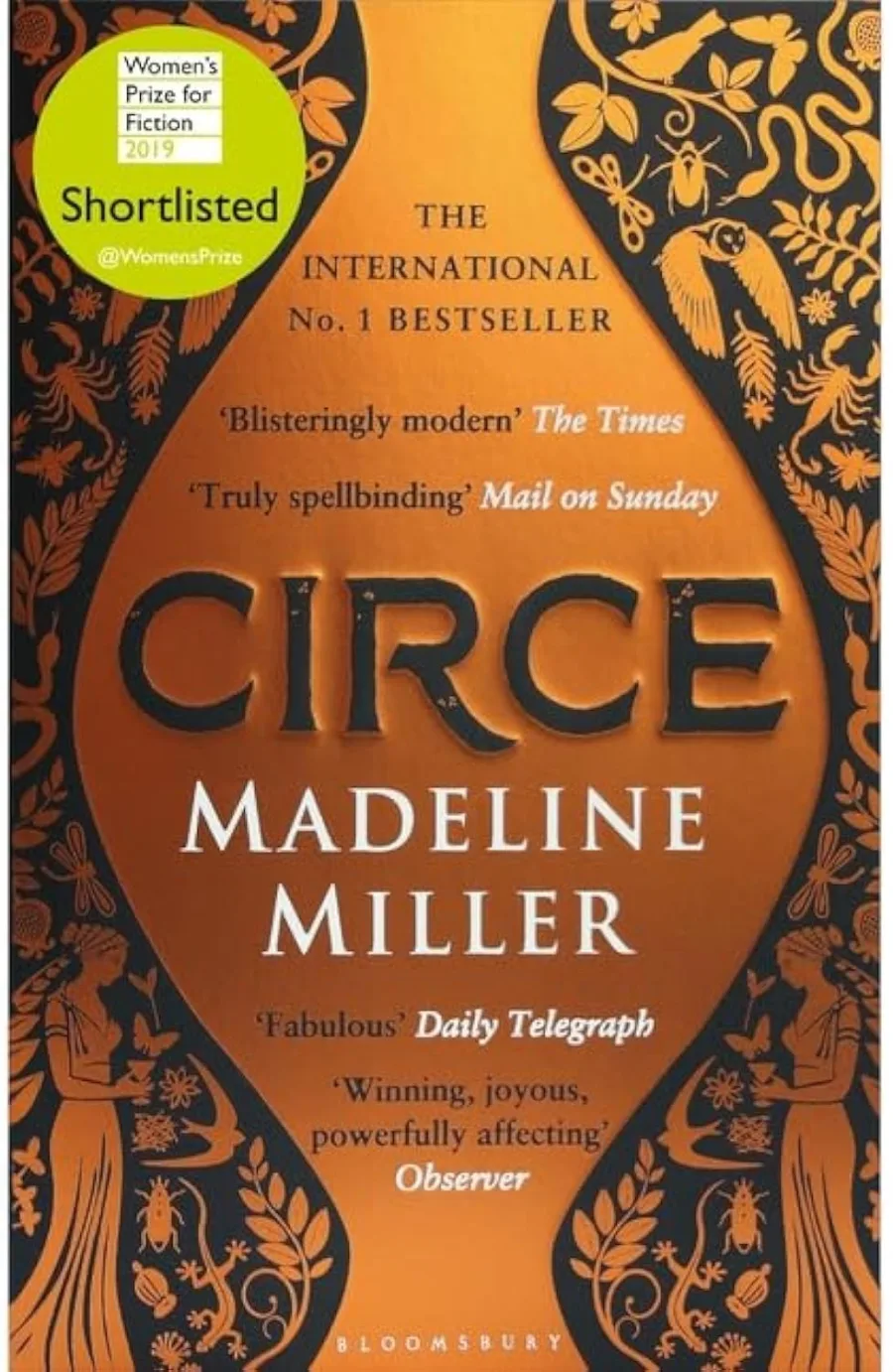
Circe
Paperback
• 352 Pages
• ₹ 599.00
• English
• 9781904233886
No ratings yet
| Publisher | Bloomsbury Publishing |
|---|---|
| ISBN13 | 9781904233886 |
| ASIN/SKU | 1526614677 |
| Book Format | Paperback |
| Language | English |
| Pages | 352 |
| List Price | ₹ 599.00 |
| Publishing Date | 18/04/2019 |
| Dimensions | 20.3 x 25.4 x 4.7 cm |
| Weight | 300 g |
| Book Code | BD00070770 |
Buy this Book
Amazon Stores
Ebook Stores
Other Stores
Discover Circe by Madeline Miller. This book is published by Bloomsbury Publishing in Paperback format, ISBN 9781904233886, ASIN 1526614677, under Science Fiction and Fantasy, Historical Fantasy, Gaslamp Fantasy.
Book Description
A NUMBER ONE INTERNATIONAL BESTSELLERCHOSEN AS A BOOK OF THE YEAR BY THE GUARDIAN, TELEGRAPH, SUNDAY TELEGRAPH, I PAPER, SUNDAY EXPRESS, IRISH TIMES, TIMES LITERARY SUPPLEMENT, AMAZON, AUDIBLE, BUZZFEED, REFINERY 29, WASHINGTON POST, BOSTON GLOBE, SEATTLE TIMES, TIME MAGAZINE, NEWSWEEK, PEOPLE, ENTERTAINMENT WEEKLY, KIRKUS, PUBLISHERS WEEKLY AND GOODREADSIn the house of Helios, god of the sun and mightiest of the Titans, a daughter is born. Circe is a strange child - not powerful and terrible, like her father, nor gorgeous and mercenary like her mother. Scorned and rejected, Circe grows up in the shadows, at home in neither the world of gods or mortals. But Circe has a dark power of her own: witchcraft. When her gift threatens the gods, she is banished to the island of Aiaia where she hones her occult craft, casting spells, gathering strange herbs and taming wild beasts. Yet a woman who stands alone will never be left in peace for long - and among her island's guests is an unexpected visitor: the mortal Odysseus, for whom Circe will risk everything. So Circe sets forth her tale, a vivid, mesmerizing epic of family rivalry, love and loss - the defiant, inextinguishable song of woman burning hot and bright through the darkness of a man's world.
Author Biography
Madeline Miller grew up in New York City and Philadelphia. She attended Brown University, where she earned her BA and MA in Classics. She has taught and tutored Latin, Greek, and Shakespeare to high school students for over fifteen years. She has also studied at the University of Chicago’s Committee on Social Thought, and in the Dramaturgy department at Yale School of Drama, where she focused on the adaptation of classical texts to modern forms.
The Song of Achilles, her first novel, was awarded the 2012 Orange Prize for Fiction and was a New York Times Bestseller. Her second novel, Circe, was an instant number 1 New York Times bestseller, and won the Indies Choice Best Adult Fiction of the Year Award and the Indies Choice Best Audiobook of the Year Award, as well as being shortlisted for the 2019 Women's Prize for Fiction. Circe also won The Red Tentacle Award, an American Library Association Alex Award (adult books of special interest to teen readers), and the 2018 Elle Big Book Award. Miller's novels have been translated into over twenty-five languages including Dutch, Mandarin, Japanese, Turkish, Arabic and Greek, and her essays have appeared in a number of publications including the Guardian, Wall Street Journal, Washington Post, Telegraph, Lapham's Quarterly and NPR.org. Most recently, she has published a standalone short story, Galatea. She currently lives outside Philadelphia, Pennsylvania. Visit her website at: www.madelinemiller.com
Photo credit: Nina Subin
The Song of Achilles, her first novel, was awarded the 2012 Orange Prize for Fiction and was a New York Times Bestseller. Her second novel, Circe, was an instant number 1 New York Times bestseller, and won the Indies Choice Best Adult Fiction of the Year Award and the Indies Choice Best Audiobook of the Year Award, as well as being shortlisted for the 2019 Women's Prize for Fiction. Circe also won The Red Tentacle Award, an American Library Association Alex Award (adult books of special interest to teen readers), and the 2018 Elle Big Book Award. Miller's novels have been translated into over twenty-five languages including Dutch, Mandarin, Japanese, Turkish, Arabic and Greek, and her essays have appeared in a number of publications including the Guardian, Wall Street Journal, Washington Post, Telegraph, Lapham's Quarterly and NPR.org. Most recently, she has published a standalone short story, Galatea. She currently lives outside Philadelphia, Pennsylvania. Visit her website at: www.madelinemiller.com
Photo credit: Nina Subin
Editorial Reviews
A novel to be gobbled greedily in a single sitting ― Observer
Circe is poised to become the literary sensation of the summer, as much for the quality of its writing as its timeliness ― Sunday Times Magazine
Enough magic, enchantment, voyages and wonders to satisfy the most jaded sword-and-sorcery palate. Miller approaches Odysseus's story from Circe's point of view, richly evoking her protagonist's overlapping identities as goddess, witch, lover and mother -- Adam Roberts ― Guardian, Books of the Year
A triumph ― The Times, Books of the Year
Circe back as superwoman . Homer's witch get a kickass modern makeover. Miller's Me Too-era, kickass portrait of a woman trying to defy the men and Fates arrayed against her is enchanting. Blisteringly modern ― The Times
In a thrilling tour de force of imagination, Miller makes her otherworldly heroine a complex, sympathetic figure for whom we cheer throughout. Circe is a truly spellbinding novel, the mesmerising shimmer of ancient magic rising from it like a heat haze ― Mail on Sunday
A brilliantly strange work of mythic science fiction, as effortlessly expressive within the palaces of gods as it is about the world below . Superb . This is both a fabulous novel and a fascinating retelling; the best compliment, perhaps, that any myth could hope for ― Daily Telegraph
This year's novels were filled with the angry clamour of women's voices: ignored, idealistic or excitingly ambivalent. Madeline Miller reflected the mood for feminist revisionism with her lissom follow-up Circe, which casts the witch goddess in the Odyssey not as a bit player in a man's epic but as the star of her own show -- Claire Allfree ― Daily Telegraph, Books of the Year
It was a big year for creative retelling of myth and pre-modern literature; a favourite was Madeline Miller's Circe, a distinctive, lyrical novel about power, agency and reponsibility, from the point of view of this crafty, much-misunderstood goddess -- Emily Wilson ― Times Literary Supplement, Books of the Year
The writing is lovely, the tone assured, and the touch just right -- Alexander McCall Smith ― Independent, Books of the Year
It is out of these insights that Miller achieves real narrative propulsion . Supple, pitched in a register that bridges man and myth ― Guardian
The first witch in Western literature sets Homer straight as she tells her life story, from her unhappy childhood to her lonely island exile. The woman who emerges is complex and sympathetic. A spellbinding tour de force of imagination ― Mail on Sunday, ‘Sizzling summer reads’
Miller has effected a transformation just as impressive as any of her heroine's own: she's turned an ancient tale of female subjugation into one of empowerment and courage full of contemporary resonances -- Lucy Scholes ― Independent
Circe is poised to become the literary sensation of the summer, as much for the quality of its writing as its timeliness ― Sunday Times Magazine
Enough magic, enchantment, voyages and wonders to satisfy the most jaded sword-and-sorcery palate. Miller approaches Odysseus's story from Circe's point of view, richly evoking her protagonist's overlapping identities as goddess, witch, lover and mother -- Adam Roberts ― Guardian, Books of the Year
A triumph ― The Times, Books of the Year
Circe back as superwoman . Homer's witch get a kickass modern makeover. Miller's Me Too-era, kickass portrait of a woman trying to defy the men and Fates arrayed against her is enchanting. Blisteringly modern ― The Times
In a thrilling tour de force of imagination, Miller makes her otherworldly heroine a complex, sympathetic figure for whom we cheer throughout. Circe is a truly spellbinding novel, the mesmerising shimmer of ancient magic rising from it like a heat haze ― Mail on Sunday
A brilliantly strange work of mythic science fiction, as effortlessly expressive within the palaces of gods as it is about the world below . Superb . This is both a fabulous novel and a fascinating retelling; the best compliment, perhaps, that any myth could hope for ― Daily Telegraph
This year's novels were filled with the angry clamour of women's voices: ignored, idealistic or excitingly ambivalent. Madeline Miller reflected the mood for feminist revisionism with her lissom follow-up Circe, which casts the witch goddess in the Odyssey not as a bit player in a man's epic but as the star of her own show -- Claire Allfree ― Daily Telegraph, Books of the Year
It was a big year for creative retelling of myth and pre-modern literature; a favourite was Madeline Miller's Circe, a distinctive, lyrical novel about power, agency and reponsibility, from the point of view of this crafty, much-misunderstood goddess -- Emily Wilson ― Times Literary Supplement, Books of the Year
The writing is lovely, the tone assured, and the touch just right -- Alexander McCall Smith ― Independent, Books of the Year
It is out of these insights that Miller achieves real narrative propulsion . Supple, pitched in a register that bridges man and myth ― Guardian
The first witch in Western literature sets Homer straight as she tells her life story, from her unhappy childhood to her lonely island exile. The woman who emerges is complex and sympathetic. A spellbinding tour de force of imagination ― Mail on Sunday, ‘Sizzling summer reads’
Miller has effected a transformation just as impressive as any of her heroine's own: she's turned an ancient tale of female subjugation into one of empowerment and courage full of contemporary resonances -- Lucy Scholes ― Independent
Book Summary
Madeline Miller’s Circe is a powerful retelling of Greek mythology that transforms a familiar mythical figure into a deeply human story about identity, loneliness, love, power, motherhood, and the difficult journey toward self-acceptance. Circe, traditionally remembered as the dangerous enchantress who turns Odysseus’s men into pigs in Homer’s Odyssey, receives an entirely different treatment in Miller’s novel. Rather than presenting her simply as a villainous witch, Miller imagines Circe as a woman who spends centuries discovering who she is and learning that her greatest strength does not come from being loved, admired, or feared by others, but from becoming fully herself.
Circe is born into the household of Helios, the powerful Titan god of the sun, and Perse, a beautiful Oceanid nymph. From the beginning, Circe feels different from the gods around her. Her voice is strange, her appearance is not as dazzling as those of the other gods, and she does not possess the effortless beauty and divine authority that her family values. The gods of Miller’s world are immortal, powerful, and often beautiful, but they are also vain, cruel, selfish, and deeply concerned with status. Circe grows up surrounded by people who have enormous power but very little emotional warmth.
Her childhood establishes one of the novel’s most important themes: being different can make a person feel isolated, but it can also become the beginning of self-discovery. Circe does not fit comfortably into the world into which she was born. She is fascinated by mortals and by the natural world, even though gods generally regard humans as inferior. Her curiosity makes her unusual. Instead of accepting the values of her divine family, she begins questioning them.
Circe’s early experiences with love also teach her painful lessons. She develops feelings for Glaucos, a mortal fisherman, and becomes fascinated by his kindness and humanity. She believes that if she can transform him into a god, he will become worthy of the divine world and perhaps love her. Using a magical herb, she succeeds in transforming Glaucos into a god. But the transformation changes him. Glaucos becomes proud and abandons Circe for the beautiful nymph Scylla.
Heartbroken and jealous, Circe uses her growing knowledge of magic to transform Scylla into a terrible sea monster. This is the first major turning point in Circe’s life. She discovers that she possesses a kind of power that even the gods do not fully understand. Her magic comes not from divine inheritance but from her knowledge of plants, herbs, and transformation. Yet her victory over Scylla is not a triumph. It teaches Circe that power without wisdom can create consequences that cannot be undone.
When Helios discovers what Circe has done, the gods punish her by exiling her to the remote island of Aiaia. At first, this punishment seems like the ultimate humiliation. Circe is separated from her family and condemned to live alone. But the island gradually becomes the place where she develops into the person she was always capable of becoming.
Aiaia gives Circe something the palace of Helios never could: freedom. Alone among forests, animals, plants, and the sea, she begins to study witchcraft seriously. She learns which herbs heal, which poisons harm, and how nature can be manipulated through knowledge. Her transformation into a witch is therefore not simply a magical transformation. It is an intellectual and emotional awakening. She learns to depend on herself.
The loneliness of Aiaia is painful, but it also becomes productive. Circe no longer has to measure herself against divine beauty or family expectations. She can make mistakes without an audience. She can explore her abilities without asking permission. Slowly, she builds a life based on her own choices.
Yet independence does not mean that Circe stops longing for companionship. She remains fascinated by mortals and by the complicated nature of human life. Unlike the gods, mortals have limited time, and their lives therefore possess an urgency that the immortals often lack. Circe begins to recognize that mortality, which the gods consider a weakness, can also give life meaning.
One of the most memorable episodes occurs when Odysseus arrives on Aiaia. By this point, Circe has become confident in her magic, and when Odysseus’s men enter her home, she transforms them into pigs. This famous episode from The Odyssey is reimagined with greater psychological complexity. Circe is not simply an evil sorceress attacking innocent sailors. She is protecting herself from men who have entered her space with violence and entitlement.
Odysseus, however, is different. He is clever, observant, ambitious, and deeply flawed. Circe and Odysseus develop a complicated relationship based partly on mutual respect and partly on attraction. Their relationship reveals another central idea in the novel: love does not automatically make people good, and intelligence does not necessarily make someone morally admirable.
Circe eventually learns that Odysseus is capable of both tenderness and cruelty. She sees the contradictions within him. Their relationship becomes one of the novel’s most important explorations of human intimacy because Circe understands that loving someone does not require pretending that they are perfect.
Odysseus eventually leaves Aiaia, but his departure does not end Circe’s involvement with his story. She later encounters his son Telegonus, who becomes one of the most important people in her life. Motherhood changes Circe profoundly. Having spent much of her existence feeling unwanted or misunderstood, she now becomes responsible for another human being.
Circe’s relationship with Telegonus forces her to confront a new kind of fear. As a mother, she cannot completely protect her child from the world. She worries about his future, his safety, and the choices he will make. Her experience demonstrates that love creates vulnerability. The more deeply we care about someone, the more deeply we can be hurt by what happens to them.
At the same time, motherhood gives Circe a sense of purpose that is different from the ambitions and desires that shaped her youth. She does not want Telegonus to become a copy of herself or of the gods. She wants him to have the freedom to become his own person. This becomes another stage in Circe’s understanding of love: genuine love requires allowing another person to exist independently rather than trying to possess them.
Throughout the novel, Miller repeatedly contrasts gods and mortals. The gods possess immortality, but their endless lives often make them careless. Because they do not experience time as humans do, they can treat suffering casually. Mortals, by contrast, know that their lives are short. Their limitations make their relationships, achievements, and choices more meaningful.
Circe gradually comes to admire this mortal capacity for commitment. A human being may have only a few decades, yet still choose to love, create a family, protect another person, or pursue a dream. The brevity of life makes those choices precious.
Another important part of Circe’s development is her relationship with Penelope. After Odysseus’s death, Penelope arrives on Aiaia with Telemachus and Telegonus. Rather than portraying Penelope simply as Odysseus’s faithful wife waiting at home, Miller gives her intelligence, strength, grief, and complexity. Circe and Penelope initially have reasons to distrust one another, but their relationship gradually becomes one of mutual understanding.
Their connection is particularly meaningful because both women have been shaped by Odysseus in different ways. Instead of competing over him, they come to recognize each other’s humanity. Through Penelope, Circe discovers that women can build relationships with one another that are not defined by rivalry for male attention.
Telemachus also becomes important to Circe’s later life. He is very different from the heroic image associated with his father. He is quieter, thoughtful, and uncomfortable with the violence and expectations attached to heroic masculinity. Through him, Miller questions the traditional idea that greatness must involve conquest, fame, or glory.
The novel’s treatment of power is equally significant. Circe begins by believing that power might allow her to obtain what she wants. She transforms Glaucos because she wants his love. She transforms Scylla because she wants revenge. Over time, she learns that power cannot guarantee happiness. In fact, uncontrolled power can create the very suffering one is trying to escape.
Her mature understanding of magic is therefore different. Magic becomes a form of knowledge rather than domination. She learns to respect nature and understand consequences. Her strength becomes quieter. She no longer needs to prove that she is powerful.
The final stage of Circe’s journey concerns mortality. As an immortal, she might seem to possess everything humans desire: endless life, magical ability, and freedom from aging. Yet Circe comes to understand that immortality also carries enormous loneliness. Endless existence can make every relationship feel temporary and every loss repeatable. Eventually, she begins considering the possibility of becoming mortal.
This decision represents the completion of her transformation. At the beginning of the novel, Circe desperately wants to be more like the gods around her. She wants beauty, acceptance, love, and power. By the end, she realizes that becoming fully herself matters more than belonging to the world that rejected her.
Choosing mortality is therefore not simply a rejection of immortality. It is an affirmation of human life. To become mortal means accepting uncertainty, aging, suffering, and death. But it also means accepting that each moment matters. Love becomes more precious because it cannot last forever. Time becomes valuable because it is limited.
Miller’s Circe ultimately tells a story about a woman learning to define herself outside the expectations imposed upon her. Circe is not presented as perfectly good or perfectly wise. She makes terrible mistakes. She acts out of jealousy, anger, fear, and loneliness. She hurts others and must live with the consequences. Her humanity comes precisely from this imperfection.
Her journey is therefore not a simple transformation from weakness to strength. It is a transformation from dependence to self-knowledge. She learns that being powerful does not mean controlling everyone around her. Being loved does not mean possessing another person. Being different does not mean being inferior. And solitude does not necessarily mean emptiness.
The deepest message of Circe is that identity is something we build through our choices. We may inherit a family, a reputation, expectations, or circumstances, but we are not required to remain trapped inside them. Circe begins life as the overlooked daughter of a powerful god and ends as someone who has created her own moral and emotional world.
Her story also offers a moving meditation on what it means to be a woman in a world structured by powerful men. Circe repeatedly encounters systems in which women are judged according to beauty, obedience, sexuality, or usefulness. Her gradual independence comes from refusing to let those standards determine her worth.
In the end, Circe is much more than a retelling of Greek mythology. It is a story about becoming oneself after years of feeling like an outsider. It asks what we do with the wounds given to us by family, lovers, society, and our own mistakes. Circe cannot undo her past, but she can decide what kind of person she becomes because of it.
Her greatest victory is not defeating another god or mastering another spell. It is learning to live according to her own understanding of love, responsibility, freedom, and truth. By choosing a finite human life, she finally embraces the very quality that the gods around her had taught her to despise: vulnerability. And in doing so, she discovers that a life does not need to be eternal to be meaningful. It only needs to be truly lived.
Circe is born into the household of Helios, the powerful Titan god of the sun, and Perse, a beautiful Oceanid nymph. From the beginning, Circe feels different from the gods around her. Her voice is strange, her appearance is not as dazzling as those of the other gods, and she does not possess the effortless beauty and divine authority that her family values. The gods of Miller’s world are immortal, powerful, and often beautiful, but they are also vain, cruel, selfish, and deeply concerned with status. Circe grows up surrounded by people who have enormous power but very little emotional warmth.
Her childhood establishes one of the novel’s most important themes: being different can make a person feel isolated, but it can also become the beginning of self-discovery. Circe does not fit comfortably into the world into which she was born. She is fascinated by mortals and by the natural world, even though gods generally regard humans as inferior. Her curiosity makes her unusual. Instead of accepting the values of her divine family, she begins questioning them.
Circe’s early experiences with love also teach her painful lessons. She develops feelings for Glaucos, a mortal fisherman, and becomes fascinated by his kindness and humanity. She believes that if she can transform him into a god, he will become worthy of the divine world and perhaps love her. Using a magical herb, she succeeds in transforming Glaucos into a god. But the transformation changes him. Glaucos becomes proud and abandons Circe for the beautiful nymph Scylla.
Heartbroken and jealous, Circe uses her growing knowledge of magic to transform Scylla into a terrible sea monster. This is the first major turning point in Circe’s life. She discovers that she possesses a kind of power that even the gods do not fully understand. Her magic comes not from divine inheritance but from her knowledge of plants, herbs, and transformation. Yet her victory over Scylla is not a triumph. It teaches Circe that power without wisdom can create consequences that cannot be undone.
When Helios discovers what Circe has done, the gods punish her by exiling her to the remote island of Aiaia. At first, this punishment seems like the ultimate humiliation. Circe is separated from her family and condemned to live alone. But the island gradually becomes the place where she develops into the person she was always capable of becoming.
Aiaia gives Circe something the palace of Helios never could: freedom. Alone among forests, animals, plants, and the sea, she begins to study witchcraft seriously. She learns which herbs heal, which poisons harm, and how nature can be manipulated through knowledge. Her transformation into a witch is therefore not simply a magical transformation. It is an intellectual and emotional awakening. She learns to depend on herself.
The loneliness of Aiaia is painful, but it also becomes productive. Circe no longer has to measure herself against divine beauty or family expectations. She can make mistakes without an audience. She can explore her abilities without asking permission. Slowly, she builds a life based on her own choices.
Yet independence does not mean that Circe stops longing for companionship. She remains fascinated by mortals and by the complicated nature of human life. Unlike the gods, mortals have limited time, and their lives therefore possess an urgency that the immortals often lack. Circe begins to recognize that mortality, which the gods consider a weakness, can also give life meaning.
One of the most memorable episodes occurs when Odysseus arrives on Aiaia. By this point, Circe has become confident in her magic, and when Odysseus’s men enter her home, she transforms them into pigs. This famous episode from The Odyssey is reimagined with greater psychological complexity. Circe is not simply an evil sorceress attacking innocent sailors. She is protecting herself from men who have entered her space with violence and entitlement.
Odysseus, however, is different. He is clever, observant, ambitious, and deeply flawed. Circe and Odysseus develop a complicated relationship based partly on mutual respect and partly on attraction. Their relationship reveals another central idea in the novel: love does not automatically make people good, and intelligence does not necessarily make someone morally admirable.
Circe eventually learns that Odysseus is capable of both tenderness and cruelty. She sees the contradictions within him. Their relationship becomes one of the novel’s most important explorations of human intimacy because Circe understands that loving someone does not require pretending that they are perfect.
Odysseus eventually leaves Aiaia, but his departure does not end Circe’s involvement with his story. She later encounters his son Telegonus, who becomes one of the most important people in her life. Motherhood changes Circe profoundly. Having spent much of her existence feeling unwanted or misunderstood, she now becomes responsible for another human being.
Circe’s relationship with Telegonus forces her to confront a new kind of fear. As a mother, she cannot completely protect her child from the world. She worries about his future, his safety, and the choices he will make. Her experience demonstrates that love creates vulnerability. The more deeply we care about someone, the more deeply we can be hurt by what happens to them.
At the same time, motherhood gives Circe a sense of purpose that is different from the ambitions and desires that shaped her youth. She does not want Telegonus to become a copy of herself or of the gods. She wants him to have the freedom to become his own person. This becomes another stage in Circe’s understanding of love: genuine love requires allowing another person to exist independently rather than trying to possess them.
Throughout the novel, Miller repeatedly contrasts gods and mortals. The gods possess immortality, but their endless lives often make them careless. Because they do not experience time as humans do, they can treat suffering casually. Mortals, by contrast, know that their lives are short. Their limitations make their relationships, achievements, and choices more meaningful.
Circe gradually comes to admire this mortal capacity for commitment. A human being may have only a few decades, yet still choose to love, create a family, protect another person, or pursue a dream. The brevity of life makes those choices precious.
Another important part of Circe’s development is her relationship with Penelope. After Odysseus’s death, Penelope arrives on Aiaia with Telemachus and Telegonus. Rather than portraying Penelope simply as Odysseus’s faithful wife waiting at home, Miller gives her intelligence, strength, grief, and complexity. Circe and Penelope initially have reasons to distrust one another, but their relationship gradually becomes one of mutual understanding.
Their connection is particularly meaningful because both women have been shaped by Odysseus in different ways. Instead of competing over him, they come to recognize each other’s humanity. Through Penelope, Circe discovers that women can build relationships with one another that are not defined by rivalry for male attention.
Telemachus also becomes important to Circe’s later life. He is very different from the heroic image associated with his father. He is quieter, thoughtful, and uncomfortable with the violence and expectations attached to heroic masculinity. Through him, Miller questions the traditional idea that greatness must involve conquest, fame, or glory.
The novel’s treatment of power is equally significant. Circe begins by believing that power might allow her to obtain what she wants. She transforms Glaucos because she wants his love. She transforms Scylla because she wants revenge. Over time, she learns that power cannot guarantee happiness. In fact, uncontrolled power can create the very suffering one is trying to escape.
Her mature understanding of magic is therefore different. Magic becomes a form of knowledge rather than domination. She learns to respect nature and understand consequences. Her strength becomes quieter. She no longer needs to prove that she is powerful.
The final stage of Circe’s journey concerns mortality. As an immortal, she might seem to possess everything humans desire: endless life, magical ability, and freedom from aging. Yet Circe comes to understand that immortality also carries enormous loneliness. Endless existence can make every relationship feel temporary and every loss repeatable. Eventually, she begins considering the possibility of becoming mortal.
This decision represents the completion of her transformation. At the beginning of the novel, Circe desperately wants to be more like the gods around her. She wants beauty, acceptance, love, and power. By the end, she realizes that becoming fully herself matters more than belonging to the world that rejected her.
Choosing mortality is therefore not simply a rejection of immortality. It is an affirmation of human life. To become mortal means accepting uncertainty, aging, suffering, and death. But it also means accepting that each moment matters. Love becomes more precious because it cannot last forever. Time becomes valuable because it is limited.
Miller’s Circe ultimately tells a story about a woman learning to define herself outside the expectations imposed upon her. Circe is not presented as perfectly good or perfectly wise. She makes terrible mistakes. She acts out of jealousy, anger, fear, and loneliness. She hurts others and must live with the consequences. Her humanity comes precisely from this imperfection.
Her journey is therefore not a simple transformation from weakness to strength. It is a transformation from dependence to self-knowledge. She learns that being powerful does not mean controlling everyone around her. Being loved does not mean possessing another person. Being different does not mean being inferior. And solitude does not necessarily mean emptiness.
The deepest message of Circe is that identity is something we build through our choices. We may inherit a family, a reputation, expectations, or circumstances, but we are not required to remain trapped inside them. Circe begins life as the overlooked daughter of a powerful god and ends as someone who has created her own moral and emotional world.
Her story also offers a moving meditation on what it means to be a woman in a world structured by powerful men. Circe repeatedly encounters systems in which women are judged according to beauty, obedience, sexuality, or usefulness. Her gradual independence comes from refusing to let those standards determine her worth.
In the end, Circe is much more than a retelling of Greek mythology. It is a story about becoming oneself after years of feeling like an outsider. It asks what we do with the wounds given to us by family, lovers, society, and our own mistakes. Circe cannot undo her past, but she can decide what kind of person she becomes because of it.
Her greatest victory is not defeating another god or mastering another spell. It is learning to live according to her own understanding of love, responsibility, freedom, and truth. By choosing a finite human life, she finally embraces the very quality that the gods around her had taught her to despise: vulnerability. And in doing so, she discovers that a life does not need to be eternal to be meaningful. It only needs to be truly lived.
Sample Chapters
Sample Chapters will be added soon…
Reader Reviews
No reviews yet.
Circe