
Meditations (Deluxe Hardbound Edition)
Hardcover
• 304 Pages
• ₹ 320.00
• English
• 9789354407260
No ratings yet
| Publisher | Fingerprint! Publishing |
|---|---|
| ISBN13 | 9789354407260 |
| ASIN/SKU | 9354407269 |
| Book Format | Hardcover |
| Language | English |
| Pages | 304 |
| List Price | ₹ 320.00 |
| Publishing Date | 15/02/2003 |
| Dimensions | 22.3 x 2.03 x 14.5 cm |
| Weight | 378 g |
| Book Code | BD00070768 |
Buy this Book
Amazon Stores
Ebook Stores
Other Stores
Discover Meditations (Deluxe Hardbound Edition) by Marcus Aurelius. This book is published by Fingerprint! Publishing in Hardcover format, ISBN 9789354407260, ASIN 9354407269, under Religion and Spirituality, Meditation.
Book Description
A timeless guide to Stoic philosophy, Meditations by Marcus Aurelius offers invaluable insights into life, virtue, and resilience. This influential work offers a window into the mind of a Stoic philosopher-king as he reflects on the nature of the universe, the meaning of life, and the virtues that lead to a fulfilling existence. This inspirational read is a must-have for anyone seeking personal growth and enlightenment.
Ancient wisdom for modern life!
Offers practical advice on navigating life’s challenges and embracing the present moment.
Serves as a source of inspiration for those seeking a more purposeful and meaningful existence.
Includes teachings that encourage self-reflection and the art of mindfulness for a more balanced and fulfilling life.
Provides practical insights on resilience, self-discipline, and finding inner peace.
A must-read for those on a journey of self-discovery.
Ancient wisdom for modern life!
Offers practical advice on navigating life’s challenges and embracing the present moment.
Serves as a source of inspiration for those seeking a more purposeful and meaningful existence.
Includes teachings that encourage self-reflection and the art of mindfulness for a more balanced and fulfilling life.
Provides practical insights on resilience, self-discipline, and finding inner peace.
A must-read for those on a journey of self-discovery.
Author Biography
Marcus Aurelius Antoninus was born to an upper-class Roman family in A.D. 121 and was later adopted by the future emperor Antoninus Pius, whom he succeeded in 161. His reign was marked by a successful campaign against Parthia, but was overshadowed in later years by plague, an abortive revolt in the eastern provinces, and the deaths of friends and family, including his co-emperor Lucius Verus. A student of philosophy from his earliest youth, he was especially influenced by the first-century Stoic thinker Epictetus. His later reputation rests on his Meditations, written during his later years and never meant for formal publication. He died in 180, while campaigning against the barbarian tribes on Rome’s northern frontier.
Editorial Reviews
Editorial Reviews will be added soon…
Book Summary
Marcus Aurelius’s Meditations is one of the most intimate and enduring works of Stoic philosophy. Written not as a book for publication but as a private collection of reflections, reminders, and exercises, it reveals the inner life of a Roman emperor who was constantly surrounded by responsibility, political pressure, war, illness, loss, and the demands of public life. Marcus Aurelius did not write Meditations to impress readers or present himself as a perfect philosopher. He wrote primarily to remind himself how he ought to live. That private quality gives the book much of its unusual power. It feels less like a philosophical lecture and more like a thoughtful conversation with a human being trying, day after day, to become wiser, calmer, more disciplined, and more compassionate.
At the heart of Meditations is a simple Stoic principle: human beings cannot control everything that happens to them, but they can control how they respond to what happens. Life contains events that are pleasant and painful, predictable and unexpected, fair and unfair. We cannot command other people, reverse the past, prevent death, or guarantee success. What remains within our power is our judgment, our intention, our attitude, and our actions. Marcus repeatedly brings himself back to this distinction because he knows how easily the mind becomes disturbed by things outside its control. His philosophy is therefore not about escaping difficulty but about meeting difficulty with clarity and dignity.
The book begins with Marcus reflecting on the people from whom he learned important qualities. He remembers his grandfather, parents, teachers, relatives, and mentors, acknowledging what each taught him. From one person he learned kindness, from another self-control, from another humility, and from another patience. This opening is significant because it shows that Marcus did not imagine wisdom as something he possessed naturally. He saw character as something formed through relationships and example. He also demonstrates gratitude, recognizing that his personality and moral education were shaped by people who came before him. The emperor who ruled a vast empire begins his philosophical reflections not by praising himself but by remembering what he owes to others.
The Stoic idea of virtue becomes the foundation of the entire work. For Marcus, a good life is not primarily measured by wealth, status, pleasure, fame, or power. These things may come and go, but they do not determine whether a person is morally good. What matters is the quality of the person’s character. Marcus repeatedly returns to four central virtues associated with Stoicism: wisdom, justice, courage, and self-control. A person should think clearly, act fairly, face difficulties bravely, and resist being controlled by uncontrolled desires and impulses.
This idea becomes especially meaningful when we remember Marcus’s position. He was an emperor, one of the most powerful people in the ancient world. Yet Meditations repeatedly reminds him that power does not make a person superior. Fame is temporary, possessions are temporary, and even the memory of famous people eventually disappears. Marcus therefore warns himself not to become arrogant because of his position. He must remain human among human beings. Leadership, in his view, creates a responsibility to serve rather than an excuse to dominate.
One of the most important themes in Meditations is the impermanence of life. Marcus frequently reminds himself that everything changes. Human bodies age, relationships change, political systems collapse, cities disappear, and generations replace generations. Even people who become famous are eventually forgotten. At first, these reflections may seem gloomy, but Marcus does not use mortality simply to create sadness. Instead, he uses it to create perspective.
If life is short, then wasting it on resentment, jealousy, vanity, and pointless arguments becomes foolish. If everything eventually changes, then clinging desperately to temporary circumstances only increases suffering. Remembering death can therefore make life more meaningful. Marcus wants himself to recognize that the present moment is the only part of life actually available to him. The past cannot be changed, and the future cannot be fully controlled. What he can do is live correctly now.
This emphasis on the present is closely connected with Marcus’s reflections on death. He does not treat death as an extraordinary tragedy reserved for some unfortunate people. Death is part of nature. Every human being, regardless of wealth or rank, eventually faces it. The important question is not how to avoid death but how to live before it arrives. Marcus repeatedly reminds himself that he should not fear what is natural. Death may be unknown, but it is not something outside the order of existence.
Another major theme is the relationship between our external circumstances and our internal judgments. Marcus recognizes that an event itself and our interpretation of that event are not always the same thing. Someone may insult us, criticize us, reject us, or behave badly toward us. The immediate emotional reaction may be anger or humiliation. But Marcus asks himself to pause and examine the judgment behind the emotion. Why should another person's opinion determine his peace? Why should an insult become a permanent wound simply because he chooses to interpret it as one?
This does not mean that Stoicism asks people to pretend that pain does not exist. Marcus clearly understands that human beings experience grief, disappointment, exhaustion, and fear. Instead, he encourages a disciplined relationship with these emotions. We should notice them without allowing them to rule us. The goal is not emotional emptiness but emotional freedom. A person who can experience anger without becoming cruel, fear without becoming cowardly, and grief without losing all sense of purpose has developed inner strength.
Marcus is equally concerned with how we respond to difficult people. He knows that public life inevitably involves selfish, dishonest, rude, jealous, and unreasonable individuals. Rather than allowing such people to determine his character, he tells himself that their behavior should not make him behave badly in return. If someone is selfish, he should not become selfish. If someone is cruel, he should not become cruel. If someone is dishonest, he should not abandon his own integrity.
This is one of the most humane aspects of Meditations. Marcus understands that people often behave badly because they are mistaken about what is good. They may be driven by ignorance, fear, desire, insecurity, or confusion. This does not mean that harmful actions should simply be accepted, but Marcus encourages himself to respond with reason rather than revenge. The proper response to another person's moral failure is to preserve one's own moral character.
The idea of living according to nature appears throughout the book. For Marcus, human beings are rational and social creatures. To live according to nature therefore means to use reason and cooperate with others. We are not isolated individuals whose only purpose is personal pleasure. We belong to a larger human community. Marcus often describes humanity as part of a single interconnected whole. Just as different parts of the body work together, individuals should contribute to society.
This belief in human interconnectedness leads naturally to the Stoic concept of duty. Marcus was not free to simply abandon his responsibilities whenever life became difficult. As emperor, husband, father, citizen, and human being, he had obligations. Even when he was tired or frustrated, he believed he should perform the task in front of him properly. This is one reason his philosophy remains practical. He does not suggest waiting for perfect circumstances before living well. Virtue must be practiced in ordinary responsibilities.
Marcus repeatedly encourages himself to focus on the work immediately before him. If he is speaking with someone, he should listen properly. If he is performing a responsibility, he should give it his attention. If he is facing a difficult decision, he should use reason rather than panic. This concentration on the present task prevents the mind from becoming overwhelmed by everything that could possibly go wrong.
Another powerful theme is the danger of seeking external approval. Marcus reminds himself that fame is unstable. People who praise us today may criticize us tomorrow. Even if everyone admires us, their admiration cannot last forever. Therefore, living for reputation is an unstable way to live. The better question is whether we ourselves know that we are acting honestly and responsibly.
This does not mean Marcus encourages complete indifference to other people. Quite the opposite. He emphasizes justice, kindness, cooperation, and concern for the common good. The distinction is that our moral worth should not depend on applause. We should do what is right because it is right, not because others will notice.
Meditations also contains a strong lesson about simplicity. Marcus repeatedly warns against unnecessary desires. The human mind can become trapped in endless wanting: more money, more recognition, more comfort, more pleasure, more influence. Yet every achievement can create another desire. A person who depends on external things for happiness therefore remains vulnerable. Marcus encourages himself to become satisfied with what is necessary and to appreciate the present without constantly demanding more from life.
The book's reflections on hardship are particularly powerful. Marcus does not imagine adversity as meaningless suffering. Difficult circumstances can become opportunities to practice virtue. An obstacle can test patience. An insult can test self-control. Responsibility can test discipline. Loss can test acceptance. Fear can test courage. In this sense, Marcus sees character not as something demonstrated when life is easy but as something revealed when life becomes difficult.
This attitude is captured in the Stoic idea that obstacles can become part of the path. A problem may prevent us from achieving one immediate goal, but it can also force us to develop qualities we otherwise might never have developed. The obstacle becomes material for moral growth. This does not mean every tragedy is secretly good or that suffering should be romanticized. Rather, it means that even when circumstances cannot be changed, we can still decide what kind of person we will be within those circumstances.
Throughout the book, Marcus also warns against overthinking. The mind can create unnecessary suffering by constantly imagining future disasters or replaying past events. He repeatedly brings himself back to what is real and immediate. What actually happened? What is within my control? What action is required now? These questions provide a practical method for dealing with anxiety and confusion.
There is also a striking humility in Marcus's awareness of his own imperfections. He frequently reminds himself not to become proud, impatient, or distracted. He knows that philosophical knowledge is not enough. A person can understand the principles of Stoicism and still fail to practice them. The real test is behavior. If Marcus claims to value kindness but becomes cruel under pressure, his philosophy means little. If he believes in self-control but becomes enslaved to anger, his knowledge has not transformed him.
This makes Meditations feel remarkably modern. Marcus is not presenting a perfect life. He is documenting the struggle to live according to one's ideals. His repeated reminders suggest that even an emperor needed to tell himself, again and again, not to become angry, not to seek praise, not to fear death, not to waste time, and not to allow difficult people to corrupt his character.
Ultimately, Meditations is a book about inner freedom. Marcus Aurelius recognizes that external freedom is limited. We are born into circumstances we did not choose, encounter people we cannot control, experience losses we cannot prevent, and eventually face death. But within those limitations there remains a profound area of freedom: the ability to choose our response.
The book therefore asks the reader to live deliberately. Do not waste the present moment. Do not surrender your peace to other people's opinions. Do not allow wealth or status to define your worth. Do not become cruel because someone else is cruel. Accept what cannot be changed, while acting firmly where action is possible. Remember that life is temporary, and therefore use your limited time wisely. Treat other people as fellow human beings rather than obstacles to your personal desires. Most importantly, work continually on the quality of your own character.
The lasting appeal of Meditations comes from this combination of philosophical depth and human vulnerability. Marcus Aurelius was an emperor, but his private struggles were deeply human. He worried about anger, distraction, ambition, death, responsibility, and the behavior of other people—problems that remain familiar centuries later. His answer is not a promise that life will become easy. Instead, he offers a way of meeting life with greater steadiness.
In the end, Meditations teaches that a meaningful life does not require perfect circumstances. It requires clear judgment, self-control, courage, justice, humility, and compassion. We cannot decide how long we will live or what the world will give us, but we can decide how faithfully we live the life that is actually ours. Marcus's repeated message is therefore both simple and demanding: focus on the present, do your duty, accept nature's changes, treat others well, and guard the character within you. Everything else is temporary. The way we choose to live is what remains truly ours.
At the heart of Meditations is a simple Stoic principle: human beings cannot control everything that happens to them, but they can control how they respond to what happens. Life contains events that are pleasant and painful, predictable and unexpected, fair and unfair. We cannot command other people, reverse the past, prevent death, or guarantee success. What remains within our power is our judgment, our intention, our attitude, and our actions. Marcus repeatedly brings himself back to this distinction because he knows how easily the mind becomes disturbed by things outside its control. His philosophy is therefore not about escaping difficulty but about meeting difficulty with clarity and dignity.
The book begins with Marcus reflecting on the people from whom he learned important qualities. He remembers his grandfather, parents, teachers, relatives, and mentors, acknowledging what each taught him. From one person he learned kindness, from another self-control, from another humility, and from another patience. This opening is significant because it shows that Marcus did not imagine wisdom as something he possessed naturally. He saw character as something formed through relationships and example. He also demonstrates gratitude, recognizing that his personality and moral education were shaped by people who came before him. The emperor who ruled a vast empire begins his philosophical reflections not by praising himself but by remembering what he owes to others.
The Stoic idea of virtue becomes the foundation of the entire work. For Marcus, a good life is not primarily measured by wealth, status, pleasure, fame, or power. These things may come and go, but they do not determine whether a person is morally good. What matters is the quality of the person’s character. Marcus repeatedly returns to four central virtues associated with Stoicism: wisdom, justice, courage, and self-control. A person should think clearly, act fairly, face difficulties bravely, and resist being controlled by uncontrolled desires and impulses.
This idea becomes especially meaningful when we remember Marcus’s position. He was an emperor, one of the most powerful people in the ancient world. Yet Meditations repeatedly reminds him that power does not make a person superior. Fame is temporary, possessions are temporary, and even the memory of famous people eventually disappears. Marcus therefore warns himself not to become arrogant because of his position. He must remain human among human beings. Leadership, in his view, creates a responsibility to serve rather than an excuse to dominate.
One of the most important themes in Meditations is the impermanence of life. Marcus frequently reminds himself that everything changes. Human bodies age, relationships change, political systems collapse, cities disappear, and generations replace generations. Even people who become famous are eventually forgotten. At first, these reflections may seem gloomy, but Marcus does not use mortality simply to create sadness. Instead, he uses it to create perspective.
If life is short, then wasting it on resentment, jealousy, vanity, and pointless arguments becomes foolish. If everything eventually changes, then clinging desperately to temporary circumstances only increases suffering. Remembering death can therefore make life more meaningful. Marcus wants himself to recognize that the present moment is the only part of life actually available to him. The past cannot be changed, and the future cannot be fully controlled. What he can do is live correctly now.
This emphasis on the present is closely connected with Marcus’s reflections on death. He does not treat death as an extraordinary tragedy reserved for some unfortunate people. Death is part of nature. Every human being, regardless of wealth or rank, eventually faces it. The important question is not how to avoid death but how to live before it arrives. Marcus repeatedly reminds himself that he should not fear what is natural. Death may be unknown, but it is not something outside the order of existence.
Another major theme is the relationship between our external circumstances and our internal judgments. Marcus recognizes that an event itself and our interpretation of that event are not always the same thing. Someone may insult us, criticize us, reject us, or behave badly toward us. The immediate emotional reaction may be anger or humiliation. But Marcus asks himself to pause and examine the judgment behind the emotion. Why should another person's opinion determine his peace? Why should an insult become a permanent wound simply because he chooses to interpret it as one?
This does not mean that Stoicism asks people to pretend that pain does not exist. Marcus clearly understands that human beings experience grief, disappointment, exhaustion, and fear. Instead, he encourages a disciplined relationship with these emotions. We should notice them without allowing them to rule us. The goal is not emotional emptiness but emotional freedom. A person who can experience anger without becoming cruel, fear without becoming cowardly, and grief without losing all sense of purpose has developed inner strength.
Marcus is equally concerned with how we respond to difficult people. He knows that public life inevitably involves selfish, dishonest, rude, jealous, and unreasonable individuals. Rather than allowing such people to determine his character, he tells himself that their behavior should not make him behave badly in return. If someone is selfish, he should not become selfish. If someone is cruel, he should not become cruel. If someone is dishonest, he should not abandon his own integrity.
This is one of the most humane aspects of Meditations. Marcus understands that people often behave badly because they are mistaken about what is good. They may be driven by ignorance, fear, desire, insecurity, or confusion. This does not mean that harmful actions should simply be accepted, but Marcus encourages himself to respond with reason rather than revenge. The proper response to another person's moral failure is to preserve one's own moral character.
The idea of living according to nature appears throughout the book. For Marcus, human beings are rational and social creatures. To live according to nature therefore means to use reason and cooperate with others. We are not isolated individuals whose only purpose is personal pleasure. We belong to a larger human community. Marcus often describes humanity as part of a single interconnected whole. Just as different parts of the body work together, individuals should contribute to society.
This belief in human interconnectedness leads naturally to the Stoic concept of duty. Marcus was not free to simply abandon his responsibilities whenever life became difficult. As emperor, husband, father, citizen, and human being, he had obligations. Even when he was tired or frustrated, he believed he should perform the task in front of him properly. This is one reason his philosophy remains practical. He does not suggest waiting for perfect circumstances before living well. Virtue must be practiced in ordinary responsibilities.
Marcus repeatedly encourages himself to focus on the work immediately before him. If he is speaking with someone, he should listen properly. If he is performing a responsibility, he should give it his attention. If he is facing a difficult decision, he should use reason rather than panic. This concentration on the present task prevents the mind from becoming overwhelmed by everything that could possibly go wrong.
Another powerful theme is the danger of seeking external approval. Marcus reminds himself that fame is unstable. People who praise us today may criticize us tomorrow. Even if everyone admires us, their admiration cannot last forever. Therefore, living for reputation is an unstable way to live. The better question is whether we ourselves know that we are acting honestly and responsibly.
This does not mean Marcus encourages complete indifference to other people. Quite the opposite. He emphasizes justice, kindness, cooperation, and concern for the common good. The distinction is that our moral worth should not depend on applause. We should do what is right because it is right, not because others will notice.
Meditations also contains a strong lesson about simplicity. Marcus repeatedly warns against unnecessary desires. The human mind can become trapped in endless wanting: more money, more recognition, more comfort, more pleasure, more influence. Yet every achievement can create another desire. A person who depends on external things for happiness therefore remains vulnerable. Marcus encourages himself to become satisfied with what is necessary and to appreciate the present without constantly demanding more from life.
The book's reflections on hardship are particularly powerful. Marcus does not imagine adversity as meaningless suffering. Difficult circumstances can become opportunities to practice virtue. An obstacle can test patience. An insult can test self-control. Responsibility can test discipline. Loss can test acceptance. Fear can test courage. In this sense, Marcus sees character not as something demonstrated when life is easy but as something revealed when life becomes difficult.
This attitude is captured in the Stoic idea that obstacles can become part of the path. A problem may prevent us from achieving one immediate goal, but it can also force us to develop qualities we otherwise might never have developed. The obstacle becomes material for moral growth. This does not mean every tragedy is secretly good or that suffering should be romanticized. Rather, it means that even when circumstances cannot be changed, we can still decide what kind of person we will be within those circumstances.
Throughout the book, Marcus also warns against overthinking. The mind can create unnecessary suffering by constantly imagining future disasters or replaying past events. He repeatedly brings himself back to what is real and immediate. What actually happened? What is within my control? What action is required now? These questions provide a practical method for dealing with anxiety and confusion.
There is also a striking humility in Marcus's awareness of his own imperfections. He frequently reminds himself not to become proud, impatient, or distracted. He knows that philosophical knowledge is not enough. A person can understand the principles of Stoicism and still fail to practice them. The real test is behavior. If Marcus claims to value kindness but becomes cruel under pressure, his philosophy means little. If he believes in self-control but becomes enslaved to anger, his knowledge has not transformed him.
This makes Meditations feel remarkably modern. Marcus is not presenting a perfect life. He is documenting the struggle to live according to one's ideals. His repeated reminders suggest that even an emperor needed to tell himself, again and again, not to become angry, not to seek praise, not to fear death, not to waste time, and not to allow difficult people to corrupt his character.
Ultimately, Meditations is a book about inner freedom. Marcus Aurelius recognizes that external freedom is limited. We are born into circumstances we did not choose, encounter people we cannot control, experience losses we cannot prevent, and eventually face death. But within those limitations there remains a profound area of freedom: the ability to choose our response.
The book therefore asks the reader to live deliberately. Do not waste the present moment. Do not surrender your peace to other people's opinions. Do not allow wealth or status to define your worth. Do not become cruel because someone else is cruel. Accept what cannot be changed, while acting firmly where action is possible. Remember that life is temporary, and therefore use your limited time wisely. Treat other people as fellow human beings rather than obstacles to your personal desires. Most importantly, work continually on the quality of your own character.
The lasting appeal of Meditations comes from this combination of philosophical depth and human vulnerability. Marcus Aurelius was an emperor, but his private struggles were deeply human. He worried about anger, distraction, ambition, death, responsibility, and the behavior of other people—problems that remain familiar centuries later. His answer is not a promise that life will become easy. Instead, he offers a way of meeting life with greater steadiness.
In the end, Meditations teaches that a meaningful life does not require perfect circumstances. It requires clear judgment, self-control, courage, justice, humility, and compassion. We cannot decide how long we will live or what the world will give us, but we can decide how faithfully we live the life that is actually ours. Marcus's repeated message is therefore both simple and demanding: focus on the present, do your duty, accept nature's changes, treat others well, and guard the character within you. Everything else is temporary. The way we choose to live is what remains truly ours.
Sample Chapters
Sample Chapters will be added soon…
Reader Reviews
No reviews yet.
Meditations (Deluxe Hardbound Edition)
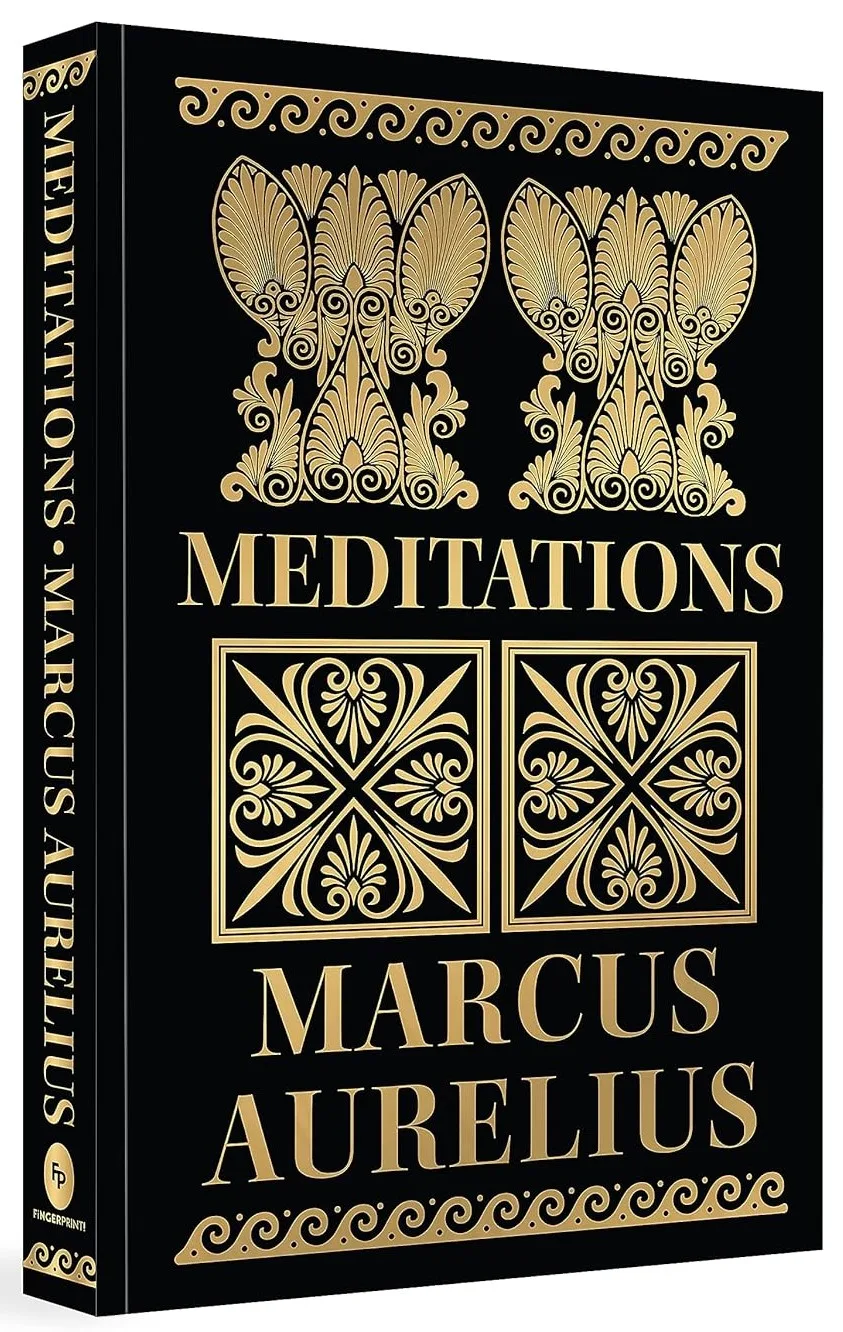
Download Cover Image
Do you want to download the full cover image for Meditations (Deluxe Hardbound Edition)?