
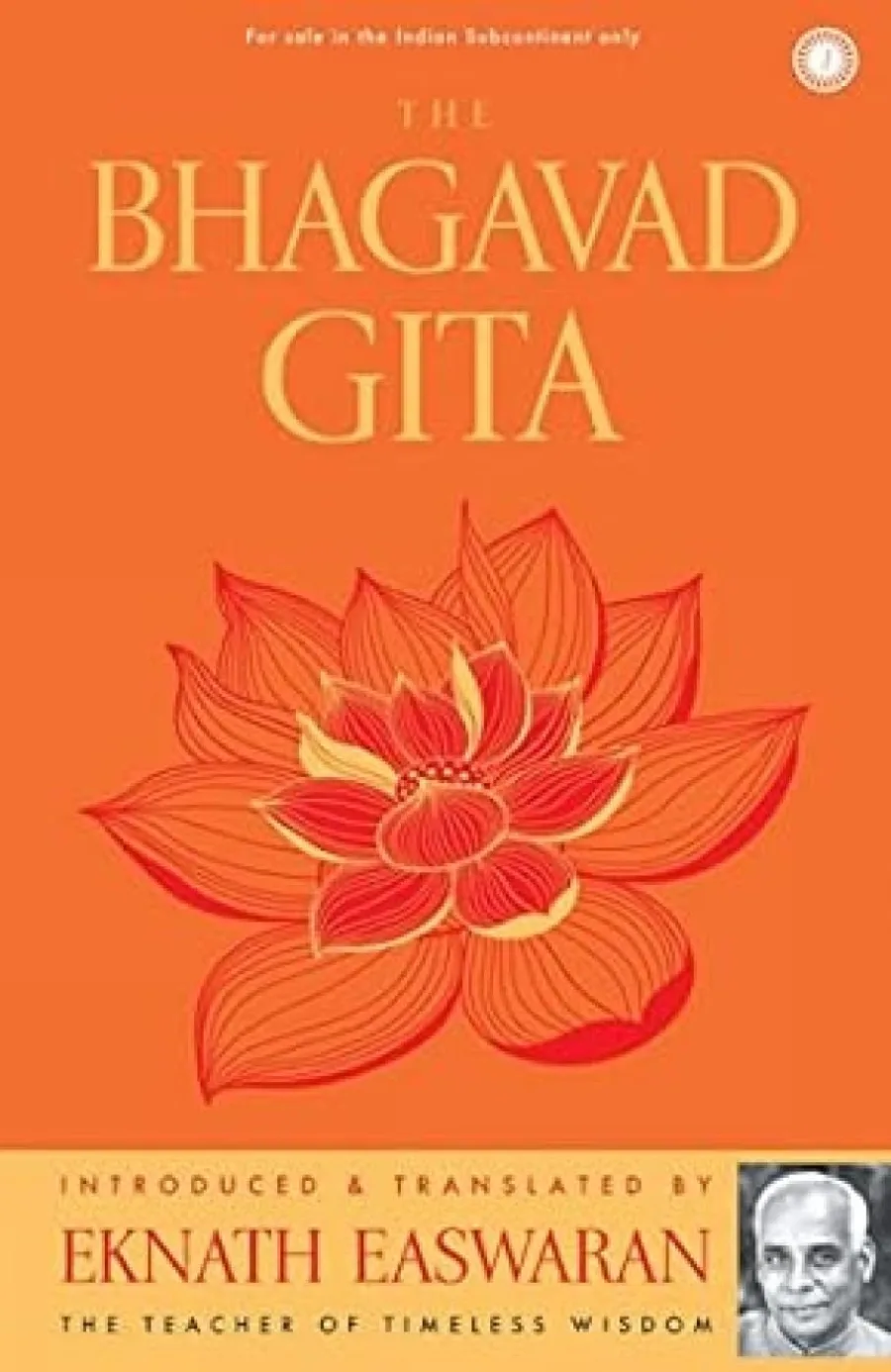
The Bhagavad Gita
Paperback
• 293 Pages
• ₹ 399.00
• English
• 9788184950908
No ratings yet
| Publisher | Jaico Publishing House |
|---|---|
| ISBN13 | 9788184950908 |
| ASIN/SKU | 818495090X |
| Book Format | Paperback |
| Language | English |
| Pages | 293 |
| List Price | ₹ 399.00 |
| Publishing Date | 25/06/2009 |
| Dimensions | 25 x 20 x 5 cm |
| Weight | 260 g |
| Book Code | BD00070763 |
Buy this Book
Amazon Stores
Ebook Stores
Other Stores
Discover The Bhagavad Gita by Eknath Easwaran. This book is published by Jaico Publishing House in Paperback format, ISBN 9788184950908, ASIN 818495090X, under Religion and Spirituality, Hinduism.
Book Description
Eknath Easwaran points out, the Gita is not what it seems -it's not a dialogue between two mythical figures at the dawn of Indian history. "The battlefield is a perfect backdrop, but the Gita's subject is the war within, the struggle for self-mastery that every human being must wage" To live a life that is meaningful, fulfilling and worthwhile. The Bhagavad Gita, 'The Song of the Lord,' is the best known of all the Indian scriptures and Eknath Easwaran's reliable, readable version has consistently been the bestselling translation. The Bhagavad Gita opens, dramatically, on a battlefield, as the warrior Arjuna turns in anguish to his spiritual guide, Sri Krishna, for answers to the fundamental questions of life. Easwaran's introduction places the Gita in its historical setting and brings out the universality and timelessness of its teachings. Chapter introductions give clear explanations of key concepts and notes and a glossary explain Sanskrit terms.
Author Biography
Eknath Easwaran (1910-1999) is one of the twentieth century's great spiritual teachers and an authentic guide to timeless wisdom.
He is a recognized authority on the Indian spiritual classics. His translations of the Bhagavad Gita, the Upanishads, and the Dhammapada are the best-selling editions in the USA.
His books on meditation, spiritual living, and the classics of world mysticism have been translated into sixteen languages. His book Passage Meditation (originally titled Meditation) has sold over 200,000 copies since it was first published in 1978. Two million copies of Easwaran's books are in print.
Born in Kerala, India, Easwaran was a professor of English literature at a leading Indian university when he came to the United States in 1959 on the Fulbright exchange program. A gifted teacher, he moved from education for degrees to education for living, and gave talks on meditation and spiritual living for 40 years. His meditation class at UC Berkeley in 1968 was the first accredited course on meditation at any major university.
In 1961 he founded the Blue Mountain Center of Meditation, a nonprofit organization that publishes his books, videos, and audio talks, and offers retreats and online programs.
Easwaran lived what he taught, giving him lasting appeal as a spiritual teacher and author of deep insight and warmth.
Discovering Meditation
Easwaran discovered meditation mid-life, while he was teaching on a college campus in central India. In the midst of a successful career he found himself haunted by age-old questions: Why am I here? What is life for? What will happen when I die?
Meanwhile in a few short months he lost two people passionately dear to him: Mahatma Gandhi, whom he’d visited in his ashram, and his beloved grandmother, who was his spiritual teacher. Finally he came home one day to find his dog had been killed by a passing truck, and his sense of loss would not subside. His dog stood for death itself, for all who had passed away.
“Almost instinctively,” Easwaran said, “I went to my room and picked up my Gita, most of which I knew by heart. I closed my eyes, and as I began to repeat the verses silently to myself, the words opened up and took me deep, deep in.” Over the next weeks he continued in the same way, seated in silence in the early morning. His meditation practice had begun.
Still leading a full life at the university, Easwaran looked for guidance in this new inner world. He read the Upanishads, Patanjali, the Catholic mystics, the Buddhist scriptures, the poetry of the Sufis. In addition to his Bhagavad Gita, he found passages for meditation from every major spiritual tradition. Some of the mystics he studied had chosen not to retire into monasteries but, like himself, to seek the spiritual path in the midst of everyday life.
In meditation, he found a deep connection between the wisdom in the passages and the way he conducted himself throughout the day. It was a thrilling discovery. “The passages were lifelines, guiding me to the source of wisdom deep within and then guiding me back into daily life.”
Years passed, and Easwaran’s inner and outer life became richer and more challenging as his meditation deepened.
In 1959 he came to the US on the Fulbright scholarship and lectured widely on the spiritual heritage of India. Some students were eager to learn about meditation, and Easwaran loved teaching. He developed a simple, effective eight-point program of passage meditation based on his own spiritual experience. Thousands of people of all ages and backgrounds now follow this program all around the world.
Easwaran as a Teacher
In the introduction to one of his key books, Easwaran described his approach as a teacher. He appealed to people, he said, “partly because I have not retired from the world – I live very much as a family man, a good husband, son, and friend – but also because I have tried to combine the best of West and East.
He is a recognized authority on the Indian spiritual classics. His translations of the Bhagavad Gita, the Upanishads, and the Dhammapada are the best-selling editions in the USA.
His books on meditation, spiritual living, and the classics of world mysticism have been translated into sixteen languages. His book Passage Meditation (originally titled Meditation) has sold over 200,000 copies since it was first published in 1978. Two million copies of Easwaran's books are in print.
Born in Kerala, India, Easwaran was a professor of English literature at a leading Indian university when he came to the United States in 1959 on the Fulbright exchange program. A gifted teacher, he moved from education for degrees to education for living, and gave talks on meditation and spiritual living for 40 years. His meditation class at UC Berkeley in 1968 was the first accredited course on meditation at any major university.
In 1961 he founded the Blue Mountain Center of Meditation, a nonprofit organization that publishes his books, videos, and audio talks, and offers retreats and online programs.
Easwaran lived what he taught, giving him lasting appeal as a spiritual teacher and author of deep insight and warmth.
Discovering Meditation
Easwaran discovered meditation mid-life, while he was teaching on a college campus in central India. In the midst of a successful career he found himself haunted by age-old questions: Why am I here? What is life for? What will happen when I die?
Meanwhile in a few short months he lost two people passionately dear to him: Mahatma Gandhi, whom he’d visited in his ashram, and his beloved grandmother, who was his spiritual teacher. Finally he came home one day to find his dog had been killed by a passing truck, and his sense of loss would not subside. His dog stood for death itself, for all who had passed away.
“Almost instinctively,” Easwaran said, “I went to my room and picked up my Gita, most of which I knew by heart. I closed my eyes, and as I began to repeat the verses silently to myself, the words opened up and took me deep, deep in.” Over the next weeks he continued in the same way, seated in silence in the early morning. His meditation practice had begun.
Still leading a full life at the university, Easwaran looked for guidance in this new inner world. He read the Upanishads, Patanjali, the Catholic mystics, the Buddhist scriptures, the poetry of the Sufis. In addition to his Bhagavad Gita, he found passages for meditation from every major spiritual tradition. Some of the mystics he studied had chosen not to retire into monasteries but, like himself, to seek the spiritual path in the midst of everyday life.
In meditation, he found a deep connection between the wisdom in the passages and the way he conducted himself throughout the day. It was a thrilling discovery. “The passages were lifelines, guiding me to the source of wisdom deep within and then guiding me back into daily life.”
Years passed, and Easwaran’s inner and outer life became richer and more challenging as his meditation deepened.
In 1959 he came to the US on the Fulbright scholarship and lectured widely on the spiritual heritage of India. Some students were eager to learn about meditation, and Easwaran loved teaching. He developed a simple, effective eight-point program of passage meditation based on his own spiritual experience. Thousands of people of all ages and backgrounds now follow this program all around the world.
Easwaran as a Teacher
In the introduction to one of his key books, Easwaran described his approach as a teacher. He appealed to people, he said, “partly because I have not retired from the world – I live very much as a family man, a good husband, son, and friend – but also because I have tried to combine the best of West and East.
Editorial Reviews
Editorial Reviews will be added soon…
Book Summary
The Bhagavad Gita, in Eknath Easwaran's widely read translation and commentary, is presented not simply as an ancient Hindu scripture but as a practical guide to living with wisdom, courage, self-discipline, and compassion. Easwaran approaches the Gita as a universal spiritual text whose central questions remain relevant to anyone facing difficult choices, emotional turmoil, conflicting responsibilities, or the search for a deeper purpose. His interpretation emphasizes that the Gita is ultimately concerned with the transformation of consciousness: how an ordinary human being can move from confusion and self-centeredness toward clarity, self-mastery, love, and freedom.
The setting of the Gita is the battlefield of Kurukshetra. Arjuna, one of the greatest warriors of his time, is prepared to fight, but when he sees friends, relatives, teachers, and loved ones standing on the opposing side, his confidence collapses. His bow slips from his hands, his body trembles, and he becomes overwhelmed by grief. He cannot understand how fighting can possibly be right when the people he must fight are people he loves. He wants to withdraw from the battle.
This crisis is the starting point of the spiritual journey. Eknath Easwaran treats Arjuna's dilemma as something much larger than a historical conflict. The battlefield becomes a symbol of the conflicts that exist within every human life. We may not stand on an actual battlefield, but we regularly encounter situations in which two responsibilities appear to oppose each other. We may have to choose between security and purpose, personal desire and duty, anger and forgiveness, comfort and growth. Like Arjuna, we may know that action is necessary while feeling completely uncertain about what action is right.
Krishna, who serves as Arjuna's charioteer, becomes his spiritual teacher. Instead of simply telling Arjuna what decision to make, Krishna gradually changes Arjuna's understanding of life, action, death, the self, desire, and the nature of reality. The conversation becomes a journey from paralysis to understanding.
One of Easwaran's most important contributions is his emphasis on the Gita as a practical manual for daily living. The teachings are not intended merely for scholars or people who have withdrawn from ordinary life. They can be practiced by anyone—in a family, workplace, community, or ordinary household. Spiritual growth, in this view, does not require escaping from responsibility. It requires learning how to perform responsibility without being enslaved by ego and attachment.
A central teaching is selfless action, or karma yoga. Krishna tells Arjuna that human beings have control over their actions but not complete control over the results. This is one of the Gita's most enduring ideas. People naturally want their efforts to produce particular outcomes. We want our work to be rewarded, our relationships to succeed, our plans to work, and our ambitions to be fulfilled. When results do not match expectations, disappointment and anxiety arise.
The Gita does not tell us to stop caring about results. Instead, it teaches us to give our best to the action itself while releasing excessive attachment to the outcome. Easwaran presents this as a powerful practical discipline. If a person becomes completely dependent on success for happiness, every failure becomes a threat to identity. But when the individual learns to focus on sincere effort, action becomes more peaceful and effective.
This principle can transform everyday life. A student can study diligently without allowing examination results to determine their entire sense of worth. A professional can work with dedication without becoming consumed by promotion or recognition. A parent can care deeply for a child while recognizing that the child's life cannot be completely controlled. In each case, the challenge is to act wholeheartedly without trying to possess the result.
Closely connected with selfless action is the idea of detachment. Easwaran makes an important distinction between detachment and indifference. Detachment does not mean becoming cold or uncaring. It means caring deeply without becoming psychologically dependent on getting one's way. A detached person can love, work, serve, and participate fully in life while maintaining an inner freedom.
The Gita's teaching about desire is another essential part of Easwaran's interpretation. Desire itself is not portrayed as the enemy. The problem occurs when desire becomes compulsive. A person sees something attractive, becomes attached to it, and begins to believe that happiness depends upon possessing it. If the desire is frustrated, anger appears. Anger can cloud judgment, and confused judgment can lead to destructive action.
This creates a chain of psychological reactions. The Gita's analysis is remarkably close to what people experience in everyday life. A small desire can become an obsession, and an obsession can gradually control behavior. Easwaran therefore emphasizes the importance of learning to manage desire rather than allowing every impulse to dictate action.
This leads to the question of mind training. The Gita repeatedly describes the disciplined mind as an ally and the uncontrolled mind as an enemy. For Easwaran, this teaching has tremendous practical significance. The mind is constantly generating thoughts, memories, fears, fantasies, judgments, and desires. If we automatically believe and obey every thought, we have very little freedom.
Easwaran's broader spiritual approach emphasizes meditation as a central method for training attention. Instead of allowing the mind to jump endlessly from one thought to another, meditation teaches concentration and steadiness. Over time, this can create a gap between awareness and impulse. A person may still experience anger or fear, but they no longer have to act upon it immediately.
This idea is crucial to the Gita's vision of freedom. Freedom is not simply the ability to do whatever one wants. If every impulse controls us, we are not actually free. Real freedom involves the ability to choose how to respond. A person who can remain calm in the presence of provocation has greater freedom than someone who reacts instantly to every insult.
Easwaran also highlights the Gita's teaching on meditation and spiritual discipline. The mind is compared to something that must be steadily trained rather than violently suppressed. When concentration wanders, it should be gently brought back. This requires patience because the mind does not become peaceful overnight.
The Gita's spiritual path is therefore not based on instant transformation. It is a gradual process. Repeated practice changes habits. When a person repeatedly chooses patience instead of anger, generosity instead of selfishness, and awareness instead of impulsive reaction, those choices gradually become part of character.
Another major theme is the unity of spiritual paths. The Gita presents several approaches to spiritual realization, including the paths of selfless action, knowledge, meditation, and devotion. Easwaran emphasizes their complementary nature rather than treating them as mutually exclusive. Different people may begin from different temperaments, but the goal is the same: freedom from the narrow ego and realization of one's deeper nature.
The path of devotion, or bhakti, is especially important. Krishna asks Arjuna to dedicate his actions and consciousness to the Divine. Easwaran interprets this not merely as religious ritual but as a transformation of the center of one's life. Instead of living exclusively for personal gain, the individual begins to orient life toward something greater than the ego.
This can take the form of love, service, prayer, meditation, or dedication. The essential movement is from “What can I get?” toward “What can I give?” Such a shift changes relationships and daily responsibilities. Ordinary actions can become spiritual practice when performed with love and without selfish attachment.
The Gita's teaching about the Self is also central. Krishna tells Arjuna that the deepest self is not identical with the changing body or personality. The body grows old and eventually dies, while thoughts, emotions, roles, and circumstances continually change. Yet beneath these changes lies a deeper spiritual reality.
This teaching gives Krishna's discussion of death a very different meaning. Arjuna's fear is partly rooted in identification with physical life and relationships. Krishna does not deny the pain of loss, but he asks Arjuna to see human existence from a larger perspective. Death is a change in the condition of embodied existence, not the destruction of the deepest spiritual self.
Easwaran approaches this teaching in a way that encourages the reader to look beyond surface identity. Modern people often define themselves through profession, possessions, social position, appearance, nationality, relationships, achievements, or failures. All of these identities can change. If one's entire sense of self depends on them, insecurity is inevitable.
The Gita suggests that there is something deeper than these temporary roles. Spiritual practice is partly the process of discovering that deeper identity.
One of the most profound sections of the Gita is Krishna's revelation of the universal form, or Vishvarupa. Arjuna is given a vision in which Krishna appears as the totality of existence—creation, destruction, countless beings, immense cosmic forces, and the movement of time. The experience overwhelms Arjuna.
Easwaran's presentation of this episode emphasizes the vastness of reality and the limitations of individual perspective. Human beings often see only a tiny portion of existence and then assume that their immediate perspective is the whole truth. The cosmic vision reminds Arjuna that life is far larger than his personal fears and preferences.
Yet the Gita does not leave Arjuna permanently overwhelmed by this cosmic vision. Krishna returns to a more intimate form. This movement is important: spirituality must ultimately become livable. One does not need to remain in an extraordinary mystical experience. The real test is whether spiritual understanding changes ordinary conduct.
The later chapters deepen the Gita's teaching on equanimity. A wise person remains balanced amid pleasure and pain, success and failure, praise and blame. This does not mean becoming emotionally numb. Rather, it means developing an inner center that is not completely controlled by circumstances.
This is one of the most practical lessons in Easwaran's interpretation. If happiness depends entirely on favorable circumstances, life will always be unstable because circumstances inevitably change. Inner steadiness allows a person to experience both joy and sorrow without being completely carried away by either.
The Gita also describes the qualities of a spiritually mature person. Such a person is compassionate, self-controlled, peaceful, free from excessive possessiveness, and able to remain steady under pressure. Spirituality is therefore measured not simply by what someone believes but by how that person behaves.
This is particularly important because the Gita can easily be misunderstood as a purely philosophical work. Easwaran continually brings its teachings back to character. If meditation makes someone calmer, more compassionate, and less selfish, it is working. If spiritual knowledge merely makes someone proud of being knowledgeable, something essential has been missed.
The concept of seva, or selfless service, naturally follows from this vision. When the ego becomes less dominant, service becomes more natural. One begins to see other people not merely as competitors or instruments for personal gain but as fellow human beings whose well-being matters.
The Gita's final message is not that every difficulty will disappear. Arjuna still has to return to the battlefield. The external situation remains difficult. What changes is Arjuna himself. His confusion has been replaced by clarity, and his paralysis by a willingness to act according to his understanding.
This is perhaps the most important lesson of the entire book: spiritual wisdom does not necessarily remove life's challenges; it changes the person who meets them.
Easwaran's interpretation makes this message particularly accessible because he presents the Gita as a guide for modern life rather than merely as a historical or theological document. The battlefield can be understood as a metaphor for the difficult situations every person encounters. Krishna's teachings become instructions for working with anger, fear, desire, anxiety, attachment, ambition, and uncertainty.
Ultimately, The Bhagavad Gita by Eknath Easwaran is a book about discovering freedom in the middle of ordinary life. It teaches that we cannot control everything that happens, but we can gradually learn to control our responses. We cannot guarantee particular outcomes, but we can offer our best effort. We cannot prevent change and death, but we can understand them more deeply. We cannot eliminate every desire, but we can learn not to become slaves to desire. We cannot escape responsibility, but we can transform responsibility into service.
The deepest movement of the Gita is from ego to selflessness, from confusion to clarity, from attachment to freedom, from restless desire to inner peace, and from self-centered living to a life of service and love.
Easwaran's presentation makes this ancient wisdom feel remarkably immediate. The questions that troubled Arjuna—What should I do? How can I act when every choice has consequences? How can I remain peaceful when life is uncertain? Who am I beneath my changing circumstances?—are still questions that human beings ask today.
The answer offered by the Gita is not a formula for avoiding difficulty. It is a discipline for meeting difficulty with greater awareness. Do the work that belongs to you. Give yourself fully to it. Train the mind. Reduce selfish attachment. Cultivate compassion. Remember the deeper Self. Serve others. And learn to remain steady whether life gives you success or disappointment.
In the end, Arjuna does not receive a life without conflict. He receives something more valuable: the inner clarity to face life without being overwhelmed by it. That transformation is the heart of Eknath Easwaran's The Bhagavad Gita, and it is what makes the book continue to speak across centuries—as a spiritual text, a guide to self-mastery, and above all, an invitation to live with greater courage, wisdom, love, and inner freedom.
The setting of the Gita is the battlefield of Kurukshetra. Arjuna, one of the greatest warriors of his time, is prepared to fight, but when he sees friends, relatives, teachers, and loved ones standing on the opposing side, his confidence collapses. His bow slips from his hands, his body trembles, and he becomes overwhelmed by grief. He cannot understand how fighting can possibly be right when the people he must fight are people he loves. He wants to withdraw from the battle.
This crisis is the starting point of the spiritual journey. Eknath Easwaran treats Arjuna's dilemma as something much larger than a historical conflict. The battlefield becomes a symbol of the conflicts that exist within every human life. We may not stand on an actual battlefield, but we regularly encounter situations in which two responsibilities appear to oppose each other. We may have to choose between security and purpose, personal desire and duty, anger and forgiveness, comfort and growth. Like Arjuna, we may know that action is necessary while feeling completely uncertain about what action is right.
Krishna, who serves as Arjuna's charioteer, becomes his spiritual teacher. Instead of simply telling Arjuna what decision to make, Krishna gradually changes Arjuna's understanding of life, action, death, the self, desire, and the nature of reality. The conversation becomes a journey from paralysis to understanding.
One of Easwaran's most important contributions is his emphasis on the Gita as a practical manual for daily living. The teachings are not intended merely for scholars or people who have withdrawn from ordinary life. They can be practiced by anyone—in a family, workplace, community, or ordinary household. Spiritual growth, in this view, does not require escaping from responsibility. It requires learning how to perform responsibility without being enslaved by ego and attachment.
A central teaching is selfless action, or karma yoga. Krishna tells Arjuna that human beings have control over their actions but not complete control over the results. This is one of the Gita's most enduring ideas. People naturally want their efforts to produce particular outcomes. We want our work to be rewarded, our relationships to succeed, our plans to work, and our ambitions to be fulfilled. When results do not match expectations, disappointment and anxiety arise.
The Gita does not tell us to stop caring about results. Instead, it teaches us to give our best to the action itself while releasing excessive attachment to the outcome. Easwaran presents this as a powerful practical discipline. If a person becomes completely dependent on success for happiness, every failure becomes a threat to identity. But when the individual learns to focus on sincere effort, action becomes more peaceful and effective.
This principle can transform everyday life. A student can study diligently without allowing examination results to determine their entire sense of worth. A professional can work with dedication without becoming consumed by promotion or recognition. A parent can care deeply for a child while recognizing that the child's life cannot be completely controlled. In each case, the challenge is to act wholeheartedly without trying to possess the result.
Closely connected with selfless action is the idea of detachment. Easwaran makes an important distinction between detachment and indifference. Detachment does not mean becoming cold or uncaring. It means caring deeply without becoming psychologically dependent on getting one's way. A detached person can love, work, serve, and participate fully in life while maintaining an inner freedom.
The Gita's teaching about desire is another essential part of Easwaran's interpretation. Desire itself is not portrayed as the enemy. The problem occurs when desire becomes compulsive. A person sees something attractive, becomes attached to it, and begins to believe that happiness depends upon possessing it. If the desire is frustrated, anger appears. Anger can cloud judgment, and confused judgment can lead to destructive action.
This creates a chain of psychological reactions. The Gita's analysis is remarkably close to what people experience in everyday life. A small desire can become an obsession, and an obsession can gradually control behavior. Easwaran therefore emphasizes the importance of learning to manage desire rather than allowing every impulse to dictate action.
This leads to the question of mind training. The Gita repeatedly describes the disciplined mind as an ally and the uncontrolled mind as an enemy. For Easwaran, this teaching has tremendous practical significance. The mind is constantly generating thoughts, memories, fears, fantasies, judgments, and desires. If we automatically believe and obey every thought, we have very little freedom.
Easwaran's broader spiritual approach emphasizes meditation as a central method for training attention. Instead of allowing the mind to jump endlessly from one thought to another, meditation teaches concentration and steadiness. Over time, this can create a gap between awareness and impulse. A person may still experience anger or fear, but they no longer have to act upon it immediately.
This idea is crucial to the Gita's vision of freedom. Freedom is not simply the ability to do whatever one wants. If every impulse controls us, we are not actually free. Real freedom involves the ability to choose how to respond. A person who can remain calm in the presence of provocation has greater freedom than someone who reacts instantly to every insult.
Easwaran also highlights the Gita's teaching on meditation and spiritual discipline. The mind is compared to something that must be steadily trained rather than violently suppressed. When concentration wanders, it should be gently brought back. This requires patience because the mind does not become peaceful overnight.
The Gita's spiritual path is therefore not based on instant transformation. It is a gradual process. Repeated practice changes habits. When a person repeatedly chooses patience instead of anger, generosity instead of selfishness, and awareness instead of impulsive reaction, those choices gradually become part of character.
Another major theme is the unity of spiritual paths. The Gita presents several approaches to spiritual realization, including the paths of selfless action, knowledge, meditation, and devotion. Easwaran emphasizes their complementary nature rather than treating them as mutually exclusive. Different people may begin from different temperaments, but the goal is the same: freedom from the narrow ego and realization of one's deeper nature.
The path of devotion, or bhakti, is especially important. Krishna asks Arjuna to dedicate his actions and consciousness to the Divine. Easwaran interprets this not merely as religious ritual but as a transformation of the center of one's life. Instead of living exclusively for personal gain, the individual begins to orient life toward something greater than the ego.
This can take the form of love, service, prayer, meditation, or dedication. The essential movement is from “What can I get?” toward “What can I give?” Such a shift changes relationships and daily responsibilities. Ordinary actions can become spiritual practice when performed with love and without selfish attachment.
The Gita's teaching about the Self is also central. Krishna tells Arjuna that the deepest self is not identical with the changing body or personality. The body grows old and eventually dies, while thoughts, emotions, roles, and circumstances continually change. Yet beneath these changes lies a deeper spiritual reality.
This teaching gives Krishna's discussion of death a very different meaning. Arjuna's fear is partly rooted in identification with physical life and relationships. Krishna does not deny the pain of loss, but he asks Arjuna to see human existence from a larger perspective. Death is a change in the condition of embodied existence, not the destruction of the deepest spiritual self.
Easwaran approaches this teaching in a way that encourages the reader to look beyond surface identity. Modern people often define themselves through profession, possessions, social position, appearance, nationality, relationships, achievements, or failures. All of these identities can change. If one's entire sense of self depends on them, insecurity is inevitable.
The Gita suggests that there is something deeper than these temporary roles. Spiritual practice is partly the process of discovering that deeper identity.
One of the most profound sections of the Gita is Krishna's revelation of the universal form, or Vishvarupa. Arjuna is given a vision in which Krishna appears as the totality of existence—creation, destruction, countless beings, immense cosmic forces, and the movement of time. The experience overwhelms Arjuna.
Easwaran's presentation of this episode emphasizes the vastness of reality and the limitations of individual perspective. Human beings often see only a tiny portion of existence and then assume that their immediate perspective is the whole truth. The cosmic vision reminds Arjuna that life is far larger than his personal fears and preferences.
Yet the Gita does not leave Arjuna permanently overwhelmed by this cosmic vision. Krishna returns to a more intimate form. This movement is important: spirituality must ultimately become livable. One does not need to remain in an extraordinary mystical experience. The real test is whether spiritual understanding changes ordinary conduct.
The later chapters deepen the Gita's teaching on equanimity. A wise person remains balanced amid pleasure and pain, success and failure, praise and blame. This does not mean becoming emotionally numb. Rather, it means developing an inner center that is not completely controlled by circumstances.
This is one of the most practical lessons in Easwaran's interpretation. If happiness depends entirely on favorable circumstances, life will always be unstable because circumstances inevitably change. Inner steadiness allows a person to experience both joy and sorrow without being completely carried away by either.
The Gita also describes the qualities of a spiritually mature person. Such a person is compassionate, self-controlled, peaceful, free from excessive possessiveness, and able to remain steady under pressure. Spirituality is therefore measured not simply by what someone believes but by how that person behaves.
This is particularly important because the Gita can easily be misunderstood as a purely philosophical work. Easwaran continually brings its teachings back to character. If meditation makes someone calmer, more compassionate, and less selfish, it is working. If spiritual knowledge merely makes someone proud of being knowledgeable, something essential has been missed.
The concept of seva, or selfless service, naturally follows from this vision. When the ego becomes less dominant, service becomes more natural. One begins to see other people not merely as competitors or instruments for personal gain but as fellow human beings whose well-being matters.
The Gita's final message is not that every difficulty will disappear. Arjuna still has to return to the battlefield. The external situation remains difficult. What changes is Arjuna himself. His confusion has been replaced by clarity, and his paralysis by a willingness to act according to his understanding.
This is perhaps the most important lesson of the entire book: spiritual wisdom does not necessarily remove life's challenges; it changes the person who meets them.
Easwaran's interpretation makes this message particularly accessible because he presents the Gita as a guide for modern life rather than merely as a historical or theological document. The battlefield can be understood as a metaphor for the difficult situations every person encounters. Krishna's teachings become instructions for working with anger, fear, desire, anxiety, attachment, ambition, and uncertainty.
Ultimately, The Bhagavad Gita by Eknath Easwaran is a book about discovering freedom in the middle of ordinary life. It teaches that we cannot control everything that happens, but we can gradually learn to control our responses. We cannot guarantee particular outcomes, but we can offer our best effort. We cannot prevent change and death, but we can understand them more deeply. We cannot eliminate every desire, but we can learn not to become slaves to desire. We cannot escape responsibility, but we can transform responsibility into service.
The deepest movement of the Gita is from ego to selflessness, from confusion to clarity, from attachment to freedom, from restless desire to inner peace, and from self-centered living to a life of service and love.
Easwaran's presentation makes this ancient wisdom feel remarkably immediate. The questions that troubled Arjuna—What should I do? How can I act when every choice has consequences? How can I remain peaceful when life is uncertain? Who am I beneath my changing circumstances?—are still questions that human beings ask today.
The answer offered by the Gita is not a formula for avoiding difficulty. It is a discipline for meeting difficulty with greater awareness. Do the work that belongs to you. Give yourself fully to it. Train the mind. Reduce selfish attachment. Cultivate compassion. Remember the deeper Self. Serve others. And learn to remain steady whether life gives you success or disappointment.
In the end, Arjuna does not receive a life without conflict. He receives something more valuable: the inner clarity to face life without being overwhelmed by it. That transformation is the heart of Eknath Easwaran's The Bhagavad Gita, and it is what makes the book continue to speak across centuries—as a spiritual text, a guide to self-mastery, and above all, an invitation to live with greater courage, wisdom, love, and inner freedom.
Sample Chapters
Sample Chapters will be added soon…
Reader Reviews
No reviews yet.
The Bhagavad Gita
Download Cover Image
Do you want to download the full cover image for The Bhagavad Gita?