
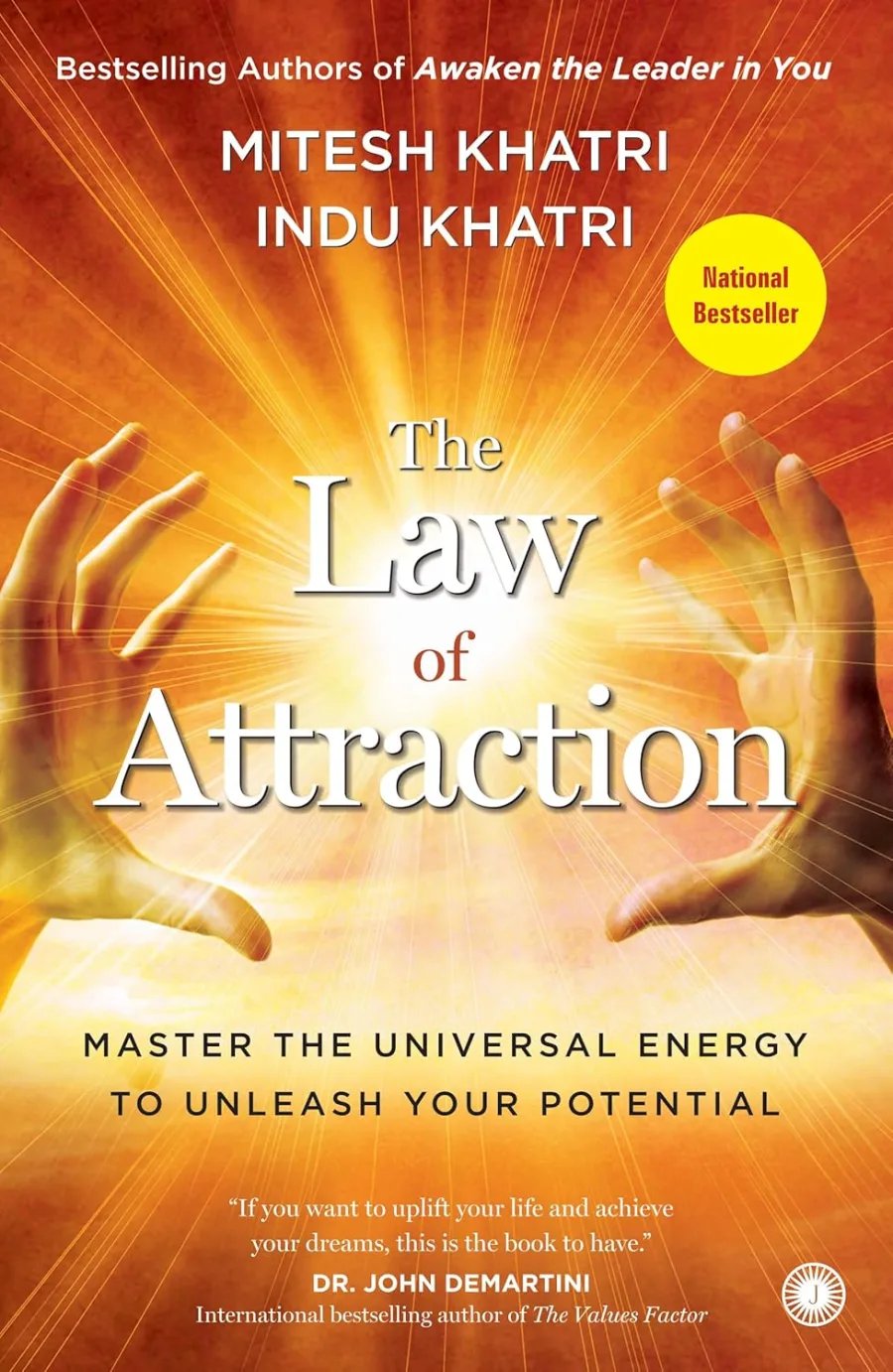
The Law of Attraction
Paperback
• 216 Pages
• ₹ 299.00
• English
• 9788184958362
No ratings yet
| Publisher | Jaico Publishing House |
|---|---|
| ISBN13 | 9788184958362 |
| ASIN/SKU | 8184958366 |
| Book Format | Paperback |
| Language | English |
| Pages | 216 |
| List Price | ₹ 299.00 |
| Publishing Date | 01/01/2016 |
| Dimensions | 13.97 x 1.35 x 21.59 cm |
| Weight | 189 g |
| Book Code | BD00070762 |
Buy this Book
Amazon Stores
Ebook Stores
Other Stores
Discover The Law of Attraction by Indu Khatri. This book is published by Jaico Publishing House in Paperback format, ISBN 9788184958362, ASIN 8184958366, under Self-Help, Personal Transformation.
Book Description
You already have everything to transform your life into anything you desire.
Do you believe it?
The Law of Attraction is the power key to unlock your destiny, to consciously attract more of what you want and less of what you don’t want. This book teaches you how to use the hidden energy within you to alter your life circumstances to create abundance of happiness and success.
Once you read this book, there is no turning back. So grab your copy now and start manifesting your dreams into reality!
Do you believe it?
The Law of Attraction is the power key to unlock your destiny, to consciously attract more of what you want and less of what you don’t want. This book teaches you how to use the hidden energy within you to alter your life circumstances to create abundance of happiness and success.
Once you read this book, there is no turning back. So grab your copy now and start manifesting your dreams into reality!
Author Biography
Mitesh Khatri is an Internationally trusted Leadership Facilitator, Transformation Expert & Best Selling Author. With over a decade's experience Mitesh has trained thousands of people across hundreds of organizations all over the world.
When world’s top organizations need to Inspire Leadership & Motivate their employees in record breaking time, they call upon Mitesh Khatri. See more at: http://www.miteshkhatri.com/
Indu Khatri is the Co-Author of Awaken The Leader In You and the principle Content Designer for Leadership & Transformational Trainings. Mitesh & Indu are Life Partners, Business Partners and now Co-Authors of their Best-Selling book.
Indu is also the Driving Force & main Inspiration for the book as well as the Extraordinary Trainings conducted by Mitesh. See more at: http://www.miteshkhatri.com/about-us/
When world’s top organizations need to Inspire Leadership & Motivate their employees in record breaking time, they call upon Mitesh Khatri. See more at: http://www.miteshkhatri.com/
Indu Khatri is the Co-Author of Awaken The Leader In You and the principle Content Designer for Leadership & Transformational Trainings. Mitesh & Indu are Life Partners, Business Partners and now Co-Authors of their Best-Selling book.
Indu is also the Driving Force & main Inspiration for the book as well as the Extraordinary Trainings conducted by Mitesh. See more at: http://www.miteshkhatri.com/about-us/
Editorial Reviews
“If you want to uplift your life and achieve your dreams, this is the book to have.”
DR. JOHN DEMARTINI
International bestselling author of The Values Factor
DR. JOHN DEMARTINI
International bestselling author of The Values Factor
Book Summary
The Law of Attraction by Mitesh Khatri and Indu Khatri is a practical self-help book built around the idea that our thoughts, feelings, beliefs, and actions influence the experiences we move toward in life. Published by Jaico Publishing House, the book presents the Law of Attraction not simply as a theory about positive thinking, but as a practice involving intention, visualization, emotional awareness, belief, gratitude, and purposeful action. The authors describe it as a way of consciously directing one's inner energy toward desired goals rather than allowing habitual fears and negative thinking to determine one's direction. The book is structured around ideas such as “like attracts like,” the FTBA cycle of feelings, thoughts, beliefs and actions, visualization, action, and the use of the Law of Attraction in relationships, money, health, family life, and everyday situations.
At the heart of the book is a simple but powerful question: What if the quality of your inner world has a greater influence on the direction of your outer life than you have previously realized? The authors encourage readers to examine the thoughts they repeatedly think, the emotions they repeatedly experience, and the beliefs they hold about themselves. Their argument is that people often try to change their circumstances without first examining the mental and emotional patterns through which they approach those circumstances. If someone continually expects failure, focuses on problems, doubts their own worth, and imagines negative outcomes, those patterns can influence the choices and actions they take. Conversely, a person who develops clarity, confidence, positive expectations, and purposeful action may begin noticing opportunities and behaving in ways that support their goals.
The book begins by introducing the Law of Attraction as a principle of conscious creation. The authors describe it as a “power key” through which people can consciously attract more of what they want and less of what they do not want. The emphasis is therefore on consciousness. Many people move through life on autopilot. They react to circumstances, repeat familiar thoughts, accept limiting assumptions, and then wonder why the same patterns keep appearing. The authors want the reader to become more deliberate. Instead of merely reacting to life, the reader is encouraged to decide what kind of experience they want to create and then align their inner state and behavior with that intention.
A major concept in the book is “like attracts like.” In the authors' framework, the emotional and mental frequency a person repeatedly occupies influences what they notice, expect, and move toward. If someone constantly thinks in terms of scarcity, fear, and impossibility, their attention becomes organized around those experiences. If they cultivate gratitude, possibility, confidence, and abundance, they become more receptive to corresponding opportunities and experiences. The concept is presented as a way of understanding how one's inner orientation can shape one's life.
This does not mean that simply wishing for something automatically makes it happen. One of the book's practical concerns is understanding why the Law of Attraction sometimes appears not to work. The authors devote a section specifically to this question. The underlying message is that merely saying positive words while holding contradictory beliefs and emotions is unlikely to produce meaningful transformation. A person may repeatedly say, “I am successful,” while internally believing that success is impossible for them. The spoken affirmation and the deeper belief are then pulling in different directions.
This leads to one of the book's most important frameworks: FTBA—Feelings, Thoughts, Beliefs, and Actions. The authors use this cycle to explain how inner patterns can translate into outer behavior. Feelings influence thoughts; thoughts reinforce beliefs; beliefs influence actions; and actions contribute to results and experiences. The process can become either constructive or destructive.
Consider someone who believes they are not capable of succeeding. That belief may generate anxiety when an opportunity appears. The anxiety produces thoughts such as, “I will probably fail,” which may lead the person to avoid taking action. The lack of action then produces little progress, apparently confirming the original belief. A negative cycle has been created.
The same process can work in a more constructive direction. Someone who develops the belief that they are capable of learning may respond to difficulty differently. They may feel more hopeful, think about possible solutions, take action, learn from mistakes, and gradually create evidence that strengthens their confidence. The book's emphasis is therefore not simply on thinking positive thoughts but on changing the entire cycle connecting inner experience with outward behavior.
This is where limiting beliefs become especially important. Many people carry invisible assumptions about money, success, relationships, intelligence, worthiness, and possibility. These beliefs may have developed through childhood experiences, social conditioning, criticism, failure, or repeated negative messages. Because they become familiar, people often mistake them for facts. The book encourages readers to identify these beliefs and question whether they are actually helping them.
The idea of “deserving capacity” is connected with this process. A person may consciously want wealth, love, recognition, or success but unconsciously feel that they do not deserve it. In such a situation, the conscious desire and the deeper belief conflict. The authors encourage readers to expand their sense of what they are capable of receiving and to cultivate beliefs consistent with their goals.
Visualization is another major technique in the book. The authors describe visualization as a way of mentally experiencing a desired outcome before it becomes physically real. Instead of merely saying, “I want to be successful,” the reader is encouraged to imagine what success would actually look and feel like. The book's contents explicitly identify visualization as a central technique, describing it as a way of imagining what one wants and seeing it mentally as already achieved.
The deeper purpose of visualization is to give the mind a clear direction. A vague desire is difficult to act upon. A specific mental picture creates greater clarity. Someone who wants a new career, for example, can imagine the kind of work they want to perform, the environment in which they want to work, the responsibilities they would like to have, and the feelings associated with achieving that goal. This mental clarity can then influence real-world choices.
However, the book does not stop with imagination. Action is presented as the final tuning of the process. This is crucial because manifestation without action can easily become wishful thinking. If a person wants financial improvement, they still need to learn, work, plan, save, communicate, create value, or pursue opportunities. If someone wants a healthier life, they need to make choices that support health. If they want a meaningful relationship, they need to communicate, listen, develop trust, and behave with care.
The Law of Attraction therefore becomes most useful in the book when thought and action are connected. The desired future should influence today's behavior. The person begins to act as someone moving toward the desired outcome rather than someone merely waiting for it.
The authors also emphasize gratitude, which functions as a way of shifting attention from deficiency to appreciation. Human beings naturally notice what they lack. Once one desire is fulfilled, attention often moves immediately to the next missing thing. This creates a permanent feeling of insufficiency. Gratitude interrupts that pattern by encouraging awareness of what is already present.
Gratitude does not require pretending that everything is perfect. Rather, it changes the emotional starting point from which one approaches life. A person who appreciates what they already have may still pursue improvement, but the pursuit comes from a different emotional foundation. Instead of constantly thinking, “I am incomplete until I get this,” the person can think, “I value what I have, and I am also open to creating more.”
The book applies its principles to relationships as well. The Law of Attraction is presented as relevant to marriage, friendship, family relationships, and interpersonal connection. The underlying principle is that relationships are influenced by emotional patterns, expectations, beliefs, and behavior. A person who constantly expects rejection may behave defensively, which can itself make genuine connection more difficult. Someone who develops trust, appreciation, openness, and healthy communication may create a different relational environment.
This perspective encourages personal responsibility without suggesting that one person controls another. We cannot completely control how other people behave, but we can examine what we bring into our relationships: our expectations, communication style, emotional reactions, boundaries, and assumptions.
The book also discusses money and abundance. Financial circumstances are influenced by many real-world factors, but the authors focus on the psychological side of money. People can carry beliefs such as “money is difficult to earn,” “wealth is only for certain people,” or “I will never have enough.” Such beliefs can affect risk-taking, learning, planning, negotiation, and opportunities. The book encourages readers to develop a more expansive relationship with abundance while still taking practical action.
Similarly, its discussion of health emphasizes the connection between mental attitude and personal behavior. Positive thinking should not be confused with a substitute for medical care or practical health choices. Within the book's self-help framework, the broader point is that one's beliefs and emotional state can influence habits, motivation, stress, and the willingness to take constructive action.
The authors even extend the Law of Attraction to children, suggesting that the principles can be applied to how young people develop beliefs about themselves and the world. This highlights one of the book's broader themes: patterns of thought are learned and can therefore be consciously reshaped.
Another interesting aspect is the book's discussion of Vastu, showing the authors' attempt to connect the Law of Attraction with the physical environment. The broader idea is that people are influenced not only by what they think internally but also by the spaces and conditions in which they live. Regardless of how one interprets the more metaphysical aspects of this discussion, the practical takeaway is that environment can affect mood, attention, habits, and behavior.
Throughout the book, the authors maintain an encouraging tone. The goal is to make the Law of Attraction practical rather than abstract. The book's published descriptions emphasize exercises, visualization, affirmations, journaling, gratitude, and actionable routines, presenting these as tools that readers can use in daily life. This makes the book less like a purely philosophical discussion and more like a personal-development guide.
Perhaps the most useful way to understand the book is as a framework for intentional living. Instead of allowing thoughts and emotions to operate unconsciously, the reader is asked to become an observer and eventually a participant in shaping them. What do I want? Why do I want it? What do I believe about myself in relation to it? What emotions arise when I imagine having it? What limiting beliefs stand in the way? What action can I take today?
These questions transform the Law of Attraction from a vague promise into a process of self-examination.
At the same time, the book's philosophy is best understood as a self-help framework rather than as a scientifically established law of nature. The publisher describes the work in terms of “universal energy” and conscious attraction, while the practical techniques—such as visualization, affirmations, goal-setting, gratitude, and journaling—can also be understood through the more familiar lens of motivation, attention, belief, and behavior. The value of these practices therefore does not require accepting every metaphysical claim literally.
Ultimately, The Law of Attraction by Indu Khatri and Mitesh Khatri is a book about moving from unconscious patterns to conscious direction. Its central message is that people have more influence over their mindset, attention, beliefs, and actions than they often realize. By becoming clear about what they want, identifying limiting beliefs, cultivating supportive emotions, visualizing desired outcomes, practicing gratitude, and taking aligned action, readers are encouraged to become active participants in their personal growth.
The deepest lesson is perhaps not that the universe will automatically deliver everything a person imagines. It is that what we repeatedly think about, believe, feel, and act upon can profoundly shape the direction of our lives. A change in inner orientation can lead to a change in behavior; changed behavior can create new experiences; and those experiences can gradually create a very different life.
The book therefore leaves the reader with a practical invitation: become conscious of your mental patterns, define your desires clearly, believe that growth is possible, stop feeding the thoughts that continually pull you backward, and then take meaningful action. The process begins in the mind, but it must eventually express itself in life. In that sense, The Law of Attraction is ultimately a book about possibility—the possibility that by changing how we think, feel, believe, and act, we can begin changing the direction in which our lives move.
At the heart of the book is a simple but powerful question: What if the quality of your inner world has a greater influence on the direction of your outer life than you have previously realized? The authors encourage readers to examine the thoughts they repeatedly think, the emotions they repeatedly experience, and the beliefs they hold about themselves. Their argument is that people often try to change their circumstances without first examining the mental and emotional patterns through which they approach those circumstances. If someone continually expects failure, focuses on problems, doubts their own worth, and imagines negative outcomes, those patterns can influence the choices and actions they take. Conversely, a person who develops clarity, confidence, positive expectations, and purposeful action may begin noticing opportunities and behaving in ways that support their goals.
The book begins by introducing the Law of Attraction as a principle of conscious creation. The authors describe it as a “power key” through which people can consciously attract more of what they want and less of what they do not want. The emphasis is therefore on consciousness. Many people move through life on autopilot. They react to circumstances, repeat familiar thoughts, accept limiting assumptions, and then wonder why the same patterns keep appearing. The authors want the reader to become more deliberate. Instead of merely reacting to life, the reader is encouraged to decide what kind of experience they want to create and then align their inner state and behavior with that intention.
A major concept in the book is “like attracts like.” In the authors' framework, the emotional and mental frequency a person repeatedly occupies influences what they notice, expect, and move toward. If someone constantly thinks in terms of scarcity, fear, and impossibility, their attention becomes organized around those experiences. If they cultivate gratitude, possibility, confidence, and abundance, they become more receptive to corresponding opportunities and experiences. The concept is presented as a way of understanding how one's inner orientation can shape one's life.
This does not mean that simply wishing for something automatically makes it happen. One of the book's practical concerns is understanding why the Law of Attraction sometimes appears not to work. The authors devote a section specifically to this question. The underlying message is that merely saying positive words while holding contradictory beliefs and emotions is unlikely to produce meaningful transformation. A person may repeatedly say, “I am successful,” while internally believing that success is impossible for them. The spoken affirmation and the deeper belief are then pulling in different directions.
This leads to one of the book's most important frameworks: FTBA—Feelings, Thoughts, Beliefs, and Actions. The authors use this cycle to explain how inner patterns can translate into outer behavior. Feelings influence thoughts; thoughts reinforce beliefs; beliefs influence actions; and actions contribute to results and experiences. The process can become either constructive or destructive.
Consider someone who believes they are not capable of succeeding. That belief may generate anxiety when an opportunity appears. The anxiety produces thoughts such as, “I will probably fail,” which may lead the person to avoid taking action. The lack of action then produces little progress, apparently confirming the original belief. A negative cycle has been created.
The same process can work in a more constructive direction. Someone who develops the belief that they are capable of learning may respond to difficulty differently. They may feel more hopeful, think about possible solutions, take action, learn from mistakes, and gradually create evidence that strengthens their confidence. The book's emphasis is therefore not simply on thinking positive thoughts but on changing the entire cycle connecting inner experience with outward behavior.
This is where limiting beliefs become especially important. Many people carry invisible assumptions about money, success, relationships, intelligence, worthiness, and possibility. These beliefs may have developed through childhood experiences, social conditioning, criticism, failure, or repeated negative messages. Because they become familiar, people often mistake them for facts. The book encourages readers to identify these beliefs and question whether they are actually helping them.
The idea of “deserving capacity” is connected with this process. A person may consciously want wealth, love, recognition, or success but unconsciously feel that they do not deserve it. In such a situation, the conscious desire and the deeper belief conflict. The authors encourage readers to expand their sense of what they are capable of receiving and to cultivate beliefs consistent with their goals.
Visualization is another major technique in the book. The authors describe visualization as a way of mentally experiencing a desired outcome before it becomes physically real. Instead of merely saying, “I want to be successful,” the reader is encouraged to imagine what success would actually look and feel like. The book's contents explicitly identify visualization as a central technique, describing it as a way of imagining what one wants and seeing it mentally as already achieved.
The deeper purpose of visualization is to give the mind a clear direction. A vague desire is difficult to act upon. A specific mental picture creates greater clarity. Someone who wants a new career, for example, can imagine the kind of work they want to perform, the environment in which they want to work, the responsibilities they would like to have, and the feelings associated with achieving that goal. This mental clarity can then influence real-world choices.
However, the book does not stop with imagination. Action is presented as the final tuning of the process. This is crucial because manifestation without action can easily become wishful thinking. If a person wants financial improvement, they still need to learn, work, plan, save, communicate, create value, or pursue opportunities. If someone wants a healthier life, they need to make choices that support health. If they want a meaningful relationship, they need to communicate, listen, develop trust, and behave with care.
The Law of Attraction therefore becomes most useful in the book when thought and action are connected. The desired future should influence today's behavior. The person begins to act as someone moving toward the desired outcome rather than someone merely waiting for it.
The authors also emphasize gratitude, which functions as a way of shifting attention from deficiency to appreciation. Human beings naturally notice what they lack. Once one desire is fulfilled, attention often moves immediately to the next missing thing. This creates a permanent feeling of insufficiency. Gratitude interrupts that pattern by encouraging awareness of what is already present.
Gratitude does not require pretending that everything is perfect. Rather, it changes the emotional starting point from which one approaches life. A person who appreciates what they already have may still pursue improvement, but the pursuit comes from a different emotional foundation. Instead of constantly thinking, “I am incomplete until I get this,” the person can think, “I value what I have, and I am also open to creating more.”
The book applies its principles to relationships as well. The Law of Attraction is presented as relevant to marriage, friendship, family relationships, and interpersonal connection. The underlying principle is that relationships are influenced by emotional patterns, expectations, beliefs, and behavior. A person who constantly expects rejection may behave defensively, which can itself make genuine connection more difficult. Someone who develops trust, appreciation, openness, and healthy communication may create a different relational environment.
This perspective encourages personal responsibility without suggesting that one person controls another. We cannot completely control how other people behave, but we can examine what we bring into our relationships: our expectations, communication style, emotional reactions, boundaries, and assumptions.
The book also discusses money and abundance. Financial circumstances are influenced by many real-world factors, but the authors focus on the psychological side of money. People can carry beliefs such as “money is difficult to earn,” “wealth is only for certain people,” or “I will never have enough.” Such beliefs can affect risk-taking, learning, planning, negotiation, and opportunities. The book encourages readers to develop a more expansive relationship with abundance while still taking practical action.
Similarly, its discussion of health emphasizes the connection between mental attitude and personal behavior. Positive thinking should not be confused with a substitute for medical care or practical health choices. Within the book's self-help framework, the broader point is that one's beliefs and emotional state can influence habits, motivation, stress, and the willingness to take constructive action.
The authors even extend the Law of Attraction to children, suggesting that the principles can be applied to how young people develop beliefs about themselves and the world. This highlights one of the book's broader themes: patterns of thought are learned and can therefore be consciously reshaped.
Another interesting aspect is the book's discussion of Vastu, showing the authors' attempt to connect the Law of Attraction with the physical environment. The broader idea is that people are influenced not only by what they think internally but also by the spaces and conditions in which they live. Regardless of how one interprets the more metaphysical aspects of this discussion, the practical takeaway is that environment can affect mood, attention, habits, and behavior.
Throughout the book, the authors maintain an encouraging tone. The goal is to make the Law of Attraction practical rather than abstract. The book's published descriptions emphasize exercises, visualization, affirmations, journaling, gratitude, and actionable routines, presenting these as tools that readers can use in daily life. This makes the book less like a purely philosophical discussion and more like a personal-development guide.
Perhaps the most useful way to understand the book is as a framework for intentional living. Instead of allowing thoughts and emotions to operate unconsciously, the reader is asked to become an observer and eventually a participant in shaping them. What do I want? Why do I want it? What do I believe about myself in relation to it? What emotions arise when I imagine having it? What limiting beliefs stand in the way? What action can I take today?
These questions transform the Law of Attraction from a vague promise into a process of self-examination.
At the same time, the book's philosophy is best understood as a self-help framework rather than as a scientifically established law of nature. The publisher describes the work in terms of “universal energy” and conscious attraction, while the practical techniques—such as visualization, affirmations, goal-setting, gratitude, and journaling—can also be understood through the more familiar lens of motivation, attention, belief, and behavior. The value of these practices therefore does not require accepting every metaphysical claim literally.
Ultimately, The Law of Attraction by Indu Khatri and Mitesh Khatri is a book about moving from unconscious patterns to conscious direction. Its central message is that people have more influence over their mindset, attention, beliefs, and actions than they often realize. By becoming clear about what they want, identifying limiting beliefs, cultivating supportive emotions, visualizing desired outcomes, practicing gratitude, and taking aligned action, readers are encouraged to become active participants in their personal growth.
The deepest lesson is perhaps not that the universe will automatically deliver everything a person imagines. It is that what we repeatedly think about, believe, feel, and act upon can profoundly shape the direction of our lives. A change in inner orientation can lead to a change in behavior; changed behavior can create new experiences; and those experiences can gradually create a very different life.
The book therefore leaves the reader with a practical invitation: become conscious of your mental patterns, define your desires clearly, believe that growth is possible, stop feeding the thoughts that continually pull you backward, and then take meaningful action. The process begins in the mind, but it must eventually express itself in life. In that sense, The Law of Attraction is ultimately a book about possibility—the possibility that by changing how we think, feel, believe, and act, we can begin changing the direction in which our lives move.
Sample Chapters
Sample Chapters will be added soon…
Reader Reviews
No reviews yet.
The Law of Attraction
Download Cover Image
Do you want to download the full cover image for The Law of Attraction?