
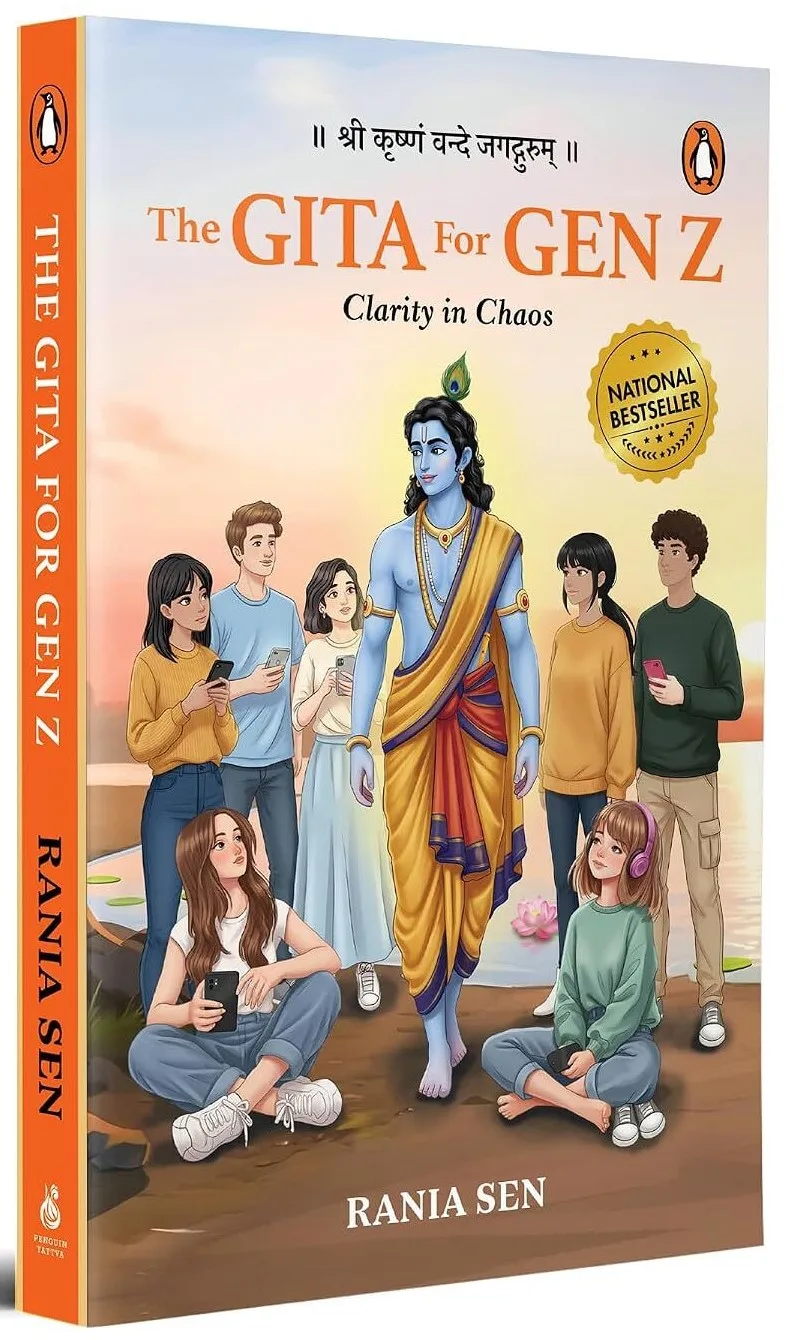
The Gita for Gen Z: Clarity in Chaos: Timeless Wisdom from the Bhagavad Gita
Paperback
• 272 Pages
• ₹ 399.00
• English
• 9780143482383
No ratings yet
| Publisher | India Penguin Tattva |
|---|---|
| ISBN13 | 9780143482383 |
| ASIN/SKU | 0143482386 |
| Book Format | Paperback |
| Language | English |
| Pages | 272 |
| List Price | ₹ 399.00 |
| Publishing Date | 16/03/2026 |
| Dimensions | 25 x 20 x 2.5 cm |
| Weight | 190 g |
| Book Code | BD00070759 |
Buy this Book
Amazon Stores
Ebook Stores
Other Stores
Discover The Gita for Gen Z: Clarity in Chaos: Timeless Wisdom from the Bhagavad Gita by Rania Sen. This book is published by India Penguin Tattva in Paperback format, ISBN 9780143482383, ASIN 0143482386, under Religion and Spirituality, Theology and Philosophy of Religion, Spiritual Self-Help.
Book Description
The Gita for Gen Z is your compass for when life feels chaotic. It helps you overcome challenges like heartbreak, overthinking, exam pressure or career anxiety, while filling your heart with happiness, enthusiasm, courage, and the mental strength needed to win life’s everyday battles.
Rooted in the timeless wisdom of the Bhagavad Gita, the book breaks long-held misconceptions and reveals the Gita not just as a religious text, but as a practical guide to fearless living.
Get ready to embark on an immersive reading experience as you discover the peace of mind you seek, and the divinity of the world reveals itself to you in fresh ways.
Rooted in the timeless wisdom of the Bhagavad Gita, the book breaks long-held misconceptions and reveals the Gita not just as a religious text, but as a practical guide to fearless living.
Get ready to embark on an immersive reading experience as you discover the peace of mind you seek, and the divinity of the world reveals itself to you in fresh ways.
Author Biography
Rania Sen, fondly known as Gitika, is a 20-year-old author from Bhusawar in Bharatpur, Rajasthan. She holds a BA from the University of Rajasthan and is currently pursuing an LLB alongside an MA in Bhagavad Gita Studies from IGNOU. She memorised the entire Bhagavad Gita at an early age, an achievement for which she was felicitated by the Government of Haryana at the First International Gita Mahotsav in 2016 in Kurukshetra and in 2017 by the Government of Rajasthan, along with continued recognition thereafter
Editorial Reviews
Editorial Reviews will be added soon…
Book Summary
The Gita for Gen Z: Clarity in Chaos: Timeless Wisdom from the Bhagavad Gita by Rania Sen presents the ancient wisdom of the Bhagavad Gita in a language and framework that speaks directly to the uncertainties of modern young life. Instead of treating the Gita as a distant religious scripture belonging only to another age, the book approaches its teachings as practical guidance for people dealing with anxiety, confusion, ambition, relationships, social pressure, identity, failure, success, and the overwhelming pace of contemporary life. Its central message is that although circumstances change dramatically across generations, the fundamental questions of human existence remain remarkably similar: Who am I? What should I do? How should I respond when life becomes confusing? How can I act without being destroyed by the results of my actions?
The original Bhagavad Gita takes place on the battlefield of Kurukshetra, where Arjuna finds himself unable to move forward. He sees relatives, teachers, friends, and respected elders on both sides of the conflict. The situation becomes so emotionally overwhelming that his confidence collapses. He puts down his weapon and tells Krishna that he does not know what he should do. This moment of paralysis becomes the starting point of the Gita's spiritual teaching. In Sen's contemporary framing, Arjuna's crisis can be understood as a familiar modern experience. The battlefield may look different, but young people today can also feel surrounded by impossible choices, competing expectations, uncertain futures, and the fear of making the wrong decision.
The book's fundamental strength lies in this connection between an ancient spiritual dialogue and the emotional realities of a younger generation. Modern life offers enormous possibilities, but those possibilities can themselves become sources of confusion. Students may wonder which career to choose, professionals may feel trapped between ambition and burnout, young people may compare themselves constantly with others online, and many may struggle with the feeling that everyone else seems to know exactly what they are doing. Arjuna's crisis therefore becomes symbolic of a much broader human condition: knowing that action is necessary while simultaneously being afraid of choosing incorrectly.
One of the Gita's most important lessons is that confusion does not necessarily mean failure. Arjuna's crisis becomes the doorway to wisdom because he finally admits that he does not know what to do. This humility is important. People often believe that they must appear confident even when they are uncertain. They fear asking for help because uncertainty can feel like weakness. But the Gita presents a different possibility. Honest recognition of confusion can be the beginning of genuine learning.
Krishna does not immediately give Arjuna a simple instruction. Instead, he gradually changes Arjuna's understanding of himself, his responsibilities, his mind, and his relationship with action. The book similarly emphasizes that clarity does not always come from receiving a perfect answer. Sometimes clarity develops when we learn how to think differently about the problem.
A central teaching discussed through the Gita is dharma, or one's duty and responsibility. For a modern reader, dharma can be understood less as a rigid social role and more as the responsibility to act according to one's values, circumstances, abilities, and genuine obligations. The important question becomes: “What is mine to do?” This is particularly meaningful in a world where young people are constantly exposed to other people's lives and achievements.
Social media can create the illusion that everyone else is living a better, more successful, more exciting life. People begin comparing careers, bodies, relationships, possessions, travel, education, and accomplishments. The Gita's teaching encourages a shift away from constantly measuring oneself against others. Instead of trying to imitate someone else's path, one should understand one's own responsibilities and walk one's own path sincerely.
This connects with the famous teaching of karma yoga: act wholeheartedly, but do not become psychologically dependent upon the fruits of your action. This does not mean that results do not matter. Rather, it means that one's peace should not be completely controlled by results. A student can prepare sincerely for an examination, but cannot control every circumstance surrounding the final score. An entrepreneur can build a business carefully, but cannot control every market condition. A person can behave honestly in a relationship but cannot control another person's response.
The distinction between effort and outcome is therefore crucial. Modern culture often encourages people to define themselves through achievements. Marks, salaries, promotions, followers, awards, and social recognition can become measures of self-worth. When success arrives, confidence rises; when failure arrives, identity collapses. The Gita offers a more stable foundation: your responsibility is to make the best effort available to you, while recognizing that outcomes involve many factors beyond your control.
This teaching can be especially valuable in relation to failure. Failure often feels personal because people unconsciously turn an event into an identity. Instead of saying, “I failed at this,” they begin thinking, “I am a failure.” The Gita separates action from identity. A result is an experience, not necessarily a definition of the whole person. This perspective allows mistakes to become opportunities for learning rather than permanent judgments about one's worth.
Another major theme is control of the mind. The Gita repeatedly recognizes that the mind can become one's friend or one's enemy. This is highly relevant to contemporary life, where people are surrounded by constant stimulation. Notifications, messages, short videos, news, advertising, entertainment, and endless streams of information compete for attention. The modern mind can become exhausted without ever becoming truly quiet.
The book's Gita-based approach encourages awareness rather than simply suppressing thoughts. The goal is not to eliminate the mind but to stop being controlled by every thought and emotion that appears. Anger arises; observe it. Anxiety arises; observe it. Jealousy arises; observe it. Fear appears; observe it. The ability to create a small space between an emotion and a reaction can dramatically change behavior.
This idea of emotional distance does not mean becoming emotionless. Instead, it means learning that emotions are experiences rather than commands. A person can feel anger without immediately sending an aggressive message. They can experience insecurity without allowing it to dictate a major life decision. They can feel sadness without concluding that life will always remain painful. Awareness creates a pause, and within that pause there is freedom.
The Gita also addresses desire. Desire itself is not presented as something that must simply be destroyed. Human beings naturally want things. The problem develops when desire becomes obsessive and begins controlling consciousness. One achievement creates another desire, and satisfaction remains temporary. A person thinks, “Once I get this, I will finally be happy,” only to discover that another goal immediately appears.
This cycle is particularly visible in modern consumer culture. People are constantly told that they need a better phone, better clothes, better appearance, better career, better lifestyle, or greater recognition. The mind becomes trained to experience what it has as insufficient. The Gita's wisdom challenges this cycle by encouraging inner steadiness. External improvement can be valuable, but lasting peace cannot depend entirely on acquiring the next thing.
Relationships are another area in which the Gita's teachings become relevant. Attachment and love are not identical. Attachment often contains fear: fear of losing someone, fear of rejection, fear of being alone, or fear that another person will not behave according to our expectations. Love, by contrast, can contain care without excessive possession. The Gita encourages a more balanced relationship with people in which affection does not require complete control.
The book's discussion of action also has implications for career and ambition. Young people are often told to “follow their passion,” but passion alone may not always provide clarity. The Gita encourages disciplined action and responsibility. One should identify what needs to be done and perform it sincerely rather than waiting endlessly for perfect motivation. Meaning can emerge through committed action just as much as through discovering a predetermined purpose.
Another important idea is detachment. Detachment is sometimes misunderstood as indifference. In the Gita, it is closer to freedom from compulsive dependence. A detached person can care deeply while remaining inwardly stable. They can work hard without believing that one result determines their entire future. They can love someone without believing that possession is necessary for love. They can pursue success without becoming psychologically destroyed by failure.
The book also presents Krishna's broader vision of the self. According to the Gita, human beings are more than their temporary bodies, roles, emotions, and social identities. The deeper self, or Atman, is not destroyed by the changing circumstances of ordinary life. This teaching provides the philosophical foundation for Krishna's call to Arjuna to move beyond fear and act according to his deeper understanding.
For a contemporary reader, this can be approached as an invitation to look beyond constantly changing labels. A person may be a student today, an employee tomorrow, a parent later, and eventually a retiree. Roles change. Opinions change. Bodies change. Circumstances change. If identity is completely tied to these temporary conditions, inner stability becomes difficult. The Gita proposes a deeper center that is not dependent upon every external change.
The book also emphasizes balance. The Gita does not advocate extreme indulgence or extreme self-denial. Krishna describes a disciplined life in which eating, sleeping, working, recreation, and spiritual practice are brought into balance. This teaching feels particularly relevant in an age of burnout. Constant productivity is not the same as meaningful action. A person who never rests eventually loses clarity and energy. A balanced life creates the conditions for better decisions.
The spiritual path presented through the Gita is also broader than a single method. Different people may approach truth through knowledge, disciplined action, meditation, devotion, or a combination of these. This allows the book to speak to readers with different temperaments. Some may find clarity through reflection, others through service, disciplined work, meditation, or devotion.
Perhaps the most important transformation in the Gita is the transformation of Arjuna himself. Krishna does not remove the battlefield. He does not magically eliminate the difficult circumstances. Instead, he changes Arjuna's understanding of those circumstances. At the beginning, Arjuna is overwhelmed by fear, grief, and confusion. By the end, he says that his confusion has been dispelled and that he is prepared to act.
This distinction is crucial. Spiritual wisdom does not necessarily mean that life becomes easy. It means that one's relationship with difficulty changes. Problems remain, responsibilities remain, uncertainty remains, but the individual becomes more capable of meeting them without collapsing inwardly.
The Gita for Gen Z therefore presents the Bhagavad Gita as a source of practical clarity rather than merely an ancient philosophical text. Its relevance comes from the fact that modern technology may have transformed how people communicate and work, but it has not eliminated fear, desire, insecurity, comparison, loneliness, ambition, grief, or uncertainty. Arjuna's questions remain recognizable because human psychology has not changed as dramatically as technology has.
The deepest message of the book is ultimately about inner freedom. Freedom does not mean getting everything one wants. It means becoming less dependent upon external circumstances for one's sense of worth and peace. It means acting sincerely without allowing every outcome to determine one's emotional state. It means learning to observe the mind rather than becoming its prisoner.
In this sense, the Gita's wisdom can be reduced to a simple but demanding practice: know yourself, understand your responsibility, act sincerely, control what you can, release excessive attachment to what you cannot control, and remain connected to something deeper than temporary success or failure.
For a generation living amid enormous possibilities and enormous pressures, this message can be particularly meaningful. The Gita does not promise a life without confusion. Instead, it offers a way of moving through confusion with greater awareness. It does not promise that every decision will be correct. It teaches us how to act when certainty is impossible. It does not promise that failure will disappear. It teaches us not to turn failure into an identity.
Ultimately, The Gita for Gen Z: Clarity in Chaos uses the timeless dialogue between Krishna and Arjuna to illuminate a very contemporary struggle: how to remain inwardly steady while the world around us keeps changing. Its most enduring lesson is that peace does not necessarily come when every external problem has been solved. Sometimes it begins when we stop demanding perfect certainty from life and learn to meet each moment with awareness, responsibility, courage, and detachment.
The battlefield of Kurukshetra can therefore be understood as more than an ancient physical battlefield. It can also represent the battlefield within the human mind—the place where fear competes with courage, desire with wisdom, comparison with self-understanding, and attachment with freedom. Arjuna's journey from paralysis to clarity becomes an invitation to undertake the same journey ourselves: not to escape life's challenges, but to face them with a clearer mind and a steadier heart.
The original Bhagavad Gita takes place on the battlefield of Kurukshetra, where Arjuna finds himself unable to move forward. He sees relatives, teachers, friends, and respected elders on both sides of the conflict. The situation becomes so emotionally overwhelming that his confidence collapses. He puts down his weapon and tells Krishna that he does not know what he should do. This moment of paralysis becomes the starting point of the Gita's spiritual teaching. In Sen's contemporary framing, Arjuna's crisis can be understood as a familiar modern experience. The battlefield may look different, but young people today can also feel surrounded by impossible choices, competing expectations, uncertain futures, and the fear of making the wrong decision.
The book's fundamental strength lies in this connection between an ancient spiritual dialogue and the emotional realities of a younger generation. Modern life offers enormous possibilities, but those possibilities can themselves become sources of confusion. Students may wonder which career to choose, professionals may feel trapped between ambition and burnout, young people may compare themselves constantly with others online, and many may struggle with the feeling that everyone else seems to know exactly what they are doing. Arjuna's crisis therefore becomes symbolic of a much broader human condition: knowing that action is necessary while simultaneously being afraid of choosing incorrectly.
One of the Gita's most important lessons is that confusion does not necessarily mean failure. Arjuna's crisis becomes the doorway to wisdom because he finally admits that he does not know what to do. This humility is important. People often believe that they must appear confident even when they are uncertain. They fear asking for help because uncertainty can feel like weakness. But the Gita presents a different possibility. Honest recognition of confusion can be the beginning of genuine learning.
Krishna does not immediately give Arjuna a simple instruction. Instead, he gradually changes Arjuna's understanding of himself, his responsibilities, his mind, and his relationship with action. The book similarly emphasizes that clarity does not always come from receiving a perfect answer. Sometimes clarity develops when we learn how to think differently about the problem.
A central teaching discussed through the Gita is dharma, or one's duty and responsibility. For a modern reader, dharma can be understood less as a rigid social role and more as the responsibility to act according to one's values, circumstances, abilities, and genuine obligations. The important question becomes: “What is mine to do?” This is particularly meaningful in a world where young people are constantly exposed to other people's lives and achievements.
Social media can create the illusion that everyone else is living a better, more successful, more exciting life. People begin comparing careers, bodies, relationships, possessions, travel, education, and accomplishments. The Gita's teaching encourages a shift away from constantly measuring oneself against others. Instead of trying to imitate someone else's path, one should understand one's own responsibilities and walk one's own path sincerely.
This connects with the famous teaching of karma yoga: act wholeheartedly, but do not become psychologically dependent upon the fruits of your action. This does not mean that results do not matter. Rather, it means that one's peace should not be completely controlled by results. A student can prepare sincerely for an examination, but cannot control every circumstance surrounding the final score. An entrepreneur can build a business carefully, but cannot control every market condition. A person can behave honestly in a relationship but cannot control another person's response.
The distinction between effort and outcome is therefore crucial. Modern culture often encourages people to define themselves through achievements. Marks, salaries, promotions, followers, awards, and social recognition can become measures of self-worth. When success arrives, confidence rises; when failure arrives, identity collapses. The Gita offers a more stable foundation: your responsibility is to make the best effort available to you, while recognizing that outcomes involve many factors beyond your control.
This teaching can be especially valuable in relation to failure. Failure often feels personal because people unconsciously turn an event into an identity. Instead of saying, “I failed at this,” they begin thinking, “I am a failure.” The Gita separates action from identity. A result is an experience, not necessarily a definition of the whole person. This perspective allows mistakes to become opportunities for learning rather than permanent judgments about one's worth.
Another major theme is control of the mind. The Gita repeatedly recognizes that the mind can become one's friend or one's enemy. This is highly relevant to contemporary life, where people are surrounded by constant stimulation. Notifications, messages, short videos, news, advertising, entertainment, and endless streams of information compete for attention. The modern mind can become exhausted without ever becoming truly quiet.
The book's Gita-based approach encourages awareness rather than simply suppressing thoughts. The goal is not to eliminate the mind but to stop being controlled by every thought and emotion that appears. Anger arises; observe it. Anxiety arises; observe it. Jealousy arises; observe it. Fear appears; observe it. The ability to create a small space between an emotion and a reaction can dramatically change behavior.
This idea of emotional distance does not mean becoming emotionless. Instead, it means learning that emotions are experiences rather than commands. A person can feel anger without immediately sending an aggressive message. They can experience insecurity without allowing it to dictate a major life decision. They can feel sadness without concluding that life will always remain painful. Awareness creates a pause, and within that pause there is freedom.
The Gita also addresses desire. Desire itself is not presented as something that must simply be destroyed. Human beings naturally want things. The problem develops when desire becomes obsessive and begins controlling consciousness. One achievement creates another desire, and satisfaction remains temporary. A person thinks, “Once I get this, I will finally be happy,” only to discover that another goal immediately appears.
This cycle is particularly visible in modern consumer culture. People are constantly told that they need a better phone, better clothes, better appearance, better career, better lifestyle, or greater recognition. The mind becomes trained to experience what it has as insufficient. The Gita's wisdom challenges this cycle by encouraging inner steadiness. External improvement can be valuable, but lasting peace cannot depend entirely on acquiring the next thing.
Relationships are another area in which the Gita's teachings become relevant. Attachment and love are not identical. Attachment often contains fear: fear of losing someone, fear of rejection, fear of being alone, or fear that another person will not behave according to our expectations. Love, by contrast, can contain care without excessive possession. The Gita encourages a more balanced relationship with people in which affection does not require complete control.
The book's discussion of action also has implications for career and ambition. Young people are often told to “follow their passion,” but passion alone may not always provide clarity. The Gita encourages disciplined action and responsibility. One should identify what needs to be done and perform it sincerely rather than waiting endlessly for perfect motivation. Meaning can emerge through committed action just as much as through discovering a predetermined purpose.
Another important idea is detachment. Detachment is sometimes misunderstood as indifference. In the Gita, it is closer to freedom from compulsive dependence. A detached person can care deeply while remaining inwardly stable. They can work hard without believing that one result determines their entire future. They can love someone without believing that possession is necessary for love. They can pursue success without becoming psychologically destroyed by failure.
The book also presents Krishna's broader vision of the self. According to the Gita, human beings are more than their temporary bodies, roles, emotions, and social identities. The deeper self, or Atman, is not destroyed by the changing circumstances of ordinary life. This teaching provides the philosophical foundation for Krishna's call to Arjuna to move beyond fear and act according to his deeper understanding.
For a contemporary reader, this can be approached as an invitation to look beyond constantly changing labels. A person may be a student today, an employee tomorrow, a parent later, and eventually a retiree. Roles change. Opinions change. Bodies change. Circumstances change. If identity is completely tied to these temporary conditions, inner stability becomes difficult. The Gita proposes a deeper center that is not dependent upon every external change.
The book also emphasizes balance. The Gita does not advocate extreme indulgence or extreme self-denial. Krishna describes a disciplined life in which eating, sleeping, working, recreation, and spiritual practice are brought into balance. This teaching feels particularly relevant in an age of burnout. Constant productivity is not the same as meaningful action. A person who never rests eventually loses clarity and energy. A balanced life creates the conditions for better decisions.
The spiritual path presented through the Gita is also broader than a single method. Different people may approach truth through knowledge, disciplined action, meditation, devotion, or a combination of these. This allows the book to speak to readers with different temperaments. Some may find clarity through reflection, others through service, disciplined work, meditation, or devotion.
Perhaps the most important transformation in the Gita is the transformation of Arjuna himself. Krishna does not remove the battlefield. He does not magically eliminate the difficult circumstances. Instead, he changes Arjuna's understanding of those circumstances. At the beginning, Arjuna is overwhelmed by fear, grief, and confusion. By the end, he says that his confusion has been dispelled and that he is prepared to act.
This distinction is crucial. Spiritual wisdom does not necessarily mean that life becomes easy. It means that one's relationship with difficulty changes. Problems remain, responsibilities remain, uncertainty remains, but the individual becomes more capable of meeting them without collapsing inwardly.
The Gita for Gen Z therefore presents the Bhagavad Gita as a source of practical clarity rather than merely an ancient philosophical text. Its relevance comes from the fact that modern technology may have transformed how people communicate and work, but it has not eliminated fear, desire, insecurity, comparison, loneliness, ambition, grief, or uncertainty. Arjuna's questions remain recognizable because human psychology has not changed as dramatically as technology has.
The deepest message of the book is ultimately about inner freedom. Freedom does not mean getting everything one wants. It means becoming less dependent upon external circumstances for one's sense of worth and peace. It means acting sincerely without allowing every outcome to determine one's emotional state. It means learning to observe the mind rather than becoming its prisoner.
In this sense, the Gita's wisdom can be reduced to a simple but demanding practice: know yourself, understand your responsibility, act sincerely, control what you can, release excessive attachment to what you cannot control, and remain connected to something deeper than temporary success or failure.
For a generation living amid enormous possibilities and enormous pressures, this message can be particularly meaningful. The Gita does not promise a life without confusion. Instead, it offers a way of moving through confusion with greater awareness. It does not promise that every decision will be correct. It teaches us how to act when certainty is impossible. It does not promise that failure will disappear. It teaches us not to turn failure into an identity.
Ultimately, The Gita for Gen Z: Clarity in Chaos uses the timeless dialogue between Krishna and Arjuna to illuminate a very contemporary struggle: how to remain inwardly steady while the world around us keeps changing. Its most enduring lesson is that peace does not necessarily come when every external problem has been solved. Sometimes it begins when we stop demanding perfect certainty from life and learn to meet each moment with awareness, responsibility, courage, and detachment.
The battlefield of Kurukshetra can therefore be understood as more than an ancient physical battlefield. It can also represent the battlefield within the human mind—the place where fear competes with courage, desire with wisdom, comparison with self-understanding, and attachment with freedom. Arjuna's journey from paralysis to clarity becomes an invitation to undertake the same journey ourselves: not to escape life's challenges, but to face them with a clearer mind and a steadier heart.
Sample Chapters
Sample Chapters will be added soon…
Reader Reviews
No reviews yet.
The Gita for Gen Z: Clarity in Chaos: Timeless Wisdom from the Bhagavad Gita
Download Cover Image
Do you want to download the full cover image for The Gita for Gen Z: Clarity in Chaos: Timeless Wisdom from the Bhagavad Gita?