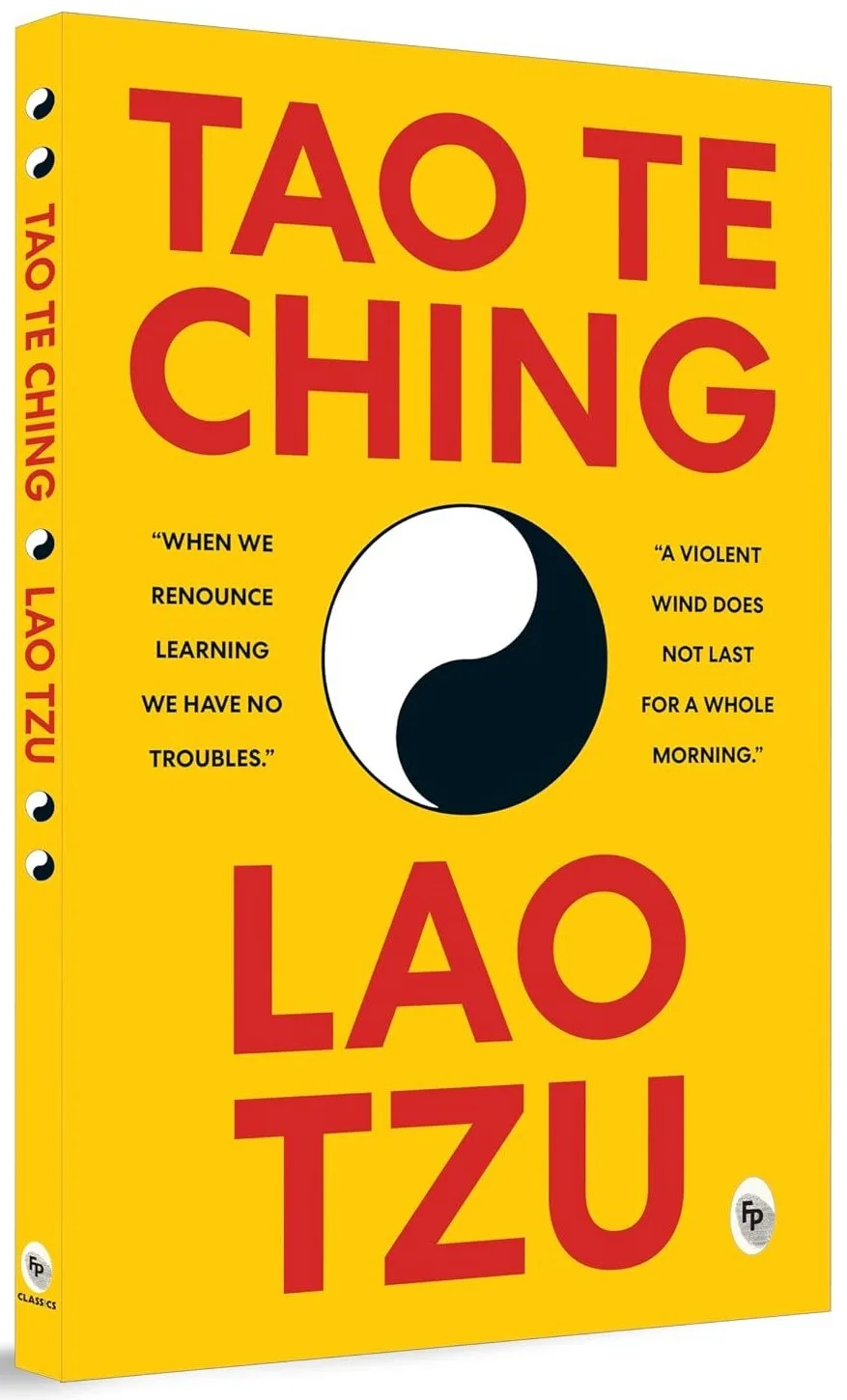
Tao Te Ching
Paperback
• 116 Pages
• ₹ 419.00
• English
• 9789386538185
No ratings yet
| Publisher | Fingerprint! Publishing |
|---|---|
| ISBN13 | 9789386538185 |
| ASIN/SKU | 9386538180 |
| Book Format | Paperback |
| Language | English |
| Pages | 116 |
| List Price | ₹ 419.00 |
| Publishing Date | 06/11/2017 |
| Dimensions | 19.5 x 12.5 x 1 cm |
| Weight | 120 g |
| Book Code | BD00070757 |
Buy this Book
Amazon Stores
Ebook Stores
Other Stores
Discover Tao Te Ching by Lao Tzu. This book is published by Fingerprint! Publishing in Paperback format, ISBN 9789386538185, ASIN 9386538180, under Religion and Spirituality, Mysticism.
Book Description
Tao Te Ching by Lao Tzu is a profound philosophical guide that explores the principles of Taoism and the art of living in harmony with the natural flow of existence. Discover ancient wisdom and timeless insights in this influential classic.
Ancient wisdom for a world in search of peace.
Embark on a journey of self-discovery and inner wisdom.
Explore the profound teachings of Taoism and the concept of “The Way.”
Gain insights into living a balanced and fulfilling life.
Reflect on the nature of existence, simplicity, and the power of non-action.
This edition offers a faithful translation of Lao Tzu's timeless masterpiece, providing a valuable resource for those seeking spiritual enlightenment and philosophical guidance.
Ancient wisdom for a world in search of peace.
Embark on a journey of self-discovery and inner wisdom.
Explore the profound teachings of Taoism and the concept of “The Way.”
Gain insights into living a balanced and fulfilling life.
Reflect on the nature of existence, simplicity, and the power of non-action.
This edition offers a faithful translation of Lao Tzu's timeless masterpiece, providing a valuable resource for those seeking spiritual enlightenment and philosophical guidance.
Author Biography
The traditional founder of Taoism, one of the three great religious and philosophical traditions originated in China, Lao Tzu (meaning “Old Master”) was a mystic Chinese philosopher and writer who lived during the Eastern Zhou Dynasty. Though the historical authenticity of Lao Tzu is not certain, according to tradition, he is believed to have been a slightly older contemporary of Confucius. He is reckoned a scholar who worked as a record keeper in the court of Zhou in the 6th century B.C. and is best known as the author of Tao Te Ching, a fundamental text of Taoism.
Translated roughly as “the way of integrity,” Tao Te Ching contains political advice for rulers; lessons on leading a balanced life; guidance on self-knowledge, peace, humility, virtue, morality; and common wisdom. Written more than two thousand years ago, this treatise is one of the most translated works of world literature. Its ancient wisdom still stands relevant in modern times.
Translated roughly as “the way of integrity,” Tao Te Ching contains political advice for rulers; lessons on leading a balanced life; guidance on self-knowledge, peace, humility, virtue, morality; and common wisdom. Written more than two thousand years ago, this treatise is one of the most translated works of world literature. Its ancient wisdom still stands relevant in modern times.
Editorial Reviews
Editorial Reviews will be added soon…
Book Summary
Tao Te Ching, traditionally attributed to Lao Tzu, is one of the foundational texts of Taoism and one of the most influential works of Chinese philosophy. Short in length but immense in meaning, the book consists of eighty-one brief chapters that explore the nature of the Tao, the character of a wise person, the dangers of excessive ambition, the relationship between humanity and nature, and the art of living with simplicity, humility, and inner balance. Rather than presenting a rigid system of beliefs, Tao Te Ching offers a way of seeing life. Its central invitation is to stop fighting the natural movement of existence and learn to live in harmony with it.
The word Tao can be translated as “the Way,” although no single English word fully captures its meaning. In Lao Tzu's philosophy, the Tao is not simply a road, a god, or a set of rules. It is the mysterious underlying principle through which everything exists and changes. It is the source from which the universe emerges and the process through which all things unfold. The opening chapter immediately warns that the ultimate Tao cannot be completely captured by language. The moment we try to define the deepest reality, we have already reduced something limitless into a limited concept. This establishes the tone of the entire book: Tao Te Ching does not attempt to give final answers to every question. Instead, it teaches the reader to become comfortable with mystery.
One of the most important ideas in the book is that reality does not always need to be forced. Human beings often believe that progress requires constant effort, control, competition, and interference. Lao Tzu questions this assumption. He introduces the principle of wu wei, often translated as “non-action” or “effortless action.” It does not mean laziness, passivity, or doing absolutely nothing. Rather, it means acting without unnecessary force—responding appropriately to circumstances instead of constantly trying to impose one's will upon them.
A useful image for understanding this principle is water. Water is soft, flexible, and apparently weak, yet over time it can reshape stone and carve valleys. It does not fight the landscape directly. It flows around obstacles and follows the natural contours of the earth. Lao Tzu repeatedly uses water as a model for the wise person. The truly strong person does not always need to appear powerful. The truly capable person does not constantly advertise capability. The person who understands the Tao learns to be flexible rather than rigid.
This idea challenges conventional definitions of strength. Society often associates strength with dominance, aggression, wealth, status, and the ability to control others. Lao Tzu presents another form of strength: the ability to remain soft without becoming weak, humble without becoming insignificant, and calm without becoming passive. What appears gentle can endure precisely because it does not exhaust itself through unnecessary resistance.
The Tao Te Ching also places enormous importance on simplicity. Lao Tzu sees excessive desire as one of the major sources of human dissatisfaction. People constantly compare themselves with others, accumulate possessions, seek recognition, and pursue greater status. Each achievement can create another desire. The person who obtains wealth wants more wealth; the person who gains authority wants greater authority; the person who receives praise becomes afraid of losing it. Desire therefore creates a cycle in which satisfaction remains temporary.
Lao Tzu does not suggest that every human desire is evil. Instead, he encourages a return to what is essential. When unnecessary desires are reduced, the mind becomes quieter. When the mind becomes quieter, perception becomes clearer. A person no longer needs to chase every opportunity, answer every insult, or prove every point. Life becomes less complicated.
This emphasis on simplicity is closely connected with the concept of emptiness. One of the most memorable ideas in the book is that an object is useful not only because of what it contains but also because of the empty space within it. A cup is useful because it has an empty interior. A room is useful because there is space inside it. A wheel functions because of the empty center around which its spokes are arranged. Lao Tzu uses such images to show that absence can be as important as presence.
This principle extends into human life. Silence can be meaningful. Not knowing can create openness. Stepping back can make room for understanding. A leader who does not constantly interfere may allow people to flourish. A person who does not fill every moment with activity may discover something deeper within themselves.
Lao Tzu's understanding of leadership is especially striking. The ideal ruler does not dominate the population through excessive laws, punishment, propaganda, or personal glory. Instead, the ruler governs with restraint and wisdom. The best leadership is so subtle that when the work is accomplished, people feel that they themselves achieved it. This reflects the larger Taoist idea that the most effective action often appears effortless.
The political chapters of Tao Te Ching are therefore not simply about ancient Chinese government. They raise a broader question about power: what happens when those who possess power become obsessed with exercising it? Lao Tzu suggests that excessive control often produces resistance. When authorities interfere with every aspect of life, people become frustrated and deceptive. When leaders create endless rules, people may learn to manipulate those rules. When rulers seek glory, they may destabilize the very society they claim to protect.
For Lao Tzu, good leadership begins with humility. The wise leader does not place himself above the people. Instead, he serves them. This is one of the paradoxes running throughout the book: the person who wants to become great should not constantly seek greatness. The person who puts others first may eventually gain their trust. The person who does not insist upon recognition may become genuinely respected.
The book's treatment of knowledge is equally subtle. Lao Tzu does not reject learning, but he distinguishes between intellectual accumulation and genuine wisdom. A person can possess enormous amounts of information and still misunderstand life. Knowledge can become another form of pride when people use it to prove their superiority. True wisdom, by contrast, involves seeing the limits of one's knowledge.
This is why the sage is often portrayed as quiet, humble, receptive, and willing to remain uncertain. The wise person does not need to have an opinion about everything. There is strength in listening. There is intelligence in waiting. There is wisdom in recognizing when action is necessary and when action would only make matters worse.
Another central theme is the unity of opposites. Lao Tzu repeatedly shows how apparently opposite qualities depend upon one another. We recognize beauty because ugliness exists. We understand high because there is low. Strength and weakness, presence and absence, beginning and ending, difficulty and ease are interconnected.
This is not simply a philosophical game. It changes how one understands life. Success contains the possibility of failure. Victory can create the conditions for future defeat. Wealth can generate anxiety. Power can produce vulnerability. Conversely, hardship can develop patience, and weakness can reveal hidden forms of strength. The wise person therefore does not cling rigidly to one side of an apparent contradiction.
The Taoist sage learns to move with change rather than demanding permanence. Everything in nature is constantly transforming. Seasons change, plants grow and decay, rivers move, human beings are born and eventually die. Suffering often arises because people want temporary things to remain permanent. We want youth to remain, relationships to remain unchanged, success to remain, and circumstances to remain under our control.
Lao Tzu's response is not despair but acceptance. Change is not an error in the design of existence. Change is existence. To live according to the Tao is therefore to accept movement rather than endlessly resisting it.
The book's reflections on humility are particularly beautiful. Lao Tzu repeatedly returns to images of valleys, low places, water, and yielding. Water naturally flows downward. A valley becomes a place where streams gather. What remains low can become the place where everything else comes together.
Human beings, however, often want to rise above others. We want to be admired, superior, powerful, and visible. Lao Tzu suggests that this constant upward struggle can separate us from the natural order. Humility, by contrast, allows us to remain connected with life.
The Tao Te Ching also offers a distinctive approach to conflict. When people respond to aggression with greater aggression, violence can multiply. The wise person does not seek conflict, but neither does wisdom necessarily mean surrendering to injustice. Instead, Lao Tzu emphasizes restraint, proportion, and the recognition that force carries consequences.
The strongest response is often the one that prevents a conflict from becoming larger. Once conflict becomes an arena for ego, winning may become more important than solving the original problem. Lao Tzu therefore encourages the individual to release the desire to dominate.
The second half of the book explores Te, commonly translated as “virtue,” “integrity,” or “inner power.” Te is not virtue in the narrow sense of following externally imposed moral rules. It refers more deeply to the quality of a person who lives in harmony with the Tao. Such a person does not need to constantly display goodness. Their character becomes natural rather than performative.
This distinction is important. Someone may behave morally because they want praise, reward, or social approval. Another person may act compassionately because compassion has become part of their nature. Lao Tzu values the latter. When goodness is genuine, it does not need to announce itself.
The Tao Te Ching therefore repeatedly encourages the reader to return to the natural, the simple, and the authentic. Human beings often complicate what is already sufficient. We create elaborate ambitions, identities, social expectations, and personal narratives, then become trapped inside them. Lao Tzu asks us to strip away what is unnecessary.
This does not mean abandoning ordinary life. The Taoist ideal is not necessarily an isolated hermit. One can live in a family, community, profession, or political society while practicing Taoist principles. The transformation happens in one's relationship with life. Instead of constantly asking, “How can I control everything?” one begins asking, “What is this situation asking of me?” Instead of forcing every outcome, one learns when to act and when to allow.
The final chapters reinforce the book's central paradoxes. The greatest achievement may come through restraint. The greatest strength may appear as gentleness. The deepest knowledge may involve admitting what we do not know. The person who gives may receive. The person who does not compete may become difficult to defeat.
Perhaps the most enduring message of Tao Te Ching is that life does not always have to be conquered. Much of human suffering comes from turning existence into a continuous battle—against other people, against circumstances, against aging, against uncertainty, and even against ourselves. Lao Tzu proposes another possibility: cooperation with the movement of reality.
The book teaches that simplicity is not emptiness in the negative sense. It is freedom from unnecessary complication. Humility is not weakness. It is freedom from the exhausting need to prove oneself. Non-action is not laziness. It is action without unnecessary force. Detachment is not lack of love. It is the ability to care without trying to possess or control everything.
In this sense, Tao Te Ching remains deeply human. It understands that people want security, recognition, love, success, and control. It does not condemn these impulses harshly. Instead, it gently asks whether these pursuits actually provide the peace we expect from them. Again and again, Lao Tzu directs the reader away from accumulation and toward awareness.
Ultimately, Tao Te Ching is less a book that tells us what to believe than a book that teaches us how to look. It invites us to observe nature, our desires, our conflicts, our ambitions, and our fears with greater patience. It asks us to notice how often we create resistance where none is necessary. And it suggests that beneath the noise of constant striving there is another way of living—quieter, simpler, more flexible, and more deeply connected with the natural movement of life.
The wisdom of Lao Tzu can therefore be summarized in a deceptively simple movement: less forcing, more allowing; less ego, more humility; less excess, more simplicity; less control, more harmony. The Tao is not something one conquers or possesses. It is something one learns to recognize and follow. For anyone struggling with excessive ambition, anxiety, conflict, attachment, or the pressure to control every outcome, Tao Te Ching offers a gentle reminder that sometimes the wisest thing a person can do is stop pushing against the river and learn how to move with its current.
The word Tao can be translated as “the Way,” although no single English word fully captures its meaning. In Lao Tzu's philosophy, the Tao is not simply a road, a god, or a set of rules. It is the mysterious underlying principle through which everything exists and changes. It is the source from which the universe emerges and the process through which all things unfold. The opening chapter immediately warns that the ultimate Tao cannot be completely captured by language. The moment we try to define the deepest reality, we have already reduced something limitless into a limited concept. This establishes the tone of the entire book: Tao Te Ching does not attempt to give final answers to every question. Instead, it teaches the reader to become comfortable with mystery.
One of the most important ideas in the book is that reality does not always need to be forced. Human beings often believe that progress requires constant effort, control, competition, and interference. Lao Tzu questions this assumption. He introduces the principle of wu wei, often translated as “non-action” or “effortless action.” It does not mean laziness, passivity, or doing absolutely nothing. Rather, it means acting without unnecessary force—responding appropriately to circumstances instead of constantly trying to impose one's will upon them.
A useful image for understanding this principle is water. Water is soft, flexible, and apparently weak, yet over time it can reshape stone and carve valleys. It does not fight the landscape directly. It flows around obstacles and follows the natural contours of the earth. Lao Tzu repeatedly uses water as a model for the wise person. The truly strong person does not always need to appear powerful. The truly capable person does not constantly advertise capability. The person who understands the Tao learns to be flexible rather than rigid.
This idea challenges conventional definitions of strength. Society often associates strength with dominance, aggression, wealth, status, and the ability to control others. Lao Tzu presents another form of strength: the ability to remain soft without becoming weak, humble without becoming insignificant, and calm without becoming passive. What appears gentle can endure precisely because it does not exhaust itself through unnecessary resistance.
The Tao Te Ching also places enormous importance on simplicity. Lao Tzu sees excessive desire as one of the major sources of human dissatisfaction. People constantly compare themselves with others, accumulate possessions, seek recognition, and pursue greater status. Each achievement can create another desire. The person who obtains wealth wants more wealth; the person who gains authority wants greater authority; the person who receives praise becomes afraid of losing it. Desire therefore creates a cycle in which satisfaction remains temporary.
Lao Tzu does not suggest that every human desire is evil. Instead, he encourages a return to what is essential. When unnecessary desires are reduced, the mind becomes quieter. When the mind becomes quieter, perception becomes clearer. A person no longer needs to chase every opportunity, answer every insult, or prove every point. Life becomes less complicated.
This emphasis on simplicity is closely connected with the concept of emptiness. One of the most memorable ideas in the book is that an object is useful not only because of what it contains but also because of the empty space within it. A cup is useful because it has an empty interior. A room is useful because there is space inside it. A wheel functions because of the empty center around which its spokes are arranged. Lao Tzu uses such images to show that absence can be as important as presence.
This principle extends into human life. Silence can be meaningful. Not knowing can create openness. Stepping back can make room for understanding. A leader who does not constantly interfere may allow people to flourish. A person who does not fill every moment with activity may discover something deeper within themselves.
Lao Tzu's understanding of leadership is especially striking. The ideal ruler does not dominate the population through excessive laws, punishment, propaganda, or personal glory. Instead, the ruler governs with restraint and wisdom. The best leadership is so subtle that when the work is accomplished, people feel that they themselves achieved it. This reflects the larger Taoist idea that the most effective action often appears effortless.
The political chapters of Tao Te Ching are therefore not simply about ancient Chinese government. They raise a broader question about power: what happens when those who possess power become obsessed with exercising it? Lao Tzu suggests that excessive control often produces resistance. When authorities interfere with every aspect of life, people become frustrated and deceptive. When leaders create endless rules, people may learn to manipulate those rules. When rulers seek glory, they may destabilize the very society they claim to protect.
For Lao Tzu, good leadership begins with humility. The wise leader does not place himself above the people. Instead, he serves them. This is one of the paradoxes running throughout the book: the person who wants to become great should not constantly seek greatness. The person who puts others first may eventually gain their trust. The person who does not insist upon recognition may become genuinely respected.
The book's treatment of knowledge is equally subtle. Lao Tzu does not reject learning, but he distinguishes between intellectual accumulation and genuine wisdom. A person can possess enormous amounts of information and still misunderstand life. Knowledge can become another form of pride when people use it to prove their superiority. True wisdom, by contrast, involves seeing the limits of one's knowledge.
This is why the sage is often portrayed as quiet, humble, receptive, and willing to remain uncertain. The wise person does not need to have an opinion about everything. There is strength in listening. There is intelligence in waiting. There is wisdom in recognizing when action is necessary and when action would only make matters worse.
Another central theme is the unity of opposites. Lao Tzu repeatedly shows how apparently opposite qualities depend upon one another. We recognize beauty because ugliness exists. We understand high because there is low. Strength and weakness, presence and absence, beginning and ending, difficulty and ease are interconnected.
This is not simply a philosophical game. It changes how one understands life. Success contains the possibility of failure. Victory can create the conditions for future defeat. Wealth can generate anxiety. Power can produce vulnerability. Conversely, hardship can develop patience, and weakness can reveal hidden forms of strength. The wise person therefore does not cling rigidly to one side of an apparent contradiction.
The Taoist sage learns to move with change rather than demanding permanence. Everything in nature is constantly transforming. Seasons change, plants grow and decay, rivers move, human beings are born and eventually die. Suffering often arises because people want temporary things to remain permanent. We want youth to remain, relationships to remain unchanged, success to remain, and circumstances to remain under our control.
Lao Tzu's response is not despair but acceptance. Change is not an error in the design of existence. Change is existence. To live according to the Tao is therefore to accept movement rather than endlessly resisting it.
The book's reflections on humility are particularly beautiful. Lao Tzu repeatedly returns to images of valleys, low places, water, and yielding. Water naturally flows downward. A valley becomes a place where streams gather. What remains low can become the place where everything else comes together.
Human beings, however, often want to rise above others. We want to be admired, superior, powerful, and visible. Lao Tzu suggests that this constant upward struggle can separate us from the natural order. Humility, by contrast, allows us to remain connected with life.
The Tao Te Ching also offers a distinctive approach to conflict. When people respond to aggression with greater aggression, violence can multiply. The wise person does not seek conflict, but neither does wisdom necessarily mean surrendering to injustice. Instead, Lao Tzu emphasizes restraint, proportion, and the recognition that force carries consequences.
The strongest response is often the one that prevents a conflict from becoming larger. Once conflict becomes an arena for ego, winning may become more important than solving the original problem. Lao Tzu therefore encourages the individual to release the desire to dominate.
The second half of the book explores Te, commonly translated as “virtue,” “integrity,” or “inner power.” Te is not virtue in the narrow sense of following externally imposed moral rules. It refers more deeply to the quality of a person who lives in harmony with the Tao. Such a person does not need to constantly display goodness. Their character becomes natural rather than performative.
This distinction is important. Someone may behave morally because they want praise, reward, or social approval. Another person may act compassionately because compassion has become part of their nature. Lao Tzu values the latter. When goodness is genuine, it does not need to announce itself.
The Tao Te Ching therefore repeatedly encourages the reader to return to the natural, the simple, and the authentic. Human beings often complicate what is already sufficient. We create elaborate ambitions, identities, social expectations, and personal narratives, then become trapped inside them. Lao Tzu asks us to strip away what is unnecessary.
This does not mean abandoning ordinary life. The Taoist ideal is not necessarily an isolated hermit. One can live in a family, community, profession, or political society while practicing Taoist principles. The transformation happens in one's relationship with life. Instead of constantly asking, “How can I control everything?” one begins asking, “What is this situation asking of me?” Instead of forcing every outcome, one learns when to act and when to allow.
The final chapters reinforce the book's central paradoxes. The greatest achievement may come through restraint. The greatest strength may appear as gentleness. The deepest knowledge may involve admitting what we do not know. The person who gives may receive. The person who does not compete may become difficult to defeat.
Perhaps the most enduring message of Tao Te Ching is that life does not always have to be conquered. Much of human suffering comes from turning existence into a continuous battle—against other people, against circumstances, against aging, against uncertainty, and even against ourselves. Lao Tzu proposes another possibility: cooperation with the movement of reality.
The book teaches that simplicity is not emptiness in the negative sense. It is freedom from unnecessary complication. Humility is not weakness. It is freedom from the exhausting need to prove oneself. Non-action is not laziness. It is action without unnecessary force. Detachment is not lack of love. It is the ability to care without trying to possess or control everything.
In this sense, Tao Te Ching remains deeply human. It understands that people want security, recognition, love, success, and control. It does not condemn these impulses harshly. Instead, it gently asks whether these pursuits actually provide the peace we expect from them. Again and again, Lao Tzu directs the reader away from accumulation and toward awareness.
Ultimately, Tao Te Ching is less a book that tells us what to believe than a book that teaches us how to look. It invites us to observe nature, our desires, our conflicts, our ambitions, and our fears with greater patience. It asks us to notice how often we create resistance where none is necessary. And it suggests that beneath the noise of constant striving there is another way of living—quieter, simpler, more flexible, and more deeply connected with the natural movement of life.
The wisdom of Lao Tzu can therefore be summarized in a deceptively simple movement: less forcing, more allowing; less ego, more humility; less excess, more simplicity; less control, more harmony. The Tao is not something one conquers or possesses. It is something one learns to recognize and follow. For anyone struggling with excessive ambition, anxiety, conflict, attachment, or the pressure to control every outcome, Tao Te Ching offers a gentle reminder that sometimes the wisest thing a person can do is stop pushing against the river and learn how to move with its current.
Sample Chapters
Sample Chapters will be added soon…
Reader Reviews
No reviews yet.
Tao Te Ching