
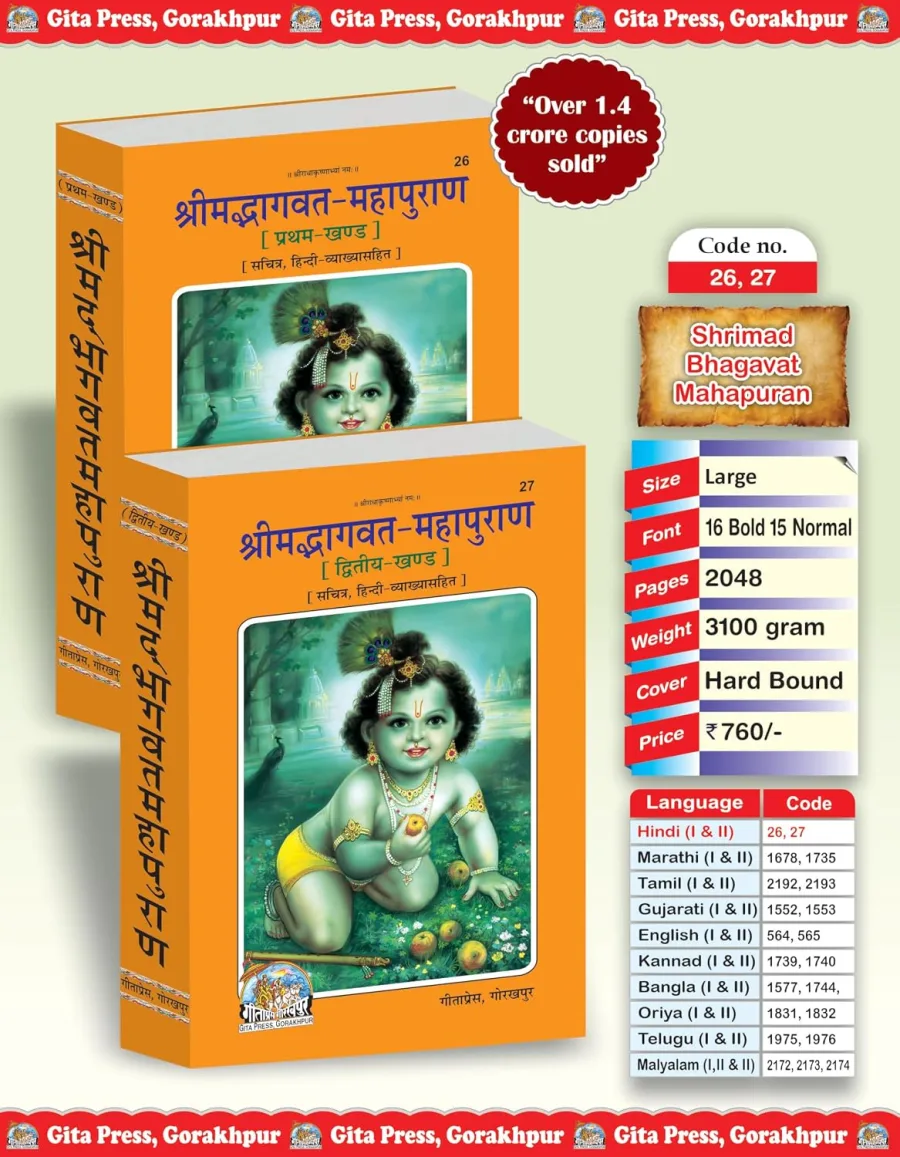
Shrimad Bhagwat Mahapuran Complete Set – (Part 1 & 2) | Gita Press, Gorakhpur
Hardcover
• 2048 Pages
• ₹ 880.00
• Hindi
• 9789369947515
No ratings yet
| Publisher | Gita Press, Gorakhpur |
|---|---|
| ISBN13 | 9789369947515 |
| ASIN/SKU | B0BGWXNLNV |
| Book Format | Hardcover |
| Language | Hindi |
| Pages | 2048 |
| List Price | ₹ 880.00 |
| Publishing Date | 06/07/2022 |
| Dimensions | 27 x 18.5 x 10 cm |
| Weight | 3 kg 400 g |
| Book Code | BD00070756 |
Buy this Book
Amazon Stores
Ebook Stores
Other Stores
Discover Shrimad Bhagwat Mahapuran Complete Set – (Part 1 and 2) | Gita Press, Gorakhpur by Gorakhpur Gita Press. This book is published by Gita Press, Gorakhpur in Hardcover format, ISBN 9789369947515, ASIN B0BGWXNLNV, under Religion and Spirituality, History of Religion, Hinduism.
Book Description
Shrimad Bhagavata Mahapurana — the complete two-volume Hindi set: Vedavyasa's final work, all 12 Skandhas, 335 chapters, 18,000 shlokas — the most beloved devotional scripture in Indian history, from creation narrative through the complete life of Lord Krishna.
The Bhagavata opens with an extraordinary scene: Shukadeva Goswami, already liberated, is asked by the dying King Parikshita what is the best use of the seven days remaining to him. Shukadeva's answer — seven days of Bhagavata Katha — sets up the entire scripture as a response to the most fundamental human question: how to die well, and therefore how to live well. What follows across 12 Skandhas is the most complete philosophical and devotional library ever assembled in a single text: the Sankhya-Yoga of Kapila Muni (3rd Skandha), the extraordinary devotional narratives of Dhruva, Prahlada, and Gajendra, and the 4,000-shloka Dashama Skandha that narrates Krishna's complete life.
Vol. 1 covers Skandhas 1–6. Vol. 2 covers Skandhas 7–12, including the complete Dashama Skandha and Uddhava Gita. Over 11 lakh copies across 120 editions reflect sustained devotee demand built by word of mouth, not advertising.
Vol. 1 (Skandhas 1–6): Creation, Narada's teaching, Kapila's Sankhya, Dhruva, Prahlada, Gajendra
Vol. 2 (Skandhas 7–12): Complete Dashama Skandha (Krishna's life), Uddhava Gita, Kali Yuga signs
Sanskrit shlokas with Hindi translation throughout
For: Bhagavata Saptaha reading, Janmashtami, systematic Purana study
The complete Bhagavata — nothing condensed or removed
इस संस्करण के बारे में
श्रीमद्भागवत महापुराण — महर्षि वेदव्यास की सर्वश्रेष्ठ रचना, जिसे 'निगम-कल्प-तरोर्गलितं फलम्' अर्थात् वेद-रूपी कल्पवृक्ष का पका हुआ फल कहा गया है। इसके 12 स्कन्धों, 335 अध्यायों और 18,000 श्लोकों में सृष्टि-रचना से लेकर श्रीकृष्ण की सम्पूर्ण लीला-कथा (दशम स्कन्ध) और उद्धव-गीता (एकादश स्कन्ध) तक — भक्ति-दर्शन का सम्पूर्ण विश्वकोश है। इस संस्करण में मूल संस्कृत पाठ, प्रवाहमय हिन्दी अनुवाद और पारम्परिक चित्रों के साथ समस्त स्कन्धों का विशद विवेचन उपलब्ध है। भागवत-सप्ताह, जन्माष्टमी और परिवार के नित्य स्वाध्याय के लिये यह अनिवार्य ग्रन्थ है।
The Bhagavata opens with an extraordinary scene: Shukadeva Goswami, already liberated, is asked by the dying King Parikshita what is the best use of the seven days remaining to him. Shukadeva's answer — seven days of Bhagavata Katha — sets up the entire scripture as a response to the most fundamental human question: how to die well, and therefore how to live well. What follows across 12 Skandhas is the most complete philosophical and devotional library ever assembled in a single text: the Sankhya-Yoga of Kapila Muni (3rd Skandha), the extraordinary devotional narratives of Dhruva, Prahlada, and Gajendra, and the 4,000-shloka Dashama Skandha that narrates Krishna's complete life.
Vol. 1 covers Skandhas 1–6. Vol. 2 covers Skandhas 7–12, including the complete Dashama Skandha and Uddhava Gita. Over 11 lakh copies across 120 editions reflect sustained devotee demand built by word of mouth, not advertising.
Vol. 1 (Skandhas 1–6): Creation, Narada's teaching, Kapila's Sankhya, Dhruva, Prahlada, Gajendra
Vol. 2 (Skandhas 7–12): Complete Dashama Skandha (Krishna's life), Uddhava Gita, Kali Yuga signs
Sanskrit shlokas with Hindi translation throughout
For: Bhagavata Saptaha reading, Janmashtami, systematic Purana study
The complete Bhagavata — nothing condensed or removed
इस संस्करण के बारे में
श्रीमद्भागवत महापुराण — महर्षि वेदव्यास की सर्वश्रेष्ठ रचना, जिसे 'निगम-कल्प-तरोर्गलितं फलम्' अर्थात् वेद-रूपी कल्पवृक्ष का पका हुआ फल कहा गया है। इसके 12 स्कन्धों, 335 अध्यायों और 18,000 श्लोकों में सृष्टि-रचना से लेकर श्रीकृष्ण की सम्पूर्ण लीला-कथा (दशम स्कन्ध) और उद्धव-गीता (एकादश स्कन्ध) तक — भक्ति-दर्शन का सम्पूर्ण विश्वकोश है। इस संस्करण में मूल संस्कृत पाठ, प्रवाहमय हिन्दी अनुवाद और पारम्परिक चित्रों के साथ समस्त स्कन्धों का विशद विवेचन उपलब्ध है। भागवत-सप्ताह, जन्माष्टमी और परिवार के नित्य स्वाध्याय के लिये यह अनिवार्य ग्रन्थ है।
Author Biography
Gita Press, Gorakhpur, established in 1923 under Gobind Bhawan Karyalaya, is one of the world's largest publishers of Hindu religious literature. For over a century it has published the Ramcharitmanas, the Bhagavad Gita, the Puranas, the Upanishads and thousands of devotional works in Hindi, Sanskrit and India's regional languages, guided by a not-for-profit mission to bring sacred texts into every home at the most affordable price. Its editions are valued for their textual accuracy, clear typesetting and durable, economical production.
Editorial Reviews
About this edition: A faithful Gita Press, Gorakhpur edition of Srimad Bhagavat Mahapurana Part-1 of 2. It presents this Purana in Gita Press's trusted edition, preserving the sacred narratives, hymns and teachings in accessible form. Set in Hindi with the clear, accurate typesetting Gita Press is known for, printed on durable paper and produced for daily study and worship.
Book Summary
Shrimad Bhagwat Mahapuran, traditionally attributed to Maharishi Ved Vyasa, is one of the eighteen Mahapuranas and one of the most influential devotional scriptures of Hindu tradition. The complete work is arranged into twelve Skandhas and is traditionally associated with approximately 18,000 verses. The Gita Press, Gorakhpur edition presents this vast spiritual text in a form intended for sustained reading, study, recitation, and devotional practice. Gita Press currently publishes the Hindi complete set in two parts, while other editions are available with Sanskrit text and translations. Gita Press
At its heart, the Bhagwat Mahapuran is a book about the human search for something lasting in a world where everything changes. It speaks about creation and destruction, kings and sages, gods and demons, families and kingdoms, birth and death, knowledge and ignorance, attachment and freedom. Yet beneath all these stories lies one central teaching: the deepest fulfillment of human life comes through loving remembrance and devotion to the Supreme, especially in the form of Lord Krishna. The work does not present devotion merely as a ritual or religious obligation. It presents bhakti as a way of transforming the heart.
The story begins in a remarkable setting. King Parikshit, the grandson of Arjuna and descendant of the Pandavas, has been cursed to die within seven days. Instead of spending his final days trying desperately to escape death, he withdraws from worldly concerns and sits on the banks of the Ganga to seek spiritual knowledge. Great sages gather around him, and among them arrives Shukadeva, the young son of Ved Vyasa. Parikshit asks the most fundamental question a human being can ask: what should a person do when death is approaching? Shukadeva's response becomes the narration of the Bhagwat Mahapuran. The complete work therefore emerges from a conversation about death, but its real subject is how one should live. Desertcart
The opening Skandha establishes the spiritual atmosphere of the entire scripture. It describes the gathering of sages, the greatness of hearing sacred stories, and the circumstances that led Parikshit to his final days. The text repeatedly emphasizes shravan—the attentive hearing of divine narratives—as a powerful spiritual practice. This is important because the Bhagwat does not imagine spiritual life as something available only to scholars, philosophers, or ascetics. A person can begin simply by listening with sincerity.
The first Skandha also introduces the great sage Narada and his meeting with Ved Vyasa. Vyasa has compiled enormous bodies of spiritual knowledge, yet he remains inwardly dissatisfied. Narada explains that although Vyasa has spoken extensively about duty, knowledge, and religious principles, he has not sufficiently glorified the loving devotion to Bhagavan that directly touches the heart. This insight becomes one of the foundations of the Bhagwat's purpose. Knowledge without transformation of the heart is incomplete; religious activity without devotion can become mechanical; and worldly achievement cannot provide permanent satisfaction.
The Second Skandha moves more deeply into cosmology and spiritual contemplation. Shukadeva explains different ways of meditating upon the Supreme and describes the cosmic form of God. The universe itself becomes an object of contemplation. Mountains, oceans, planets, living beings, time, and the forces of nature are presented as expressions within the greater reality. Yet the text gradually guides the reader from the visible universe toward the inner spiritual reality beyond it.
The Third Skandha expands these themes through the dialogue of Vidura and the sage Maitreya. Here the Bhagwat explores creation, the nature of matter, the individual soul, divine manifestation, and the relationship between the Supreme and the material world. One of its most important philosophical sections is the teaching of Kapila, who explains spiritual discrimination and the nature of consciousness. Kapila's teachings emphasize that human suffering is closely connected with identification with material nature. The soul becomes entangled in temporary identities and desires, while liberation comes through genuine knowledge, disciplined awareness, and devotion.
The Fourth Skandha turns philosophy into memorable human stories. Among its most beloved narratives is the story of Dhruva. Dhruva is a young prince who experiences rejection and humiliation and becomes determined to obtain a position that cannot be taken away from him. He enters the forest and performs intense spiritual practice. But when he finally receives the vision of the Lord, his desires change. What he originally wanted no longer seems important compared with the divine presence he has encountered. Dhruva's story therefore illustrates a profound psychological truth: when the heart discovers something greater, many of its earlier ambitions naturally lose their power.
The story of King Prithu and the account of Daksha's sacrifice further explore the dangers of pride, anger, social conflict, and attachment to status. The Bhagwat repeatedly shows that spiritual failure does not necessarily arise from ignorance alone. Even learned and powerful people can become trapped by ego. The remedy is humility and remembrance of the Supreme.
The Fifth Skandha broadens the narrative into descriptions of the universe, geography, cosmic time, and different realms of existence. Some of these passages can feel very different from a modern scientific description of the cosmos, but their purpose within the Purana is not simply geographical or astronomical. They create a vision of existence in which human life is one small part of an immense cosmic order. The reader is repeatedly reminded that worldly status is temporary and that consciousness must eventually turn toward a deeper purpose.
The Sixth Skandha contains one of the Bhagwat's most emotionally powerful stories: the story of Ajamila. Ajamila begins life as a virtuous person but gradually falls into destructive habits. At the moment of death, frightened and helpless, he calls out the name of his son, Narayana. Because the name is also the divine name of the Lord, the story develops into a profound reflection on the power of God's name and the possibility of spiritual transformation.
The story does not simply suggest that a person can deliberately live wrongly and then escape all consequences by uttering a name at the last moment. Rather, it emphasizes the mysterious power of divine remembrance and the possibility that grace can reach a person even after a long period of spiritual decline. Ajamila's subsequent awakening is crucial: he recognizes the wasted years of his life and turns sincerely toward spiritual practice.
The Seventh Skandha introduces perhaps the most famous devotee in the entire Purana—Prahlada. Born into the family of the demon king Hiranyakashipu, Prahlada remains devoted to Vishnu despite his father's hatred of Vishnu. Hiranyakashipu uses power, intimidation, and violence to force his son to abandon his faith, but Prahlada remains calm.
Prahlada's story presents devotion as an inner freedom that cannot easily be destroyed by external circumstances. He does not answer hatred with hatred. His strength comes from his awareness that God is present everywhere. The famous appearance of Narasimha, the man-lion incarnation of Vishnu, brings the story to its dramatic conclusion. Yet the deeper message is not merely the destruction of a demon. It is the destruction of arrogance—the belief that worldly power can make one independent of the ultimate reality.
The Eighth Skandha continues with stories involving cosmic struggles, divine intervention, and the relationship between the gods, demons, and Supreme Lord. The story of Gajendra, the elephant king, is especially moving. Trapped by a crocodile and unable to save himself through physical strength, Gajendra finally turns toward the Supreme with complete surrender. His prayer expresses one of the Bhagwat's central ideas: when the limited powers of the individual are exhausted, surrender can become the doorway to divine grace.
The Ninth Skandha focuses largely on dynasties and royal histories, preparing the narrative ground for the appearance of Krishna. Stories of kings and sages demonstrate the rise and fall of generations. Even powerful rulers eventually disappear. This reinforces one of the Purana's recurring lessons: no worldly achievement is permanent. The only enduring treasure is spiritual realization.
The Tenth Skandha is the emotional and devotional heart of the entire Bhagwat Mahapuran. It tells the life and divine play of Sri Krishna, from his miraculous birth to his childhood in Gokula and Vrindavan, his youth, his relationships with the cowherds and gopis, his confrontation with Kamsa, and his later life as a central figure in the wider political and spiritual drama of his age. The Gita Press edition of the complete Bhagwat includes this entire narrative as part of the twelve-Skandha work. Brij Bhoomi
The childhood episodes of Krishna are among the most beloved stories in Indian devotional culture. Krishna stealing butter, playing with the cowherd boys, teasing the gopis, dancing on the serpent Kaliya, lifting Govardhan Hill, and enchanting the people of Vrindavan are not presented merely as entertaining mythology. They express a distinctive vision of the divine: God is not only distant, majestic, and frightening. God can also be intimate, playful, lovable, and accessible.
The Govardhan episode illustrates this beautifully. Krishna encourages the people of Vrindavan to place their trust in the divine rather than in fear-based ritualism. When torrential rain threatens the community, Krishna lifts Govardhan Hill and shelters everyone beneath it. The image is powerful because the divine becomes the protector of ordinary people—their families, animals, homes, and simple lives.
The Rasa Lila is among the most profound and frequently discussed portions of the Tenth Skandha. Its language of love is intensely devotional, portraying the gopis' longing for Krishna as a symbol of the soul's longing for the Supreme. The Bhagwat transforms ordinary ideas of attachment into a spiritual metaphor: the deepest desire of the heart is ultimately a desire for union with the divine. This section has profoundly influenced Indian devotional poetry, music, dance, painting, and theology.
Krishna's departure from Vrindavan introduces another dimension of love. The devotees experience separation from him, and their longing becomes itself a form of remembrance. The Bhagwat thereby suggests that love does not depend solely upon physical presence. Even absence can deepen remembrance.
The later portion of Krishna's life includes his destruction of Kamsa, his establishment of his kingdom, his relationships with the Pandavas and other figures, and the larger events surrounding his earthly mission. The narrative eventually approaches Krishna's departure from the world, preparing the reader for the final Skandhas.
The Eleventh Skandha contains another major philosophical treasure: the teachings associated with the Uddhava Gita. Krishna instructs Uddhava on devotion, detachment, spiritual knowledge, meditation, the nature of the mind, and the proper way to live in a changing world. These teachings deepen themes developed throughout the Purana. True spirituality is not simply withdrawal from life; it is learning how to see life without becoming enslaved by it.
One particularly important idea is that the mind can either bind or liberate a person. Desire, attachment, pride, and identification with temporary things create bondage. Wisdom, devotion, self-control, and remembrance of the Supreme gradually free the individual. The Bhagwat repeatedly returns to this inner transformation.
The Twelfth Skandha brings the scripture toward its conclusion. It describes the decline associated with Kali Yuga, the changing character of society and human life, various dynastic histories, and ultimately the importance of spiritual remembrance. The final message is remarkably consistent with the opening. Parikshit began with only seven days remaining. He cannot stop time, defeat death, or preserve his body forever. What he can do is transform the quality of his consciousness before death.
This is perhaps the most humane feature of the entire Bhagwat Mahapuran. It does not pretend that suffering, aging, loss, or death can be removed from human existence. Instead, it asks what can be changed within us. A person may lose wealth, status, youth, relationships, and even physical strength, but remembrance of the divine remains a source of inner direction.
The complete Gita Press set therefore should not be understood merely as a collection of ancient stories. It is a vast spiritual narrative in which philosophy is expressed through human experience. Dhruva teaches how wounded ambition can become devotion. Prahlada teaches courage and steadfastness. Ajamila teaches the possibility of spiritual recovery. Gajendra teaches surrender. The gopis represent complete loving absorption. Uddhava represents the seeker who wants to understand the meaning of divine love through wisdom. Parikshit represents every human being who eventually confronts mortality.
Above all, the Shrimad Bhagwat Mahapuran teaches that spiritual life is ultimately a movement from self-centered existence toward loving awareness of the Supreme. Its repeated emphasis on bhakti does not reject knowledge; rather, it brings knowledge, action, meditation, ethics, and emotion into a larger spiritual vision. The scripture argues that the heart must participate in realization. One may know many things intellectually, but genuine wisdom changes how one loves, acts, suffers, forgives, and faces death.
The Gita Press complete edition is particularly suited to readers who want to approach the Bhagwat as a sustained scripture rather than as a collection of isolated Krishna stories. Gita Press identifies its Hindi version as a two-part complete set, and its catalog also carries Sanskrit-text editions and other translated editions. Gita Press
Ultimately, the Shrimad Bhagwat Mahapuran is a book about remembrance. Human beings forget what is lasting and become absorbed in what is temporary. The Bhagwat continually brings the reader back to the same question: What deserves the deepest place in one's heart? Its answer is bhakti—loving remembrance of God. Through its enormous range of stories, philosophical discussions, cosmological descriptions, royal histories, devotional songs, and teachings, it turns that answer into a lived spiritual journey.
Its enduring appeal lies precisely in this combination of grandeur and intimacy. It can speak about cosmic creation in one passage and about the tears of a lonely devotee in the next. It can discuss the nature of consciousness and then tell a simple story about a child. It can describe divine manifestations while also confronting the ordinary human realities of fear, grief, jealousy, love, regret, hope, and death.
For the reader willing to move patiently through its twelve Skandhas, the complete Shrimad Bhagwat Mahapuran offers not merely information about Hindu mythology but an invitation to examine one's own life. Its deepest question is not simply, “What happened in the ancient world?” but “Where is your heart going?” In the Bhagwat's vision, the journey toward God begins when that question becomes sincere—and continues through listening, reflection, devotion, surrender, and loving remembrance.
At its heart, the Bhagwat Mahapuran is a book about the human search for something lasting in a world where everything changes. It speaks about creation and destruction, kings and sages, gods and demons, families and kingdoms, birth and death, knowledge and ignorance, attachment and freedom. Yet beneath all these stories lies one central teaching: the deepest fulfillment of human life comes through loving remembrance and devotion to the Supreme, especially in the form of Lord Krishna. The work does not present devotion merely as a ritual or religious obligation. It presents bhakti as a way of transforming the heart.
The story begins in a remarkable setting. King Parikshit, the grandson of Arjuna and descendant of the Pandavas, has been cursed to die within seven days. Instead of spending his final days trying desperately to escape death, he withdraws from worldly concerns and sits on the banks of the Ganga to seek spiritual knowledge. Great sages gather around him, and among them arrives Shukadeva, the young son of Ved Vyasa. Parikshit asks the most fundamental question a human being can ask: what should a person do when death is approaching? Shukadeva's response becomes the narration of the Bhagwat Mahapuran. The complete work therefore emerges from a conversation about death, but its real subject is how one should live. Desertcart
The opening Skandha establishes the spiritual atmosphere of the entire scripture. It describes the gathering of sages, the greatness of hearing sacred stories, and the circumstances that led Parikshit to his final days. The text repeatedly emphasizes shravan—the attentive hearing of divine narratives—as a powerful spiritual practice. This is important because the Bhagwat does not imagine spiritual life as something available only to scholars, philosophers, or ascetics. A person can begin simply by listening with sincerity.
The first Skandha also introduces the great sage Narada and his meeting with Ved Vyasa. Vyasa has compiled enormous bodies of spiritual knowledge, yet he remains inwardly dissatisfied. Narada explains that although Vyasa has spoken extensively about duty, knowledge, and religious principles, he has not sufficiently glorified the loving devotion to Bhagavan that directly touches the heart. This insight becomes one of the foundations of the Bhagwat's purpose. Knowledge without transformation of the heart is incomplete; religious activity without devotion can become mechanical; and worldly achievement cannot provide permanent satisfaction.
The Second Skandha moves more deeply into cosmology and spiritual contemplation. Shukadeva explains different ways of meditating upon the Supreme and describes the cosmic form of God. The universe itself becomes an object of contemplation. Mountains, oceans, planets, living beings, time, and the forces of nature are presented as expressions within the greater reality. Yet the text gradually guides the reader from the visible universe toward the inner spiritual reality beyond it.
The Third Skandha expands these themes through the dialogue of Vidura and the sage Maitreya. Here the Bhagwat explores creation, the nature of matter, the individual soul, divine manifestation, and the relationship between the Supreme and the material world. One of its most important philosophical sections is the teaching of Kapila, who explains spiritual discrimination and the nature of consciousness. Kapila's teachings emphasize that human suffering is closely connected with identification with material nature. The soul becomes entangled in temporary identities and desires, while liberation comes through genuine knowledge, disciplined awareness, and devotion.
The Fourth Skandha turns philosophy into memorable human stories. Among its most beloved narratives is the story of Dhruva. Dhruva is a young prince who experiences rejection and humiliation and becomes determined to obtain a position that cannot be taken away from him. He enters the forest and performs intense spiritual practice. But when he finally receives the vision of the Lord, his desires change. What he originally wanted no longer seems important compared with the divine presence he has encountered. Dhruva's story therefore illustrates a profound psychological truth: when the heart discovers something greater, many of its earlier ambitions naturally lose their power.
The story of King Prithu and the account of Daksha's sacrifice further explore the dangers of pride, anger, social conflict, and attachment to status. The Bhagwat repeatedly shows that spiritual failure does not necessarily arise from ignorance alone. Even learned and powerful people can become trapped by ego. The remedy is humility and remembrance of the Supreme.
The Fifth Skandha broadens the narrative into descriptions of the universe, geography, cosmic time, and different realms of existence. Some of these passages can feel very different from a modern scientific description of the cosmos, but their purpose within the Purana is not simply geographical or astronomical. They create a vision of existence in which human life is one small part of an immense cosmic order. The reader is repeatedly reminded that worldly status is temporary and that consciousness must eventually turn toward a deeper purpose.
The Sixth Skandha contains one of the Bhagwat's most emotionally powerful stories: the story of Ajamila. Ajamila begins life as a virtuous person but gradually falls into destructive habits. At the moment of death, frightened and helpless, he calls out the name of his son, Narayana. Because the name is also the divine name of the Lord, the story develops into a profound reflection on the power of God's name and the possibility of spiritual transformation.
The story does not simply suggest that a person can deliberately live wrongly and then escape all consequences by uttering a name at the last moment. Rather, it emphasizes the mysterious power of divine remembrance and the possibility that grace can reach a person even after a long period of spiritual decline. Ajamila's subsequent awakening is crucial: he recognizes the wasted years of his life and turns sincerely toward spiritual practice.
The Seventh Skandha introduces perhaps the most famous devotee in the entire Purana—Prahlada. Born into the family of the demon king Hiranyakashipu, Prahlada remains devoted to Vishnu despite his father's hatred of Vishnu. Hiranyakashipu uses power, intimidation, and violence to force his son to abandon his faith, but Prahlada remains calm.
Prahlada's story presents devotion as an inner freedom that cannot easily be destroyed by external circumstances. He does not answer hatred with hatred. His strength comes from his awareness that God is present everywhere. The famous appearance of Narasimha, the man-lion incarnation of Vishnu, brings the story to its dramatic conclusion. Yet the deeper message is not merely the destruction of a demon. It is the destruction of arrogance—the belief that worldly power can make one independent of the ultimate reality.
The Eighth Skandha continues with stories involving cosmic struggles, divine intervention, and the relationship between the gods, demons, and Supreme Lord. The story of Gajendra, the elephant king, is especially moving. Trapped by a crocodile and unable to save himself through physical strength, Gajendra finally turns toward the Supreme with complete surrender. His prayer expresses one of the Bhagwat's central ideas: when the limited powers of the individual are exhausted, surrender can become the doorway to divine grace.
The Ninth Skandha focuses largely on dynasties and royal histories, preparing the narrative ground for the appearance of Krishna. Stories of kings and sages demonstrate the rise and fall of generations. Even powerful rulers eventually disappear. This reinforces one of the Purana's recurring lessons: no worldly achievement is permanent. The only enduring treasure is spiritual realization.
The Tenth Skandha is the emotional and devotional heart of the entire Bhagwat Mahapuran. It tells the life and divine play of Sri Krishna, from his miraculous birth to his childhood in Gokula and Vrindavan, his youth, his relationships with the cowherds and gopis, his confrontation with Kamsa, and his later life as a central figure in the wider political and spiritual drama of his age. The Gita Press edition of the complete Bhagwat includes this entire narrative as part of the twelve-Skandha work. Brij Bhoomi
The childhood episodes of Krishna are among the most beloved stories in Indian devotional culture. Krishna stealing butter, playing with the cowherd boys, teasing the gopis, dancing on the serpent Kaliya, lifting Govardhan Hill, and enchanting the people of Vrindavan are not presented merely as entertaining mythology. They express a distinctive vision of the divine: God is not only distant, majestic, and frightening. God can also be intimate, playful, lovable, and accessible.
The Govardhan episode illustrates this beautifully. Krishna encourages the people of Vrindavan to place their trust in the divine rather than in fear-based ritualism. When torrential rain threatens the community, Krishna lifts Govardhan Hill and shelters everyone beneath it. The image is powerful because the divine becomes the protector of ordinary people—their families, animals, homes, and simple lives.
The Rasa Lila is among the most profound and frequently discussed portions of the Tenth Skandha. Its language of love is intensely devotional, portraying the gopis' longing for Krishna as a symbol of the soul's longing for the Supreme. The Bhagwat transforms ordinary ideas of attachment into a spiritual metaphor: the deepest desire of the heart is ultimately a desire for union with the divine. This section has profoundly influenced Indian devotional poetry, music, dance, painting, and theology.
Krishna's departure from Vrindavan introduces another dimension of love. The devotees experience separation from him, and their longing becomes itself a form of remembrance. The Bhagwat thereby suggests that love does not depend solely upon physical presence. Even absence can deepen remembrance.
The later portion of Krishna's life includes his destruction of Kamsa, his establishment of his kingdom, his relationships with the Pandavas and other figures, and the larger events surrounding his earthly mission. The narrative eventually approaches Krishna's departure from the world, preparing the reader for the final Skandhas.
The Eleventh Skandha contains another major philosophical treasure: the teachings associated with the Uddhava Gita. Krishna instructs Uddhava on devotion, detachment, spiritual knowledge, meditation, the nature of the mind, and the proper way to live in a changing world. These teachings deepen themes developed throughout the Purana. True spirituality is not simply withdrawal from life; it is learning how to see life without becoming enslaved by it.
One particularly important idea is that the mind can either bind or liberate a person. Desire, attachment, pride, and identification with temporary things create bondage. Wisdom, devotion, self-control, and remembrance of the Supreme gradually free the individual. The Bhagwat repeatedly returns to this inner transformation.
The Twelfth Skandha brings the scripture toward its conclusion. It describes the decline associated with Kali Yuga, the changing character of society and human life, various dynastic histories, and ultimately the importance of spiritual remembrance. The final message is remarkably consistent with the opening. Parikshit began with only seven days remaining. He cannot stop time, defeat death, or preserve his body forever. What he can do is transform the quality of his consciousness before death.
This is perhaps the most humane feature of the entire Bhagwat Mahapuran. It does not pretend that suffering, aging, loss, or death can be removed from human existence. Instead, it asks what can be changed within us. A person may lose wealth, status, youth, relationships, and even physical strength, but remembrance of the divine remains a source of inner direction.
The complete Gita Press set therefore should not be understood merely as a collection of ancient stories. It is a vast spiritual narrative in which philosophy is expressed through human experience. Dhruva teaches how wounded ambition can become devotion. Prahlada teaches courage and steadfastness. Ajamila teaches the possibility of spiritual recovery. Gajendra teaches surrender. The gopis represent complete loving absorption. Uddhava represents the seeker who wants to understand the meaning of divine love through wisdom. Parikshit represents every human being who eventually confronts mortality.
Above all, the Shrimad Bhagwat Mahapuran teaches that spiritual life is ultimately a movement from self-centered existence toward loving awareness of the Supreme. Its repeated emphasis on bhakti does not reject knowledge; rather, it brings knowledge, action, meditation, ethics, and emotion into a larger spiritual vision. The scripture argues that the heart must participate in realization. One may know many things intellectually, but genuine wisdom changes how one loves, acts, suffers, forgives, and faces death.
The Gita Press complete edition is particularly suited to readers who want to approach the Bhagwat as a sustained scripture rather than as a collection of isolated Krishna stories. Gita Press identifies its Hindi version as a two-part complete set, and its catalog also carries Sanskrit-text editions and other translated editions. Gita Press
Ultimately, the Shrimad Bhagwat Mahapuran is a book about remembrance. Human beings forget what is lasting and become absorbed in what is temporary. The Bhagwat continually brings the reader back to the same question: What deserves the deepest place in one's heart? Its answer is bhakti—loving remembrance of God. Through its enormous range of stories, philosophical discussions, cosmological descriptions, royal histories, devotional songs, and teachings, it turns that answer into a lived spiritual journey.
Its enduring appeal lies precisely in this combination of grandeur and intimacy. It can speak about cosmic creation in one passage and about the tears of a lonely devotee in the next. It can discuss the nature of consciousness and then tell a simple story about a child. It can describe divine manifestations while also confronting the ordinary human realities of fear, grief, jealousy, love, regret, hope, and death.
For the reader willing to move patiently through its twelve Skandhas, the complete Shrimad Bhagwat Mahapuran offers not merely information about Hindu mythology but an invitation to examine one's own life. Its deepest question is not simply, “What happened in the ancient world?” but “Where is your heart going?” In the Bhagwat's vision, the journey toward God begins when that question becomes sincere—and continues through listening, reflection, devotion, surrender, and loving remembrance.
Sample Chapters
Sample Chapters will be added soon…
Reader Reviews
No reviews yet.
Shrimad Bhagwat Mahapuran Complete Set – (Part 1 & 2) | Gita Press, Gorakhpur
Download Cover Image
Do you want to download the full cover image for Shrimad Bhagwat Mahapuran Complete Set – (Part 1 & 2) | Gita Press, Gorakhpur?