
112 Meditations for Self Realization: Vigyan Bhairava Tantra
Paperback
• 917 Pages
• ₹ 199.00
• English
• 9788172344917
No ratings yet
| Publisher | Fingerprint! Publishing |
|---|---|
| ISBN13 | 9788172344917 |
| ASIN/SKU | 8172344910 |
| Book Format | Paperback |
| Language | English |
| Pages | 917 |
| List Price | ₹ 199.00 |
| Publishing Date | 01/01/2014 |
| Dimensions | 20 x 12.5 x 1.8 cm |
| Weight | 173 g |
| Book Code | BD00070755 |
Buy this Book
Amazon Stores
Ebook Stores
Other Stores
Discover 112 Meditations for Self Realization: Vigyan Bhairava Tantra by Ranjit Chaudhri. This book is published by Fingerprint! Publishing in Paperback format, ISBN 9788172344917, ASIN 8172344910, under Religion and Spirituality, History.
Book Description
The Vigyan Bhairava Tantra is one of yoga's most important texts. It is an ancient text on yoga and meditation revealed by God centuries ago. It was written to show mankind how to reach a state of enlightenment. The Vigyan Bhairava Tantra contains a great deal of practical wisdom. It shows people how to overcome suffering and find peace and joy in their lives. Although written centuries ago, the message of The Vigyan Bhairva Tantra is eternal. It was meant for all times.
Author Biography
Ranjit Chaudhri is a best selling author of spiritual books, a yogi and an entrepreneur.. He has translated some important texts of Yoga and Kashmir Shaivism, from Sanskrit to English. These include, The Shiva Sutras, 112 Meditations for Self Realization: The Vigyan Bhairava Tantra, Sounds of Liberation, The Spanda Karikas and The Yoga Sutras of Patanjali. He believes the wisdom of some of our ancient spiritual texts can lead to self-transformation and make the world a better place. His extensive knowledge of yoga, gained from over forty years of experience, helps to explain and clarify the profound messages of the texts he has translated. He attended Brandeis University and the London School of Economics. His motivational videos are available on YouTube.
Editorial Reviews
Editorial Reviews will be added soon…
Book Summary
112 Meditations for Self Realization: Vigyan Bhairava Tantra by Ranjit Chaudhri is a contemporary presentation of one of the most intriguing meditation texts associated with the tantric tradition, the Vigyan Bhairava Tantra. The book introduces readers to 112 meditation approaches that use ordinary human experiences—breathing, sensation, sound, movement, emotion, attention, silence, and even moments of fear or desire—as possible doorways to deeper awareness. Rather than presenting self-realization as something that can be reached only through withdrawal from everyday life, the teachings suggest that almost any experience can become a meditation when it is approached with complete attention.
At the heart of the work is a simple but profound question: How can a human being directly experience reality rather than merely think about it? The text does not primarily answer this through philosophical arguments. Instead, it offers practices. The emphasis is on experimentation. The reader is encouraged to try a method, observe what happens within, and discover through experience rather than accepting an idea simply because it sounds convincing.
The traditional background of the Vigyan Bhairava Tantra is presented through a dialogue between Bhairava and Devi. Devi asks about the ultimate reality and how it can be experienced. Instead of giving her an elaborate theoretical explanation, Bhairava reveals a series of meditation techniques. These methods form the heart of the teaching. Ranjit Chaudhri’s presentation makes these methods more accessible to modern readers who may not be familiar with tantric terminology or traditional spiritual literature.
One of the most important ideas in the book is that awareness itself is the essential doorway. Human beings usually live in a state of partial attention. We eat while thinking about something else, listen while preparing a response, walk while absorbed in our thoughts, and experience emotions while simultaneously constructing stories about them. The mind is constantly moving between memories and imagined futures.
The meditations invite the reader to interrupt this automatic movement. For a brief moment, attention becomes complete. When attention is total, the ordinary experience of breathing, seeing, hearing, touching, or thinking can become much deeper. The practice is not necessarily about adding something to life. It is about becoming fully present to what is already happening.
Breathing is one of the central gateways in the collection. Breath is uniquely useful because it is always present and naturally connects the conscious and unconscious dimensions of life. Most of the time, breathing happens automatically. Yet it can also be observed deliberately.
The meditations explore different aspects of the breath: its movement, pauses, transitions, rhythm, and subtle changes. Particularly important are the moments between inhalation and exhalation. In ordinary experience, these gaps may pass unnoticed. When attention becomes sensitive to them, however, the mind can momentarily become still.
The significance of these practices is not that a particular breathing pattern is magical in itself. Rather, the breath provides an anchor for attention. By observing it closely, the practitioner may discover moments in which mental activity becomes quieter and awareness becomes more immediate.
The book repeatedly returns to the space between things. There is a pause between breaths, a gap between thoughts, silence between sounds, and stillness between movements. Ordinary attention tends to focus on objects—the breath, a sound, a thought, a sensation—but the meditative approach also invites awareness of the spaces surrounding them.
This is an important shift. Instead of constantly searching for something to hold the mind, the practitioner begins noticing moments in which there is nothing particular to grasp. These gaps can reveal a quality of awareness that is less dependent on mental activity.
Another group of meditations involves the senses. Sight, sound, touch, taste, and smell are not treated as obstacles to spirituality. They can become tools for awareness. A person may observe an object with extraordinary attention, listen to a sound without immediately naming it, or become completely aware of a physical sensation.
Normally, the mind quickly labels sensory experience. We see a flower and immediately think “flower.” We hear a sound and identify its source. We touch something and judge whether it is pleasant or unpleasant. The meditation approach encourages a more direct encounter with experience before conceptual interpretation takes over.
This emphasis on direct perception is one of the distinctive features of the Vigyan Bhairava Tantra. The objective is not to escape the senses but to experience them more completely. When perception becomes clear and undivided, the distinction between observer and experience can begin to feel less rigid.
The book also explores sound and silence as meditation objects. A sound can be followed attentively from its beginning to its disappearance. Instead of focusing only on the sound itself, the practitioner may notice the silence from which it emerges and into which it returns.
This can transform ordinary experiences. A bell, a voice, music, wind, or even a simple environmental noise can become a meditation. The key is not the specialness of the sound but the quality of attention given to it.
Similarly, silence is not merely the absence of external noise. The deeper challenge is becoming aware of the internal noise created by thoughts, memories, judgments, and desires. A person may sit in a completely quiet room while experiencing tremendous mental activity. The practices therefore point toward a deeper kind of silence in which the mind is not constantly generating commentary.
Another major theme is the observation of thoughts. The book does not suggest that thoughts must be forcibly stopped. Trying to suppress thought can itself create more mental struggle. Instead, the practitioner learns to observe thoughts without automatically following them.
A thought appears, remains for a moment, and disappears. Another thought replaces it. When awareness watches this process without interference, something important becomes visible: thoughts are changing events, not necessarily permanent truths.
This can be especially valuable for people who struggle with overthinking. The practice does not require winning an argument with the mind. It asks us to step back and observe the mind. When we stop identifying completely with every thought, thoughts may lose some of their power.
The meditations also deal with emotion and desire, areas that many spiritual traditions have treated with caution. The tantric approach is distinctive because it often does not begin by rejecting human experience. Instead, intense experiences can become opportunities for awareness.
For example, desire can be observed without immediately acting on it. Anger can be experienced without being automatically expressed. Fear can be felt directly rather than immediately escaping into distraction. The important movement is from unconscious reaction toward conscious observation.
This does not mean that every desire should be acted upon or every emotion should be indulged. Rather, the teaching suggests that suppression and unconscious expression are not the only possibilities. There is a third possibility: witnessing.
When an emotion is observed fully, without judgment and without immediate reaction, its structure becomes clearer. A person can notice physical sensations, thoughts, impulses, and changes in breathing. Through such observation, emotional energy can become an object of meditation rather than something that controls behavior.
The book also recognizes fear as a possible doorway to awareness. Fear tends to make people contract, escape, or distract themselves. Yet if fear is observed directly, without immediately creating a story around it, the experience can reveal layers of physical and psychological reaction.
The point is not to deliberately place oneself in danger. Rather, when fear naturally arises, it can sometimes be observed rather than immediately resisted. The practitioner may discover that the mind's interpretation of fear is often more elaborate than the immediate physical sensation itself.
Another recurring principle is totality. Half-hearted attention rarely produces deep transformation. The meditations encourage complete involvement in whatever is being observed. If breathing is the object, attention rests deeply with breathing. If walking becomes the practice, walking is experienced fully. If a sensation is being observed, the sensation is not treated casually.
This total attention gradually challenges the habitual division between “spiritual” and “ordinary” life. Meditation does not necessarily need a special room, special clothing, or a particular time of day. Ordinary activities can become opportunities for awareness.
The book therefore presents self-realization not as the acquisition of a new identity but as a recognition of something already present. The word “self-realization” can sound abstract, but in this context it points toward direct awareness of one's deeper nature beyond the constantly changing stream of thoughts, roles, memories, and desires.
The ordinary personality is built from many layers: family identity, profession, social status, beliefs, memories, ambitions, fears, and opinions. These aspects are real in everyday life, but they are constantly changing. The meditative inquiry asks what remains when attention moves beneath this changing psychological surface.
This is where the teachings become philosophical as well as practical. The practitioner is gradually invited to distinguish awareness from the objects appearing within awareness. Thoughts are observed. Sensations are observed. Emotions are observed. Memories are observed. If all these can be observed, what is the nature of the awareness in which they appear?
The book does not encourage merely intellectual speculation about this question. Its emphasis remains experiential. The reader is repeatedly directed back toward practice.
Another significant feature is the sheer variety of the 112 methods. Not every technique will suit every person. Some may find breath meditation natural; others may respond more deeply to sound, sensation, movement, visual concentration, emotional awareness, or moments of stillness.
This diversity reflects an important practical insight: human beings have different temperaments. There is no single meditation method that must work equally well for everyone. A person should experiment patiently and discover which doorway allows attention to become naturally concentrated.
At the same time, the variety should not become an excuse for constantly jumping from one technique to another. Depth requires practice. A method may initially feel ordinary or ineffective, but sustained attention can reveal dimensions that are not obvious during the first attempt.
Ultimately, 112 Meditations for Self Realization: Vigyan Bhairava Tantra presents meditation as a process of becoming intimate with one's own experience. Instead of running away from life, the practitioner learns to look more carefully at life. Breath becomes a doorway. Sound becomes a doorway. Sensation becomes a doorway. Emotion becomes a doorway. Silence becomes a doorway. Even moments of uncertainty or intensity can become opportunities for awareness.
The deepest lesson of the book is that awakening does not necessarily require finding something extraordinary outside oneself. What is needed may be a radical change in the quality of attention brought to ordinary experience.
When we breathe consciously, we discover the present. When we observe thoughts without attachment, we discover space. When we experience sensations directly, we discover immediacy. When we watch emotions without becoming them, we discover freedom. When we notice the silence between thoughts and sounds, we discover stillness.
The journey described by these 112 meditations is therefore not about accumulating spiritual knowledge. It is about removing the distance between ourselves and the experience of being alive. The practices encourage the reader to stop postponing awareness until some future moment when life becomes perfect. The opportunity is always present—in the next breath, the next sound, the next sensation, the next pause.
In the end, 112 Meditations for Self Realization can be read as an invitation to experiment with consciousness itself. Its message is both simple and demanding: pay attention completely. Do not merely think about reality; experience it. Do not constantly escape uncomfortable moments; observe them. Do not wait for extraordinary circumstances; discover the depth hidden within ordinary ones.
Through its 112 meditation approaches, the book opens many possible doors toward stillness and self-understanding. The doors are different, but the direction is the same: from distraction toward awareness, from identification toward witnessing, from mental noise toward silence, and from searching outside oneself toward discovering the depth of consciousness within.
Its ultimate promise is not that meditation will make life free from difficulty. Rather, it suggests that through deeper awareness, our relationship with difficulty, pleasure, thought, emotion, and change can transform. We may begin to live less mechanically and more consciously. And in that increased awareness, the search for self-realization becomes not a distant spiritual goal, but an unfolding discovery available in the very experience of this moment.
At the heart of the work is a simple but profound question: How can a human being directly experience reality rather than merely think about it? The text does not primarily answer this through philosophical arguments. Instead, it offers practices. The emphasis is on experimentation. The reader is encouraged to try a method, observe what happens within, and discover through experience rather than accepting an idea simply because it sounds convincing.
The traditional background of the Vigyan Bhairava Tantra is presented through a dialogue between Bhairava and Devi. Devi asks about the ultimate reality and how it can be experienced. Instead of giving her an elaborate theoretical explanation, Bhairava reveals a series of meditation techniques. These methods form the heart of the teaching. Ranjit Chaudhri’s presentation makes these methods more accessible to modern readers who may not be familiar with tantric terminology or traditional spiritual literature.
One of the most important ideas in the book is that awareness itself is the essential doorway. Human beings usually live in a state of partial attention. We eat while thinking about something else, listen while preparing a response, walk while absorbed in our thoughts, and experience emotions while simultaneously constructing stories about them. The mind is constantly moving between memories and imagined futures.
The meditations invite the reader to interrupt this automatic movement. For a brief moment, attention becomes complete. When attention is total, the ordinary experience of breathing, seeing, hearing, touching, or thinking can become much deeper. The practice is not necessarily about adding something to life. It is about becoming fully present to what is already happening.
Breathing is one of the central gateways in the collection. Breath is uniquely useful because it is always present and naturally connects the conscious and unconscious dimensions of life. Most of the time, breathing happens automatically. Yet it can also be observed deliberately.
The meditations explore different aspects of the breath: its movement, pauses, transitions, rhythm, and subtle changes. Particularly important are the moments between inhalation and exhalation. In ordinary experience, these gaps may pass unnoticed. When attention becomes sensitive to them, however, the mind can momentarily become still.
The significance of these practices is not that a particular breathing pattern is magical in itself. Rather, the breath provides an anchor for attention. By observing it closely, the practitioner may discover moments in which mental activity becomes quieter and awareness becomes more immediate.
The book repeatedly returns to the space between things. There is a pause between breaths, a gap between thoughts, silence between sounds, and stillness between movements. Ordinary attention tends to focus on objects—the breath, a sound, a thought, a sensation—but the meditative approach also invites awareness of the spaces surrounding them.
This is an important shift. Instead of constantly searching for something to hold the mind, the practitioner begins noticing moments in which there is nothing particular to grasp. These gaps can reveal a quality of awareness that is less dependent on mental activity.
Another group of meditations involves the senses. Sight, sound, touch, taste, and smell are not treated as obstacles to spirituality. They can become tools for awareness. A person may observe an object with extraordinary attention, listen to a sound without immediately naming it, or become completely aware of a physical sensation.
Normally, the mind quickly labels sensory experience. We see a flower and immediately think “flower.” We hear a sound and identify its source. We touch something and judge whether it is pleasant or unpleasant. The meditation approach encourages a more direct encounter with experience before conceptual interpretation takes over.
This emphasis on direct perception is one of the distinctive features of the Vigyan Bhairava Tantra. The objective is not to escape the senses but to experience them more completely. When perception becomes clear and undivided, the distinction between observer and experience can begin to feel less rigid.
The book also explores sound and silence as meditation objects. A sound can be followed attentively from its beginning to its disappearance. Instead of focusing only on the sound itself, the practitioner may notice the silence from which it emerges and into which it returns.
This can transform ordinary experiences. A bell, a voice, music, wind, or even a simple environmental noise can become a meditation. The key is not the specialness of the sound but the quality of attention given to it.
Similarly, silence is not merely the absence of external noise. The deeper challenge is becoming aware of the internal noise created by thoughts, memories, judgments, and desires. A person may sit in a completely quiet room while experiencing tremendous mental activity. The practices therefore point toward a deeper kind of silence in which the mind is not constantly generating commentary.
Another major theme is the observation of thoughts. The book does not suggest that thoughts must be forcibly stopped. Trying to suppress thought can itself create more mental struggle. Instead, the practitioner learns to observe thoughts without automatically following them.
A thought appears, remains for a moment, and disappears. Another thought replaces it. When awareness watches this process without interference, something important becomes visible: thoughts are changing events, not necessarily permanent truths.
This can be especially valuable for people who struggle with overthinking. The practice does not require winning an argument with the mind. It asks us to step back and observe the mind. When we stop identifying completely with every thought, thoughts may lose some of their power.
The meditations also deal with emotion and desire, areas that many spiritual traditions have treated with caution. The tantric approach is distinctive because it often does not begin by rejecting human experience. Instead, intense experiences can become opportunities for awareness.
For example, desire can be observed without immediately acting on it. Anger can be experienced without being automatically expressed. Fear can be felt directly rather than immediately escaping into distraction. The important movement is from unconscious reaction toward conscious observation.
This does not mean that every desire should be acted upon or every emotion should be indulged. Rather, the teaching suggests that suppression and unconscious expression are not the only possibilities. There is a third possibility: witnessing.
When an emotion is observed fully, without judgment and without immediate reaction, its structure becomes clearer. A person can notice physical sensations, thoughts, impulses, and changes in breathing. Through such observation, emotional energy can become an object of meditation rather than something that controls behavior.
The book also recognizes fear as a possible doorway to awareness. Fear tends to make people contract, escape, or distract themselves. Yet if fear is observed directly, without immediately creating a story around it, the experience can reveal layers of physical and psychological reaction.
The point is not to deliberately place oneself in danger. Rather, when fear naturally arises, it can sometimes be observed rather than immediately resisted. The practitioner may discover that the mind's interpretation of fear is often more elaborate than the immediate physical sensation itself.
Another recurring principle is totality. Half-hearted attention rarely produces deep transformation. The meditations encourage complete involvement in whatever is being observed. If breathing is the object, attention rests deeply with breathing. If walking becomes the practice, walking is experienced fully. If a sensation is being observed, the sensation is not treated casually.
This total attention gradually challenges the habitual division between “spiritual” and “ordinary” life. Meditation does not necessarily need a special room, special clothing, or a particular time of day. Ordinary activities can become opportunities for awareness.
The book therefore presents self-realization not as the acquisition of a new identity but as a recognition of something already present. The word “self-realization” can sound abstract, but in this context it points toward direct awareness of one's deeper nature beyond the constantly changing stream of thoughts, roles, memories, and desires.
The ordinary personality is built from many layers: family identity, profession, social status, beliefs, memories, ambitions, fears, and opinions. These aspects are real in everyday life, but they are constantly changing. The meditative inquiry asks what remains when attention moves beneath this changing psychological surface.
This is where the teachings become philosophical as well as practical. The practitioner is gradually invited to distinguish awareness from the objects appearing within awareness. Thoughts are observed. Sensations are observed. Emotions are observed. Memories are observed. If all these can be observed, what is the nature of the awareness in which they appear?
The book does not encourage merely intellectual speculation about this question. Its emphasis remains experiential. The reader is repeatedly directed back toward practice.
Another significant feature is the sheer variety of the 112 methods. Not every technique will suit every person. Some may find breath meditation natural; others may respond more deeply to sound, sensation, movement, visual concentration, emotional awareness, or moments of stillness.
This diversity reflects an important practical insight: human beings have different temperaments. There is no single meditation method that must work equally well for everyone. A person should experiment patiently and discover which doorway allows attention to become naturally concentrated.
At the same time, the variety should not become an excuse for constantly jumping from one technique to another. Depth requires practice. A method may initially feel ordinary or ineffective, but sustained attention can reveal dimensions that are not obvious during the first attempt.
Ultimately, 112 Meditations for Self Realization: Vigyan Bhairava Tantra presents meditation as a process of becoming intimate with one's own experience. Instead of running away from life, the practitioner learns to look more carefully at life. Breath becomes a doorway. Sound becomes a doorway. Sensation becomes a doorway. Emotion becomes a doorway. Silence becomes a doorway. Even moments of uncertainty or intensity can become opportunities for awareness.
The deepest lesson of the book is that awakening does not necessarily require finding something extraordinary outside oneself. What is needed may be a radical change in the quality of attention brought to ordinary experience.
When we breathe consciously, we discover the present. When we observe thoughts without attachment, we discover space. When we experience sensations directly, we discover immediacy. When we watch emotions without becoming them, we discover freedom. When we notice the silence between thoughts and sounds, we discover stillness.
The journey described by these 112 meditations is therefore not about accumulating spiritual knowledge. It is about removing the distance between ourselves and the experience of being alive. The practices encourage the reader to stop postponing awareness until some future moment when life becomes perfect. The opportunity is always present—in the next breath, the next sound, the next sensation, the next pause.
In the end, 112 Meditations for Self Realization can be read as an invitation to experiment with consciousness itself. Its message is both simple and demanding: pay attention completely. Do not merely think about reality; experience it. Do not constantly escape uncomfortable moments; observe them. Do not wait for extraordinary circumstances; discover the depth hidden within ordinary ones.
Through its 112 meditation approaches, the book opens many possible doors toward stillness and self-understanding. The doors are different, but the direction is the same: from distraction toward awareness, from identification toward witnessing, from mental noise toward silence, and from searching outside oneself toward discovering the depth of consciousness within.
Its ultimate promise is not that meditation will make life free from difficulty. Rather, it suggests that through deeper awareness, our relationship with difficulty, pleasure, thought, emotion, and change can transform. We may begin to live less mechanically and more consciously. And in that increased awareness, the search for self-realization becomes not a distant spiritual goal, but an unfolding discovery available in the very experience of this moment.
Sample Chapters
Sample Chapters will be added soon…
Reader Reviews
No reviews yet.
112 Meditations for Self Realization: Vigyan Bhairava Tantra
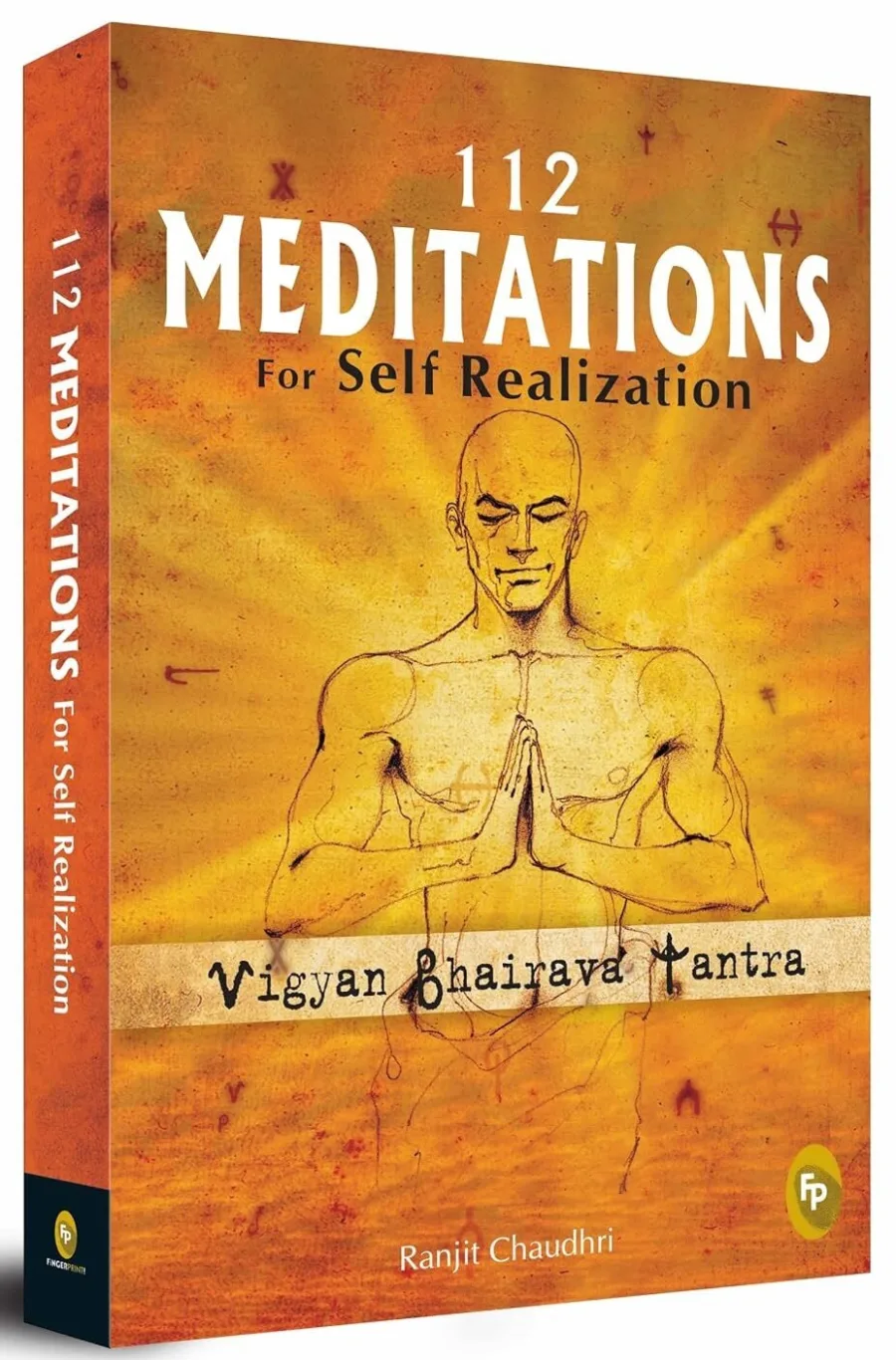
Download Cover Image
Do you want to download the full cover image for 112 Meditations for Self Realization: Vigyan Bhairava Tantra?