
Top 600 Words of the Quran
Paperback
• 318 Pages
• ₹ 999.00
• English
• 9788199526921
No ratings yet
| Publisher | Al Hidaya |
|---|---|
| ISBN13 | 9788199526921 |
| ASIN/SKU | B0G4WVNHLK |
| Book Format | Paperback |
| Language | English |
| Pages | 318 |
| List Price | ₹ 999.00 |
| Publishing Date | 31/12/2024 |
| Dimensions | 22 x 14 x 3 cm |
| Weight | 360 g |
| Book Code | BD00070754 |
Buy this Book
Amazon Stores
Ebook Stores
Other Stores
Discover Top 600 Words of the Quran by Al Hidaya. This book is published by Al Hidaya in Paperback format, ISBN 9788199526921, ASIN B0G4WVNHLK, under Religion and Spirituality, Islam.
Book Description
The Holy Quran contains approximately 600 pages, and each page has an average of 130 words. This means the Quran has around 78,000 words in total. Among these, there are certain words that appear repeatedly throughout the Quran. In fact, studies and linguistic analysis show that just 600 unique words make up around 80% of the Quran’s content. This means that by learning these 600 most frequently used words, you can begin to understand the Quran directly in Arabic, without always needing a translation. Not only will this deepen your connection with the Quran, but it will also enhance your focus during salah (namaz), as many of these words are also used in daily prayers. This eBook is a carefully compiled collection of those 600 frequently occurring words, designed to help you take your first meaningful step toward understanding the words of Allah. We pray to Allah Subhanahu wa ta'ala to grant us all the true understanding of the Quran, guide us on the straight path, and increase us in beneficial knowledge and wisdom. Ameen.
Author Biography
Author Biography will be added soon…
Editorial Reviews
Editorial Reviews will be added soon…
Book Summary
Top 600 Words of the Quran by Al Hidaya is a practical and accessible book designed to help readers become more familiar with the vocabulary of the Qur’an. Rather than approaching the Qur’an only as a text to be translated from beginning to end, the book focuses on an important foundation of understanding: recognizing the Arabic words and expressions that appear repeatedly throughout the Qur’anic text. Its central idea is simple but powerful—learning a relatively small and carefully selected vocabulary can make a large portion of Qur’anic language more familiar and meaningful to the reader.
For many people who wish to understand the Qur’an in its original Arabic, the greatest difficulty is not necessarily the complexity of every individual verse. It is the feeling that the language is unfamiliar. A reader may recognize a few well-known words but still struggle to understand a complete passage. Top 600 Words of the Quran addresses this difficulty by turning Qur’anic vocabulary into something that can be studied gradually. Instead of asking the learner to memorize an enormous dictionary, it concentrates attention on a limited group of frequently occurring words.
The underlying philosophy of the book is therefore one of accessibility through repetition. The Qur’an contains many words and grammatical forms, but a comparatively small group of words appears again and again. When readers learn these recurring words, they begin to recognize familiar patterns whenever they encounter Qur’anic verses. A word that once looked completely foreign may gradually become recognizable, and that recognition can make reading the Arabic Qur’an feel less intimidating.
The book can consequently be understood as a bridge between simply reciting Qur’anic Arabic and beginning to understand it directly. For a beginner, this is an important distinction. Someone may be able to recite Arabic beautifully while still depending heavily on translation for meaning. Learning Qur’anic vocabulary creates an opportunity to connect sound, written form, and meaning.
At the heart of the book is the idea that vocabulary is a gateway to comprehension. Each important word carries meaning, but words also acquire richness from the contexts in which they appear. A learner who encounters a familiar Qur’anic word repeatedly begins to understand not only its basic translation but also something about how it functions within different verses.
This process can make Qur’anic reading increasingly personal. Instead of seeing a verse as a sequence of unfamiliar Arabic expressions, the reader may suddenly recognize several words. Even partial recognition can change the experience of reading. A person may realize, for example, that a word connected with knowledge, mercy, prayer, guidance, creation, forgiveness, or judgment has appeared many times before. The Qur’anic vocabulary gradually begins to form a familiar linguistic landscape.
The selection of 600 words is particularly significant because it makes the goal feel achievable. Learning an entire language can seem overwhelming, but learning a carefully chosen vocabulary of several hundred high-frequency words is a much more manageable undertaking. The book encourages a step-by-step approach in which progress comes from consistency rather than from trying to master everything at once.
This makes the work especially suitable for readers who feel that they have reached a plateau in their relationship with Qur’anic Arabic. They may already know how to recite the Qur’an, recognize the Arabic alphabet, or understand a few common expressions, but they may not yet be comfortable identifying words while reading. The vocabulary-centered approach gives such readers a practical next step.
Another important feature of Qur’anic vocabulary is that many words are connected to major spiritual concepts. Learning the language therefore does more than increase linguistic ability. It can introduce the learner to recurring ideas within the Qur’an itself. Words associated with Allah, worship, faith, knowledge, mercy, guidance, repentance, patience, righteousness, the human being, creation, the Hereafter, reward, punishment, and moral conduct occur throughout the Qur’anic message.
As learners become familiar with these words, they may also begin to recognize the interconnectedness of Qur’anic themes. A verse about guidance may contain vocabulary that appears elsewhere in discussions of faith and righteous action. Words related to mercy may occur alongside forgiveness and repentance. Words concerning the world and creation may appear in passages that invite human beings to reflect on divine power and wisdom.
Thus, vocabulary learning can become a form of thematic learning. The reader is not simply memorizing isolated words but gradually becoming acquainted with the language through which the Qur’an communicates its central ideas.
The book also reflects an important characteristic of Arabic: a single root can generate a family of related words. Qur’anic Arabic is strongly based on root patterns, and recognizing these relationships can help learners understand unfamiliar forms. Once a reader becomes familiar with a particular root and its basic meaning, related words may become easier to recognize.
This makes vocabulary study more powerful than simple word-for-word memorization. A learner begins to notice relationships between words rather than treating every word as completely separate. Over time, the Arabic text can become more transparent because familiar patterns begin to stand out.
The emphasis on frequent words also helps address one of the biggest frustrations faced by beginners: forgetting what they have learned. If a person memorizes obscure vocabulary that appears only once or twice, there may be little opportunity to reinforce it naturally. Frequently occurring Qur’anic words, however, return repeatedly. Every subsequent encounter provides another opportunity for recognition.
In this way, repetition becomes the teacher. A word learned today may appear again tomorrow in another verse and again several days later in a different passage. Each encounter strengthens memory. The learner gradually moves from deliberate recall—“What does this word mean?”—toward automatic recognition—“I know this word.”
The book can therefore encourage a more active style of Qur’anic reading. Instead of immediately looking at a translation for every phrase, a learner can first try to identify the words already known. Even when only a portion of a verse is understood, this exercise develops confidence. The reader begins participating in the process of understanding rather than relying entirely on an external translation.
At the same time, vocabulary knowledge should not be confused with complete interpretation. Knowing the meaning of individual Arabic words does not automatically provide a full understanding of a Qur’anic verse. Grammar, context, rhetorical structure, classical Arabic usage, the relationship between verses, and established Qur’anic interpretation all matter. The value of a vocabulary book is that it provides one of the essential foundations upon which deeper study can be built.
This distinction makes the book particularly useful as a starting point rather than a replacement for tafsir or comprehensive Arabic study. A reader who develops a basic Qur’anic vocabulary can subsequently approach translations, commentaries, Arabic grammar, and tafsir with greater confidence.
The spiritual dimension of this process is also important. For Muslims, the Qur’an is not simply a literary work to be studied academically. It is sacred revelation and a source of guidance. Learning its vocabulary can therefore become an act of personal engagement. A reader who begins recognizing the language of verses during recitation may experience a deeper connection between what is being recited and what is being understood.
This can transform familiar acts of worship. During prayer, for instance, a person may begin to recognize the meanings of words that previously sounded familiar only through repetition. The experience of recitation can gradually become more conscious. The Arabic is no longer only something the tongue remembers; parts of its meaning begin to reach the mind and heart as well.
The book's approach is also valuable because it encourages small, sustainable progress. Many people begin learning a religious language with enthusiasm but stop when they encounter too much information. A list of hundreds of words can still be substantial, but it is finite and measurable. The learner can divide the vocabulary into smaller groups and review them regularly.
This creates a sense of achievement. After learning the first group of words, the reader can recognize them in verses. After learning more, the number of familiar expressions increases. Eventually, the Arabic text begins to contain islands of recognition surrounded by fewer completely unfamiliar expressions. With continued study, those islands can gradually expand.
Another lesson implicit in the book is that understanding grows through patience. Qur’anic Arabic cannot be mastered overnight. There will be words that are forgotten, grammatical forms that remain confusing, and verses whose meanings cannot be understood simply by knowing the vocabulary. Progress may sometimes feel slow. Yet repeated exposure gradually produces results.
This patient approach mirrors the broader spiritual value of sustained learning. Knowledge is not merely about collecting information. It requires humility, repetition, attention, and willingness to begin again. The learner does not have to understand everything immediately. What matters is continuing to return to the text.
The 600-word framework can also encourage readers to discover how frequently certain concepts occur in the Qur’an. As familiar vocabulary accumulates, the reader may begin noticing recurring concerns: humanity's relationship with Allah, the importance of faith and righteous action, the consequences of moral choices, the signs present in creation, the temporary nature of worldly life, the importance of gratitude and patience, the possibility of repentance, and the reality of accountability.
The vocabulary therefore becomes a doorway into the Qur’an's larger message. Words are not isolated objects; they belong to sentences, verses, stories, warnings, promises, prayers, and reflections. Understanding more words allows the learner to see more of these connections.
Ultimately, Top 600 Words of the Quran can be viewed as a practical invitation to move one step closer to the Qur’anic text. It does not demand that the reader become an Arabic scholar. Instead, it makes the first stage of Qur’anic vocabulary learning feel achievable. Its approach is particularly helpful for readers who want to reduce their dependence on translation and gradually develop the ability to recognize commonly occurring Qur’anic Arabic for themselves.
The deepest value of such a book lies not simply in memorizing 600 words. The real goal is the confidence that develops when the reader opens the Qur’an and begins recognizing language directly. A familiar word here, a repeated expression there, and a recognizable root elsewhere can slowly transform an apparently difficult text into something increasingly approachable.
In that sense, Top 600 Words of the Quran is ultimately a book about building a relationship with the Qur’an through language. It presents vocabulary learning as a gradual journey rather than an intimidating academic project. Each word learned becomes a small key, and every new key opens another part of the text.
For a sincere learner, the journey is not only linguistic. It can also become reflective and spiritual. As words associated with guidance, mercy, forgiveness, faith, worship, creation, justice, patience, and the Hereafter become familiar, the learner begins to encounter the Qur’an with greater awareness.
The book's central message can therefore be expressed simply: you do not have to know all of Arabic before you can begin understanding the Qur’an more deeply. Start with the words that occur most often. Learn them patiently. Recognize them in context. Review them repeatedly. Let familiarity grow naturally.
With time, what once seemed like an unfamiliar language can begin to feel increasingly recognizable. And that gradual recognition can become the first step toward a more direct, thoughtful, and meaningful engagement with the Qur’an.
For many people who wish to understand the Qur’an in its original Arabic, the greatest difficulty is not necessarily the complexity of every individual verse. It is the feeling that the language is unfamiliar. A reader may recognize a few well-known words but still struggle to understand a complete passage. Top 600 Words of the Quran addresses this difficulty by turning Qur’anic vocabulary into something that can be studied gradually. Instead of asking the learner to memorize an enormous dictionary, it concentrates attention on a limited group of frequently occurring words.
The underlying philosophy of the book is therefore one of accessibility through repetition. The Qur’an contains many words and grammatical forms, but a comparatively small group of words appears again and again. When readers learn these recurring words, they begin to recognize familiar patterns whenever they encounter Qur’anic verses. A word that once looked completely foreign may gradually become recognizable, and that recognition can make reading the Arabic Qur’an feel less intimidating.
The book can consequently be understood as a bridge between simply reciting Qur’anic Arabic and beginning to understand it directly. For a beginner, this is an important distinction. Someone may be able to recite Arabic beautifully while still depending heavily on translation for meaning. Learning Qur’anic vocabulary creates an opportunity to connect sound, written form, and meaning.
At the heart of the book is the idea that vocabulary is a gateway to comprehension. Each important word carries meaning, but words also acquire richness from the contexts in which they appear. A learner who encounters a familiar Qur’anic word repeatedly begins to understand not only its basic translation but also something about how it functions within different verses.
This process can make Qur’anic reading increasingly personal. Instead of seeing a verse as a sequence of unfamiliar Arabic expressions, the reader may suddenly recognize several words. Even partial recognition can change the experience of reading. A person may realize, for example, that a word connected with knowledge, mercy, prayer, guidance, creation, forgiveness, or judgment has appeared many times before. The Qur’anic vocabulary gradually begins to form a familiar linguistic landscape.
The selection of 600 words is particularly significant because it makes the goal feel achievable. Learning an entire language can seem overwhelming, but learning a carefully chosen vocabulary of several hundred high-frequency words is a much more manageable undertaking. The book encourages a step-by-step approach in which progress comes from consistency rather than from trying to master everything at once.
This makes the work especially suitable for readers who feel that they have reached a plateau in their relationship with Qur’anic Arabic. They may already know how to recite the Qur’an, recognize the Arabic alphabet, or understand a few common expressions, but they may not yet be comfortable identifying words while reading. The vocabulary-centered approach gives such readers a practical next step.
Another important feature of Qur’anic vocabulary is that many words are connected to major spiritual concepts. Learning the language therefore does more than increase linguistic ability. It can introduce the learner to recurring ideas within the Qur’an itself. Words associated with Allah, worship, faith, knowledge, mercy, guidance, repentance, patience, righteousness, the human being, creation, the Hereafter, reward, punishment, and moral conduct occur throughout the Qur’anic message.
As learners become familiar with these words, they may also begin to recognize the interconnectedness of Qur’anic themes. A verse about guidance may contain vocabulary that appears elsewhere in discussions of faith and righteous action. Words related to mercy may occur alongside forgiveness and repentance. Words concerning the world and creation may appear in passages that invite human beings to reflect on divine power and wisdom.
Thus, vocabulary learning can become a form of thematic learning. The reader is not simply memorizing isolated words but gradually becoming acquainted with the language through which the Qur’an communicates its central ideas.
The book also reflects an important characteristic of Arabic: a single root can generate a family of related words. Qur’anic Arabic is strongly based on root patterns, and recognizing these relationships can help learners understand unfamiliar forms. Once a reader becomes familiar with a particular root and its basic meaning, related words may become easier to recognize.
This makes vocabulary study more powerful than simple word-for-word memorization. A learner begins to notice relationships between words rather than treating every word as completely separate. Over time, the Arabic text can become more transparent because familiar patterns begin to stand out.
The emphasis on frequent words also helps address one of the biggest frustrations faced by beginners: forgetting what they have learned. If a person memorizes obscure vocabulary that appears only once or twice, there may be little opportunity to reinforce it naturally. Frequently occurring Qur’anic words, however, return repeatedly. Every subsequent encounter provides another opportunity for recognition.
In this way, repetition becomes the teacher. A word learned today may appear again tomorrow in another verse and again several days later in a different passage. Each encounter strengthens memory. The learner gradually moves from deliberate recall—“What does this word mean?”—toward automatic recognition—“I know this word.”
The book can therefore encourage a more active style of Qur’anic reading. Instead of immediately looking at a translation for every phrase, a learner can first try to identify the words already known. Even when only a portion of a verse is understood, this exercise develops confidence. The reader begins participating in the process of understanding rather than relying entirely on an external translation.
At the same time, vocabulary knowledge should not be confused with complete interpretation. Knowing the meaning of individual Arabic words does not automatically provide a full understanding of a Qur’anic verse. Grammar, context, rhetorical structure, classical Arabic usage, the relationship between verses, and established Qur’anic interpretation all matter. The value of a vocabulary book is that it provides one of the essential foundations upon which deeper study can be built.
This distinction makes the book particularly useful as a starting point rather than a replacement for tafsir or comprehensive Arabic study. A reader who develops a basic Qur’anic vocabulary can subsequently approach translations, commentaries, Arabic grammar, and tafsir with greater confidence.
The spiritual dimension of this process is also important. For Muslims, the Qur’an is not simply a literary work to be studied academically. It is sacred revelation and a source of guidance. Learning its vocabulary can therefore become an act of personal engagement. A reader who begins recognizing the language of verses during recitation may experience a deeper connection between what is being recited and what is being understood.
This can transform familiar acts of worship. During prayer, for instance, a person may begin to recognize the meanings of words that previously sounded familiar only through repetition. The experience of recitation can gradually become more conscious. The Arabic is no longer only something the tongue remembers; parts of its meaning begin to reach the mind and heart as well.
The book's approach is also valuable because it encourages small, sustainable progress. Many people begin learning a religious language with enthusiasm but stop when they encounter too much information. A list of hundreds of words can still be substantial, but it is finite and measurable. The learner can divide the vocabulary into smaller groups and review them regularly.
This creates a sense of achievement. After learning the first group of words, the reader can recognize them in verses. After learning more, the number of familiar expressions increases. Eventually, the Arabic text begins to contain islands of recognition surrounded by fewer completely unfamiliar expressions. With continued study, those islands can gradually expand.
Another lesson implicit in the book is that understanding grows through patience. Qur’anic Arabic cannot be mastered overnight. There will be words that are forgotten, grammatical forms that remain confusing, and verses whose meanings cannot be understood simply by knowing the vocabulary. Progress may sometimes feel slow. Yet repeated exposure gradually produces results.
This patient approach mirrors the broader spiritual value of sustained learning. Knowledge is not merely about collecting information. It requires humility, repetition, attention, and willingness to begin again. The learner does not have to understand everything immediately. What matters is continuing to return to the text.
The 600-word framework can also encourage readers to discover how frequently certain concepts occur in the Qur’an. As familiar vocabulary accumulates, the reader may begin noticing recurring concerns: humanity's relationship with Allah, the importance of faith and righteous action, the consequences of moral choices, the signs present in creation, the temporary nature of worldly life, the importance of gratitude and patience, the possibility of repentance, and the reality of accountability.
The vocabulary therefore becomes a doorway into the Qur’an's larger message. Words are not isolated objects; they belong to sentences, verses, stories, warnings, promises, prayers, and reflections. Understanding more words allows the learner to see more of these connections.
Ultimately, Top 600 Words of the Quran can be viewed as a practical invitation to move one step closer to the Qur’anic text. It does not demand that the reader become an Arabic scholar. Instead, it makes the first stage of Qur’anic vocabulary learning feel achievable. Its approach is particularly helpful for readers who want to reduce their dependence on translation and gradually develop the ability to recognize commonly occurring Qur’anic Arabic for themselves.
The deepest value of such a book lies not simply in memorizing 600 words. The real goal is the confidence that develops when the reader opens the Qur’an and begins recognizing language directly. A familiar word here, a repeated expression there, and a recognizable root elsewhere can slowly transform an apparently difficult text into something increasingly approachable.
In that sense, Top 600 Words of the Quran is ultimately a book about building a relationship with the Qur’an through language. It presents vocabulary learning as a gradual journey rather than an intimidating academic project. Each word learned becomes a small key, and every new key opens another part of the text.
For a sincere learner, the journey is not only linguistic. It can also become reflective and spiritual. As words associated with guidance, mercy, forgiveness, faith, worship, creation, justice, patience, and the Hereafter become familiar, the learner begins to encounter the Qur’an with greater awareness.
The book's central message can therefore be expressed simply: you do not have to know all of Arabic before you can begin understanding the Qur’an more deeply. Start with the words that occur most often. Learn them patiently. Recognize them in context. Review them repeatedly. Let familiarity grow naturally.
With time, what once seemed like an unfamiliar language can begin to feel increasingly recognizable. And that gradual recognition can become the first step toward a more direct, thoughtful, and meaningful engagement with the Qur’an.
Sample Chapters
Sample Chapters will be added soon…
Reader Reviews
No reviews yet.
Top 600 Words of the Quran
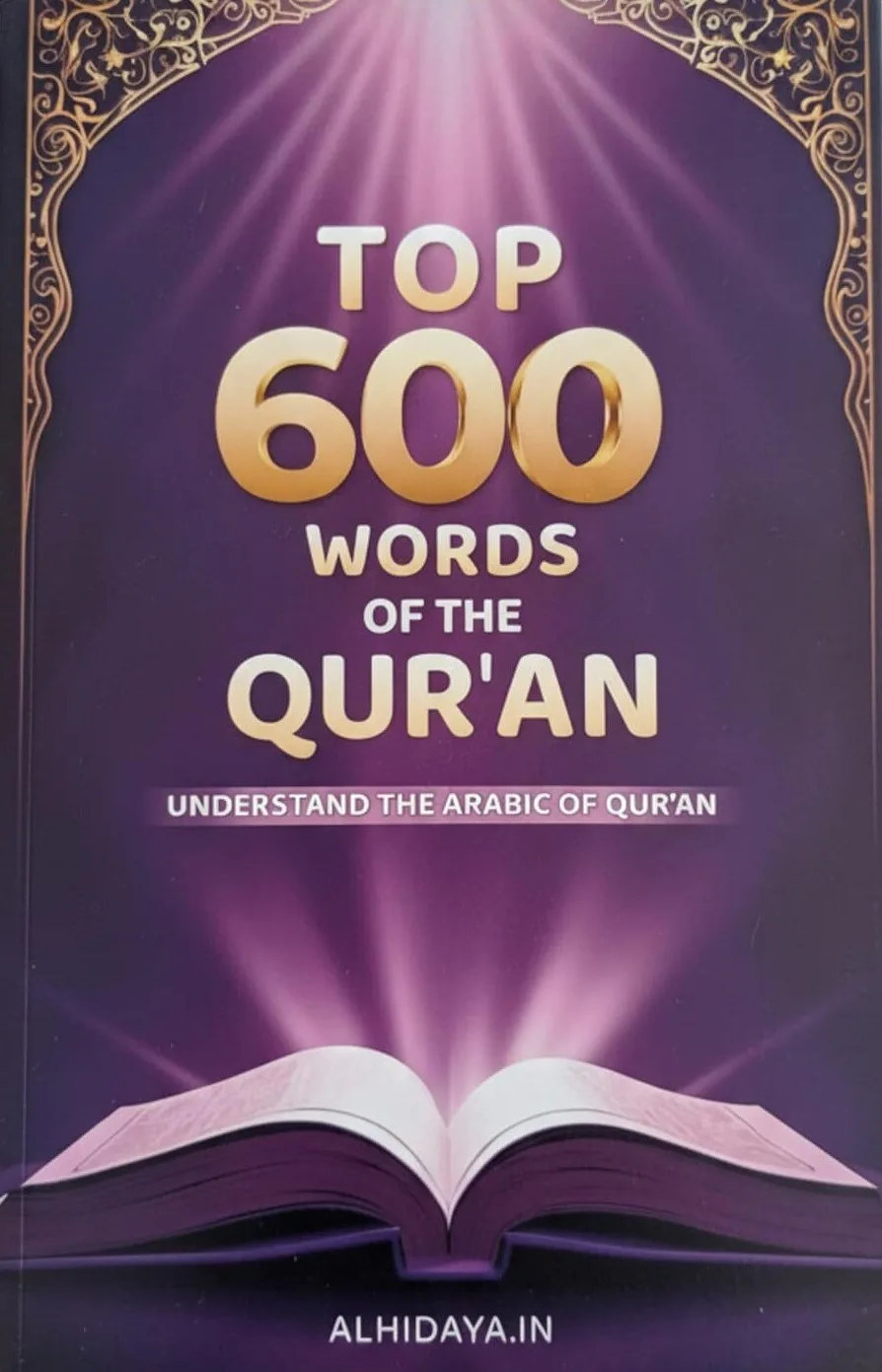
Download Cover Image
Do you want to download the full cover image for Top 600 Words of the Quran?