
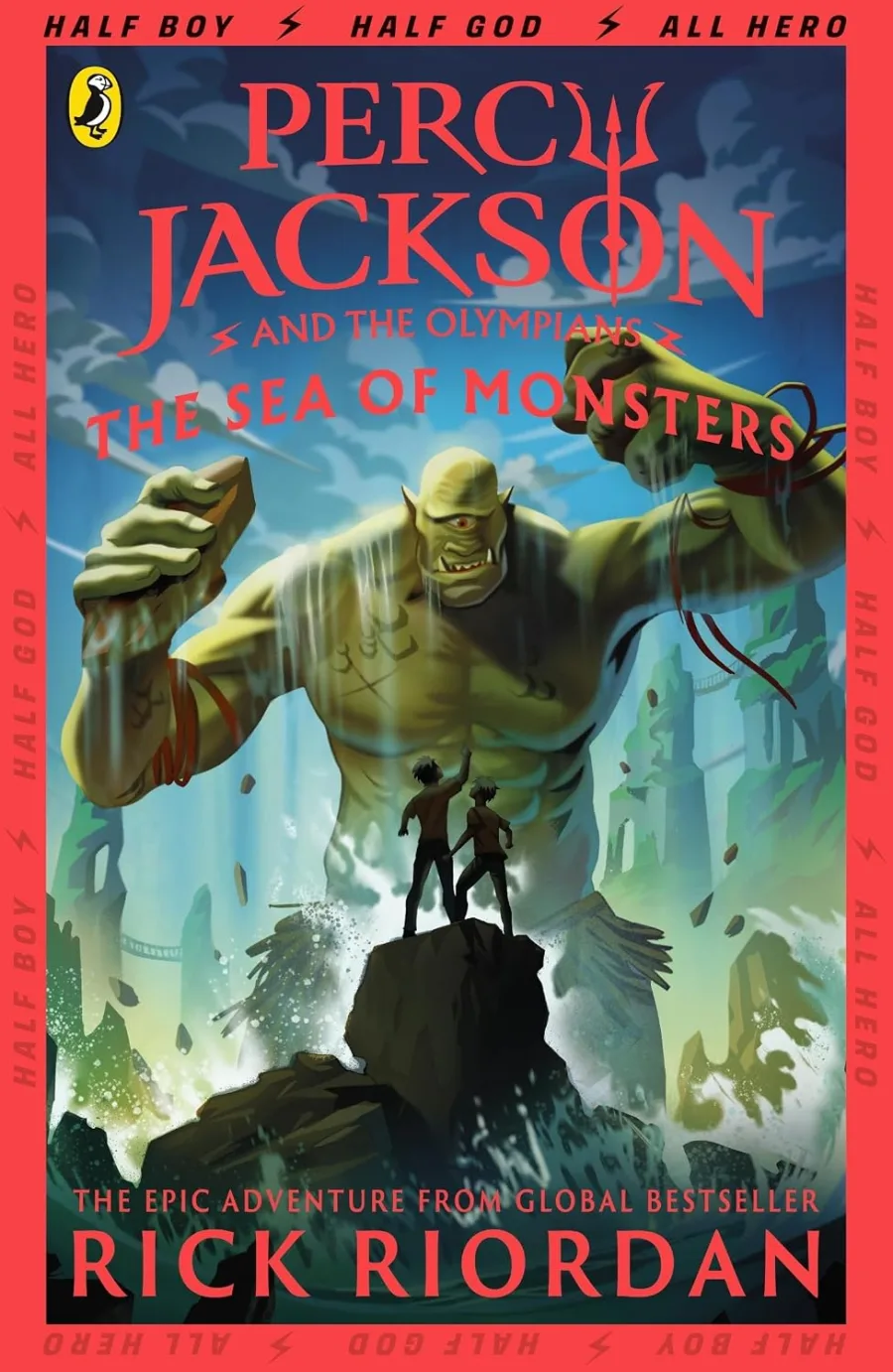
Percy Jackson and the Sea of Monsters (Book 2)
Paperback
• 288 Pages
• ₹ 319.00
• English
• 9780735232143
No ratings yet
| Publisher | Puffin |
|---|---|
| ISBN13 | 9780735232143 |
| ASIN/SKU | 0141346841 |
| Book Format | Paperback |
| Language | English |
| Pages | 288 |
| List Price | ₹ 319.00 |
| Publishing Date | 04/07/2013 |
| Dimensions | 19.8 x 1.8 x 12.9 cm |
| Weight | 203 g |
| Book Code | BD00070752 |
Buy this Book
Amazon Stores
Ebook Stores
Other Stores
Discover Percy Jackson and the Sea of Monsters (Book 2) by Rick Riordan. This book is published by Puffin in Paperback format, ISBN 9780735232143, ASIN 0141346841, under Children's Books, Children's Horror and Ghost Stories, Fantasy Adventure for Children.
Book Description
The second book in the bestselling Percy Jackson and the Olympians series. Now with a new cover look! Discover the story behind the Disney+ series.
HALF BOY - HALF GOD - ALL HERO.
I've almost made it a year without one of my teachers turning into a monster. Just one more day to go. Surely even I can get through that?
Percy Jackson's life has been surprisingly quiet since he stopped all-out war on Mount Olympus. That is until an innocent game of dodgeball turns monstrously ugly. . .
Now Camp Half-Blood - the only safe place on earth for demigods like Percy - is under attack, and unless he can find the magical Golden Fleece, everything he's come to love will be destroyed.
Percy and his friends must journey into the Sea of Monsters to save their camp. But as the son of the sea god - how hard can this quest be?
Return to the World of Percy Jackson in the best-selling, brand-new adventure featuring the original hero in Percy Jackson and the Olympians: Chalice of the Gods – out now!
And don't miss the trio's next adventure in Percy Jackson and the Olympians: Wrath of the Triple Goddess, coming soon!
HALF BOY - HALF GOD - ALL HERO.
I've almost made it a year without one of my teachers turning into a monster. Just one more day to go. Surely even I can get through that?
Percy Jackson's life has been surprisingly quiet since he stopped all-out war on Mount Olympus. That is until an innocent game of dodgeball turns monstrously ugly. . .
Now Camp Half-Blood - the only safe place on earth for demigods like Percy - is under attack, and unless he can find the magical Golden Fleece, everything he's come to love will be destroyed.
Percy and his friends must journey into the Sea of Monsters to save their camp. But as the son of the sea god - how hard can this quest be?
Return to the World of Percy Jackson in the best-selling, brand-new adventure featuring the original hero in Percy Jackson and the Olympians: Chalice of the Gods – out now!
And don't miss the trio's next adventure in Percy Jackson and the Olympians: Wrath of the Triple Goddess, coming soon!
Author Biography
Rick Riordan (he/him), dubbed 'storyteller of the gods' by Publishers Weekly, is the author of five #1 New York Times best-selling middle grade series with millions of copies sold throughout the world, including Percy Jackson and the Olympians, now a live-action series on Disney+. Rick is also the publisher of an imprint at Disney-Hyperion, Rick Riordan Presents, dedicated to finding other authors of highly entertaining fiction based on world cultures and mythologies. He lives in Boston, Massachusetts with his wife and two sons. Follow him on Twitter at @RickRiordan.
Editorial Reviews
Editorial Reviews will be added soon…
Book Summary
Percy Jackson and the Sea of Monsters by Rick Riordan is the second novel in Rick Riordan’s popular Percy Jackson & the Olympians series. Blending Greek mythology, adventure, humor, friendship, and coming-of-age themes, the novel follows Percy Jackson as he faces a new threat that endangers both his home at Camp Half-Blood and the wider world of demigods. While the first book introduced Percy to his identity as the son of Poseidon, The Sea of Monsters takes him deeper into the dangerous world of gods, monsters, prophecies, and heroic responsibility. At its heart, the story is about learning that courage is not the absence of fear, that appearances can be deceptive, and that true friendship often means standing beside someone when doing so is difficult.
Percy begins the story feeling strangely disconnected from the world he has come to accept as his own. After the extraordinary events of The Lightning Thief, he has returned to Camp Half-Blood, the safe haven for demigods. Yet this safety is beginning to disappear. Percy has been experiencing troubling dreams about his friend Grover Underwood, a satyr who has gone missing while searching for the god Pan. In these dreams, Grover appears to be in serious danger and seems to be calling Percy for help. Percy does not fully understand what the dreams mean, but he knows that something is wrong.
At the same time, Camp Half-Blood itself is under threat. The magical boundary protecting the camp has been poisoned, leaving the demigods vulnerable to attacks from monsters. The protective tree at the camp’s border, which is connected to Thalia, daughter of Zeus, is dying. Without the tree’s magical protection, monsters can enter the camp freely. The place Percy considers home is no longer secure.
The crisis becomes even more complicated when Percy discovers that his best friend Annabeth Chase is also deeply concerned about the camp. Annabeth is intelligent, determined, and courageous, but she carries her own emotional wounds and insecurities. Percy and Annabeth have developed a strong friendship, although their relationship is often filled with teasing, arguments, and disagreements. Beneath their banter is a growing sense of loyalty and trust that becomes increasingly important as the story progresses.
Percy’s life becomes more complicated when he meets Tyson, a large, gentle, seemingly awkward young boy who turns out to be a Cyclops. At first, Percy is embarrassed by Tyson and does not want others to know that Tyson is his half-brother. This is an important part of Percy’s emotional journey because Tyson does not fit Percy’s idea of what a brother should be. Tyson is physically enormous and possesses the frightening appearance associated with Cyclopes, creatures traditionally portrayed in Greek mythology as dangerous monsters.
However, Tyson is kind, innocent, loyal, and deeply attached to Percy. Unlike many characters who judge him by his appearance, Tyson genuinely cares about Percy. Their relationship gradually forces Percy to confront his own prejudices. Percy realizes that being a monster by appearance does not necessarily mean being monstrous in character. Conversely, people who look heroic may not always behave heroically.
The only way to restore Camp Half-Blood’s protective barrier is to obtain the Golden Fleece, a magical object from Greek mythology possessing extraordinary healing powers. The fleece is located on an island in the Sea of Monsters, the modern-day version of the legendary waters once known to ancient Greek heroes as a place filled with deadly creatures and supernatural dangers.
The quest, however, is not given to Percy. Instead, the camp’s leadership assigns the mission to Clarisse La Rue, daughter of Ares. Clarisse is strong, aggressive, competitive, and frequently hostile toward Percy. She represents a very different kind of hero from Percy. Whereas Percy often relies on instinct, friendship, and compassion, Clarisse approaches challenges through force and determination.
Percy is frustrated by the decision, especially because he believes Grover is in danger. Eventually, Percy, Annabeth, and Tyson leave Camp Half-Blood to rescue Grover and find the Golden Fleece. Their journey takes them into a modern world where ancient Greek mythology exists alongside ordinary contemporary life. Riordan’s great strength in the novel is his ability to make the mythological world feel both familiar and surprising. Monsters, magical objects, gods, and legendary places appear in settings that resemble the modern world, creating much of the book’s humor and excitement.
The heroes eventually discover that the Sea of Monsters is associated with the region known to humans as the Bermuda Triangle. This becomes the setting for one of the novel’s central adventures. Their journey is filled with dangers, including monsters and supernatural enemies who test their courage and resourcefulness.
One of the most memorable encounters involves Circe, the enchantress from Greek mythology. Circe has a long history of transforming men into animals, and Percy becomes one of her victims. This episode is humorous but also reinforces one of the novel’s recurring ideas: appearances and assumptions can be dangerously misleading. Annabeth must use her intelligence to help Percy escape, demonstrating once again that strength in the Percy Jackson universe is not simply physical. Intelligence, loyalty, adaptability, and emotional courage are equally important.
The journey eventually brings Percy and his companions into contact with the Sirens. In Greek mythology, the Sirens lure sailors to destruction by appealing to their deepest desires. Annabeth becomes fascinated by the possibility of hearing their song because she wants to understand her own ambitions and fears. Her encounter reveals that even brave and intelligent people can be vulnerable to temptation.
The Sirens show characters not simply what they want but what they imagine their perfect lives could become. For Annabeth, the vision is connected to her desire to build something meaningful and prove herself. Her reaction reveals how deeply she cares about the future and how much pressure she places on herself.
Meanwhile, Grover’s situation becomes increasingly desperate. He has been captured by the Cyclops Polyphemus, a creature from Homer’s Odyssey. Polyphemus has obtained the Golden Fleece and is using its magical power to attract satyrs. Grover is trapped on his island and must use his intelligence to survive.
This is another place where Riordan creatively combines ancient mythology with modern storytelling. The Cyclops who once appeared as a terrifying figure in Homer becomes part of a new adventure involving Percy and his friends. The novel does not simply retell Greek myths; it reimagines them and places them inside a contemporary fantasy world.
Percy eventually confronts Polyphemus and discovers that Tyson’s abilities are crucial to their survival. Tyson, despite being underestimated because of his appearance and innocence, proves himself to be brave, capable, and deeply loyal. Percy’s attitude toward his brother changes significantly. What initially embarrassed him becomes something he values and protects.
The rescue of Grover and recovery of the Golden Fleece lead to a climactic confrontation. Percy and his friends must work together despite their differences. The final victory does not belong to one hero alone. It depends on cooperation, courage, intelligence, and trust.
When the Golden Fleece is finally brought back to Camp Half-Blood, its magical power restores the camp’s protective boundary. Yet the fleece has an unexpected effect: it also restores Thalia’s tree. This creates one of the novel’s most important developments because Thalia was not merely a tree. She was once a demigod and daughter of Zeus who sacrificed herself to protect her friends.
The restoration of Thalia changes the meaning of the prophecy surrounding Percy. Earlier, Percy had understood that he might have an important role in the future of the gods because of the prophecy concerning a child of one of the Big Three Olympians—Zeus, Poseidon, or Hades. With Thalia alive again, Percy is no longer necessarily the only demigod who fits the prophecy’s conditions.
This ending introduces a much larger uncertainty into the series. Percy’s future becomes less predictable, and the return of Thalia suggests that the struggles of the demigods are connected to a much greater conflict that has yet to unfold.
One of the strongest aspects of The Sea of Monsters is its exploration of friendship. Percy’s relationship with Grover demonstrates the lengths to which a person may go for someone they care about. Percy does not abandon Grover when the situation becomes dangerous. Even when the official quest does not include him, Percy is determined to find his friend.
His relationship with Annabeth also develops. Annabeth is more than a clever companion; she challenges Percy to think, question himself, and become more responsible. Their friendship is built on mutual trust, but it is not perfect. They disagree, become frustrated with each other, and sometimes make mistakes. That imperfection makes their relationship feel human.
Tyson’s presence deepens the theme of acceptance. Percy initially feels uncomfortable acknowledging Tyson as his brother because of what Tyson looks like and because Percy fears how others will react. Gradually, however, Percy realizes that family is not determined by appearance or social approval. Tyson’s kindness and loyalty make him far more admirable than many supposedly civilized characters.
The book also explores the idea that heroism is not always glamorous. Percy repeatedly finds himself frightened, uncertain, and confused. He does not possess complete knowledge of what he is doing. Yet he continues forward because other people depend on him. His courage comes from action despite uncertainty.
Clarisse provides another perspective on heroism. She is aggressive and difficult, but she is also brave and determined. Her presence reminds readers that people can possess good qualities without being easy to like. The novel therefore avoids presenting heroism as a single personality type.
At a deeper level, The Sea of Monsters is about learning to look beyond appearances. Tyson looks frightening but has a gentle heart. Clarisse appears harsh but demonstrates courage. Annabeth appears confident but carries deep insecurities. Percy himself is often uncertain about his identity and abilities. The monsters of mythology are sometimes more complicated than the labels attached to them.
Rick Riordan also uses humor to keep the story accessible. Percy narrates the events with a youthful, sarcastic voice, making even dangerous situations entertaining. His jokes and observations prevent the mythology from becoming overly serious or distant. Ancient legends become part of a living world where demigods travel through modern cities, encounter magical creatures, and struggle with problems that resemble ordinary teenage concerns.
Ultimately, Percy Jackson and the Sea of Monsters is a story about friendship, family, courage, identity, and acceptance wrapped inside a fast-moving mythological adventure. Percy begins the story uncertain about Tyson and worried about the safety of his home. Through the journey, he learns to accept his brother, trust his friends more deeply, and recognize that heroism is measured not by appearance or reputation but by the choices a person makes when others need help.
The restoration of Camp Half-Blood provides a temporary sense of safety, but the resurrection of Thalia ensures that the story does not end with complete certainty. Instead, the boundaries of Percy’s world become larger and more complicated. The novel leaves readers with the feeling that the real adventure has only begun.
What makes The Sea of Monsters memorable is its combination of a child’s sense of wonder with genuinely human emotional questions. Beneath the monsters and magic are familiar struggles: wanting to belong, feeling embarrassed by family, worrying about disappointing others, trying to understand friendship, and discovering that people are rarely exactly what they seem. Percy’s journey therefore feels larger than a battle between heroes and monsters. It becomes a journey toward maturity, where courage means accepting others, facing uncomfortable truths, and continuing to stand beside the people who matter.
In the end, the Golden Fleece may save Camp Half-Blood, but Percy’s most important discoveries are personal. He learns that family can arrive in unexpected forms, that friendship requires loyalty even when circumstances become frightening, and that someone’s outward appearance tells only a small part of their story. These lessons give the adventure its emotional heart and prepare Percy for the increasingly dangerous challenges that await him in the next stages of his journey.
Percy begins the story feeling strangely disconnected from the world he has come to accept as his own. After the extraordinary events of The Lightning Thief, he has returned to Camp Half-Blood, the safe haven for demigods. Yet this safety is beginning to disappear. Percy has been experiencing troubling dreams about his friend Grover Underwood, a satyr who has gone missing while searching for the god Pan. In these dreams, Grover appears to be in serious danger and seems to be calling Percy for help. Percy does not fully understand what the dreams mean, but he knows that something is wrong.
At the same time, Camp Half-Blood itself is under threat. The magical boundary protecting the camp has been poisoned, leaving the demigods vulnerable to attacks from monsters. The protective tree at the camp’s border, which is connected to Thalia, daughter of Zeus, is dying. Without the tree’s magical protection, monsters can enter the camp freely. The place Percy considers home is no longer secure.
The crisis becomes even more complicated when Percy discovers that his best friend Annabeth Chase is also deeply concerned about the camp. Annabeth is intelligent, determined, and courageous, but she carries her own emotional wounds and insecurities. Percy and Annabeth have developed a strong friendship, although their relationship is often filled with teasing, arguments, and disagreements. Beneath their banter is a growing sense of loyalty and trust that becomes increasingly important as the story progresses.
Percy’s life becomes more complicated when he meets Tyson, a large, gentle, seemingly awkward young boy who turns out to be a Cyclops. At first, Percy is embarrassed by Tyson and does not want others to know that Tyson is his half-brother. This is an important part of Percy’s emotional journey because Tyson does not fit Percy’s idea of what a brother should be. Tyson is physically enormous and possesses the frightening appearance associated with Cyclopes, creatures traditionally portrayed in Greek mythology as dangerous monsters.
However, Tyson is kind, innocent, loyal, and deeply attached to Percy. Unlike many characters who judge him by his appearance, Tyson genuinely cares about Percy. Their relationship gradually forces Percy to confront his own prejudices. Percy realizes that being a monster by appearance does not necessarily mean being monstrous in character. Conversely, people who look heroic may not always behave heroically.
The only way to restore Camp Half-Blood’s protective barrier is to obtain the Golden Fleece, a magical object from Greek mythology possessing extraordinary healing powers. The fleece is located on an island in the Sea of Monsters, the modern-day version of the legendary waters once known to ancient Greek heroes as a place filled with deadly creatures and supernatural dangers.
The quest, however, is not given to Percy. Instead, the camp’s leadership assigns the mission to Clarisse La Rue, daughter of Ares. Clarisse is strong, aggressive, competitive, and frequently hostile toward Percy. She represents a very different kind of hero from Percy. Whereas Percy often relies on instinct, friendship, and compassion, Clarisse approaches challenges through force and determination.
Percy is frustrated by the decision, especially because he believes Grover is in danger. Eventually, Percy, Annabeth, and Tyson leave Camp Half-Blood to rescue Grover and find the Golden Fleece. Their journey takes them into a modern world where ancient Greek mythology exists alongside ordinary contemporary life. Riordan’s great strength in the novel is his ability to make the mythological world feel both familiar and surprising. Monsters, magical objects, gods, and legendary places appear in settings that resemble the modern world, creating much of the book’s humor and excitement.
The heroes eventually discover that the Sea of Monsters is associated with the region known to humans as the Bermuda Triangle. This becomes the setting for one of the novel’s central adventures. Their journey is filled with dangers, including monsters and supernatural enemies who test their courage and resourcefulness.
One of the most memorable encounters involves Circe, the enchantress from Greek mythology. Circe has a long history of transforming men into animals, and Percy becomes one of her victims. This episode is humorous but also reinforces one of the novel’s recurring ideas: appearances and assumptions can be dangerously misleading. Annabeth must use her intelligence to help Percy escape, demonstrating once again that strength in the Percy Jackson universe is not simply physical. Intelligence, loyalty, adaptability, and emotional courage are equally important.
The journey eventually brings Percy and his companions into contact with the Sirens. In Greek mythology, the Sirens lure sailors to destruction by appealing to their deepest desires. Annabeth becomes fascinated by the possibility of hearing their song because she wants to understand her own ambitions and fears. Her encounter reveals that even brave and intelligent people can be vulnerable to temptation.
The Sirens show characters not simply what they want but what they imagine their perfect lives could become. For Annabeth, the vision is connected to her desire to build something meaningful and prove herself. Her reaction reveals how deeply she cares about the future and how much pressure she places on herself.
Meanwhile, Grover’s situation becomes increasingly desperate. He has been captured by the Cyclops Polyphemus, a creature from Homer’s Odyssey. Polyphemus has obtained the Golden Fleece and is using its magical power to attract satyrs. Grover is trapped on his island and must use his intelligence to survive.
This is another place where Riordan creatively combines ancient mythology with modern storytelling. The Cyclops who once appeared as a terrifying figure in Homer becomes part of a new adventure involving Percy and his friends. The novel does not simply retell Greek myths; it reimagines them and places them inside a contemporary fantasy world.
Percy eventually confronts Polyphemus and discovers that Tyson’s abilities are crucial to their survival. Tyson, despite being underestimated because of his appearance and innocence, proves himself to be brave, capable, and deeply loyal. Percy’s attitude toward his brother changes significantly. What initially embarrassed him becomes something he values and protects.
The rescue of Grover and recovery of the Golden Fleece lead to a climactic confrontation. Percy and his friends must work together despite their differences. The final victory does not belong to one hero alone. It depends on cooperation, courage, intelligence, and trust.
When the Golden Fleece is finally brought back to Camp Half-Blood, its magical power restores the camp’s protective boundary. Yet the fleece has an unexpected effect: it also restores Thalia’s tree. This creates one of the novel’s most important developments because Thalia was not merely a tree. She was once a demigod and daughter of Zeus who sacrificed herself to protect her friends.
The restoration of Thalia changes the meaning of the prophecy surrounding Percy. Earlier, Percy had understood that he might have an important role in the future of the gods because of the prophecy concerning a child of one of the Big Three Olympians—Zeus, Poseidon, or Hades. With Thalia alive again, Percy is no longer necessarily the only demigod who fits the prophecy’s conditions.
This ending introduces a much larger uncertainty into the series. Percy’s future becomes less predictable, and the return of Thalia suggests that the struggles of the demigods are connected to a much greater conflict that has yet to unfold.
One of the strongest aspects of The Sea of Monsters is its exploration of friendship. Percy’s relationship with Grover demonstrates the lengths to which a person may go for someone they care about. Percy does not abandon Grover when the situation becomes dangerous. Even when the official quest does not include him, Percy is determined to find his friend.
His relationship with Annabeth also develops. Annabeth is more than a clever companion; she challenges Percy to think, question himself, and become more responsible. Their friendship is built on mutual trust, but it is not perfect. They disagree, become frustrated with each other, and sometimes make mistakes. That imperfection makes their relationship feel human.
Tyson’s presence deepens the theme of acceptance. Percy initially feels uncomfortable acknowledging Tyson as his brother because of what Tyson looks like and because Percy fears how others will react. Gradually, however, Percy realizes that family is not determined by appearance or social approval. Tyson’s kindness and loyalty make him far more admirable than many supposedly civilized characters.
The book also explores the idea that heroism is not always glamorous. Percy repeatedly finds himself frightened, uncertain, and confused. He does not possess complete knowledge of what he is doing. Yet he continues forward because other people depend on him. His courage comes from action despite uncertainty.
Clarisse provides another perspective on heroism. She is aggressive and difficult, but she is also brave and determined. Her presence reminds readers that people can possess good qualities without being easy to like. The novel therefore avoids presenting heroism as a single personality type.
At a deeper level, The Sea of Monsters is about learning to look beyond appearances. Tyson looks frightening but has a gentle heart. Clarisse appears harsh but demonstrates courage. Annabeth appears confident but carries deep insecurities. Percy himself is often uncertain about his identity and abilities. The monsters of mythology are sometimes more complicated than the labels attached to them.
Rick Riordan also uses humor to keep the story accessible. Percy narrates the events with a youthful, sarcastic voice, making even dangerous situations entertaining. His jokes and observations prevent the mythology from becoming overly serious or distant. Ancient legends become part of a living world where demigods travel through modern cities, encounter magical creatures, and struggle with problems that resemble ordinary teenage concerns.
Ultimately, Percy Jackson and the Sea of Monsters is a story about friendship, family, courage, identity, and acceptance wrapped inside a fast-moving mythological adventure. Percy begins the story uncertain about Tyson and worried about the safety of his home. Through the journey, he learns to accept his brother, trust his friends more deeply, and recognize that heroism is measured not by appearance or reputation but by the choices a person makes when others need help.
The restoration of Camp Half-Blood provides a temporary sense of safety, but the resurrection of Thalia ensures that the story does not end with complete certainty. Instead, the boundaries of Percy’s world become larger and more complicated. The novel leaves readers with the feeling that the real adventure has only begun.
What makes The Sea of Monsters memorable is its combination of a child’s sense of wonder with genuinely human emotional questions. Beneath the monsters and magic are familiar struggles: wanting to belong, feeling embarrassed by family, worrying about disappointing others, trying to understand friendship, and discovering that people are rarely exactly what they seem. Percy’s journey therefore feels larger than a battle between heroes and monsters. It becomes a journey toward maturity, where courage means accepting others, facing uncomfortable truths, and continuing to stand beside the people who matter.
In the end, the Golden Fleece may save Camp Half-Blood, but Percy’s most important discoveries are personal. He learns that family can arrive in unexpected forms, that friendship requires loyalty even when circumstances become frightening, and that someone’s outward appearance tells only a small part of their story. These lessons give the adventure its emotional heart and prepare Percy for the increasingly dangerous challenges that await him in the next stages of his journey.
Sample Chapters
Sample Chapters will be added soon…
Reader Reviews
No reviews yet.
Percy Jackson and the Sea of Monsters (Book 2)
Download Cover Image
Do you want to download the full cover image for Percy Jackson and the Sea of Monsters (Book 2)?