
The Shiva Sutras
Paperback
• 144 Pages
• ₹ 139.00
• English
• 9789389178203
No ratings yet
| Publisher | Fingerprint! Publishing |
|---|---|
| ISBN13 | 9789389178203 |
| ASIN/SKU | 9389178207 |
| Book Format | Paperback |
| Language | English |
| Pages | 144 |
| List Price | ₹ 139.00 |
| Publishing Date | 01/08/2019 |
| Dimensions | 12.7 x 1.02 x 20.32 cm |
| Weight | 150 g |
| Book Code | BD00070745 |
Buy this Book
Amazon Stores
Ebook Stores
Other Stores
Discover The Shiva Sutras by Ranjit Chaudhri. This book is published by Fingerprint! Publishing in Paperback format, ISBN 9789389178203, ASIN 9389178207, under Religion and Spirituality, Spiritual Self-Help, History of Religion.
Book Description
According to the legend, Sage Vasugupta received a divine revelation in a dream where Lord Shiva instructed him to seek out a specific stone near a serene stream. To his amazement, the stone turned over at his touch, revealing the sacred Shiva Sutras etched upon its surface. These profound sutras, reserved for those deemed worthy of divine grace, unravel the mysteries of our true nature and the illusory existence we inhabit. Ranjit Chaudhri has translated some important texts of Kashmir Shaivism from Sanskrit into English. These include 112 Meditations for Self Realization: The Vigyan Bhairava Tantra, The Shiva Sutras: Eternal Wisdom for Life, and Sounds of Liberation: The Spanda Karikas.
Explore the divinity of Lord Shiva!
The Shiva Sutras serve as a guiding light towards liberation from the illusion we perceive, leading us to ultimate reality.
These sutras possess a transformative message that has the power to alleviate our suffering.
By following the path illuminated by the Shiva Sutras, we can unveil a wondrous new realm of possibilities.
The sutras offer profound insights that help us transcend the limitations of our current existence.
Through the wisdom contained in the Shiva Sutras, we can embark on a journey of self-discovery and spiritual growth
Explore the divinity of Lord Shiva!
The Shiva Sutras serve as a guiding light towards liberation from the illusion we perceive, leading us to ultimate reality.
These sutras possess a transformative message that has the power to alleviate our suffering.
By following the path illuminated by the Shiva Sutras, we can unveil a wondrous new realm of possibilities.
The sutras offer profound insights that help us transcend the limitations of our current existence.
Through the wisdom contained in the Shiva Sutras, we can embark on a journey of self-discovery and spiritual growth
Author Biography
Ranjit Chaudhri is a best selling author of spiritual books, a yogi and an entrepreneur.. He has translated some important texts of Yoga and Kashmir Shaivism, from Sanskrit to English. These include, The Shiva Sutras, 112 Meditations for Self Realization: The Vigyan Bhairava Tantra, Sounds of Liberation, The Spanda Karikas and The Yoga Sutras of Patanjali. He believes the wisdom of some of our ancient spiritual texts can lead to self-transformation and make the world a better place. His extensive knowledge of yoga, gained from over forty years of experience, helps to explain and clarify the profound messages of the texts he has translated. He attended Brandeis University and the London School of Economics. His motivational videos are available on YouTube.
Editorial Reviews
Editorial Reviews will be added soon…
Book Summary
Ranjit Chaudhri’s The Shiva Sutras is an accessible presentation of one of the most important texts of Kashmir Shaivism, a spiritual tradition that explores consciousness, liberation, and the deepest nature of the self. The Shiva Sutras are traditionally attributed to the sage Vasugupta and consist of a collection of concise aphorisms that describe how ordinary human awareness can awaken to its essential divine nature. In Chaudhri’s treatment, these brief and sometimes mysterious statements become an invitation to look inward and question the assumptions through which we normally experience ourselves and the world. Rather than presenting spirituality as something distant, ritualistic, or reserved for a few extraordinary people, the book brings attention back to everyday consciousness and the possibility of recognizing the sacred within it.
The central concern of the Shiva Sutras is consciousness. We usually think of ourselves as individual people moving through a world that exists independently outside us. We identify ourselves with the body, our memories, our profession, our relationships, our successes and failures, and the constant stream of thoughts passing through the mind. The Shiva Sutras challenge this limited understanding. Their deeper message is that behind this changing personality lies a universal consciousness, traditionally identified with Shiva. Liberation therefore does not mean becoming something completely different. It means recognizing what we already are at the deepest level.
This is one of the most striking ideas running through the text. Human beings ordinarily experience themselves as separate individuals, but Kashmir Shaivism describes this separation as a contraction of consciousness. The infinite consciousness that is capable of knowing everything appears to become a limited individual who knows only a tiny portion of reality. We become absorbed in the narrow story of “me”: my body, my problems, my desires, my fears and my plans. Spiritual awakening involves reversing this contraction and recognizing the larger consciousness from which individual experience arises.
The opening aphorism, “Consciousness is the Self,” captures this entire vision in remarkably few words. The self being described here is not simply the personality or ego. It is consciousness itself—the fundamental awareness through which every thought, sensation, perception and experience becomes known. Before we can see a tree, hear music, remember yesterday, or imagine tomorrow, there must be awareness in which these experiences appear. The Shiva Sutras direct attention toward that basic awareness.
This shift in perspective changes the way we understand spiritual practice. If consciousness is already present everywhere, then awakening cannot simply be a matter of acquiring something that we do not possess. Instead, practice helps remove the confusion that prevents us from recognizing our true nature. In this sense, enlightenment is less like obtaining a new possession and more like remembering something that has always been present.
The text presents several pathways through which this awakening can occur. Traditionally, the Shiva Sutras are divided into three sections associated with different levels of spiritual practice: Shambhavopaya, Shaktopaya, and Anavopaya. These approaches correspond broadly to progressively more concrete ways of working with consciousness. The highest path emphasizes direct recognition; another works more deliberately with thought and awareness; the most accessible path uses practices involving the body, breath, concentration and other techniques. Chaudhri’s accessible presentation helps make these ideas understandable to readers who may not have prior familiarity with Kashmir Shaivism.
The highest approach is based on a sudden recognition of one's true nature. Instead of attempting to control every thought or construct a new identity, the seeker is encouraged to recognize the awareness that is already present. There are moments in ordinary life when the mind becomes unexpectedly still—a breathtaking landscape, a sudden insight, intense joy, deep love, or even an instant of surprise can interrupt the usual stream of thought. For a brief moment, the ordinary sense of self may disappear, leaving pure awareness. The Shiva Sutras point toward the possibility of recognizing and stabilizing this deeper state.
This makes the teaching surprisingly relevant to modern life. We are surrounded by stimulation and constantly encouraged to think about what we should achieve next. Our attention is pulled toward phones, messages, entertainment, work and endless information. The Shiva Sutras ask us to consider what remains when we stop chasing external stimulation. Who are we before the next thought appears? What is the awareness that notices the thought? Can we become conscious of consciousness itself?
The second major approach works with the mind and its patterns. Thoughts are not necessarily enemies to be destroyed. The important question is how we relate to them. Ordinarily, a thought arises and we immediately become identified with it. If anger appears, we say, “I am angry.” If fear appears, we say, “I am afraid.” If a desire appears, we say, “I need this.” The Shiva Sutras invite a different relationship. We can observe thoughts without becoming completely absorbed in them. The moment there is awareness of a thought, there is already a small space between awareness and the thought.
This distinction is extremely important. The teaching does not demand that the mind become permanently empty. Instead, it points toward the recognition that thoughts are movements within consciousness. Just as waves arise on the surface of an ocean without becoming something separate from the ocean, thoughts arise within awareness without being separate from the consciousness that knows them.
The third approach is more practical and concrete. It recognizes that many seekers need methods through which attention can gradually become refined. Breath, concentration, bodily awareness, mantra and other forms of disciplined practice can help quiet the scattered mind. These methods are not ends in themselves. Their purpose is to make the seeker aware of the consciousness underlying ordinary experience.
The importance of breath is especially understandable. Breath is constantly occurring, yet most of the time we do not notice it. When attention is deliberately brought to breathing, the mind begins to settle. The spaces between inhalation and exhalation can become moments of stillness in which ordinary mental activity briefly loosens its grip. Such practices demonstrate one of the characteristic features of the Shiva Sutras: profound spiritual insight can emerge from something as ordinary as breathing.
Another central idea is the power of attention. Whatever receives our sustained attention becomes more powerful in our experience. If the mind constantly focuses on fear, fear can dominate our inner world. If it repeatedly dwells on resentment, resentment becomes part of our identity. If attention turns toward awareness itself, however, something different begins to happen. We start to discover that we are not merely the contents of consciousness; we are also the space in which those contents appear.
The Shiva Sutras therefore challenge the ordinary hierarchy between spiritual and everyday life. Enlightenment is not necessarily something that can happen only in a monastery, temple, cave or isolated retreat. Every experience can become an opportunity for recognition. Seeing, hearing, speaking, eating, walking, breathing and interacting with other people all take place within consciousness. The spiritual task is to become aware of this fact rather than continually seeking some special experience elsewhere.
This leads to another important theme: the transformation of ordinary experience. Kashmir Shaivism does not fundamentally reject the world. The universe is understood as an expression of divine consciousness. Shiva is not merely a transcendent deity somewhere beyond creation; consciousness manifests itself as the entire diversity of existence. The world, therefore, is not simply an obstacle to liberation. The problem is our limited way of perceiving it.
When we see ourselves as isolated individuals competing against an external world, fear and desire naturally arise. We feel incomplete and therefore spend our lives trying to become complete through possessions, relationships, recognition or achievement. The Shiva Sutras offer another possibility: if the deeper self is already whole, then external achievements can be enjoyed without being mistaken for the source of our fundamental identity.
This does not mean abandoning ordinary responsibilities. Instead, awareness can transform how those responsibilities are approached. Work can be performed without excessive attachment to its outcome. Relationships can become less dependent on possession and control. Difficult emotions can be experienced without immediately becoming identities. Success and failure can be seen as changing experiences rather than definitions of who we are.
The idea of freedom is therefore central. Liberation, or moksha, is not merely escape from physical existence. It is freedom from the mistaken belief that we are only limited individuals. The liberated person recognizes the larger consciousness within which individual life unfolds. Such freedom can coexist with ordinary activity. One can act in the world while remaining inwardly connected to the source of awareness.
The Shiva Sutras also emphasize the role of the teacher and spiritual transmission. Intellectual understanding alone may not be enough. A person can read hundreds of books about consciousness while remaining completely identified with the ego. Genuine transformation requires direct recognition. A teacher can point toward what cannot easily be captured in conceptual language, much like someone pointing toward the moon rather than describing it endlessly.
This is why the aphoristic style of the Shiva Sutras is so powerful. The statements are short, but their brevity is deliberate. They are not designed simply to provide information. They are intended to provoke recognition. A single sentence can become an object of contemplation for a long period because its meaning expands as one's own awareness changes.
One of the most humane aspects of this spiritual teaching is that it does not require perfection before beginning the journey. Confusion, fear, desire, anger and distraction are part of ordinary human experience. The seeker does not have to wait until the mind becomes completely pure. The very act of observing these experiences can become spiritual practice. Awareness can include even our failures.
This creates a compassionate understanding of inner growth. Instead of fighting ourselves, we can learn to observe ourselves. Instead of treating every unwanted emotion as an enemy, we can ask what happens when the emotion is simply witnessed. Instead of continually trying to construct a better personality, we can investigate the awareness that exists before personality.
Ultimately, The Shiva Sutras is a book about recognition. Its deepest invitation is not to believe in a complicated philosophical system but to examine one's own experience. What is present when thoughts come and go? What remains when emotions change? What is the awareness that has witnessed our childhood, youth, relationships, successes, losses and changing identities? The Shiva Sutras suggest that this witnessing consciousness is not merely a private psychological phenomenon. It is connected with the universal consciousness traditionally called Shiva.
The lasting message of the book is therefore both profound and simple: the reality we are searching for is not necessarily somewhere outside us. The divine is not merely an object of belief; it can be discovered as the very consciousness through which we experience life. Every breath, thought, sensation and moment can become a doorway into that recognition.
For a modern reader, Chaudhri’s presentation of the Shiva Sutras can consequently be approached as an invitation to slow down and investigate the nature of awareness. Its teachings encourage us to step back from the endless identification with thoughts, roles and circumstances and discover the quiet presence underneath them. The journey is inward, but its effect can be outward: greater freedom, greater clarity, less compulsive identification, and a more intimate relationship with life.
In the end, the wisdom of the Shiva Sutras rests on a beautiful paradox. We spend much of our lives trying to become someone, achieve something and reach somewhere, while the deepest spiritual teaching tells us that what we seek is already present as consciousness itself. Awakening is not the manufacture of a new self. It is the recognition of the self that was never absent. The Shiva Sutras, as presented by Ranjit Chaudhri, opens this ancient teaching in a lucid and approachable way, making its central question available to anyone willing to look closely at the simple fact of being aware.
The central concern of the Shiva Sutras is consciousness. We usually think of ourselves as individual people moving through a world that exists independently outside us. We identify ourselves with the body, our memories, our profession, our relationships, our successes and failures, and the constant stream of thoughts passing through the mind. The Shiva Sutras challenge this limited understanding. Their deeper message is that behind this changing personality lies a universal consciousness, traditionally identified with Shiva. Liberation therefore does not mean becoming something completely different. It means recognizing what we already are at the deepest level.
This is one of the most striking ideas running through the text. Human beings ordinarily experience themselves as separate individuals, but Kashmir Shaivism describes this separation as a contraction of consciousness. The infinite consciousness that is capable of knowing everything appears to become a limited individual who knows only a tiny portion of reality. We become absorbed in the narrow story of “me”: my body, my problems, my desires, my fears and my plans. Spiritual awakening involves reversing this contraction and recognizing the larger consciousness from which individual experience arises.
The opening aphorism, “Consciousness is the Self,” captures this entire vision in remarkably few words. The self being described here is not simply the personality or ego. It is consciousness itself—the fundamental awareness through which every thought, sensation, perception and experience becomes known. Before we can see a tree, hear music, remember yesterday, or imagine tomorrow, there must be awareness in which these experiences appear. The Shiva Sutras direct attention toward that basic awareness.
This shift in perspective changes the way we understand spiritual practice. If consciousness is already present everywhere, then awakening cannot simply be a matter of acquiring something that we do not possess. Instead, practice helps remove the confusion that prevents us from recognizing our true nature. In this sense, enlightenment is less like obtaining a new possession and more like remembering something that has always been present.
The text presents several pathways through which this awakening can occur. Traditionally, the Shiva Sutras are divided into three sections associated with different levels of spiritual practice: Shambhavopaya, Shaktopaya, and Anavopaya. These approaches correspond broadly to progressively more concrete ways of working with consciousness. The highest path emphasizes direct recognition; another works more deliberately with thought and awareness; the most accessible path uses practices involving the body, breath, concentration and other techniques. Chaudhri’s accessible presentation helps make these ideas understandable to readers who may not have prior familiarity with Kashmir Shaivism.
The highest approach is based on a sudden recognition of one's true nature. Instead of attempting to control every thought or construct a new identity, the seeker is encouraged to recognize the awareness that is already present. There are moments in ordinary life when the mind becomes unexpectedly still—a breathtaking landscape, a sudden insight, intense joy, deep love, or even an instant of surprise can interrupt the usual stream of thought. For a brief moment, the ordinary sense of self may disappear, leaving pure awareness. The Shiva Sutras point toward the possibility of recognizing and stabilizing this deeper state.
This makes the teaching surprisingly relevant to modern life. We are surrounded by stimulation and constantly encouraged to think about what we should achieve next. Our attention is pulled toward phones, messages, entertainment, work and endless information. The Shiva Sutras ask us to consider what remains when we stop chasing external stimulation. Who are we before the next thought appears? What is the awareness that notices the thought? Can we become conscious of consciousness itself?
The second major approach works with the mind and its patterns. Thoughts are not necessarily enemies to be destroyed. The important question is how we relate to them. Ordinarily, a thought arises and we immediately become identified with it. If anger appears, we say, “I am angry.” If fear appears, we say, “I am afraid.” If a desire appears, we say, “I need this.” The Shiva Sutras invite a different relationship. We can observe thoughts without becoming completely absorbed in them. The moment there is awareness of a thought, there is already a small space between awareness and the thought.
This distinction is extremely important. The teaching does not demand that the mind become permanently empty. Instead, it points toward the recognition that thoughts are movements within consciousness. Just as waves arise on the surface of an ocean without becoming something separate from the ocean, thoughts arise within awareness without being separate from the consciousness that knows them.
The third approach is more practical and concrete. It recognizes that many seekers need methods through which attention can gradually become refined. Breath, concentration, bodily awareness, mantra and other forms of disciplined practice can help quiet the scattered mind. These methods are not ends in themselves. Their purpose is to make the seeker aware of the consciousness underlying ordinary experience.
The importance of breath is especially understandable. Breath is constantly occurring, yet most of the time we do not notice it. When attention is deliberately brought to breathing, the mind begins to settle. The spaces between inhalation and exhalation can become moments of stillness in which ordinary mental activity briefly loosens its grip. Such practices demonstrate one of the characteristic features of the Shiva Sutras: profound spiritual insight can emerge from something as ordinary as breathing.
Another central idea is the power of attention. Whatever receives our sustained attention becomes more powerful in our experience. If the mind constantly focuses on fear, fear can dominate our inner world. If it repeatedly dwells on resentment, resentment becomes part of our identity. If attention turns toward awareness itself, however, something different begins to happen. We start to discover that we are not merely the contents of consciousness; we are also the space in which those contents appear.
The Shiva Sutras therefore challenge the ordinary hierarchy between spiritual and everyday life. Enlightenment is not necessarily something that can happen only in a monastery, temple, cave or isolated retreat. Every experience can become an opportunity for recognition. Seeing, hearing, speaking, eating, walking, breathing and interacting with other people all take place within consciousness. The spiritual task is to become aware of this fact rather than continually seeking some special experience elsewhere.
This leads to another important theme: the transformation of ordinary experience. Kashmir Shaivism does not fundamentally reject the world. The universe is understood as an expression of divine consciousness. Shiva is not merely a transcendent deity somewhere beyond creation; consciousness manifests itself as the entire diversity of existence. The world, therefore, is not simply an obstacle to liberation. The problem is our limited way of perceiving it.
When we see ourselves as isolated individuals competing against an external world, fear and desire naturally arise. We feel incomplete and therefore spend our lives trying to become complete through possessions, relationships, recognition or achievement. The Shiva Sutras offer another possibility: if the deeper self is already whole, then external achievements can be enjoyed without being mistaken for the source of our fundamental identity.
This does not mean abandoning ordinary responsibilities. Instead, awareness can transform how those responsibilities are approached. Work can be performed without excessive attachment to its outcome. Relationships can become less dependent on possession and control. Difficult emotions can be experienced without immediately becoming identities. Success and failure can be seen as changing experiences rather than definitions of who we are.
The idea of freedom is therefore central. Liberation, or moksha, is not merely escape from physical existence. It is freedom from the mistaken belief that we are only limited individuals. The liberated person recognizes the larger consciousness within which individual life unfolds. Such freedom can coexist with ordinary activity. One can act in the world while remaining inwardly connected to the source of awareness.
The Shiva Sutras also emphasize the role of the teacher and spiritual transmission. Intellectual understanding alone may not be enough. A person can read hundreds of books about consciousness while remaining completely identified with the ego. Genuine transformation requires direct recognition. A teacher can point toward what cannot easily be captured in conceptual language, much like someone pointing toward the moon rather than describing it endlessly.
This is why the aphoristic style of the Shiva Sutras is so powerful. The statements are short, but their brevity is deliberate. They are not designed simply to provide information. They are intended to provoke recognition. A single sentence can become an object of contemplation for a long period because its meaning expands as one's own awareness changes.
One of the most humane aspects of this spiritual teaching is that it does not require perfection before beginning the journey. Confusion, fear, desire, anger and distraction are part of ordinary human experience. The seeker does not have to wait until the mind becomes completely pure. The very act of observing these experiences can become spiritual practice. Awareness can include even our failures.
This creates a compassionate understanding of inner growth. Instead of fighting ourselves, we can learn to observe ourselves. Instead of treating every unwanted emotion as an enemy, we can ask what happens when the emotion is simply witnessed. Instead of continually trying to construct a better personality, we can investigate the awareness that exists before personality.
Ultimately, The Shiva Sutras is a book about recognition. Its deepest invitation is not to believe in a complicated philosophical system but to examine one's own experience. What is present when thoughts come and go? What remains when emotions change? What is the awareness that has witnessed our childhood, youth, relationships, successes, losses and changing identities? The Shiva Sutras suggest that this witnessing consciousness is not merely a private psychological phenomenon. It is connected with the universal consciousness traditionally called Shiva.
The lasting message of the book is therefore both profound and simple: the reality we are searching for is not necessarily somewhere outside us. The divine is not merely an object of belief; it can be discovered as the very consciousness through which we experience life. Every breath, thought, sensation and moment can become a doorway into that recognition.
For a modern reader, Chaudhri’s presentation of the Shiva Sutras can consequently be approached as an invitation to slow down and investigate the nature of awareness. Its teachings encourage us to step back from the endless identification with thoughts, roles and circumstances and discover the quiet presence underneath them. The journey is inward, but its effect can be outward: greater freedom, greater clarity, less compulsive identification, and a more intimate relationship with life.
In the end, the wisdom of the Shiva Sutras rests on a beautiful paradox. We spend much of our lives trying to become someone, achieve something and reach somewhere, while the deepest spiritual teaching tells us that what we seek is already present as consciousness itself. Awakening is not the manufacture of a new self. It is the recognition of the self that was never absent. The Shiva Sutras, as presented by Ranjit Chaudhri, opens this ancient teaching in a lucid and approachable way, making its central question available to anyone willing to look closely at the simple fact of being aware.
Sample Chapters
Sample Chapters will be added soon…
Reader Reviews
No reviews yet.
The Shiva Sutras
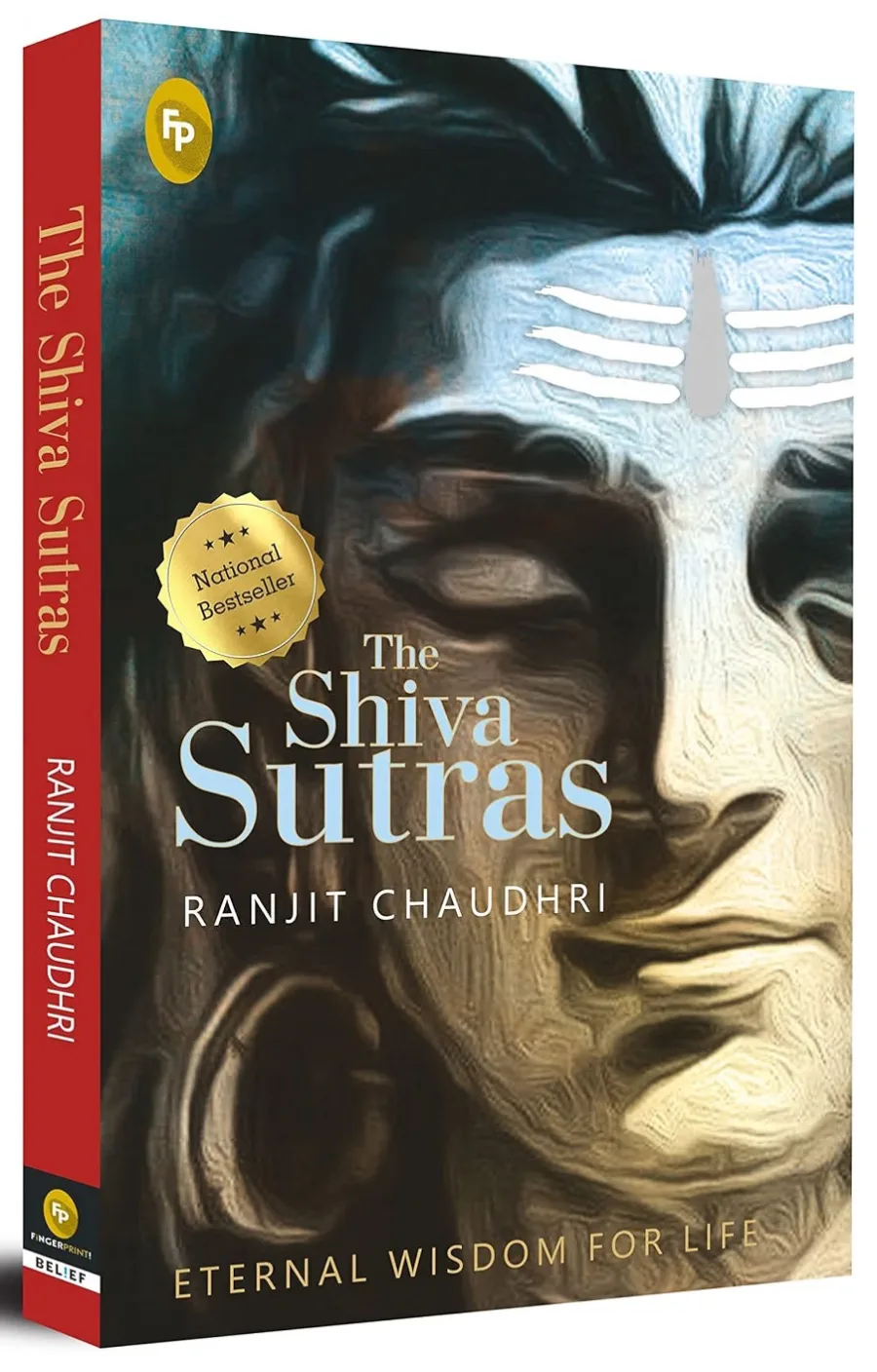
Download Cover Image
Do you want to download the full cover image for The Shiva Sutras?