
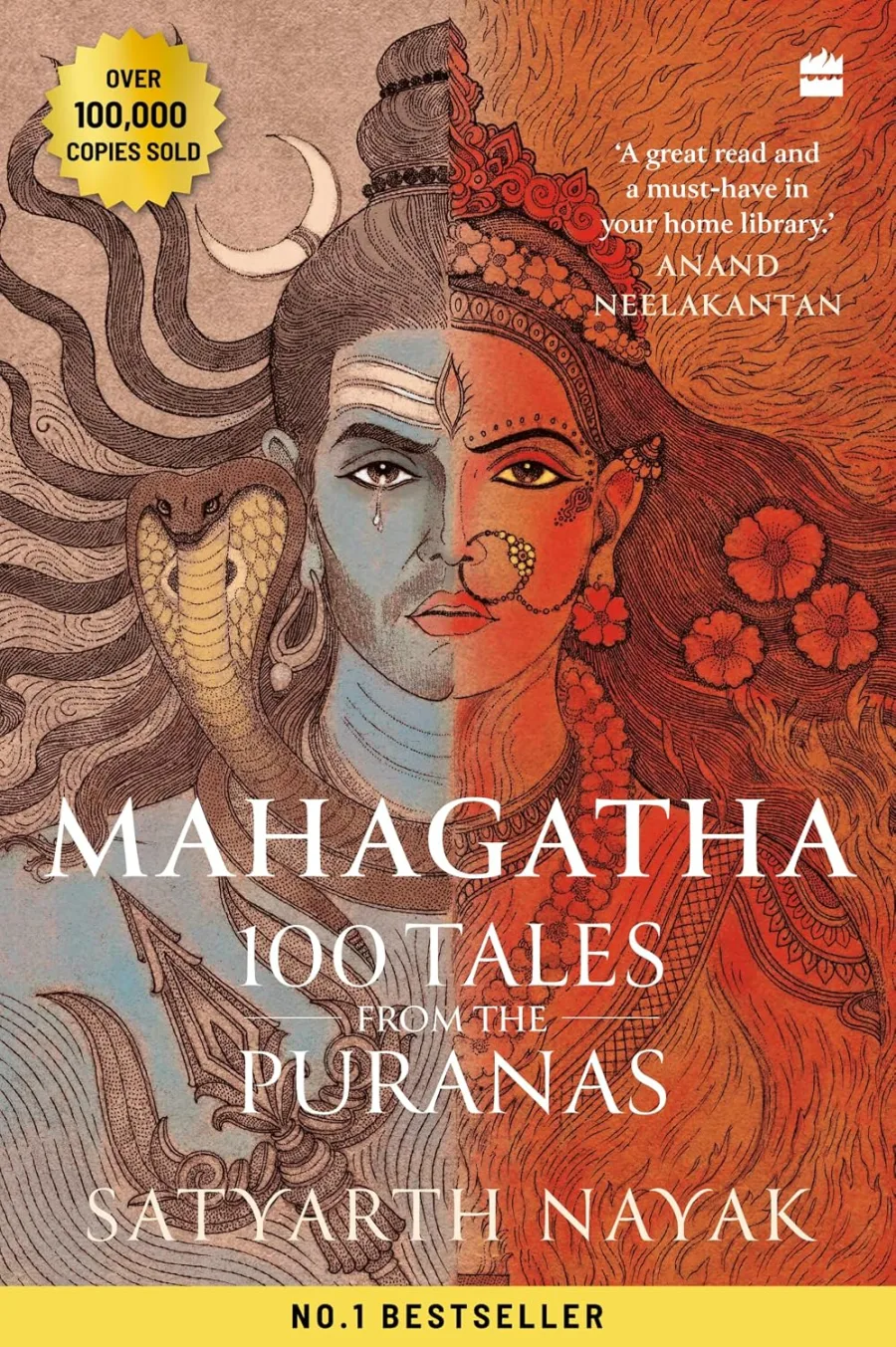
Mahagatha: 100 Tales from the Puranas
Paperback
• 436 Pages
• ₹ 359.00
• English
• 9789356294493
No ratings yet
| Publisher | HarperCollins India |
|---|---|
| ISBN13 | 9789356294493 |
| ASIN/SKU | 9356294496 |
| Book Format | Paperback |
| Language | English |
| Pages | 436 |
| List Price | ₹ 359.00 |
| Publishing Date | 08/12/2022 |
| Dimensions | 3.5 x 14.5 x 21 cm |
| Weight | 430 g |
| Book Code | BD00070744 |
Buy this Book
Amazon Stores
Ebook Stores
Other Stores
Discover Mahagatha: 100 Tales from the Puranas by Satyarth Nayak. This book is published by HarperCollins India in Paperback format, ISBN 9789356294493, ASIN 9356294496, under Religion and Spirituality, Religious and Spiritual Fiction, History of Religion.
Book Description
Do you know the story where Brahma and Vishnu race against each other or where Shiva battles Krishna? Where Indra attempts foeticide ? Do you know about Maya Sita or Narada's monkey face? Or why Surya falls from the sky or why Chandra commits adultery?
The Puranas of Hinduism are a universe of wisdom, embodying a fundamental quest for answers that makes them forever relevant. Now, for the first time, 100 of the greatest mythological tales from these ancient texts have been handpicked and compiled into an epic illustrated edition. Besides popular legends of devas, asuras, sages and kings, Satyarth Nayak has dug up lesser-known stories, like the one where Vishnu is beheaded or where Saraswati curses Lakshmi or where Harishchandra tricks Varuna. Nayak also recounts these 100 tales in a unique chronological format, beginning with Creation in Satya Yuga and ending with the advent of Kali Yuga. Using Puranic markers, he constructs a narrative that travels through the four yugas, offering continuous and organic action. In such a reading, it is revealed that these stories are not isolated events but linked to each other in the grand scheme of things. That every occurrence has a past and a future. A cause and effect. An interconnected cycle of karma and karma-phal.
Delving into the minds of gods, demons and humans alike, Mahagatha seeks a deeper understanding of their motivations. The timelessness of their impulses speaks across the aeons to readers of today. Written in lively prose with charming illustrations, these 100 tales will entertain and enlighten, and make you connect the dots of Hindu mythology like never before.
The Puranas of Hinduism are a universe of wisdom, embodying a fundamental quest for answers that makes them forever relevant. Now, for the first time, 100 of the greatest mythological tales from these ancient texts have been handpicked and compiled into an epic illustrated edition. Besides popular legends of devas, asuras, sages and kings, Satyarth Nayak has dug up lesser-known stories, like the one where Vishnu is beheaded or where Saraswati curses Lakshmi or where Harishchandra tricks Varuna. Nayak also recounts these 100 tales in a unique chronological format, beginning with Creation in Satya Yuga and ending with the advent of Kali Yuga. Using Puranic markers, he constructs a narrative that travels through the four yugas, offering continuous and organic action. In such a reading, it is revealed that these stories are not isolated events but linked to each other in the grand scheme of things. That every occurrence has a past and a future. A cause and effect. An interconnected cycle of karma and karma-phal.
Delving into the minds of gods, demons and humans alike, Mahagatha seeks a deeper understanding of their motivations. The timelessness of their impulses speaks across the aeons to readers of today. Written in lively prose with charming illustrations, these 100 tales will entertain and enlighten, and make you connect the dots of Hindu mythology like never before.
Author Biography
Author....script-writer....journalist....I don several hats. With Masters in English Literature from St. Stephen's College, Delhi, writing has always been a passion. I was Correspondent with CNN-IBN which won me the SAARC Heal Honour 2008 for Health Reporting.
'THE EMPEROR'S RIDDLES' is my debut novel. A mystery thriller with elements of Ancient Indian History and Buddhist Mythology, the thriller hit the stands at the Delhi World Book Fair in February 2014 and has received a great response. The book's cover carries quotes from India's most celebrated mystery authors.
'THE EMPEROR'S RIDDLES' is my debut novel. A mystery thriller with elements of Ancient Indian History and Buddhist Mythology, the thriller hit the stands at the Delhi World Book Fair in February 2014 and has received a great response. The book's cover carries quotes from India's most celebrated mystery authors.
Editorial Reviews
'A great read and a must-have in your home library.' ANAND NEELAKANTAN
Book Summary
Satyarth Nayak’s Mahagatha: 100 Tales from the Puranas is an ambitious retelling of Hindu Puranic mythology that attempts to do something more than simply collect familiar stories. Published by HarperCollins India in 2022, the 436-page book brings together one hundred tales drawn from the vast narrative universe of the Puranas and arranges them chronologically, beginning with creation and moving through the four Yugas toward the advent of Kali Yuga. Google Books Rather than presenting each myth as an isolated episode, Nayak tries to reveal the connections between them—the forgotten curses that produce later events, the boons that create new dangers, the actions that return as consequences, and the recurring movement of karma and karma-phala. PR Newswire
At the heart of Mahagatha is the idea that Hindu mythology is not merely a collection of entertaining stories about gods, demons, kings, sages and celestial beings. It is a huge interconnected narrative in which actions have consequences and apparently separate events often belong to a much larger chain. This approach gives the book its distinctive character. A story that may seem strange or even inexplicable when heard by itself can acquire another dimension when its background and consequences are understood. Nayak therefore presents the Puranic universe almost like an enormous family history in which characters continually reappear in different circumstances, sometimes as ancestors, descendants, rivals, allies, victims or agents of destiny.
The book begins at the beginning—before the familiar world of gods and humans has taken recognizable shape. Creation itself becomes a story. Brahma emerges as the creator, but creation does not proceed as a simple act of divine command. There are struggles, failures, disagreements and unexpected complications. The early tales introduce readers to the cosmic personalities who will dominate much of the subsequent narrative: Brahma, Vishnu, Shiva, Narada, Daksha and numerous other divine and semi-divine beings. One of the early stories, “Brahma and Narada Fight,” immediately establishes an important characteristic of the book: even figures associated with divine wisdom are not presented as emotionless abstractions. Google Books They have desires, frustrations, pride, affection and anger.
This human quality is one of the most interesting features of Mahagatha. The gods of these stories are immensely powerful, but power does not automatically make them perfect. They can become attached, jealous, impatient, proud or compassionate. They make decisions, grant boons, pronounce curses and sometimes suffer the consequences of their own actions. The asuras, meanwhile, are not always depicted as creatures without virtue. They can be extraordinarily devoted, disciplined and courageous. Their problem often lies not in the absence of qualities but in how those qualities are directed. A demon who performs severe austerities may receive a tremendous boon, but the boon can later become the source of destruction. A god who grants that boon may then have to find a way to restore cosmic balance.
This recurring pattern makes karma one of the book’s most important underlying ideas. The Puranic universe of Mahagatha operates through consequences. A curse may appear in one story and become significant much later. A promise can alter the destiny of an entire lineage. A boon can transform an ordinary being into a threat to the gods themselves. The relationship between action and consequence is therefore rarely immediate. What happens today may become the cause of something that happens much later, sometimes across generations or Yugas.
Nayak’s chronological arrangement is particularly important here. Instead of following the conventional approach of placing popular myths next to one another without a larger temporal structure, he begins with creation in Satya Yuga and progresses toward Kali Yuga. The author has described this chronological approach as an attempt to create a continuous narrative from the Puranic material. The Times of India The result is that readers gradually begin to see mythology as a flowing river rather than a collection of disconnected ponds.
Among the stories are many familiar episodes, but the book also deliberately seeks out less familiar narratives. Readers encounter stories such as the race between Brahma and Vishnu, Shiva’s confrontation with Krishna, Maya Sita, Narada’s monkey face, Surya’s fall from the sky and Chandra’s adultery. Nayak also includes more unusual episodes, including the beheading of Vishnu, Saraswati’s curse upon Lakshmi and Harishchandra’s deception of Varuna. Google Books These selections are important because they remind readers that Hindu mythology is far larger than the stories most commonly repeated in popular culture.
The tale of Brahma and Vishnu competing to discover the limits of Shiva, for example, reflects a recurring Puranic fascination with divine hierarchy, identity and the limits of individual power. Such stories do not simply ask which god is stronger. They explore the difficulty of understanding the infinite through finite perception. The gods themselves can become caught in competition and pride, only to discover that reality is greater than their assumptions.
Similarly, the stories involving Shiva frequently reveal the tension between divine compassion and unintended consequences. Shiva is often extraordinarily generous toward those who perform severe penance. But generosity can create danger when the recipient uses divine power without wisdom. Stories involving powerful asuras repeatedly return to this paradox: devotion can produce extraordinary spiritual power, but the moral direction of that power remains crucial.
The stories of Vishnu operate somewhat differently. Vishnu’s role is repeatedly associated with preservation and the restoration of balance. Yet preservation does not always mean passive protection. It can involve disguise, strategy, sacrifice and morally complicated decisions. The stories surrounding avatars and divine interventions demonstrate that maintaining cosmic order can require action that appears mysterious when viewed from only one perspective.
The feminine divine also occupies an important place in this narrative universe. Stories involving Saraswati, Lakshmi, Parvati, Durga and Kali reveal different aspects of power, knowledge, prosperity, motherhood and destruction. The feminine figures are not merely supporting characters standing beside male gods. They can determine the course of events, issue curses, defeat forces that the male gods cannot overcome and embody dimensions of Shakti that are central to the Puranic imagination.
The story of Mahishasura, for instance, belongs to the broader pattern in which a powerful asura becomes almost impossible for the gods to defeat, leading to the emergence of a divine feminine force. Similar patterns occur in stories involving other demons whose powers become excessive. The deeper theme is the restoration of balance when power has moved beyond its proper limits.
One of the most appealing aspects of Mahagatha is that it does not treat mythology as a world populated only by gods. Sages and humans repeatedly become crucial to the cosmic story. Narada is particularly important because he moves between worlds, carrying information, provoking events and connecting characters. He can appear mischievous, but his interventions frequently become part of a larger chain of events. Through characters like Narada, the book demonstrates how apparently minor actions can produce major consequences.
Kings and ordinary human beings also become vehicles for exploring difficult questions about truth, duty, desire and sacrifice. Stories involving figures such as Harishchandra reveal that dharma is not always easy or comfortable. A person may understand the principle of truth yet still face circumstances in which following it demands enormous personal suffering. These stories give the Puranic world emotional depth because their conflicts are recognizable even when their settings are supernatural.
The same is true of stories involving family relationships. Parents and children, husbands and wives, teachers and disciples, brothers and rivals repeatedly become caught in conflicts between personal attachment and larger obligations. Daksha’s relationship with Shiva and Sati, for example, belongs to this wider world of pride, family tension and divine consequence. Such stories suggest that even beings of extraordinary status cannot escape the emotional complexity of relationships.
Another strength of Nayak’s approach is his willingness to explore motivations. The publisher describes the book as an attempt to delve into the minds of gods, demons and humans and understand their motivations rather than merely recording their actions. PR Newswire This makes the stories more accessible to modern readers. Instead of asking only “What happened?”, the narrative repeatedly encourages us to ask “Why did it happen?” and “What followed because of it?”
The writing style contributes significantly to this accessibility. Reviews have noted that the prose is simple, lucid and engaging, while the short chapters make the large volume manageable. Neerja's Musings The book is also illustrated, giving visual form to many of its mythological episodes. The result is a work that can function both as an introduction for newcomers and as a convenient way for familiar readers to revisit stories they may have encountered in childhood.
At the same time, Mahagatha is not intended to replace the Puranas themselves. The Puranic tradition is enormous, internally diverse and sometimes contains different versions of the same story. Nayak has selected and retold one hundred narratives from that much larger body of material. Consequently, the book should be understood as a curated retelling rather than a complete account of Puranic literature. Some readers have also observed that compressing complex stories into accessible retellings can inevitably simplify their philosophical and cultural nuances. reader@work This is an important consideration for anyone approaching the book as a first step toward deeper study.
The chronological structure can also be both a strength and a challenge. Because characters and events are interconnected, reading the book sequentially helps the reader understand why certain events matter later. Reviews have specifically noted that reading the stories chronologically makes the connections between characters and events easier to follow. Wordsopedia The large cast, however, can occasionally become difficult to keep track of, especially for readers unfamiliar with Hindu mythology.
Ultimately, Mahagatha is about connection. Its hundred stories demonstrate that the Puranic imagination rarely sees events as isolated. Creation leads to conflict; conflict produces curses; curses shape destinies; destinies produce new conflicts; and through this endless cycle, the universe continually moves toward restoration and transformation. Gods can make mistakes. Demons can possess admirable qualities. Humans can perform extraordinary acts. Sages can alter the destiny of kings. A single promise can affect generations.
That is what gives the book its title and its larger purpose. Mahagatha is not simply a “hundred tales” collection. It is an attempt to construct one vast story out of many stories. The individual narratives become chapters in a much larger meditation on dharma, desire, devotion, pride, sacrifice, destiny, karma and cosmic balance.
For a reader unfamiliar with the Puranas, the book offers a welcoming doorway into a remarkably vast tradition. For someone who grew up hearing stories of Shiva, Vishnu, Krishna, Durga, Rama, sages and asuras, it can provide a new context in which familiar tales begin to connect with one another. And for readers already interested in Indian mythology, its greatest attraction lies in the lesser-known episodes and the attempt to understand the motivations and consequences behind them.
In the end, Mahagatha: 100 Tales from the Puranas presents mythology not as something frozen in the distant past, but as a living narrative about timeless human impulses. Pride, love, anger, devotion, ambition, jealousy, sacrifice and compassion remain recognizable regardless of whether the characters are human beings, devas or asuras. The worlds may be celestial, the time scales may stretch across Yugas, and the events may involve miraculous powers, but the emotional questions remain surprisingly close to our own lives. That combination—ancient cosmology and recognizable human emotion—is what makes Satyarth Nayak’s retelling accessible, memorable and useful as an introduction to the interconnected world of the Puranas.
At the heart of Mahagatha is the idea that Hindu mythology is not merely a collection of entertaining stories about gods, demons, kings, sages and celestial beings. It is a huge interconnected narrative in which actions have consequences and apparently separate events often belong to a much larger chain. This approach gives the book its distinctive character. A story that may seem strange or even inexplicable when heard by itself can acquire another dimension when its background and consequences are understood. Nayak therefore presents the Puranic universe almost like an enormous family history in which characters continually reappear in different circumstances, sometimes as ancestors, descendants, rivals, allies, victims or agents of destiny.
The book begins at the beginning—before the familiar world of gods and humans has taken recognizable shape. Creation itself becomes a story. Brahma emerges as the creator, but creation does not proceed as a simple act of divine command. There are struggles, failures, disagreements and unexpected complications. The early tales introduce readers to the cosmic personalities who will dominate much of the subsequent narrative: Brahma, Vishnu, Shiva, Narada, Daksha and numerous other divine and semi-divine beings. One of the early stories, “Brahma and Narada Fight,” immediately establishes an important characteristic of the book: even figures associated with divine wisdom are not presented as emotionless abstractions. Google Books They have desires, frustrations, pride, affection and anger.
This human quality is one of the most interesting features of Mahagatha. The gods of these stories are immensely powerful, but power does not automatically make them perfect. They can become attached, jealous, impatient, proud or compassionate. They make decisions, grant boons, pronounce curses and sometimes suffer the consequences of their own actions. The asuras, meanwhile, are not always depicted as creatures without virtue. They can be extraordinarily devoted, disciplined and courageous. Their problem often lies not in the absence of qualities but in how those qualities are directed. A demon who performs severe austerities may receive a tremendous boon, but the boon can later become the source of destruction. A god who grants that boon may then have to find a way to restore cosmic balance.
This recurring pattern makes karma one of the book’s most important underlying ideas. The Puranic universe of Mahagatha operates through consequences. A curse may appear in one story and become significant much later. A promise can alter the destiny of an entire lineage. A boon can transform an ordinary being into a threat to the gods themselves. The relationship between action and consequence is therefore rarely immediate. What happens today may become the cause of something that happens much later, sometimes across generations or Yugas.
Nayak’s chronological arrangement is particularly important here. Instead of following the conventional approach of placing popular myths next to one another without a larger temporal structure, he begins with creation in Satya Yuga and progresses toward Kali Yuga. The author has described this chronological approach as an attempt to create a continuous narrative from the Puranic material. The Times of India The result is that readers gradually begin to see mythology as a flowing river rather than a collection of disconnected ponds.
Among the stories are many familiar episodes, but the book also deliberately seeks out less familiar narratives. Readers encounter stories such as the race between Brahma and Vishnu, Shiva’s confrontation with Krishna, Maya Sita, Narada’s monkey face, Surya’s fall from the sky and Chandra’s adultery. Nayak also includes more unusual episodes, including the beheading of Vishnu, Saraswati’s curse upon Lakshmi and Harishchandra’s deception of Varuna. Google Books These selections are important because they remind readers that Hindu mythology is far larger than the stories most commonly repeated in popular culture.
The tale of Brahma and Vishnu competing to discover the limits of Shiva, for example, reflects a recurring Puranic fascination with divine hierarchy, identity and the limits of individual power. Such stories do not simply ask which god is stronger. They explore the difficulty of understanding the infinite through finite perception. The gods themselves can become caught in competition and pride, only to discover that reality is greater than their assumptions.
Similarly, the stories involving Shiva frequently reveal the tension between divine compassion and unintended consequences. Shiva is often extraordinarily generous toward those who perform severe penance. But generosity can create danger when the recipient uses divine power without wisdom. Stories involving powerful asuras repeatedly return to this paradox: devotion can produce extraordinary spiritual power, but the moral direction of that power remains crucial.
The stories of Vishnu operate somewhat differently. Vishnu’s role is repeatedly associated with preservation and the restoration of balance. Yet preservation does not always mean passive protection. It can involve disguise, strategy, sacrifice and morally complicated decisions. The stories surrounding avatars and divine interventions demonstrate that maintaining cosmic order can require action that appears mysterious when viewed from only one perspective.
The feminine divine also occupies an important place in this narrative universe. Stories involving Saraswati, Lakshmi, Parvati, Durga and Kali reveal different aspects of power, knowledge, prosperity, motherhood and destruction. The feminine figures are not merely supporting characters standing beside male gods. They can determine the course of events, issue curses, defeat forces that the male gods cannot overcome and embody dimensions of Shakti that are central to the Puranic imagination.
The story of Mahishasura, for instance, belongs to the broader pattern in which a powerful asura becomes almost impossible for the gods to defeat, leading to the emergence of a divine feminine force. Similar patterns occur in stories involving other demons whose powers become excessive. The deeper theme is the restoration of balance when power has moved beyond its proper limits.
One of the most appealing aspects of Mahagatha is that it does not treat mythology as a world populated only by gods. Sages and humans repeatedly become crucial to the cosmic story. Narada is particularly important because he moves between worlds, carrying information, provoking events and connecting characters. He can appear mischievous, but his interventions frequently become part of a larger chain of events. Through characters like Narada, the book demonstrates how apparently minor actions can produce major consequences.
Kings and ordinary human beings also become vehicles for exploring difficult questions about truth, duty, desire and sacrifice. Stories involving figures such as Harishchandra reveal that dharma is not always easy or comfortable. A person may understand the principle of truth yet still face circumstances in which following it demands enormous personal suffering. These stories give the Puranic world emotional depth because their conflicts are recognizable even when their settings are supernatural.
The same is true of stories involving family relationships. Parents and children, husbands and wives, teachers and disciples, brothers and rivals repeatedly become caught in conflicts between personal attachment and larger obligations. Daksha’s relationship with Shiva and Sati, for example, belongs to this wider world of pride, family tension and divine consequence. Such stories suggest that even beings of extraordinary status cannot escape the emotional complexity of relationships.
Another strength of Nayak’s approach is his willingness to explore motivations. The publisher describes the book as an attempt to delve into the minds of gods, demons and humans and understand their motivations rather than merely recording their actions. PR Newswire This makes the stories more accessible to modern readers. Instead of asking only “What happened?”, the narrative repeatedly encourages us to ask “Why did it happen?” and “What followed because of it?”
The writing style contributes significantly to this accessibility. Reviews have noted that the prose is simple, lucid and engaging, while the short chapters make the large volume manageable. Neerja's Musings The book is also illustrated, giving visual form to many of its mythological episodes. The result is a work that can function both as an introduction for newcomers and as a convenient way for familiar readers to revisit stories they may have encountered in childhood.
At the same time, Mahagatha is not intended to replace the Puranas themselves. The Puranic tradition is enormous, internally diverse and sometimes contains different versions of the same story. Nayak has selected and retold one hundred narratives from that much larger body of material. Consequently, the book should be understood as a curated retelling rather than a complete account of Puranic literature. Some readers have also observed that compressing complex stories into accessible retellings can inevitably simplify their philosophical and cultural nuances. reader@work This is an important consideration for anyone approaching the book as a first step toward deeper study.
The chronological structure can also be both a strength and a challenge. Because characters and events are interconnected, reading the book sequentially helps the reader understand why certain events matter later. Reviews have specifically noted that reading the stories chronologically makes the connections between characters and events easier to follow. Wordsopedia The large cast, however, can occasionally become difficult to keep track of, especially for readers unfamiliar with Hindu mythology.
Ultimately, Mahagatha is about connection. Its hundred stories demonstrate that the Puranic imagination rarely sees events as isolated. Creation leads to conflict; conflict produces curses; curses shape destinies; destinies produce new conflicts; and through this endless cycle, the universe continually moves toward restoration and transformation. Gods can make mistakes. Demons can possess admirable qualities. Humans can perform extraordinary acts. Sages can alter the destiny of kings. A single promise can affect generations.
That is what gives the book its title and its larger purpose. Mahagatha is not simply a “hundred tales” collection. It is an attempt to construct one vast story out of many stories. The individual narratives become chapters in a much larger meditation on dharma, desire, devotion, pride, sacrifice, destiny, karma and cosmic balance.
For a reader unfamiliar with the Puranas, the book offers a welcoming doorway into a remarkably vast tradition. For someone who grew up hearing stories of Shiva, Vishnu, Krishna, Durga, Rama, sages and asuras, it can provide a new context in which familiar tales begin to connect with one another. And for readers already interested in Indian mythology, its greatest attraction lies in the lesser-known episodes and the attempt to understand the motivations and consequences behind them.
In the end, Mahagatha: 100 Tales from the Puranas presents mythology not as something frozen in the distant past, but as a living narrative about timeless human impulses. Pride, love, anger, devotion, ambition, jealousy, sacrifice and compassion remain recognizable regardless of whether the characters are human beings, devas or asuras. The worlds may be celestial, the time scales may stretch across Yugas, and the events may involve miraculous powers, but the emotional questions remain surprisingly close to our own lives. That combination—ancient cosmology and recognizable human emotion—is what makes Satyarth Nayak’s retelling accessible, memorable and useful as an introduction to the interconnected world of the Puranas.
Sample Chapters
Sample Chapters will be added soon…
Reader Reviews
No reviews yet.
Mahagatha: 100 Tales from the Puranas
Download Cover Image
Do you want to download the full cover image for Mahagatha: 100 Tales from the Puranas?