
The Story Of My Experiments With Truth
Paperback
• 448 Pages
• ₹ 149.00
• English
• 9788172343118
No ratings yet
| Publisher | Fingerprint! Publishing |
|---|---|
| ISBN13 | 9788172343118 |
| ASIN/SKU | 8172343116 |
| Book Format | Paperback |
| Language | English |
| Pages | 448 |
| List Price | ₹ 149.00 |
| Publishing Date | 01/01/2009 |
| Dimensions | 20 x 13 x 2 cm |
| Weight | 305 g |
| Book Code | BD00070742 |
Buy this Book
Amazon Stores
Ebook Stores
Other Stores
Discover The Story Of My Experiments With Truth by Mahatma Gandhi. This book is published by Fingerprint! Publishing in Paperback format, ISBN 9788172343118, ASIN 8172343116, under Biographies and Memoirs, Ethics, Photography Books.
Book Description
Explore the remarkable autobiography of Mahatma Gandhi, "The Story of My Experiments with Truth." Gandhi's insightful narrative takes readers on a transformative journey through his life, principles, and nonviolent philosophy, leaving an indelible mark on the world.
Mahatma Gandhi's autobiography, "The Story of My Experiments with Truth"
Delve into the life and experiences of one of history's greatest leaders
Gandhi's introspective journey, his principles, and his nonviolent philosophy
Perfect for those seeking inspiration, personal growth, and a deeper understanding of Gandhi's legacy
A timeless classic that continues to resonate with readers, promoting peace, truth, and self-reflection.
Mahatma Gandhi's autobiography, "The Story of My Experiments with Truth"
Delve into the life and experiences of one of history's greatest leaders
Gandhi's introspective journey, his principles, and his nonviolent philosophy
Perfect for those seeking inspiration, personal growth, and a deeper understanding of Gandhi's legacy
A timeless classic that continues to resonate with readers, promoting peace, truth, and self-reflection.
Author Biography
Mohandas Karamchand Gandhi, or the Mahatama, was the leader of the Indian national movement. He fought the colonial regime with his philosophy of Satyagraha and Ahimsa. His birthday, October 2nd, is celebrated as the International Day of Non-violence
Editorial Reviews
Editorial Reviews will be added soon…
Book Summary
The Story of My Experiments with Truth by Mahatma Gandhi is much more than a conventional autobiography. It is an unusually intimate account of a human being trying, failing, reflecting, correcting himself, and gradually discovering the principles by which he wants to live. Gandhi does not present his life as a finished success story. Instead, he calls it a series of “experiments” because he sees truth, morality, self-discipline, non-violence, religion, diet, simplicity, and service as things that must be tested through actual living. The autobiography was originally written in Gujarati and covers Gandhi’s life from his childhood through 1921, ending at a point when his public life had become so prominent that he felt there was comparatively little private history left to recount.
From the beginning, Gandhi makes his purpose clear. He is not trying to prove that he has always been right or that he possesses a perfect character. He wants to describe his practical experiments with principles, especially truth and non-violence. He openly acknowledges that his understanding may change and that he has had to examine his own actions repeatedly. For him, truth is the highest principle, and the rest of his moral life grows from the attempt to discover and live according to it. This gives the book its distinctive character: Gandhi is simultaneously the author, the subject, and the person conducting the experiment.
The story begins with Gandhi’s childhood in Porbandar and Rajkot, where he grows up in a religious household. His family environment introduces him to ideas of duty, devotion, morality, and religious tolerance. As a child, however, he is not presented as exceptionally brave or virtuous. He describes himself as shy and sometimes fearful. His early life contains mistakes that he later remembers with considerable embarrassment. These experiences become important because Gandhi's moral development begins not with perfection but with the recognition of his own weaknesses.
One of the most revealing parts of the early autobiography concerns his experiments with meat, smoking, stealing, and other youthful temptations. Gandhi had been persuaded that eating meat could make Indians stronger and perhaps help them resist British domination. He secretly ate meat, partly because he believed that physical strength was connected with national strength. Yet the experience brought him guilt because it involved deceiving his parents. The moral conflict between desire and conscience became more important to him than the experiment itself.
He also recounts stealing a small amount of money and later confessing the act to his father in writing. The episode becomes a powerful lesson in the relationship between truth and repentance. Instead of being punished violently, Gandhi encounters his father's silent sorrow. The emotional effect is profound. Gandhi realizes that honesty can require courage, but confession can also produce healing. This becomes one of the earliest examples of his belief that truth is not merely about speaking accurate words; it is about having the courage to confront oneself.
Gandhi also reflects critically on his childhood marriage to Kasturba. Married at thirteen, he later looks back on the experience with discomfort and recognizes the immaturity and possessiveness that shaped his early understanding of marriage. He does not hide the jealousy and controlling behavior he displayed as a young husband. His willingness to record these weaknesses is significant because the autobiography repeatedly asks the reader to see the difference between the person Gandhi was and the person he hoped to become.
The death of his father becomes another important moment. Gandhi describes being deeply absorbed in his relationship with Kasturba while his father was dying, and he carries a sense of shame about this for years. Instead of presenting himself as morally superior, he uses the memory to examine attachment, desire, responsibility, and self-control. His autobiography therefore becomes a record of conscience as much as a record of events.
Religion gradually becomes more important in Gandhi's life. His upbringing in a Vaishnava environment exposes him to devotion, while his contact with Jain ideas introduces him to non-violence and restraint. Later, his reading and relationships expose him to Christianity, Hindu philosophy, Buddhism, Islam, and other traditions. He does not approach religion merely as an intellectual subject. He wants to discover whether religious principles can transform everyday conduct. His spiritual journey eventually leads him toward the conviction that different religions may contain genuine truth while human beings remain imperfect interpreters of them.
His journey to England marks another stage in his development. Gandhi travels to London to study law, and at first he becomes fascinated by the appearance and manners of an English gentleman. He experiments with clothing, dancing, speech, music, and other aspects of fashionable life. Yet he gradually realizes that imitating an external lifestyle does not make him a better person. His attention turns toward simpler living, vegetarianism, ethical discipline, and religious study.
Vegetarianism becomes particularly important because Gandhi approaches it as an ethical and intellectual question rather than simply as a family custom. He reads vegetarian literature, joins vegetarian organizations, and learns to make his own decisions instead of merely following inherited habits. This becomes a pattern throughout his life: a belief becomes meaningful to Gandhi only when he examines it personally and attempts to practice it.
After qualifying as a barrister, Gandhi returns to India but initially struggles to establish himself professionally. His shyness makes public speaking difficult, and his first legal experiences are not particularly successful. Eventually, an opportunity takes him to South Africa, and this journey becomes the great turning point of his life.
In South Africa, Gandhi encounters racial discrimination in a direct and humiliating form. The famous incident in which he is removed from a train despite possessing a valid ticket becomes a decisive experience. Instead of responding with violence, he begins to ask why such injustice exists and what a person should do when confronted by it. His personal humiliation gradually becomes connected to the larger discrimination experienced by the Indian community.
Gandhi begins organizing Indians, studying the laws that affect them, writing petitions, speaking publicly, and building institutions. He learns that political rights cannot be separated from personal responsibility. If a community wants dignity, its members must also develop discipline, courage, unity, and a willingness to sacrifice.
South Africa is where Gandhi's concept of Satyagraha begins to take shape. The term was developed to describe a form of struggle based on truth and firmness rather than hatred or violence. Gandhi rejected the idea that his movement was simply “passive resistance,” because he believed that genuine non-violent resistance required active courage. The aim was not merely to defeat an opponent but to appeal to the opponent's conscience through truth, non-violence, and willingness to suffer rather than inflict suffering.
This distinction is central to Gandhi's philosophy. Non-violence, in his understanding, is not cowardice. A person who is afraid to fight is not necessarily non-violent. True non-violence requires the courage to face suffering without responding with hatred. Gandhi's experiments in South Africa gradually turn this idea from a personal moral principle into a method of collective action.
His South African years also deepen his commitment to simplicity. Gandhi begins questioning conventional ideas about wealth, professional status, possessions, and comfort. He experiments with diet, manual work, community living, sanitation, education, and self-restraint. His political philosophy becomes increasingly connected to the way he believes a person should live privately.
The relationship between personal discipline and public service becomes especially clear in his experiments with brahmacharya, or celibacy. Gandhi treats self-control as a way of redirecting human energy toward service and spiritual development. These experiments are deeply personal and sometimes controversial, but within the autobiography they represent his larger attempt to bring his private desires under conscious discipline.
Gandhi's experiences during the Boer War and the Zulu conflict also reveal the complexities of his evolving philosophy. He becomes involved in humanitarian service and medical assistance, believing that service to human beings is itself a moral obligation. His later understanding of non-violence would continue to develop, but these experiences show that his philosophy did not appear fully formed. It emerged through difficult choices and reflection.
Another important theme is service. Gandhi increasingly sees public work not as a route to personal power but as an opportunity to serve people who are vulnerable or neglected. This attitude becomes especially visible after his return to India.
Back in India, Gandhi initially travels widely and observes the country carefully. He seeks guidance from Gopal Krishna Gokhale, whom he regards as an important mentor. Rather than immediately presenting himself as a national leader, Gandhi spends time learning about India's conditions. He travels by third-class railway compartments, visits villages, speaks with ordinary people, and studies the problems faced by workers and peasants.
His political work becomes closely connected with local struggles. The Champaran movement over indigo cultivation, the Ahmedabad mill workers' dispute, and the Kheda Satyagraha demonstrate how his philosophy is applied to concrete social problems. Gandhi emphasizes investigation before action. He believes that a leader must understand the facts, listen to affected people, and then determine what form of resistance is appropriate. The contents of the autobiography specifically include his work in Champaran, Ahmedabad, Kheda, and the development of the ashram.
The ashram becomes another laboratory for Gandhi's experiments. It is not simply a place where followers live together; it is intended to be a community in which principles are practiced. Simplicity, manual labor, sanitation, communal responsibility, education, religious reflection, and self-restraint become part of everyday life. Gandhi believes that social transformation cannot be separated from personal transformation.
One of the most important developments in the later sections is Gandhi's growing emphasis on Ahimsa, or non-violence. For him, non-violence is closely tied to truth. A person cannot claim to pursue truth while deliberately cultivating hatred. At the same time, Gandhi recognizes how difficult this principle is. His life repeatedly places him in situations involving injustice, political pressure, violence, and public anger.
The Rowlatt Bills, the nationwide agitation of 1919, and the events surrounding Punjab and Amritsar intensify Gandhi's political engagement. Yet the experience also teaches him that mass movements can become dangerous when people act emotionally rather than with discipline. Gandhi later describes the nationwide agitation as involving what he calls a serious miscalculation, reflecting his willingness to admit that political action can go wrong even when its intentions are sincere. The autobiography's final part records this period of increasing national involvement, including his work with Navajivan, Young India, the Punjab question, the Khilafat issue, the Congress, and the rise of khadi.
Khadi becomes symbolic of another major idea: freedom must involve ordinary people's participation. Gandhi does not regard political independence merely as replacing one group of rulers with another. He increasingly connects freedom with self-reliance, dignity of labor, village life, economic responsibility, and moral discipline.
Perhaps the most remarkable quality of The Story of My Experiments with Truth is its willingness to place Gandhi's imperfections alongside his ideals. He writes about fear, anger, jealousy, mistakes, physical desires, dietary experiments, failures in law, misunderstandings, political errors, and personal shortcomings. The result is not a conventional heroic biography. It is a portrait of someone continually trying to close the gap between what he believes and how he lives.
The book's deepest lesson is therefore not that Gandhi discovered a perfect formula for life. It is that moral growth requires continuous examination. Truth must be practiced. Self-control must be practiced. Compassion must be practiced. Non-violence must be practiced. Courage must be practiced. Even failure can become useful when it leads to honest self-examination.
Gandhi's life, as presented in this autobiography, is ultimately an attempt to make private conduct and public principles agree. Politics, religion, diet, marriage, work, money, health, education, and social service are not separate compartments. They are connected because every action becomes part of the character a person is building.
By ending the autobiography in 1921, Gandhi deliberately leaves the story incomplete. His most famous political struggles were still ahead. Yet this incompleteness fits the philosophy of the book. The “experiments” were never supposed to have a final ending. A human being continues to learn, revise, fail, and begin again.
The Story of My Experiments with Truth therefore remains powerful because it asks a question that extends beyond Gandhi's political career: How should a human being live when ideals are difficult to practice? Gandhi's answer is to experiment honestly. Begin with the truth as one understands it, test it through action, observe the consequences, admit mistakes, correct oneself, and continue the search.
The book's enduring message is that character is not created by claiming to be good. It is created through thousands of choices made when nobody is watching. Gandhi presents himself not as someone who began with certainty, but as someone who repeatedly questioned himself and tried to live more faithfully according to his conscience. His autobiography is consequently both a record of one extraordinary life and a broader meditation on truth, self-discipline, service, courage, simplicity, and non-violence.
At its heart, the book suggests that the search for truth is not merely an intellectual exercise. It is a way of living. And for Gandhi, the most meaningful experiment is one in which a person's beliefs gradually become visible in the way that person eats, speaks, works, treats others, responds to injustice, accepts suffering, and takes responsibility for mistakes. That lifelong attempt—to bring thought, action, and conscience closer together—is the real story behind The Story of My Experiments with Truth.
From the beginning, Gandhi makes his purpose clear. He is not trying to prove that he has always been right or that he possesses a perfect character. He wants to describe his practical experiments with principles, especially truth and non-violence. He openly acknowledges that his understanding may change and that he has had to examine his own actions repeatedly. For him, truth is the highest principle, and the rest of his moral life grows from the attempt to discover and live according to it. This gives the book its distinctive character: Gandhi is simultaneously the author, the subject, and the person conducting the experiment.
The story begins with Gandhi’s childhood in Porbandar and Rajkot, where he grows up in a religious household. His family environment introduces him to ideas of duty, devotion, morality, and religious tolerance. As a child, however, he is not presented as exceptionally brave or virtuous. He describes himself as shy and sometimes fearful. His early life contains mistakes that he later remembers with considerable embarrassment. These experiences become important because Gandhi's moral development begins not with perfection but with the recognition of his own weaknesses.
One of the most revealing parts of the early autobiography concerns his experiments with meat, smoking, stealing, and other youthful temptations. Gandhi had been persuaded that eating meat could make Indians stronger and perhaps help them resist British domination. He secretly ate meat, partly because he believed that physical strength was connected with national strength. Yet the experience brought him guilt because it involved deceiving his parents. The moral conflict between desire and conscience became more important to him than the experiment itself.
He also recounts stealing a small amount of money and later confessing the act to his father in writing. The episode becomes a powerful lesson in the relationship between truth and repentance. Instead of being punished violently, Gandhi encounters his father's silent sorrow. The emotional effect is profound. Gandhi realizes that honesty can require courage, but confession can also produce healing. This becomes one of the earliest examples of his belief that truth is not merely about speaking accurate words; it is about having the courage to confront oneself.
Gandhi also reflects critically on his childhood marriage to Kasturba. Married at thirteen, he later looks back on the experience with discomfort and recognizes the immaturity and possessiveness that shaped his early understanding of marriage. He does not hide the jealousy and controlling behavior he displayed as a young husband. His willingness to record these weaknesses is significant because the autobiography repeatedly asks the reader to see the difference between the person Gandhi was and the person he hoped to become.
The death of his father becomes another important moment. Gandhi describes being deeply absorbed in his relationship with Kasturba while his father was dying, and he carries a sense of shame about this for years. Instead of presenting himself as morally superior, he uses the memory to examine attachment, desire, responsibility, and self-control. His autobiography therefore becomes a record of conscience as much as a record of events.
Religion gradually becomes more important in Gandhi's life. His upbringing in a Vaishnava environment exposes him to devotion, while his contact with Jain ideas introduces him to non-violence and restraint. Later, his reading and relationships expose him to Christianity, Hindu philosophy, Buddhism, Islam, and other traditions. He does not approach religion merely as an intellectual subject. He wants to discover whether religious principles can transform everyday conduct. His spiritual journey eventually leads him toward the conviction that different religions may contain genuine truth while human beings remain imperfect interpreters of them.
His journey to England marks another stage in his development. Gandhi travels to London to study law, and at first he becomes fascinated by the appearance and manners of an English gentleman. He experiments with clothing, dancing, speech, music, and other aspects of fashionable life. Yet he gradually realizes that imitating an external lifestyle does not make him a better person. His attention turns toward simpler living, vegetarianism, ethical discipline, and religious study.
Vegetarianism becomes particularly important because Gandhi approaches it as an ethical and intellectual question rather than simply as a family custom. He reads vegetarian literature, joins vegetarian organizations, and learns to make his own decisions instead of merely following inherited habits. This becomes a pattern throughout his life: a belief becomes meaningful to Gandhi only when he examines it personally and attempts to practice it.
After qualifying as a barrister, Gandhi returns to India but initially struggles to establish himself professionally. His shyness makes public speaking difficult, and his first legal experiences are not particularly successful. Eventually, an opportunity takes him to South Africa, and this journey becomes the great turning point of his life.
In South Africa, Gandhi encounters racial discrimination in a direct and humiliating form. The famous incident in which he is removed from a train despite possessing a valid ticket becomes a decisive experience. Instead of responding with violence, he begins to ask why such injustice exists and what a person should do when confronted by it. His personal humiliation gradually becomes connected to the larger discrimination experienced by the Indian community.
Gandhi begins organizing Indians, studying the laws that affect them, writing petitions, speaking publicly, and building institutions. He learns that political rights cannot be separated from personal responsibility. If a community wants dignity, its members must also develop discipline, courage, unity, and a willingness to sacrifice.
South Africa is where Gandhi's concept of Satyagraha begins to take shape. The term was developed to describe a form of struggle based on truth and firmness rather than hatred or violence. Gandhi rejected the idea that his movement was simply “passive resistance,” because he believed that genuine non-violent resistance required active courage. The aim was not merely to defeat an opponent but to appeal to the opponent's conscience through truth, non-violence, and willingness to suffer rather than inflict suffering.
This distinction is central to Gandhi's philosophy. Non-violence, in his understanding, is not cowardice. A person who is afraid to fight is not necessarily non-violent. True non-violence requires the courage to face suffering without responding with hatred. Gandhi's experiments in South Africa gradually turn this idea from a personal moral principle into a method of collective action.
His South African years also deepen his commitment to simplicity. Gandhi begins questioning conventional ideas about wealth, professional status, possessions, and comfort. He experiments with diet, manual work, community living, sanitation, education, and self-restraint. His political philosophy becomes increasingly connected to the way he believes a person should live privately.
The relationship between personal discipline and public service becomes especially clear in his experiments with brahmacharya, or celibacy. Gandhi treats self-control as a way of redirecting human energy toward service and spiritual development. These experiments are deeply personal and sometimes controversial, but within the autobiography they represent his larger attempt to bring his private desires under conscious discipline.
Gandhi's experiences during the Boer War and the Zulu conflict also reveal the complexities of his evolving philosophy. He becomes involved in humanitarian service and medical assistance, believing that service to human beings is itself a moral obligation. His later understanding of non-violence would continue to develop, but these experiences show that his philosophy did not appear fully formed. It emerged through difficult choices and reflection.
Another important theme is service. Gandhi increasingly sees public work not as a route to personal power but as an opportunity to serve people who are vulnerable or neglected. This attitude becomes especially visible after his return to India.
Back in India, Gandhi initially travels widely and observes the country carefully. He seeks guidance from Gopal Krishna Gokhale, whom he regards as an important mentor. Rather than immediately presenting himself as a national leader, Gandhi spends time learning about India's conditions. He travels by third-class railway compartments, visits villages, speaks with ordinary people, and studies the problems faced by workers and peasants.
His political work becomes closely connected with local struggles. The Champaran movement over indigo cultivation, the Ahmedabad mill workers' dispute, and the Kheda Satyagraha demonstrate how his philosophy is applied to concrete social problems. Gandhi emphasizes investigation before action. He believes that a leader must understand the facts, listen to affected people, and then determine what form of resistance is appropriate. The contents of the autobiography specifically include his work in Champaran, Ahmedabad, Kheda, and the development of the ashram.
The ashram becomes another laboratory for Gandhi's experiments. It is not simply a place where followers live together; it is intended to be a community in which principles are practiced. Simplicity, manual labor, sanitation, communal responsibility, education, religious reflection, and self-restraint become part of everyday life. Gandhi believes that social transformation cannot be separated from personal transformation.
One of the most important developments in the later sections is Gandhi's growing emphasis on Ahimsa, or non-violence. For him, non-violence is closely tied to truth. A person cannot claim to pursue truth while deliberately cultivating hatred. At the same time, Gandhi recognizes how difficult this principle is. His life repeatedly places him in situations involving injustice, political pressure, violence, and public anger.
The Rowlatt Bills, the nationwide agitation of 1919, and the events surrounding Punjab and Amritsar intensify Gandhi's political engagement. Yet the experience also teaches him that mass movements can become dangerous when people act emotionally rather than with discipline. Gandhi later describes the nationwide agitation as involving what he calls a serious miscalculation, reflecting his willingness to admit that political action can go wrong even when its intentions are sincere. The autobiography's final part records this period of increasing national involvement, including his work with Navajivan, Young India, the Punjab question, the Khilafat issue, the Congress, and the rise of khadi.
Khadi becomes symbolic of another major idea: freedom must involve ordinary people's participation. Gandhi does not regard political independence merely as replacing one group of rulers with another. He increasingly connects freedom with self-reliance, dignity of labor, village life, economic responsibility, and moral discipline.
Perhaps the most remarkable quality of The Story of My Experiments with Truth is its willingness to place Gandhi's imperfections alongside his ideals. He writes about fear, anger, jealousy, mistakes, physical desires, dietary experiments, failures in law, misunderstandings, political errors, and personal shortcomings. The result is not a conventional heroic biography. It is a portrait of someone continually trying to close the gap between what he believes and how he lives.
The book's deepest lesson is therefore not that Gandhi discovered a perfect formula for life. It is that moral growth requires continuous examination. Truth must be practiced. Self-control must be practiced. Compassion must be practiced. Non-violence must be practiced. Courage must be practiced. Even failure can become useful when it leads to honest self-examination.
Gandhi's life, as presented in this autobiography, is ultimately an attempt to make private conduct and public principles agree. Politics, religion, diet, marriage, work, money, health, education, and social service are not separate compartments. They are connected because every action becomes part of the character a person is building.
By ending the autobiography in 1921, Gandhi deliberately leaves the story incomplete. His most famous political struggles were still ahead. Yet this incompleteness fits the philosophy of the book. The “experiments” were never supposed to have a final ending. A human being continues to learn, revise, fail, and begin again.
The Story of My Experiments with Truth therefore remains powerful because it asks a question that extends beyond Gandhi's political career: How should a human being live when ideals are difficult to practice? Gandhi's answer is to experiment honestly. Begin with the truth as one understands it, test it through action, observe the consequences, admit mistakes, correct oneself, and continue the search.
The book's enduring message is that character is not created by claiming to be good. It is created through thousands of choices made when nobody is watching. Gandhi presents himself not as someone who began with certainty, but as someone who repeatedly questioned himself and tried to live more faithfully according to his conscience. His autobiography is consequently both a record of one extraordinary life and a broader meditation on truth, self-discipline, service, courage, simplicity, and non-violence.
At its heart, the book suggests that the search for truth is not merely an intellectual exercise. It is a way of living. And for Gandhi, the most meaningful experiment is one in which a person's beliefs gradually become visible in the way that person eats, speaks, works, treats others, responds to injustice, accepts suffering, and takes responsibility for mistakes. That lifelong attempt—to bring thought, action, and conscience closer together—is the real story behind The Story of My Experiments with Truth.
Sample Chapters
Sample Chapters will be added soon…
Reader Reviews
No reviews yet.
The Story Of My Experiments With Truth
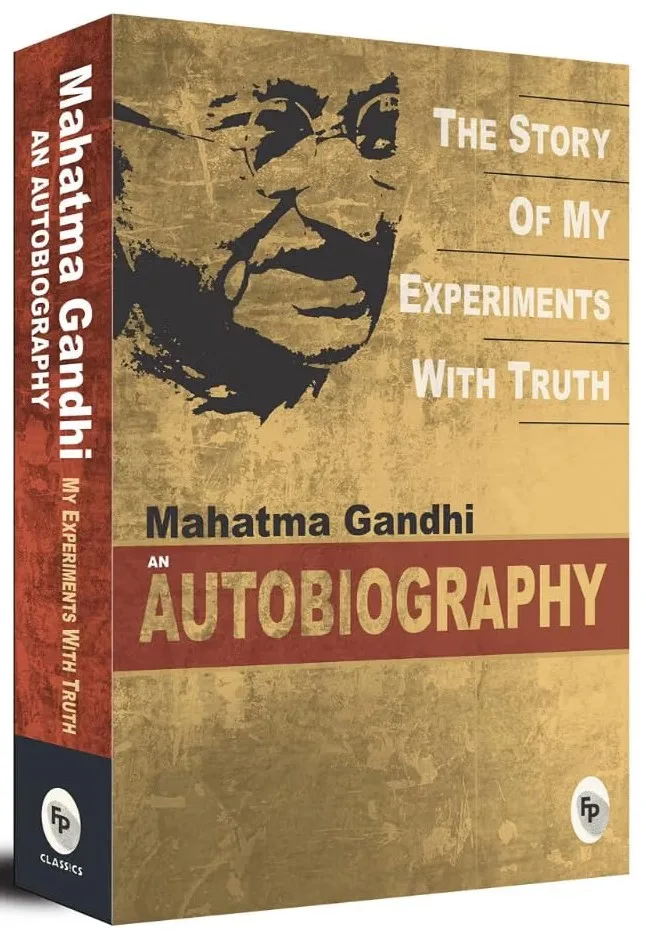
Download Cover Image
Do you want to download the full cover image for The Story Of My Experiments With Truth?