
Focus on What Matters: A Collection of Stoic Letters on Living Well
Paperback
• 276 Pages
• ₹ 254.00
• English
• 9780143461845
No ratings yet
| Publisher | India Penguin |
|---|---|
| ISBN13 | 9780143461845 |
| ASIN/SKU | 0143461842 |
| Book Format | Paperback |
| Language | English |
| Pages | 276 |
| List Price | ₹ 254.00 |
| Publishing Date | 01/08/2023 |
| Dimensions | 12.9 x 1.6 x 19.8 cm |
| Weight | 274 g |
| Book Code | BD00070741 |
Buy this Book
Amazon Stores
Ebook Stores
Other Stores
Discover Focus on What Matters: A Collection of Stoic Letters on Living Well by Darius Foroux. This book is published by India Penguin in Paperback format, ISBN 9780143461845, ASIN 0143461842, under Religion and Spirituality, Self-Help for Happiness, Meditation.
Book Description
Why is it so hard to live well amidst the chaos and noise? While you might think this is a problem of the modern world, it's a timeless issue.
2000 years ago, the ancient Stoics talked about the exact same challenges we're facing today, like:
How can we find inner peace?
What does it take to be happy?
Can we become more resilient?
The answers can be found in the philosophy of Stoicism. I've used the philosophy since 2014 to change my life and career.
Focus on What Matters is a collection of 70 letters/essays I wrote about different aspects of life, from happiness, wealth, health to relationships and much more.
These letters, inspired by the original works of the Stoic philosopher Seneca, serve as reminders to focus on the right things in our chaotic lives.
The goal of the original "Letters From A Stoic" by Seneca was to share Stoic ideas with his friend, Lucilius, who had hedonistic tendencies and lived a busy life.
Focus on What Matters is inspired by those letters. It will show you..
Simple thought exercises to become resilient and focused
How to live in the present moment every day
Authentic Stoic values for a life of happiness
A way to build more discipline
In short, this book helps you to live well despite the challenges of daily life.
2000 years ago, the ancient Stoics talked about the exact same challenges we're facing today, like:
How can we find inner peace?
What does it take to be happy?
Can we become more resilient?
The answers can be found in the philosophy of Stoicism. I've used the philosophy since 2014 to change my life and career.
Focus on What Matters is a collection of 70 letters/essays I wrote about different aspects of life, from happiness, wealth, health to relationships and much more.
These letters, inspired by the original works of the Stoic philosopher Seneca, serve as reminders to focus on the right things in our chaotic lives.
The goal of the original "Letters From A Stoic" by Seneca was to share Stoic ideas with his friend, Lucilius, who had hedonistic tendencies and lived a busy life.
Focus on What Matters is inspired by those letters. It will show you..
Simple thought exercises to become resilient and focused
How to live in the present moment every day
Authentic Stoic values for a life of happiness
A way to build more discipline
In short, this book helps you to live well despite the challenges of daily life.
Author Biography
Darius Foroux is the author of 10 books, including the bestsellers Do It Today, Think Straight, and Win Your Inner Battles. Since 2015, he has been sharing his thoughts on life, business, and productivity on his blog.
His ideas and work have been featured in TIME, NBC, Fast Company, Inc., Observer, and many other publications. Join his free newsletter on his website.
His ideas and work have been featured in TIME, NBC, Fast Company, Inc., Observer, and many other publications. Join his free newsletter on his website.
Editorial Reviews
Editorial Reviews will be added soon…
Book Summary
Focus on What Matters: A Collection of Stoic Letters on Living Well by Darius Foroux is a modern reflection on an ancient problem: how to live a good life when the world constantly competes for our attention. Inspired by Seneca’s Letters from a Stoic, Foroux presents the book as a collection of 70 short letters and essays dealing with happiness, wealth, health, relationships, discipline, resilience, focus, fear, and the challenge of living intentionally. Rather than presenting Stoicism as an abstract philosophical system, Foroux tries to turn its central ideas into practical guidance for everyday life.
The central message of the book is contained in its title. Human beings have limited time, energy, attention, and emotional capacity. Yet modern life encourages us to treat everything as important. We answer every notification, follow every controversy, compare ourselves with strangers, worry about events beyond our control, pursue goals simply because other people value them, and fill our days with activity without asking whether that activity contributes to a meaningful life. Foroux argues that a calmer and more purposeful life begins when we become selective about what deserves our attention. The problem is not simply that the world contains too many distractions; it is that we repeatedly give those distractions permission to occupy our minds.
The book's Stoic foundation begins with the distinction between what we can control and what we cannot. This is one of the oldest and most important ideas in Stoicism, and Foroux repeatedly brings it into modern situations. We cannot completely control what other people think of us, whether a business succeeds, whether someone accepts our proposal, how the economy behaves, what happens in the news, or what difficulties appear in our lives. We can, however, influence our own judgments, choices, preparation, effort, habits, and responses. Much unnecessary suffering comes from trying to control the first category while neglecting the second.
Foroux does not suggest that people should stop caring about results. Instead, he encourages a healthier relationship with results. We should work seriously toward worthwhile goals while recognizing that the final outcome is never entirely ours to command. This attitude creates a useful form of emotional freedom. If success is the only condition under which we allow ourselves to feel satisfied, we become vulnerable to every external event. But if we measure ourselves primarily by whether we acted thoughtfully, courageously, honestly, and consistently, we retain a degree of stability even when circumstances disappoint us.
This idea naturally leads to the book's emphasis on inner life. Foroux sees the mind as something that requires training. Just as the body becomes stronger through repeated physical exercise, our ability to remain calm, focused, and rational develops through repeated mental practice. Stoicism therefore becomes less a collection of quotations and more a daily discipline. The reader is encouraged to examine thoughts, question assumptions, recognize emotional reactions, and create enough distance from immediate impulses to choose a better response.
One of the book's strongest concerns is distraction. Modern technology has made distraction extraordinarily easy. There is always another message, video, headline, email, social-media post, opinion, or piece of entertainment waiting for us. The problem is not merely that these things consume minutes. They fragment attention. A person may spend an entire day technically working while repeatedly shifting attention between tasks, messages, websites, and thoughts. At the end of such a day, exhaustion can coexist with the feeling that nothing truly important was accomplished.
Foroux therefore treats focus as a form of self-respect. If something genuinely matters, it deserves uninterrupted attention. Single-minded focus allows people to produce meaningful work because mental energy is not constantly being divided. The point is not to become productive for productivity's sake. The deeper purpose is to make sure that our limited time is spent on activities that deserve it. In this sense, focus is ultimately a philosophical question: before asking how to do more, we should ask what is actually worth doing.
This also explains Foroux's repeated concern with time. Time is different from money because lost money can sometimes be recovered, while yesterday cannot. Yet people often spend time casually and protect money carefully. We may hesitate before spending a small amount of cash but lose hours to meaningless browsing without noticing. Stoic thinking asks us to reverse this habit and recognize the extraordinary value of our finite existence.
The awareness of mortality is important here. Stoicism has long encouraged people to remember that life is temporary, not as a gloomy exercise but as a way of clarifying priorities. When we genuinely remember that our time is limited, trivial conflicts become less attractive. We begin to ask different questions. Is this argument worth my emotional energy? Is this purchase worth the time required to earn the money? Is this ambition genuinely mine? Am I spending enough time with people I love? Am I postponing something meaningful because I assume there will always be another opportunity?
Foroux also examines happiness. His approach challenges the assumption that happiness comes primarily from acquiring more desirable external things. Wealth, recognition, comfort, and professional success can certainly make aspects of life easier, but they cannot guarantee inner peace. If our happiness depends entirely on circumstances remaining favorable, it will always be fragile. Stoicism instead directs attention toward character, judgment, gratitude, self-control, meaningful relationships, and purposeful action.
This does not mean Foroux advocates rejecting money or ambition. One of the useful aspects of his interpretation is that Stoicism is not presented as a demand to abandon worldly success. A person can build a company, pursue financial security, seek professional achievement, or enjoy material comfort while still practicing Stoic principles. The crucial question is whether these external things control the person's sense of worth and peace. Wealth can be useful without becoming an identity. Success can be enjoyable without becoming the foundation of self-esteem.
The same principle applies to failure. Foroux encourages readers to treat setbacks as information rather than as permanent definitions of themselves. Failure can reveal weaknesses in a plan, insufficient preparation, poor judgment, or circumstances that were impossible to anticipate. Instead of asking, "Why does this always happen to me?" a Stoic approach asks, "What can I learn from what happened, and what can I do differently next time?" This shift moves a person from helplessness toward responsibility.
Responsibility is therefore another recurring theme. Taking responsibility does not mean blaming ourselves for everything that goes wrong. It means recognizing where our choices still matter. Even when circumstances are difficult, there is usually some decision available: how to interpret the situation, what action to take next, what lesson to extract, or what behavior to avoid repeating. Personal responsibility restores agency because it moves attention away from excuses and toward action.
The book also applies Stoic ideas to relationships. Other people are among the greatest sources of both happiness and frustration. People disappoint us, misunderstand us, criticize us, behave selfishly, or simply fail to meet our expectations. Foroux's Stoic perspective asks readers to distinguish between another person's behavior and their own reaction to it. We cannot dictate how others behave, but we can decide whether their behavior will dominate our inner life.
This does not mean becoming cold or indifferent toward others. On the contrary, Stoicism can encourage patience, compassion, forgiveness, and fairness. If we recognize that everyone struggles with fears, desires, weaknesses, and misunderstandings, we may become less eager to react angrily. A calmer person can still establish boundaries and disagree firmly, but does not need to surrender emotional control in the process.
Another important theme is living in the present. Human beings frequently live psychologically in times that do not exist. We replay the past and wish we had acted differently, or we project ourselves into the future and worry about possibilities that may never occur. Foroux's Stoic approach brings attention back to the present moment—not because the past and future are irrelevant, but because the present is where action is possible.
This is especially relevant to anxiety. Worry often feels like preparation, but excessive worry rarely improves our ability to deal with uncertainty. Preparing for difficulties is useful; repeatedly imagining every possible disaster is not. Foroux encourages readers to prepare rationally and then return their attention to the life actually happening in front of them.
Discipline is another essential part of this philosophy. Motivation is unreliable because emotions change from day to day. A person cannot expect to feel inspired every morning. Meaningful progress therefore requires habits and commitments that continue even when enthusiasm disappears. Discipline is not portrayed as harsh punishment but as a structure that protects important priorities from temporary moods.
The letters also repeatedly return to simplicity. A complicated life is not necessarily a richer life. More possessions, more commitments, more goals, more information, and more social obligations can create the appearance of abundance while producing inner exhaustion. Simplifying does not require rejecting everything. It means becoming more deliberate about what remains. When unnecessary commitments are removed, attention becomes available for the people, projects, and values that truly matter.
Perhaps the deepest lesson of Focus on What Matters is that a meaningful life is built through repeated small choices. There is no single moment at which a person permanently becomes disciplined, calm, focused, or wise. These qualities have to be practiced. We lose focus and return to it. We become angry and learn to respond differently. We waste time and become more careful with it. We fail and examine what happened. We become distracted and consciously return to the task in front of us.
This is why the letter format suits the book. Rather than presenting one grand argument and ending with a final answer, Foroux circles around the same fundamental questions from different directions. The collection is inspired by Seneca's letters to Lucilius, and like that model, its purpose is partly repetitive: important ideas need to be remembered because knowing something intellectually is very different from practicing it consistently.
Ultimately, Focus on What Matters is less about becoming extraordinarily productive than about becoming more intentional. Its central question is simple but demanding: What deserves my limited time, attention, and energy? Once that question becomes part of everyday thinking, many decisions become clearer. Some ambitions may prove meaningful; others may reveal themselves as borrowed desires. Some worries deserve action; others deserve acceptance. Some relationships deserve greater care; some distractions deserve less space.
Foroux's modern interpretation of Stoicism offers a practical reminder that we cannot control the entire world, but we can become more thoughtful about the small territory that belongs to us: our attention, our judgments, our actions, our habits, and our responses. The world will remain noisy. Uncertainty will remain. Other people will remain unpredictable. Success will never be guaranteed. Time will continue to pass.
The Stoic response is not to escape this reality but to live intelligently within it. Focus on what matters. Let go of what does not belong to you. Give full attention to the present task. Build character rather than merely chasing outcomes. Accept setbacks without surrendering to them. Value relationships without demanding perfection from people. Use wealth and success as tools rather than as measures of human worth. And, above all, remember that life is finite.
In that sense, the book's message is ultimately about freedom. The person who learns to choose what deserves attention becomes less controlled by the endless demands of the outside world. The goal is not to eliminate every difficulty or distraction, but to stop allowing every difficulty and distraction to determine how we live. Focus on What Matters invites readers to make that choice repeatedly, patiently, and deliberately—until living with greater clarity becomes not an occasional exercise, but a way of life.
The central message of the book is contained in its title. Human beings have limited time, energy, attention, and emotional capacity. Yet modern life encourages us to treat everything as important. We answer every notification, follow every controversy, compare ourselves with strangers, worry about events beyond our control, pursue goals simply because other people value them, and fill our days with activity without asking whether that activity contributes to a meaningful life. Foroux argues that a calmer and more purposeful life begins when we become selective about what deserves our attention. The problem is not simply that the world contains too many distractions; it is that we repeatedly give those distractions permission to occupy our minds.
The book's Stoic foundation begins with the distinction between what we can control and what we cannot. This is one of the oldest and most important ideas in Stoicism, and Foroux repeatedly brings it into modern situations. We cannot completely control what other people think of us, whether a business succeeds, whether someone accepts our proposal, how the economy behaves, what happens in the news, or what difficulties appear in our lives. We can, however, influence our own judgments, choices, preparation, effort, habits, and responses. Much unnecessary suffering comes from trying to control the first category while neglecting the second.
Foroux does not suggest that people should stop caring about results. Instead, he encourages a healthier relationship with results. We should work seriously toward worthwhile goals while recognizing that the final outcome is never entirely ours to command. This attitude creates a useful form of emotional freedom. If success is the only condition under which we allow ourselves to feel satisfied, we become vulnerable to every external event. But if we measure ourselves primarily by whether we acted thoughtfully, courageously, honestly, and consistently, we retain a degree of stability even when circumstances disappoint us.
This idea naturally leads to the book's emphasis on inner life. Foroux sees the mind as something that requires training. Just as the body becomes stronger through repeated physical exercise, our ability to remain calm, focused, and rational develops through repeated mental practice. Stoicism therefore becomes less a collection of quotations and more a daily discipline. The reader is encouraged to examine thoughts, question assumptions, recognize emotional reactions, and create enough distance from immediate impulses to choose a better response.
One of the book's strongest concerns is distraction. Modern technology has made distraction extraordinarily easy. There is always another message, video, headline, email, social-media post, opinion, or piece of entertainment waiting for us. The problem is not merely that these things consume minutes. They fragment attention. A person may spend an entire day technically working while repeatedly shifting attention between tasks, messages, websites, and thoughts. At the end of such a day, exhaustion can coexist with the feeling that nothing truly important was accomplished.
Foroux therefore treats focus as a form of self-respect. If something genuinely matters, it deserves uninterrupted attention. Single-minded focus allows people to produce meaningful work because mental energy is not constantly being divided. The point is not to become productive for productivity's sake. The deeper purpose is to make sure that our limited time is spent on activities that deserve it. In this sense, focus is ultimately a philosophical question: before asking how to do more, we should ask what is actually worth doing.
This also explains Foroux's repeated concern with time. Time is different from money because lost money can sometimes be recovered, while yesterday cannot. Yet people often spend time casually and protect money carefully. We may hesitate before spending a small amount of cash but lose hours to meaningless browsing without noticing. Stoic thinking asks us to reverse this habit and recognize the extraordinary value of our finite existence.
The awareness of mortality is important here. Stoicism has long encouraged people to remember that life is temporary, not as a gloomy exercise but as a way of clarifying priorities. When we genuinely remember that our time is limited, trivial conflicts become less attractive. We begin to ask different questions. Is this argument worth my emotional energy? Is this purchase worth the time required to earn the money? Is this ambition genuinely mine? Am I spending enough time with people I love? Am I postponing something meaningful because I assume there will always be another opportunity?
Foroux also examines happiness. His approach challenges the assumption that happiness comes primarily from acquiring more desirable external things. Wealth, recognition, comfort, and professional success can certainly make aspects of life easier, but they cannot guarantee inner peace. If our happiness depends entirely on circumstances remaining favorable, it will always be fragile. Stoicism instead directs attention toward character, judgment, gratitude, self-control, meaningful relationships, and purposeful action.
This does not mean Foroux advocates rejecting money or ambition. One of the useful aspects of his interpretation is that Stoicism is not presented as a demand to abandon worldly success. A person can build a company, pursue financial security, seek professional achievement, or enjoy material comfort while still practicing Stoic principles. The crucial question is whether these external things control the person's sense of worth and peace. Wealth can be useful without becoming an identity. Success can be enjoyable without becoming the foundation of self-esteem.
The same principle applies to failure. Foroux encourages readers to treat setbacks as information rather than as permanent definitions of themselves. Failure can reveal weaknesses in a plan, insufficient preparation, poor judgment, or circumstances that were impossible to anticipate. Instead of asking, "Why does this always happen to me?" a Stoic approach asks, "What can I learn from what happened, and what can I do differently next time?" This shift moves a person from helplessness toward responsibility.
Responsibility is therefore another recurring theme. Taking responsibility does not mean blaming ourselves for everything that goes wrong. It means recognizing where our choices still matter. Even when circumstances are difficult, there is usually some decision available: how to interpret the situation, what action to take next, what lesson to extract, or what behavior to avoid repeating. Personal responsibility restores agency because it moves attention away from excuses and toward action.
The book also applies Stoic ideas to relationships. Other people are among the greatest sources of both happiness and frustration. People disappoint us, misunderstand us, criticize us, behave selfishly, or simply fail to meet our expectations. Foroux's Stoic perspective asks readers to distinguish between another person's behavior and their own reaction to it. We cannot dictate how others behave, but we can decide whether their behavior will dominate our inner life.
This does not mean becoming cold or indifferent toward others. On the contrary, Stoicism can encourage patience, compassion, forgiveness, and fairness. If we recognize that everyone struggles with fears, desires, weaknesses, and misunderstandings, we may become less eager to react angrily. A calmer person can still establish boundaries and disagree firmly, but does not need to surrender emotional control in the process.
Another important theme is living in the present. Human beings frequently live psychologically in times that do not exist. We replay the past and wish we had acted differently, or we project ourselves into the future and worry about possibilities that may never occur. Foroux's Stoic approach brings attention back to the present moment—not because the past and future are irrelevant, but because the present is where action is possible.
This is especially relevant to anxiety. Worry often feels like preparation, but excessive worry rarely improves our ability to deal with uncertainty. Preparing for difficulties is useful; repeatedly imagining every possible disaster is not. Foroux encourages readers to prepare rationally and then return their attention to the life actually happening in front of them.
Discipline is another essential part of this philosophy. Motivation is unreliable because emotions change from day to day. A person cannot expect to feel inspired every morning. Meaningful progress therefore requires habits and commitments that continue even when enthusiasm disappears. Discipline is not portrayed as harsh punishment but as a structure that protects important priorities from temporary moods.
The letters also repeatedly return to simplicity. A complicated life is not necessarily a richer life. More possessions, more commitments, more goals, more information, and more social obligations can create the appearance of abundance while producing inner exhaustion. Simplifying does not require rejecting everything. It means becoming more deliberate about what remains. When unnecessary commitments are removed, attention becomes available for the people, projects, and values that truly matter.
Perhaps the deepest lesson of Focus on What Matters is that a meaningful life is built through repeated small choices. There is no single moment at which a person permanently becomes disciplined, calm, focused, or wise. These qualities have to be practiced. We lose focus and return to it. We become angry and learn to respond differently. We waste time and become more careful with it. We fail and examine what happened. We become distracted and consciously return to the task in front of us.
This is why the letter format suits the book. Rather than presenting one grand argument and ending with a final answer, Foroux circles around the same fundamental questions from different directions. The collection is inspired by Seneca's letters to Lucilius, and like that model, its purpose is partly repetitive: important ideas need to be remembered because knowing something intellectually is very different from practicing it consistently.
Ultimately, Focus on What Matters is less about becoming extraordinarily productive than about becoming more intentional. Its central question is simple but demanding: What deserves my limited time, attention, and energy? Once that question becomes part of everyday thinking, many decisions become clearer. Some ambitions may prove meaningful; others may reveal themselves as borrowed desires. Some worries deserve action; others deserve acceptance. Some relationships deserve greater care; some distractions deserve less space.
Foroux's modern interpretation of Stoicism offers a practical reminder that we cannot control the entire world, but we can become more thoughtful about the small territory that belongs to us: our attention, our judgments, our actions, our habits, and our responses. The world will remain noisy. Uncertainty will remain. Other people will remain unpredictable. Success will never be guaranteed. Time will continue to pass.
The Stoic response is not to escape this reality but to live intelligently within it. Focus on what matters. Let go of what does not belong to you. Give full attention to the present task. Build character rather than merely chasing outcomes. Accept setbacks without surrendering to them. Value relationships without demanding perfection from people. Use wealth and success as tools rather than as measures of human worth. And, above all, remember that life is finite.
In that sense, the book's message is ultimately about freedom. The person who learns to choose what deserves attention becomes less controlled by the endless demands of the outside world. The goal is not to eliminate every difficulty or distraction, but to stop allowing every difficulty and distraction to determine how we live. Focus on What Matters invites readers to make that choice repeatedly, patiently, and deliberately—until living with greater clarity becomes not an occasional exercise, but a way of life.
Sample Chapters
Sample Chapters will be added soon…
Reader Reviews
No reviews yet.
Focus on What Matters: A Collection of Stoic Letters on Living Well
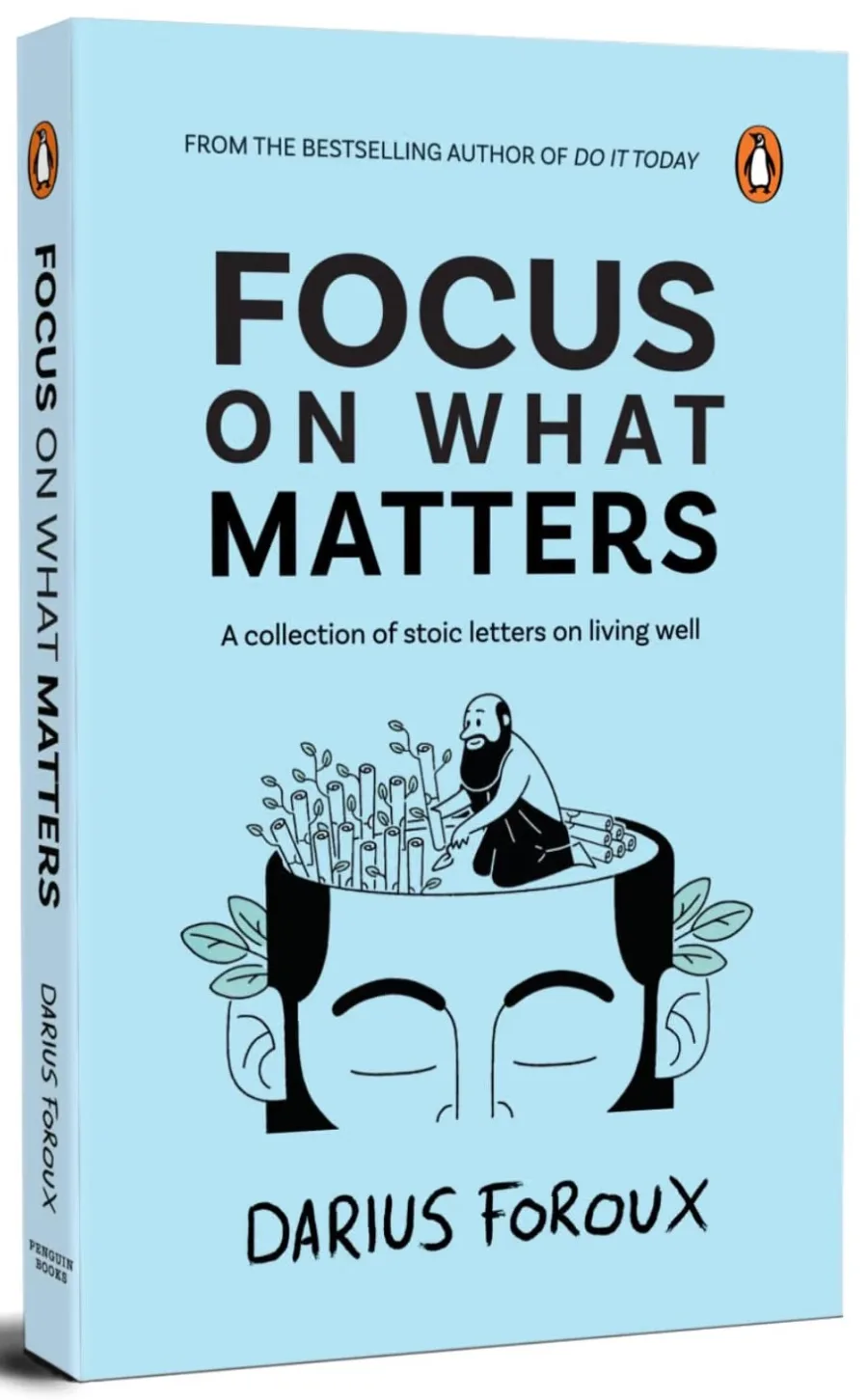
Download Cover Image
Do you want to download the full cover image for Focus on What Matters: A Collection of Stoic Letters on Living Well?