
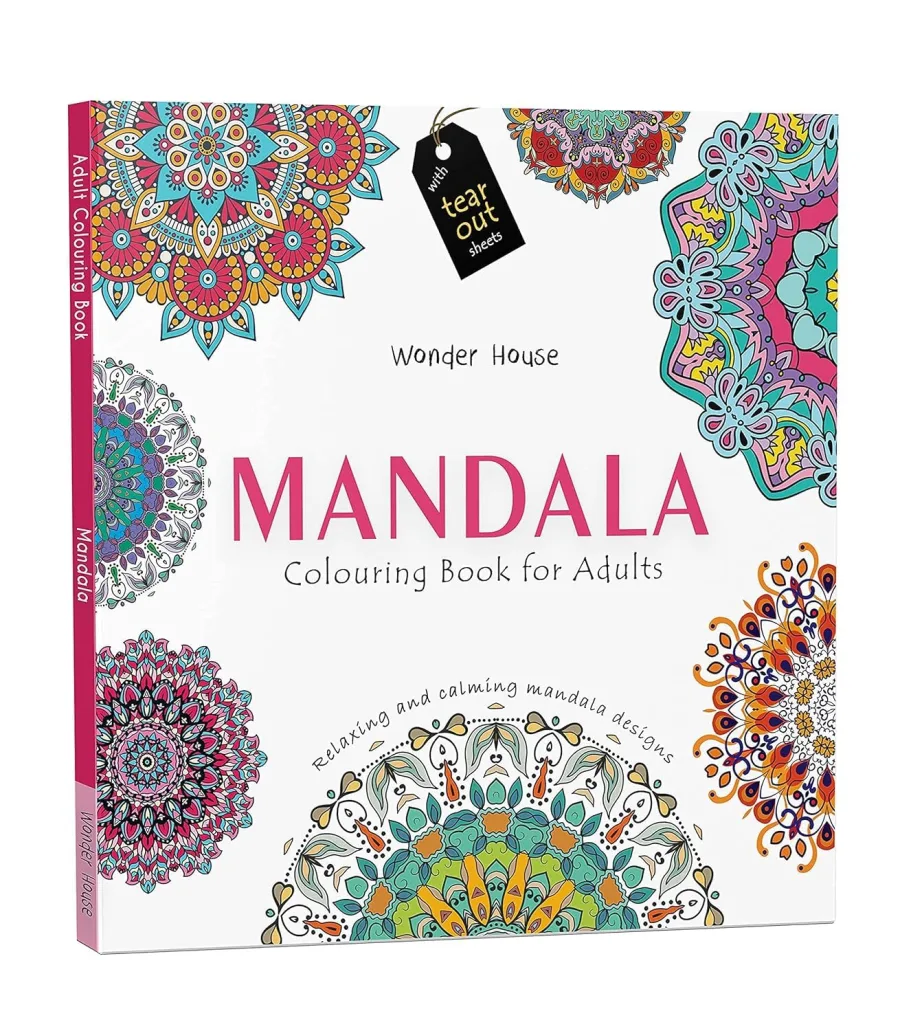
Mandala | Colouring Books For Adults
Paperback
• 64 Pages
• ₹ 299.00
• English
• 9789386538611
No ratings yet
| Publisher | Wonder House Books |
|---|---|
| ISBN13 | 9789386538611 |
| ASIN/SKU | 938653861X |
| Book Format | Paperback |
| Language | English |
| Pages | 64 |
| List Price | ₹ 299.00 |
| Publishing Date | 01/01/2018 |
| Dimensions | 28 x 28 x 0.5 cm |
| Weight | 100 g |
| Book Code | BD00070732 |
Buy this Book
Amazon Stores
Ebook Stores
Other Stores
Discover Mandala | Colouring Books For Adults by Wonder House Books. This book is published by Wonder House Books in Paperback format, ISBN 9789386538611, ASIN 938653861X, under Children's Books, Drawing, Mandala and Geometric Pattern Colouring Books for Grown-Ups.
Book Description
Mandalas are spiritual and ritual diagrams representing the various interpretations of our universe. These powerful diagrams can help you embark on a spiritual journey of self-discovery by allowing you to take a break from a hectic lifestyle. Relax and get rid of your anxieties by adding myriad colors to these extraordinary, beautiful designs.
Gorgeous illustrations
Engaging book to express creativity
Includes tear out sheets
Inculcates imagination and creativity
Encourages relaxation
Gorgeous illustrations
Engaging book to express creativity
Includes tear out sheets
Inculcates imagination and creativity
Encourages relaxation
Author Biography
Wonder House has a dedicated team of editors and designers involved in the development of magnificent and enriching children books. The team pays special attention to develop age appropriate content and does extensive research on every topic included in the book. Our mission is to develop highly informative content which will help the children to master different skills. At Wonder House, we strive to make learning a joy.
Editorial Reviews
Editorial Reviews will be added soon…
Book Summary
Mandala: Colouring Books for Adults by Wonder House Books is not a conventional book that one reads from beginning to end. It is an invitation to slow down, become attentive, and express oneself through colour. Published in 2018, the book contains 64 pages and is designed around mandala patterns, with tear-out sheets that can be displayed, gifted, or framed. Wonder House describes the book as a journey toward calm, clarity, creativity, mindfulness, and self-expression.
The central idea of the book is beautifully simple: sometimes the mind does not need more information; it needs a quiet activity. Modern life often keeps people surrounded by screens, messages, deadlines, responsibilities, and constant stimulation. Even when the body is resting, the mind may continue moving from one thought to another. A mandala colouring book creates a small space in which that restless movement can gradually become slower. The act of choosing a colour, filling a shape, following a line, and watching a pattern develop gives the mind something gentle and concrete to focus upon.
The word “mandala” comes from an ancient spiritual and artistic tradition. Mandalas are generally understood as symbolic diagrams associated with ideas of wholeness, order, the universe, and the self. In different traditions, circular and symmetrical patterns have been used as objects of contemplation and spiritual reflection. Wonder House brings this traditional visual language into the accessible form of an adult colouring book.
What makes the concept particularly appealing is that the reader is not simply looking at finished artwork. The reader participates in completing it. Every blank design becomes a personal creative space. Two people can colour exactly the same mandala and produce completely different results. One person might choose bright reds, oranges, and yellows, creating an energetic image. Another might use blues, greens, and violets to create something quiet and dreamlike. Someone else might use only two or three colours. None of these approaches is necessarily right or wrong. The freedom to make those decisions is an important part of the experience.
The book therefore changes the usual relationship between a book and its reader. Instead of asking the reader to understand an argument, follow a story, remember information, or reach a conclusion, it asks the reader simply to engage. There is no examination at the end, no required interpretation, and no artistic standard that must be achieved. The value lies in the process itself.
A major theme running through the book is mindfulness. Mindfulness, in its simplest sense, involves paying attention to the present moment rather than becoming completely absorbed in thoughts about the past or future. Colouring naturally encourages this kind of attention. When working on a detailed pattern, the eyes have to follow boundaries, the hand has to move carefully, and the mind has to make small decisions about colour and sequence. The activity can therefore become a quiet form of concentration.
This does not mean that colouring automatically removes every worry. Rather, it can provide a temporary change in the way attention is being used. Instead of repeatedly thinking about a difficult conversation, a busy schedule, unfinished work, or everyday responsibilities, the person can devote attention to something immediate and manageable. The page in front of them has a limited task: colour this shape, then the next one, and gradually continue.
That sense of manageable progress is another important feature of the book. Large problems in life can feel overwhelming because they contain too many unknowns at once. A mandala is different. It is made up of small sections. One does not have to complete the entire design in a single sitting. A person can colour for ten minutes, stop, and return later. The unfinished page remains exactly where it was left. This makes the activity flexible enough to fit into ordinary life.
The designs also introduce a sense of order. Mandalas frequently use symmetry, repetition, circles, geometric forms, floral motifs, and carefully arranged patterns. Such repetition can create a visual rhythm. As a person moves from the centre of a design toward its outer sections, or follows repeated shapes around a circle, there can be a satisfying feeling of structure gradually emerging from an empty page.
The book is also concerned with creativity, although it approaches creativity in a non-intimidating way. Many adults believe that they are “not artistic” because they cannot draw realistically or have not received formal art training. A colouring book removes much of that pressure. The outlines are already present. The user does not have to invent the basic composition. Instead, creativity enters through colour choices, combinations, shading, contrasts, repetition, and personal interpretation.
This makes the book suitable for people at different levels of artistic experience. The publisher specifically describes it as containing designs with different levels of complexity. Some patterns can be approached relatively easily, while others allow a person to spend considerably more time working through intricate details.
For a beginner, this variety can make the book approachable. A person can start with a design that feels comfortable and gradually experiment with more complicated patterns. For an experienced colouring enthusiast, the more detailed designs provide opportunities for careful shading and colour combinations. The book therefore does not require the user to possess a particular artistic identity.
Another important quality is the large format. Wonder House lists the dimensions as approximately 28 × 28 cm, giving the pages a substantial square canvas for the mandala designs. The generous page size is useful because mandalas depend on visual detail. Small patterns can become difficult to work with when they are compressed onto a small page. A larger design gives the hand more room and makes individual shapes easier to see.
The book also contains tear-out sheets, which add a practical dimension to the experience. Once a mandala has been completed, the page does not necessarily have to remain inside the book. It can be removed for display, framing, gifting, or simply keeping separately. The publisher specifically presents the tear-out feature as useful for displaying finished artwork.
This feature subtly changes the emotional meaning of the activity. The finished page becomes more than something that was coloured during a quiet afternoon. It becomes a small piece of personal artwork. A person may put it on a wall, give it to a friend, use it as a decorative object, or keep it as a record of a particular period in life. In this way, the book can create a visible connection between time spent quietly and something tangible that remains afterward.
The physical design also makes the book suitable as a gift. Its subject connects creativity with relaxation and self-care, while the designs do not demand specialist knowledge. The publisher positions it for both beginners and experienced colouring enthusiasts, and lists it for readers aged 14 and above.
The choice of colouring materials is another area in which the book allows personal experimentation. Publisher descriptions mention coloured pencils, gel pens, and fine-tip markers as suitable possibilities. Different materials create different experiences. Coloured pencils allow gradual shading and blending; gel pens can create strong, luminous details; fine-tip markers can produce clean and vivid areas of colour. The choice becomes part of the creative ritual.
Reader feedback also suggests that the large designs and variety of patterns are important attractions. Some readers describe the designs as easy to see and relaxing to work on, while others appreciate the range of complexity. At the same time, individual experiences with removing pages and the performance of different colouring materials can vary. These practical observations are worth keeping in mind because the colouring experience depends not only on the artwork but also on the tools being used and the way the finished pages are handled.
Perhaps the deepest idea behind Mandala: Colouring Books for Adults is that creativity does not have to produce something commercially valuable to be worthwhile. Much of adult life is organized around productivity. We work to accomplish something, study to pass something, exercise to achieve something, and often even relax with the expectation that relaxation should improve our productivity later. Colouring offers a different possibility. The activity can be valuable simply because it creates a peaceful period of focused attention.
This makes the book particularly relevant to the idea of self-care. Self-care is sometimes presented through expensive products, elaborate routines, or major lifestyle changes. A colouring book suggests something much simpler: take some time, sit down, choose colours, and allow yourself to work without rushing.
There is also an emotional dimension to finishing a mandala. At the beginning, the page may appear empty except for black outlines. As colour is gradually added, the image becomes increasingly complete. This transformation can create a small but satisfying sense of accomplishment. The result is visible. The person can look at the finished design and know that the transformation happened through their own patience and choices.
Ultimately, Mandala: Colouring Books for Adults is best understood not as a book that tells the reader something, but as a book that gives the reader something to do with attention. Its 64 pages provide a collection of patterned spaces in which creativity, concentration, colour, and quiet can meet.
Its greatest appeal lies in its simplicity. There is no need to be a professional artist. There is no requirement to understand complex spiritual philosophy. There is no single correct colour palette. One can approach the pages slowly, experimentally, playfully, or meditatively. The mandala provides the structure, while the individual supplies the personality.
In a world where attention is constantly being pulled in different directions, this kind of activity can feel refreshingly uncomplicated. A circle becomes a flower-like pattern; a blank outline becomes a colourful image; a few quiet minutes can become a small creative ritual. The completed page is ultimately less important than the experience of creating it.
For that reason, Mandala: Colouring Books for Adults can be seen as a meeting point between art, leisure, mindfulness, and personal expression. It does not promise that colouring will solve every difficulty in life. Instead, it offers something more modest and perhaps more realistic: a peaceful activity through which a person can pause, concentrate, experiment with colour, and spend some time with their own thoughts.
The book's underlying message is therefore gentle but meaningful. Creativity does not always need to be ambitious. Sometimes it can simply mean sitting quietly with a page and deciding what colour belongs in the next small space. In that moment, there is nowhere else to be and nothing else that has to be accomplished. There is only the pattern, the colour, the movement of the hand, and the gradual emergence of something personal from an empty page. That is the quiet experience at the heart of Mandala: Colouring Books for Adults.
The central idea of the book is beautifully simple: sometimes the mind does not need more information; it needs a quiet activity. Modern life often keeps people surrounded by screens, messages, deadlines, responsibilities, and constant stimulation. Even when the body is resting, the mind may continue moving from one thought to another. A mandala colouring book creates a small space in which that restless movement can gradually become slower. The act of choosing a colour, filling a shape, following a line, and watching a pattern develop gives the mind something gentle and concrete to focus upon.
The word “mandala” comes from an ancient spiritual and artistic tradition. Mandalas are generally understood as symbolic diagrams associated with ideas of wholeness, order, the universe, and the self. In different traditions, circular and symmetrical patterns have been used as objects of contemplation and spiritual reflection. Wonder House brings this traditional visual language into the accessible form of an adult colouring book.
What makes the concept particularly appealing is that the reader is not simply looking at finished artwork. The reader participates in completing it. Every blank design becomes a personal creative space. Two people can colour exactly the same mandala and produce completely different results. One person might choose bright reds, oranges, and yellows, creating an energetic image. Another might use blues, greens, and violets to create something quiet and dreamlike. Someone else might use only two or three colours. None of these approaches is necessarily right or wrong. The freedom to make those decisions is an important part of the experience.
The book therefore changes the usual relationship between a book and its reader. Instead of asking the reader to understand an argument, follow a story, remember information, or reach a conclusion, it asks the reader simply to engage. There is no examination at the end, no required interpretation, and no artistic standard that must be achieved. The value lies in the process itself.
A major theme running through the book is mindfulness. Mindfulness, in its simplest sense, involves paying attention to the present moment rather than becoming completely absorbed in thoughts about the past or future. Colouring naturally encourages this kind of attention. When working on a detailed pattern, the eyes have to follow boundaries, the hand has to move carefully, and the mind has to make small decisions about colour and sequence. The activity can therefore become a quiet form of concentration.
This does not mean that colouring automatically removes every worry. Rather, it can provide a temporary change in the way attention is being used. Instead of repeatedly thinking about a difficult conversation, a busy schedule, unfinished work, or everyday responsibilities, the person can devote attention to something immediate and manageable. The page in front of them has a limited task: colour this shape, then the next one, and gradually continue.
That sense of manageable progress is another important feature of the book. Large problems in life can feel overwhelming because they contain too many unknowns at once. A mandala is different. It is made up of small sections. One does not have to complete the entire design in a single sitting. A person can colour for ten minutes, stop, and return later. The unfinished page remains exactly where it was left. This makes the activity flexible enough to fit into ordinary life.
The designs also introduce a sense of order. Mandalas frequently use symmetry, repetition, circles, geometric forms, floral motifs, and carefully arranged patterns. Such repetition can create a visual rhythm. As a person moves from the centre of a design toward its outer sections, or follows repeated shapes around a circle, there can be a satisfying feeling of structure gradually emerging from an empty page.
The book is also concerned with creativity, although it approaches creativity in a non-intimidating way. Many adults believe that they are “not artistic” because they cannot draw realistically or have not received formal art training. A colouring book removes much of that pressure. The outlines are already present. The user does not have to invent the basic composition. Instead, creativity enters through colour choices, combinations, shading, contrasts, repetition, and personal interpretation.
This makes the book suitable for people at different levels of artistic experience. The publisher specifically describes it as containing designs with different levels of complexity. Some patterns can be approached relatively easily, while others allow a person to spend considerably more time working through intricate details.
For a beginner, this variety can make the book approachable. A person can start with a design that feels comfortable and gradually experiment with more complicated patterns. For an experienced colouring enthusiast, the more detailed designs provide opportunities for careful shading and colour combinations. The book therefore does not require the user to possess a particular artistic identity.
Another important quality is the large format. Wonder House lists the dimensions as approximately 28 × 28 cm, giving the pages a substantial square canvas for the mandala designs. The generous page size is useful because mandalas depend on visual detail. Small patterns can become difficult to work with when they are compressed onto a small page. A larger design gives the hand more room and makes individual shapes easier to see.
The book also contains tear-out sheets, which add a practical dimension to the experience. Once a mandala has been completed, the page does not necessarily have to remain inside the book. It can be removed for display, framing, gifting, or simply keeping separately. The publisher specifically presents the tear-out feature as useful for displaying finished artwork.
This feature subtly changes the emotional meaning of the activity. The finished page becomes more than something that was coloured during a quiet afternoon. It becomes a small piece of personal artwork. A person may put it on a wall, give it to a friend, use it as a decorative object, or keep it as a record of a particular period in life. In this way, the book can create a visible connection between time spent quietly and something tangible that remains afterward.
The physical design also makes the book suitable as a gift. Its subject connects creativity with relaxation and self-care, while the designs do not demand specialist knowledge. The publisher positions it for both beginners and experienced colouring enthusiasts, and lists it for readers aged 14 and above.
The choice of colouring materials is another area in which the book allows personal experimentation. Publisher descriptions mention coloured pencils, gel pens, and fine-tip markers as suitable possibilities. Different materials create different experiences. Coloured pencils allow gradual shading and blending; gel pens can create strong, luminous details; fine-tip markers can produce clean and vivid areas of colour. The choice becomes part of the creative ritual.
Reader feedback also suggests that the large designs and variety of patterns are important attractions. Some readers describe the designs as easy to see and relaxing to work on, while others appreciate the range of complexity. At the same time, individual experiences with removing pages and the performance of different colouring materials can vary. These practical observations are worth keeping in mind because the colouring experience depends not only on the artwork but also on the tools being used and the way the finished pages are handled.
Perhaps the deepest idea behind Mandala: Colouring Books for Adults is that creativity does not have to produce something commercially valuable to be worthwhile. Much of adult life is organized around productivity. We work to accomplish something, study to pass something, exercise to achieve something, and often even relax with the expectation that relaxation should improve our productivity later. Colouring offers a different possibility. The activity can be valuable simply because it creates a peaceful period of focused attention.
This makes the book particularly relevant to the idea of self-care. Self-care is sometimes presented through expensive products, elaborate routines, or major lifestyle changes. A colouring book suggests something much simpler: take some time, sit down, choose colours, and allow yourself to work without rushing.
There is also an emotional dimension to finishing a mandala. At the beginning, the page may appear empty except for black outlines. As colour is gradually added, the image becomes increasingly complete. This transformation can create a small but satisfying sense of accomplishment. The result is visible. The person can look at the finished design and know that the transformation happened through their own patience and choices.
Ultimately, Mandala: Colouring Books for Adults is best understood not as a book that tells the reader something, but as a book that gives the reader something to do with attention. Its 64 pages provide a collection of patterned spaces in which creativity, concentration, colour, and quiet can meet.
Its greatest appeal lies in its simplicity. There is no need to be a professional artist. There is no requirement to understand complex spiritual philosophy. There is no single correct colour palette. One can approach the pages slowly, experimentally, playfully, or meditatively. The mandala provides the structure, while the individual supplies the personality.
In a world where attention is constantly being pulled in different directions, this kind of activity can feel refreshingly uncomplicated. A circle becomes a flower-like pattern; a blank outline becomes a colourful image; a few quiet minutes can become a small creative ritual. The completed page is ultimately less important than the experience of creating it.
For that reason, Mandala: Colouring Books for Adults can be seen as a meeting point between art, leisure, mindfulness, and personal expression. It does not promise that colouring will solve every difficulty in life. Instead, it offers something more modest and perhaps more realistic: a peaceful activity through which a person can pause, concentrate, experiment with colour, and spend some time with their own thoughts.
The book's underlying message is therefore gentle but meaningful. Creativity does not always need to be ambitious. Sometimes it can simply mean sitting quietly with a page and deciding what colour belongs in the next small space. In that moment, there is nowhere else to be and nothing else that has to be accomplished. There is only the pattern, the colour, the movement of the hand, and the gradual emergence of something personal from an empty page. That is the quiet experience at the heart of Mandala: Colouring Books for Adults.
Sample Chapters
Sample Chapters will be added soon…
Reader Reviews
No reviews yet.
Mandala | Colouring Books For Adults
Download Cover Image
Do you want to download the full cover image for Mandala | Colouring Books For Adults?