
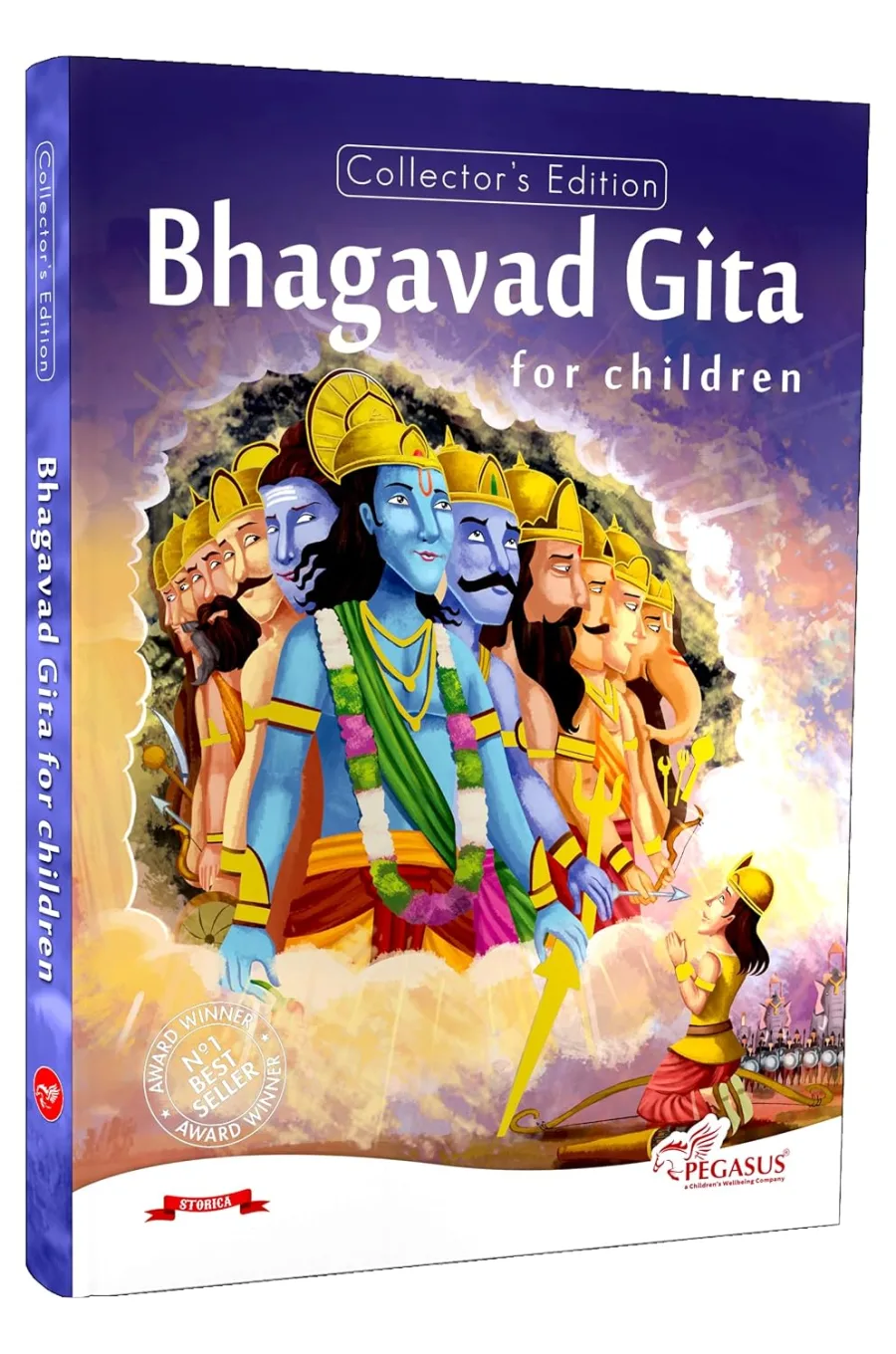
Bhagavad Gita for Children
Hardcover
• 192 Pages
• ₹ 399.00
• English
• 9788131942475
No ratings yet
| Publisher | Pegasus |
|---|---|
| ISBN13 | 9788131942475 |
| ASIN/SKU | 8131942473 |
| Book Format | Hardcover |
| Language | English |
| Pages | 192 |
| List Price | ₹ 399.00 |
| Publishing Date | 20/03/2017 |
| Dimensions | 20.3 x 25.4 x 4.7 cm |
| Weight | 634 g |
| Book Code | BD00070729 |
Buy this Book
Amazon Stores
Ebook Stores
Other Stores
Discover Bhagavad Gita for Children by Sudha Gupta. This book is published by Pegasus in Hardcover format, ISBN 9788131942475, ASIN 8131942473, under Religion and Spirituality, Children's Religion, Hinduism.
Book Description
Bhagavad Gita is one of the most sacred books of India. It is a part of the great epic Mahabharata and contains seven hundred verses. They were uttered by the Supreme Lord Himself at the start of Mahabharata War, when Arjuna did not want to indulge in war seeing all his relatives standing in the enemy army.
Author Biography
Sudha Gupta serves as Chairperson and Director of Mother's Pride. As an educationist, Mrs. Gupta has single-handedly revolutionized pre-school education. Her thoughts have inspired parents and teachers to look at early childhood education from a new perspective. Her emphasis on overall development of child and not just academics has opened new window for tiny tots to blossom into extraordinary beings. Now this visionary has set her eyes to transform formal education.
Editorial Reviews
Editorial Reviews will be added soon…
Book Summary
Bhagavad Gita for Children by Sudha Gupta is a child-friendly introduction to one of the most important spiritual texts of Indian tradition. Published by Pegasus, the book presents the central ideas and stories associated with the Bhagavad Gita in simple, accessible language, supported by illustrations intended to make the material engaging for young readers. The commonly listed edition is a 192-page illustrated hardcover, while some listings describe slightly different edition details.
The Bhagavad Gita itself is part of the Mahabharata and consists of a dialogue between Prince Arjuna and Lord Krishna on the battlefield of Kurukshetra. Arjuna is overwhelmed when he sees members of his own family, teachers, friends, and respected elders standing on the opposite side of the battlefield. He does not want to fight. His emotional crisis becomes the starting point for one of the most profound conversations about duty, right action, knowledge, self-control, devotion, and the nature of life. Sudha Gupta's purpose is not to reproduce the philosophical complexity of the original Sanskrit text in a scholarly manner, but to introduce children to its world and its essential moral and spiritual ideas.
One of the book's greatest strengths is the decision to approach the Gita through stories and simple explanations rather than expecting a young reader to understand difficult philosophical terminology immediately. The publisher describes the work as using simple language and attractive illustrations, while another description specifically notes that the book contains stories related to Lord Krishna alongside the essence of the Bhagavad Gita. This makes the book less intimidating than a conventional translation or commentary.
At the heart of the book is the figure of Arjuna. For children, Arjuna is important not simply because he is a great warrior, but because he experiences emotions that are surprisingly familiar. He becomes confused, frightened, uncertain, and unable to decide what he should do. This is a valuable way of presenting the Gita to a young audience. Children also encounter moments when they do not know whether to tell the truth, stand up for someone, obey an instruction, admit a mistake, compete fairly, or choose between what is easy and what is right. Arjuna's crisis therefore becomes something more than an ancient battlefield story. It becomes a story about making difficult decisions.
Krishna's role in the narrative is equally important. Rather than simply ordering Arjuna to fight, Krishna gradually helps him understand his situation. The conversation explores the difference between acting impulsively and acting with understanding. Arjuna initially sees only the immediate emotional consequences of his decision. Krishna encourages him to look more deeply at duty, responsibility, the temporary nature of the physical body, and the importance of performing one's rightful actions without becoming consumed by their results.
For a child, one of the most important lessons emerging from this teaching is the idea of doing one's duty sincerely. The Gita's teaching about action is often associated with karma yoga: performing one's responsibilities without becoming excessively attached to success or failure. In a simplified form, the lesson can be understood as: do the work that is yours to do, do it honestly and carefully, and do not allow fear of the result to prevent you from doing what is right.
This idea has an immediate connection with childhood. A student may have to study for an examination, practise an instrument, complete homework, participate in a competition, or help at home. Sometimes the child becomes anxious about winning, receiving praise, or being better than others. The Gita offers a different way of looking at effort. The quality of one's action matters greatly, while the final result is not completely within one's control.
Another important theme is courage. Arjuna's problem is not that he lacks physical bravery. He is already a powerful warrior. His difficulty is emotional and moral. He cannot see clearly because his feelings have overwhelmed his judgment. Krishna's teaching therefore suggests that true courage is not simply the ability to face physical danger. It also involves having the strength to face difficult truths, responsibilities, uncertainty, and one's own inner confusion.
This is particularly meaningful for young readers because childhood itself contains many small forms of uncertainty. A child may fear failure, rejection, punishment, embarrassment, or disappointing parents and teachers. Through Arjuna's experience, the book can help children understand that feeling confused does not necessarily mean that one is weak. What matters is learning how to pause, think, seek guidance, and act with greater clarity.
The book also introduces children to the idea of dharma, one of the central concepts associated with the Gita. Dharma can be difficult to translate into one English word because it can involve duty, moral responsibility, right conduct, and living according to one's proper role and principles. For a young reader, however, it can be approached through everyday questions: What is the right thing to do? What responsibility belongs to me? Should I do something simply because it is easy, or because it is right?
The Gita's answer is not presented as a simplistic rule that every difficult situation has an obvious solution. Arjuna himself needs a long conversation before he can understand his responsibility. That is an important lesson in itself. Moral decisions sometimes require thought. We cannot always decide what is right merely by following our immediate feelings.
A second major teaching is self-control. The Gita repeatedly discusses the restless nature of the mind and the importance of learning to govern one's thoughts, desires, and emotions. For children, this can be understood in very practical ways. Anger, jealousy, impatience, greed, and excessive excitement can all affect judgment. A child who learns to pause before reacting is already practising a small form of the discipline that Krishna teaches Arjuna.
The book's presentation of Krishna also contributes to its appeal. Krishna is not introduced only as a distant divine figure. Through stories surrounding his life and character, young readers encounter a figure associated with wisdom, generosity, courage, compassion, and righteous conduct. The publisher specifically presents the book as a means of helping children learn about Krishna and encouraging good character.
This connection between spiritual teaching and character formation is central to the book. The objective is not merely to tell children what the Bhagavad Gita says. It is to show why its ideas can matter in everyday life. Courage, kindness, honesty, responsibility, generosity, discipline, and doing what is right are presented as qualities worth developing.
The book's illustrations play an important supporting role in this process. Because the intended audience includes young children, visual storytelling makes unfamiliar names, settings, characters, and events easier to approach. The book is described as containing colourful pictures and illustrations, and its presentation is deliberately designed to encourage children's interest in reading.
Another significant feature is the book's relationship with Indian cultural heritage. A child who has never encountered the Mahabharata may find the opening circumstances of the Gita unfamiliar: a massive battlefield, two armies facing each other, royal families divided, and Krishna serving as Arjuna's charioteer. By presenting these elements through accessible storytelling, the book provides an entry point into a much larger cultural tradition.
The Gita itself, however, is not merely a historical or mythological story. Its central questions remain deeply human. What should I do when my emotions conflict with my responsibilities? How should I respond to failure? Why should I act ethically when doing so is difficult? What is the difference between temporary pleasure and lasting peace? How can I control my mind? What does it mean to live a meaningful life?
Sudha Gupta's child-oriented adaptation makes these questions approachable without requiring the young reader to begin with complex philosophical terminology. This is one reason the book can also be useful to adults who want a gentle introduction to the subject. Reader responses collected on Goodreads include comments describing it as a lucid introduction and as a useful starting point for understanding Krishna and Indian mythology.
At the same time, it is important to understand what kind of book this is. It should not be approached as a substitute for a complete scholarly translation or traditional commentary on all 700 verses of the Bhagavad Gita. The available descriptions make clear that the book is designed for children and concentrates on stories, accessible explanations, and the essence of the teachings. Its value therefore lies in introduction and accessibility, rather than exhaustive philosophical analysis.
Perhaps the most beautiful lesson young readers can take from the book is that wisdom begins when we honestly acknowledge our confusion. Arjuna does not pretend to know everything. He admits that he is unable to determine the right course of action and turns to Krishna for guidance. This makes him an unusually relatable figure. A child does not need to be fearless, perfectly disciplined, or completely wise before beginning a spiritual journey. Curiosity and the willingness to learn are enough.
The Gita also teaches that external success is not the only measure of a meaningful life. A person can win and still be disturbed within; someone can lose and yet have acted with honesty, courage, and dignity. The emphasis on disciplined action, inner balance, and freedom from excessive attachment to results offers children a healthy way of thinking about achievement. It encourages effort without making self-worth dependent entirely upon winning.
Ultimately, Bhagavad Gita for Children is a gentle doorway into a much larger philosophical tradition. Sudha Gupta takes an ancient dialogue that can sometimes appear intimidating and presents its central ideas through a format that young readers can approach with curiosity. The book introduces Arjuna's dilemma, Krishna's guidance, the importance of duty, the discipline of action, self-control, courage, kindness, righteousness, and devotion. Its simple language and illustrations help transform abstract spiritual ideas into stories and values that children can begin to recognize in their own lives.
In the end, the book's central message can be expressed quite simply: life will often place us in situations where we are confused about what to do, but we can learn to face those situations with courage, wisdom, self-control, and a sincere commitment to what is right. The battlefield of Kurukshetra becomes, in this sense, more than a place from an ancient epic. It becomes a metaphor for the difficult choices every human being eventually faces. For children, this adaptation offers a first glimpse of the idea that spiritual wisdom is not only about knowing sacred stories—it is also about learning how to live with greater clarity, responsibility, kindness, and inner strength.
The Bhagavad Gita itself is part of the Mahabharata and consists of a dialogue between Prince Arjuna and Lord Krishna on the battlefield of Kurukshetra. Arjuna is overwhelmed when he sees members of his own family, teachers, friends, and respected elders standing on the opposite side of the battlefield. He does not want to fight. His emotional crisis becomes the starting point for one of the most profound conversations about duty, right action, knowledge, self-control, devotion, and the nature of life. Sudha Gupta's purpose is not to reproduce the philosophical complexity of the original Sanskrit text in a scholarly manner, but to introduce children to its world and its essential moral and spiritual ideas.
One of the book's greatest strengths is the decision to approach the Gita through stories and simple explanations rather than expecting a young reader to understand difficult philosophical terminology immediately. The publisher describes the work as using simple language and attractive illustrations, while another description specifically notes that the book contains stories related to Lord Krishna alongside the essence of the Bhagavad Gita. This makes the book less intimidating than a conventional translation or commentary.
At the heart of the book is the figure of Arjuna. For children, Arjuna is important not simply because he is a great warrior, but because he experiences emotions that are surprisingly familiar. He becomes confused, frightened, uncertain, and unable to decide what he should do. This is a valuable way of presenting the Gita to a young audience. Children also encounter moments when they do not know whether to tell the truth, stand up for someone, obey an instruction, admit a mistake, compete fairly, or choose between what is easy and what is right. Arjuna's crisis therefore becomes something more than an ancient battlefield story. It becomes a story about making difficult decisions.
Krishna's role in the narrative is equally important. Rather than simply ordering Arjuna to fight, Krishna gradually helps him understand his situation. The conversation explores the difference between acting impulsively and acting with understanding. Arjuna initially sees only the immediate emotional consequences of his decision. Krishna encourages him to look more deeply at duty, responsibility, the temporary nature of the physical body, and the importance of performing one's rightful actions without becoming consumed by their results.
For a child, one of the most important lessons emerging from this teaching is the idea of doing one's duty sincerely. The Gita's teaching about action is often associated with karma yoga: performing one's responsibilities without becoming excessively attached to success or failure. In a simplified form, the lesson can be understood as: do the work that is yours to do, do it honestly and carefully, and do not allow fear of the result to prevent you from doing what is right.
This idea has an immediate connection with childhood. A student may have to study for an examination, practise an instrument, complete homework, participate in a competition, or help at home. Sometimes the child becomes anxious about winning, receiving praise, or being better than others. The Gita offers a different way of looking at effort. The quality of one's action matters greatly, while the final result is not completely within one's control.
Another important theme is courage. Arjuna's problem is not that he lacks physical bravery. He is already a powerful warrior. His difficulty is emotional and moral. He cannot see clearly because his feelings have overwhelmed his judgment. Krishna's teaching therefore suggests that true courage is not simply the ability to face physical danger. It also involves having the strength to face difficult truths, responsibilities, uncertainty, and one's own inner confusion.
This is particularly meaningful for young readers because childhood itself contains many small forms of uncertainty. A child may fear failure, rejection, punishment, embarrassment, or disappointing parents and teachers. Through Arjuna's experience, the book can help children understand that feeling confused does not necessarily mean that one is weak. What matters is learning how to pause, think, seek guidance, and act with greater clarity.
The book also introduces children to the idea of dharma, one of the central concepts associated with the Gita. Dharma can be difficult to translate into one English word because it can involve duty, moral responsibility, right conduct, and living according to one's proper role and principles. For a young reader, however, it can be approached through everyday questions: What is the right thing to do? What responsibility belongs to me? Should I do something simply because it is easy, or because it is right?
The Gita's answer is not presented as a simplistic rule that every difficult situation has an obvious solution. Arjuna himself needs a long conversation before he can understand his responsibility. That is an important lesson in itself. Moral decisions sometimes require thought. We cannot always decide what is right merely by following our immediate feelings.
A second major teaching is self-control. The Gita repeatedly discusses the restless nature of the mind and the importance of learning to govern one's thoughts, desires, and emotions. For children, this can be understood in very practical ways. Anger, jealousy, impatience, greed, and excessive excitement can all affect judgment. A child who learns to pause before reacting is already practising a small form of the discipline that Krishna teaches Arjuna.
The book's presentation of Krishna also contributes to its appeal. Krishna is not introduced only as a distant divine figure. Through stories surrounding his life and character, young readers encounter a figure associated with wisdom, generosity, courage, compassion, and righteous conduct. The publisher specifically presents the book as a means of helping children learn about Krishna and encouraging good character.
This connection between spiritual teaching and character formation is central to the book. The objective is not merely to tell children what the Bhagavad Gita says. It is to show why its ideas can matter in everyday life. Courage, kindness, honesty, responsibility, generosity, discipline, and doing what is right are presented as qualities worth developing.
The book's illustrations play an important supporting role in this process. Because the intended audience includes young children, visual storytelling makes unfamiliar names, settings, characters, and events easier to approach. The book is described as containing colourful pictures and illustrations, and its presentation is deliberately designed to encourage children's interest in reading.
Another significant feature is the book's relationship with Indian cultural heritage. A child who has never encountered the Mahabharata may find the opening circumstances of the Gita unfamiliar: a massive battlefield, two armies facing each other, royal families divided, and Krishna serving as Arjuna's charioteer. By presenting these elements through accessible storytelling, the book provides an entry point into a much larger cultural tradition.
The Gita itself, however, is not merely a historical or mythological story. Its central questions remain deeply human. What should I do when my emotions conflict with my responsibilities? How should I respond to failure? Why should I act ethically when doing so is difficult? What is the difference between temporary pleasure and lasting peace? How can I control my mind? What does it mean to live a meaningful life?
Sudha Gupta's child-oriented adaptation makes these questions approachable without requiring the young reader to begin with complex philosophical terminology. This is one reason the book can also be useful to adults who want a gentle introduction to the subject. Reader responses collected on Goodreads include comments describing it as a lucid introduction and as a useful starting point for understanding Krishna and Indian mythology.
At the same time, it is important to understand what kind of book this is. It should not be approached as a substitute for a complete scholarly translation or traditional commentary on all 700 verses of the Bhagavad Gita. The available descriptions make clear that the book is designed for children and concentrates on stories, accessible explanations, and the essence of the teachings. Its value therefore lies in introduction and accessibility, rather than exhaustive philosophical analysis.
Perhaps the most beautiful lesson young readers can take from the book is that wisdom begins when we honestly acknowledge our confusion. Arjuna does not pretend to know everything. He admits that he is unable to determine the right course of action and turns to Krishna for guidance. This makes him an unusually relatable figure. A child does not need to be fearless, perfectly disciplined, or completely wise before beginning a spiritual journey. Curiosity and the willingness to learn are enough.
The Gita also teaches that external success is not the only measure of a meaningful life. A person can win and still be disturbed within; someone can lose and yet have acted with honesty, courage, and dignity. The emphasis on disciplined action, inner balance, and freedom from excessive attachment to results offers children a healthy way of thinking about achievement. It encourages effort without making self-worth dependent entirely upon winning.
Ultimately, Bhagavad Gita for Children is a gentle doorway into a much larger philosophical tradition. Sudha Gupta takes an ancient dialogue that can sometimes appear intimidating and presents its central ideas through a format that young readers can approach with curiosity. The book introduces Arjuna's dilemma, Krishna's guidance, the importance of duty, the discipline of action, self-control, courage, kindness, righteousness, and devotion. Its simple language and illustrations help transform abstract spiritual ideas into stories and values that children can begin to recognize in their own lives.
In the end, the book's central message can be expressed quite simply: life will often place us in situations where we are confused about what to do, but we can learn to face those situations with courage, wisdom, self-control, and a sincere commitment to what is right. The battlefield of Kurukshetra becomes, in this sense, more than a place from an ancient epic. It becomes a metaphor for the difficult choices every human being eventually faces. For children, this adaptation offers a first glimpse of the idea that spiritual wisdom is not only about knowing sacred stories—it is also about learning how to live with greater clarity, responsibility, kindness, and inner strength.
Sample Chapters
Sample Chapters will be added soon…
Reader Reviews
No reviews yet.
Bhagavad Gita for Children
Download Cover Image
Do you want to download the full cover image for Bhagavad Gita for Children?