
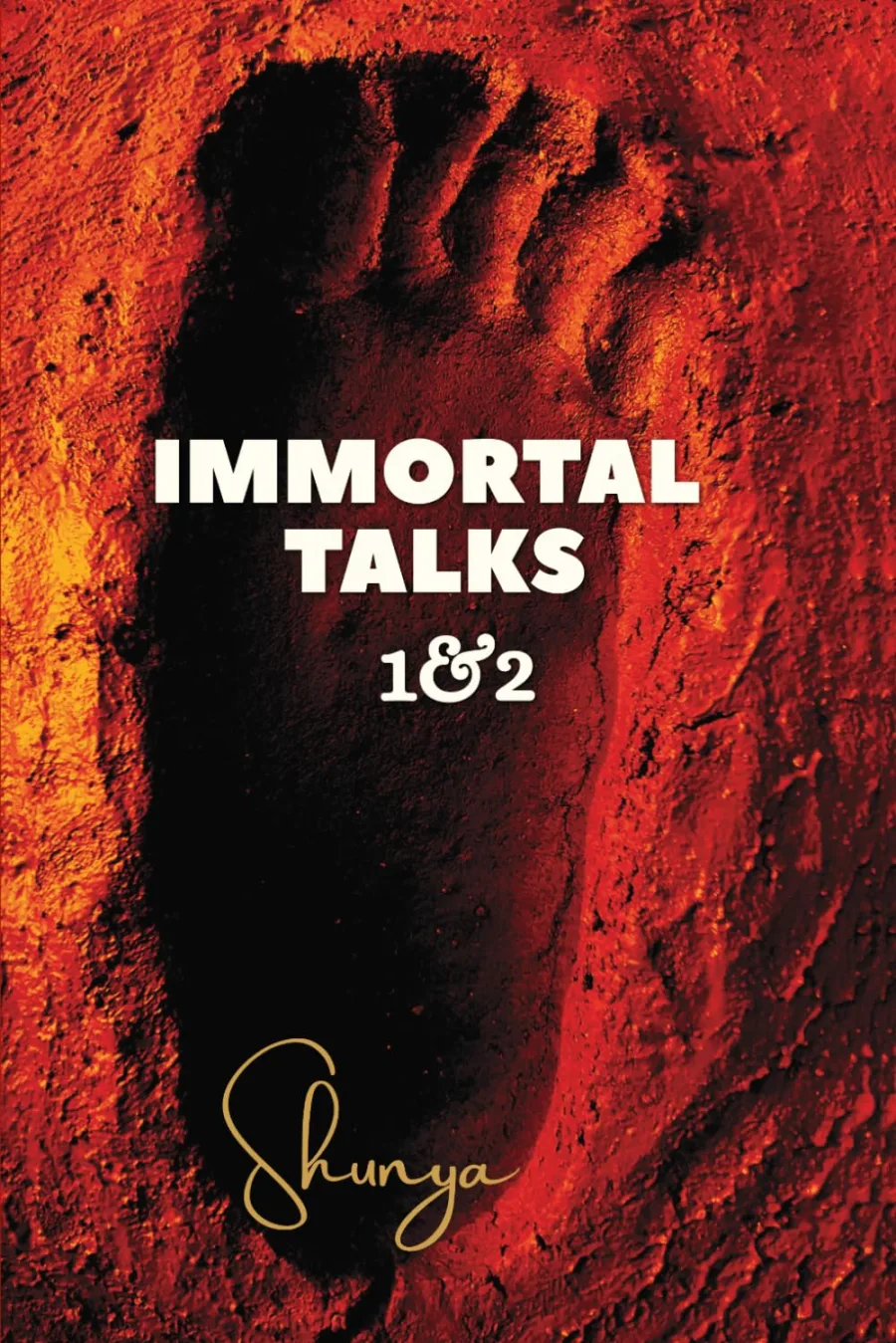
Immortal Talks: 1 & 2
Paperback
• 240 Pages
• ₹ 599.00
• English
No ratings yet
| Publisher | Seer Books |
|---|---|
| ASIN/SKU | 8193305264 |
| Book Format | Paperback |
| Language | English |
| Pages | 240 |
| List Price | ₹ 599.00 |
| Publishing Date | 20/03/2025 |
| Dimensions | 15.24 x 1.45 x 22.86 cm |
| Weight | 328 g |
| Book Code | BD00070726 |
Buy this Book
Amazon Stores
Ebook Stores
Other Stores
Discover Immortal Talks: 1 and 2 by Shunya. This book is published by Seer Books in Paperback format, ASIN 8193305264, under Religion and Spirituality, Hinduism.
Book Description
Book Description will be added soon…
Author Biography
Shunya is the anonymous author of the Immortal Talks series in English and Kalihanuvani in Hindi. Choosing to remain unnamed, he invites readers to engage with the knowledge rather than the individual behind it.
For reader correspondence and updates:
@immortaltalks (English)
@kalihanuvani (Hindi)
Available on Instagram, Facebook, Threads, and Gmail.
For reader correspondence and updates:
@immortaltalks (English)
@kalihanuvani (Hindi)
Available on Instagram, Facebook, Threads, and Gmail.
Editorial Reviews
Editorial Reviews will be added soon…
Book Summary
Immortal Talks: 1 & 2 by Shunya is a spiritual-philosophical work presented through the imaginative framework of a mysterious encounter between human seekers and an immortal being identified as Lord Hanuman. Rather than functioning like a conventional religious text, the book blends mythology, fiction, metaphysics, spirituality, and philosophical inquiry. The combined edition brings together the first two installments of the series and contains twelve chapters, beginning with “The Alternate Mother” and ending with “Continuity.” Seer Books
The story begins in an atmosphere of secrecy and mystery. Deep in a forested mountain region, two monks from the ordinary world encounter a secluded community of people known as the Mahatangs. These people live apart from mainstream society and appear to communicate with an invisible presence. To an outside observer, their behavior might easily seem irrational or impossible. Yet the monks continue watching them because something about their conversations suggests that they are not simply performing rituals or imagining supernatural experiences. They eventually discover that the Mahatangs believe themselves to be disciples of an immortal being who visits them periodically. According to the premise of the book, Lord Hanuman, having attained immortality, promised to return to his mortal disciples every forty-one years. His return becomes the central event around which the entire narrative unfolds. Seer Books
The arrival of the monks gives the story another important dimension. They come from mainstream society, carrying with them the assumptions, logic, doubts, and limitations of ordinary human life. Their presence allows the reader to enter the secluded world of the Mahatangs without having to accept everything immediately. They are, in a sense, observers on behalf of the reader. Their curiosity becomes our curiosity, and their confusion becomes our confusion. The book therefore does not simply present spiritual teachings as abstract statements. Instead, it places those teachings inside a mysterious story and gradually exposes the reader to ideas about existence, consciousness, karma, death, destiny, desire, time, space, and the soul. Seer Books
One of the central ideas running through Immortal Talks is that human beings may understand reality far less completely than they imagine. Ordinary life teaches us to trust what we can see, measure, remember, and logically explain. Shunya repeatedly challenges this limited way of looking at existence. The conversations attributed to the immortal teacher suggest that visible reality may be only one layer of a much larger existence. Human beings live inside particular perceptions, memories, desires, and assumptions, and these mental structures can easily become confused with reality itself.
This is why the book repeatedly returns to the relationship between reality and perception. What a person experiences as reality is influenced by the condition of the mind and by the level of awareness through which the person experiences the world. Two people can encounter the same event and experience entirely different realities because their internal worlds are different. The book encourages readers to question whether what they call “reality” is actually reality itself or merely their interpretation of it.
The chapter “The Alternate Mother” introduces the reader to the book's unusual way of discussing relationships, identity, and existence. The story uses an imaginative situation to make a deeper point: human experience is not always as simple or fixed as it appears. The roles we attach to people—mother, child, friend, enemy, stranger, teacher—belong to a particular framework of experience. From a broader spiritual perspective, relationships may have deeper causes and consequences extending beyond one lifetime.
This connects naturally with the book's treatment of karma. Karma is not presented merely as a system of reward and punishment in which good deeds automatically bring pleasant experiences and bad deeds bring suffering. The discussion is more subtle. Human beings continuously create tendencies through their actions, desires, attachments, memories, and choices. These tendencies influence future experience. In this sense, karma becomes part of the machinery through which consciousness continues to experience life.
The book also explores the complicated relationship between karma and desire. Desire is one of the forces that keeps human beings engaged with worldly experience. People want relationships, success, recognition, possessions, pleasure, security, and countless other things. There is nothing inherently mysterious about wanting something. The deeper problem arises when desire becomes attachment. A person begins to believe that happiness depends upon obtaining or retaining a particular object, person, status, or experience. When circumstances inevitably change, suffering follows.
The book's spiritual perspective suggests that freedom does not necessarily mean abandoning the world. Rather, it involves changing one's relationship with the world. A person can participate in life without becoming completely imprisoned by the things life offers. This distinction between love and attachment is especially important. Love can allow another person to be free, while attachment attempts to possess and control. In this way, the book turns an apparently simple emotional distinction into a broader spiritual principle. Goodreads
“The Mermaid” continues the book's use of unusual metaphors to explain difficult spiritual ideas. Throughout Immortal Talks, stories and images are used because certain experiences are difficult to communicate through straightforward intellectual language. The book recognizes a fundamental problem: some aspects of consciousness cannot easily be reduced to ordinary definitions. This leads naturally to the chapter “Describing the Indescribable.”
Here, language itself becomes a subject of inquiry. Human language is built to identify things, separate one object from another, describe events, and communicate thoughts. But spiritual experience can involve states that do not fit neatly into these categories. The attempt to describe an experience may therefore distort it. A person who has never tasted something cannot completely understand its taste from a verbal description. In a similar way, the book suggests that certain dimensions of spiritual awareness have to be experienced rather than merely explained.
This idea becomes particularly important when the book turns toward time and space. “The Strings of Time” challenges the ordinary human perception of time as a simple line moving from past to present to future. The narrative introduces a more complex conception in which time can be viewed from different levels of awareness. The past is not necessarily as dead and inaccessible as ordinary consciousness assumes, while the future may not be as separate from the present as human beings imagine.
The discussion of time also connects with the book's fascination with parallel realities and alternative possibilities. The second volume develops these ideas further. Readers encounter a vision of existence in which reality may contain possibilities beyond the single physical sequence that an individual experiences. The concept is not presented merely as science fiction; it becomes a philosophical tool for questioning the limits of human perception. Some readers have particularly noted the second book's interest in parallel realities, consciousness, and the possibility of experiencing different versions of existence. Goodreads
“Defeating Death” moves the discussion toward perhaps the most universal fear of all. Death is generally understood as the end of individual existence, and much human anxiety is built around that belief. Immortal Talks approaches death from a different spiritual framework. If the soul is distinct from the physical body, then bodily death is not necessarily the destruction of consciousness. It becomes a transition rather than an absolute ending.
The book does not treat this idea simply as an invitation to stop fearing death. Instead, it asks a deeper question: Who is the person who is afraid of death? Is the self identical to the body, the mind, memories, personality, or something deeper? If everything associated with the physical personality changes over time, what remains continuous?
This question becomes central to the second half of the combined volume. “The Cursed Souls” expands the discussion of consciousness, suffering, and the consequences of unresolved tendencies. The idea of a soul carrying impressions from one experience into another allows the book to explore reincarnation and the persistence of unfinished patterns. Human beings may forget the circumstances that shaped them, but the deeper structures of consciousness may continue.
“A Thousand Lives” develops this idea dramatically. The title itself suggests the enormous scale of existence beyond one human lifetime. Instead of seeing a person's present life as an isolated event, the book encourages the reader to imagine existence as a much longer journey. Birth and death then become points within a larger continuum.
This perspective changes the meaning of many ordinary human problems. A conflict that seems enormous within one lifetime may look very different when viewed against a much larger spiritual timeline. Likewise, a person's talents, fears, attractions, and unexplained tendencies may be interpreted as parts of a longer journey rather than entirely accidental features of one brief existence.
“The Linga Code” takes the discussion into symbolism and deeper metaphysical territory. The linga, traditionally associated with Shiva and widely interpreted within Hindu spiritual traditions as a symbol of profound cosmic principles, becomes part of the book's attempt to connect symbolic forms with larger truths. Shunya repeatedly uses familiar religious imagery while encouraging readers to look beyond literal interpretations.
One of the most interesting developments in the second book is the discussion of the different dimensions of the human being. The human personality is not presented as a single, simple entity. The book distinguishes between different layers or “bodies” associated with physical existence, intellect, intelligence, consciousness-related processes, and accumulated impressions. Reader discussions of the second volume have particularly highlighted its treatment of physical, intellectual, intelligence, chitta, and samskara dimensions. Goodreads
This framework helps explain why people sometimes behave in ways they themselves do not fully understand. A person may intellectually know that something is harmful yet still feel compelled to do it. Another person may suddenly experience an attraction, fear, reaction, or intuition without understanding where it came from. The book suggests that human behavior emerges from several interacting layers rather than from intellect alone.
“Incomplete” takes this idea further by suggesting that unfinished experiences and tendencies remain significant. Human beings often want closure. They want every story to have a clear beginning, middle, and end. But existence may not operate according to this preference. Some experiences remain unresolved, and some questions cannot be answered immediately.
This leads naturally to “The Invisible Four,” where the book continues exploring aspects of existence that cannot be directly perceived through ordinary senses. The invisible does not necessarily mean nonexistent. Much of human life already depends upon invisible forces—thoughts, emotions, memories, intentions, and relationships. The book extends this observation into metaphysical territory.
“The Awareness Setting” is perhaps one of the most practically significant ideas in the combined work. Awareness is presented not merely as passive observation but as something that changes how a person experiences reality. When awareness becomes sharper, a person can begin to notice the difference between an impulse and a choice, between desire and genuine need, between attachment and love, and between intellectual knowledge and deeper understanding.
The final chapter, “Continuity,” brings the major themes together. Life, death, memory, karma, consciousness, time, and identity are treated not as isolated subjects but as interconnected parts of a single mystery. What appears to be an ending may actually be another transition. What appears to be a beginning may have roots far beyond what the individual can remember.
Ultimately, Immortal Talks: 1 & 2 is less interested in giving the reader a simple collection of spiritual answers than in changing the questions the reader asks. Its fictional framework provides the mystery, Lord Hanuman provides the voice of extraordinary wisdom within the story, and the monks provide a bridge between the supernatural world of the narrative and the ordinary world of the reader. The combined edition contains twelve chapters and brings together both volumes, allowing the philosophical and narrative threads to be experienced as one continuous work. Seer Books
The deepest message of the book is that human beings may be far more than the personalities they see in the mirror. The body changes, circumstances change, relationships change, thoughts change, and even one's sense of identity changes. Yet behind this constant movement lies the possibility of a deeper awareness that can observe these changes without being completely controlled by them.
For readers approaching the book as fiction, Immortal Talks offers an imaginative supernatural story filled with mystery, hidden communities, an immortal teacher, metaphysical possibilities, and unusual ideas about time and existence. For readers approaching it as philosophy or spirituality, it becomes an invitation to examine consciousness, attachment, karma, death, reincarnation, and the nature of the self. The book does not require every reader to accept its metaphysical propositions literally. Its greater value lies in the questions it provokes: What is reality? What survives death? How much of our behavior is truly conscious? Are our desires controlling us? Is time as straightforward as we believe? And beneath the changing personality, what is the enduring self?
In that sense, Immortal Talks: 1 & 2 is ultimately a journey inward. Its forests, immortals, monks, hidden disciples, parallel realities, souls, and cosmic mysteries create the outer story, but its real subject is the human search for understanding. The book asks readers to slow down, look beyond immediate appearances, and consider that existence may be much larger, stranger, and more interconnected than ordinary human awareness allows us to see.
The story begins in an atmosphere of secrecy and mystery. Deep in a forested mountain region, two monks from the ordinary world encounter a secluded community of people known as the Mahatangs. These people live apart from mainstream society and appear to communicate with an invisible presence. To an outside observer, their behavior might easily seem irrational or impossible. Yet the monks continue watching them because something about their conversations suggests that they are not simply performing rituals or imagining supernatural experiences. They eventually discover that the Mahatangs believe themselves to be disciples of an immortal being who visits them periodically. According to the premise of the book, Lord Hanuman, having attained immortality, promised to return to his mortal disciples every forty-one years. His return becomes the central event around which the entire narrative unfolds. Seer Books
The arrival of the monks gives the story another important dimension. They come from mainstream society, carrying with them the assumptions, logic, doubts, and limitations of ordinary human life. Their presence allows the reader to enter the secluded world of the Mahatangs without having to accept everything immediately. They are, in a sense, observers on behalf of the reader. Their curiosity becomes our curiosity, and their confusion becomes our confusion. The book therefore does not simply present spiritual teachings as abstract statements. Instead, it places those teachings inside a mysterious story and gradually exposes the reader to ideas about existence, consciousness, karma, death, destiny, desire, time, space, and the soul. Seer Books
One of the central ideas running through Immortal Talks is that human beings may understand reality far less completely than they imagine. Ordinary life teaches us to trust what we can see, measure, remember, and logically explain. Shunya repeatedly challenges this limited way of looking at existence. The conversations attributed to the immortal teacher suggest that visible reality may be only one layer of a much larger existence. Human beings live inside particular perceptions, memories, desires, and assumptions, and these mental structures can easily become confused with reality itself.
This is why the book repeatedly returns to the relationship between reality and perception. What a person experiences as reality is influenced by the condition of the mind and by the level of awareness through which the person experiences the world. Two people can encounter the same event and experience entirely different realities because their internal worlds are different. The book encourages readers to question whether what they call “reality” is actually reality itself or merely their interpretation of it.
The chapter “The Alternate Mother” introduces the reader to the book's unusual way of discussing relationships, identity, and existence. The story uses an imaginative situation to make a deeper point: human experience is not always as simple or fixed as it appears. The roles we attach to people—mother, child, friend, enemy, stranger, teacher—belong to a particular framework of experience. From a broader spiritual perspective, relationships may have deeper causes and consequences extending beyond one lifetime.
This connects naturally with the book's treatment of karma. Karma is not presented merely as a system of reward and punishment in which good deeds automatically bring pleasant experiences and bad deeds bring suffering. The discussion is more subtle. Human beings continuously create tendencies through their actions, desires, attachments, memories, and choices. These tendencies influence future experience. In this sense, karma becomes part of the machinery through which consciousness continues to experience life.
The book also explores the complicated relationship between karma and desire. Desire is one of the forces that keeps human beings engaged with worldly experience. People want relationships, success, recognition, possessions, pleasure, security, and countless other things. There is nothing inherently mysterious about wanting something. The deeper problem arises when desire becomes attachment. A person begins to believe that happiness depends upon obtaining or retaining a particular object, person, status, or experience. When circumstances inevitably change, suffering follows.
The book's spiritual perspective suggests that freedom does not necessarily mean abandoning the world. Rather, it involves changing one's relationship with the world. A person can participate in life without becoming completely imprisoned by the things life offers. This distinction between love and attachment is especially important. Love can allow another person to be free, while attachment attempts to possess and control. In this way, the book turns an apparently simple emotional distinction into a broader spiritual principle. Goodreads
“The Mermaid” continues the book's use of unusual metaphors to explain difficult spiritual ideas. Throughout Immortal Talks, stories and images are used because certain experiences are difficult to communicate through straightforward intellectual language. The book recognizes a fundamental problem: some aspects of consciousness cannot easily be reduced to ordinary definitions. This leads naturally to the chapter “Describing the Indescribable.”
Here, language itself becomes a subject of inquiry. Human language is built to identify things, separate one object from another, describe events, and communicate thoughts. But spiritual experience can involve states that do not fit neatly into these categories. The attempt to describe an experience may therefore distort it. A person who has never tasted something cannot completely understand its taste from a verbal description. In a similar way, the book suggests that certain dimensions of spiritual awareness have to be experienced rather than merely explained.
This idea becomes particularly important when the book turns toward time and space. “The Strings of Time” challenges the ordinary human perception of time as a simple line moving from past to present to future. The narrative introduces a more complex conception in which time can be viewed from different levels of awareness. The past is not necessarily as dead and inaccessible as ordinary consciousness assumes, while the future may not be as separate from the present as human beings imagine.
The discussion of time also connects with the book's fascination with parallel realities and alternative possibilities. The second volume develops these ideas further. Readers encounter a vision of existence in which reality may contain possibilities beyond the single physical sequence that an individual experiences. The concept is not presented merely as science fiction; it becomes a philosophical tool for questioning the limits of human perception. Some readers have particularly noted the second book's interest in parallel realities, consciousness, and the possibility of experiencing different versions of existence. Goodreads
“Defeating Death” moves the discussion toward perhaps the most universal fear of all. Death is generally understood as the end of individual existence, and much human anxiety is built around that belief. Immortal Talks approaches death from a different spiritual framework. If the soul is distinct from the physical body, then bodily death is not necessarily the destruction of consciousness. It becomes a transition rather than an absolute ending.
The book does not treat this idea simply as an invitation to stop fearing death. Instead, it asks a deeper question: Who is the person who is afraid of death? Is the self identical to the body, the mind, memories, personality, or something deeper? If everything associated with the physical personality changes over time, what remains continuous?
This question becomes central to the second half of the combined volume. “The Cursed Souls” expands the discussion of consciousness, suffering, and the consequences of unresolved tendencies. The idea of a soul carrying impressions from one experience into another allows the book to explore reincarnation and the persistence of unfinished patterns. Human beings may forget the circumstances that shaped them, but the deeper structures of consciousness may continue.
“A Thousand Lives” develops this idea dramatically. The title itself suggests the enormous scale of existence beyond one human lifetime. Instead of seeing a person's present life as an isolated event, the book encourages the reader to imagine existence as a much longer journey. Birth and death then become points within a larger continuum.
This perspective changes the meaning of many ordinary human problems. A conflict that seems enormous within one lifetime may look very different when viewed against a much larger spiritual timeline. Likewise, a person's talents, fears, attractions, and unexplained tendencies may be interpreted as parts of a longer journey rather than entirely accidental features of one brief existence.
“The Linga Code” takes the discussion into symbolism and deeper metaphysical territory. The linga, traditionally associated with Shiva and widely interpreted within Hindu spiritual traditions as a symbol of profound cosmic principles, becomes part of the book's attempt to connect symbolic forms with larger truths. Shunya repeatedly uses familiar religious imagery while encouraging readers to look beyond literal interpretations.
One of the most interesting developments in the second book is the discussion of the different dimensions of the human being. The human personality is not presented as a single, simple entity. The book distinguishes between different layers or “bodies” associated with physical existence, intellect, intelligence, consciousness-related processes, and accumulated impressions. Reader discussions of the second volume have particularly highlighted its treatment of physical, intellectual, intelligence, chitta, and samskara dimensions. Goodreads
This framework helps explain why people sometimes behave in ways they themselves do not fully understand. A person may intellectually know that something is harmful yet still feel compelled to do it. Another person may suddenly experience an attraction, fear, reaction, or intuition without understanding where it came from. The book suggests that human behavior emerges from several interacting layers rather than from intellect alone.
“Incomplete” takes this idea further by suggesting that unfinished experiences and tendencies remain significant. Human beings often want closure. They want every story to have a clear beginning, middle, and end. But existence may not operate according to this preference. Some experiences remain unresolved, and some questions cannot be answered immediately.
This leads naturally to “The Invisible Four,” where the book continues exploring aspects of existence that cannot be directly perceived through ordinary senses. The invisible does not necessarily mean nonexistent. Much of human life already depends upon invisible forces—thoughts, emotions, memories, intentions, and relationships. The book extends this observation into metaphysical territory.
“The Awareness Setting” is perhaps one of the most practically significant ideas in the combined work. Awareness is presented not merely as passive observation but as something that changes how a person experiences reality. When awareness becomes sharper, a person can begin to notice the difference between an impulse and a choice, between desire and genuine need, between attachment and love, and between intellectual knowledge and deeper understanding.
The final chapter, “Continuity,” brings the major themes together. Life, death, memory, karma, consciousness, time, and identity are treated not as isolated subjects but as interconnected parts of a single mystery. What appears to be an ending may actually be another transition. What appears to be a beginning may have roots far beyond what the individual can remember.
Ultimately, Immortal Talks: 1 & 2 is less interested in giving the reader a simple collection of spiritual answers than in changing the questions the reader asks. Its fictional framework provides the mystery, Lord Hanuman provides the voice of extraordinary wisdom within the story, and the monks provide a bridge between the supernatural world of the narrative and the ordinary world of the reader. The combined edition contains twelve chapters and brings together both volumes, allowing the philosophical and narrative threads to be experienced as one continuous work. Seer Books
The deepest message of the book is that human beings may be far more than the personalities they see in the mirror. The body changes, circumstances change, relationships change, thoughts change, and even one's sense of identity changes. Yet behind this constant movement lies the possibility of a deeper awareness that can observe these changes without being completely controlled by them.
For readers approaching the book as fiction, Immortal Talks offers an imaginative supernatural story filled with mystery, hidden communities, an immortal teacher, metaphysical possibilities, and unusual ideas about time and existence. For readers approaching it as philosophy or spirituality, it becomes an invitation to examine consciousness, attachment, karma, death, reincarnation, and the nature of the self. The book does not require every reader to accept its metaphysical propositions literally. Its greater value lies in the questions it provokes: What is reality? What survives death? How much of our behavior is truly conscious? Are our desires controlling us? Is time as straightforward as we believe? And beneath the changing personality, what is the enduring self?
In that sense, Immortal Talks: 1 & 2 is ultimately a journey inward. Its forests, immortals, monks, hidden disciples, parallel realities, souls, and cosmic mysteries create the outer story, but its real subject is the human search for understanding. The book asks readers to slow down, look beyond immediate appearances, and consider that existence may be much larger, stranger, and more interconnected than ordinary human awareness allows us to see.
Sample Chapters
Sample Chapters will be added soon…
Reader Reviews
No reviews yet.
Immortal Talks: 1 & 2
Download Cover Image
Do you want to download the full cover image for Immortal Talks: 1 & 2?