
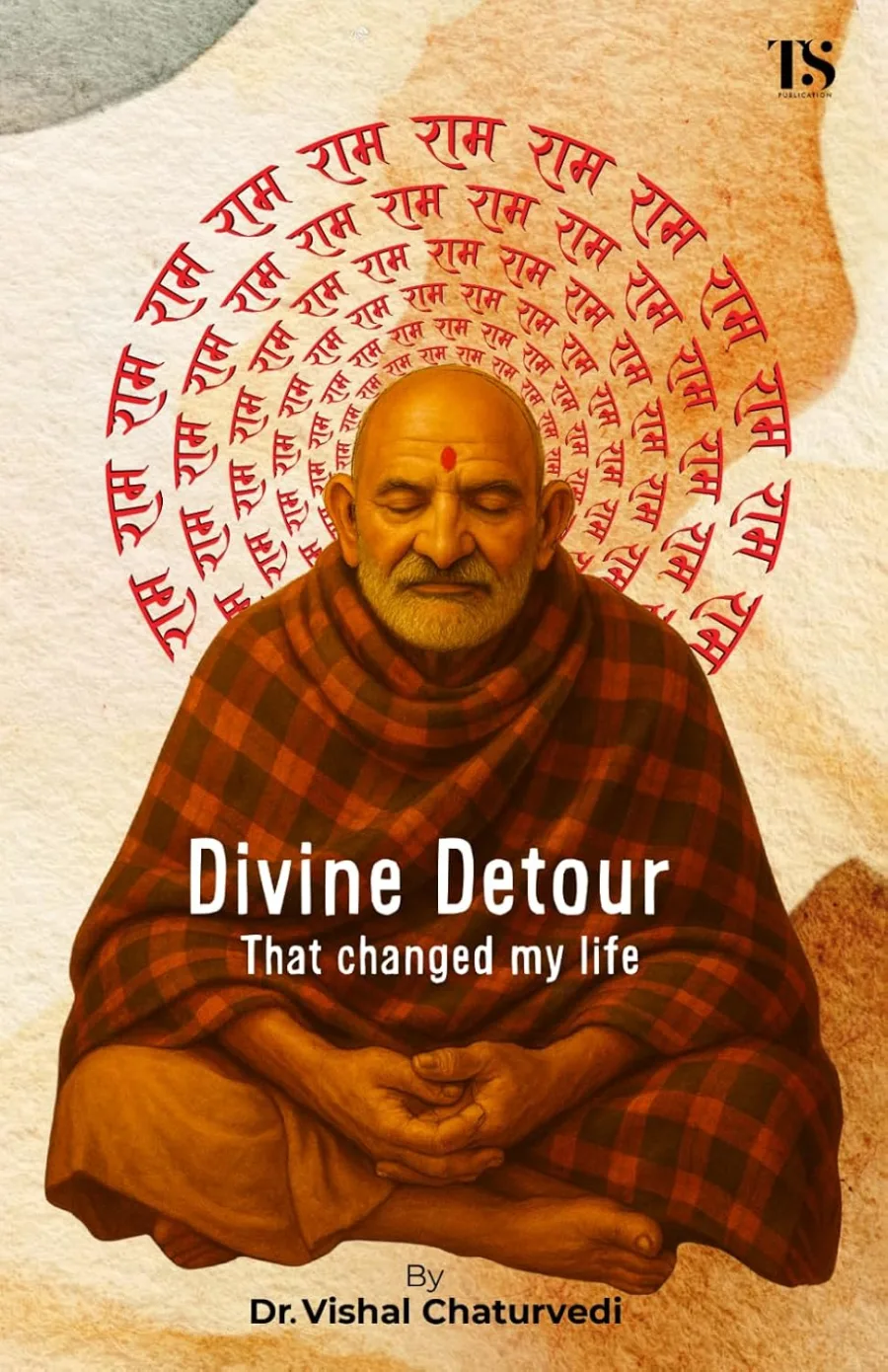
Divine Detour : That Changed My Life
Paperback
• 103 Pages
• ₹ 501.00
• English
• 9789349262232
No ratings yet
| Publisher | Truth and Social Publication |
|---|---|
| ISBN13 | 9789349262232 |
| ASIN/SKU | 9349262231 |
| Book Format | Paperback |
| Language | English |
| Pages | 103 |
| List Price | ₹ 501.00 |
| Publishing Date | 10/06/2026 |
| Book Code | BD00070720 |
Buy this Book
Amazon Stores
Ebook Stores
Other Stores
Discover Divine Detour : That Changed My Life by Dr. Vishal Chaturvedi. This book is published by Truth and Social Publication in Paperback format, ISBN 9789349262232, ASIN 9349262231, under Religion and Spirituality, Hinduism.
Book Description
Divine Detour: That Changed My Life – A Journey of Faith, Devotion and Divine Grace Divine Detour: That Changed My Life by Dr. Vishal Chaturvedi is a deeply personal spiritual memoir about faith, transformation, devotion, self-discovery, and the mysterious ways in which life can lead us toward a higher purpose. In 2006, an unexpected visit to Kainchi Dham, associated with the revered spiritual master Neem Karoli Baba, became a turning point in the author's life. What initially appeared to be an accidental detour gradually unfolded into a profound spiritual journey, leading him toward deeper devotion, inner transformation, and an enduring connection with Lord Hanuman. Through heartfelt personal experiences, spiritual reflections, devotional practices, and lessons drawn from his journey, the author explores how faith and surrender can transform the way we understand ourselves, our challenges, and the purpose of our lives. Inside This Spiritual Memoir The author's personal journey of spiritual awakening and transformation Experiences connected with Kainchi Dham and Neem Karoli Baba The meaning and practice of Hanuman Bhakti Personal reflections on faith, devotion, and surrender Stories of meaningful spiritual experiences and divine grace Lessons on purpose, self-discovery, and inner peace Reflections on miracles and experiences that changed the author's perspective Insights into devotional living and modern spirituality A Story of Faith and Transformation Divine Detour is more than a conventional autobiography. It is an invitation to look beyond everyday circumstances and reflect on the unexpected moments that can change the direction of our lives. The book explores the transformative power of faith, devotion, surrender, spirituality, and self-reflection, while sharing the author's personal experiences in an accessible and heartfelt manner. Why Read Divine Detour? Authentic personal spiritual experiences Inspiring reflections on faith and devotion A personal perspective on Neem Karoli Baba and Kainchi Dham Insights into Hanuman Bhakti and devotional practice Thought-provoking lessons about purpose and inner peace Encouragement for personal growth and spiritual reflection Accessible storytelling for both beginners and experienced spiritual seekers Who Is This Book For? Followers and admirers of Neem Karoli Baba Devotees of Lord Hanuman Spiritual seekers and truth seekers Readers interested in Indian spirituality Readers of spiritual memoirs and inspirational life stories Devotional literature enthusiasts Yoga and meditation practitioners Readers interested in self-discovery and personal transformation Anyone seeking greater purpose, faith, and inner peace Whether you are beginning your spiritual journey or have been walking the path of devotion for years, Divine Detour: That Changed My Life offers a heartfelt story of faith, surrender, transformation, and the possibility of discovering grace in the most unexpected turns of life. Sometimes what feels like a detour may be the beginning of a completely new journey.
Author Biography
Author Biography will be added soon…
Editorial Reviews
Editorial Reviews will be added soon…
Book Summary
Divine Detour: That Changed My Life by Dr. Vishal Chaturvedi is a deeply personal spiritual memoir about faith, unexpected encounters, devotion, surrender, and the mysterious ways in which a seemingly ordinary incident can redirect an entire life. At its heart is the author's encounter with Neem Karoli Baba, also known as Maharajji, and the profound influence that Baba's life, teachings, devotion to Hanuman, and philosophy of service had on him. Rather than presenting spirituality as something distant or confined to temples and religious texts, the book explores how a spiritual encounter can gradually change the way a person understands life, purpose, relationships, and service. Published by Truth and Social Publication, the book eventually became the foundation for Chaturvedi's later cinematic work Hanuman Ansh.
The title Divine Detour captures the central idea of the memoir beautifully. A detour is normally something we regard as an inconvenience. We have a destination in mind, a route planned, and a clear idea of where we want to go. Then something unexpected happens and we are forced to take another road. In ordinary life, such interruptions can feel frustrating or meaningless. Chaturvedi's story suggests another possibility: perhaps some detours are not mistakes at all. Perhaps an unexpected change of direction can take us toward something we could never have discovered by following the original route.
The personal journey behind the book began years before it was written. In an interview, Chaturvedi recalls a road trip in Uttarakhand with friends, during which heavy rain caused their car to slide and stop unexpectedly near the entrance to Kainchi Dham, the spiritual centre associated with Neem Karoli Baba. The incident happened around 2003 according to his recollection in the interview, although other published accounts of the memoir place the transformative encounter in 2006. What is consistent across these accounts is the essential point: an unplanned stop brought him to Kainchi Dham, where he learned about Neem Karoli Baba and began a spiritual journey that remained with him for many years.
What makes this encounter particularly meaningful is that Chaturvedi was not approaching the experience as someone who had already devoted his life to spirituality. He has described himself and his friends as doctors and has spoken about being skeptical when the unusual incident occurred. They initially returned to their car rather than immediately embracing the significance of the place. A friend then told them about Kainchi Dham and Neem Karoli Baba. That small moment became the beginning of a much larger story.
This is one of the most human aspects of Divine Detour. Spiritual transformation does not necessarily begin with a dramatic revelation. Sometimes it begins with curiosity. A person hears a name, encounters a place, meets someone, reads a story, or experiences an event that refuses to leave the mind. At first, there may be doubt. There may even be resistance. But something about the experience continues to return. Chaturvedi's memoir grows out of precisely this kind of gradual awakening.
Neem Karoli Baba occupies the spiritual centre of the book. Rather than treating him simply as a historical figure, Chaturvedi explores the saint through stories, experiences, research, and the effect his teachings had on devotees. Published descriptions characterize the book as a spiritual memoir rather than a conventional biography. It is therefore less concerned with providing a detached chronological account and more concerned with understanding the meaning of Baba's presence and philosophy through the author's own spiritual journey.
One of the most important ideas associated with the book is Hanuman bhakti, or devotion to Lord Hanuman. Hanuman represents devotion, strength, humility, courage, discipline, and complete dedication to a higher purpose. In the spiritual world surrounding Neem Karoli Baba, Hanuman devotion is not merely ritual worship. It becomes a way of understanding how one should live. The devotee seeks to replace ego with service, fear with faith, and self-centred ambition with dedication.
This gives the memoir a deeper meaning than a simple account of an encounter with a famous saint. Chaturvedi's journey becomes a movement from curiosity toward devotion. The author gradually discovers that spirituality is not merely about believing that extraordinary things can happen. It is also about changing one's own way of living.
A particularly important teaching associated with Neem Karoli Baba is “Love everyone, serve everyone.” Published accounts of the book emphasize seva, compassion, devotion, and service as central themes. This principle provides a simple but profound framework for the spiritual journey described in Divine Detour. It shifts the focus of spirituality from the self to other people.
It is easy to think of spiritual life as something private: meditation, prayer, pilgrimage, chanting, or personal experiences of the divine. The philosophy presented through Baba's influence adds another dimension. Spirituality becomes visible through how one treats another person. Feeding someone who is hungry, helping someone who is suffering, listening to someone who is lonely, or serving without expecting recognition can become forms of devotion.
This idea is particularly powerful because it makes spirituality practical. A person does not need to wait for a supernatural experience before beginning a spiritual life. Service can begin immediately. Compassion can begin immediately. Love can begin immediately. In this sense, Divine Detour presents devotion as something that should eventually move beyond the temple and enter ordinary human relationships.
Another major theme is surrender. Modern life often teaches people to control everything. We make plans, establish targets, build careers, manage finances, organize relationships, and try to predict the future. Yet life repeatedly demonstrates that control has limits. Unexpected illness, failure, rejection, accidents, opportunities, relationships, and encounters can change the direction of a person's life in an instant.
The metaphor of the detour therefore becomes a spiritual lesson in surrender. Chaturvedi's story suggests that not every unexpected turn needs to be understood immediately. Sometimes the meaning of an event becomes visible only years later. What looks like an interruption at one moment may become the foundation of an entirely new chapter.
This is particularly evident in the long period between the author's first encounter with the story of Neem Karoli Baba and the eventual creation of the book and film. Chaturvedi carried the story for years and repeatedly tried to develop it. He eventually wrote Divine Detour during 2023–2024, after spending years researching the subject. He has explained that he removed digital devices from his room while writing, worked with pen and paper, and used the process to gather his thoughts and references without distraction.
That long gestation period is itself part of the book's meaning. Spiritual transformation is rarely instantaneous. An encounter may happen in a few minutes, but understanding it can take years. The event at Kainchi Dham may have been brief, yet its consequences continued to unfold throughout Chaturvedi's life.
The book also reflects the importance of faith in the midst of uncertainty. Chaturvedi's path was not perfectly straightforward. His original professional background was in medicine, but he eventually moved toward storytelling and filmmaking. The story he wanted to tell about Neem Karoli Baba was not immediately accepted by everyone. In his interview with Filmfare, he recalls pitching the concept to producers and an OTT platform, where the project was rejected. Rather than abandoning it, the rejection strengthened his determination to tell the story. Later, he found producers, investors, and collaborators who helped bring the project to life.
This part of the journey gives the book an additional layer. Faith is not presented only as religious belief. It also becomes the courage to continue with something that feels meaningful even when external circumstances do not immediately support it. The author sees the eventual development of the project as part of the same unexpected spiritual journey that began with the detour to Kainchi Dham.
Research was another important component. Chaturvedi has said that he studied books, Indian authors, websites, references, spoke with people, and visited places connected with Neem Karoli Baba before compiling his research into the book. This means that Divine Detour stands at the intersection of personal experience and research. It is neither simply an autobiography nor a detached historical biography. It is an attempt to understand a spiritual figure through the author's own encounter with his legacy.
The memoir also explores the idea of divine guidance. For the author, the unexpected arrival at Kainchi Dham came to represent more than coincidence. The spiritual interpretation of the event is central to the book: an ordinary journey unexpectedly opened the door to a completely different path. This does not require every reader to interpret the event in exactly the same way. A reader can approach the story as an account of faith and personal meaning while still recognizing the broader human lesson: significant changes in life often begin in circumstances we did not plan.
The connection between Divine Detour and Hanuman Ansh further demonstrates how deeply this story affected Chaturvedi. He has explained that he carried the story for nearly two decades before it became a film. He wrote the book with the intention of eventually bringing the story to the screen, and the published film coverage identifies Divine Detour as the source material for Hanuman Ansh.
The book's spiritual message can therefore be understood through several connected ideas: faith, devotion, surrender, compassion, seva, Hanuman bhakti, and openness to life's unexpected directions. None of these ideas is treated merely as an abstract philosophical concept. They emerge from the author's lived experience and his long engagement with Neem Karoli Baba's story.
Perhaps the most accessible lesson of Divine Detour is that a meaningful life does not always follow the route we initially imagine. People often judge their lives according to plans: where they expected to be, what they expected to achieve, and how quickly they expected to reach their destination. When life changes those plans, disappointment can easily follow. The memoir invites readers to consider another perspective. A detour may contain an opportunity for learning that the original road could never have offered.
The book also encourages humility. If life can change direction unexpectedly, then certainty should be held gently. We may think we know exactly what we need, yet circumstances can introduce people and experiences that change our understanding completely. In the spiritual perspective of the memoir, surrender does not mean giving up responsibility. It means accepting that life contains dimensions beyond our immediate understanding.
Ultimately, Divine Detour: That Changed My Life is a story about an unexpected encounter that gradually became a spiritual calling. Dr. Vishal Chaturvedi's journey from medicine and skepticism toward storytelling, research, devotion, and a deeper engagement with Neem Karoli Baba illustrates how one moment can continue unfolding across decades. The book's central message is not simply that miracles happen. It is that transformation can begin quietly, through an encounter we initially do not understand, and that the meaning of such an encounter may reveal itself only with time.
At its deepest level, Divine Detour asks readers to reconsider the unexpected turns in their own lives. The road that seems to have gone wrong may eventually lead somewhere meaningful. The delay may create space for something new. The stranger may become a teacher. The interruption may become an invitation. And the destination we once considered essential may turn out to be less important than the person we become along the way.
Through Neem Karoli Baba's influence, Hanuman devotion, the practice of seva, and the author's own personal transformation, the book presents spirituality as a lived experience rather than merely an idea. Its enduring invitation is simple: remain open, serve others, have faith, and do not assume that every detour is a mistake. Sometimes, what looks like a departure from the path may be the very path that changes your life.
The title Divine Detour captures the central idea of the memoir beautifully. A detour is normally something we regard as an inconvenience. We have a destination in mind, a route planned, and a clear idea of where we want to go. Then something unexpected happens and we are forced to take another road. In ordinary life, such interruptions can feel frustrating or meaningless. Chaturvedi's story suggests another possibility: perhaps some detours are not mistakes at all. Perhaps an unexpected change of direction can take us toward something we could never have discovered by following the original route.
The personal journey behind the book began years before it was written. In an interview, Chaturvedi recalls a road trip in Uttarakhand with friends, during which heavy rain caused their car to slide and stop unexpectedly near the entrance to Kainchi Dham, the spiritual centre associated with Neem Karoli Baba. The incident happened around 2003 according to his recollection in the interview, although other published accounts of the memoir place the transformative encounter in 2006. What is consistent across these accounts is the essential point: an unplanned stop brought him to Kainchi Dham, where he learned about Neem Karoli Baba and began a spiritual journey that remained with him for many years.
What makes this encounter particularly meaningful is that Chaturvedi was not approaching the experience as someone who had already devoted his life to spirituality. He has described himself and his friends as doctors and has spoken about being skeptical when the unusual incident occurred. They initially returned to their car rather than immediately embracing the significance of the place. A friend then told them about Kainchi Dham and Neem Karoli Baba. That small moment became the beginning of a much larger story.
This is one of the most human aspects of Divine Detour. Spiritual transformation does not necessarily begin with a dramatic revelation. Sometimes it begins with curiosity. A person hears a name, encounters a place, meets someone, reads a story, or experiences an event that refuses to leave the mind. At first, there may be doubt. There may even be resistance. But something about the experience continues to return. Chaturvedi's memoir grows out of precisely this kind of gradual awakening.
Neem Karoli Baba occupies the spiritual centre of the book. Rather than treating him simply as a historical figure, Chaturvedi explores the saint through stories, experiences, research, and the effect his teachings had on devotees. Published descriptions characterize the book as a spiritual memoir rather than a conventional biography. It is therefore less concerned with providing a detached chronological account and more concerned with understanding the meaning of Baba's presence and philosophy through the author's own spiritual journey.
One of the most important ideas associated with the book is Hanuman bhakti, or devotion to Lord Hanuman. Hanuman represents devotion, strength, humility, courage, discipline, and complete dedication to a higher purpose. In the spiritual world surrounding Neem Karoli Baba, Hanuman devotion is not merely ritual worship. It becomes a way of understanding how one should live. The devotee seeks to replace ego with service, fear with faith, and self-centred ambition with dedication.
This gives the memoir a deeper meaning than a simple account of an encounter with a famous saint. Chaturvedi's journey becomes a movement from curiosity toward devotion. The author gradually discovers that spirituality is not merely about believing that extraordinary things can happen. It is also about changing one's own way of living.
A particularly important teaching associated with Neem Karoli Baba is “Love everyone, serve everyone.” Published accounts of the book emphasize seva, compassion, devotion, and service as central themes. This principle provides a simple but profound framework for the spiritual journey described in Divine Detour. It shifts the focus of spirituality from the self to other people.
It is easy to think of spiritual life as something private: meditation, prayer, pilgrimage, chanting, or personal experiences of the divine. The philosophy presented through Baba's influence adds another dimension. Spirituality becomes visible through how one treats another person. Feeding someone who is hungry, helping someone who is suffering, listening to someone who is lonely, or serving without expecting recognition can become forms of devotion.
This idea is particularly powerful because it makes spirituality practical. A person does not need to wait for a supernatural experience before beginning a spiritual life. Service can begin immediately. Compassion can begin immediately. Love can begin immediately. In this sense, Divine Detour presents devotion as something that should eventually move beyond the temple and enter ordinary human relationships.
Another major theme is surrender. Modern life often teaches people to control everything. We make plans, establish targets, build careers, manage finances, organize relationships, and try to predict the future. Yet life repeatedly demonstrates that control has limits. Unexpected illness, failure, rejection, accidents, opportunities, relationships, and encounters can change the direction of a person's life in an instant.
The metaphor of the detour therefore becomes a spiritual lesson in surrender. Chaturvedi's story suggests that not every unexpected turn needs to be understood immediately. Sometimes the meaning of an event becomes visible only years later. What looks like an interruption at one moment may become the foundation of an entirely new chapter.
This is particularly evident in the long period between the author's first encounter with the story of Neem Karoli Baba and the eventual creation of the book and film. Chaturvedi carried the story for years and repeatedly tried to develop it. He eventually wrote Divine Detour during 2023–2024, after spending years researching the subject. He has explained that he removed digital devices from his room while writing, worked with pen and paper, and used the process to gather his thoughts and references without distraction.
That long gestation period is itself part of the book's meaning. Spiritual transformation is rarely instantaneous. An encounter may happen in a few minutes, but understanding it can take years. The event at Kainchi Dham may have been brief, yet its consequences continued to unfold throughout Chaturvedi's life.
The book also reflects the importance of faith in the midst of uncertainty. Chaturvedi's path was not perfectly straightforward. His original professional background was in medicine, but he eventually moved toward storytelling and filmmaking. The story he wanted to tell about Neem Karoli Baba was not immediately accepted by everyone. In his interview with Filmfare, he recalls pitching the concept to producers and an OTT platform, where the project was rejected. Rather than abandoning it, the rejection strengthened his determination to tell the story. Later, he found producers, investors, and collaborators who helped bring the project to life.
This part of the journey gives the book an additional layer. Faith is not presented only as religious belief. It also becomes the courage to continue with something that feels meaningful even when external circumstances do not immediately support it. The author sees the eventual development of the project as part of the same unexpected spiritual journey that began with the detour to Kainchi Dham.
Research was another important component. Chaturvedi has said that he studied books, Indian authors, websites, references, spoke with people, and visited places connected with Neem Karoli Baba before compiling his research into the book. This means that Divine Detour stands at the intersection of personal experience and research. It is neither simply an autobiography nor a detached historical biography. It is an attempt to understand a spiritual figure through the author's own encounter with his legacy.
The memoir also explores the idea of divine guidance. For the author, the unexpected arrival at Kainchi Dham came to represent more than coincidence. The spiritual interpretation of the event is central to the book: an ordinary journey unexpectedly opened the door to a completely different path. This does not require every reader to interpret the event in exactly the same way. A reader can approach the story as an account of faith and personal meaning while still recognizing the broader human lesson: significant changes in life often begin in circumstances we did not plan.
The connection between Divine Detour and Hanuman Ansh further demonstrates how deeply this story affected Chaturvedi. He has explained that he carried the story for nearly two decades before it became a film. He wrote the book with the intention of eventually bringing the story to the screen, and the published film coverage identifies Divine Detour as the source material for Hanuman Ansh.
The book's spiritual message can therefore be understood through several connected ideas: faith, devotion, surrender, compassion, seva, Hanuman bhakti, and openness to life's unexpected directions. None of these ideas is treated merely as an abstract philosophical concept. They emerge from the author's lived experience and his long engagement with Neem Karoli Baba's story.
Perhaps the most accessible lesson of Divine Detour is that a meaningful life does not always follow the route we initially imagine. People often judge their lives according to plans: where they expected to be, what they expected to achieve, and how quickly they expected to reach their destination. When life changes those plans, disappointment can easily follow. The memoir invites readers to consider another perspective. A detour may contain an opportunity for learning that the original road could never have offered.
The book also encourages humility. If life can change direction unexpectedly, then certainty should be held gently. We may think we know exactly what we need, yet circumstances can introduce people and experiences that change our understanding completely. In the spiritual perspective of the memoir, surrender does not mean giving up responsibility. It means accepting that life contains dimensions beyond our immediate understanding.
Ultimately, Divine Detour: That Changed My Life is a story about an unexpected encounter that gradually became a spiritual calling. Dr. Vishal Chaturvedi's journey from medicine and skepticism toward storytelling, research, devotion, and a deeper engagement with Neem Karoli Baba illustrates how one moment can continue unfolding across decades. The book's central message is not simply that miracles happen. It is that transformation can begin quietly, through an encounter we initially do not understand, and that the meaning of such an encounter may reveal itself only with time.
At its deepest level, Divine Detour asks readers to reconsider the unexpected turns in their own lives. The road that seems to have gone wrong may eventually lead somewhere meaningful. The delay may create space for something new. The stranger may become a teacher. The interruption may become an invitation. And the destination we once considered essential may turn out to be less important than the person we become along the way.
Through Neem Karoli Baba's influence, Hanuman devotion, the practice of seva, and the author's own personal transformation, the book presents spirituality as a lived experience rather than merely an idea. Its enduring invitation is simple: remain open, serve others, have faith, and do not assume that every detour is a mistake. Sometimes, what looks like a departure from the path may be the very path that changes your life.
Sample Chapters
Sample Chapters will be added soon…
Reader Reviews
No reviews yet.
Divine Detour : That Changed My Life
Download Cover Image
Do you want to download the full cover image for Divine Detour : That Changed My Life?