
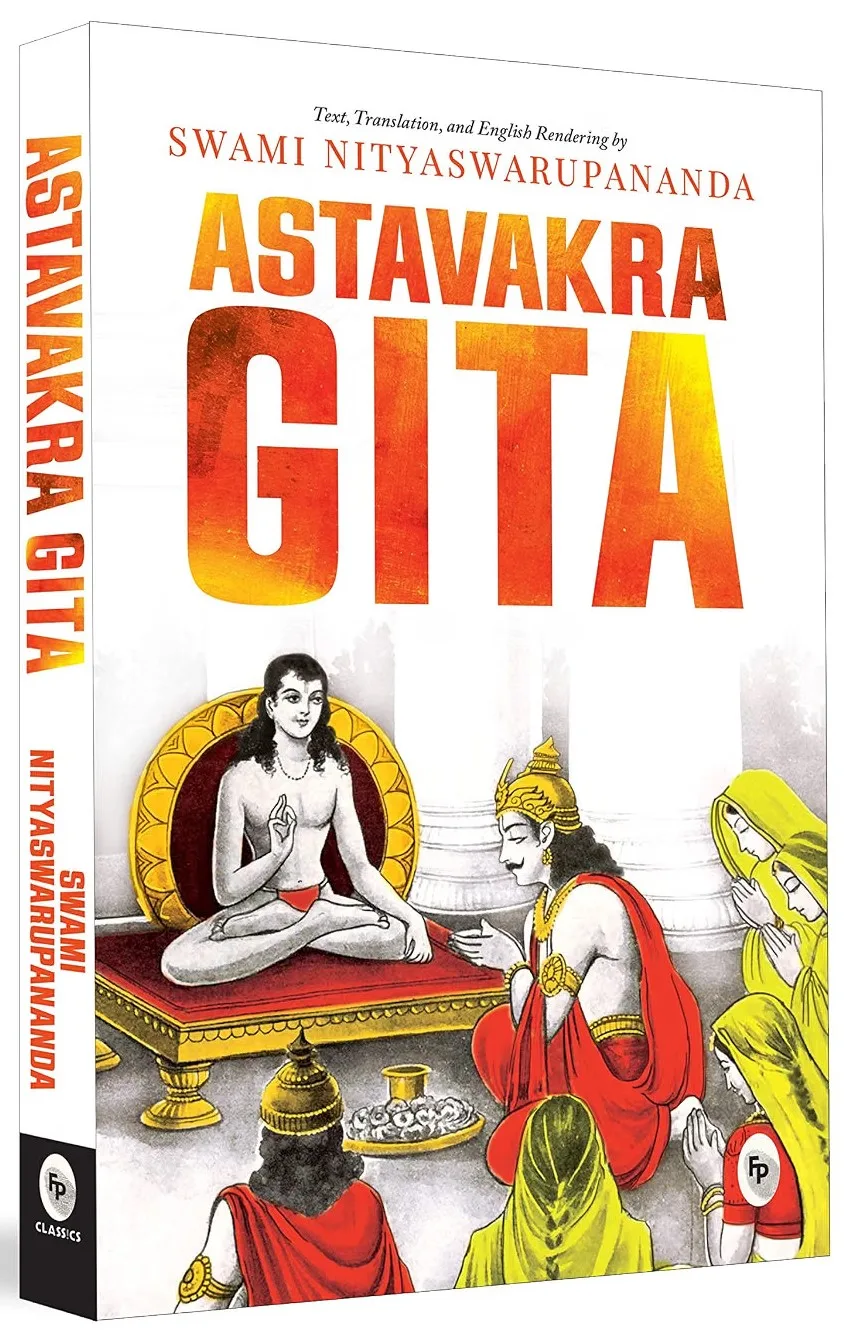
Ashtavakra Gita
Paperback
• 208 Pages
• ₹ 199.00
• English
• 9789354407352
No ratings yet
| Publisher | Fingerprint! Publishing |
|---|---|
| ISBN13 | 9789354407352 |
| ASIN/SKU | 9354407358 |
| Book Format | Paperback |
| Language | English |
| Pages | 208 |
| List Price | ₹ 199.00 |
| Publishing Date | 15/02/2023 |
| Dimensions | 12.7 x 1.17 x 19.69 cm |
| Weight | 155 g |
| Book Code | BD00070717 |
Buy this Book
Amazon Stores
Ebook Stores
Other Stores
Discover Ashtavakra Gita by Swami Nityaswarupananda. This book is published by Fingerprint! Publishing in Paperback format, ISBN 9789354407352, ASIN 9354407358, under Religion and Spirituality, History of Religion, Theology and Philosophy of Religion.
Book Description
The Aṣṭāvakra Gītā, also known as the Aṣṭāvakra Saṃhitā, is a short treatise on Advaita Vedānta, ascribed to the great sage Aṣṭāvakra. Sage Aṣṭāvakra demonstrates a profound knowledge of Brahman that Swami Nityaswarupanand of Ramakrishna Mission has placed before the readers in this book in simple, easy-to-understand English.
The subtle philosophical truths are expounded in the form of a lucid dialogue between the teenage sage Aṣṭāvakra and his royal disciple, King Janaka. To Aṣṭāvakra, self-knowledge through direct mystical intuition is the only goal to be reached and experienced in the dynamic silence of one’s own deepest meditation.
Swami Nityaswarupanand’s English translations, word definitions, commentary, and scholarly introduction have all significantly increased the worth of the original text.
This classic collectable is a must-read for all!
It is one of the famous spiritual books that has captured the hearts of people for decades
It will deliver humbling, comforting truths about life and existence
The thought-provoking ideas will lead you to deep introspection
A promising read to begin your spiritual journey
Wisdom to lead a better and meaningful life
The subtle philosophical truths are expounded in the form of a lucid dialogue between the teenage sage Aṣṭāvakra and his royal disciple, King Janaka. To Aṣṭāvakra, self-knowledge through direct mystical intuition is the only goal to be reached and experienced in the dynamic silence of one’s own deepest meditation.
Swami Nityaswarupanand’s English translations, word definitions, commentary, and scholarly introduction have all significantly increased the worth of the original text.
This classic collectable is a must-read for all!
It is one of the famous spiritual books that has captured the hearts of people for decades
It will deliver humbling, comforting truths about life and existence
The thought-provoking ideas will lead you to deep introspection
A promising read to begin your spiritual journey
Wisdom to lead a better and meaningful life
Author Biography
Swami Nityaswarupananda (1899–1992) was a monk of Sri Ramakrishna Math. Swami Nityaswarupananda has translated Ashtavakara Gita into English. He established the Ramakrishna Mission Institute of Culture in Kolkata in 1938.
Editorial Reviews
Editorial Reviews will be added soon…
Book Summary
Ashtavakra Gita by Swami Nityaswarupananda presents one of the most direct and uncompromising expressions of Advaita Vedanta, the non-dual philosophy of the Hindu spiritual tradition. Traditionally attributed to the dialogue between the sage Ashtavakra and King Janaka, the text is a conversation about the nature of the Self, consciousness, freedom, attachment, and liberation. Unlike many spiritual works that guide the seeker gradually through religious practices, rituals, disciplines, or stages of development, the Ashtavakra Gita speaks with remarkable directness. Its central message is that the true Self is already free, pure, peaceful, and untouched by the changing events of life. Bondage arises because a person mistakenly identifies the Self with the body, mind, desires, emotions, and the world of changing experience.
Swami Nityaswarupananda's English rendering makes this ancient dialogue accessible to modern readers while preserving its philosophical intensity. The book is not primarily a story in the conventional sense. Instead, it is a sustained spiritual inquiry in which Ashtavakra points King Janaka toward the recognition of his real nature. The result is a text that can feel both simple and extraordinarily demanding. Its vocabulary may be straightforward, but its implications challenge some of the deepest assumptions people make about themselves.
The dialogue begins with King Janaka's search for liberation. Janaka asks how knowledge, liberation, and renunciation may be attained. Ashtavakra responds in a manner that immediately shifts the conversation away from external achievement. The sage tells Janaka, in essence, that freedom does not require becoming something new. The essential Self is already free. The obstacle is mistaken identification. This becomes the foundation for everything that follows.
The ordinary human being tends to say, “I am the body,” “I am happy,” “I am sad,” “I am successful,” “I have failed,” or “I am afraid.” The Ashtavakra Gita asks the reader to look more carefully at these statements. The body changes continuously from childhood to old age. Thoughts appear and disappear. Feelings rise and fall. Desires change. Opinions change. Circumstances change. If all these things are constantly changing, what is it that remains aware of them?
The answer offered by Ashtavakra is the Self, or pure consciousness. The Self is not another object that can be seen, measured, or possessed. It is the awareness in whose presence all experiences occur. Just as a screen remains present while different images appear upon it, consciousness remains while thoughts, emotions, sensations, and perceptions come and go. The images may be pleasant or disturbing, but the screen itself is not fundamentally altered by them.
This analogy helps explain one of the book's most important teachings: the Self is the witness. The mind can be restless, but awareness knows that the mind is restless. The body can experience pleasure or pain, but awareness knows those sensations. Emotions can change from joy to sadness, but awareness remains present through both. The spiritual mistake, according to the text, is to confuse what is observed with the observer.
This does not mean that the body and mind are unreal in the ordinary practical sense. People still experience hunger, illness, relationships, responsibilities, and the consequences of actions. Rather, the deeper teaching is that these changing experiences should not be mistaken for the whole of one's identity. The body belongs to the changing field of experience; the Self is the awareness in which that field is known.
The book consequently places enormous emphasis on non-identification. Liberation is not necessarily the disappearance of the body or the destruction of the world. It is freedom from the belief that “this changing body-mind is who I fundamentally am.” When identification weakens, attachment also begins to weaken. If a person believes completely that possessions, status, relationships, success, and failure define the Self, every change in those areas produces fear. But when the Self is recognized as something deeper than circumstances, the grip of those changes can loosen.
One of the most striking features of the Ashtavakra Gita is its teaching on detachment. Detachment here should not be confused with indifference or emotional coldness. It is freedom from compulsive dependence. A detached person can still love, work, care, and participate in life. The difference is that they no longer believe that external objects must behave in a particular way for them to be whole.
Ashtavakra repeatedly points Janaka away from the search for fulfilment through objects. Desire is presented as one of the forces that keeps consciousness outwardly directed. When a person thinks, “I will be complete when I obtain this,” the mind creates a future condition for happiness. Once the object is obtained, another desire often appears. The cycle continues. The text therefore asks the seeker to discover the completeness that is already present in the Self.
The teaching is especially radical because it challenges the assumption that liberation is something that must be achieved through time. From the standpoint of Advaita, if the Self is already free, then liberation cannot literally be the production of a new state. It is the recognition of what has always been true. Ignorance makes the individual imagine bondage; knowledge reveals freedom.
This explains why the Ashtavakra Gita places such extraordinary importance on knowledge. Knowledge here does not mean collecting philosophical information. A person can memorize spiritual texts and still remain identified with the ego. True knowledge means direct recognition of one's nature as consciousness. The distinction resembles the difference between reading about fire and actually experiencing heat. Intellectual understanding may prepare the mind, but realization must become immediate and transformative.
The book also explores the ego, which is closely related to mistaken identity. The ego is the sense of “I” associated with the body, mind, personal history, desires, achievements, and opinions. Ashtavakra does not ask Janaka to build a better ego. He asks him to examine the assumption behind the ego. Who is this “I”? What remains when every changing description is observed rather than identified with?
This inquiry can lead to a profound shift. Instead of thinking, “I am angry,” one can recognize, “Anger is being experienced.” Instead of “I am afraid,” one can observe, “Fear is present.” This does not deny the experience. It creates distance between awareness and the passing state. In the language of the text, the witness remains untouched even though experiences continue to arise.
The metaphor of space is particularly useful in understanding this teaching. Space contains everything but is not damaged by what appears within it. A house may be built within space, objects may occupy it, smoke may fill it, or the house may eventually disappear, yet space itself remains. Similarly, consciousness contains experiences without becoming fundamentally limited by them. The body and mind may undergo countless changes, but the witnessing Self remains free.
Another recurring theme is peace. The peace described in the Ashtavakra Gita is deeper than temporary relaxation. It is not simply a pleasant mood. It arises from freedom from compulsive identification and desire. If peace depends upon circumstances, it can be disturbed whenever circumstances change. But if peace is understood as the natural condition of the Self, then external events do not have the final authority over inner freedom.
This does not imply that a realized person never experiences physical pain, emotional movement, or difficult circumstances. Rather, the text distinguishes the changing experience from the deeper awareness in which it occurs. A storm can pass through the sky without damaging the sky itself. In a similar way, experiences may arise within consciousness without defining its essential nature.
The Ashtavakra Gita also has a radical perspective on renunciation. It does not insist that spiritual liberation requires physically abandoning society. True renunciation is inward. A person may live in a palace or a forest and still remain attached. Conversely, someone living an ordinary household life may possess profound inner freedom. The essential question is not where one lives but whether the mind remains bound by identification and desire.
This teaching is particularly important because it prevents spirituality from becoming merely an external performance. Changing clothing, location, occupation, or social status does not automatically produce wisdom. What matters is the transformation of understanding. If attachment remains, external renunciation changes little. If attachment falls away through genuine insight, liberation can be recognized even amid ordinary life.
The dialogue between Ashtavakra and Janaka also illustrates the relationship between teacher and seeker. Janaka represents the sincere seeker who is ready to question fundamental assumptions. Ashtavakra does not flatter him or give him an elaborate program of gradual improvement. Instead, he points directly toward the truth and repeatedly challenges Janaka to recognize it. The intensity of the teaching reflects the conviction that reality does not need to be manufactured. It needs to be seen.
As the dialogue progresses, Janaka's responses become increasingly filled with recognition. He begins to express the freedom, peace, and completeness that Ashtavakra has been describing. His transformation demonstrates that spiritual awakening is not merely theoretical. The intellectual question “Who am I?” can become an experiential realization.
The book also challenges the tendency to divide life into spiritual and non-spiritual categories. If the Self is consciousness itself, then every experience occurs within it. The seeker does not need to travel somewhere else to find reality. The spiritual task is to recognize what is present even now. This is one reason the text can feel so immediate despite its ancient origins.
At the same time, the radical simplicity of the teaching can be difficult for the ordinary mind to accept. Human beings are deeply attached to their personal identities. We care about our families, careers, memories, aspirations, and relationships. The suggestion that none of these constitutes the ultimate Self can initially feel unsettling. Yet the text is not asking the reader to deny ordinary life. It is asking for a deeper understanding of it.
The ultimate message is that freedom is one's nature rather than an achievement. The seeker does not have to become worthy of the Self. The Self is already pure and complete. Ignorance creates the appearance of limitation, much as a rope may be mistaken for a snake in dim light. When the rope is clearly seen, the imagined snake does not have to be physically removed. It simply disappears as a mistaken interpretation. Likewise, when the Self is recognized, the imagined limitation of the ego loses its authority.
The Ashtavakra Gita therefore leads the reader toward a radical form of inner freedom. It asks us to question the deepest assumption behind everyday experience: “I am this separate, limited individual.” In its place, it points toward awareness that is described as pure, peaceful, unattached, and free.
Ultimately, Ashtavakra Gita by Swami Nityaswarupananda is a profound meditation on the nature of consciousness and liberation. Its message is uncompromising: the freedom people seek is not ultimately found in possessions, accomplishments, changing circumstances, or even temporary spiritual experiences. It is discovered through recognizing the Self as the unchanging awareness behind all experience.
The book's enduring power lies in the simplicity of its central invitation. Instead of continually asking, “How can I improve myself?” it asks a more fundamental question: “Who is this ‘I’ that wants to be improved?” Instead of asking how to create permanent peace in an impermanent world, it directs attention toward the awareness in which the world appears. Instead of treating liberation as something far away, it points to the possibility that what is being sought is already present.
For a reader willing to sit quietly with its teachings, the Ashtavakra Gita can become more than a philosophical text. It can become a mirror. It asks the reader to examine attachment, identity, desire, fear, and the restless search for fulfilment, and then to look beyond them toward the silent awareness that has been present throughout. Its final promise is not the acquisition of another possession but the recognition of one's own freedom. In that recognition, the restless search can come to an end, and what remains is the simple, profound experience of being—aware, peaceful, and free.
Swami Nityaswarupananda's English rendering makes this ancient dialogue accessible to modern readers while preserving its philosophical intensity. The book is not primarily a story in the conventional sense. Instead, it is a sustained spiritual inquiry in which Ashtavakra points King Janaka toward the recognition of his real nature. The result is a text that can feel both simple and extraordinarily demanding. Its vocabulary may be straightforward, but its implications challenge some of the deepest assumptions people make about themselves.
The dialogue begins with King Janaka's search for liberation. Janaka asks how knowledge, liberation, and renunciation may be attained. Ashtavakra responds in a manner that immediately shifts the conversation away from external achievement. The sage tells Janaka, in essence, that freedom does not require becoming something new. The essential Self is already free. The obstacle is mistaken identification. This becomes the foundation for everything that follows.
The ordinary human being tends to say, “I am the body,” “I am happy,” “I am sad,” “I am successful,” “I have failed,” or “I am afraid.” The Ashtavakra Gita asks the reader to look more carefully at these statements. The body changes continuously from childhood to old age. Thoughts appear and disappear. Feelings rise and fall. Desires change. Opinions change. Circumstances change. If all these things are constantly changing, what is it that remains aware of them?
The answer offered by Ashtavakra is the Self, or pure consciousness. The Self is not another object that can be seen, measured, or possessed. It is the awareness in whose presence all experiences occur. Just as a screen remains present while different images appear upon it, consciousness remains while thoughts, emotions, sensations, and perceptions come and go. The images may be pleasant or disturbing, but the screen itself is not fundamentally altered by them.
This analogy helps explain one of the book's most important teachings: the Self is the witness. The mind can be restless, but awareness knows that the mind is restless. The body can experience pleasure or pain, but awareness knows those sensations. Emotions can change from joy to sadness, but awareness remains present through both. The spiritual mistake, according to the text, is to confuse what is observed with the observer.
This does not mean that the body and mind are unreal in the ordinary practical sense. People still experience hunger, illness, relationships, responsibilities, and the consequences of actions. Rather, the deeper teaching is that these changing experiences should not be mistaken for the whole of one's identity. The body belongs to the changing field of experience; the Self is the awareness in which that field is known.
The book consequently places enormous emphasis on non-identification. Liberation is not necessarily the disappearance of the body or the destruction of the world. It is freedom from the belief that “this changing body-mind is who I fundamentally am.” When identification weakens, attachment also begins to weaken. If a person believes completely that possessions, status, relationships, success, and failure define the Self, every change in those areas produces fear. But when the Self is recognized as something deeper than circumstances, the grip of those changes can loosen.
One of the most striking features of the Ashtavakra Gita is its teaching on detachment. Detachment here should not be confused with indifference or emotional coldness. It is freedom from compulsive dependence. A detached person can still love, work, care, and participate in life. The difference is that they no longer believe that external objects must behave in a particular way for them to be whole.
Ashtavakra repeatedly points Janaka away from the search for fulfilment through objects. Desire is presented as one of the forces that keeps consciousness outwardly directed. When a person thinks, “I will be complete when I obtain this,” the mind creates a future condition for happiness. Once the object is obtained, another desire often appears. The cycle continues. The text therefore asks the seeker to discover the completeness that is already present in the Self.
The teaching is especially radical because it challenges the assumption that liberation is something that must be achieved through time. From the standpoint of Advaita, if the Self is already free, then liberation cannot literally be the production of a new state. It is the recognition of what has always been true. Ignorance makes the individual imagine bondage; knowledge reveals freedom.
This explains why the Ashtavakra Gita places such extraordinary importance on knowledge. Knowledge here does not mean collecting philosophical information. A person can memorize spiritual texts and still remain identified with the ego. True knowledge means direct recognition of one's nature as consciousness. The distinction resembles the difference between reading about fire and actually experiencing heat. Intellectual understanding may prepare the mind, but realization must become immediate and transformative.
The book also explores the ego, which is closely related to mistaken identity. The ego is the sense of “I” associated with the body, mind, personal history, desires, achievements, and opinions. Ashtavakra does not ask Janaka to build a better ego. He asks him to examine the assumption behind the ego. Who is this “I”? What remains when every changing description is observed rather than identified with?
This inquiry can lead to a profound shift. Instead of thinking, “I am angry,” one can recognize, “Anger is being experienced.” Instead of “I am afraid,” one can observe, “Fear is present.” This does not deny the experience. It creates distance between awareness and the passing state. In the language of the text, the witness remains untouched even though experiences continue to arise.
The metaphor of space is particularly useful in understanding this teaching. Space contains everything but is not damaged by what appears within it. A house may be built within space, objects may occupy it, smoke may fill it, or the house may eventually disappear, yet space itself remains. Similarly, consciousness contains experiences without becoming fundamentally limited by them. The body and mind may undergo countless changes, but the witnessing Self remains free.
Another recurring theme is peace. The peace described in the Ashtavakra Gita is deeper than temporary relaxation. It is not simply a pleasant mood. It arises from freedom from compulsive identification and desire. If peace depends upon circumstances, it can be disturbed whenever circumstances change. But if peace is understood as the natural condition of the Self, then external events do not have the final authority over inner freedom.
This does not imply that a realized person never experiences physical pain, emotional movement, or difficult circumstances. Rather, the text distinguishes the changing experience from the deeper awareness in which it occurs. A storm can pass through the sky without damaging the sky itself. In a similar way, experiences may arise within consciousness without defining its essential nature.
The Ashtavakra Gita also has a radical perspective on renunciation. It does not insist that spiritual liberation requires physically abandoning society. True renunciation is inward. A person may live in a palace or a forest and still remain attached. Conversely, someone living an ordinary household life may possess profound inner freedom. The essential question is not where one lives but whether the mind remains bound by identification and desire.
This teaching is particularly important because it prevents spirituality from becoming merely an external performance. Changing clothing, location, occupation, or social status does not automatically produce wisdom. What matters is the transformation of understanding. If attachment remains, external renunciation changes little. If attachment falls away through genuine insight, liberation can be recognized even amid ordinary life.
The dialogue between Ashtavakra and Janaka also illustrates the relationship between teacher and seeker. Janaka represents the sincere seeker who is ready to question fundamental assumptions. Ashtavakra does not flatter him or give him an elaborate program of gradual improvement. Instead, he points directly toward the truth and repeatedly challenges Janaka to recognize it. The intensity of the teaching reflects the conviction that reality does not need to be manufactured. It needs to be seen.
As the dialogue progresses, Janaka's responses become increasingly filled with recognition. He begins to express the freedom, peace, and completeness that Ashtavakra has been describing. His transformation demonstrates that spiritual awakening is not merely theoretical. The intellectual question “Who am I?” can become an experiential realization.
The book also challenges the tendency to divide life into spiritual and non-spiritual categories. If the Self is consciousness itself, then every experience occurs within it. The seeker does not need to travel somewhere else to find reality. The spiritual task is to recognize what is present even now. This is one reason the text can feel so immediate despite its ancient origins.
At the same time, the radical simplicity of the teaching can be difficult for the ordinary mind to accept. Human beings are deeply attached to their personal identities. We care about our families, careers, memories, aspirations, and relationships. The suggestion that none of these constitutes the ultimate Self can initially feel unsettling. Yet the text is not asking the reader to deny ordinary life. It is asking for a deeper understanding of it.
The ultimate message is that freedom is one's nature rather than an achievement. The seeker does not have to become worthy of the Self. The Self is already pure and complete. Ignorance creates the appearance of limitation, much as a rope may be mistaken for a snake in dim light. When the rope is clearly seen, the imagined snake does not have to be physically removed. It simply disappears as a mistaken interpretation. Likewise, when the Self is recognized, the imagined limitation of the ego loses its authority.
The Ashtavakra Gita therefore leads the reader toward a radical form of inner freedom. It asks us to question the deepest assumption behind everyday experience: “I am this separate, limited individual.” In its place, it points toward awareness that is described as pure, peaceful, unattached, and free.
Ultimately, Ashtavakra Gita by Swami Nityaswarupananda is a profound meditation on the nature of consciousness and liberation. Its message is uncompromising: the freedom people seek is not ultimately found in possessions, accomplishments, changing circumstances, or even temporary spiritual experiences. It is discovered through recognizing the Self as the unchanging awareness behind all experience.
The book's enduring power lies in the simplicity of its central invitation. Instead of continually asking, “How can I improve myself?” it asks a more fundamental question: “Who is this ‘I’ that wants to be improved?” Instead of asking how to create permanent peace in an impermanent world, it directs attention toward the awareness in which the world appears. Instead of treating liberation as something far away, it points to the possibility that what is being sought is already present.
For a reader willing to sit quietly with its teachings, the Ashtavakra Gita can become more than a philosophical text. It can become a mirror. It asks the reader to examine attachment, identity, desire, fear, and the restless search for fulfilment, and then to look beyond them toward the silent awareness that has been present throughout. Its final promise is not the acquisition of another possession but the recognition of one's own freedom. In that recognition, the restless search can come to an end, and what remains is the simple, profound experience of being—aware, peaceful, and free.
Sample Chapters
Sample Chapters will be added soon…
Reader Reviews
No reviews yet.
Ashtavakra Gita
Download Cover Image
Do you want to download the full cover image for Ashtavakra Gita?