
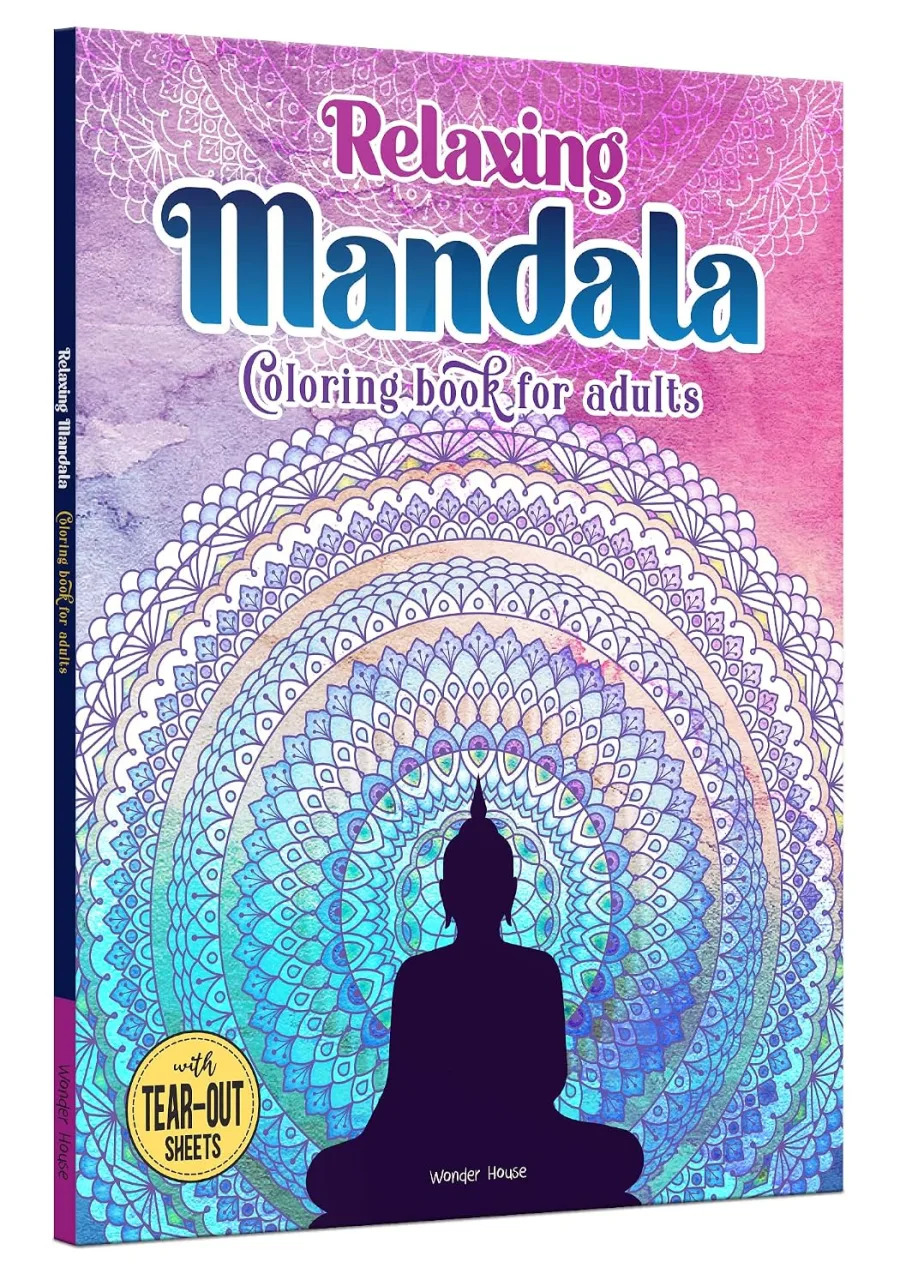
Relaxing Mandala Coloring Book For Adults
Paperback
• 48 Pages
• ₹ 199.00
• English
• 9789354404863
No ratings yet
| Publisher | Wonder House Books |
|---|---|
| ISBN13 | 9789354404863 |
| ASIN/SKU | 9354404863 |
| Book Format | Paperback |
| Language | English |
| Pages | 48 |
| List Price | ₹ 199.00 |
| Publishing Date | 31/05/2022 |
| Dimensions | 12.7 x 19.5 x 2.5 cm |
| Weight | 250 g |
| Book Code | BD00070715 |
Buy this Book
Amazon Stores
Ebook Stores
Other Stores
Discover Relaxing Mandala Coloring Book For Adults by Wonder House Books. This book is published by Wonder House Books in Paperback format, ISBN 9789354404863, ASIN 9354404863, under Religion and Spirituality, Spirituality.
Book Description
Relaxing Mandala Coloring Book for Adults is a beautifully designed adult coloring book filled with intricate mandalas, decorative motifs, geometric patterns, and detailed illustrations waiting to be brought to life with colour. Created for anyone who enjoys mindful creative activities, this collection offers an enjoyable way to unwind while exploring different colour combinations and artistic ideas.
From elaborate mandala patterns to nature-inspired and ornamental designs, every page provides a fresh colouring experience. With convenient tear-out sheets, finished artwork can be easily removed for displaying, sharing, or keeping. A wonderful choice for adults and older colouring enthusiasts looking for a calming and engaging creative pastime.
📚 What You’ll Explore
Intricate mandala coloring designs with varied patterns and details
Geometric, floral, nature-inspired, and decorative illustrations
Creative opportunities to experiment with colours and combinations
Detailed artwork suitable for mindful, leisurely colouring sessions
⭐ Key Features
Beautifully detailed mandala coloring pages for adults
Wide variety of artistic motifs and aesthetic patterns
Tear-out sheets for convenient removal of finished artwork
Suitable for coloured pencils, crayons, and other preferred colouring tools
🧠 Creative Benefits
Encourages creativity, imagination, and artistic self-expression
Provides an enjoyable screen-free activity for quiet leisure time
Supports focus and attention through detailed colouring
Offers a relaxing creative activity for everyday breaks and free time
🎁 Perfect For
Adults who enjoy mandala and pattern coloring books
Beginners as well as experienced colouring enthusiasts
Creative hobbies, quiet time, travel, and screen-free relaxation
A thoughtful gift for art, colouring, and craft lovers
From elaborate mandala patterns to nature-inspired and ornamental designs, every page provides a fresh colouring experience. With convenient tear-out sheets, finished artwork can be easily removed for displaying, sharing, or keeping. A wonderful choice for adults and older colouring enthusiasts looking for a calming and engaging creative pastime.
📚 What You’ll Explore
Intricate mandala coloring designs with varied patterns and details
Geometric, floral, nature-inspired, and decorative illustrations
Creative opportunities to experiment with colours and combinations
Detailed artwork suitable for mindful, leisurely colouring sessions
⭐ Key Features
Beautifully detailed mandala coloring pages for adults
Wide variety of artistic motifs and aesthetic patterns
Tear-out sheets for convenient removal of finished artwork
Suitable for coloured pencils, crayons, and other preferred colouring tools
🧠 Creative Benefits
Encourages creativity, imagination, and artistic self-expression
Provides an enjoyable screen-free activity for quiet leisure time
Supports focus and attention through detailed colouring
Offers a relaxing creative activity for everyday breaks and free time
🎁 Perfect For
Adults who enjoy mandala and pattern coloring books
Beginners as well as experienced colouring enthusiasts
Creative hobbies, quiet time, travel, and screen-free relaxation
A thoughtful gift for art, colouring, and craft lovers
Author Biography
Wonder House has a dedicated team of editors and designers involved in the development of magnificent and enriching children books. The team pays special attention to develop age appropriate content and does extensive research on every topic included in the book. Our mission is to develop highly informative content which will help the children to master different skills. At Wonder House, we strive to make learning a joy.
Editorial Reviews
Editorial Reviews will be added soon…
Book Summary
Relaxing Mandala Coloring Book for Adults by Wonder House Books is a thoughtfully designed creative activity book intended to help adults slow down, step away from the pressures of everyday life, and rediscover the simple pleasure of colouring. Rather than being a conventional book that tells a continuous story, it offers a collection of intricate mandala illustrations that invite the reader to participate in the creative process. The central idea is beautifully simple: when the mind is occupied with choosing colours, filling patterns, observing shapes, and creating visual harmony, it can temporarily move away from the constant stream of worries and distractions that often dominate modern life.
The book belongs to the growing tradition of adult colouring books that treat colouring not merely as a childhood pastime but as a relaxing, mindful, and creative activity. Its focus on mandalas gives the experience an additional sense of rhythm and balance. Mandalas are generally built around a central point and expand outward through repeated geometric, floral, or ornamental patterns. This symmetry naturally encourages attention to detail. As the colouring progresses from the centre toward the outer patterns, the activity can become absorbing and meditative. The reader does not have to produce a technically perfect drawing; the pleasure lies in gradually bringing an existing design to life.
One of the most appealing aspects of the book is its accessibility. A person does not need formal artistic training to use it. There is no requirement to understand perspective, anatomy, composition, or advanced drawing techniques. The outlines have already been created, leaving the colourist with a much more relaxed creative decision: which colours should be used, where should they be placed, and how should different shades interact? This removes much of the pressure associated with creating art from a blank page. Instead of asking, “Can I draw something beautiful?”, the reader can simply ask, “What colours do I feel like using today?”
This distinction is important because many adults gradually lose contact with creative activities as responsibilities increase. School, work, family obligations, technology, financial concerns, and social commitments can make life feel increasingly functional. Creativity may become something reserved for people who consider themselves artists. Relaxing Mandala Coloring Book for Adults quietly challenges that assumption. It presents creativity as an ordinary human activity that does not need to produce a professional result. The value of the finished page is secondary to the experience of making it.
The mandala format strengthens this experience through repetition. Repeated petals, circles, leaves, geometric shapes, curves, and decorative motifs give the mind a predictable visual structure. While colouring, the reader can concentrate on one small section at a time instead of thinking about everything that needs to be done in the wider world. A large design can be approached gradually: one segment, one shape, one colour at a time. This makes the activity especially suitable for moments when a person wants to feel mentally settled without having to engage in a demanding intellectual task.
The book's concept can therefore be connected with mindfulness, although colouring itself should not automatically be treated as a medical treatment for anxiety or other mental-health conditions. Its more modest and practical value is that it can provide a focused period of quiet attention. The hands are busy, the eyes follow patterns, and the mind makes small creative decisions. This combination can encourage the reader to remain in the present moment. Instead of replaying something that happened earlier or worrying about what might happen later, attention can return to the small area of the page currently being coloured.
Colour selection becomes part of this process. A mandala does not dictate a single correct palette, so each page can become an expression of the reader's mood and imagination. Someone might choose warm oranges, reds, and yellows to create an energetic design. Another person might prefer blues and greens for a cooler appearance. Pastel shades can produce a delicate effect, while stronger contrasts can make individual patterns stand out. The same illustration can look completely different depending on the choices of the person colouring it. This freedom gives the book a personal quality: the printed page provides the structure, but the reader provides its final visual identity.
The activity also encourages experimentation without serious consequences. A colour combination that does not work as expected is simply part of the finished artwork. There is no need to erase every mistake or begin again. This can be a refreshing change from environments in which adults often feel pressure to be efficient and correct. Colouring creates a space where experimentation is inexpensive and imperfection is acceptable. The reader can try a darker shade, add contrast, repeat a colour, or deliberately break a pattern. There are very few rules unless the colourist chooses to create them.
The symmetrical nature of mandalas also creates a subtle feeling of order. Modern life can often feel fragmented, with multiple notifications, unfinished tasks, conversations, deadlines, and competing demands. A mandala offers the opposite visual experience. Its elements are arranged around a centre, with patterns repeating and expanding in an organized manner. Colouring such a structure can provide a temporary sense of coherence. The reader sees a complicated design gradually becoming complete through small, orderly actions.
At the same time, the book does not require the reader to finish a page in one sitting. This is another strength of the format. A person can spend ten minutes colouring before work, return to the same design later in the evening, or devote a longer weekend session to it. Because there is no prescribed pace, the activity can adapt to different lifestyles. A page can be treated as a short break or as a longer creative project.
For adults who spend much of their day looking at screens, colouring also provides a different kind of engagement. Digital entertainment often demands rapid responses, scrolling, clicking, reading, watching, or switching between tasks. Colouring is slower. The physical movement of a pencil or colouring tool across paper creates a more tangible experience. The gradual filling of a shape provides visible evidence of progress. This can make the activity feel satisfying precisely because it does not demand speed.
The book can also become a form of personal expression. Although every reader begins with the same printed illustrations, no two completed mandalas need look alike. Colour choices can reflect personality, mood, memories, seasons, or simple preferences. Someone may consistently gravitate toward certain colours, while another person may deliberately experiment with unusual combinations. Over time, a collection of finished pages can become a visual record of changing tastes and creative discoveries.
There is also a social dimension to the book. Colouring does not necessarily have to be a solitary activity. Friends or family members can colour together, each working on their own page or comparing different approaches to the same design. This can create a relaxed form of companionship because conversation can happen naturally without the activity itself requiring constant attention. The book can therefore function as both a private relaxation tool and a gentle shared pastime.
Another appealing feature is the sense of accomplishment that comes from completing a page. Many everyday activities involve work that seems endless: emails continue arriving, household tasks return, and professional responsibilities generate new assignments. A mandala offers a clearly defined beginning and end. When the last uncoloured shape is filled, the reader can look at a completed piece of work. The achievement may be small, but it is concrete. The finished page provides a visual reminder that sustained attention can transform an empty outline into something personal and complete.
The book's title, Relaxing Mandala Coloring Book for Adults, therefore captures its purpose quite directly. The emphasis is not on producing technically sophisticated artwork but on creating an atmosphere in which adults can relax through a simple creative process. The mandalas provide enough complexity to maintain attention without requiring the reader to invent an image from scratch. This balance between structure and freedom is what makes the format effective as a leisure activity.
The book can also encourage patience. Some designs contain many small sections, and filling each one carefully takes time. The process naturally rewards a slower approach. Rushing may cause colours to go outside outlines or make the activity feel like another task to complete. Working gradually, on the other hand, allows the reader to notice small details. The experience can become a quiet reminder that not everything needs to be done quickly.
Perhaps the most humane quality of the book is that it gives adults permission to do something simply because it feels pleasant. Not every activity needs to improve productivity, generate income, teach a professional skill, or accomplish an important external goal. Sometimes it is valuable to sit down with coloured pencils and spend time creating something beautiful for no reason other than enjoyment. In a culture that often measures time according to output, this can feel surprisingly restorative.
The mandala itself also carries a long history as a symbolic form in South Asian religious and artistic traditions, where circular and symmetrical designs have been used in different cultural and spiritual contexts. In an adult colouring book, however, the mandala functions primarily as an artistic framework for creative engagement. Readers can appreciate its symmetry and visual balance without needing to approach every design as a religious object or assign a particular spiritual meaning to it.
Ultimately, Relaxing Mandala Coloring Book for Adults by Wonder House Books is a celebration of slow creativity. It transforms colouring from a childhood activity into a simple adult ritual of attention and expression. Its intricate mandala patterns offer structure, while the choice of colours gives the reader freedom. The repeated shapes encourage concentration, the gradual process encourages patience, and the completed pages provide a satisfying sense of achievement.
The deeper message of the book is not that colouring can solve every problem in life. Rather, it reminds the reader that even in a busy life, there can be small spaces for quietness. Ten or twenty minutes spent colouring cannot remove responsibilities, but it can create a pause between one responsibility and the next. During that pause, the mind can concentrate on something tangible and beautiful. The reader can breathe, choose a colour, fill a shape, and watch a pattern slowly emerge.
In this way, the book offers something wonderfully uncomplicated. It does not ask the reader to be an artist, to follow strict instructions, or to produce a perfect result. It simply provides a page, a pattern, and an opportunity to begin. Every completed mandala becomes a small personal creation, shaped by the colours and attention of the person who made it. Relaxing Mandala Coloring Book for Adults ultimately suggests that creativity does not have to be ambitious to be meaningful. Sometimes, the quiet act of colouring one small shape after another is enough to make a busy day feel a little slower, calmer, and more personal.
The book belongs to the growing tradition of adult colouring books that treat colouring not merely as a childhood pastime but as a relaxing, mindful, and creative activity. Its focus on mandalas gives the experience an additional sense of rhythm and balance. Mandalas are generally built around a central point and expand outward through repeated geometric, floral, or ornamental patterns. This symmetry naturally encourages attention to detail. As the colouring progresses from the centre toward the outer patterns, the activity can become absorbing and meditative. The reader does not have to produce a technically perfect drawing; the pleasure lies in gradually bringing an existing design to life.
One of the most appealing aspects of the book is its accessibility. A person does not need formal artistic training to use it. There is no requirement to understand perspective, anatomy, composition, or advanced drawing techniques. The outlines have already been created, leaving the colourist with a much more relaxed creative decision: which colours should be used, where should they be placed, and how should different shades interact? This removes much of the pressure associated with creating art from a blank page. Instead of asking, “Can I draw something beautiful?”, the reader can simply ask, “What colours do I feel like using today?”
This distinction is important because many adults gradually lose contact with creative activities as responsibilities increase. School, work, family obligations, technology, financial concerns, and social commitments can make life feel increasingly functional. Creativity may become something reserved for people who consider themselves artists. Relaxing Mandala Coloring Book for Adults quietly challenges that assumption. It presents creativity as an ordinary human activity that does not need to produce a professional result. The value of the finished page is secondary to the experience of making it.
The mandala format strengthens this experience through repetition. Repeated petals, circles, leaves, geometric shapes, curves, and decorative motifs give the mind a predictable visual structure. While colouring, the reader can concentrate on one small section at a time instead of thinking about everything that needs to be done in the wider world. A large design can be approached gradually: one segment, one shape, one colour at a time. This makes the activity especially suitable for moments when a person wants to feel mentally settled without having to engage in a demanding intellectual task.
The book's concept can therefore be connected with mindfulness, although colouring itself should not automatically be treated as a medical treatment for anxiety or other mental-health conditions. Its more modest and practical value is that it can provide a focused period of quiet attention. The hands are busy, the eyes follow patterns, and the mind makes small creative decisions. This combination can encourage the reader to remain in the present moment. Instead of replaying something that happened earlier or worrying about what might happen later, attention can return to the small area of the page currently being coloured.
Colour selection becomes part of this process. A mandala does not dictate a single correct palette, so each page can become an expression of the reader's mood and imagination. Someone might choose warm oranges, reds, and yellows to create an energetic design. Another person might prefer blues and greens for a cooler appearance. Pastel shades can produce a delicate effect, while stronger contrasts can make individual patterns stand out. The same illustration can look completely different depending on the choices of the person colouring it. This freedom gives the book a personal quality: the printed page provides the structure, but the reader provides its final visual identity.
The activity also encourages experimentation without serious consequences. A colour combination that does not work as expected is simply part of the finished artwork. There is no need to erase every mistake or begin again. This can be a refreshing change from environments in which adults often feel pressure to be efficient and correct. Colouring creates a space where experimentation is inexpensive and imperfection is acceptable. The reader can try a darker shade, add contrast, repeat a colour, or deliberately break a pattern. There are very few rules unless the colourist chooses to create them.
The symmetrical nature of mandalas also creates a subtle feeling of order. Modern life can often feel fragmented, with multiple notifications, unfinished tasks, conversations, deadlines, and competing demands. A mandala offers the opposite visual experience. Its elements are arranged around a centre, with patterns repeating and expanding in an organized manner. Colouring such a structure can provide a temporary sense of coherence. The reader sees a complicated design gradually becoming complete through small, orderly actions.
At the same time, the book does not require the reader to finish a page in one sitting. This is another strength of the format. A person can spend ten minutes colouring before work, return to the same design later in the evening, or devote a longer weekend session to it. Because there is no prescribed pace, the activity can adapt to different lifestyles. A page can be treated as a short break or as a longer creative project.
For adults who spend much of their day looking at screens, colouring also provides a different kind of engagement. Digital entertainment often demands rapid responses, scrolling, clicking, reading, watching, or switching between tasks. Colouring is slower. The physical movement of a pencil or colouring tool across paper creates a more tangible experience. The gradual filling of a shape provides visible evidence of progress. This can make the activity feel satisfying precisely because it does not demand speed.
The book can also become a form of personal expression. Although every reader begins with the same printed illustrations, no two completed mandalas need look alike. Colour choices can reflect personality, mood, memories, seasons, or simple preferences. Someone may consistently gravitate toward certain colours, while another person may deliberately experiment with unusual combinations. Over time, a collection of finished pages can become a visual record of changing tastes and creative discoveries.
There is also a social dimension to the book. Colouring does not necessarily have to be a solitary activity. Friends or family members can colour together, each working on their own page or comparing different approaches to the same design. This can create a relaxed form of companionship because conversation can happen naturally without the activity itself requiring constant attention. The book can therefore function as both a private relaxation tool and a gentle shared pastime.
Another appealing feature is the sense of accomplishment that comes from completing a page. Many everyday activities involve work that seems endless: emails continue arriving, household tasks return, and professional responsibilities generate new assignments. A mandala offers a clearly defined beginning and end. When the last uncoloured shape is filled, the reader can look at a completed piece of work. The achievement may be small, but it is concrete. The finished page provides a visual reminder that sustained attention can transform an empty outline into something personal and complete.
The book's title, Relaxing Mandala Coloring Book for Adults, therefore captures its purpose quite directly. The emphasis is not on producing technically sophisticated artwork but on creating an atmosphere in which adults can relax through a simple creative process. The mandalas provide enough complexity to maintain attention without requiring the reader to invent an image from scratch. This balance between structure and freedom is what makes the format effective as a leisure activity.
The book can also encourage patience. Some designs contain many small sections, and filling each one carefully takes time. The process naturally rewards a slower approach. Rushing may cause colours to go outside outlines or make the activity feel like another task to complete. Working gradually, on the other hand, allows the reader to notice small details. The experience can become a quiet reminder that not everything needs to be done quickly.
Perhaps the most humane quality of the book is that it gives adults permission to do something simply because it feels pleasant. Not every activity needs to improve productivity, generate income, teach a professional skill, or accomplish an important external goal. Sometimes it is valuable to sit down with coloured pencils and spend time creating something beautiful for no reason other than enjoyment. In a culture that often measures time according to output, this can feel surprisingly restorative.
The mandala itself also carries a long history as a symbolic form in South Asian religious and artistic traditions, where circular and symmetrical designs have been used in different cultural and spiritual contexts. In an adult colouring book, however, the mandala functions primarily as an artistic framework for creative engagement. Readers can appreciate its symmetry and visual balance without needing to approach every design as a religious object or assign a particular spiritual meaning to it.
Ultimately, Relaxing Mandala Coloring Book for Adults by Wonder House Books is a celebration of slow creativity. It transforms colouring from a childhood activity into a simple adult ritual of attention and expression. Its intricate mandala patterns offer structure, while the choice of colours gives the reader freedom. The repeated shapes encourage concentration, the gradual process encourages patience, and the completed pages provide a satisfying sense of achievement.
The deeper message of the book is not that colouring can solve every problem in life. Rather, it reminds the reader that even in a busy life, there can be small spaces for quietness. Ten or twenty minutes spent colouring cannot remove responsibilities, but it can create a pause between one responsibility and the next. During that pause, the mind can concentrate on something tangible and beautiful. The reader can breathe, choose a colour, fill a shape, and watch a pattern slowly emerge.
In this way, the book offers something wonderfully uncomplicated. It does not ask the reader to be an artist, to follow strict instructions, or to produce a perfect result. It simply provides a page, a pattern, and an opportunity to begin. Every completed mandala becomes a small personal creation, shaped by the colours and attention of the person who made it. Relaxing Mandala Coloring Book for Adults ultimately suggests that creativity does not have to be ambitious to be meaningful. Sometimes, the quiet act of colouring one small shape after another is enough to make a busy day feel a little slower, calmer, and more personal.
Sample Chapters
Sample Chapters will be added soon…
Reader Reviews
No reviews yet.
Relaxing Mandala Coloring Book For Adults
Download Cover Image
Do you want to download the full cover image for Relaxing Mandala Coloring Book For Adults?