
Hanuman Chalisa: हनुमान चालीसा – Hanuman Chalisa Pocket Size Book (Hindi & English)
Hardcover
• 60 Pages
• ₹ 195.00
• Hindi
• 9789353768959
No ratings yet
| Publisher | Om Books International |
|---|---|
| ISBN13 | 9789353768959 |
| ASIN/SKU | 9353768950 |
| Book Format | Hardcover |
| Language | Hindi |
| Pages | 60 |
| List Price | ₹ 195.00 |
| Publishing Date | 24/08/2023 |
| Dimensions | 7.3 x 0.9 x 10.4 cm |
| Weight | 45 g |
| Book Code | BD00070714 |
Buy this Book
Amazon Stores
Ebook Stores
Other Stores
Discover Hanuman Chalisa: हनुमान चालीसा – Hanuman Chalisa Pocket Size Book (Hindi and English) by Goswami Tulsidas. This book is published by Om Books International in Hardcover format, ISBN 9789353768959, ASIN 9353768950, under Religion and Spirituality, Theology and Philosophy of Religion, Spirituality.
Book Description
संत कवि तुलसीदासजी द्वारा सोलहवीं शताब्दी में रचित हनुमान चालीसा आज भी लोकप्रिय है और लगभग प्रत्येक हिंदू को कंठस्थ है। हनुमानजी सर्वप्रिय देवता हैं, और सात चिरंजीवियों में से एक हैं। हनुमानजी की वीरता, सेवा व भक्ति अतुलनीय है। मान्यता है कि हनुमान चालीसा का पाठ करने से सब प्रकार के भय, रोग एवं शोक दूर हो जाते हैं और हृदय में भक्ति और ज्ञान का संचार होता है।
The Hanuman Chalisa is a beautiful odewritten by the saint poet Goswami Tulsidasin the 16th century and till date remains a popular prayer among all Hindus, most of whom know it by heart. Hanuman is considered to be one of the seven eternal beings on Earth. Hanuman’s valour and dedication is unparalleled. The recitation of the Hanuman Chalisa eradicates all fear and instils devotion and knowledge.
The Hanuman Chalisa is a beautiful odewritten by the saint poet Goswami Tulsidasin the 16th century and till date remains a popular prayer among all Hindus, most of whom know it by heart. Hanuman is considered to be one of the seven eternal beings on Earth. Hanuman’s valour and dedication is unparalleled. The recitation of the Hanuman Chalisa eradicates all fear and instils devotion and knowledge.
Author Biography
Tulsidas(1497-1623), a poet-saint, reformer and philosopher of India is renowned for his devotion to Lord Shri Rama . A composer of several popular works, he is best known as the author of the epic Ramcharitmanas, a retelling of Valmiki’s Ramayana in the vernacular Awadhi. He has been acclaimed as one of the greatest poets in Hindi, Indian, and world literature. The impact of Tulsidas and his works on the art, culture and society is widespread throughout India.
Editorial Reviews
Editorial Reviews will be added soon…
Book Summary
Hanuman Chalisa by Goswami Tulsidas is one of the most beloved devotional compositions in the Hindi language and a profound expression of faith in Lord Hanuman, the devoted servant of Lord Rama. Traditionally attributed to Goswami Tulsidas, the great sixteenth-century poet and devotee of Rama, the Hanuman Chalisa consists of forty verses, or chaupais, framed by introductory and concluding dohas. Though brief in size, the work contains a remarkably rich portrait of Hanuman as a symbol of devotion, courage, wisdom, humility, strength, and selfless service. Its enduring appeal comes from the way it combines spiritual teaching with intimate prayer: it praises Hanuman, recalls episodes from the Ramayana, describes his extraordinary qualities, and asks for protection, wisdom, strength, and freedom from suffering.
The composition begins by establishing the attitude with which spiritual knowledge should be approached. Tulsidas first bows before his guru and seeks divine grace so that his mind may become clear enough to praise Hanuman properly. This opening is important because it immediately introduces one of the central ideas of the Chalisa: genuine spiritual understanding does not arise from pride. The poet does not present himself as someone who possesses complete knowledge. Instead, he approaches the divine with humility. Before describing Hanuman's greatness, he asks for the purity and intelligence necessary to speak of it. In this way, the opening itself becomes a lesson in devotion. Knowledge is valuable, but humility gives knowledge its proper direction.
Tulsidas then turns directly toward Hanuman, addressing him as an embodiment of wisdom, virtue, and strength. Hanuman is described as a figure whose physical power is matched by extraordinary intelligence and disciplined character. This combination is essential to understanding the devotional ideal presented in the Chalisa. Strength by itself is not considered sufficient. A powerful person without wisdom can cause destruction, while intelligence without courage may remain inactive. Hanuman represents the harmony of both. His strength is placed at the service of righteousness, and his intelligence is guided by devotion.
One of the most important themes in the Hanuman Chalisa is devotion to Lord Rama. Hanuman's greatness is repeatedly understood through his relationship with Rama. He is not portrayed as seeking power or recognition for himself. His extraordinary abilities become meaningful because he uses them in Rama's service. This makes Hanuman a model of bhakti, or loving devotion. His devotion is not merely an emotion expressed through words. It is active, practical, and courageous. When Rama needs help, Hanuman acts. When others are frightened, Hanuman provides reassurance. When a seemingly impossible task appears before him, he does not allow the difficulty to become an excuse for inaction.
The Chalisa recalls several important episodes from the Ramayana to demonstrate this character. Hanuman is praised for meeting Rama and Lakshmana, understanding their situation, and becoming one of Rama's most trusted companions. His meeting with Rama marks a turning point in the story because Hanuman's loyalty and intelligence become essential to the search for Sita. Through these references, Tulsidas transforms Hanuman from a legendary hero into an example of how a person can discover the highest purpose of life through selfless service.
The famous episode of Hanuman's leap across the ocean receives particular emphasis. When the search for Sita requires someone to cross the vast sea and enter Lanka, Hanuman accepts the seemingly impossible task. His leap symbolizes more than physical strength. It represents the ability to move beyond fear and limitation when motivated by a higher purpose. In ordinary life, people frequently encounter obstacles that appear too large to overcome. The Hanuman Chalisa uses Hanuman's journey as a reminder that courage can emerge when personal concerns are replaced by devotion and responsibility.
Hanuman's journey to Lanka also demonstrates his remarkable adaptability. He does not rely on physical strength alone. He changes his form, observes his surroundings, searches carefully, and uses intelligence to complete his mission. He eventually finds Sita and gives her Rama's message and sign of reassurance. This part of the story reveals another important quality celebrated by Tulsidas: true strength includes discernment. Hanuman knows when to be powerful, when to be gentle, when to speak, when to remain silent, and when to act. His greatness lies partly in knowing what each situation requires.
The Chalisa also recalls Hanuman's confrontation with the forces of Lanka. When necessary, he becomes formidable and destructive, demonstrating that devotion does not mean weakness or passivity. He burns Lanka after his tail is set on fire, creating fear among Rama's enemies. Yet even this extraordinary display of power is presented within the larger framework of Rama's mission. Hanuman does not act merely to satisfy anger or ego. His power is directed toward restoring justice and helping Rama accomplish his purpose.
Another celebrated episode is Hanuman's role in the battle against Ravana's forces. His loyalty remains unwavering even when circumstances become dangerous. The Chalisa remembers how he brings the life-saving mountain containing the Sanjivani herb when Lakshmana is gravely wounded. Unable to identify the precise herb quickly enough, Hanuman carries the entire mountain. The story captures his practical determination: when the ideal solution is uncertain, he does not surrender to confusion. He finds another way to accomplish the essential task. In devotional interpretation, this becomes a powerful lesson in resourcefulness and perseverance.
Tulsidas repeatedly praises Hanuman's ability to remove difficulties and protect those who remember him with faith. The Chalisa therefore has a deeply personal dimension. It is not simply a biography or praise poem. It is also a prayer spoken from the position of an ordinary human being who struggles with fear, weakness, confusion, and suffering. The devotee turns toward Hanuman because Hanuman represents a source of courage that appears larger than the individual's own limitations.
This protective aspect of Hanuman is especially important in the devotional tradition. He is regarded as a powerful guardian against fear, negative influences, and adversity. The Chalisa expresses the belief that sincere remembrance of Hanuman can strengthen the heart and provide spiritual protection. Such statements should be understood within their religious and devotional context. For a believer, they express trust in divine grace; for a reader approaching the work philosophically, they can also be read as symbolic teachings about courage, resilience, discipline, and the ability to confront fear.
A particularly beautiful aspect of the Chalisa is its treatment of humility. Hanuman possesses immense strength, yet he never becomes arrogant. He performs extraordinary deeds but attributes everything ultimately to Rama. This paradox is at the centre of his character: the stronger he becomes, the more completely he dedicates himself to service. His greatness does not separate him from his Lord; it deepens his devotion. Tulsidas therefore offers a different definition of greatness from the one commonly associated with worldly achievement. True greatness is not merely the ability to dominate others. It is the ability to use one's gifts for a purpose greater than oneself.
Hanuman is also praised as a repository of knowledge and wisdom. His devotion is not portrayed as blind. He understands the deeper significance of Rama's mission and is capable of making intelligent decisions in complex situations. This combination of buddhi and bal—intelligence and strength—is one of the most enduring lessons of the work. A complete human being needs both. Courage without wisdom can become recklessness; wisdom without courage can become hesitation. Hanuman brings the two together through disciplined devotion.
The Chalisa also celebrates Hanuman's extraordinary relationship with Rama, Lakshmana, Sita, and other figures of the Ramayana. He is presented as one who serves without demanding reward. This idea of selfless action closely resembles the broader spiritual principle found throughout Hindu thought: action becomes spiritually meaningful when it is performed without selfish attachment. Hanuman is the ideal servant because his actions are not driven by personal ambition. He does not ask what he will gain. His question is what he can do.
Another recurring theme is freedom from fear. The devotee who recites the Chalisa seeks courage to face the difficulties of life. Fear can arise from uncertainty, illness, loss, conflict, loneliness, or the feeling that one's circumstances are beyond control. Hanuman's image answers this fear with movement and action. He leaps across oceans, enters hostile territory, faces powerful enemies, carries mountains, and continues serving even when the situation appears impossible. His example suggests that courage does not necessarily mean the absence of fear. It means refusing to allow fear to determine one's actions.
The concluding verses return to the intimate relationship between Hanuman and the devotee. The Chalisa promises spiritual benefits to those who recite it with faith and devotion, including strength, relief from difficulties, and closeness to Rama. The famous closing prayer places the devotee under Hanuman's protection and asks for the presence of divine grace. The final emphasis returns to Rama, reminding the reader that Hanuman's power cannot be separated from his devotion to Rama.
This is one of the most significant structural features of the work. Although the title is Hanuman Chalisa, its spiritual horizon extends toward Rama. Hanuman's identity is inseparable from service to Rama. In this sense, Tulsidas presents devotion as relational rather than self-centred. Hanuman is not worshipped merely because he is powerful. He is revered because his power is completely surrendered to divine purpose. For the devotee, remembering Hanuman therefore becomes a way of remembering Rama and the values represented by Rama's life.
The simplicity of the language has also contributed greatly to the Chalisa's extraordinary popularity. Unlike philosophical works that may require extensive study, the Hanuman Chalisa can be memorized and recited by ordinary people. Its rhythm, repetition, imagery, and emotional directness make it suitable for daily prayer. It can be recited privately, in a temple, within a family, or collectively with other devotees. Over generations, it has become part of everyday devotional life for countless Hindi-speaking and other Indian communities.
Yet the work remains meaningful even when approached beyond the context of ritual. Hanuman can be read as a model of disciplined energy: a person who possesses enormous capacity but directs it toward service. He demonstrates that knowledge should be accompanied by humility, strength by responsibility, courage by wisdom, and devotion by action. His story also challenges the modern tendency to define success through personal recognition. Hanuman accomplishes extraordinary things while remaining inwardly dedicated to someone greater than himself.
Ultimately, Hanuman Chalisa by Goswami Tulsidas is a compact spiritual portrait of an ideal devotee. Through forty verses, Tulsidas presents Hanuman as powerful yet humble, intelligent yet devoted, fearless yet compassionate, capable of extraordinary action yet free from personal pride. The Ramayana episodes remembered in the poem give these qualities concrete form, while the prayers addressed to Hanuman transform the poem into a living devotional practice.
The deepest message of the Hanuman Chalisa is that strength reaches its highest form when it becomes service. Hanuman's greatness does not come simply from his ability to leap across an ocean, defeat enemies, or carry a mountain. It comes from the purpose behind those actions. He acts for Rama, for Sita, for Lakshmana, and ultimately for the restoration of righteousness. His life teaches that one's abilities become meaningful when they are used for something larger than the self.
For this reason, the Hanuman Chalisa continues to speak to readers and devotees across generations. It offers courage to the frightened, humility to the powerful, direction to the confused, and hope to those facing difficulties. Whether recited as an act of devotion or read as a poetic expression of spiritual ideals, it presents Hanuman as an enduring symbol of strength governed by wisdom and power guided by love. Its forty verses are therefore much more than praise: they form a gentle but powerful invitation to cultivate courage, discipline, humility, devotion, and selfless action in one's own life.
The composition begins by establishing the attitude with which spiritual knowledge should be approached. Tulsidas first bows before his guru and seeks divine grace so that his mind may become clear enough to praise Hanuman properly. This opening is important because it immediately introduces one of the central ideas of the Chalisa: genuine spiritual understanding does not arise from pride. The poet does not present himself as someone who possesses complete knowledge. Instead, he approaches the divine with humility. Before describing Hanuman's greatness, he asks for the purity and intelligence necessary to speak of it. In this way, the opening itself becomes a lesson in devotion. Knowledge is valuable, but humility gives knowledge its proper direction.
Tulsidas then turns directly toward Hanuman, addressing him as an embodiment of wisdom, virtue, and strength. Hanuman is described as a figure whose physical power is matched by extraordinary intelligence and disciplined character. This combination is essential to understanding the devotional ideal presented in the Chalisa. Strength by itself is not considered sufficient. A powerful person without wisdom can cause destruction, while intelligence without courage may remain inactive. Hanuman represents the harmony of both. His strength is placed at the service of righteousness, and his intelligence is guided by devotion.
One of the most important themes in the Hanuman Chalisa is devotion to Lord Rama. Hanuman's greatness is repeatedly understood through his relationship with Rama. He is not portrayed as seeking power or recognition for himself. His extraordinary abilities become meaningful because he uses them in Rama's service. This makes Hanuman a model of bhakti, or loving devotion. His devotion is not merely an emotion expressed through words. It is active, practical, and courageous. When Rama needs help, Hanuman acts. When others are frightened, Hanuman provides reassurance. When a seemingly impossible task appears before him, he does not allow the difficulty to become an excuse for inaction.
The Chalisa recalls several important episodes from the Ramayana to demonstrate this character. Hanuman is praised for meeting Rama and Lakshmana, understanding their situation, and becoming one of Rama's most trusted companions. His meeting with Rama marks a turning point in the story because Hanuman's loyalty and intelligence become essential to the search for Sita. Through these references, Tulsidas transforms Hanuman from a legendary hero into an example of how a person can discover the highest purpose of life through selfless service.
The famous episode of Hanuman's leap across the ocean receives particular emphasis. When the search for Sita requires someone to cross the vast sea and enter Lanka, Hanuman accepts the seemingly impossible task. His leap symbolizes more than physical strength. It represents the ability to move beyond fear and limitation when motivated by a higher purpose. In ordinary life, people frequently encounter obstacles that appear too large to overcome. The Hanuman Chalisa uses Hanuman's journey as a reminder that courage can emerge when personal concerns are replaced by devotion and responsibility.
Hanuman's journey to Lanka also demonstrates his remarkable adaptability. He does not rely on physical strength alone. He changes his form, observes his surroundings, searches carefully, and uses intelligence to complete his mission. He eventually finds Sita and gives her Rama's message and sign of reassurance. This part of the story reveals another important quality celebrated by Tulsidas: true strength includes discernment. Hanuman knows when to be powerful, when to be gentle, when to speak, when to remain silent, and when to act. His greatness lies partly in knowing what each situation requires.
The Chalisa also recalls Hanuman's confrontation with the forces of Lanka. When necessary, he becomes formidable and destructive, demonstrating that devotion does not mean weakness or passivity. He burns Lanka after his tail is set on fire, creating fear among Rama's enemies. Yet even this extraordinary display of power is presented within the larger framework of Rama's mission. Hanuman does not act merely to satisfy anger or ego. His power is directed toward restoring justice and helping Rama accomplish his purpose.
Another celebrated episode is Hanuman's role in the battle against Ravana's forces. His loyalty remains unwavering even when circumstances become dangerous. The Chalisa remembers how he brings the life-saving mountain containing the Sanjivani herb when Lakshmana is gravely wounded. Unable to identify the precise herb quickly enough, Hanuman carries the entire mountain. The story captures his practical determination: when the ideal solution is uncertain, he does not surrender to confusion. He finds another way to accomplish the essential task. In devotional interpretation, this becomes a powerful lesson in resourcefulness and perseverance.
Tulsidas repeatedly praises Hanuman's ability to remove difficulties and protect those who remember him with faith. The Chalisa therefore has a deeply personal dimension. It is not simply a biography or praise poem. It is also a prayer spoken from the position of an ordinary human being who struggles with fear, weakness, confusion, and suffering. The devotee turns toward Hanuman because Hanuman represents a source of courage that appears larger than the individual's own limitations.
This protective aspect of Hanuman is especially important in the devotional tradition. He is regarded as a powerful guardian against fear, negative influences, and adversity. The Chalisa expresses the belief that sincere remembrance of Hanuman can strengthen the heart and provide spiritual protection. Such statements should be understood within their religious and devotional context. For a believer, they express trust in divine grace; for a reader approaching the work philosophically, they can also be read as symbolic teachings about courage, resilience, discipline, and the ability to confront fear.
A particularly beautiful aspect of the Chalisa is its treatment of humility. Hanuman possesses immense strength, yet he never becomes arrogant. He performs extraordinary deeds but attributes everything ultimately to Rama. This paradox is at the centre of his character: the stronger he becomes, the more completely he dedicates himself to service. His greatness does not separate him from his Lord; it deepens his devotion. Tulsidas therefore offers a different definition of greatness from the one commonly associated with worldly achievement. True greatness is not merely the ability to dominate others. It is the ability to use one's gifts for a purpose greater than oneself.
Hanuman is also praised as a repository of knowledge and wisdom. His devotion is not portrayed as blind. He understands the deeper significance of Rama's mission and is capable of making intelligent decisions in complex situations. This combination of buddhi and bal—intelligence and strength—is one of the most enduring lessons of the work. A complete human being needs both. Courage without wisdom can become recklessness; wisdom without courage can become hesitation. Hanuman brings the two together through disciplined devotion.
The Chalisa also celebrates Hanuman's extraordinary relationship with Rama, Lakshmana, Sita, and other figures of the Ramayana. He is presented as one who serves without demanding reward. This idea of selfless action closely resembles the broader spiritual principle found throughout Hindu thought: action becomes spiritually meaningful when it is performed without selfish attachment. Hanuman is the ideal servant because his actions are not driven by personal ambition. He does not ask what he will gain. His question is what he can do.
Another recurring theme is freedom from fear. The devotee who recites the Chalisa seeks courage to face the difficulties of life. Fear can arise from uncertainty, illness, loss, conflict, loneliness, or the feeling that one's circumstances are beyond control. Hanuman's image answers this fear with movement and action. He leaps across oceans, enters hostile territory, faces powerful enemies, carries mountains, and continues serving even when the situation appears impossible. His example suggests that courage does not necessarily mean the absence of fear. It means refusing to allow fear to determine one's actions.
The concluding verses return to the intimate relationship between Hanuman and the devotee. The Chalisa promises spiritual benefits to those who recite it with faith and devotion, including strength, relief from difficulties, and closeness to Rama. The famous closing prayer places the devotee under Hanuman's protection and asks for the presence of divine grace. The final emphasis returns to Rama, reminding the reader that Hanuman's power cannot be separated from his devotion to Rama.
This is one of the most significant structural features of the work. Although the title is Hanuman Chalisa, its spiritual horizon extends toward Rama. Hanuman's identity is inseparable from service to Rama. In this sense, Tulsidas presents devotion as relational rather than self-centred. Hanuman is not worshipped merely because he is powerful. He is revered because his power is completely surrendered to divine purpose. For the devotee, remembering Hanuman therefore becomes a way of remembering Rama and the values represented by Rama's life.
The simplicity of the language has also contributed greatly to the Chalisa's extraordinary popularity. Unlike philosophical works that may require extensive study, the Hanuman Chalisa can be memorized and recited by ordinary people. Its rhythm, repetition, imagery, and emotional directness make it suitable for daily prayer. It can be recited privately, in a temple, within a family, or collectively with other devotees. Over generations, it has become part of everyday devotional life for countless Hindi-speaking and other Indian communities.
Yet the work remains meaningful even when approached beyond the context of ritual. Hanuman can be read as a model of disciplined energy: a person who possesses enormous capacity but directs it toward service. He demonstrates that knowledge should be accompanied by humility, strength by responsibility, courage by wisdom, and devotion by action. His story also challenges the modern tendency to define success through personal recognition. Hanuman accomplishes extraordinary things while remaining inwardly dedicated to someone greater than himself.
Ultimately, Hanuman Chalisa by Goswami Tulsidas is a compact spiritual portrait of an ideal devotee. Through forty verses, Tulsidas presents Hanuman as powerful yet humble, intelligent yet devoted, fearless yet compassionate, capable of extraordinary action yet free from personal pride. The Ramayana episodes remembered in the poem give these qualities concrete form, while the prayers addressed to Hanuman transform the poem into a living devotional practice.
The deepest message of the Hanuman Chalisa is that strength reaches its highest form when it becomes service. Hanuman's greatness does not come simply from his ability to leap across an ocean, defeat enemies, or carry a mountain. It comes from the purpose behind those actions. He acts for Rama, for Sita, for Lakshmana, and ultimately for the restoration of righteousness. His life teaches that one's abilities become meaningful when they are used for something larger than the self.
For this reason, the Hanuman Chalisa continues to speak to readers and devotees across generations. It offers courage to the frightened, humility to the powerful, direction to the confused, and hope to those facing difficulties. Whether recited as an act of devotion or read as a poetic expression of spiritual ideals, it presents Hanuman as an enduring symbol of strength governed by wisdom and power guided by love. Its forty verses are therefore much more than praise: they form a gentle but powerful invitation to cultivate courage, discipline, humility, devotion, and selfless action in one's own life.
Sample Chapters
Sample Chapters will be added soon…
Reader Reviews
No reviews yet.
Hanuman Chalisa: हनुमान चालीसा – Hanuman Chalisa Pocket Size Book (Hindi & English)
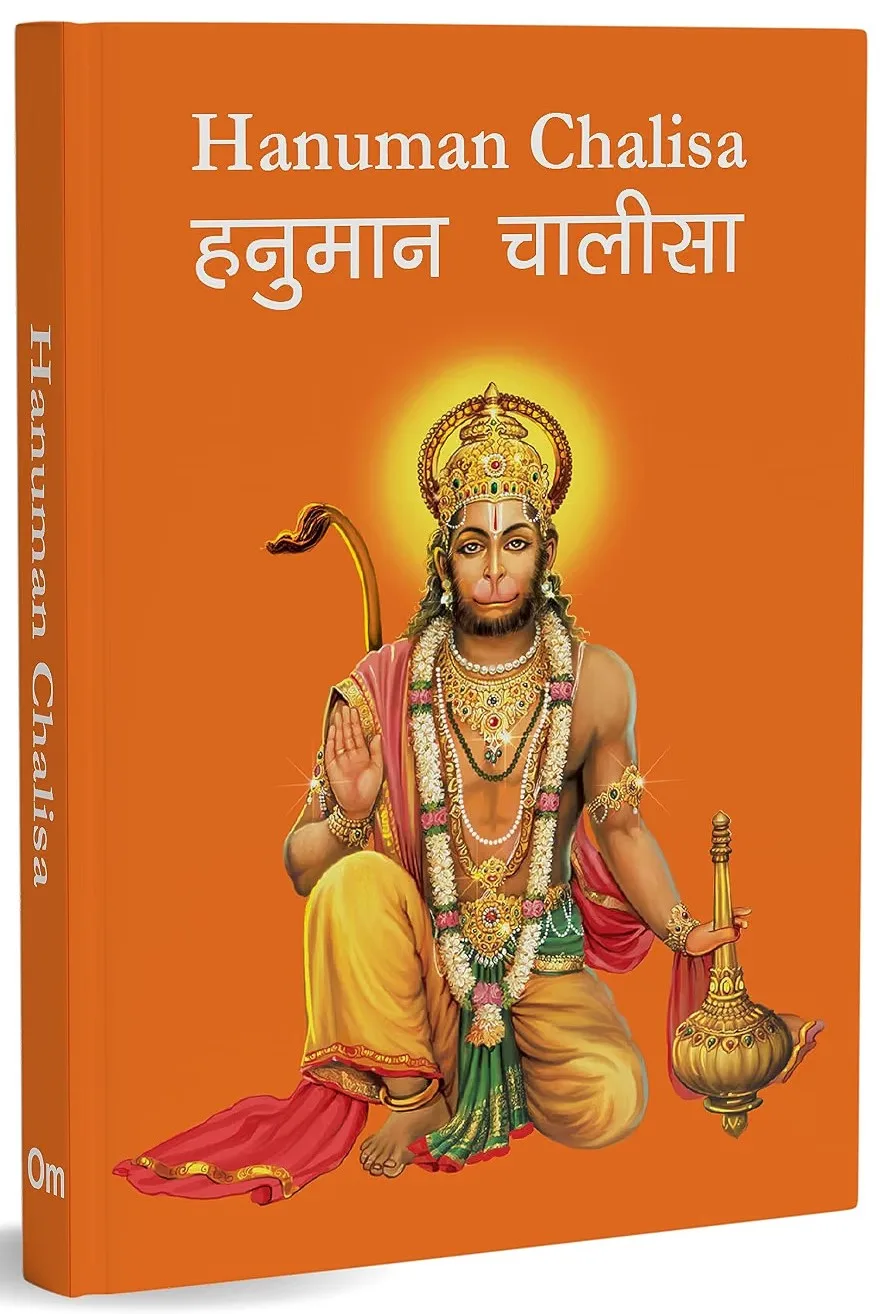
Download Cover Image
Do you want to download the full cover image for Hanuman Chalisa: हनुमान चालीसा – Hanuman Chalisa Pocket Size Book (Hindi & English)?