
Bhagavad Gita for Pregnancy
Unknown Format
• 150 Pages
• ₹ 500.00
• English
No ratings yet
| Publisher | Nurturing Kosha |
|---|---|
| ASIN/SKU | B0GV4FCZG2 |
| Book Format | Unknown Format |
| Language | English |
| Pages | 150 |
| List Price | ₹ 500.00 |
| Publishing Date | 26/03/2026 |
| Dimensions | 21 x 15 x 1 cm |
| Weight | 300 g |
| Book Code | BD00070713 |
Buy this Book
Amazon Stores
Ebook Stores
Other Stores
Discover Bhagavad Gita for Pregnancy by Vishakha Gupta. This book is published by Nurturing Kosha in Unknown Format format, ASIN B0GV4FCZG2, under Religion and Spirituality, Hinduism.
Book Description
Bhagavad Gita for Pregnancy is a thoughtfully adapted, easy-to-read version of the Gita created especially for moms-to-be. Instead of all 700 verses, this book brings together 108 carefully selected shlokas, organised into 12 themes inspired by Hindu philosophy such as Dharma and Sthita Pragya. Each verse is paired with a pregnancy reflection that helps you relate its wisdom to your own thoughts, emotions, and everyday experiences—making it feel relevant, comforting, and not overwhelming. Designed to be more than just a book, it also includes 12 guided activities (one for each theme) to make your journey interactive and meaningful. Whether you read a single verse or a few pages at a time, it helps you create small moments of calm, grounding, and connection with your baby through Garbha Samvaad. Thoughtfully created as a labour of love, this 150-page book is a gentle companion you can return to at your own pace—on both the good days and the difficult ones.
Author Biography
Author Biography will be added soon…
Editorial Reviews
Editorial Reviews will be added soon…
Book Summary
Bhagavad Gita for Pregnancy by Vishakha Gupta is a contemporary, accessible interpretation of selected Bhagavad Gita teachings created especially for the emotional and spiritual journey of pregnancy. Rather than presenting the Gita as a traditional scripture to be studied from beginning to end, the book brings 108 selected verses into the everyday world of an expectant mother, connecting ancient ideas about duty, surrender, courage, compassion, self-awareness, and inner steadiness with the fears, hopes, changes, and uncertainties that accompany pregnancy. The book is structured as a gentle daily practice: one verse, one reflection, and a small period of quiet attention. Its published description presents 108 shlokas with Sanskrit, transliteration, plain-English meanings, reflections, 12 themes, and 12 guided activities, designed around approximately ten minutes of daily reading.
At the heart of the book is a simple but meaningful idea: pregnancy is not only a physical process but also a profound emotional transformation. A woman preparing to become a mother may experience happiness and gratitude alongside anxiety, exhaustion, self-doubt, fear of childbirth, concern about the baby's health, changing relationships, and a feeling that much of her life has suddenly moved beyond her control. The book approaches these emotions without treating them as failures. Instead, it uses the wisdom of the Bhagavad Gita to encourage a calmer relationship with uncertainty. The author's own description of the project emphasizes that the Gita speaks particularly well to moments when a person feels overwhelmed and does not know what comes next.
The connection with Arjuna's situation is central to this approach. In the Bhagavad Gita, Arjuna stands on the battlefield facing an overwhelming moral and emotional crisis. Although he is surrounded by people and circumstances that demand action, he becomes confused, frightened, and unable to see a clear path forward. Krishna does not simply tell him to stop feeling afraid. Instead, the conversation gradually teaches him how to face difficult circumstances with greater clarity. Bhagavad Gita for Pregnancy adapts this basic emotional framework to motherhood. Pregnancy, too, can place a person in a situation where preparation is possible but control is limited. An expectant mother can make careful choices, seek medical guidance, eat thoughtfully, rest, prepare for childbirth, and learn about parenting, yet she cannot completely control the future. The book therefore presents inner steadiness as an important companion to practical preparation.
One of the strongest themes running through the book is the distinction between action and attachment to results. The familiar Gita teaching that one should focus on one's actions rather than becoming consumed by their outcomes takes on a particularly intimate meaning during pregnancy. An expectant mother naturally wants everything to go perfectly. She may worry about test results, developmental milestones, labour, delivery, breastfeeding, and the baby's future. Such concerns often arise precisely because she cares so deeply. The book does not suggest that she should stop caring. Rather, its message can be understood as an invitation to separate responsible action from constant mental fear about what cannot yet be known. She can do what is reasonably within her control while learning to release the demand that every outcome must match her expectations.
This becomes especially relevant to the idea of surrender. Surrender in the book is not presented as passivity or neglect. It is closer to accepting the limits of personal control while continuing to act responsibly. Pregnancy provides countless examples of this tension. A mother may have a carefully imagined birth plan, only to discover that circumstances require something different. She may hope for one type of delivery and eventually need another. The author's pregnancy-focused writing explicitly applies this Gita-inspired perspective to fears around childbirth and changing birth plans, while also emphasizing that medical guidance should remain central to decisions concerning mother and baby.
Another important idea is SthitaPragya, the state of being inwardly steady or established in wisdom. This concept is particularly appropriate for the emotional fluctuations of pregnancy. Hormonal changes, physical discomfort, fatigue, social expectations, and uncertainty can make emotions feel unusually intense. The book does not promise a pregnancy free from difficult feelings. Instead, it encourages the reader to develop a little space between an emotion and her reaction to it. Fear may arise without becoming the whole story. A worrying thought may appear without having to dictate the entire day. Happiness can be experienced without the constant fear that it will disappear. In this sense, steadiness does not mean emotional numbness; it means learning to remain present even when emotions change.
The book also explores the importance of Dharma, or one's responsibility and meaningful duty. Pregnancy can bring a major shift in a woman's understanding of herself. She is not simply preparing for the arrival of a child; she is beginning to inhabit a new role. Yet the transition can create pressure. Social expectations can make mothers feel that they must behave according to an ideal image of pregnancy and motherhood. The Gita's broader teaching about doing one's duty without being consumed by comparison provides a useful counterpoint to this pressure. The book encourages the mother to concentrate on her own journey rather than measuring herself against other women's pregnancies, birth stories, bodies, routines, or experiences.
This idea of freedom from comparison is especially valuable in a modern environment saturated with advice. Pregnancy can attract opinions from family members, friends, social media, books, websites, and strangers. Everyone may seem to have a different rule about what a mother should eat, think, feel, do, avoid, or believe. The author's contemporary pregnancy writing recognizes how exhausting this flood of advice can become. One of the practical lessons associated with the book is therefore the cultivation of an inner centre—a place from which a woman can listen to advice without allowing every outside opinion to become an internal command.
Compassion, represented through themes such as Karuna, is another significant dimension. Pregnancy can sometimes create an unusual form of guilt. A woman may feel guilty for being tired, anxious, irritated, uncomfortable, or insufficiently joyful. Because pregnancy is frequently described as a beautiful and magical experience, women can feel that negative emotions somehow contradict gratitude. The book challenges this kind of emotional perfectionism by making room for ordinary human feelings. Its underlying message is compassionate: becoming a mother does not require becoming emotionally perfect. A woman can be grateful and frightened at the same time. She can love her unborn child and still feel exhausted. She can look forward to motherhood while grieving aspects of her former life.
The concept of Jaya, associated with victory, can likewise be understood in a deeper way than simply winning. The book's approach suggests that victory during pregnancy is not necessarily about having a flawless pregnancy or achieving a particular birth experience. It can mean developing courage, patience, awareness, and trust while moving through circumstances that cannot always be controlled. The emphasis shifts from external perfection to inner growth. In that sense, pregnancy becomes not merely a period of waiting for a baby but a period in which the mother herself is being transformed.
The book's structure reinforces this reflective purpose. Rather than asking a pregnant reader to study long philosophical passages every day, it offers a manageable rhythm. The publisher describes it as 108 verses, with Sanskrit, transliteration, plain-English meaning, a reflection following each verse, and 12 themes accompanied by guided activities. The suggested practice is around ten minutes a day and can begin in any trimester. This makes the book less like an academic study of the Gita and more like a devotional-reflective companion. The short format is important because pregnancy itself can make sustained concentration difficult. Ten quiet minutes can feel achievable even on a tiring day.
The use of Sanskrit alongside transliteration and simple meaning also creates a bridge between tradition and accessibility. Readers familiar with the Bhagavad Gita may recognize the verses and encounter them in a new context, while readers who have never studied the scripture can approach them without needing extensive prior knowledge. The book's purpose is not to replace traditional translations or scholarly commentaries. Rather, it selects teachings and places them inside a specific life experience: pregnancy.
An especially distinctive aspect of the book is its emphasis on the relationship between the mother's inner world and her developing relationship with her baby. The publisher frames this through the Pancha Kosha idea of five layers—body, breath, mind, wisdom, and bliss—and explains that this particular book concentrates especially on the mental, wisdom, and bliss dimensions. Within this framework, the mind represents the worries and emotional turbulence of pregnancy; wisdom represents discernment amid the enormous amount of information and advice available to a mother; and bliss represents a deeper form of joy that does not depend entirely on circumstances.
This makes the book's concept of bonding broader than simply talking to the unborn child. It is also about the mother's relationship with herself. Before a woman can navigate motherhood confidently, she may need to become more comfortable with her own thoughts and emotions. The quiet act of reading a verse, considering its meaning, and sitting with it for a few minutes can become a small ritual of self-connection. The book is therefore both outward-looking and inward-looking: it encourages a mother to think about the child she is welcoming while also recognizing the woman she is becoming.
Importantly, the book does not present spiritual reflection as a substitute for medical care. Its purpose is emotional and philosophical rather than clinical. Pregnancy involves genuine medical decisions, and those decisions require qualified healthcare professionals. The book's value lies elsewhere—in helping create a calmer mental environment in which an expectant mother can approach those decisions with greater clarity rather than being dominated by fear.
Overall, Bhagavad Gita for Pregnancy can be understood as an attempt to bring an ancient philosophical conversation into one of the most emotionally significant periods of modern life. Vishakha Gupta does not treat the Bhagavad Gita merely as a sacred text to be admired from a distance. Instead, the selected verses are presented as companions for ordinary moments of pregnancy: moments of worry, waiting, uncertainty, excitement, fatigue, anticipation, and profound change. The book's central promise is not that the Gita will eliminate every difficult emotion. Its more practical promise is that its teachings can help a woman meet those emotions with greater awareness and steadiness.
The deepest message of the book is therefore about learning to live with love without demanding certainty. A pregnant woman already knows that she cannot completely control the future, but emotionally accepting that truth can be difficult. The Bhagavad Gita offers a language for that difficulty. Through ideas of duty, surrender, compassion, discernment, equanimity, and non-attachment, the book encourages the mother to do what she can, release what she cannot control, and remain present for the life unfolding before her.
In this sense, Bhagavad Gita for Pregnancy is less a conventional pregnancy manual and more a reflective spiritual companion. Its 108 selected verses, pregnancy-focused reflections, themes, and activities turn the immense philosophical landscape of the Gita into a small daily practice. The book invites the expectant mother to pause rather than rush, reflect rather than overthink, and accept rather than constantly resist uncertainty. Its most humane insight is that pregnancy does not require a woman to be fearless; it asks her to keep moving forward even while fear, hope, love, and uncertainty coexist. The result is a gentle introduction to Gita-inspired reflection for mothers who want their pregnancy to include not only preparation for birth, but also preparation of the heart and mind for the profound experience of becoming a parent.
At the heart of the book is a simple but meaningful idea: pregnancy is not only a physical process but also a profound emotional transformation. A woman preparing to become a mother may experience happiness and gratitude alongside anxiety, exhaustion, self-doubt, fear of childbirth, concern about the baby's health, changing relationships, and a feeling that much of her life has suddenly moved beyond her control. The book approaches these emotions without treating them as failures. Instead, it uses the wisdom of the Bhagavad Gita to encourage a calmer relationship with uncertainty. The author's own description of the project emphasizes that the Gita speaks particularly well to moments when a person feels overwhelmed and does not know what comes next.
The connection with Arjuna's situation is central to this approach. In the Bhagavad Gita, Arjuna stands on the battlefield facing an overwhelming moral and emotional crisis. Although he is surrounded by people and circumstances that demand action, he becomes confused, frightened, and unable to see a clear path forward. Krishna does not simply tell him to stop feeling afraid. Instead, the conversation gradually teaches him how to face difficult circumstances with greater clarity. Bhagavad Gita for Pregnancy adapts this basic emotional framework to motherhood. Pregnancy, too, can place a person in a situation where preparation is possible but control is limited. An expectant mother can make careful choices, seek medical guidance, eat thoughtfully, rest, prepare for childbirth, and learn about parenting, yet she cannot completely control the future. The book therefore presents inner steadiness as an important companion to practical preparation.
One of the strongest themes running through the book is the distinction between action and attachment to results. The familiar Gita teaching that one should focus on one's actions rather than becoming consumed by their outcomes takes on a particularly intimate meaning during pregnancy. An expectant mother naturally wants everything to go perfectly. She may worry about test results, developmental milestones, labour, delivery, breastfeeding, and the baby's future. Such concerns often arise precisely because she cares so deeply. The book does not suggest that she should stop caring. Rather, its message can be understood as an invitation to separate responsible action from constant mental fear about what cannot yet be known. She can do what is reasonably within her control while learning to release the demand that every outcome must match her expectations.
This becomes especially relevant to the idea of surrender. Surrender in the book is not presented as passivity or neglect. It is closer to accepting the limits of personal control while continuing to act responsibly. Pregnancy provides countless examples of this tension. A mother may have a carefully imagined birth plan, only to discover that circumstances require something different. She may hope for one type of delivery and eventually need another. The author's pregnancy-focused writing explicitly applies this Gita-inspired perspective to fears around childbirth and changing birth plans, while also emphasizing that medical guidance should remain central to decisions concerning mother and baby.
Another important idea is SthitaPragya, the state of being inwardly steady or established in wisdom. This concept is particularly appropriate for the emotional fluctuations of pregnancy. Hormonal changes, physical discomfort, fatigue, social expectations, and uncertainty can make emotions feel unusually intense. The book does not promise a pregnancy free from difficult feelings. Instead, it encourages the reader to develop a little space between an emotion and her reaction to it. Fear may arise without becoming the whole story. A worrying thought may appear without having to dictate the entire day. Happiness can be experienced without the constant fear that it will disappear. In this sense, steadiness does not mean emotional numbness; it means learning to remain present even when emotions change.
The book also explores the importance of Dharma, or one's responsibility and meaningful duty. Pregnancy can bring a major shift in a woman's understanding of herself. She is not simply preparing for the arrival of a child; she is beginning to inhabit a new role. Yet the transition can create pressure. Social expectations can make mothers feel that they must behave according to an ideal image of pregnancy and motherhood. The Gita's broader teaching about doing one's duty without being consumed by comparison provides a useful counterpoint to this pressure. The book encourages the mother to concentrate on her own journey rather than measuring herself against other women's pregnancies, birth stories, bodies, routines, or experiences.
This idea of freedom from comparison is especially valuable in a modern environment saturated with advice. Pregnancy can attract opinions from family members, friends, social media, books, websites, and strangers. Everyone may seem to have a different rule about what a mother should eat, think, feel, do, avoid, or believe. The author's contemporary pregnancy writing recognizes how exhausting this flood of advice can become. One of the practical lessons associated with the book is therefore the cultivation of an inner centre—a place from which a woman can listen to advice without allowing every outside opinion to become an internal command.
Compassion, represented through themes such as Karuna, is another significant dimension. Pregnancy can sometimes create an unusual form of guilt. A woman may feel guilty for being tired, anxious, irritated, uncomfortable, or insufficiently joyful. Because pregnancy is frequently described as a beautiful and magical experience, women can feel that negative emotions somehow contradict gratitude. The book challenges this kind of emotional perfectionism by making room for ordinary human feelings. Its underlying message is compassionate: becoming a mother does not require becoming emotionally perfect. A woman can be grateful and frightened at the same time. She can love her unborn child and still feel exhausted. She can look forward to motherhood while grieving aspects of her former life.
The concept of Jaya, associated with victory, can likewise be understood in a deeper way than simply winning. The book's approach suggests that victory during pregnancy is not necessarily about having a flawless pregnancy or achieving a particular birth experience. It can mean developing courage, patience, awareness, and trust while moving through circumstances that cannot always be controlled. The emphasis shifts from external perfection to inner growth. In that sense, pregnancy becomes not merely a period of waiting for a baby but a period in which the mother herself is being transformed.
The book's structure reinforces this reflective purpose. Rather than asking a pregnant reader to study long philosophical passages every day, it offers a manageable rhythm. The publisher describes it as 108 verses, with Sanskrit, transliteration, plain-English meaning, a reflection following each verse, and 12 themes accompanied by guided activities. The suggested practice is around ten minutes a day and can begin in any trimester. This makes the book less like an academic study of the Gita and more like a devotional-reflective companion. The short format is important because pregnancy itself can make sustained concentration difficult. Ten quiet minutes can feel achievable even on a tiring day.
The use of Sanskrit alongside transliteration and simple meaning also creates a bridge between tradition and accessibility. Readers familiar with the Bhagavad Gita may recognize the verses and encounter them in a new context, while readers who have never studied the scripture can approach them without needing extensive prior knowledge. The book's purpose is not to replace traditional translations or scholarly commentaries. Rather, it selects teachings and places them inside a specific life experience: pregnancy.
An especially distinctive aspect of the book is its emphasis on the relationship between the mother's inner world and her developing relationship with her baby. The publisher frames this through the Pancha Kosha idea of five layers—body, breath, mind, wisdom, and bliss—and explains that this particular book concentrates especially on the mental, wisdom, and bliss dimensions. Within this framework, the mind represents the worries and emotional turbulence of pregnancy; wisdom represents discernment amid the enormous amount of information and advice available to a mother; and bliss represents a deeper form of joy that does not depend entirely on circumstances.
This makes the book's concept of bonding broader than simply talking to the unborn child. It is also about the mother's relationship with herself. Before a woman can navigate motherhood confidently, she may need to become more comfortable with her own thoughts and emotions. The quiet act of reading a verse, considering its meaning, and sitting with it for a few minutes can become a small ritual of self-connection. The book is therefore both outward-looking and inward-looking: it encourages a mother to think about the child she is welcoming while also recognizing the woman she is becoming.
Importantly, the book does not present spiritual reflection as a substitute for medical care. Its purpose is emotional and philosophical rather than clinical. Pregnancy involves genuine medical decisions, and those decisions require qualified healthcare professionals. The book's value lies elsewhere—in helping create a calmer mental environment in which an expectant mother can approach those decisions with greater clarity rather than being dominated by fear.
Overall, Bhagavad Gita for Pregnancy can be understood as an attempt to bring an ancient philosophical conversation into one of the most emotionally significant periods of modern life. Vishakha Gupta does not treat the Bhagavad Gita merely as a sacred text to be admired from a distance. Instead, the selected verses are presented as companions for ordinary moments of pregnancy: moments of worry, waiting, uncertainty, excitement, fatigue, anticipation, and profound change. The book's central promise is not that the Gita will eliminate every difficult emotion. Its more practical promise is that its teachings can help a woman meet those emotions with greater awareness and steadiness.
The deepest message of the book is therefore about learning to live with love without demanding certainty. A pregnant woman already knows that she cannot completely control the future, but emotionally accepting that truth can be difficult. The Bhagavad Gita offers a language for that difficulty. Through ideas of duty, surrender, compassion, discernment, equanimity, and non-attachment, the book encourages the mother to do what she can, release what she cannot control, and remain present for the life unfolding before her.
In this sense, Bhagavad Gita for Pregnancy is less a conventional pregnancy manual and more a reflective spiritual companion. Its 108 selected verses, pregnancy-focused reflections, themes, and activities turn the immense philosophical landscape of the Gita into a small daily practice. The book invites the expectant mother to pause rather than rush, reflect rather than overthink, and accept rather than constantly resist uncertainty. Its most humane insight is that pregnancy does not require a woman to be fearless; it asks her to keep moving forward even while fear, hope, love, and uncertainty coexist. The result is a gentle introduction to Gita-inspired reflection for mothers who want their pregnancy to include not only preparation for birth, but also preparation of the heart and mind for the profound experience of becoming a parent.
Sample Chapters
Sample Chapters will be added soon…
Reader Reviews
No reviews yet.
Bhagavad Gita for Pregnancy
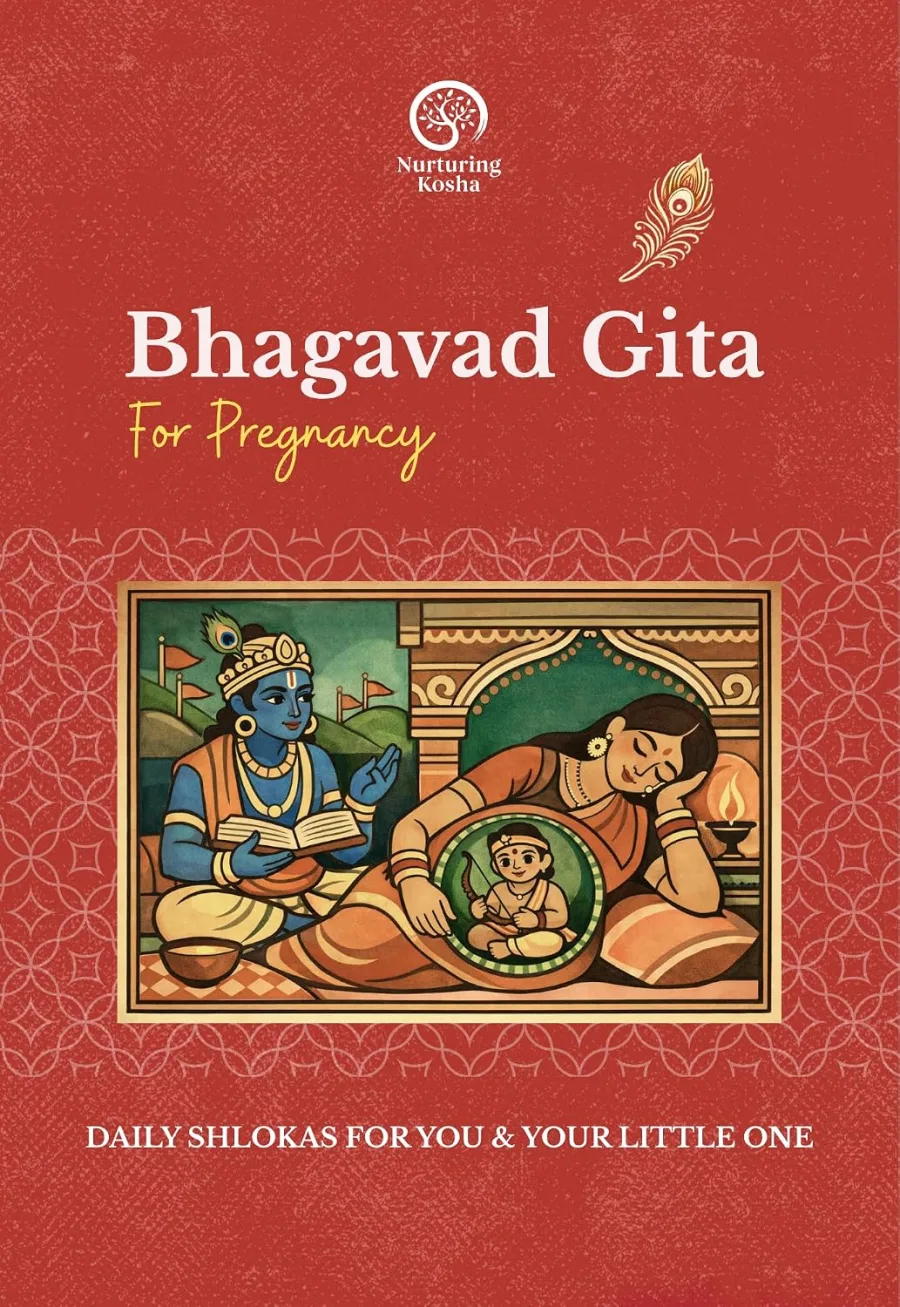
Download Cover Image
Do you want to download the full cover image for Bhagavad Gita for Pregnancy?