
Becoming Hanuman: A 500 Year Old 5 Minutes Ritual to Unlock Your True Potential
Paperback
• 264 Pages
• ₹ 499.00
• English
• 9789359370095
No ratings yet
| Publisher | Anand Bhardwaj |
|---|---|
| ISBN13 | 9789359370095 |
| ASIN/SKU | 9359370096 |
| Book Format | Paperback |
| Language | English |
| Pages | 264 |
| List Price | ₹ 499.00 |
| Publishing Date | 29/07/2026 |
| Book Code | BD00070710 |
Buy this Book
Amazon Stores
Ebook Stores
Other Stores
Discover Becoming Hanuman: A 500 Year Old 5 Minutes Ritual to Unlock Your True Potential by B. Anand. This book is published by Anand Bhardwaj in Paperback format, ISBN 9789359370095, ASIN 9359370096, under Religion and Spirituality, Hinduism.
Book Description
BECOMING HANUMAN
A 500-Year-Old, 5-Minute Ritual to Rewire Your Brain to Unlock Your True Potential
You've probably recited it before.
Maybe in your grandmother's house, early morning, half-asleep. Maybe at a temple you visited because someone you loved was sick. Maybe on your phone, in a traffic jam, because you didn't know what else to do.
The Hanuman Chalisa. Forty verses. Five minutes. A ritual half a billion people perform every day.
But what if no one ever told you what it actually does?
This is the story of Sanket Mishra — 28, Prayagraj-born, living alone in Gurugram, quietly drowning. Good job. No direction. A name that means signal, but a life that feels like nothing but noise.
On a desperate trek into the Himalayas, he meets a scholar no one was supposed to find. An old man in a mountain temple who doesn't offer Sanket prayers or platitudes — he offers him something stranger: neuroscience.
Because every verse of the Hanuman Chalisa, it turns out, is a precise instruction. Not to a god outside you. To the brain inside you.
Becoming Hanuman decodes Tulsidas's 500-year-old masterwork — verse by verse — through the lens of modern brain science. Oxytocin and brotherhood. Neuroplasticity and devotion. The default mode network and the nature of sankat. Fear, courage, identity, transformation — the Chalisa maps all of it, with a precision that shouldn't be possible for something written in 1574.
And yet, here we are.
This book is not for the devotee who wants their faith confirmed.
It is for the person who has quietly stopped believing they are capable of more.
It is for anyone who ever recited those forty verses and felt something — but couldn't name what.
It is, most of all, for the Sanket in you. The one sitting in a city that wasn't supposed to be your whole life. The one who knows, somewhere below the noise, that there is something vast inside — waiting to be remembered.
Hanuman didn't become limitless.
He was reminded that he already was.
So can you.
3 parts. 44 chapters. 200 days. One ritual that changes everything. Hanuman didn't become limitless.
A 500-Year-Old, 5-Minute Ritual to Rewire Your Brain to Unlock Your True Potential
You've probably recited it before.
Maybe in your grandmother's house, early morning, half-asleep. Maybe at a temple you visited because someone you loved was sick. Maybe on your phone, in a traffic jam, because you didn't know what else to do.
The Hanuman Chalisa. Forty verses. Five minutes. A ritual half a billion people perform every day.
But what if no one ever told you what it actually does?
This is the story of Sanket Mishra — 28, Prayagraj-born, living alone in Gurugram, quietly drowning. Good job. No direction. A name that means signal, but a life that feels like nothing but noise.
On a desperate trek into the Himalayas, he meets a scholar no one was supposed to find. An old man in a mountain temple who doesn't offer Sanket prayers or platitudes — he offers him something stranger: neuroscience.
Because every verse of the Hanuman Chalisa, it turns out, is a precise instruction. Not to a god outside you. To the brain inside you.
Becoming Hanuman decodes Tulsidas's 500-year-old masterwork — verse by verse — through the lens of modern brain science. Oxytocin and brotherhood. Neuroplasticity and devotion. The default mode network and the nature of sankat. Fear, courage, identity, transformation — the Chalisa maps all of it, with a precision that shouldn't be possible for something written in 1574.
And yet, here we are.
This book is not for the devotee who wants their faith confirmed.
It is for the person who has quietly stopped believing they are capable of more.
It is for anyone who ever recited those forty verses and felt something — but couldn't name what.
It is, most of all, for the Sanket in you. The one sitting in a city that wasn't supposed to be your whole life. The one who knows, somewhere below the noise, that there is something vast inside — waiting to be remembered.
Hanuman didn't become limitless.
He was reminded that he already was.
So can you.
3 parts. 44 chapters. 200 days. One ritual that changes everything. Hanuman didn't become limitless.
Author Biography
Author Biography will be added soon…
Editorial Reviews
Editorial Reviews will be added soon…
Book Summary
Becoming Hanuman: A 500 Year Old 5 Minutes Ritual to Unlock Your True Potential by B. Anand is a spiritual and self-development book that draws inspiration from the powerful symbolism of Lord Hanuman to explore human potential, courage, discipline, devotion, and inner strength. At its heart, the book presents a simple idea: extraordinary abilities are not necessarily created from nothing; they can be awakened from within. Through a short daily ritual, combined with focused intention and the qualities represented by Hanuman, the author encourages readers to reconnect with the strength, confidence, clarity, and purpose that may already exist inside them.
The title Becoming Hanuman is not meant to suggest literally becoming a mythological figure. Instead, Hanuman serves as an ideal of what a human being can become when physical energy, mental discipline, emotional stability, devotion, humility, and purposeful action work together. In the traditional stories of the Ramayana, Hanuman is remembered for his immense strength, extraordinary courage, unwavering loyalty to Lord Rama, and remarkable ability to overcome seemingly impossible obstacles. B. Anand uses these qualities as a framework for personal transformation. The book therefore moves between spirituality and practical self-improvement, asking readers to consider whether many of their limitations are genuine limitations or simply beliefs they have accepted about themselves.
One of the most important ideas running through the book is the difference between having potential and realizing potential. A person may possess intelligence, talent, creativity, courage, or physical ability, yet still fail to use these qualities fully. Fear, self-doubt, distraction, negative habits, social conditioning, and repeated experiences of failure can gradually create an internal picture of limitation. The person begins to believe, consciously or unconsciously, that certain things are beyond reach. The story of Hanuman provides a powerful metaphor for this condition. Hanuman possesses tremendous strength, but there are moments in the traditional narrative when he does not fully recognize what he is capable of doing. He needs to be reminded of his forgotten power.
This becomes a central message of Becoming Hanuman: sometimes transformation begins not by acquiring a new power but by remembering an existing one. The reader is encouraged to look beyond the identity created by past failures and circumstances. Instead of asking, “What am I capable of?” from the narrow perspective of present limitations, the book invites a deeper question: “What might become possible if I stopped defining myself by my fears?”
The five-minute ritual mentioned in the title is important because the author does not build the entire process around complicated spiritual practices or lengthy routines. The emphasis is on consistency and intention. A practice that takes only a few minutes can be easier to integrate into everyday life than a demanding routine that requires large amounts of time. The underlying principle is simple: a small practice repeated faithfully can gradually influence the way a person thinks, feels, and acts.
The ritual is presented within a larger spiritual framework rather than as a mechanical formula for success. Its purpose is to create a deliberate pause in the day—a moment when the individual turns attention inward, reconnects with a chosen ideal, and prepares the mind for purposeful action. In this sense, the ritual is less about the number of minutes and more about the quality of attention brought to those minutes. Five minutes of genuine concentration can be more meaningful than an hour of distracted activity.
The figure of Hanuman gives the ritual its emotional and symbolic power. Hanuman represents strength without arrogance. This distinction is especially significant. Strength by itself can become destructive when separated from wisdom and humility. Hanuman's greatness in the Ramayana is not simply that he is powerful; it is that his power is directed toward service. His abilities are placed at the disposal of something larger than his individual ego. B. Anand uses this idea to suggest that true personal power should not merely make a person more ambitious. It should make that person more useful, dependable, courageous, and purposeful.
The book therefore treats devotion as a form of strength rather than weakness. In a modern culture that often associates success with personal achievement, self-promotion, and competition, Hanuman presents a different model. His greatness comes partly from his complete dedication to a higher purpose. He does not constantly ask what he can gain. His actions are motivated by what needs to be done.
This perspective can change the way readers understand ambition. Ambition does not have to mean an endless attempt to prove one's superiority. It can mean committing oneself wholeheartedly to meaningful work. When a person has a clear purpose, difficulties become easier to endure because effort is connected to something beyond immediate comfort.
Another major theme is courage. The book encourages readers to understand courage not as the absence of fear but as the willingness to act despite fear. Hanuman's journey is filled with obstacles that appear larger than his individual capacity. Yet he continues to move forward. This becomes a metaphor for the situations readers encounter in their own lives: difficult decisions, professional uncertainty, financial pressure, relationship problems, personal insecurity, or dreams that seem too ambitious.
The lesson is not that every obstacle will disappear simply because someone thinks positively. Rather, the book emphasizes the importance of changing one's relationship with obstacles. A person who believes an obstacle is completely impossible may stop before making a serious attempt. A person who regards the obstacle as a challenge may begin searching for another route. This shift in mental attitude can influence behavior, and behavior is what eventually creates tangible change.
Closely connected to courage is self-discipline. Potential without discipline remains potential. A person may have extraordinary dreams but continue to live according to habits that undermine those dreams. The book's short ritual therefore symbolizes a larger principle: transformation depends on repeated action. Motivation can rise and fall, but a disciplined practice provides continuity.
This is particularly relevant in contemporary life, where attention is constantly divided. Phones, social media, entertainment, notifications, and endless streams of information can make sustained concentration difficult. A brief daily ritual offers an intentional interruption to this pattern. It gives the mind a fixed point around which the day can be organized. The practice becomes a reminder that the individual, rather than the surrounding noise, should determine where attention is directed.
The book also places considerable importance on mental conditioning. The thoughts a person repeatedly entertains can influence emotional responses and eventually behavior. If someone constantly repeats an internal story of weakness, failure, or inadequacy, that story can begin to feel like objective truth. Conversely, deliberately cultivating courage, confidence, responsibility, and purpose can create a different psychological orientation.
However, the deeper message is not simply “think positively.” Becoming Hanuman goes beyond superficial positive thinking by connecting thought with action. Confidence becomes meaningful when it produces courageous behavior. Discipline becomes meaningful when it leads to consistent work. Devotion becomes meaningful when it results in service. Spirituality becomes meaningful when it changes the way a person lives.
One of the most appealing aspects of the Hanuman ideal is that strength and humility exist together. Modern ideas of personal empowerment sometimes encourage people to focus heavily on themselves: their achievements, their status, their desires, and their recognition. Hanuman offers a different image of greatness. He is immensely powerful but does not need to constantly display that power. His identity is grounded in service.
This creates an important lesson about ego. A person can become stronger without becoming self-important. In fact, the book suggests that genuine inner strength may reduce the need for external validation. Someone who knows their purpose does not need to prove themselves at every moment. They can work quietly, endure difficulty, accept responsibility, and allow results to speak for themselves.
The book's spiritual dimension also encourages readers to see life as something larger than individual achievement. Hanuman's story is inseparable from devotion to Rama, and this relationship provides the foundation for the book's broader philosophy. For readers approaching the book from a spiritual perspective, Hanuman represents surrender to divine purpose. For readers approaching it as a personal-development text, he can also represent dedication to a meaningful ideal. In either interpretation, the message is that human beings often become stronger when their efforts are connected to something larger than immediate self-interest.
Another significant lesson is the importance of remembering one's identity during moments of difficulty. People often behave according to the identity they have constructed for themselves. Someone who thinks of themselves as weak may avoid challenges. Someone who thinks of themselves as incapable may abandon difficult projects early. Someone who sees themselves as resilient may interpret the same difficulty differently. The book encourages readers to consciously cultivate an identity based on courage, discipline, service, and faith.
Ultimately, Becoming Hanuman is less about supernatural transformation than about inner awakening. The five-minute ritual serves as a practical doorway into a larger process. It encourages readers to establish a daily moment of reflection, reconnect with their deepest intentions, and carry those intentions into ordinary actions.
The book's most enduring message can be expressed simply: human potential is often hidden beneath layers of fear, habit, distraction, and self-doubt. Awakening that potential requires more than wishing for change. It requires awareness, discipline, courage, and repeated action. Hanuman becomes a powerful symbol because his story brings these qualities together. He is strong but humble, courageous but devoted, powerful but obedient to a higher purpose, and capable of extraordinary action without being driven by ego.
For readers, Becoming Hanuman can therefore be understood as an invitation to examine the distance between the person they currently are and the person they believe they could become. Its five-minute practice emphasizes that transformation does not always begin with a dramatic decision. Sometimes it begins with a small daily act of attention. Five minutes may appear insignificant, but when those minutes are used consistently to strengthen intention and reshape one's inner orientation, they can become the beginning of a much larger journey.
In the end, becoming “Hanuman” is not about imitating a mythological character literally. It is about embodying the qualities that Hanuman represents: courage in the face of fear, strength guided by wisdom, discipline in pursuit of purpose, humility despite ability, devotion beyond ego, and a willingness to use one's gifts in service of something meaningful. B. Anand's central invitation is to stop underestimating what lies within and to begin consciously awakening it. The journey starts quietly, perhaps with only five minutes, but its real destination is a transformed way of thinking and living.
The title Becoming Hanuman is not meant to suggest literally becoming a mythological figure. Instead, Hanuman serves as an ideal of what a human being can become when physical energy, mental discipline, emotional stability, devotion, humility, and purposeful action work together. In the traditional stories of the Ramayana, Hanuman is remembered for his immense strength, extraordinary courage, unwavering loyalty to Lord Rama, and remarkable ability to overcome seemingly impossible obstacles. B. Anand uses these qualities as a framework for personal transformation. The book therefore moves between spirituality and practical self-improvement, asking readers to consider whether many of their limitations are genuine limitations or simply beliefs they have accepted about themselves.
One of the most important ideas running through the book is the difference between having potential and realizing potential. A person may possess intelligence, talent, creativity, courage, or physical ability, yet still fail to use these qualities fully. Fear, self-doubt, distraction, negative habits, social conditioning, and repeated experiences of failure can gradually create an internal picture of limitation. The person begins to believe, consciously or unconsciously, that certain things are beyond reach. The story of Hanuman provides a powerful metaphor for this condition. Hanuman possesses tremendous strength, but there are moments in the traditional narrative when he does not fully recognize what he is capable of doing. He needs to be reminded of his forgotten power.
This becomes a central message of Becoming Hanuman: sometimes transformation begins not by acquiring a new power but by remembering an existing one. The reader is encouraged to look beyond the identity created by past failures and circumstances. Instead of asking, “What am I capable of?” from the narrow perspective of present limitations, the book invites a deeper question: “What might become possible if I stopped defining myself by my fears?”
The five-minute ritual mentioned in the title is important because the author does not build the entire process around complicated spiritual practices or lengthy routines. The emphasis is on consistency and intention. A practice that takes only a few minutes can be easier to integrate into everyday life than a demanding routine that requires large amounts of time. The underlying principle is simple: a small practice repeated faithfully can gradually influence the way a person thinks, feels, and acts.
The ritual is presented within a larger spiritual framework rather than as a mechanical formula for success. Its purpose is to create a deliberate pause in the day—a moment when the individual turns attention inward, reconnects with a chosen ideal, and prepares the mind for purposeful action. In this sense, the ritual is less about the number of minutes and more about the quality of attention brought to those minutes. Five minutes of genuine concentration can be more meaningful than an hour of distracted activity.
The figure of Hanuman gives the ritual its emotional and symbolic power. Hanuman represents strength without arrogance. This distinction is especially significant. Strength by itself can become destructive when separated from wisdom and humility. Hanuman's greatness in the Ramayana is not simply that he is powerful; it is that his power is directed toward service. His abilities are placed at the disposal of something larger than his individual ego. B. Anand uses this idea to suggest that true personal power should not merely make a person more ambitious. It should make that person more useful, dependable, courageous, and purposeful.
The book therefore treats devotion as a form of strength rather than weakness. In a modern culture that often associates success with personal achievement, self-promotion, and competition, Hanuman presents a different model. His greatness comes partly from his complete dedication to a higher purpose. He does not constantly ask what he can gain. His actions are motivated by what needs to be done.
This perspective can change the way readers understand ambition. Ambition does not have to mean an endless attempt to prove one's superiority. It can mean committing oneself wholeheartedly to meaningful work. When a person has a clear purpose, difficulties become easier to endure because effort is connected to something beyond immediate comfort.
Another major theme is courage. The book encourages readers to understand courage not as the absence of fear but as the willingness to act despite fear. Hanuman's journey is filled with obstacles that appear larger than his individual capacity. Yet he continues to move forward. This becomes a metaphor for the situations readers encounter in their own lives: difficult decisions, professional uncertainty, financial pressure, relationship problems, personal insecurity, or dreams that seem too ambitious.
The lesson is not that every obstacle will disappear simply because someone thinks positively. Rather, the book emphasizes the importance of changing one's relationship with obstacles. A person who believes an obstacle is completely impossible may stop before making a serious attempt. A person who regards the obstacle as a challenge may begin searching for another route. This shift in mental attitude can influence behavior, and behavior is what eventually creates tangible change.
Closely connected to courage is self-discipline. Potential without discipline remains potential. A person may have extraordinary dreams but continue to live according to habits that undermine those dreams. The book's short ritual therefore symbolizes a larger principle: transformation depends on repeated action. Motivation can rise and fall, but a disciplined practice provides continuity.
This is particularly relevant in contemporary life, where attention is constantly divided. Phones, social media, entertainment, notifications, and endless streams of information can make sustained concentration difficult. A brief daily ritual offers an intentional interruption to this pattern. It gives the mind a fixed point around which the day can be organized. The practice becomes a reminder that the individual, rather than the surrounding noise, should determine where attention is directed.
The book also places considerable importance on mental conditioning. The thoughts a person repeatedly entertains can influence emotional responses and eventually behavior. If someone constantly repeats an internal story of weakness, failure, or inadequacy, that story can begin to feel like objective truth. Conversely, deliberately cultivating courage, confidence, responsibility, and purpose can create a different psychological orientation.
However, the deeper message is not simply “think positively.” Becoming Hanuman goes beyond superficial positive thinking by connecting thought with action. Confidence becomes meaningful when it produces courageous behavior. Discipline becomes meaningful when it leads to consistent work. Devotion becomes meaningful when it results in service. Spirituality becomes meaningful when it changes the way a person lives.
One of the most appealing aspects of the Hanuman ideal is that strength and humility exist together. Modern ideas of personal empowerment sometimes encourage people to focus heavily on themselves: their achievements, their status, their desires, and their recognition. Hanuman offers a different image of greatness. He is immensely powerful but does not need to constantly display that power. His identity is grounded in service.
This creates an important lesson about ego. A person can become stronger without becoming self-important. In fact, the book suggests that genuine inner strength may reduce the need for external validation. Someone who knows their purpose does not need to prove themselves at every moment. They can work quietly, endure difficulty, accept responsibility, and allow results to speak for themselves.
The book's spiritual dimension also encourages readers to see life as something larger than individual achievement. Hanuman's story is inseparable from devotion to Rama, and this relationship provides the foundation for the book's broader philosophy. For readers approaching the book from a spiritual perspective, Hanuman represents surrender to divine purpose. For readers approaching it as a personal-development text, he can also represent dedication to a meaningful ideal. In either interpretation, the message is that human beings often become stronger when their efforts are connected to something larger than immediate self-interest.
Another significant lesson is the importance of remembering one's identity during moments of difficulty. People often behave according to the identity they have constructed for themselves. Someone who thinks of themselves as weak may avoid challenges. Someone who thinks of themselves as incapable may abandon difficult projects early. Someone who sees themselves as resilient may interpret the same difficulty differently. The book encourages readers to consciously cultivate an identity based on courage, discipline, service, and faith.
Ultimately, Becoming Hanuman is less about supernatural transformation than about inner awakening. The five-minute ritual serves as a practical doorway into a larger process. It encourages readers to establish a daily moment of reflection, reconnect with their deepest intentions, and carry those intentions into ordinary actions.
The book's most enduring message can be expressed simply: human potential is often hidden beneath layers of fear, habit, distraction, and self-doubt. Awakening that potential requires more than wishing for change. It requires awareness, discipline, courage, and repeated action. Hanuman becomes a powerful symbol because his story brings these qualities together. He is strong but humble, courageous but devoted, powerful but obedient to a higher purpose, and capable of extraordinary action without being driven by ego.
For readers, Becoming Hanuman can therefore be understood as an invitation to examine the distance between the person they currently are and the person they believe they could become. Its five-minute practice emphasizes that transformation does not always begin with a dramatic decision. Sometimes it begins with a small daily act of attention. Five minutes may appear insignificant, but when those minutes are used consistently to strengthen intention and reshape one's inner orientation, they can become the beginning of a much larger journey.
In the end, becoming “Hanuman” is not about imitating a mythological character literally. It is about embodying the qualities that Hanuman represents: courage in the face of fear, strength guided by wisdom, discipline in pursuit of purpose, humility despite ability, devotion beyond ego, and a willingness to use one's gifts in service of something meaningful. B. Anand's central invitation is to stop underestimating what lies within and to begin consciously awakening it. The journey starts quietly, perhaps with only five minutes, but its real destination is a transformed way of thinking and living.
Sample Chapters
Sample Chapters will be added soon…
Reader Reviews
No reviews yet.
Becoming Hanuman: A 500 Year Old 5 Minutes Ritual to Unlock Your True Potential
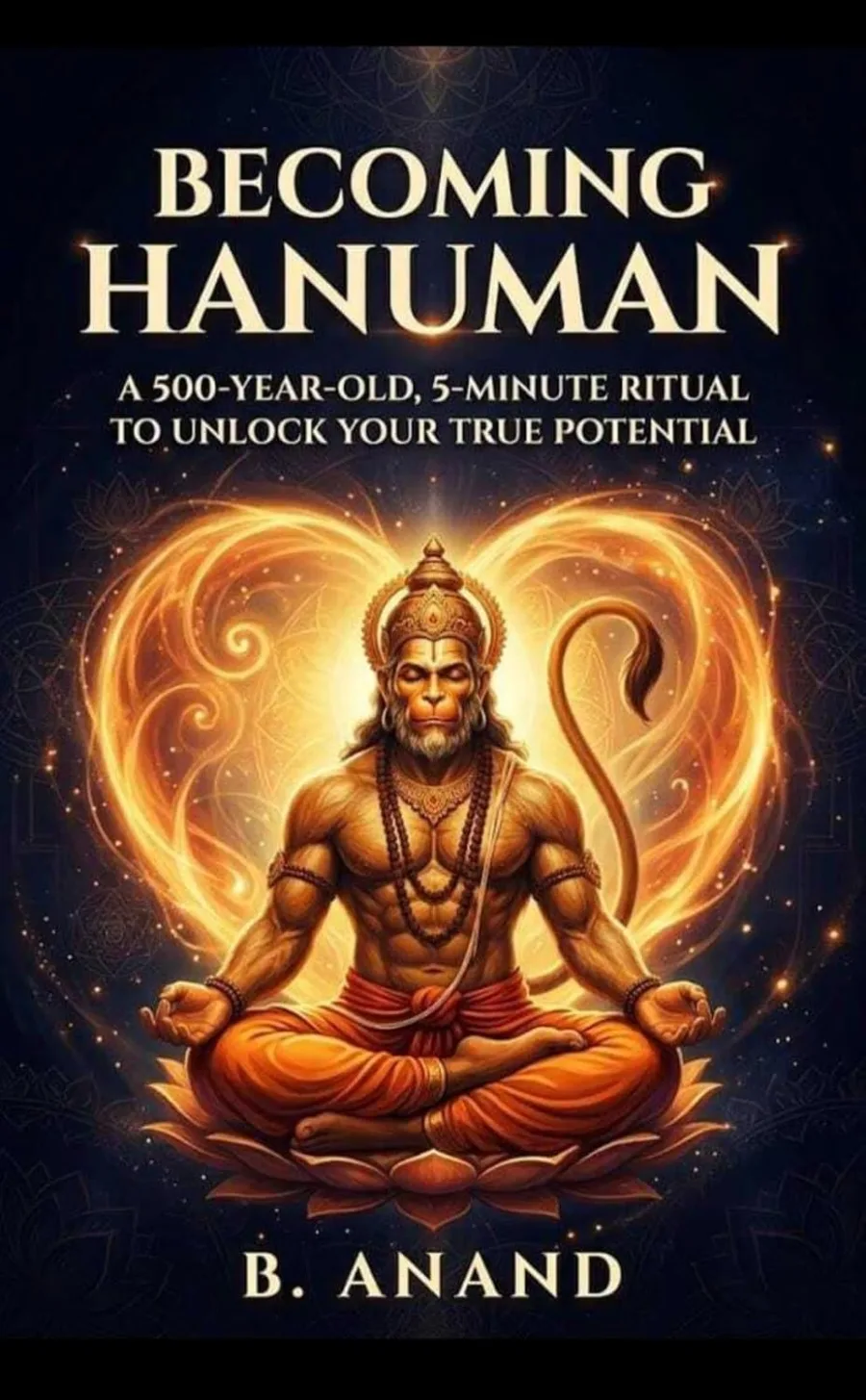
Download Cover Image
Do you want to download the full cover image for Becoming Hanuman: A 500 Year Old 5 Minutes Ritual to Unlock Your True Potential?