
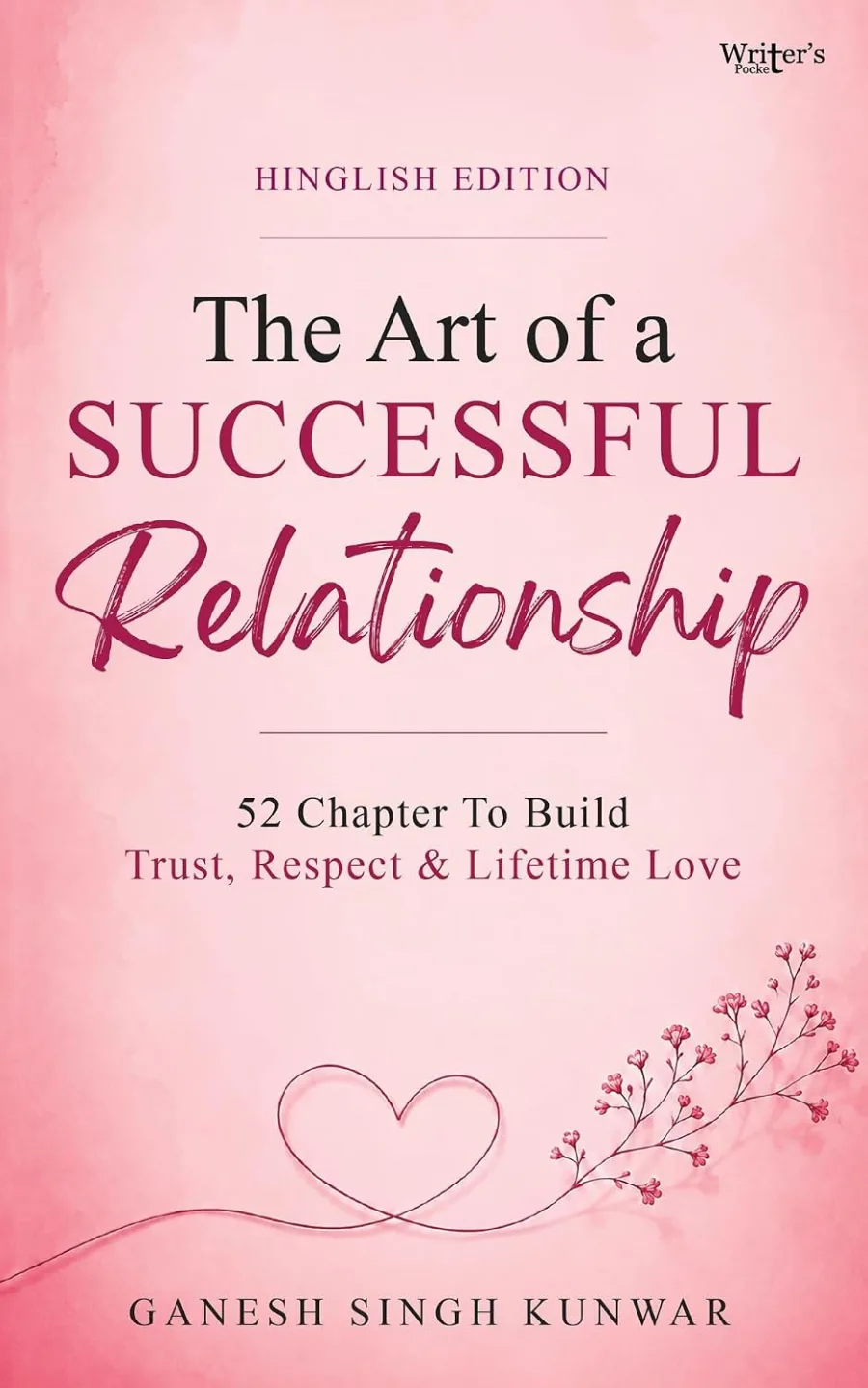
The Art Of Successful Relationship
Paperback
• 255 Pages
• ₹ 439.00
• English
• 9789379033291
No ratings yet
| Publisher | Writer's Pocket |
|---|---|
| ISBN13 | 9789379033291 |
| ASIN/SKU | 937903329X |
| Book Format | Paperback |
| Language | English |
| Pages | 255 |
| List Price | ₹ 439.00 |
| Publishing Date | 04/08/0226 |
| Dimensions | 20.32 x 12.7 x 0.51 cm |
| Weight | 200 g |
| Book Code | BD00070479 |
Buy this Book
Amazon Stores
Ebook Stores
Other Stores
Discover The Art Of Successful Relationship by Ganesh Singh Kunwar. This book is published by Writer's Pocket in Paperback format, ISBN 9789379033291, ASIN 937903329X, under Parenting and Relationships, Communication and Social Skills, Family and Relationships.
Book Description
THE ART OF SUCCESSFUL RELATIONSHIP Har Relationship ki shuruaat pyaar se hoti hai, lekin use zindagi bhar mazboot banaye rakhna ek kala hai. The Art of a Successful Relationship ek practical guide hai jo aapko batati hai ki sirf pyaar hi nahi, balki Trust, Respect, Communication, Understanding aur Daily Efforts hi kisi bhi Relationship ki asli buniyad hote hain. Is book ke 52 Chapters mein aap jaanenge ki kaise ek healthy aur lifetime Relationship banaya jaata hai. Har chapter simple Hinglish mein likha gaya hai, jisme practical lessons, real-life understanding aur aise principles hain jinhe har couple apni zindagi mein aasani se apply kar sakta hai. Is Book Mein Aap Seekhenge: Trust ko mazboot kaise banayein. Respect aur Communication ka asli importance. Conflicts ko healthy tareeke se kaise solve karein. Lifetime Commitment ka secret. Ek successful aur happy Relationship ki practical habits. Ek strong Relationship perfect logon se nahi banta, balki do aise logon se banta hai jo har din ek-doosre ko samajhne, respect dene aur saath nibhaane ka faisla karte hain. Agar aap apne Relationship ko sirf chalana nahi, balki lifetime tak khushhaal banana chahte hain, to ye kitaab aapke liye hai.
Author Biography
Author Biography will be added soon…
Editorial Reviews
Editorial Reviews will be added soon…
Book Summary
The Art Of Successful Relationship by Ganesh Singh Kunwar is a practical and reflective guide to understanding what makes relationships healthy, meaningful and lasting. The book focuses on the idea that successful relationships do not happen automatically simply because two people care about each other. They require understanding, communication, patience, trust, emotional maturity and a willingness to work through differences. Whether the relationship is between romantic partners, family members, friends or people working together, the principles of respect and mutual understanding remain important. The book's central message is that relationships are not something we simply “have”; they are something we continuously build.
At the heart of the book is the importance of understanding human relationships. Every person enters a relationship with a different personality, background, set of expectations and emotional needs. Problems often arise when people assume that others think and feel exactly as they do. A successful relationship requires the ability to recognize these differences without immediately treating them as faults. Understanding another person does not mean agreeing with everything they say or do. It means making a genuine effort to see situations from their perspective and recognize the emotions behind their behavior.
One of the most important foundations of any successful relationship is communication. People can be physically close and still feel emotionally distant when they do not communicate honestly. The book emphasizes the need to express feelings, expectations, concerns and disagreements clearly instead of allowing them to remain hidden. Silence may sometimes avoid an argument temporarily, but unresolved issues can accumulate and eventually damage trust. Healthy communication gives people an opportunity to understand one another before small misunderstandings become major conflicts.
However, communication is not simply about speaking. Listening is equally important. Many people listen only to prepare their response or defend themselves. Genuine listening requires attention and patience. When someone feels heard, they are more likely to feel respected and emotionally secure. The book's broader relationship philosophy suggests that people should try to understand what the other person is actually saying instead of immediately assuming negative intentions.
Another major foundation is trust. Trust develops gradually through consistent behavior. It is created when people keep promises, respect boundaries, tell the truth and demonstrate reliability. Trust cannot normally be demanded; it has to be earned. Once trust is repeatedly broken, rebuilding it can take considerable time. This makes honesty particularly important. Even uncomfortable truths are generally healthier for a relationship than repeated deception.
The book also highlights the role of respect. Love without respect can become controlling, possessive or emotionally unhealthy. Respect means recognizing that another person has their own thoughts, choices, boundaries, ambitions and individuality. A strong relationship does not require one person to lose their identity in order to make the other person happy. Instead, both individuals should be able to grow while remaining connected.
Emotional understanding is another important part of successful relationships. People sometimes react strongly not because of the immediate situation but because something deeper has been triggered—fear of rejection, insecurity, past disappointment, loneliness or a feeling of being ignored. Learning to identify these emotional patterns can reduce unnecessary conflict. Rather than asking only, “Why did you do this?”, partners and friends can also ask, “What are you feeling, and what do you need?” Such questions can create a more compassionate relationship.
The book also addresses the reality of conflict. Disagreement is not necessarily proof that a relationship is failing. Two people with different personalities will naturally disagree. The real test is how they handle those disagreements. Arguments become damaging when they involve insults, humiliation, threats, manipulation or attempts to win at any cost. A healthier approach is to focus on the problem rather than attacking the person. The goal should be resolution and understanding, not victory.
This requires patience and emotional control. When people are angry, they may say things that they later regret. A brief pause can sometimes prevent lasting damage. Emotional maturity means learning that not every disagreement has to be resolved immediately and not every criticism requires an aggressive response. Sometimes giving another person space allows both sides to think more clearly.
Another important theme is forgiveness. Relationships inevitably involve mistakes. People forget things, misunderstand one another, become impatient or behave badly under pressure. Forgiveness can prevent a relationship from becoming permanently trapped in the past. But forgiveness does not mean pretending that harmful behavior never happened. Genuine forgiveness works best when mistakes are acknowledged and there is a willingness to change. Repeated harmful behavior should not simply be excused in the name of maintaining a relationship.
The book also encourages readers to understand the importance of boundaries. Healthy relationships need closeness, but they also need personal space. Each individual should be able to maintain some independence, interests and private time. Constant control, excessive questioning or refusal to respect personal boundaries can create resentment. A strong relationship allows people to be connected without making them feel imprisoned.
Expectations are another frequent source of relationship problems. People often carry silent expectations and then feel disappointed when others fail to meet them. One person may expect frequent communication, while another may naturally need more personal space. Someone may value gifts, while another expresses affection through practical help. Problems occur when these differences are interpreted as evidence that the other person does not care. Clearly communicating expectations can reduce such misunderstandings.
The book's philosophy also places importance on appreciation. People often notice what is wrong more quickly than what is right. Over time, partners, friends or family members may begin to take one another for granted. Simple expressions of gratitude can strengthen emotional connection. Appreciation does not have to involve dramatic gestures. Acknowledging someone's effort, thanking them for their support or recognizing their contribution can communicate that they matter.
Similarly, quality time is important. Being in the same physical space does not necessarily mean spending meaningful time together. Phones, work, social media and daily responsibilities can gradually reduce genuine interaction. Strong relationships require moments in which people can talk, share experiences and enjoy each other's company without constantly being distracted. The quality of interaction can matter more than the number of hours spent together.
Another significant idea is support during difficult times. It is easy to remain close when everything is going well. The strength of a relationship becomes clearer when one person is struggling. Emotional support means being present, listening without immediately judging and offering help when appropriate. At the same time, healthy support does not mean taking responsibility for solving another person's entire life. Each individual must ultimately take responsibility for their own choices.
The book also emphasizes self-awareness. A person cannot build consistently healthy relationships without examining their own behavior. It is easy to blame another person for every problem, but relationships involve interaction between two or more people. Asking oneself what role one has played in a conflict can be uncomfortable but valuable. Recognizing one's own weaknesses, communication patterns and emotional triggers can lead to meaningful improvement.
This leads to another important principle: self-love and a healthy relationship with oneself. People who constantly seek validation from others may become excessively dependent on relationships for their sense of worth. A healthier approach is to develop self-respect and emotional stability while remaining open to connection. A relationship should enrich a person's life rather than become the sole source of identity and happiness.
The book's ideas can also be applied to family relationships and friendships. Family members may have strong emotional connections but still experience disagreements because of differences in expectations, generations and personalities. Friends can also grow apart when communication decreases or misunderstandings remain unresolved. The same basic principles—respect, honesty, empathy, forgiveness and communication—can help strengthen these relationships.
For romantic relationships in particular, the book suggests that love is more than emotion. Attraction and affection may bring two people together, but lasting relationships require daily choices. Choosing to communicate, choosing to respect boundaries, choosing to listen and choosing to work through difficulties are all expressions of love. Feelings can change with circumstances, but commitment to healthy behavior can provide stability.
The book ultimately challenges the idea that a “perfect relationship” is one without disagreements or difficulties. Successful relationships are not conflict-free; they are resilient. They allow people to disagree without destroying one another, apologize without humiliation, forgive without forgetting lessons and change without losing their individuality. This is a much more realistic understanding of relationship success.
The deeper lesson of The Art Of Successful Relationship is that relationships are built through small, repeated actions. Trust is created by consistency. Closeness is created through communication. Respect is demonstrated through behavior. Love becomes meaningful through care. Conflict becomes manageable through emotional maturity. None of these qualities can be developed overnight. They require conscious effort and continuous practice.
Ultimately, the book presents successful relationships as a form of shared growth. Two people do not have to be identical to have a strong bond. They need to understand their differences, communicate their needs and respect each other's individuality. The strongest relationships allow both people to become better versions of themselves while creating a sense of security, companionship and belonging.
In simple terms, the book's message can be summarized as follows: listen before judging, communicate before assuming, respect before demanding, forgive while learning, and love without trying to control. A meaningful relationship is not created by grand promises alone. It is created through everyday honesty, kindness, patience, understanding and responsibility. By developing these qualities within ourselves, we can create relationships that are not only happier but also more stable, respectful and capable of surviving the inevitable difficulties of life.
At the heart of the book is the importance of understanding human relationships. Every person enters a relationship with a different personality, background, set of expectations and emotional needs. Problems often arise when people assume that others think and feel exactly as they do. A successful relationship requires the ability to recognize these differences without immediately treating them as faults. Understanding another person does not mean agreeing with everything they say or do. It means making a genuine effort to see situations from their perspective and recognize the emotions behind their behavior.
One of the most important foundations of any successful relationship is communication. People can be physically close and still feel emotionally distant when they do not communicate honestly. The book emphasizes the need to express feelings, expectations, concerns and disagreements clearly instead of allowing them to remain hidden. Silence may sometimes avoid an argument temporarily, but unresolved issues can accumulate and eventually damage trust. Healthy communication gives people an opportunity to understand one another before small misunderstandings become major conflicts.
However, communication is not simply about speaking. Listening is equally important. Many people listen only to prepare their response or defend themselves. Genuine listening requires attention and patience. When someone feels heard, they are more likely to feel respected and emotionally secure. The book's broader relationship philosophy suggests that people should try to understand what the other person is actually saying instead of immediately assuming negative intentions.
Another major foundation is trust. Trust develops gradually through consistent behavior. It is created when people keep promises, respect boundaries, tell the truth and demonstrate reliability. Trust cannot normally be demanded; it has to be earned. Once trust is repeatedly broken, rebuilding it can take considerable time. This makes honesty particularly important. Even uncomfortable truths are generally healthier for a relationship than repeated deception.
The book also highlights the role of respect. Love without respect can become controlling, possessive or emotionally unhealthy. Respect means recognizing that another person has their own thoughts, choices, boundaries, ambitions and individuality. A strong relationship does not require one person to lose their identity in order to make the other person happy. Instead, both individuals should be able to grow while remaining connected.
Emotional understanding is another important part of successful relationships. People sometimes react strongly not because of the immediate situation but because something deeper has been triggered—fear of rejection, insecurity, past disappointment, loneliness or a feeling of being ignored. Learning to identify these emotional patterns can reduce unnecessary conflict. Rather than asking only, “Why did you do this?”, partners and friends can also ask, “What are you feeling, and what do you need?” Such questions can create a more compassionate relationship.
The book also addresses the reality of conflict. Disagreement is not necessarily proof that a relationship is failing. Two people with different personalities will naturally disagree. The real test is how they handle those disagreements. Arguments become damaging when they involve insults, humiliation, threats, manipulation or attempts to win at any cost. A healthier approach is to focus on the problem rather than attacking the person. The goal should be resolution and understanding, not victory.
This requires patience and emotional control. When people are angry, they may say things that they later regret. A brief pause can sometimes prevent lasting damage. Emotional maturity means learning that not every disagreement has to be resolved immediately and not every criticism requires an aggressive response. Sometimes giving another person space allows both sides to think more clearly.
Another important theme is forgiveness. Relationships inevitably involve mistakes. People forget things, misunderstand one another, become impatient or behave badly under pressure. Forgiveness can prevent a relationship from becoming permanently trapped in the past. But forgiveness does not mean pretending that harmful behavior never happened. Genuine forgiveness works best when mistakes are acknowledged and there is a willingness to change. Repeated harmful behavior should not simply be excused in the name of maintaining a relationship.
The book also encourages readers to understand the importance of boundaries. Healthy relationships need closeness, but they also need personal space. Each individual should be able to maintain some independence, interests and private time. Constant control, excessive questioning or refusal to respect personal boundaries can create resentment. A strong relationship allows people to be connected without making them feel imprisoned.
Expectations are another frequent source of relationship problems. People often carry silent expectations and then feel disappointed when others fail to meet them. One person may expect frequent communication, while another may naturally need more personal space. Someone may value gifts, while another expresses affection through practical help. Problems occur when these differences are interpreted as evidence that the other person does not care. Clearly communicating expectations can reduce such misunderstandings.
The book's philosophy also places importance on appreciation. People often notice what is wrong more quickly than what is right. Over time, partners, friends or family members may begin to take one another for granted. Simple expressions of gratitude can strengthen emotional connection. Appreciation does not have to involve dramatic gestures. Acknowledging someone's effort, thanking them for their support or recognizing their contribution can communicate that they matter.
Similarly, quality time is important. Being in the same physical space does not necessarily mean spending meaningful time together. Phones, work, social media and daily responsibilities can gradually reduce genuine interaction. Strong relationships require moments in which people can talk, share experiences and enjoy each other's company without constantly being distracted. The quality of interaction can matter more than the number of hours spent together.
Another significant idea is support during difficult times. It is easy to remain close when everything is going well. The strength of a relationship becomes clearer when one person is struggling. Emotional support means being present, listening without immediately judging and offering help when appropriate. At the same time, healthy support does not mean taking responsibility for solving another person's entire life. Each individual must ultimately take responsibility for their own choices.
The book also emphasizes self-awareness. A person cannot build consistently healthy relationships without examining their own behavior. It is easy to blame another person for every problem, but relationships involve interaction between two or more people. Asking oneself what role one has played in a conflict can be uncomfortable but valuable. Recognizing one's own weaknesses, communication patterns and emotional triggers can lead to meaningful improvement.
This leads to another important principle: self-love and a healthy relationship with oneself. People who constantly seek validation from others may become excessively dependent on relationships for their sense of worth. A healthier approach is to develop self-respect and emotional stability while remaining open to connection. A relationship should enrich a person's life rather than become the sole source of identity and happiness.
The book's ideas can also be applied to family relationships and friendships. Family members may have strong emotional connections but still experience disagreements because of differences in expectations, generations and personalities. Friends can also grow apart when communication decreases or misunderstandings remain unresolved. The same basic principles—respect, honesty, empathy, forgiveness and communication—can help strengthen these relationships.
For romantic relationships in particular, the book suggests that love is more than emotion. Attraction and affection may bring two people together, but lasting relationships require daily choices. Choosing to communicate, choosing to respect boundaries, choosing to listen and choosing to work through difficulties are all expressions of love. Feelings can change with circumstances, but commitment to healthy behavior can provide stability.
The book ultimately challenges the idea that a “perfect relationship” is one without disagreements or difficulties. Successful relationships are not conflict-free; they are resilient. They allow people to disagree without destroying one another, apologize without humiliation, forgive without forgetting lessons and change without losing their individuality. This is a much more realistic understanding of relationship success.
The deeper lesson of The Art Of Successful Relationship is that relationships are built through small, repeated actions. Trust is created by consistency. Closeness is created through communication. Respect is demonstrated through behavior. Love becomes meaningful through care. Conflict becomes manageable through emotional maturity. None of these qualities can be developed overnight. They require conscious effort and continuous practice.
Ultimately, the book presents successful relationships as a form of shared growth. Two people do not have to be identical to have a strong bond. They need to understand their differences, communicate their needs and respect each other's individuality. The strongest relationships allow both people to become better versions of themselves while creating a sense of security, companionship and belonging.
In simple terms, the book's message can be summarized as follows: listen before judging, communicate before assuming, respect before demanding, forgive while learning, and love without trying to control. A meaningful relationship is not created by grand promises alone. It is created through everyday honesty, kindness, patience, understanding and responsibility. By developing these qualities within ourselves, we can create relationships that are not only happier but also more stable, respectful and capable of surviving the inevitable difficulties of life.
Sample Chapters
Sample Chapters will be added soon…
Reader Reviews
No reviews yet.
The Art Of Successful Relationship
Download Cover Image
Do you want to download the full cover image for The Art Of Successful Relationship?