
Railway Maths English Medium 3500+ Chapter-Wise MCQs, 3rd Edition, NTPC, RPF SI, RPF Constable, ALP
Paperback
• 406 Pages
• ₹ 350.00
• English
No ratings yet
| Publisher | Aditya Ranjan Publication |
|---|---|
| ASIN/SKU | B0H7Y456CJ |
| Book Format | Paperback |
| Language | English |
| Pages | 406 |
| List Price | ₹ 350.00 |
| Publishing Date | 06/07/2026 |
| Dimensions | 24 x 20 x 2 cm |
| Weight | 390 g |
| Book Code | BD00070475 |
Buy this Book
Amazon Stores
Ebook Stores
Other Stores
Discover Railway Maths English Medium 3500+ Chapter-Wise MCQs, 3rd Edition, NTPC, RPF SI, RPF Constable, ALP by Aditya Ranjan Sir. This book is published by Aditya Ranjan Publication in Paperback format, ASIN B0H7Y456CJ, under Exam Preparation, Indian Railways Recruitment Exams.
Book Description
Railway Maths English Medium 3500+ Chapter-Wise MCQs, 3rd Edition, NTPC, RPF SI, RPF Constable, ALP, Technician, Group D, RRB JE And Other Railway Exams
Author Biography
Author Biography will be added soon…
Editorial Reviews
Editorial Reviews will be added soon…
Book Summary
Railway Maths English Medium: 3500+ Chapter-Wise MCQs, 3rd Edition by Aditya Ranjan Sir is an examination-focused mathematics practice book designed for candidates preparing for major Railway Recruitment examinations, including RRB NTPC, RPF SI, RPF Constable and ALP. As its title suggests, the book places its main emphasis on extensive multiple-choice-question practice rather than long theoretical explanations. Its purpose is to help aspirants strengthen mathematical concepts, become familiar with common Railway-exam question patterns, improve calculation speed and develop the accuracy required to perform well in competitive examinations.
The central idea behind the book is simple: mathematics improves through repeated and purposeful practice. Knowing a formula is not enough in a competitive examination. Candidates must also know how to recognize the type of problem, select the appropriate method, perform calculations quickly and avoid careless mistakes. With more than 3,500 chapter-wise MCQs, the book provides a large question bank through which students can gradually build these skills. The chapter-wise arrangement also allows aspirants to identify weak topics and practice them separately instead of solving questions randomly.
The book is particularly useful because Railway examinations have a strong emphasis on speed and accuracy. Candidates usually have to solve many questions within a limited amount of time while competing against a large number of applicants. A student may understand a mathematical concept perfectly but still lose marks if calculations are too slow. Therefore, preparation must include not only conceptual learning but also timed practice. The large number of questions in this book gives students an opportunity to repeatedly apply the same concepts until the solving process becomes more natural and efficient.
The chapter-wise format is one of the book's major advantages. Instead of presenting thousands of questions as one continuous test, the questions are organized according to mathematical topics. This makes the book useful at different stages of preparation. A beginner can complete one chapter after studying its concepts, while an advanced student can directly select difficult or weak areas for revision. Chapter-wise practice also makes it easier to monitor progress because candidates can clearly see which subjects have been completed and which still require attention.
The mathematics required for Railway examinations generally covers areas such as number systems, simplification, percentages, ratio and proportion, averages, profit and loss, simple and compound interest, time and work, time and distance, mensuration, algebra, geometry, data interpretation and other arithmetic topics. These subjects form the foundation of competitive-exam mathematics. Although individual questions may appear different, many are based on recurring concepts and patterns. Practicing a large number of questions helps candidates recognize these patterns more quickly.
Number-based topics form an important foundation for Railway mathematics. Questions involving numbers, divisibility, factors, multiples, remainders and related concepts test a candidate's ability to manipulate numerical information efficiently. Strong command of these basics can make later chapters easier because many advanced-looking problems ultimately depend on simple numerical reasoning. Regular practice can also improve mental calculation and reduce dependence on lengthy written methods.
Simplification and calculation-based questions are especially important for improving speed. Competitive examinations often include calculations that look complicated because several operations are combined. Candidates need to understand the correct order of operations and apply shortcuts where appropriate. Repeated practice can help students recognize familiar structures and solve them with fewer steps. The aim is not simply to calculate faster but to calculate accurately while maintaining examination pressure.
Percentage, ratio and proportion are among the most frequently useful areas of arithmetic. Percentage concepts appear directly in questions involving profit, loss, discounts, interest, population and changes in quantities. Ratio and proportion are similarly connected with mixtures, partnerships, work, speed and many other topics. Understanding the relationships between these concepts allows students to solve a wide variety of questions using a relatively small set of fundamental ideas.
The chapters related to profit and loss, discount and commercial mathematics help candidates handle questions based on buying price, selling price, marked price and percentage changes. These problems are common in competitive examinations because they test both mathematical understanding and the ability to translate a real-world situation into equations. Through repeated MCQ practice, students can become familiar with the different ways these questions are framed.
Average is another fundamental topic. Average questions may involve marks, ages, salaries, runs, quantities or other numerical data. Although the basic formula is simple, competitive questions may require students to understand how an average changes when a value is added, removed or replaced. Practicing different patterns is therefore more valuable than memorizing a single formula.
Time and work questions test the relationship between work, efficiency and time. These problems can initially seem complicated because several people or machines may work at different rates. Once the concept of individual work rates is understood, however, many such questions can be reduced to systematic calculations. Extensive MCQ practice helps candidates recognize whether a problem requires the unitary method, efficiency comparison, combined work or another approach.
Similarly, time, speed and distance is an important area for Railway aspirants because it involves practical mathematical relationships and can be asked in numerous forms. Questions may involve trains, relative speed, journeys, average speed or changes in time. Railway examinations often include train-related problems, making familiarity with these patterns especially useful for candidates preparing for RRB exams.
Simple and compound interest questions introduce candidates to financial calculations. Students need to understand how interest accumulates and how principal, rate and time interact. While direct formula-based questions may be relatively straightforward, competitive examinations can also test comparisons between simple and compound interest or ask candidates to work backward from a final amount. Practice helps students determine quickly which method is appropriate.
Mensuration and geometry bring another dimension to the preparation. Candidates may need to work with areas, perimeters, volumes and properties of geometric figures. These questions require both formula recall and visualization. A common mistake is to remember a formula but use the wrong dimensions or units. Repeated practice helps students become more careful about units and the exact requirements of the question.
Algebra develops another important skill: translating relationships into mathematical expressions. Railway-level algebra questions can involve equations, identities and unknown quantities. Students who are comfortable with basic algebra can often solve arithmetic questions more efficiently as well, because algebra provides a systematic way to represent unknown information.
The book's MCQ format is particularly suitable for competitive examinations because it mirrors the way candidates encounter questions in the actual test. Multiple-choice questions require more than arriving at an answer. Candidates must also evaluate the available options and sometimes use elimination or approximation to save time. With enough practice, students can learn to recognize when a full calculation is necessary and when a shorter method is sufficient.
An important part of using this book effectively is mistake analysis. Simply solving thousands of questions is not enough. When a candidate gets a question wrong, the mistake should be classified. Was the concept misunderstood? Was the formula forgotten? Was there a calculation error? Was the question read incorrectly? Or did the candidate choose an inefficient method? Keeping track of these mistakes turns practice into measurable improvement. Questions answered correctly but with excessive time should also be reviewed because speed is an important part of Railway preparation.
The book can also support revision before the examination. After completing the syllabus, candidates can revisit individual chapters and solve selected questions to refresh important concepts. Since the questions are organized topic by topic, the book can be used repeatedly without requiring students to reread lengthy explanations. This makes it particularly convenient during the final stages of preparation, when the focus should shift toward practice, recall and accuracy.
For RRB NTPC aspirants, the book can provide extensive practice across the arithmetic and mathematical areas commonly encountered in the examination. NTPC candidates need to balance Mathematics with General Awareness and other sections, making efficient mathematical practice especially valuable. Regular chapter-wise practice can help reduce the amount of time spent on familiar question types.
For RPF SI and RPF Constable candidates, mathematics forms an important component of the overall examination preparation. The book's extensive question bank allows students to practice repeatedly and build confidence. Similarly, ALP aspirants can use it as a mathematics practice resource alongside the other technical and non-technical portions of their preparation.
The third edition also indicates that the book is intended as an updated version of the resource, reflecting the continuing need for competitive-exam preparation material to remain aligned with current examination expectations. However, candidates should always compare their preparation with the latest official examination syllabus and notification, because recruitment patterns and examination requirements can change.
The deeper lesson of Railway Maths English Medium is that success in competitive mathematics depends on familiarity, discipline and accuracy. Students often become anxious when they see difficult-looking questions, but a large proportion of examination mathematics is built around recurring concepts. Once candidates have solved enough variations of a topic, they begin to recognize the structure of a new question more quickly. Practice therefore reduces both solving time and examination anxiety.
Overall, Railway Maths English Medium 3500+ Chapter-Wise MCQs, 3rd Edition is best viewed as a comprehensive practice and revision companion for Railway-exam mathematics. Its greatest strength is the volume and organization of its questions. Rather than encouraging students to passively read mathematics, it pushes them toward active problem solving. The chapter-wise structure allows focused study, while the large MCQ collection provides enough repetition to improve speed and accuracy.
For the best results, the book should be used as part of a three-step process: learn the concept, practice the questions, and analyze the mistakes. Students should first understand the relevant formulas and methods, then solve questions without immediately looking at solutions, and finally examine every error carefully. Timed practice can be added as preparation progresses. By following this cycle consistently, aspirants can turn mathematical knowledge into actual examination performance.
Ultimately, the book's message is practical rather than complicated: you become faster at competitive mathematics by solving the right questions repeatedly and learning from every mistake. For candidates preparing for RRB NTPC, RPF SI, RPF Constable and ALP examinations, the 3,500-plus chapter-wise MCQs provide a structured way to build that practice. With disciplined use, the book can help students strengthen fundamentals, recognize question patterns, improve calculation speed, increase accuracy and approach the Railway Mathematics section with greater confidence.
The central idea behind the book is simple: mathematics improves through repeated and purposeful practice. Knowing a formula is not enough in a competitive examination. Candidates must also know how to recognize the type of problem, select the appropriate method, perform calculations quickly and avoid careless mistakes. With more than 3,500 chapter-wise MCQs, the book provides a large question bank through which students can gradually build these skills. The chapter-wise arrangement also allows aspirants to identify weak topics and practice them separately instead of solving questions randomly.
The book is particularly useful because Railway examinations have a strong emphasis on speed and accuracy. Candidates usually have to solve many questions within a limited amount of time while competing against a large number of applicants. A student may understand a mathematical concept perfectly but still lose marks if calculations are too slow. Therefore, preparation must include not only conceptual learning but also timed practice. The large number of questions in this book gives students an opportunity to repeatedly apply the same concepts until the solving process becomes more natural and efficient.
The chapter-wise format is one of the book's major advantages. Instead of presenting thousands of questions as one continuous test, the questions are organized according to mathematical topics. This makes the book useful at different stages of preparation. A beginner can complete one chapter after studying its concepts, while an advanced student can directly select difficult or weak areas for revision. Chapter-wise practice also makes it easier to monitor progress because candidates can clearly see which subjects have been completed and which still require attention.
The mathematics required for Railway examinations generally covers areas such as number systems, simplification, percentages, ratio and proportion, averages, profit and loss, simple and compound interest, time and work, time and distance, mensuration, algebra, geometry, data interpretation and other arithmetic topics. These subjects form the foundation of competitive-exam mathematics. Although individual questions may appear different, many are based on recurring concepts and patterns. Practicing a large number of questions helps candidates recognize these patterns more quickly.
Number-based topics form an important foundation for Railway mathematics. Questions involving numbers, divisibility, factors, multiples, remainders and related concepts test a candidate's ability to manipulate numerical information efficiently. Strong command of these basics can make later chapters easier because many advanced-looking problems ultimately depend on simple numerical reasoning. Regular practice can also improve mental calculation and reduce dependence on lengthy written methods.
Simplification and calculation-based questions are especially important for improving speed. Competitive examinations often include calculations that look complicated because several operations are combined. Candidates need to understand the correct order of operations and apply shortcuts where appropriate. Repeated practice can help students recognize familiar structures and solve them with fewer steps. The aim is not simply to calculate faster but to calculate accurately while maintaining examination pressure.
Percentage, ratio and proportion are among the most frequently useful areas of arithmetic. Percentage concepts appear directly in questions involving profit, loss, discounts, interest, population and changes in quantities. Ratio and proportion are similarly connected with mixtures, partnerships, work, speed and many other topics. Understanding the relationships between these concepts allows students to solve a wide variety of questions using a relatively small set of fundamental ideas.
The chapters related to profit and loss, discount and commercial mathematics help candidates handle questions based on buying price, selling price, marked price and percentage changes. These problems are common in competitive examinations because they test both mathematical understanding and the ability to translate a real-world situation into equations. Through repeated MCQ practice, students can become familiar with the different ways these questions are framed.
Average is another fundamental topic. Average questions may involve marks, ages, salaries, runs, quantities or other numerical data. Although the basic formula is simple, competitive questions may require students to understand how an average changes when a value is added, removed or replaced. Practicing different patterns is therefore more valuable than memorizing a single formula.
Time and work questions test the relationship between work, efficiency and time. These problems can initially seem complicated because several people or machines may work at different rates. Once the concept of individual work rates is understood, however, many such questions can be reduced to systematic calculations. Extensive MCQ practice helps candidates recognize whether a problem requires the unitary method, efficiency comparison, combined work or another approach.
Similarly, time, speed and distance is an important area for Railway aspirants because it involves practical mathematical relationships and can be asked in numerous forms. Questions may involve trains, relative speed, journeys, average speed or changes in time. Railway examinations often include train-related problems, making familiarity with these patterns especially useful for candidates preparing for RRB exams.
Simple and compound interest questions introduce candidates to financial calculations. Students need to understand how interest accumulates and how principal, rate and time interact. While direct formula-based questions may be relatively straightforward, competitive examinations can also test comparisons between simple and compound interest or ask candidates to work backward from a final amount. Practice helps students determine quickly which method is appropriate.
Mensuration and geometry bring another dimension to the preparation. Candidates may need to work with areas, perimeters, volumes and properties of geometric figures. These questions require both formula recall and visualization. A common mistake is to remember a formula but use the wrong dimensions or units. Repeated practice helps students become more careful about units and the exact requirements of the question.
Algebra develops another important skill: translating relationships into mathematical expressions. Railway-level algebra questions can involve equations, identities and unknown quantities. Students who are comfortable with basic algebra can often solve arithmetic questions more efficiently as well, because algebra provides a systematic way to represent unknown information.
The book's MCQ format is particularly suitable for competitive examinations because it mirrors the way candidates encounter questions in the actual test. Multiple-choice questions require more than arriving at an answer. Candidates must also evaluate the available options and sometimes use elimination or approximation to save time. With enough practice, students can learn to recognize when a full calculation is necessary and when a shorter method is sufficient.
An important part of using this book effectively is mistake analysis. Simply solving thousands of questions is not enough. When a candidate gets a question wrong, the mistake should be classified. Was the concept misunderstood? Was the formula forgotten? Was there a calculation error? Was the question read incorrectly? Or did the candidate choose an inefficient method? Keeping track of these mistakes turns practice into measurable improvement. Questions answered correctly but with excessive time should also be reviewed because speed is an important part of Railway preparation.
The book can also support revision before the examination. After completing the syllabus, candidates can revisit individual chapters and solve selected questions to refresh important concepts. Since the questions are organized topic by topic, the book can be used repeatedly without requiring students to reread lengthy explanations. This makes it particularly convenient during the final stages of preparation, when the focus should shift toward practice, recall and accuracy.
For RRB NTPC aspirants, the book can provide extensive practice across the arithmetic and mathematical areas commonly encountered in the examination. NTPC candidates need to balance Mathematics with General Awareness and other sections, making efficient mathematical practice especially valuable. Regular chapter-wise practice can help reduce the amount of time spent on familiar question types.
For RPF SI and RPF Constable candidates, mathematics forms an important component of the overall examination preparation. The book's extensive question bank allows students to practice repeatedly and build confidence. Similarly, ALP aspirants can use it as a mathematics practice resource alongside the other technical and non-technical portions of their preparation.
The third edition also indicates that the book is intended as an updated version of the resource, reflecting the continuing need for competitive-exam preparation material to remain aligned with current examination expectations. However, candidates should always compare their preparation with the latest official examination syllabus and notification, because recruitment patterns and examination requirements can change.
The deeper lesson of Railway Maths English Medium is that success in competitive mathematics depends on familiarity, discipline and accuracy. Students often become anxious when they see difficult-looking questions, but a large proportion of examination mathematics is built around recurring concepts. Once candidates have solved enough variations of a topic, they begin to recognize the structure of a new question more quickly. Practice therefore reduces both solving time and examination anxiety.
Overall, Railway Maths English Medium 3500+ Chapter-Wise MCQs, 3rd Edition is best viewed as a comprehensive practice and revision companion for Railway-exam mathematics. Its greatest strength is the volume and organization of its questions. Rather than encouraging students to passively read mathematics, it pushes them toward active problem solving. The chapter-wise structure allows focused study, while the large MCQ collection provides enough repetition to improve speed and accuracy.
For the best results, the book should be used as part of a three-step process: learn the concept, practice the questions, and analyze the mistakes. Students should first understand the relevant formulas and methods, then solve questions without immediately looking at solutions, and finally examine every error carefully. Timed practice can be added as preparation progresses. By following this cycle consistently, aspirants can turn mathematical knowledge into actual examination performance.
Ultimately, the book's message is practical rather than complicated: you become faster at competitive mathematics by solving the right questions repeatedly and learning from every mistake. For candidates preparing for RRB NTPC, RPF SI, RPF Constable and ALP examinations, the 3,500-plus chapter-wise MCQs provide a structured way to build that practice. With disciplined use, the book can help students strengthen fundamentals, recognize question patterns, improve calculation speed, increase accuracy and approach the Railway Mathematics section with greater confidence.
Sample Chapters
Sample Chapters will be added soon…
Reader Reviews
No reviews yet.
Railway Maths English Medium 3500+ Chapter-Wise MCQs, 3rd Edition, NTPC, RPF SI, RPF Constable, ALP
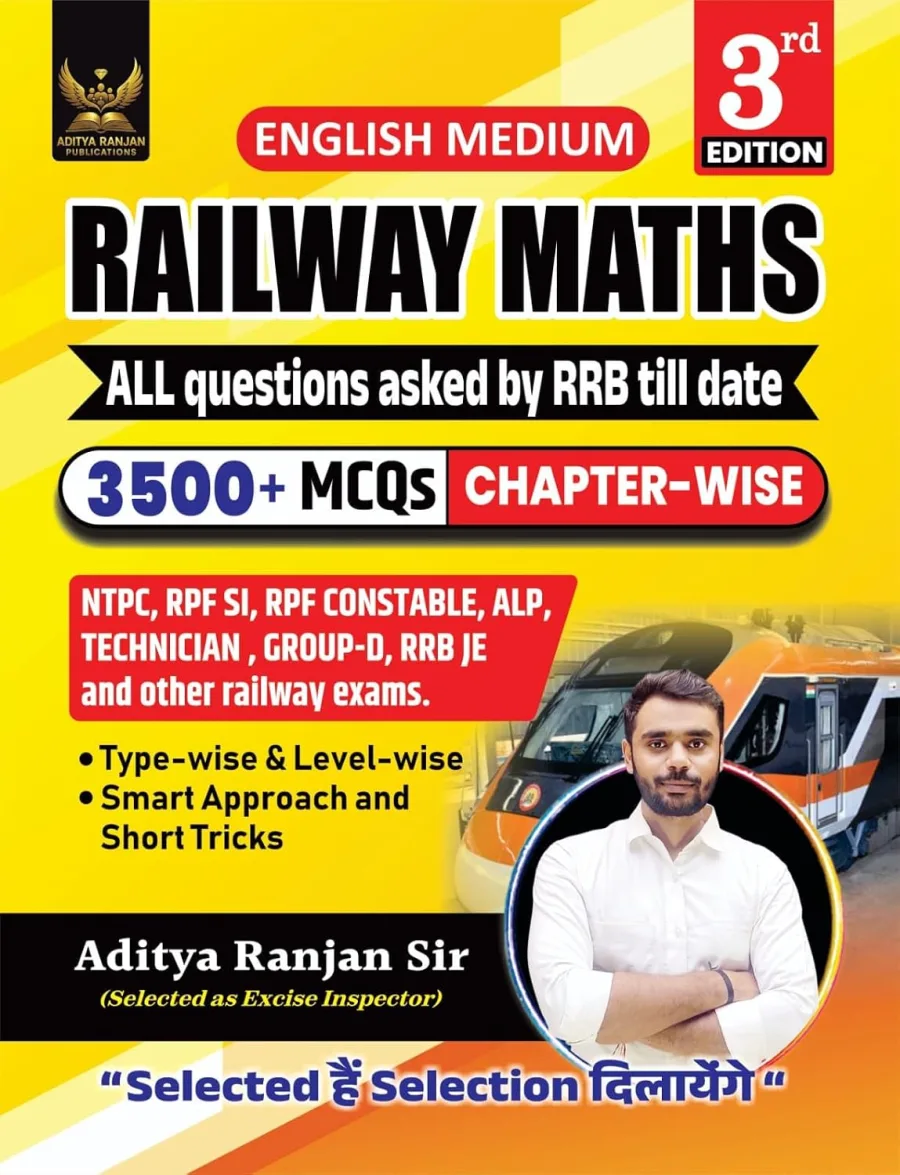
Download Cover Image
Do you want to download the full cover image for Railway Maths English Medium 3500+ Chapter-Wise MCQs, 3rd Edition, NTPC, RPF SI, RPF Constable, ALP?