
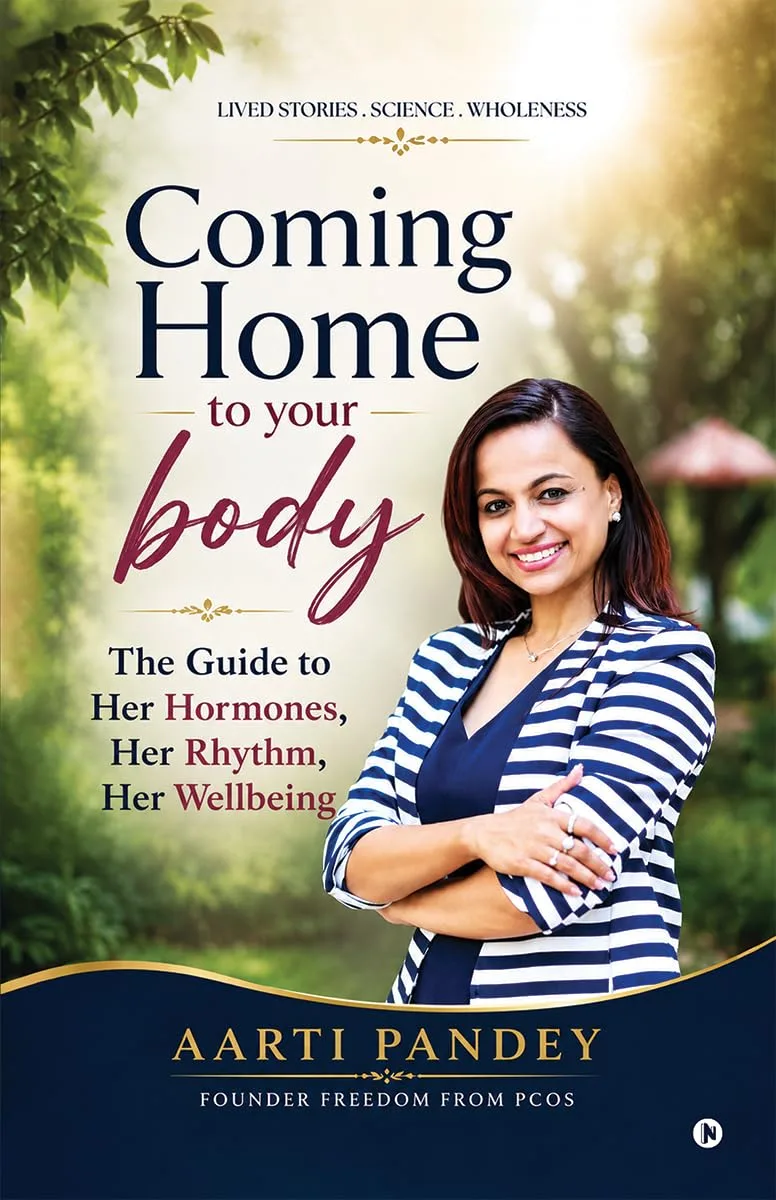
Coming Home to Your Body: The guide to Her Hormones, Her Rhythm, Her Wellbeing
Paperback
• 204 Pages
• ₹ 499.00
• English
• 9798906735447
No ratings yet
| Publisher | Notion Press |
|---|---|
| ISBN13 | 9798906735447 |
| ASIN/SKU | B0HHJM9CV6 |
| Book Format | Paperback |
| Language | English |
| Pages | 204 |
| List Price | ₹ 499.00 |
| Publishing Date | 02/09/0026 |
| Dimensions | 13.97 x 1.3 x 21.59 cm |
| Weight | 300 g |
| Book Code | BD00070472 |
Buy this Book
Amazon Stores
Ebook Stores
Other Stores
Discover Coming Home to Your Body: The guide to Her Hormones, Her Rhythm, Her Wellbeing by Aarti Pandey. This book is published by Notion Press in Paperback format, ISBN 9798906735447, ASIN B0HHJM9CV6, under Health, Fitness and Dieting, Women's Health Nursing, Health, Fitness and Nutrition.
Book Description
Coming Home to Your Body
The Guide to Her Hormones, Her Rhythm and Her Wellbeing
There comes a moment when a woman looks in the mirror and quietly wonders where she went.
Her hair is falling. Her periods no longer make sense. Her body is changing despite everything she is doing right. She wakes tired, carries everyone through the day, smiles when required, and appears completely in control.
But inside, she is asking:
What is wrong with me?
In Coming Home to Your Body, Aarti Pandey offers a gentler and far more powerful truth:
Nothing is wrong with you.
Your body is not broken. It is speaking.
Drawing from her own journey and the lived stories of women who found their way back to their bodies, their wellbeing and themselves, Aarti reveals how hormones are connected to the life a woman is actually living: what she eats, how she sleeps, how she moves, the emotions she suppresses, the stress she carries, and the many ways she has been taught to put herself last.
This is not another diet book.
It is not a rigid protocol, a prescription, or another list of things a woman must do perfectly.
It is a deeply personal, science-informed guide to understanding the language of your body, rebuilding trust with yourself, and creating the conditions for the body to return to its natural balance.
For the woman who is still functioning but no longer flourishing.
For the woman who has cared for everyone else and quietly lost sight of herself.
For the woman who knows, somewhere deep within, that her body has been trying to tell her something.
This book is your invitation.
Come home, love.
Your body has been waiting for you.
The Guide to Her Hormones, Her Rhythm and Her Wellbeing
There comes a moment when a woman looks in the mirror and quietly wonders where she went.
Her hair is falling. Her periods no longer make sense. Her body is changing despite everything she is doing right. She wakes tired, carries everyone through the day, smiles when required, and appears completely in control.
But inside, she is asking:
What is wrong with me?
In Coming Home to Your Body, Aarti Pandey offers a gentler and far more powerful truth:
Nothing is wrong with you.
Your body is not broken. It is speaking.
Drawing from her own journey and the lived stories of women who found their way back to their bodies, their wellbeing and themselves, Aarti reveals how hormones are connected to the life a woman is actually living: what she eats, how she sleeps, how she moves, the emotions she suppresses, the stress she carries, and the many ways she has been taught to put herself last.
This is not another diet book.
It is not a rigid protocol, a prescription, or another list of things a woman must do perfectly.
It is a deeply personal, science-informed guide to understanding the language of your body, rebuilding trust with yourself, and creating the conditions for the body to return to its natural balance.
For the woman who is still functioning but no longer flourishing.
For the woman who has cared for everyone else and quietly lost sight of herself.
For the woman who knows, somewhere deep within, that her body has been trying to tell her something.
This book is your invitation.
Come home, love.
Your body has been waiting for you.
Author Biography
Author Biography will be added soon…
Editorial Reviews
Editorial Reviews will be added soon…
Book Summary
Coming Home to Your Body: The Guide to Her Hormones, Her Rhythm, Her Wellbeing by Aarti Pandey is a women-focused guide that encourages readers to develop a deeper and more compassionate understanding of their bodies. At its heart, the book is about reconnecting with the body's natural signals rather than treating the body as something that must constantly be controlled, corrected or ignored. It explores themes surrounding hormones, menstrual rhythms, wellbeing, energy, emotions and self-awareness, with the broader message that women can make better choices when they understand how their bodies work and learn to listen to what their bodies are communicating.
The phrase “coming home to your body” captures the central philosophy of the book. Many women grow up learning to disconnect from their physical experiences. Menstruation may be treated as something embarrassing, hormonal changes may be misunderstood, fatigue may be dismissed, and emotional fluctuations may be viewed as personal weakness. The book challenges this kind of disconnection. Instead, it encourages women to become curious about their bodies and to see bodily changes as information rather than inconveniences. The body is presented not as an obstacle to overcome but as a source of signals that can help guide everyday decisions.
One of the central subjects is the role of hormones in women's wellbeing. Hormones act as chemical messengers in the body and influence many different processes, including reproduction, metabolism, mood, sleep and energy. Because hormonal systems interact with one another, changes in one area can sometimes affect several aspects of a woman's experience. The book encourages readers to understand that hormonal health is not an isolated issue. It is connected with sleep, nutrition, stress, physical activity, emotional wellbeing and the reproductive cycle.
The book places particular importance on the menstrual cycle. Instead of viewing menstruation simply as a monthly event, it presents the menstrual cycle as a recurring biological rhythm. Different phases of the cycle can involve changes in hormones, energy, mood, appetite and physical comfort. Learning to recognize these patterns can help women understand themselves more clearly. The intention is not to suggest that every woman experiences exactly the same cycle, but to encourage individual observation and awareness.
This idea of rhythm is especially important. Modern life often encourages people to maintain the same level of productivity every day regardless of how they feel physically or mentally. Women may be expected to work, exercise, socialize and perform at the same intensity continuously. A cycle-aware perspective questions whether this approach is always appropriate. Instead, the book encourages readers to notice periods when they may naturally have more energy and periods when rest, reflection or recovery may feel more necessary.
The book's approach also encourages women to distinguish between listening to the body and being controlled by the body. Becoming aware of physical signals does not mean allowing every temporary feeling to determine one's choices. Rather, awareness provides additional information. Hunger, fatigue, tension, changes in mood or menstrual symptoms can encourage a person to ask what may be contributing to the experience. This creates a more thoughtful relationship with the body instead of one based entirely on suppression or avoidance.
Stress and the body's response to it are another important part of this broader picture. Modern women may have to balance professional responsibilities, family expectations, relationships, household duties and personal goals. Prolonged stress can affect sleep, energy, mood and overall wellbeing. The book encourages readers to recognize that constant pressure is not simply a mental experience; it can also influence how the body feels and functions. Developing healthier ways of managing stress can therefore become an important part of caring for oneself.
Sleep is closely connected with this discussion. Rest is not laziness, and the book's philosophy challenges the idea that productivity should always come before recovery. Adequate sleep supports physical and mental functioning, and insufficient rest can make everyday challenges more difficult. Women who are constantly tired may be tempted to compensate with stimulants, excessive exercise or simply pushing themselves harder. A body-centered approach instead asks whether the underlying need for recovery is being addressed.
Nutrition is another important element of wellbeing. Food is not presented merely as a tool for controlling body weight. It is part of the body's larger system of energy, nourishment and functioning. A healthier relationship with food can involve understanding hunger, satiety, energy requirements and individual needs rather than following restrictive rules simply because they are fashionable. The book's broader philosophy encourages women to view food as nourishment rather than as something that must always be earned, restricted or feared.
This perspective also has implications for exercise and movement. Exercise is often discussed in terms of weight loss or physical appearance, but movement can serve many other purposes. It can support strength, mobility, cardiovascular health, mood and confidence. The book encourages readers to consider what their bodies need rather than automatically choosing exercise based on punishment or guilt. Rest and recovery are also part of a healthy physical routine.
Another significant theme is body image. Women are exposed to powerful cultural expectations about how their bodies should look. Advertising, social media and entertainment can create unrealistic standards that encourage constant comparison. When women judge themselves against such standards, they may begin to treat their bodies as projects that are never finished. The idea of “coming home” to the body offers an alternative: instead of asking whether the body looks acceptable, a woman can begin asking whether she feels connected to it, cares for it and understands it.
The book also encourages self-awareness and body literacy. Body literacy means developing enough knowledge to recognize patterns and understand basic aspects of one's physical experience. This can include observing menstrual cycles, noting changes in energy and mood, recognizing recurring symptoms and becoming familiar with one's normal patterns. Such awareness can make it easier to notice when something changes and, when appropriate, discuss those changes with a qualified healthcare professional.
Importantly, awareness should not be confused with self-diagnosis. Women's health can involve complex medical conditions, and symptoms that appear to be ordinary hormonal fluctuations can sometimes require professional evaluation. A responsible body-awareness approach therefore works alongside medical care rather than replacing it. The broader lesson is that women should feel empowered to ask questions about their health and seek appropriate professional guidance when something does not seem right.
The concept of wellbeing in the book is therefore broader than simply the absence of illness. Wellbeing includes physical comfort, emotional stability, energy, relationships, rest, nourishment and a sense of connection with oneself. A woman can appear highly productive from the outside while feeling disconnected or exhausted internally. The book encourages readers to pay attention to this difference and to consider whether their lifestyle genuinely supports their health.
Another important idea is self-compassion. Women often become extremely critical of themselves when their energy changes, their bodies change or they cannot maintain the same level of productivity. The book's message encourages a gentler approach. Bodies change across different stages of life, and hormonal patterns are not always predictable. Instead of treating these changes as failures, women can respond with curiosity and compassion.
The book's focus on women's rhythms also encourages readers to rethink the relationship between productivity and identity. Modern culture often rewards people for being constantly busy. The ability to work longer, sleep less and continue performing despite exhaustion can be treated as a sign of strength. Yet the book suggests that sustainable wellbeing requires another definition of strength: knowing when to act, when to slow down and when to recover. Rest is not necessarily the opposite of ambition; it can help make ambition sustainable.
Relationships with others can also influence wellbeing. A woman may understand her own needs but still struggle to communicate them because of family expectations or social conditioning. Learning to say that one needs rest, privacy, support or medical attention can require healthy boundaries. Listening to one's body can therefore lead to changes not only in personal habits but also in relationships and daily priorities.
Ultimately, Coming Home to Your Body is about reconnection. It encourages women to move away from fear, shame and constant self-correction and toward curiosity, awareness and care. Hormones and menstrual rhythms are not treated as inconveniences that women must simply tolerate. Instead, they are part of the larger biological system through which the body communicates with the individual.
The deeper message is that a healthy relationship with the body begins with listening rather than judging. A woman does not need to have a perfect routine, a perfect body or complete control over every physical experience. What matters is learning to recognize patterns, understand basic needs, care for oneself and seek appropriate support when necessary. The body can become an ally rather than an enemy.
In this sense, the book is ultimately an invitation to slow down and become more attentive to one's own physical experience. It asks women to consider what their bodies are saying through energy, fatigue, hunger, rest, emotions and menstrual rhythms. By developing this awareness, women can make more informed decisions about lifestyle and wellbeing while becoming less dependent on external expectations.
Coming Home to Your Body therefore presents women's wellbeing as an ongoing relationship rather than a destination. The goal is not to control every hormonal fluctuation or eliminate every uncomfortable feeling. It is to develop enough understanding and self-respect to respond to the body with intelligence and care. Its central message can be summed up simply: your body is not something you need to fight; it is something you can learn to understand, listen to and live with more consciously.
The phrase “coming home to your body” captures the central philosophy of the book. Many women grow up learning to disconnect from their physical experiences. Menstruation may be treated as something embarrassing, hormonal changes may be misunderstood, fatigue may be dismissed, and emotional fluctuations may be viewed as personal weakness. The book challenges this kind of disconnection. Instead, it encourages women to become curious about their bodies and to see bodily changes as information rather than inconveniences. The body is presented not as an obstacle to overcome but as a source of signals that can help guide everyday decisions.
One of the central subjects is the role of hormones in women's wellbeing. Hormones act as chemical messengers in the body and influence many different processes, including reproduction, metabolism, mood, sleep and energy. Because hormonal systems interact with one another, changes in one area can sometimes affect several aspects of a woman's experience. The book encourages readers to understand that hormonal health is not an isolated issue. It is connected with sleep, nutrition, stress, physical activity, emotional wellbeing and the reproductive cycle.
The book places particular importance on the menstrual cycle. Instead of viewing menstruation simply as a monthly event, it presents the menstrual cycle as a recurring biological rhythm. Different phases of the cycle can involve changes in hormones, energy, mood, appetite and physical comfort. Learning to recognize these patterns can help women understand themselves more clearly. The intention is not to suggest that every woman experiences exactly the same cycle, but to encourage individual observation and awareness.
This idea of rhythm is especially important. Modern life often encourages people to maintain the same level of productivity every day regardless of how they feel physically or mentally. Women may be expected to work, exercise, socialize and perform at the same intensity continuously. A cycle-aware perspective questions whether this approach is always appropriate. Instead, the book encourages readers to notice periods when they may naturally have more energy and periods when rest, reflection or recovery may feel more necessary.
The book's approach also encourages women to distinguish between listening to the body and being controlled by the body. Becoming aware of physical signals does not mean allowing every temporary feeling to determine one's choices. Rather, awareness provides additional information. Hunger, fatigue, tension, changes in mood or menstrual symptoms can encourage a person to ask what may be contributing to the experience. This creates a more thoughtful relationship with the body instead of one based entirely on suppression or avoidance.
Stress and the body's response to it are another important part of this broader picture. Modern women may have to balance professional responsibilities, family expectations, relationships, household duties and personal goals. Prolonged stress can affect sleep, energy, mood and overall wellbeing. The book encourages readers to recognize that constant pressure is not simply a mental experience; it can also influence how the body feels and functions. Developing healthier ways of managing stress can therefore become an important part of caring for oneself.
Sleep is closely connected with this discussion. Rest is not laziness, and the book's philosophy challenges the idea that productivity should always come before recovery. Adequate sleep supports physical and mental functioning, and insufficient rest can make everyday challenges more difficult. Women who are constantly tired may be tempted to compensate with stimulants, excessive exercise or simply pushing themselves harder. A body-centered approach instead asks whether the underlying need for recovery is being addressed.
Nutrition is another important element of wellbeing. Food is not presented merely as a tool for controlling body weight. It is part of the body's larger system of energy, nourishment and functioning. A healthier relationship with food can involve understanding hunger, satiety, energy requirements and individual needs rather than following restrictive rules simply because they are fashionable. The book's broader philosophy encourages women to view food as nourishment rather than as something that must always be earned, restricted or feared.
This perspective also has implications for exercise and movement. Exercise is often discussed in terms of weight loss or physical appearance, but movement can serve many other purposes. It can support strength, mobility, cardiovascular health, mood and confidence. The book encourages readers to consider what their bodies need rather than automatically choosing exercise based on punishment or guilt. Rest and recovery are also part of a healthy physical routine.
Another significant theme is body image. Women are exposed to powerful cultural expectations about how their bodies should look. Advertising, social media and entertainment can create unrealistic standards that encourage constant comparison. When women judge themselves against such standards, they may begin to treat their bodies as projects that are never finished. The idea of “coming home” to the body offers an alternative: instead of asking whether the body looks acceptable, a woman can begin asking whether she feels connected to it, cares for it and understands it.
The book also encourages self-awareness and body literacy. Body literacy means developing enough knowledge to recognize patterns and understand basic aspects of one's physical experience. This can include observing menstrual cycles, noting changes in energy and mood, recognizing recurring symptoms and becoming familiar with one's normal patterns. Such awareness can make it easier to notice when something changes and, when appropriate, discuss those changes with a qualified healthcare professional.
Importantly, awareness should not be confused with self-diagnosis. Women's health can involve complex medical conditions, and symptoms that appear to be ordinary hormonal fluctuations can sometimes require professional evaluation. A responsible body-awareness approach therefore works alongside medical care rather than replacing it. The broader lesson is that women should feel empowered to ask questions about their health and seek appropriate professional guidance when something does not seem right.
The concept of wellbeing in the book is therefore broader than simply the absence of illness. Wellbeing includes physical comfort, emotional stability, energy, relationships, rest, nourishment and a sense of connection with oneself. A woman can appear highly productive from the outside while feeling disconnected or exhausted internally. The book encourages readers to pay attention to this difference and to consider whether their lifestyle genuinely supports their health.
Another important idea is self-compassion. Women often become extremely critical of themselves when their energy changes, their bodies change or they cannot maintain the same level of productivity. The book's message encourages a gentler approach. Bodies change across different stages of life, and hormonal patterns are not always predictable. Instead of treating these changes as failures, women can respond with curiosity and compassion.
The book's focus on women's rhythms also encourages readers to rethink the relationship between productivity and identity. Modern culture often rewards people for being constantly busy. The ability to work longer, sleep less and continue performing despite exhaustion can be treated as a sign of strength. Yet the book suggests that sustainable wellbeing requires another definition of strength: knowing when to act, when to slow down and when to recover. Rest is not necessarily the opposite of ambition; it can help make ambition sustainable.
Relationships with others can also influence wellbeing. A woman may understand her own needs but still struggle to communicate them because of family expectations or social conditioning. Learning to say that one needs rest, privacy, support or medical attention can require healthy boundaries. Listening to one's body can therefore lead to changes not only in personal habits but also in relationships and daily priorities.
Ultimately, Coming Home to Your Body is about reconnection. It encourages women to move away from fear, shame and constant self-correction and toward curiosity, awareness and care. Hormones and menstrual rhythms are not treated as inconveniences that women must simply tolerate. Instead, they are part of the larger biological system through which the body communicates with the individual.
The deeper message is that a healthy relationship with the body begins with listening rather than judging. A woman does not need to have a perfect routine, a perfect body or complete control over every physical experience. What matters is learning to recognize patterns, understand basic needs, care for oneself and seek appropriate support when necessary. The body can become an ally rather than an enemy.
In this sense, the book is ultimately an invitation to slow down and become more attentive to one's own physical experience. It asks women to consider what their bodies are saying through energy, fatigue, hunger, rest, emotions and menstrual rhythms. By developing this awareness, women can make more informed decisions about lifestyle and wellbeing while becoming less dependent on external expectations.
Coming Home to Your Body therefore presents women's wellbeing as an ongoing relationship rather than a destination. The goal is not to control every hormonal fluctuation or eliminate every uncomfortable feeling. It is to develop enough understanding and self-respect to respond to the body with intelligence and care. Its central message can be summed up simply: your body is not something you need to fight; it is something you can learn to understand, listen to and live with more consciously.
Sample Chapters
Sample Chapters will be added soon…
Reader Reviews
No reviews yet.
Coming Home to Your Body: The guide to Her Hormones, Her Rhythm, Her Wellbeing
Download Cover Image
Do you want to download the full cover image for Coming Home to Your Body: The guide to Her Hormones, Her Rhythm, Her Wellbeing?