
Fiscal Fables: A Citizen’s Guide to Public Finance | A Simple Book on Indian Economy, Public Finance
Sarthak Pradhan, Pranay Kotasthane
Paperback
• 384 Pages
• ₹ 499.00
• English
• 9789377303952
No ratings yet
| Publisher | India Penguin |
|---|---|
| ISBN13 | 9789377303952 |
| ASIN/SKU | 9377303958 |
| Book Format | Paperback |
| Language | English |
| Pages | 384 |
| List Price | ₹ 499.00 |
| Publishing Date | 26/08/2026 |
| Dimensions | 25 x 12.9 x 19.8 cm |
| Weight | 290 g |
| Book Code | BD00070471 |
Buy this Book
Amazon Stores
Ebook Stores
Other Stores
Discover Fiscal Fables: A Citizen’s Guide to Public Finance | A Simple Book on Indian Economy, Public Finance by Sarthak Pradhan. This book is published by India Penguin in Paperback format, ISBN 9789377303952, ASIN 9377303958, under Business and Money, Economic Policy and Development, Public Policy.
Book Description
There is an unending debate on the north-south claims on government money. Every election cycle unmistakably sees a discussion on freebies and corruption. The states and the union continue to have multiple disagreements concerning the Goods and Services Tax. And while Indian cities contribute to the bulk of its GDP, they are perennially begging for money.
Discussions around the topics listed above are now commonplace, yet they often take place in the absence of a grasp on public finance concepts, even though this discipline provides a framework to understand the role of a government in the economy.
That’s where Fiscal Fables comes in. It demystifies India's public finances to a lay audience and explains public finance concepts with the help of relatable stories and examples, to make this vital knowledge accessible to a general interest reader.
Discussions around the topics listed above are now commonplace, yet they often take place in the absence of a grasp on public finance concepts, even though this discipline provides a framework to understand the role of a government in the economy.
That’s where Fiscal Fables comes in. It demystifies India's public finances to a lay audience and explains public finance concepts with the help of relatable stories and examples, to make this vital knowledge accessible to a general interest reader.
Author Biography
Sarthak Pradhan is a public policy researcher focused on public finance and economics.
He is a Fellow at the Takshashila Institution, an independent centre for research and education in public policy, where he teaches economic reasoning and explores the application of complexity science to policy problems. He also serves as Assistant Editor of the Indian Public Policy Review.
Based in Bengaluru, he believes that citizens who understand public money make better demands of their governments. This book is an attempt to make public finance more accessible to citizens.
He is a Fellow at the Takshashila Institution, an independent centre for research and education in public policy, where he teaches economic reasoning and explores the application of complexity science to policy problems. He also serves as Assistant Editor of the Indian Public Policy Review.
Based in Bengaluru, he believes that citizens who understand public money make better demands of their governments. This book is an attempt to make public finance more accessible to citizens.
Editorial Reviews
‘Every citizen should care about public finance, because it is their money that the government taxes and spends. This highly accessible and well-written book brings public finance to the “public” and will be an enlightening and enjoyable read for anyone interested in understanding and improving government effectiveness and citizen welfare in India.’ ― Karthik Muralidharan, Tata Chancellor’s Professor Economics, UC San Diego and author of Accelerating India’s Development
‘Public finance is among the most consequential and least understood domains in democratic life. Pradhan and Kotasthane’s Fiscal Fables corrects that asymmetry with admirable economy. In the chapters, the book moves from the distortions of Indian taxation―deadweight loss, the marginal cost of public funds, the stubborn myth that legal liability and economic incidence are the same thing―to the perennial tensions of fiscal federalism and the paradox of cities that generate the bulk of national output yet govern on a shoestring. The writing is lively without being facile. Every politically engaged Indian should read it’ ― V. Anantha Nageswaran, 18th chief economic adviser to the Government of India
‘Every Indian pays taxes, but few Indians understand where that money goes and why. Fiscal Fables changes that with wit, clarity and an understanding of how Indian governments actually work. Sarthak and Pranay have produced a citizen’s guide that is both entertaining and analytically sound. I believe even high-school
students will find it illuminating. This is essential reading for anyone who wants to move beyond headline outrage and truly understand the fiscal foundations of our republic’
― Vijay Kelkar, former finance secretary and chairman, Thirteenth Finance Commission
‘Public finance―the revenues and expenditures of governments―affects citizens, firms, states and the country daily, in both expected and unintended ways. Yet, most people are barely aware of this vital subject and understand it even less. Fiscal Fables does a commendable public service by bringing an obtuse
subject to life with clear prose and examples from everyday life that make it widely accessible. A must-read for citizens to ask―and understand―hard questions of themselves and of their governments’
― Devesh Kapur, Starr Foundation South Asia Studies Professor and Asia Programs Director, Paul H. Nitze School of Advanced International Studies, Johns Hopkins University, Washington, D.C.
‘In the 1971 film Anand, Gulzar wrote, “Hum sab to rangmanch ki kathputliyan hai jinki dor upar waale ki ungliyon mein bandhi hai.” Pradhan and Kotasthane find that when the Uparwala is the Union government, both the purse strings and the puppet strings turn out to be the same thread’ ― Shruti Rajagopalan, senior research fellow, Mercatus Center, George Mason University
‘That Kautilya and The Beatles both had impassioned views on taxation is not a thought that commonly presents itself. Nor is the idea that central to India’s federal fiscal structure is the metaphorical “national roti”. Fiscal Fables is a book that is at once light-hearted and deeply informative. I found myself smiling, thinking aha! and also letting out deep sighs, as the authors deliver what is essentially a witty, sharp crash course that demystifies many facets of the behemoth that is Indian public finance―not to mention, the incomprehensible diversity and complexity of India itself’ ― Kailash Nadh, chief technology officer, Zerodha
As citizens, we have a lot to complain about. The government collects our taxes, but our streets are filled with potholes, learning outcomes in public schools are appalling, sanitation facilities non-existent. We blame everyone from the corrupt politician to the apathetic bureaucrat, but do we, ordinary citizens, really know what happens to our taxes once they enter the black box of the government? Beyond complaining, have we asked how money flows from the Union’s coffers to the schools, health centres and other facilities? Who decides? And what say do we, as citizens, have in these decisions? Yet, accountability begins by following the money. Fiscal Fables is an important, indeed critical intervention that seeks to fill this gap. It is remarkable in its ability to take the dry and boring subject of taxes and expenditure, and make it easy to understand and fun. It is a critical democratic intervention for it tells us all we need to know about how the government spends our money, and empowers us with knowledge and tools to ask questions and demand accountability by following the money. A must-read not just for policy wonks but for all citizens so we can fulfil our fundamental duty of holding our governments to account’ ― Yamini Aiyar, author of Lessons in State Capacity from Delhi’s Schools
‘Public finance has more impact on our lives than we would probably like. Yet, the subject remains opaque and intimidating, accessible mainly to a highbrow elite of economists and policy wonks. Kotasthane and Pradhan deftly demystify this topic by harnessing stories and anecdotes from popular culture to democratize people’s understanding of how the government goes about its business, warts and all. Packed with insights and narrated with an easy lucidity, it had me exclaiming: Where was this book when I studied economics?!’ ― M.V. Rajeev Gowda, former member of Parliament, Rajya Sabha
‘Public finance is among the most consequential and least understood domains in democratic life. Pradhan and Kotasthane’s Fiscal Fables corrects that asymmetry with admirable economy. In the chapters, the book moves from the distortions of Indian taxation―deadweight loss, the marginal cost of public funds, the stubborn myth that legal liability and economic incidence are the same thing―to the perennial tensions of fiscal federalism and the paradox of cities that generate the bulk of national output yet govern on a shoestring. The writing is lively without being facile. Every politically engaged Indian should read it’ ― V. Anantha Nageswaran, 18th chief economic adviser to the Government of India
‘Every Indian pays taxes, but few Indians understand where that money goes and why. Fiscal Fables changes that with wit, clarity and an understanding of how Indian governments actually work. Sarthak and Pranay have produced a citizen’s guide that is both entertaining and analytically sound. I believe even high-school
students will find it illuminating. This is essential reading for anyone who wants to move beyond headline outrage and truly understand the fiscal foundations of our republic’
― Vijay Kelkar, former finance secretary and chairman, Thirteenth Finance Commission
‘Public finance―the revenues and expenditures of governments―affects citizens, firms, states and the country daily, in both expected and unintended ways. Yet, most people are barely aware of this vital subject and understand it even less. Fiscal Fables does a commendable public service by bringing an obtuse
subject to life with clear prose and examples from everyday life that make it widely accessible. A must-read for citizens to ask―and understand―hard questions of themselves and of their governments’
― Devesh Kapur, Starr Foundation South Asia Studies Professor and Asia Programs Director, Paul H. Nitze School of Advanced International Studies, Johns Hopkins University, Washington, D.C.
‘In the 1971 film Anand, Gulzar wrote, “Hum sab to rangmanch ki kathputliyan hai jinki dor upar waale ki ungliyon mein bandhi hai.” Pradhan and Kotasthane find that when the Uparwala is the Union government, both the purse strings and the puppet strings turn out to be the same thread’ ― Shruti Rajagopalan, senior research fellow, Mercatus Center, George Mason University
‘That Kautilya and The Beatles both had impassioned views on taxation is not a thought that commonly presents itself. Nor is the idea that central to India’s federal fiscal structure is the metaphorical “national roti”. Fiscal Fables is a book that is at once light-hearted and deeply informative. I found myself smiling, thinking aha! and also letting out deep sighs, as the authors deliver what is essentially a witty, sharp crash course that demystifies many facets of the behemoth that is Indian public finance―not to mention, the incomprehensible diversity and complexity of India itself’ ― Kailash Nadh, chief technology officer, Zerodha
As citizens, we have a lot to complain about. The government collects our taxes, but our streets are filled with potholes, learning outcomes in public schools are appalling, sanitation facilities non-existent. We blame everyone from the corrupt politician to the apathetic bureaucrat, but do we, ordinary citizens, really know what happens to our taxes once they enter the black box of the government? Beyond complaining, have we asked how money flows from the Union’s coffers to the schools, health centres and other facilities? Who decides? And what say do we, as citizens, have in these decisions? Yet, accountability begins by following the money. Fiscal Fables is an important, indeed critical intervention that seeks to fill this gap. It is remarkable in its ability to take the dry and boring subject of taxes and expenditure, and make it easy to understand and fun. It is a critical democratic intervention for it tells us all we need to know about how the government spends our money, and empowers us with knowledge and tools to ask questions and demand accountability by following the money. A must-read not just for policy wonks but for all citizens so we can fulfil our fundamental duty of holding our governments to account’ ― Yamini Aiyar, author of Lessons in State Capacity from Delhi’s Schools
‘Public finance has more impact on our lives than we would probably like. Yet, the subject remains opaque and intimidating, accessible mainly to a highbrow elite of economists and policy wonks. Kotasthane and Pradhan deftly demystify this topic by harnessing stories and anecdotes from popular culture to democratize people’s understanding of how the government goes about its business, warts and all. Packed with insights and narrated with an easy lucidity, it had me exclaiming: Where was this book when I studied economics?!’ ― M.V. Rajeev Gowda, former member of Parliament, Rajya Sabha
Book Summary
Fiscal Fables: A Citizen’s Guide to Public Finance by Sarthak Pradhan is a simple and accessible introduction to public finance and the Indian economy. The book is aimed at ordinary citizens who may hear words such as taxation, government spending, fiscal deficit, public debt, subsidies, inflation and budget but may not always understand what they actually mean or how they affect everyday life. Instead of treating economics as a subject filled with complicated mathematical models and technical terminology, the book approaches public finance as something directly connected with the lives of citizens. Its central purpose is to help readers understand how governments collect money, how they spend it, why governments borrow, and what these decisions mean for the country's economic future.
The basic idea behind the book is that public finance is ultimately about public money. Governments need resources to provide roads, schools, hospitals, defence, public transport, welfare programmes, administration and many other services. Most of this money comes from citizens and businesses through different forms of taxation and other government revenues. Because this is money collected from society, citizens have a legitimate interest in understanding where it goes. The book encourages readers to look at government finances not as an obscure subject meant only for economists, accountants or civil servants, but as an important part of citizenship.
One of the easiest ways to understand the book's approach is through the government budget. Every government has competing demands for limited resources. There is never enough money to satisfy every possible demand at the same time. A government must therefore decide what deserves priority. Should more money go toward healthcare, education, defence, infrastructure, agriculture, welfare, urban development or something else? Every budget is therefore more than a list of numbers. It reflects the government's priorities and its understanding of the country's needs. Learning to read a budget allows citizens to understand these choices more clearly.
A major subject in public finance is taxation. Taxes are one of the primary ways through which governments raise revenue. Citizens encounter taxes in many forms, sometimes directly and sometimes indirectly. Income tax affects taxable earnings, while consumption taxes affect the prices of goods and services. Businesses also pay taxes and contribute to government revenue. The important question is not simply how much tax the government collects, but how the tax burden is distributed across different sections of society. A good public-finance discussion therefore has to consider fairness, efficiency, incentives and the government's ability to provide essential services.
The book also helps readers understand the difference between direct and indirect taxation. Direct taxes are generally paid directly by the person or entity on whom the tax is imposed, while indirect taxes are collected through transactions and consumption. This distinction matters because different types of taxes affect people differently. A tax on income may have a different impact from a tax on consumption. Understanding these differences helps citizens participate more intelligently in debates about taxation and economic policy.
Another central concept is government expenditure. Collecting money is only one side of public finance; deciding how to use it is the other. Government spending can broadly support areas such as infrastructure, education, healthcare, defence, social welfare and administration. Some spending creates long-term productive capacity, while other spending is directed toward immediate support or consumption. The book encourages readers to think about not only how much the government spends but also what it spends money on and what results that spending produces.
This naturally leads to the distinction between capital expenditure and revenue expenditure. Capital expenditure generally creates or improves assets and productive capacity, such as infrastructure, while revenue expenditure is associated with the ongoing costs of running government programmes and services. Both are necessary, but their economic effects can differ. Understanding this distinction helps citizens interpret government claims about increased spending more intelligently. A larger expenditure number does not automatically mean that the government has invested more in long-term development.
The idea of the fiscal deficit is another important part of public finance. In simple terms, a fiscal deficit arises when the government's expenditure exceeds its revenues and certain non-debt receipts, requiring it to borrow to meet the gap. Deficits are not automatically good or bad. During periods of economic difficulty, borrowing can help governments support demand, protect vulnerable groups or finance productive investment. However, persistent and poorly managed deficits can increase debt and create future financial pressures. The important issue is therefore the size, purpose, quality and sustainability of government borrowing.
This connects the discussion to public debt. When governments borrow, they accumulate obligations that must eventually be serviced. Debt itself is not necessarily a problem. Countries borrow for many legitimate reasons, including infrastructure development and responding to economic crises. The concern arises when debt grows faster than the government's ability to support it. Interest payments can consume a growing share of public resources, leaving less money for other priorities. The book's citizen-focused approach encourages readers to ask whether borrowing is being used productively and whether today's decisions create unreasonable burdens for future generations.
The book also addresses subsidies and welfare spending, subjects that often generate strong political debate. Subsidies can help people access food, fuel, electricity, education, healthcare or other essential goods and services. They can protect vulnerable households and pursue social objectives. At the same time, poorly designed subsidies can become expensive, distort incentives or benefit people who do not actually need assistance. The important question is therefore not simply whether subsidies are good or bad but whether they are properly targeted, financially sustainable and capable of achieving their intended purpose.
A related issue is the difference between government spending and government investment. When the state spends money on a road, railway, school, irrigation system or other productive asset, the benefits may continue for many years. Such spending can increase productivity and support economic growth. But public investment is useful only when projects are well planned and effectively implemented. A large allocation on paper does not guarantee a successful outcome. Citizens therefore need to distinguish between announced expenditure and actual delivery.
Another important concept is inflation and its relationship with public finance. Inflation means a sustained rise in the general price level, which reduces the purchasing power of money. Government budgets can influence inflation through taxation, spending and borrowing, although inflation is also affected by monetary policy, supply conditions, energy prices, global events and other factors. Understanding this relationship helps citizens avoid simplistic explanations in which every increase in prices is blamed on a single policy or institution.
The book's wider message is that the Indian economy is interconnected. Government finances influence households, businesses, banks, investors and consumers. A change in taxation can affect consumption and investment. Public investment can influence employment and productivity. Borrowing can finance development but also create future obligations. Welfare spending can reduce hardship while requiring sustainable revenue. Economic decisions therefore involve trade-offs rather than perfect solutions.
One of the most valuable lessons is the importance of trade-offs. Government has limited resources, and every rupee used for one purpose cannot simultaneously be used somewhere else. Increasing defence expenditure may have strategic benefits but also involves an opportunity cost. Reducing taxes may leave citizens with more disposable income but reduce government revenue. Increasing subsidies may provide immediate relief but increase fiscal pressure. Borrowing may accelerate infrastructure development but increase future debt obligations. Good economic policy requires understanding these competing effects rather than looking for simplistic answers.
The book also encourages citizens to become more comfortable with economic data. Government budgets contain enormous amounts of information, but numbers can be misleading if they are examined without context. A spending figure may look large in absolute terms but be small relative to the size of the economy. A deficit may rise temporarily because of an economic crisis rather than because of permanently irresponsible spending. Similarly, an increase in revenue does not necessarily mean that every citizen is better off. Economic statistics become meaningful only when readers understand what they measure and what they leave out.
This perspective is particularly important in a democracy. Economic literacy strengthens citizenship because government financial decisions affect almost every aspect of public life. Citizens who understand taxes, budgets, deficits, debt and expenditure can ask better questions of governments and evaluate economic claims more critically. They become less dependent on slogans and more capable of examining evidence. Public finance is therefore not merely an academic subject; it is part of understanding how a democratic government actually functions.
Ultimately, Fiscal Fables: A Citizen’s Guide to Public Finance seeks to make the language of economics understandable to a much wider audience. Its central message is that public money belongs to the public, and citizens should understand how it is collected, allocated and spent. By explaining concepts such as taxation, government expenditure, fiscal deficits, public debt, subsidies, investment and economic growth in accessible terms, the book helps readers develop a practical understanding of India's economic system.
The deepest lesson is that there are no completely cost-free economic choices. Every policy involves benefits, costs, priorities and trade-offs. A responsible citizen therefore needs to look beyond whether a particular budget announcement sounds attractive and ask deeper questions: Where will the money come from? Who will benefit? Who will bear the cost? Is the spending productive? Can the policy continue in the long term? And what effect will today's decisions have on future generations?
In this way, Fiscal Fables transforms public finance from a technical subject into a matter of everyday citizenship. It encourages readers to understand the economic machinery behind government decisions and to recognize that taxes, budgets, borrowing and public spending ultimately shape the society in which they live. Its most important contribution is therefore not simply teaching economic terminology, but helping readers become more financially literate, more questioning and more informed citizens who can engage meaningfully with India's economic debates.
The basic idea behind the book is that public finance is ultimately about public money. Governments need resources to provide roads, schools, hospitals, defence, public transport, welfare programmes, administration and many other services. Most of this money comes from citizens and businesses through different forms of taxation and other government revenues. Because this is money collected from society, citizens have a legitimate interest in understanding where it goes. The book encourages readers to look at government finances not as an obscure subject meant only for economists, accountants or civil servants, but as an important part of citizenship.
One of the easiest ways to understand the book's approach is through the government budget. Every government has competing demands for limited resources. There is never enough money to satisfy every possible demand at the same time. A government must therefore decide what deserves priority. Should more money go toward healthcare, education, defence, infrastructure, agriculture, welfare, urban development or something else? Every budget is therefore more than a list of numbers. It reflects the government's priorities and its understanding of the country's needs. Learning to read a budget allows citizens to understand these choices more clearly.
A major subject in public finance is taxation. Taxes are one of the primary ways through which governments raise revenue. Citizens encounter taxes in many forms, sometimes directly and sometimes indirectly. Income tax affects taxable earnings, while consumption taxes affect the prices of goods and services. Businesses also pay taxes and contribute to government revenue. The important question is not simply how much tax the government collects, but how the tax burden is distributed across different sections of society. A good public-finance discussion therefore has to consider fairness, efficiency, incentives and the government's ability to provide essential services.
The book also helps readers understand the difference between direct and indirect taxation. Direct taxes are generally paid directly by the person or entity on whom the tax is imposed, while indirect taxes are collected through transactions and consumption. This distinction matters because different types of taxes affect people differently. A tax on income may have a different impact from a tax on consumption. Understanding these differences helps citizens participate more intelligently in debates about taxation and economic policy.
Another central concept is government expenditure. Collecting money is only one side of public finance; deciding how to use it is the other. Government spending can broadly support areas such as infrastructure, education, healthcare, defence, social welfare and administration. Some spending creates long-term productive capacity, while other spending is directed toward immediate support or consumption. The book encourages readers to think about not only how much the government spends but also what it spends money on and what results that spending produces.
This naturally leads to the distinction between capital expenditure and revenue expenditure. Capital expenditure generally creates or improves assets and productive capacity, such as infrastructure, while revenue expenditure is associated with the ongoing costs of running government programmes and services. Both are necessary, but their economic effects can differ. Understanding this distinction helps citizens interpret government claims about increased spending more intelligently. A larger expenditure number does not automatically mean that the government has invested more in long-term development.
The idea of the fiscal deficit is another important part of public finance. In simple terms, a fiscal deficit arises when the government's expenditure exceeds its revenues and certain non-debt receipts, requiring it to borrow to meet the gap. Deficits are not automatically good or bad. During periods of economic difficulty, borrowing can help governments support demand, protect vulnerable groups or finance productive investment. However, persistent and poorly managed deficits can increase debt and create future financial pressures. The important issue is therefore the size, purpose, quality and sustainability of government borrowing.
This connects the discussion to public debt. When governments borrow, they accumulate obligations that must eventually be serviced. Debt itself is not necessarily a problem. Countries borrow for many legitimate reasons, including infrastructure development and responding to economic crises. The concern arises when debt grows faster than the government's ability to support it. Interest payments can consume a growing share of public resources, leaving less money for other priorities. The book's citizen-focused approach encourages readers to ask whether borrowing is being used productively and whether today's decisions create unreasonable burdens for future generations.
The book also addresses subsidies and welfare spending, subjects that often generate strong political debate. Subsidies can help people access food, fuel, electricity, education, healthcare or other essential goods and services. They can protect vulnerable households and pursue social objectives. At the same time, poorly designed subsidies can become expensive, distort incentives or benefit people who do not actually need assistance. The important question is therefore not simply whether subsidies are good or bad but whether they are properly targeted, financially sustainable and capable of achieving their intended purpose.
A related issue is the difference between government spending and government investment. When the state spends money on a road, railway, school, irrigation system or other productive asset, the benefits may continue for many years. Such spending can increase productivity and support economic growth. But public investment is useful only when projects are well planned and effectively implemented. A large allocation on paper does not guarantee a successful outcome. Citizens therefore need to distinguish between announced expenditure and actual delivery.
Another important concept is inflation and its relationship with public finance. Inflation means a sustained rise in the general price level, which reduces the purchasing power of money. Government budgets can influence inflation through taxation, spending and borrowing, although inflation is also affected by monetary policy, supply conditions, energy prices, global events and other factors. Understanding this relationship helps citizens avoid simplistic explanations in which every increase in prices is blamed on a single policy or institution.
The book's wider message is that the Indian economy is interconnected. Government finances influence households, businesses, banks, investors and consumers. A change in taxation can affect consumption and investment. Public investment can influence employment and productivity. Borrowing can finance development but also create future obligations. Welfare spending can reduce hardship while requiring sustainable revenue. Economic decisions therefore involve trade-offs rather than perfect solutions.
One of the most valuable lessons is the importance of trade-offs. Government has limited resources, and every rupee used for one purpose cannot simultaneously be used somewhere else. Increasing defence expenditure may have strategic benefits but also involves an opportunity cost. Reducing taxes may leave citizens with more disposable income but reduce government revenue. Increasing subsidies may provide immediate relief but increase fiscal pressure. Borrowing may accelerate infrastructure development but increase future debt obligations. Good economic policy requires understanding these competing effects rather than looking for simplistic answers.
The book also encourages citizens to become more comfortable with economic data. Government budgets contain enormous amounts of information, but numbers can be misleading if they are examined without context. A spending figure may look large in absolute terms but be small relative to the size of the economy. A deficit may rise temporarily because of an economic crisis rather than because of permanently irresponsible spending. Similarly, an increase in revenue does not necessarily mean that every citizen is better off. Economic statistics become meaningful only when readers understand what they measure and what they leave out.
This perspective is particularly important in a democracy. Economic literacy strengthens citizenship because government financial decisions affect almost every aspect of public life. Citizens who understand taxes, budgets, deficits, debt and expenditure can ask better questions of governments and evaluate economic claims more critically. They become less dependent on slogans and more capable of examining evidence. Public finance is therefore not merely an academic subject; it is part of understanding how a democratic government actually functions.
Ultimately, Fiscal Fables: A Citizen’s Guide to Public Finance seeks to make the language of economics understandable to a much wider audience. Its central message is that public money belongs to the public, and citizens should understand how it is collected, allocated and spent. By explaining concepts such as taxation, government expenditure, fiscal deficits, public debt, subsidies, investment and economic growth in accessible terms, the book helps readers develop a practical understanding of India's economic system.
The deepest lesson is that there are no completely cost-free economic choices. Every policy involves benefits, costs, priorities and trade-offs. A responsible citizen therefore needs to look beyond whether a particular budget announcement sounds attractive and ask deeper questions: Where will the money come from? Who will benefit? Who will bear the cost? Is the spending productive? Can the policy continue in the long term? And what effect will today's decisions have on future generations?
In this way, Fiscal Fables transforms public finance from a technical subject into a matter of everyday citizenship. It encourages readers to understand the economic machinery behind government decisions and to recognize that taxes, budgets, borrowing and public spending ultimately shape the society in which they live. Its most important contribution is therefore not simply teaching economic terminology, but helping readers become more financially literate, more questioning and more informed citizens who can engage meaningfully with India's economic debates.
Sample Chapters
Sample Chapters will be added soon…
Reader Reviews
No reviews yet.
Fiscal Fables: A Citizen’s Guide to Public Finance | A Simple Book on Indian Economy, Public Finance
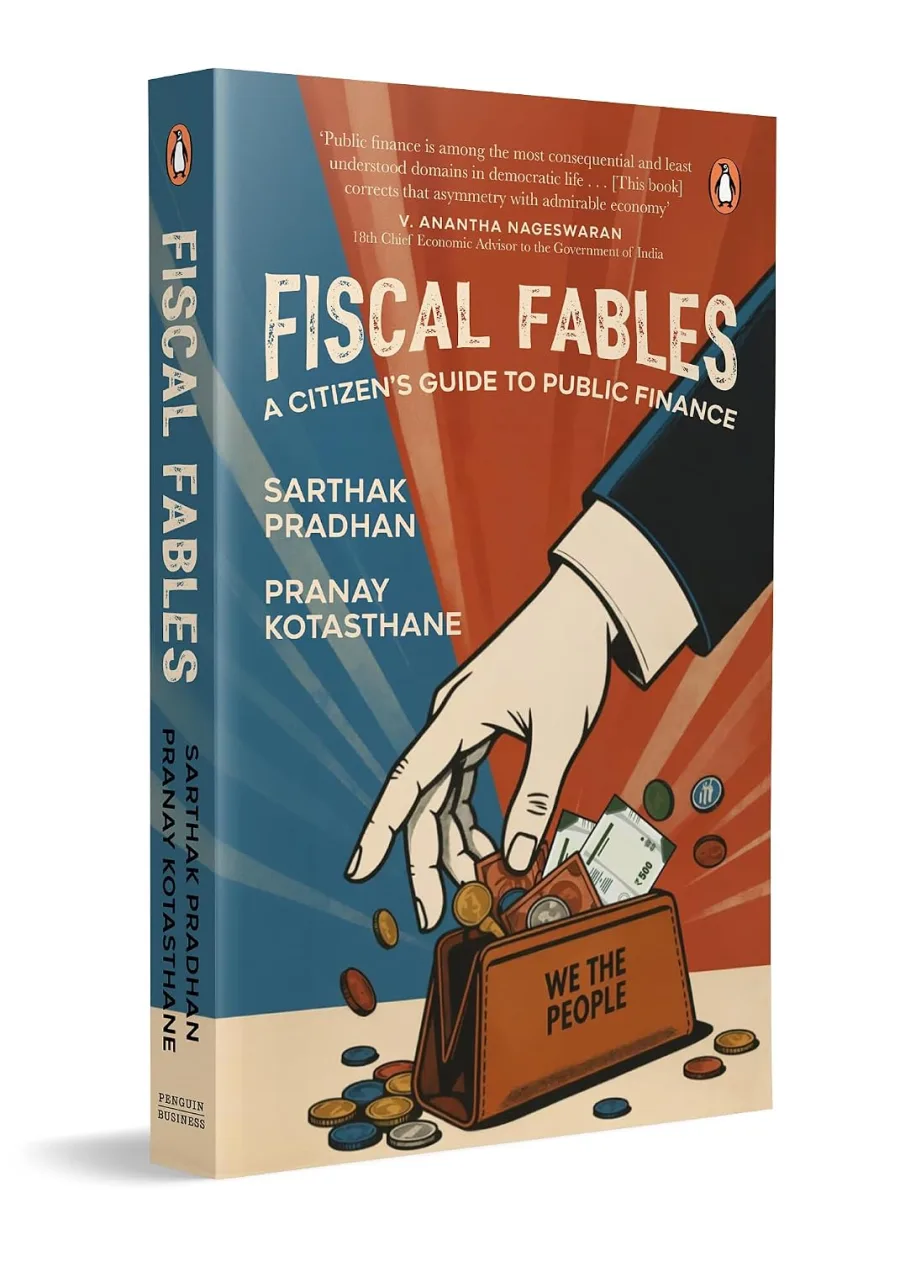
Download Cover Image
Do you want to download the full cover image for Fiscal Fables: A Citizen’s Guide to Public Finance | A Simple Book on Indian Economy, Public Finance?