
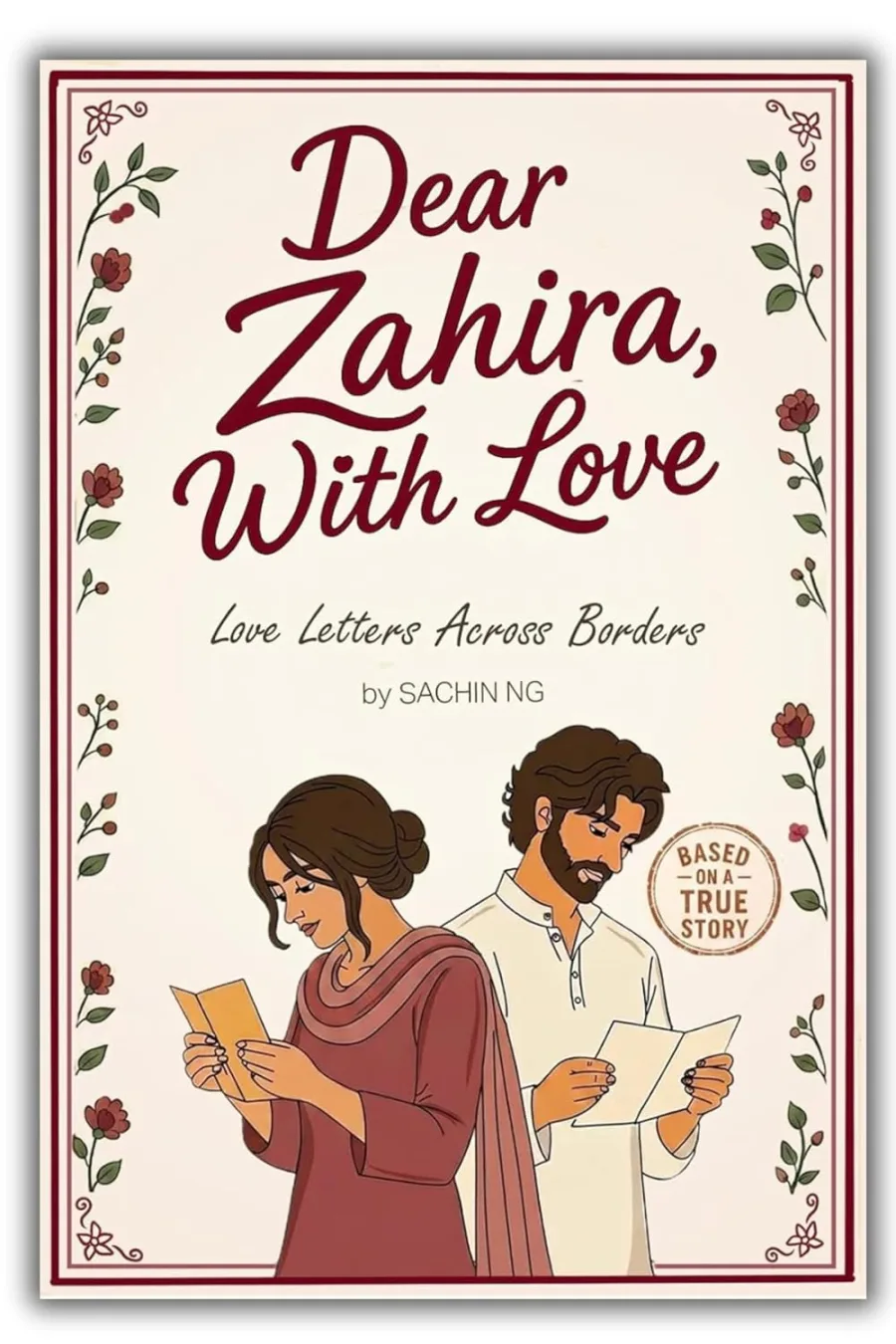
Dear Zahira, With Love: Love Letters Across Borders
Hardcover
• 255 Pages
• ₹ 295.00
• English
• 9789378716041
No ratings yet
| Publisher | Grapevine |
|---|---|
| ISBN13 | 9789378716041 |
| ASIN/SKU | 9378716040 |
| Book Format | Hardcover |
| Language | English |
| Pages | 255 |
| List Price | ₹ 295.00 |
| Publishing Date | 20/06/2026 |
| Dimensions | 15.84 x 1.8 x 23.46 cm |
| Weight | 350 g |
| Book Code | BD00070467 |
Buy this Book
Amazon Stores
Ebook Stores
Other Stores
Discover Dear Zahira, With Love: Love Letters Across Borders by Sachin NG. This book is published by Grapevine in Hardcover format, ISBN 9789378716041, ASIN 9378716040, under Romance, Historical Romance, Fantasy Romance.
Book Description
A love story stuck in the Partition of India
Ghulam Ali meets Zahira when he briefly returns to India, his motherland. Zahira falls for him almost instantly. India, however, refuses to take him back. All Ghulam wants is to return to Lucknow and be with the woman he loves.
Instead, he finds himself injured and starving in a Hindu Refugee Camp in Lahore, suspected of being a jasoos.
Having been forced to serve in the Pakistani Army, India now rejects him completely. Trapped across the border with no hope in sight, Ghulam begins writing letters—to ministers, bureaucrats, journalists, and anyone who might listen. And to Zahira Raza, the love that keeps him alive.
Zahira has always dreamed of dancing freely, but her desire is held back by a secret only Ghulam knows. As she waits for him in Lucknow, living with her naani and sister, she navigates the struggles of being a working Muslim woman in 1950s India.
Written as an exchange of love letters, Dear Zahira, With Love is the true story of Havaldaar Ghulam Ali, as relevant today as it was then.
An earlier version of this book was published under the title "Hindu Refugee Camp, Lahore".
Ghulam Ali meets Zahira when he briefly returns to India, his motherland. Zahira falls for him almost instantly. India, however, refuses to take him back. All Ghulam wants is to return to Lucknow and be with the woman he loves.
Instead, he finds himself injured and starving in a Hindu Refugee Camp in Lahore, suspected of being a jasoos.
Having been forced to serve in the Pakistani Army, India now rejects him completely. Trapped across the border with no hope in sight, Ghulam begins writing letters—to ministers, bureaucrats, journalists, and anyone who might listen. And to Zahira Raza, the love that keeps him alive.
Zahira has always dreamed of dancing freely, but her desire is held back by a secret only Ghulam knows. As she waits for him in Lucknow, living with her naani and sister, she navigates the struggles of being a working Muslim woman in 1950s India.
Written as an exchange of love letters, Dear Zahira, With Love is the true story of Havaldaar Ghulam Ali, as relevant today as it was then.
An earlier version of this book was published under the title "Hindu Refugee Camp, Lahore".
Author Biography
Sachin NG is a bestselling author and a popular speaker. He has written articles for Huffington Post and Scroll.in and has been featured in most leading newspapers and magazines.
He has also spoken at numerous Indian and international forums like South Asia Media Summit (Islamabad), TEDx (Allahabad) and several IITs and IIMs.
He now splits his time between New York and Mumbai, enjoying racquet sports, and strength training in his free time.
He has also spoken at numerous Indian and international forums like South Asia Media Summit (Islamabad), TEDx (Allahabad) and several IITs and IIMs.
He now splits his time between New York and Mumbai, enjoying racquet sports, and strength training in his free time.
Editorial Reviews
‘This saga remains especially urgent and relevant today.’
Mint
‘A moving reminder that while nations may be divided, love, memory, and hope continue to defy boundaries.’
Times Now
‘Potent reminders of an alternative vision for India-Pakistan engagement, one marked by mutual respect and forgiveness.’
Mint Lounge
‘A moving reminder that some journeys are measured not in miles, but in years of waiting.’
Times of India
‘A moving story of two lives profoundly altered by the upheaval of India’s Partition.’
ThePrint
Mint
‘A moving reminder that while nations may be divided, love, memory, and hope continue to defy boundaries.’
Times Now
‘Potent reminders of an alternative vision for India-Pakistan engagement, one marked by mutual respect and forgiveness.’
Mint Lounge
‘A moving reminder that some journeys are measured not in miles, but in years of waiting.’
Times of India
‘A moving story of two lives profoundly altered by the upheaval of India’s Partition.’
ThePrint
Book Summary
Dear Zahira, With Love: Love Letters Across Borders by Sachin NG is a deeply emotional historical romance set against the painful aftermath of the Partition of India. Based on the true story of Havaldaar Ghulam Ali and Zahira Raza, the novel explores what happens to ordinary people when political borders suddenly become stronger than personal relationships. Instead of presenting Partition only through statistics, migration, violence and political events, the book brings history down to the level of two people who fall in love and then discover that the newly created border can separate them from each other. The story is told largely through letters exchanged across the divide, giving the novel an intimate and personal quality. The letters referenced in the story date from 1958 to 1960, years after Partition had officially taken place, showing that the consequences of 1947 continued to shape people's lives long afterward.
At the centre of the story are Ghulam Ali and Zahira Raza. Their relationship begins when Ghulam briefly returns to India, the country he considers his motherland. Zahira meets him and develops feelings for him almost immediately. Their relationship might have developed into an ordinary love story under different circumstances, but the history of the subcontinent has already changed the meaning of belonging, citizenship and home. Ghulam wants to return to Lucknow and be with Zahira, but circumstances prevent him from simply crossing the border and going home. What begins as a personal desire to reunite with the woman he loves becomes a struggle against governments, bureaucracy, suspicion and the consequences of Partition.
Ghulam's situation becomes particularly tragic because he finds himself stranded in Pakistan. Instead of being able to return peacefully to India, he becomes injured, hungry and trapped in a Hindu refugee camp in Lahore. He is also viewed with suspicion and is suspected of being a spy. His identity becomes painfully complicated. He considers himself connected to India, yet circumstances have placed him on the other side of the newly created border. The same political division that has separated millions of people now determines where Ghulam is allowed to live. His personal identity is caught between geography, nationality and memory.
His situation becomes even more difficult because he is forced to serve in the Pakistani Army. The irony is painful: Ghulam wants to return to India, but circumstances push him into serving the very country that now stands between him and his homeland. His experience demonstrates how ordinary people can lose control over their lives during periods of political upheaval. Governments make decisions in the name of national security and political necessity, but individuals have to live with the consequences. Ghulam's story therefore becomes much larger than a love story. It becomes a story about the loss of freedom and the struggle to reclaim an identity that history has disrupted.
Unable to return to Lucknow, Ghulam begins writing letters. He does not write only to Zahira. He writes to ministers, bureaucrats, journalists and anyone he believes might be able to help him. His letters become a desperate attempt to make himself visible to a system that seems to have forgotten him. He tries to explain who he is, where he belongs and why he wants to return. Every letter represents another attempt to cross the invisible wall created by bureaucracy and politics. The written word becomes his only practical means of fighting his helplessness.
Among all these letters, however, those addressed to Zahira carry a different emotional weight. His correspondence with her is not simply an attempt to solve a political problem. Zahira represents home, love and hope. While ministers and officials may determine whether he can physically cross the border, Zahira gives him a reason to keep trying. His love for her becomes a source of emotional survival. Even while he is physically trapped, their relationship allows him to imagine a future in which separation will end.
Zahira's side of the story is equally important. She remains in Lucknow, living with her grandmother and sister while waiting for Ghulam. Her life is shaped not only by her separation from the man she loves but also by the expectations and restrictions placed on her as a working Muslim woman in 1950s India. Her experience shows that Partition affected people who remained in their homes just as profoundly as those who crossed borders. She has to continue living, working and managing family responsibilities while carrying the emotional uncertainty of waiting for someone who may never return.
Zahira also has her own dreams. She has always wanted to dance freely, but a secret known to Ghulam stands in the way of that dream. This part of the story gives her character a dimension beyond that of a woman simply waiting for her lover. She is an individual with ambitions, fears and personal limitations. Her relationship with Ghulam is important, but her life also involves questions of independence, social expectations and the freedom to choose her own path. Through her, the novel explores the position of women in the social environment of the 1950s.
The book's letter format is particularly significant. Instead of presenting the relationship through a conventional narrative alone, Sachin NG recreates it through correspondence. This structure makes the distance between Ghulam and Zahira feel immediate. A letter is both a connection and a reminder of separation. One person writes from one side of a border and waits for an answer from the other. The reader therefore experiences their relationship through anticipation, memory and words rather than physical meetings. The form also gives the story a documentary quality because it is inspired by real letters exchanged by the couple.
The novel's treatment of Partition is different from many familiar Partition narratives. Rather than concentrating primarily on the dramatic events of 1947, it focuses on the aftermath and the people whose lives remained unsettled years later. Recent reviews have noted that the book looks at Partition through those who were left behind or unable to cross borders, emphasizing the quieter and more enduring consequences of the historical event.
This makes the novel's understanding of Partition deeply personal. A border may be drawn on a map in a single political decision, but its consequences do not disappear when the political event is over. Families remain divided. People lose access to homes and relatives. Memories become connected with places that can no longer be visited easily. Relationships become dependent on letters and official permission. In this sense, the book suggests that Partition was not simply something that “happened” in 1947; it continued through the lives of the people who had to live with its consequences.
The novel also explores the meaning of home. For Ghulam, home is not simply the country in which he happens to be physically present. Home is connected to Lucknow, memory, belonging and Zahira. His inability to return demonstrates how complicated citizenship and identity can become when political borders change. A person can feel emotionally connected to a place even when political circumstances say that the person no longer belongs there.
At the same time, the story is about hope. Ghulam's letters are acts of hope because every letter assumes that someone might listen. Zahira's waiting is also an act of hope because she continues to believe in the possibility of reunion. Their love survives not because circumstances are kind to them but because they continue to communicate and remember one another. The letters become evidence that their relationship has not disappeared simply because physical distance has increased.
The story also gives considerable importance to human resilience. Ghulam faces hunger, injury, suspicion, forced service and separation, yet he continues trying to change his situation. Zahira faces social restrictions, uncertainty and the absence of the person she loves, yet she continues with her own life. Neither character has complete control over the political circumstances surrounding them. Their strength lies in the choices they can still make—writing, waiting, remembering, loving and refusing to surrender emotionally.
The novel's relevance extends beyond its historical setting. Sachin NG has argued that Partition continues to have a presence in everyday life whenever borders separate families, loved ones or communities. In that sense, the book asks readers to think about Partition not merely as an event from the past but as a continuing human experience.
Ultimately, Dear Zahira, With Love is a story about love caught in the machinery of history. Ghulam and Zahira's relationship shows how political decisions can enter the most private areas of human life. A border that exists for governments becomes an enormous emotional barrier for two people who simply want to be together. Yet the novel does not reduce their story to tragedy. Their letters preserve affection, hope and dignity in circumstances designed to make them feel powerless.
The deepest message of the book is that human relationships can survive circumstances that appear stronger than the people involved. Borders can separate bodies, governments can restrict movement and history can reshape identities, but memory and affection can continue to cross those boundaries. Through Ghulam and Zahira, Sachin NG turns the history of Partition into an intimate story of longing, separation and perseverance. The result is not simply a romance but a reminder that behind every major historical event are ordinary people whose lives, dreams and relationships are permanently changed. Their story asks readers to remember Partition not only through dates and political decisions, but through the human beings who continued to love, wait and hope after the maps had been redrawn.
At the centre of the story are Ghulam Ali and Zahira Raza. Their relationship begins when Ghulam briefly returns to India, the country he considers his motherland. Zahira meets him and develops feelings for him almost immediately. Their relationship might have developed into an ordinary love story under different circumstances, but the history of the subcontinent has already changed the meaning of belonging, citizenship and home. Ghulam wants to return to Lucknow and be with Zahira, but circumstances prevent him from simply crossing the border and going home. What begins as a personal desire to reunite with the woman he loves becomes a struggle against governments, bureaucracy, suspicion and the consequences of Partition.
Ghulam's situation becomes particularly tragic because he finds himself stranded in Pakistan. Instead of being able to return peacefully to India, he becomes injured, hungry and trapped in a Hindu refugee camp in Lahore. He is also viewed with suspicion and is suspected of being a spy. His identity becomes painfully complicated. He considers himself connected to India, yet circumstances have placed him on the other side of the newly created border. The same political division that has separated millions of people now determines where Ghulam is allowed to live. His personal identity is caught between geography, nationality and memory.
His situation becomes even more difficult because he is forced to serve in the Pakistani Army. The irony is painful: Ghulam wants to return to India, but circumstances push him into serving the very country that now stands between him and his homeland. His experience demonstrates how ordinary people can lose control over their lives during periods of political upheaval. Governments make decisions in the name of national security and political necessity, but individuals have to live with the consequences. Ghulam's story therefore becomes much larger than a love story. It becomes a story about the loss of freedom and the struggle to reclaim an identity that history has disrupted.
Unable to return to Lucknow, Ghulam begins writing letters. He does not write only to Zahira. He writes to ministers, bureaucrats, journalists and anyone he believes might be able to help him. His letters become a desperate attempt to make himself visible to a system that seems to have forgotten him. He tries to explain who he is, where he belongs and why he wants to return. Every letter represents another attempt to cross the invisible wall created by bureaucracy and politics. The written word becomes his only practical means of fighting his helplessness.
Among all these letters, however, those addressed to Zahira carry a different emotional weight. His correspondence with her is not simply an attempt to solve a political problem. Zahira represents home, love and hope. While ministers and officials may determine whether he can physically cross the border, Zahira gives him a reason to keep trying. His love for her becomes a source of emotional survival. Even while he is physically trapped, their relationship allows him to imagine a future in which separation will end.
Zahira's side of the story is equally important. She remains in Lucknow, living with her grandmother and sister while waiting for Ghulam. Her life is shaped not only by her separation from the man she loves but also by the expectations and restrictions placed on her as a working Muslim woman in 1950s India. Her experience shows that Partition affected people who remained in their homes just as profoundly as those who crossed borders. She has to continue living, working and managing family responsibilities while carrying the emotional uncertainty of waiting for someone who may never return.
Zahira also has her own dreams. She has always wanted to dance freely, but a secret known to Ghulam stands in the way of that dream. This part of the story gives her character a dimension beyond that of a woman simply waiting for her lover. She is an individual with ambitions, fears and personal limitations. Her relationship with Ghulam is important, but her life also involves questions of independence, social expectations and the freedom to choose her own path. Through her, the novel explores the position of women in the social environment of the 1950s.
The book's letter format is particularly significant. Instead of presenting the relationship through a conventional narrative alone, Sachin NG recreates it through correspondence. This structure makes the distance between Ghulam and Zahira feel immediate. A letter is both a connection and a reminder of separation. One person writes from one side of a border and waits for an answer from the other. The reader therefore experiences their relationship through anticipation, memory and words rather than physical meetings. The form also gives the story a documentary quality because it is inspired by real letters exchanged by the couple.
The novel's treatment of Partition is different from many familiar Partition narratives. Rather than concentrating primarily on the dramatic events of 1947, it focuses on the aftermath and the people whose lives remained unsettled years later. Recent reviews have noted that the book looks at Partition through those who were left behind or unable to cross borders, emphasizing the quieter and more enduring consequences of the historical event.
This makes the novel's understanding of Partition deeply personal. A border may be drawn on a map in a single political decision, but its consequences do not disappear when the political event is over. Families remain divided. People lose access to homes and relatives. Memories become connected with places that can no longer be visited easily. Relationships become dependent on letters and official permission. In this sense, the book suggests that Partition was not simply something that “happened” in 1947; it continued through the lives of the people who had to live with its consequences.
The novel also explores the meaning of home. For Ghulam, home is not simply the country in which he happens to be physically present. Home is connected to Lucknow, memory, belonging and Zahira. His inability to return demonstrates how complicated citizenship and identity can become when political borders change. A person can feel emotionally connected to a place even when political circumstances say that the person no longer belongs there.
At the same time, the story is about hope. Ghulam's letters are acts of hope because every letter assumes that someone might listen. Zahira's waiting is also an act of hope because she continues to believe in the possibility of reunion. Their love survives not because circumstances are kind to them but because they continue to communicate and remember one another. The letters become evidence that their relationship has not disappeared simply because physical distance has increased.
The story also gives considerable importance to human resilience. Ghulam faces hunger, injury, suspicion, forced service and separation, yet he continues trying to change his situation. Zahira faces social restrictions, uncertainty and the absence of the person she loves, yet she continues with her own life. Neither character has complete control over the political circumstances surrounding them. Their strength lies in the choices they can still make—writing, waiting, remembering, loving and refusing to surrender emotionally.
The novel's relevance extends beyond its historical setting. Sachin NG has argued that Partition continues to have a presence in everyday life whenever borders separate families, loved ones or communities. In that sense, the book asks readers to think about Partition not merely as an event from the past but as a continuing human experience.
Ultimately, Dear Zahira, With Love is a story about love caught in the machinery of history. Ghulam and Zahira's relationship shows how political decisions can enter the most private areas of human life. A border that exists for governments becomes an enormous emotional barrier for two people who simply want to be together. Yet the novel does not reduce their story to tragedy. Their letters preserve affection, hope and dignity in circumstances designed to make them feel powerless.
The deepest message of the book is that human relationships can survive circumstances that appear stronger than the people involved. Borders can separate bodies, governments can restrict movement and history can reshape identities, but memory and affection can continue to cross those boundaries. Through Ghulam and Zahira, Sachin NG turns the history of Partition into an intimate story of longing, separation and perseverance. The result is not simply a romance but a reminder that behind every major historical event are ordinary people whose lives, dreams and relationships are permanently changed. Their story asks readers to remember Partition not only through dates and political decisions, but through the human beings who continued to love, wait and hope after the maps had been redrawn.
Sample Chapters
Sample Chapters will be added soon…
Reader Reviews
No reviews yet.
Dear Zahira, With Love: Love Letters Across Borders
Download Cover Image
Do you want to download the full cover image for Dear Zahira, With Love: Love Letters Across Borders?