
PW Physics Med Easy 2.0 Notes | Notes, Formulas, Mnemonics, Tips & Tricks for NEET/JEE & Board Exams
Paperback
• 264 Pages
• ₹ 525.00
• English
No ratings yet
| Publisher | Physics Wallah Limited |
|---|---|
| ASIN/SKU | B0G2SLSS43 |
| Book Format | Paperback |
| Language | English |
| Pages | 264 |
| List Price | ₹ 525.00 |
| Publishing Date | 01/12/2025 |
| Dimensions | 29 x 24 x 2 cm |
| Weight | 300 g |
| Book Code | BD00070464 |
Buy this Book
Amazon Stores
Ebook Stores
Other Stores
Discover PW Physics Med Easy 2.0 Notes | Notes, Formulas, Mnemonics, Tips and Tricks for NEET/JEE and Board Exams by Dr. Manish Raj (MR. Sir). This book is published by Physics Wallah Limited in Paperback format, ASIN B0G2SLSS43, under Exam Preparation, AIIMS and NEET Exams.
Book Description
"PW Physics Med Easy 2.0 – Handwritten Notes for NEET, JEE & Board Exams
• All-inclusive handwritten Physics notes crafted to simplify complex concepts for exam-focused learning.
• Essential formulas that break down intricate Physics principles into easy-to-understand equations.
• Mnemonic techniques provided to support strong memory retention and faster recall during revision.
• Important examples to demonstrate practical application and improve conceptual clarity.
• Valuable tips and tricks designed to boost problem-solving efficiency and save preparation time.
• Structured and visually organized notes that strengthen conceptual understanding and recall.
• Relatable examples that help bridge theoretical concepts with real-world applications.
• Time-saving shortcuts ideal for high-pressure exam conditions.
• Suitable for NEET, JEE and Board exam aspirants, educators, and learners seeking strong Physics fundamentals.
• Authored by Dr. Manish Raj (MR Sir), a PW Physics Educator with 11 years of teaching experience.
• Guided over 3 million students and mentored multiple NEET aspirants securing notable All India Ranks.
• Recognized nationally for impactful teaching, extended lectures, and contributions to Physics Education."
• All-inclusive handwritten Physics notes crafted to simplify complex concepts for exam-focused learning.
• Essential formulas that break down intricate Physics principles into easy-to-understand equations.
• Mnemonic techniques provided to support strong memory retention and faster recall during revision.
• Important examples to demonstrate practical application and improve conceptual clarity.
• Valuable tips and tricks designed to boost problem-solving efficiency and save preparation time.
• Structured and visually organized notes that strengthen conceptual understanding and recall.
• Relatable examples that help bridge theoretical concepts with real-world applications.
• Time-saving shortcuts ideal for high-pressure exam conditions.
• Suitable for NEET, JEE and Board exam aspirants, educators, and learners seeking strong Physics fundamentals.
• Authored by Dr. Manish Raj (MR Sir), a PW Physics Educator with 11 years of teaching experience.
• Guided over 3 million students and mentored multiple NEET aspirants securing notable All India Ranks.
• Recognized nationally for impactful teaching, extended lectures, and contributions to Physics Education."
Author Biography
Author Biography will be added soon…
Editorial Reviews
Editorial Reviews will be added soon…
Book Summary
PW Physics Med Easy 2.0 Notes by Dr. Manish Raj (MR Sir) is a concise, exam-oriented Physics study and revision book designed mainly for students preparing for NEET, JEE and board examinations. Published by Physics Wallah, the book is presented in a handwritten-notes format and is built around concise concepts, important formulas, mnemonics, examples, and practical tips and tricks. The publisher lists the book in English, with ISBN 9788119352944, and describes it as a resource for NEET, JEE and board-exam preparation.
The basic philosophy of Physics Med Easy 2.0 is that Physics becomes easier when students can connect concepts, formulas and their practical application. Many students find Physics difficult because they have to remember numerous equations while also understanding when and how those equations should be used. The book attempts to reduce this difficulty by presenting important ideas in a compact form. Instead of functioning like a traditional, lengthy Physics textbook, it works more like organized classroom notes that students can use after learning a topic in detail. This makes it particularly useful for revision, especially when the examination is approaching and students need to review a large syllabus in limited time.
One of the most important features of the book is its handwritten-note presentation. The notes are designed to resemble classroom notes rather than a conventional textbook. This style can make the material feel more direct and less intimidating. The purpose is not to overwhelm students with lengthy theoretical explanations but to highlight the concepts, formulas and important observations that they need to remember. The available product information describes the book as a complete handwritten class-notes resource and says that it has been updated according to the relevant NMC and NTA syllabus.
The book covers a broad range of Physics, beginning with the basic mathematical and physical tools required for problem solving. Topics include vectors, units and dimensions, motion in one dimension, motion in a plane, Newton's laws of motion, friction, circular motion, work, energy and power, centre of mass, collisions and rotational motion. These foundational chapters are important because they form the basis for much of mechanics. A student who understands these concepts well can approach more complicated numerical problems with greater confidence.
The mechanics portion continues with topics such as gravitation, elasticity, fluid mechanics, thermal properties of matter, heat transfer, kinetic theory of gases and thermodynamics. These chapters connect motion and forces with properties of matter and thermal systems. The notes help students organize the formulas and relationships that appear repeatedly in numerical problems. For examination preparation, such organization is valuable because students often need to recall several related equations quickly and select the correct one according to the conditions given in a question.
The book also covers oscillations and waves, including simple harmonic motion and wave and sound motion. These topics require students to understand periodic motion, frequency, wavelength, energy and related mathematical relationships. The notes approach such material from a revision perspective, helping students keep important equations and concepts together rather than searching through lengthy chapters. This can be especially useful during repeated revision cycles when the goal is rapid recall.
The second major part of the book moves into electricity and magnetism. Important areas include electrostatics, electric potential, capacitors, current electricity, magnetic effects of electric current, magnetism and matter, electromagnetic induction and alternating current. These topics are central to senior-secondary Physics and are also highly relevant to competitive examinations. They contain many formulas and concepts that can initially seem unrelated, but careful organization can help students understand their connections. The book's formula-based approach is intended to make this revision process quicker and more systematic.
The coverage then extends to electromagnetic waves and optics, including ray optics and other important Physics topics. Optics often requires students to combine conceptual understanding with equations and diagrams. For competitive examinations, students must be able to recognize the physical situation presented in a question and select the appropriate relation. Concise notes and solved examples can help bridge the gap between simply memorizing a formula and actually applying it.
A major strength of Physics Med Easy 2.0 is its emphasis on important formulas. Physics contains a large number of equations, but memorizing formulas without understanding their meaning can create problems during examinations. The book attempts to make formulas easier to remember by placing them in the context of the concepts to which they belong. Students can therefore use the book as a formula-revision resource while simultaneously reminding themselves of the physical principles behind those formulas. The publisher specifically highlights the use of formulas to simplify complex Physics concepts.
Another distinctive feature is the use of mnemonics. Mnemonics are memory techniques that turn difficult information into easier patterns or memorable associations. In a subject containing numerous formulas, rules, conditions and factual details, such memory aids can save valuable time. The book uses these techniques to support quick recall, particularly during revision. However, mnemonics are most useful when they supplement conceptual understanding rather than replace it. Students should first understand the principle and then use the memory aid to make recall faster.
The book also includes important examples and solved applications. This is important because a Physics formula becomes useful only when students know how to apply it. An example demonstrates the relationship between the information given in a question, the physical concept involved and the mathematical steps required to reach the answer. By studying examples carefully, students can recognize common question patterns and avoid applying a familiar formula in an unsuitable situation. The book's listed structure specifically includes concise notes and solved examples.
The inclusion of tips and tricks adds another examination-oriented dimension. Competitive examinations such as NEET and JEE place students under considerable time pressure. A candidate may know the correct concept but lose marks because a calculation takes too long or because the question is approached inefficiently. Shortcuts and problem-solving observations can help students identify faster routes to an answer when those methods are mathematically sound. The purpose of these tricks is therefore not simply to make questions look easy, but to improve speed and efficiency after the underlying concept has been understood.
For NEET aspirants, the book can function particularly well as a revision companion. NEET requires candidates to solve Physics questions within a limited time while also managing Chemistry and Biology. Therefore, efficient recall is extremely important. Students can use the notes after completing detailed lectures or textbook study and then return to them repeatedly during revision. The publisher itself lists Physics Med Easy 2.0 among its Physics resources for NEET preparation.
For JEE students, the book can similarly serve as a compact review resource, although students targeting the higher levels of JEE preparation should supplement concise notes with detailed conceptual study and extensive problem-solving. A short-notes book is most effective when the student already understands the fundamentals. It can then help organize formulas and concepts before attempting more challenging questions. It should not be treated as a replacement for advanced practice, especially for students aiming to solve unfamiliar and multi-concept JEE problems.
The book is also relevant to board examinations because it brings together important concepts and formulas in an organized manner. Board students can use the notes to revise chapters after completing their textbook and classroom preparation. The concise format can be especially useful before school examinations or final board examinations, when students need to revisit the entire syllabus without reading every chapter from the beginning.
One of the biggest practical benefits of this book is its ability to help students with revision and backlog management. Students preparing for competitive examinations often accumulate unfinished chapters. When an examination is approaching, they may not have enough time to study every chapter through lengthy lectures or multiple reference books. Concise notes can provide a way to review essential concepts more quickly. The available product description also highlights the usefulness of the book for students who have a backlog and need to identify question patterns and revise efficiently.
However, Physics Med Easy 2.0 works best when used as part of a larger preparation strategy. Students should not depend on notes alone. A strong approach is to first understand the concept through a teacher, textbook or detailed study material, then use the book to consolidate the concept, revise formulas and study examples, and finally solve numerical and objective questions independently. When a student makes a mistake, the notes can be used to identify the relevant concept or formula, but the actual problem-solving ability must come from practice.
Overall, PW Physics Med Easy 2.0 Notes is best understood as a compact Physics revision and reference guide rather than a conventional textbook. Its combination of handwritten notes, concise concepts, formulas, mnemonics, solved examples and tips is designed to make Physics more manageable for examination-focused students. The broad syllabus coverage brings together mechanics, properties of matter, thermodynamics, waves, electricity, magnetism and optics in one organized resource.
The central lesson of the book is that effective Physics preparation depends on three connected abilities: understanding the concept, remembering the essential relationship, and applying it correctly to a problem. Formulas without understanding are difficult to use, while understanding without sufficient recall can be slow under examination pressure. By combining concise explanations with formulas, mnemonics and examples, Physics Med Easy 2.0 attempts to strengthen all three areas. For NEET, JEE and board aspirants who already have basic conceptual knowledge and need a practical resource for repeated revision, the book can serve as a useful companion for organizing Physics preparation and making last-stage revision faster, clearer and more systematic.
The basic philosophy of Physics Med Easy 2.0 is that Physics becomes easier when students can connect concepts, formulas and their practical application. Many students find Physics difficult because they have to remember numerous equations while also understanding when and how those equations should be used. The book attempts to reduce this difficulty by presenting important ideas in a compact form. Instead of functioning like a traditional, lengthy Physics textbook, it works more like organized classroom notes that students can use after learning a topic in detail. This makes it particularly useful for revision, especially when the examination is approaching and students need to review a large syllabus in limited time.
One of the most important features of the book is its handwritten-note presentation. The notes are designed to resemble classroom notes rather than a conventional textbook. This style can make the material feel more direct and less intimidating. The purpose is not to overwhelm students with lengthy theoretical explanations but to highlight the concepts, formulas and important observations that they need to remember. The available product information describes the book as a complete handwritten class-notes resource and says that it has been updated according to the relevant NMC and NTA syllabus.
The book covers a broad range of Physics, beginning with the basic mathematical and physical tools required for problem solving. Topics include vectors, units and dimensions, motion in one dimension, motion in a plane, Newton's laws of motion, friction, circular motion, work, energy and power, centre of mass, collisions and rotational motion. These foundational chapters are important because they form the basis for much of mechanics. A student who understands these concepts well can approach more complicated numerical problems with greater confidence.
The mechanics portion continues with topics such as gravitation, elasticity, fluid mechanics, thermal properties of matter, heat transfer, kinetic theory of gases and thermodynamics. These chapters connect motion and forces with properties of matter and thermal systems. The notes help students organize the formulas and relationships that appear repeatedly in numerical problems. For examination preparation, such organization is valuable because students often need to recall several related equations quickly and select the correct one according to the conditions given in a question.
The book also covers oscillations and waves, including simple harmonic motion and wave and sound motion. These topics require students to understand periodic motion, frequency, wavelength, energy and related mathematical relationships. The notes approach such material from a revision perspective, helping students keep important equations and concepts together rather than searching through lengthy chapters. This can be especially useful during repeated revision cycles when the goal is rapid recall.
The second major part of the book moves into electricity and magnetism. Important areas include electrostatics, electric potential, capacitors, current electricity, magnetic effects of electric current, magnetism and matter, electromagnetic induction and alternating current. These topics are central to senior-secondary Physics and are also highly relevant to competitive examinations. They contain many formulas and concepts that can initially seem unrelated, but careful organization can help students understand their connections. The book's formula-based approach is intended to make this revision process quicker and more systematic.
The coverage then extends to electromagnetic waves and optics, including ray optics and other important Physics topics. Optics often requires students to combine conceptual understanding with equations and diagrams. For competitive examinations, students must be able to recognize the physical situation presented in a question and select the appropriate relation. Concise notes and solved examples can help bridge the gap between simply memorizing a formula and actually applying it.
A major strength of Physics Med Easy 2.0 is its emphasis on important formulas. Physics contains a large number of equations, but memorizing formulas without understanding their meaning can create problems during examinations. The book attempts to make formulas easier to remember by placing them in the context of the concepts to which they belong. Students can therefore use the book as a formula-revision resource while simultaneously reminding themselves of the physical principles behind those formulas. The publisher specifically highlights the use of formulas to simplify complex Physics concepts.
Another distinctive feature is the use of mnemonics. Mnemonics are memory techniques that turn difficult information into easier patterns or memorable associations. In a subject containing numerous formulas, rules, conditions and factual details, such memory aids can save valuable time. The book uses these techniques to support quick recall, particularly during revision. However, mnemonics are most useful when they supplement conceptual understanding rather than replace it. Students should first understand the principle and then use the memory aid to make recall faster.
The book also includes important examples and solved applications. This is important because a Physics formula becomes useful only when students know how to apply it. An example demonstrates the relationship between the information given in a question, the physical concept involved and the mathematical steps required to reach the answer. By studying examples carefully, students can recognize common question patterns and avoid applying a familiar formula in an unsuitable situation. The book's listed structure specifically includes concise notes and solved examples.
The inclusion of tips and tricks adds another examination-oriented dimension. Competitive examinations such as NEET and JEE place students under considerable time pressure. A candidate may know the correct concept but lose marks because a calculation takes too long or because the question is approached inefficiently. Shortcuts and problem-solving observations can help students identify faster routes to an answer when those methods are mathematically sound. The purpose of these tricks is therefore not simply to make questions look easy, but to improve speed and efficiency after the underlying concept has been understood.
For NEET aspirants, the book can function particularly well as a revision companion. NEET requires candidates to solve Physics questions within a limited time while also managing Chemistry and Biology. Therefore, efficient recall is extremely important. Students can use the notes after completing detailed lectures or textbook study and then return to them repeatedly during revision. The publisher itself lists Physics Med Easy 2.0 among its Physics resources for NEET preparation.
For JEE students, the book can similarly serve as a compact review resource, although students targeting the higher levels of JEE preparation should supplement concise notes with detailed conceptual study and extensive problem-solving. A short-notes book is most effective when the student already understands the fundamentals. It can then help organize formulas and concepts before attempting more challenging questions. It should not be treated as a replacement for advanced practice, especially for students aiming to solve unfamiliar and multi-concept JEE problems.
The book is also relevant to board examinations because it brings together important concepts and formulas in an organized manner. Board students can use the notes to revise chapters after completing their textbook and classroom preparation. The concise format can be especially useful before school examinations or final board examinations, when students need to revisit the entire syllabus without reading every chapter from the beginning.
One of the biggest practical benefits of this book is its ability to help students with revision and backlog management. Students preparing for competitive examinations often accumulate unfinished chapters. When an examination is approaching, they may not have enough time to study every chapter through lengthy lectures or multiple reference books. Concise notes can provide a way to review essential concepts more quickly. The available product description also highlights the usefulness of the book for students who have a backlog and need to identify question patterns and revise efficiently.
However, Physics Med Easy 2.0 works best when used as part of a larger preparation strategy. Students should not depend on notes alone. A strong approach is to first understand the concept through a teacher, textbook or detailed study material, then use the book to consolidate the concept, revise formulas and study examples, and finally solve numerical and objective questions independently. When a student makes a mistake, the notes can be used to identify the relevant concept or formula, but the actual problem-solving ability must come from practice.
Overall, PW Physics Med Easy 2.0 Notes is best understood as a compact Physics revision and reference guide rather than a conventional textbook. Its combination of handwritten notes, concise concepts, formulas, mnemonics, solved examples and tips is designed to make Physics more manageable for examination-focused students. The broad syllabus coverage brings together mechanics, properties of matter, thermodynamics, waves, electricity, magnetism and optics in one organized resource.
The central lesson of the book is that effective Physics preparation depends on three connected abilities: understanding the concept, remembering the essential relationship, and applying it correctly to a problem. Formulas without understanding are difficult to use, while understanding without sufficient recall can be slow under examination pressure. By combining concise explanations with formulas, mnemonics and examples, Physics Med Easy 2.0 attempts to strengthen all three areas. For NEET, JEE and board aspirants who already have basic conceptual knowledge and need a practical resource for repeated revision, the book can serve as a useful companion for organizing Physics preparation and making last-stage revision faster, clearer and more systematic.
Sample Chapters
Sample Chapters will be added soon…
Reader Reviews
No reviews yet.
PW Physics Med Easy 2.0 Notes | Notes, Formulas, Mnemonics, Tips & Tricks for NEET/JEE & Board Exams
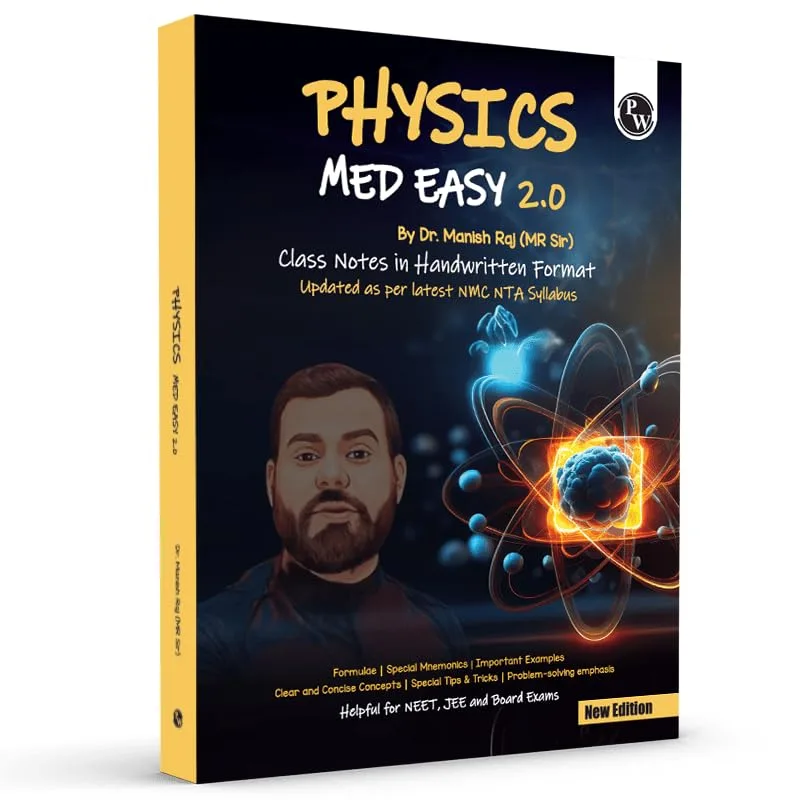
Download Cover Image
Do you want to download the full cover image for PW Physics Med Easy 2.0 Notes | Notes, Formulas, Mnemonics, Tips & Tricks for NEET/JEE & Board Exams?