
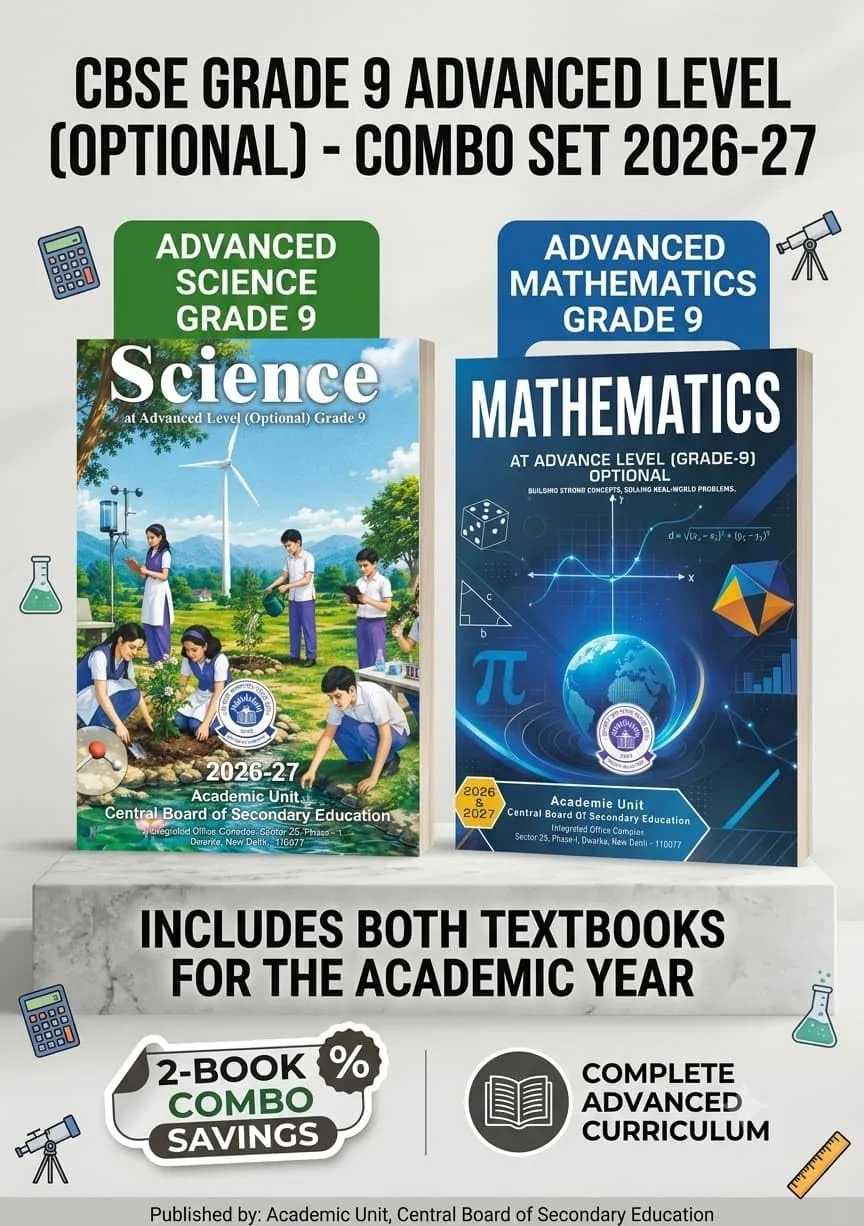
CBSE Class 9 Science & Maths Advanced Level Optional Grade 9 Textbook 2026-27 Optional
Central Board of Secondary Education
Paperback
• 180 Pages
• ₹ 240.00
• English
No ratings yet
| Publisher | Central Board of Secondary Education |
|---|---|
| ASIN/SKU | B0HBQRV6VP |
| Book Format | Paperback |
| Language | English |
| Pages | 180 |
| List Price | ₹ 240.00 |
| Publishing Date | 01/07/2026 |
| Dimensions | 24 x 28 x 3 cm |
| Weight | 600 g |
| Book Code | BD00070428 |
Buy this Book
Amazon Stores
Ebook Stores
Other Stores
Discover CBSE Class 9 Science and Maths Advanced Level Optional Grade 9 Textbook 2026-27 Optional by Central Board of Secondary Education. This book is published by Central Board of Secondary Education in Paperback format, ASIN B0HBQRV6VP, under School Books, CBSE Textbooks.
Book Description
CBSE Class 9 Science & Maths Advanced Level Optional Grade 9 Textbook 2026-27 Optional Product Description: Upgrade your learning with the official CBSE Class 9 Advanced Level (Optional) Textbook Set for Science and Mathematics (Academic Year 2026-27). Specifically published by the Academic Unit, Central Board of Secondary Education, Delhi, this combo set is designed for students seeking strong conceptual clarity, advanced problem-solving skills, and foundation building for competitive exams. Key Highlights: Official CBSE Publication: Published by Academic Unit, CBSE (Dwarka, New Delhi). Comprehensive Coverage: Includes complete advanced level curriculum for Grade 9 Science and Mathematics. Latest Syllabus: Updated according to the 2026-27 academic session. Interactive & Application-Based: Real-world examples, advanced theoretical concepts, and practical illustrations. Table of Contents / Index Included: Mathematics (Advanced Level – Grade 9): Sets Logarithms Relations and Functions Coordinate Geometry Combinatorics Exploring Some More Progressions Science (Advanced Level – Grade 9): Measurement – Foundation of Science Understanding Motion through Experience Newton’s Laws of Motion The Geometry of Power – Advanced Simple Machines Work and Energy Structure of Atom Chemical Bonding Mixtures and Their Separation Microscope and Microscopy Engineering Life: Miracles in Biotechnology
Author Biography
Author Biography will be added soon…
Editorial Reviews
Editorial Reviews will be added soon…
Book Summary
The CBSE Class 9 Science & Maths Advanced Level Optional textbook for 2026–27 is a new academic resource created for students who are ready to study beyond the regular Class 9 curriculum. It is particularly useful for learners who enjoy challenging questions, logical thinking, deeper concepts, and problems that require more than simple memorisation. The Advanced Level is optional, so students can continue with the compulsory standard course without taking it. Those who choose the Advanced Level study an additional textbook and may appear for the separate Advanced examination. The new system is intended to give academically motivated students an opportunity to build a stronger foundation for higher classes and future competitive examinations.
The Mathematics portion of the Advanced Level textbook takes students into areas that are generally introduced at a later stage of mathematical education. Instead of concentrating only on routine calculations, it encourages students to understand mathematical relationships, patterns, structures, and logical connections. The six major areas covered are Sets, Logarithms, Relations and Functions, Coordinate Geometry, Combinatorics, and Progressions. Together, these topics introduce students to a more mature style of mathematical thinking. The purpose is not simply to make students solve harder sums, but to teach them how to represent information mathematically, recognise patterns, develop general rules, and use those rules in unfamiliar situations.
The chapter on Sets provides an introduction to organising mathematical objects into clearly defined groups. Students learn ideas such as sets, subsets, representation of sets, union, intersection, and their applications. This develops an important habit of mathematical classification. Rather than looking at numbers or objects individually, students learn to see relationships between groups. Venn diagrams and set operations also help students represent complicated information visually. These concepts are useful because set theory forms a foundation for several later areas of mathematics, including probability, relations, functions, and many branches of higher mathematics.
Logarithms introduce another important mathematical idea. Students learn to understand logarithms as the inverse operation of exponentiation. Instead of treating logarithms as a collection of formulas to memorise, the Advanced Level approach encourages an understanding of why logarithmic relationships work and how logarithms can be used to solve equations and describe real-world quantities. Logarithmic thinking becomes especially important in later mathematics, science, computing, finance, and measurement systems. Studying it early gives students an opportunity to become comfortable with an idea that may otherwise appear unfamiliar when introduced in higher classes.
Relations and Functions take students further into the study of mathematical relationships. Students encounter ordered pairs, Cartesian products, domain and range, and standard forms of functions and their graphs. The central idea is to understand how one quantity can be related systematically to another. This is an important step from elementary algebra toward higher mathematics. Students begin to think of a function not merely as an equation but as a rule connecting inputs and outputs. This way of thinking is valuable in algebra, coordinate geometry, calculus, statistics, physics, economics, and computer science.
Coordinate Geometry adds another dimension to mathematical reasoning by connecting algebra with geometry. Students learn about coordinates, quadrants, reflections, slope, intercepts, and different forms of equations of lines. The subject therefore becomes more visual and analytical. Instead of studying geometric figures only through diagrams, students can describe their properties using numbers and equations. This helps students understand how algebra and geometry are closely connected and prepares them for more advanced coordinate geometry and analytical mathematics in later classes.
Combinatorics introduces students to the mathematics of counting. The focus includes the fundamental counting principle, factorials, permutations, and combinations. These ideas teach students how to count possibilities systematically without having to list every possibility separately. Such thinking is particularly useful when dealing with large numbers of possible arrangements or selections. Combinatorics also provides an important foundation for probability and appears in many areas of mathematics, computer science, statistics, and problem-solving. The chapter encourages students to look for efficient methods rather than relying on trial and error.
The final Mathematics area, Progressions, develops the ability to recognise and work with numerical patterns. The Advanced Level material includes geometric progressions, sums of terms, and infinite geometric progressions. Students learn to identify relationships between successive terms and use mathematical expressions to describe these relationships. This topic is especially useful because it trains students to move from observing a pattern to forming a mathematical rule. Such pattern recognition is one of the most important skills in advanced mathematics.
The Science portion of the Advanced Level textbook follows a similarly challenging approach. It contains ten chapters covering Physics, Chemistry, and Biology. The chapters include Measurement, Understanding Motion through Experience, Newton's Laws of Motion, Advanced Simple Machines, Work and Energy, Structure of Atom, Chemical Bonding, Mixtures and their Separation, Microscope and Microscopy, and Engineering Life: Miracles in Biotechnology. The material goes deeper than the compulsory Science course and introduces several concepts that normally appear at more advanced stages of education.
The opening Science chapter, Measurement – Foundation of Science, establishes the importance of accurate measurement in scientific work. Students become familiar with different systems of units, including CGS, FPS, MKS, and SI, as well as unit conversion. This may appear basic, but measurement is fundamental to every branch of science. A scientific observation becomes meaningful only when it can be described accurately. The chapter therefore develops precision and prepares students for numerical problem-solving in Physics and other scientific subjects.
Understanding Motion through Experience takes the study of movement beyond simple definitions. Students examine frames of reference, scalar and vector quantities, and equations describing motion. The emphasis is on understanding motion as something that depends on how an observer describes it. The introduction of vectors also prepares students for more advanced Physics because quantities such as displacement, velocity, and force require careful attention to both magnitude and direction.
Newton's Laws of Motion then develops a deeper understanding of forces and movement. Along with Newton's laws, the Advanced Level material introduces ideas such as pseudo force, gravitation, variation of gravitational acceleration with height and depth, and torque. These concepts encourage students to connect theoretical laws with physical situations. Instead of simply memorising Newton's three laws, students are encouraged to understand why objects behave in particular ways when forces act upon them.
The chapter on advanced simple machines studies mechanical systems in greater depth. Topics such as wheel and axle, mechanical advantage, tension, and the geometry behind mechanical systems help students understand how machines make work easier. The focus is on the principles operating inside machines rather than merely learning names or formulas. This develops the ability to analyse practical systems using scientific reasoning.
Work and Energy introduces a more advanced treatment of energy. Students study concepts such as conservative and non-conservative forces and spring potential energy. These ideas help students understand how energy changes from one form to another and why some mechanical processes can be described through conservation principles. This chapter is an important bridge between elementary mechanics and the more mathematical treatment of Physics encountered later.
In Chemistry, the Structure of Atom chapter explores the internal structure of matter. Students study subatomic particles, atomic spectra, and Bohr's model. The goal is to help learners understand that atoms are not indivisible particles but structured systems containing smaller components. The discussion of atomic models also demonstrates how scientific ideas develop as scientists obtain new evidence.
Chemical Bonding takes the study of matter further by explaining why atoms combine. The chapter includes the octet rule and its exceptions as well as metallic bonding and the electron-sea model. Students therefore begin to connect the microscopic structure of atoms with the observable properties of materials. Understanding chemical bonding is essential for later studies of molecules, compounds, reactions, materials, and biological chemistry.
The chapter on Mixtures and their Separation develops students' understanding of techniques used to separate substances. More advanced methods, including chromatography and fractional distillation, are introduced. These techniques demonstrate how differences in physical properties can be used to separate components of a mixture. The chapter also connects textbook science with laboratory practice and real industrial processes.
Biology receives an interesting advanced treatment through Microscope and Microscopy and Engineering Life: Miracles in Biotechnology. Microscopy introduces students to compound and electron microscopes and helps them distinguish between magnification and resolution. This is important because making an image larger does not necessarily mean that more detail becomes visible. Students therefore learn to think more carefully about how scientific instruments extend human observation.
The biotechnology chapter introduces students to modern biological technology. It covers subjects such as genetic engineering, fermenters, Bt crops, recombinant DNA technology, and related ethical questions. This makes the chapter particularly significant because it connects school science with modern agriculture, medicine, industry, and biotechnology research. At the same time, the inclusion of ethical issues reminds students that scientific progress also creates questions about responsible use, safety, society, and the environment.
Overall, the CBSE Class 9 Advanced Level Optional textbook is best understood as a bridge between school-level learning and more advanced academic study. Its Mathematics section develops abstraction, pattern recognition, logical reasoning, and problem-solving, while its Science section strengthens conceptual understanding across Physics, Chemistry, and Biology. The book is not simply a collection of unusually difficult questions. Its larger purpose is to change the way students approach learning: from remembering formulas to understanding why they work, from solving familiar examples to analysing unfamiliar situations, and from following fixed procedures to developing independent reasoning.
The Advanced Level is therefore most suitable for students who are already comfortable with the compulsory Class 9 syllabus and want an additional challenge. It should not be treated as a replacement for strong fundamentals. Instead, the standard curriculum provides the foundation, while the Advanced textbook builds greater depth on top of it. According to current descriptions of the 2026–27 structure, students may choose the Advanced Level in Mathematics, Science, or both. The Advanced examination is additional to the mandatory standard examination, and students who achieve the prescribed qualifying level receive recognition that they have cleared the Advanced Level, without the Advanced marks being added to the overall aggregate.
In simple terms, this textbook is designed for the Class 9 student who wants to ask, “What is beyond the normal syllabus?” It introduces higher-level mathematical ideas and deeper scientific concepts at an early stage while encouraging curiosity, logical thinking, application, and independent problem-solving. For students planning eventually to study demanding subjects such as engineering, medicine, science, mathematics, computer science, or competitive-examination material, the book can provide valuable early exposure. More importantly, it encourages a learning style based on understanding rather than memorisation, which can remain useful throughout higher education.
The Mathematics portion of the Advanced Level textbook takes students into areas that are generally introduced at a later stage of mathematical education. Instead of concentrating only on routine calculations, it encourages students to understand mathematical relationships, patterns, structures, and logical connections. The six major areas covered are Sets, Logarithms, Relations and Functions, Coordinate Geometry, Combinatorics, and Progressions. Together, these topics introduce students to a more mature style of mathematical thinking. The purpose is not simply to make students solve harder sums, but to teach them how to represent information mathematically, recognise patterns, develop general rules, and use those rules in unfamiliar situations.
The chapter on Sets provides an introduction to organising mathematical objects into clearly defined groups. Students learn ideas such as sets, subsets, representation of sets, union, intersection, and their applications. This develops an important habit of mathematical classification. Rather than looking at numbers or objects individually, students learn to see relationships between groups. Venn diagrams and set operations also help students represent complicated information visually. These concepts are useful because set theory forms a foundation for several later areas of mathematics, including probability, relations, functions, and many branches of higher mathematics.
Logarithms introduce another important mathematical idea. Students learn to understand logarithms as the inverse operation of exponentiation. Instead of treating logarithms as a collection of formulas to memorise, the Advanced Level approach encourages an understanding of why logarithmic relationships work and how logarithms can be used to solve equations and describe real-world quantities. Logarithmic thinking becomes especially important in later mathematics, science, computing, finance, and measurement systems. Studying it early gives students an opportunity to become comfortable with an idea that may otherwise appear unfamiliar when introduced in higher classes.
Relations and Functions take students further into the study of mathematical relationships. Students encounter ordered pairs, Cartesian products, domain and range, and standard forms of functions and their graphs. The central idea is to understand how one quantity can be related systematically to another. This is an important step from elementary algebra toward higher mathematics. Students begin to think of a function not merely as an equation but as a rule connecting inputs and outputs. This way of thinking is valuable in algebra, coordinate geometry, calculus, statistics, physics, economics, and computer science.
Coordinate Geometry adds another dimension to mathematical reasoning by connecting algebra with geometry. Students learn about coordinates, quadrants, reflections, slope, intercepts, and different forms of equations of lines. The subject therefore becomes more visual and analytical. Instead of studying geometric figures only through diagrams, students can describe their properties using numbers and equations. This helps students understand how algebra and geometry are closely connected and prepares them for more advanced coordinate geometry and analytical mathematics in later classes.
Combinatorics introduces students to the mathematics of counting. The focus includes the fundamental counting principle, factorials, permutations, and combinations. These ideas teach students how to count possibilities systematically without having to list every possibility separately. Such thinking is particularly useful when dealing with large numbers of possible arrangements or selections. Combinatorics also provides an important foundation for probability and appears in many areas of mathematics, computer science, statistics, and problem-solving. The chapter encourages students to look for efficient methods rather than relying on trial and error.
The final Mathematics area, Progressions, develops the ability to recognise and work with numerical patterns. The Advanced Level material includes geometric progressions, sums of terms, and infinite geometric progressions. Students learn to identify relationships between successive terms and use mathematical expressions to describe these relationships. This topic is especially useful because it trains students to move from observing a pattern to forming a mathematical rule. Such pattern recognition is one of the most important skills in advanced mathematics.
The Science portion of the Advanced Level textbook follows a similarly challenging approach. It contains ten chapters covering Physics, Chemistry, and Biology. The chapters include Measurement, Understanding Motion through Experience, Newton's Laws of Motion, Advanced Simple Machines, Work and Energy, Structure of Atom, Chemical Bonding, Mixtures and their Separation, Microscope and Microscopy, and Engineering Life: Miracles in Biotechnology. The material goes deeper than the compulsory Science course and introduces several concepts that normally appear at more advanced stages of education.
The opening Science chapter, Measurement – Foundation of Science, establishes the importance of accurate measurement in scientific work. Students become familiar with different systems of units, including CGS, FPS, MKS, and SI, as well as unit conversion. This may appear basic, but measurement is fundamental to every branch of science. A scientific observation becomes meaningful only when it can be described accurately. The chapter therefore develops precision and prepares students for numerical problem-solving in Physics and other scientific subjects.
Understanding Motion through Experience takes the study of movement beyond simple definitions. Students examine frames of reference, scalar and vector quantities, and equations describing motion. The emphasis is on understanding motion as something that depends on how an observer describes it. The introduction of vectors also prepares students for more advanced Physics because quantities such as displacement, velocity, and force require careful attention to both magnitude and direction.
Newton's Laws of Motion then develops a deeper understanding of forces and movement. Along with Newton's laws, the Advanced Level material introduces ideas such as pseudo force, gravitation, variation of gravitational acceleration with height and depth, and torque. These concepts encourage students to connect theoretical laws with physical situations. Instead of simply memorising Newton's three laws, students are encouraged to understand why objects behave in particular ways when forces act upon them.
The chapter on advanced simple machines studies mechanical systems in greater depth. Topics such as wheel and axle, mechanical advantage, tension, and the geometry behind mechanical systems help students understand how machines make work easier. The focus is on the principles operating inside machines rather than merely learning names or formulas. This develops the ability to analyse practical systems using scientific reasoning.
Work and Energy introduces a more advanced treatment of energy. Students study concepts such as conservative and non-conservative forces and spring potential energy. These ideas help students understand how energy changes from one form to another and why some mechanical processes can be described through conservation principles. This chapter is an important bridge between elementary mechanics and the more mathematical treatment of Physics encountered later.
In Chemistry, the Structure of Atom chapter explores the internal structure of matter. Students study subatomic particles, atomic spectra, and Bohr's model. The goal is to help learners understand that atoms are not indivisible particles but structured systems containing smaller components. The discussion of atomic models also demonstrates how scientific ideas develop as scientists obtain new evidence.
Chemical Bonding takes the study of matter further by explaining why atoms combine. The chapter includes the octet rule and its exceptions as well as metallic bonding and the electron-sea model. Students therefore begin to connect the microscopic structure of atoms with the observable properties of materials. Understanding chemical bonding is essential for later studies of molecules, compounds, reactions, materials, and biological chemistry.
The chapter on Mixtures and their Separation develops students' understanding of techniques used to separate substances. More advanced methods, including chromatography and fractional distillation, are introduced. These techniques demonstrate how differences in physical properties can be used to separate components of a mixture. The chapter also connects textbook science with laboratory practice and real industrial processes.
Biology receives an interesting advanced treatment through Microscope and Microscopy and Engineering Life: Miracles in Biotechnology. Microscopy introduces students to compound and electron microscopes and helps them distinguish between magnification and resolution. This is important because making an image larger does not necessarily mean that more detail becomes visible. Students therefore learn to think more carefully about how scientific instruments extend human observation.
The biotechnology chapter introduces students to modern biological technology. It covers subjects such as genetic engineering, fermenters, Bt crops, recombinant DNA technology, and related ethical questions. This makes the chapter particularly significant because it connects school science with modern agriculture, medicine, industry, and biotechnology research. At the same time, the inclusion of ethical issues reminds students that scientific progress also creates questions about responsible use, safety, society, and the environment.
Overall, the CBSE Class 9 Advanced Level Optional textbook is best understood as a bridge between school-level learning and more advanced academic study. Its Mathematics section develops abstraction, pattern recognition, logical reasoning, and problem-solving, while its Science section strengthens conceptual understanding across Physics, Chemistry, and Biology. The book is not simply a collection of unusually difficult questions. Its larger purpose is to change the way students approach learning: from remembering formulas to understanding why they work, from solving familiar examples to analysing unfamiliar situations, and from following fixed procedures to developing independent reasoning.
The Advanced Level is therefore most suitable for students who are already comfortable with the compulsory Class 9 syllabus and want an additional challenge. It should not be treated as a replacement for strong fundamentals. Instead, the standard curriculum provides the foundation, while the Advanced textbook builds greater depth on top of it. According to current descriptions of the 2026–27 structure, students may choose the Advanced Level in Mathematics, Science, or both. The Advanced examination is additional to the mandatory standard examination, and students who achieve the prescribed qualifying level receive recognition that they have cleared the Advanced Level, without the Advanced marks being added to the overall aggregate.
In simple terms, this textbook is designed for the Class 9 student who wants to ask, “What is beyond the normal syllabus?” It introduces higher-level mathematical ideas and deeper scientific concepts at an early stage while encouraging curiosity, logical thinking, application, and independent problem-solving. For students planning eventually to study demanding subjects such as engineering, medicine, science, mathematics, computer science, or competitive-examination material, the book can provide valuable early exposure. More importantly, it encourages a learning style based on understanding rather than memorisation, which can remain useful throughout higher education.
Sample Chapters
Sample Chapters will be added soon…
Reader Reviews
No reviews yet.
CBSE Class 9 Science & Maths Advanced Level Optional Grade 9 Textbook 2026-27 Optional
Download Cover Image
Do you want to download the full cover image for CBSE Class 9 Science & Maths Advanced Level Optional Grade 9 Textbook 2026-27 Optional?