
Arihant UPSSSC PET 2026 | Complete Preparation Guide with Chapterwise Study Notes, 2000+ Practice
Paperback
• 522 Pages
• ₹ 475.00
• Hindi
• 9788169826310
No ratings yet
| Publisher | Arihant Publications India Limited |
|---|---|
| ISBN13 | 9788169826310 |
| ASIN/SKU | 8169826314 |
| Book Format | Paperback |
| Language | Hindi |
| Pages | 522 |
| List Price | ₹ 475.00 |
| Publishing Date | 24/06/2026 |
| Dimensions | 27 x 21 x 2 cm |
| Weight | 835 g |
| Book Code | BD00070427 |
Buy this Book
Amazon Stores
Ebook Stores
Other Stores
Discover Arihant UPSSSC PET 2026 | Complete Preparation Guide with Chapterwise Study Notes, 2000+ Practice by Rajeev Pandey. This book is published by Arihant Publications India Limited in Paperback format, ISBN 9788169826310, ASIN 8169826314, under Exam Preparation, Government Exams.
Book Description
Book Description will be added soon…
Author Biography
Author Biography will be added soon…
Editorial Reviews
Editorial Reviews will be added soon…
Book Summary
Arihant UPSSSC PET 2026: Complete Preparation Guide with Chapterwise Study Notes, 2000+ Practice Questions is a comprehensive examination-preparation book designed for candidates preparing for the Uttar Pradesh Subordinate Services Selection Commission Preliminary Eligibility Test, commonly known as UPSSSC PET. Written by Rajeev Pandey and Deepali, the book aims to bring the complete PET syllabus, chapterwise study material, practice questions, solved previous-year papers, and mock practice into one organised resource. Published for the 2026 examination cycle, it is intended to help candidates prepare systematically rather than depend on scattered notes and separate question books. The publisher describes it as a Hindi-medium guide based on the latest examination pattern and includes more than 2,000 objective questions with detailed solutions as well as three practice sets.
The central purpose of the book is to make UPSSSC PET preparation more structured and examination-oriented. PET covers a wide range of subjects, including history, geography, Indian economy, constitution and public administration, science, arithmetic, Hindi, English, reasoning, current affairs, general awareness, comprehension, and data interpretation. Because the syllabus is broad, candidates can easily become confused about what to study and how much attention to give each area. This book addresses that problem by arranging the material chapter by chapter and combining explanations with practice. Rather than treating the examination as a collection of unrelated general-knowledge questions, it presents preparation as a planned process in which candidates first understand a topic, revise important information, solve objective questions, and then test themselves through previous papers and practice sets.
The Indian History section helps candidates revise important stages of India's past. It covers the major developments and events that form the foundation of general competitive-examination knowledge. The emphasis is on examination-relevant facts and concepts that can be tested through objective questions. Candidates are expected to become familiar with ancient, medieval, and modern Indian history, important dynasties and developments, major historical events, and the social and political changes that shaped the country. The chapterwise format makes it easier to study history in smaller portions instead of attempting to remember the entire subject at once.
The Indian National Movement section focuses specifically on India's struggle for independence. It helps candidates understand important events, organisations, leaders, movements, and developments associated with the freedom struggle. This is an important part of PET preparation because questions can test both factual knowledge and the sequence or significance of major events. The book's objective questions allow students to check whether they can recall important information accurately and distinguish between similar historical facts.
Geography forms another important part of the preparation. The book introduces candidates to major geographical features and concepts related to India and the wider world. Topics involving physical geography, natural resources, climate, rivers, agriculture, population, and other geographical characteristics help build the general awareness required for competitive examinations. The purpose is not to study geography at an extremely specialised level but to develop sufficient understanding to answer the types of objective questions normally encountered in PET.
The Indian Economy section introduces candidates to fundamental economic concepts and important aspects of the Indian economy. Students can use this portion to revise concepts related to development, sectors of the economy, national income, banking, government programmes, agriculture, employment, and other important economic themes. For a competitive examination, the ability to connect basic concepts with current economic developments is especially useful. The study notes therefore provide a foundation that can be strengthened through current-affairs revision.
The Constitution and Public Administration section covers important elements of India's political and administrative system. Candidates need to understand the Constitution, fundamental rights and duties, important constitutional institutions, Parliament, the executive, judiciary, elections, governance, and administrative structures. This section is particularly relevant for government-job aspirants because it connects textbook knowledge with the functioning of India's public institutions. The objective questions help candidates practise distinguishing between constitutional provisions and administrative concepts that may appear similar.
General Science provides concise examination-oriented preparation across basic scientific concepts. The section is designed for candidates who need to revise Physics, Chemistry, Biology, and everyday science without going into the depth expected from specialised science students. The focus is on concepts and facts that are useful for general competitive examinations. This approach makes the subject manageable for candidates from different educational backgrounds.
Elementary Arithmetic develops the numerical skills required for the examination. Candidates can practise basic mathematical concepts and calculations through objective questions. Since PET is a time-limited examination, knowing a formula is not enough; candidates must also be able to apply it quickly and accurately. The practice material therefore plays an important role in improving calculation speed and reducing avoidable mistakes.
General Hindi and General English address the language component of the examination. Hindi preparation focuses on the language knowledge needed to understand and answer examination questions, while English provides practice with fundamental language concepts. These sections are useful because language questions often reward accuracy and familiarity with standard rules rather than lengthy preparation. Regular practice can help candidates identify common errors and improve confidence.
The Logic and Reasoning section develops analytical thinking and the ability to identify relationships, patterns, sequences, and logical conclusions. Reasoning questions can often appear simple but become time-consuming when candidates are unfamiliar with their underlying patterns. The book's large question bank gives students opportunities to practise different types of reasoning problems and learn how to approach them efficiently.
Current Affairs and General Awareness receive significant attention because they are important components of PET. Current affairs require candidates to stay familiar with recent national and international developments, government initiatives, awards, appointments, sports, science and technology, important events, and other news-based information. General Awareness, meanwhile, covers broader factual knowledge. The book also includes one-liner current affairs, which can be useful for rapid revision before the examination.
One of the book's particularly useful features is its treatment of Hindi unseen passages, graph interpretation, and table interpretation. These areas require a different preparation method from ordinary general-knowledge questions. Candidates must read information carefully, identify relevant details, interpret data, and arrive at the correct answer. The current PET pattern gives these areas substantial weight, with Hindi passage analysis, graph interpretation, and table interpretation each accounting for 10 marks in the commonly published 2026 pattern.
The 2,000+ practice questions are one of the strongest features of the book. Large question banks are valuable because competitive examinations test not only knowledge but also speed, accuracy, and the ability to recognise question patterns. After studying a chapter, candidates can immediately test themselves with objective questions. The detailed solutions are equally important because they allow students to understand why an answer is correct rather than simply checking whether they selected the right option. Over time, this process can help identify weak areas and prevent the repetition of the same mistakes.
The inclusion of previous-year solved papers adds another practical dimension to the book. Previous papers help candidates understand the style of questions actually asked in PET and observe how different subjects are represented in the examination. The book includes solved papers from 2021, 2022, 2023, and 2025, according to the publisher's description. Working through these papers can help candidates move from topic-based preparation to full examination preparation.
The three practice sets are designed to provide additional examination-like practice. A candidate who has completed the chapterwise study material can use these sets to test overall preparation under time pressure. Full-length practice is important because knowing individual topics does not automatically mean being able to manage an entire competitive examination. Candidates must learn how to divide their time, avoid spending too long on difficult questions, maintain accuracy, and make sensible decisions about which questions to attempt.
The book is also useful because the UPSSSC PET examination covers a broad syllabus within a relatively limited time. The commonly published 2026 pattern consists of 100 objective questions for 100 marks to be completed in two hours, with one-fourth mark deducted for each incorrect answer. This makes accuracy and time management particularly important. A preparation book containing both theory and extensive practice can therefore be more useful than a book that provides only static notes.
Overall, Arihant UPSSSC PET 2026 is designed as an all-in-one preparation resource for candidates who want a systematic way to cover the PET syllabus. Its greatest strength lies in combining chapterwise study notes with a large practice bank, detailed solutions, previous-year papers, current-affairs material, and practice sets. This structure allows a candidate to follow a complete preparation cycle: learn the topic, revise it, solve questions, analyse mistakes, practise previous papers, and finally attempt full practice sets.
The book is particularly suitable for candidates who prefer studying from one comprehensive Hindi-medium source instead of collecting separate books for every subject. However, because current affairs can change continuously, candidates should also supplement the book with the latest current-affairs updates before the examination. The same is true of the official examination notification and any changes to the syllabus or pattern. Used alongside regular revision and timed practice, the book can serve as a practical foundation for candidates preparing for UPSSSC PET and, ultimately, for various Uttar Pradesh government recruitment opportunities for which PET qualification is relevant.
In simple terms, this book is more than a collection of notes. It is structured as a complete preparation system for UPSSSC PET 2026. It brings together the knowledge candidates need, the questions they need to practise, the previous papers they need to understand the examination, and the mock tests they need to measure their readiness. Its emphasis on chapterwise preparation, 2,000+ solved practice questions, previous-year papers, current affairs, and full practice sets makes it a useful guide for candidates who want to prepare in an organised and examination-focused manner.
The central purpose of the book is to make UPSSSC PET preparation more structured and examination-oriented. PET covers a wide range of subjects, including history, geography, Indian economy, constitution and public administration, science, arithmetic, Hindi, English, reasoning, current affairs, general awareness, comprehension, and data interpretation. Because the syllabus is broad, candidates can easily become confused about what to study and how much attention to give each area. This book addresses that problem by arranging the material chapter by chapter and combining explanations with practice. Rather than treating the examination as a collection of unrelated general-knowledge questions, it presents preparation as a planned process in which candidates first understand a topic, revise important information, solve objective questions, and then test themselves through previous papers and practice sets.
The Indian History section helps candidates revise important stages of India's past. It covers the major developments and events that form the foundation of general competitive-examination knowledge. The emphasis is on examination-relevant facts and concepts that can be tested through objective questions. Candidates are expected to become familiar with ancient, medieval, and modern Indian history, important dynasties and developments, major historical events, and the social and political changes that shaped the country. The chapterwise format makes it easier to study history in smaller portions instead of attempting to remember the entire subject at once.
The Indian National Movement section focuses specifically on India's struggle for independence. It helps candidates understand important events, organisations, leaders, movements, and developments associated with the freedom struggle. This is an important part of PET preparation because questions can test both factual knowledge and the sequence or significance of major events. The book's objective questions allow students to check whether they can recall important information accurately and distinguish between similar historical facts.
Geography forms another important part of the preparation. The book introduces candidates to major geographical features and concepts related to India and the wider world. Topics involving physical geography, natural resources, climate, rivers, agriculture, population, and other geographical characteristics help build the general awareness required for competitive examinations. The purpose is not to study geography at an extremely specialised level but to develop sufficient understanding to answer the types of objective questions normally encountered in PET.
The Indian Economy section introduces candidates to fundamental economic concepts and important aspects of the Indian economy. Students can use this portion to revise concepts related to development, sectors of the economy, national income, banking, government programmes, agriculture, employment, and other important economic themes. For a competitive examination, the ability to connect basic concepts with current economic developments is especially useful. The study notes therefore provide a foundation that can be strengthened through current-affairs revision.
The Constitution and Public Administration section covers important elements of India's political and administrative system. Candidates need to understand the Constitution, fundamental rights and duties, important constitutional institutions, Parliament, the executive, judiciary, elections, governance, and administrative structures. This section is particularly relevant for government-job aspirants because it connects textbook knowledge with the functioning of India's public institutions. The objective questions help candidates practise distinguishing between constitutional provisions and administrative concepts that may appear similar.
General Science provides concise examination-oriented preparation across basic scientific concepts. The section is designed for candidates who need to revise Physics, Chemistry, Biology, and everyday science without going into the depth expected from specialised science students. The focus is on concepts and facts that are useful for general competitive examinations. This approach makes the subject manageable for candidates from different educational backgrounds.
Elementary Arithmetic develops the numerical skills required for the examination. Candidates can practise basic mathematical concepts and calculations through objective questions. Since PET is a time-limited examination, knowing a formula is not enough; candidates must also be able to apply it quickly and accurately. The practice material therefore plays an important role in improving calculation speed and reducing avoidable mistakes.
General Hindi and General English address the language component of the examination. Hindi preparation focuses on the language knowledge needed to understand and answer examination questions, while English provides practice with fundamental language concepts. These sections are useful because language questions often reward accuracy and familiarity with standard rules rather than lengthy preparation. Regular practice can help candidates identify common errors and improve confidence.
The Logic and Reasoning section develops analytical thinking and the ability to identify relationships, patterns, sequences, and logical conclusions. Reasoning questions can often appear simple but become time-consuming when candidates are unfamiliar with their underlying patterns. The book's large question bank gives students opportunities to practise different types of reasoning problems and learn how to approach them efficiently.
Current Affairs and General Awareness receive significant attention because they are important components of PET. Current affairs require candidates to stay familiar with recent national and international developments, government initiatives, awards, appointments, sports, science and technology, important events, and other news-based information. General Awareness, meanwhile, covers broader factual knowledge. The book also includes one-liner current affairs, which can be useful for rapid revision before the examination.
One of the book's particularly useful features is its treatment of Hindi unseen passages, graph interpretation, and table interpretation. These areas require a different preparation method from ordinary general-knowledge questions. Candidates must read information carefully, identify relevant details, interpret data, and arrive at the correct answer. The current PET pattern gives these areas substantial weight, with Hindi passage analysis, graph interpretation, and table interpretation each accounting for 10 marks in the commonly published 2026 pattern.
The 2,000+ practice questions are one of the strongest features of the book. Large question banks are valuable because competitive examinations test not only knowledge but also speed, accuracy, and the ability to recognise question patterns. After studying a chapter, candidates can immediately test themselves with objective questions. The detailed solutions are equally important because they allow students to understand why an answer is correct rather than simply checking whether they selected the right option. Over time, this process can help identify weak areas and prevent the repetition of the same mistakes.
The inclusion of previous-year solved papers adds another practical dimension to the book. Previous papers help candidates understand the style of questions actually asked in PET and observe how different subjects are represented in the examination. The book includes solved papers from 2021, 2022, 2023, and 2025, according to the publisher's description. Working through these papers can help candidates move from topic-based preparation to full examination preparation.
The three practice sets are designed to provide additional examination-like practice. A candidate who has completed the chapterwise study material can use these sets to test overall preparation under time pressure. Full-length practice is important because knowing individual topics does not automatically mean being able to manage an entire competitive examination. Candidates must learn how to divide their time, avoid spending too long on difficult questions, maintain accuracy, and make sensible decisions about which questions to attempt.
The book is also useful because the UPSSSC PET examination covers a broad syllabus within a relatively limited time. The commonly published 2026 pattern consists of 100 objective questions for 100 marks to be completed in two hours, with one-fourth mark deducted for each incorrect answer. This makes accuracy and time management particularly important. A preparation book containing both theory and extensive practice can therefore be more useful than a book that provides only static notes.
Overall, Arihant UPSSSC PET 2026 is designed as an all-in-one preparation resource for candidates who want a systematic way to cover the PET syllabus. Its greatest strength lies in combining chapterwise study notes with a large practice bank, detailed solutions, previous-year papers, current-affairs material, and practice sets. This structure allows a candidate to follow a complete preparation cycle: learn the topic, revise it, solve questions, analyse mistakes, practise previous papers, and finally attempt full practice sets.
The book is particularly suitable for candidates who prefer studying from one comprehensive Hindi-medium source instead of collecting separate books for every subject. However, because current affairs can change continuously, candidates should also supplement the book with the latest current-affairs updates before the examination. The same is true of the official examination notification and any changes to the syllabus or pattern. Used alongside regular revision and timed practice, the book can serve as a practical foundation for candidates preparing for UPSSSC PET and, ultimately, for various Uttar Pradesh government recruitment opportunities for which PET qualification is relevant.
In simple terms, this book is more than a collection of notes. It is structured as a complete preparation system for UPSSSC PET 2026. It brings together the knowledge candidates need, the questions they need to practise, the previous papers they need to understand the examination, and the mock tests they need to measure their readiness. Its emphasis on chapterwise preparation, 2,000+ solved practice questions, previous-year papers, current affairs, and full practice sets makes it a useful guide for candidates who want to prepare in an organised and examination-focused manner.
Sample Chapters
Sample Chapters will be added soon…
Reader Reviews
No reviews yet.
Arihant UPSSSC PET 2026 | Complete Preparation Guide with Chapterwise Study Notes, 2000+ Practice
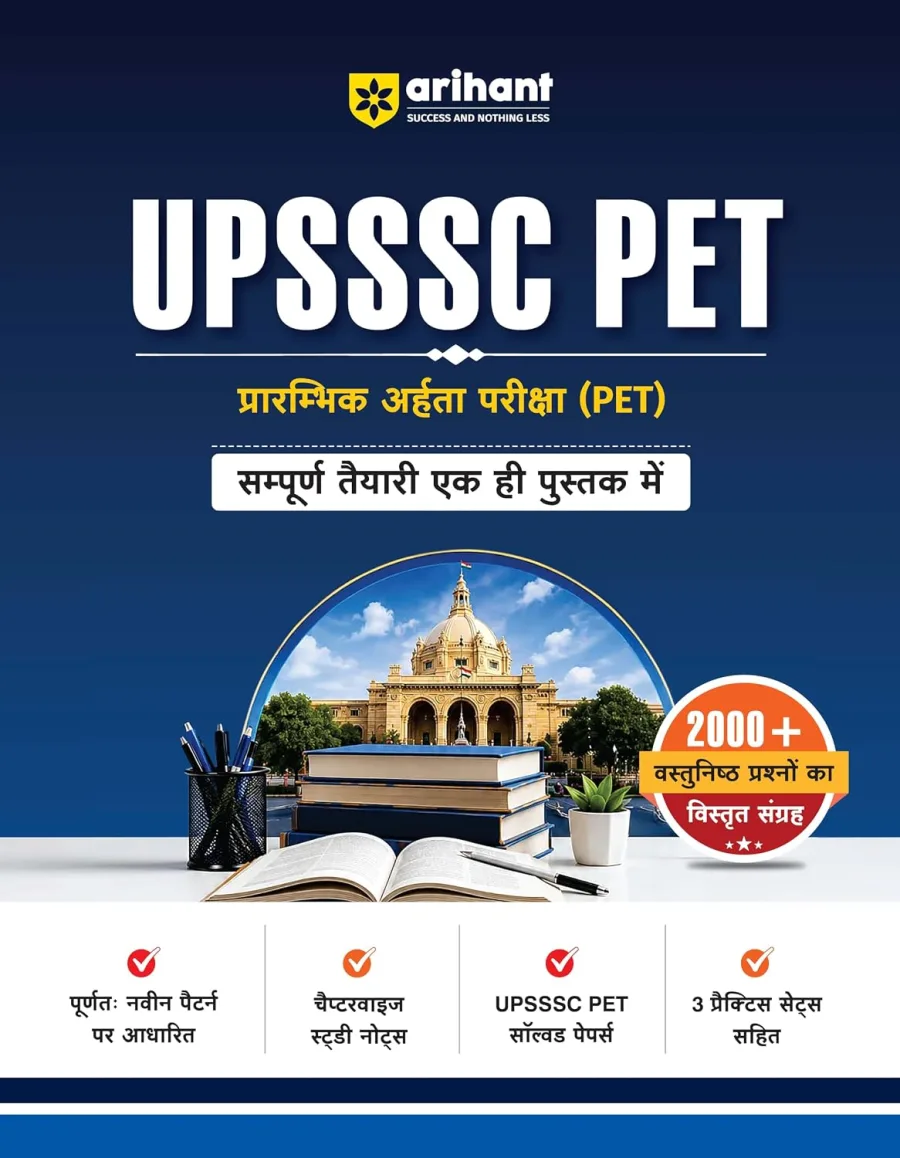
Download Cover Image
Do you want to download the full cover image for Arihant UPSSSC PET 2026 | Complete Preparation Guide with Chapterwise Study Notes, 2000+ Practice?