
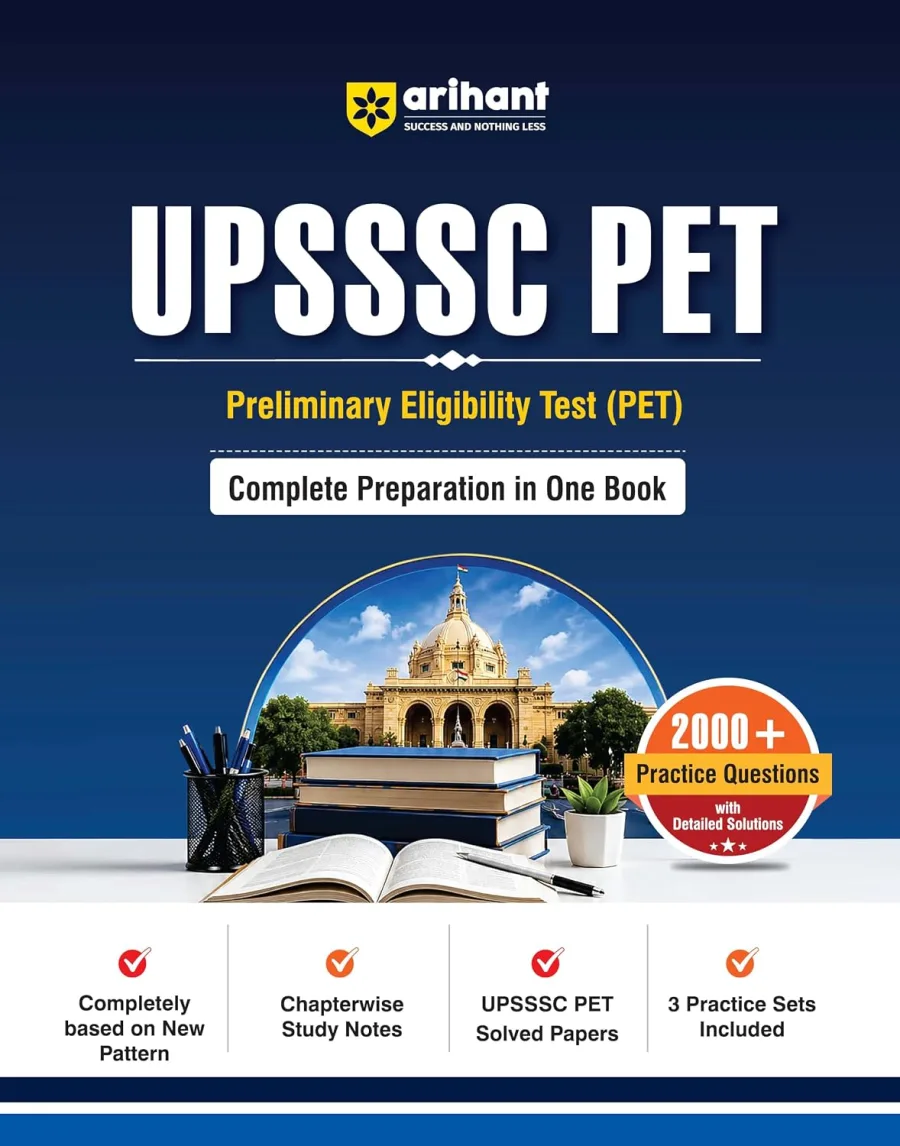
Arihant UPSSSC PET 2026 | Complete Preparation Guide with Chapterwise Study Notes, 2000+ Practice
Paperback
• 515 Pages
• ₹ 474.96
• English
• 9788169826327
No ratings yet
| Publisher | Arihant Publications India Limited |
|---|---|
| ISBN13 | 9788169826327 |
| ASIN/SKU | 8169826322 |
| Book Format | Paperback |
| Language | English |
| Pages | 515 |
| List Price | ₹ 474.96 |
| Publishing Date | 24/06/2026 |
| Dimensions | 27 x 21 x 2 cm |
| Weight | 824 g |
| Book Code | BD00070425 |
Buy this Book
Amazon Stores
Ebook Stores
Other Stores
Discover Arihant UPSSSC PET 2026 | Complete Preparation Guide with Chapterwise Study Notes, 2000+ Practice by Pradeep Srivastava. This book is published by Arihant Publications India Limited in Paperback format, ISBN 9788169826327, ASIN 8169826322, under Exam Preparation, Government Exams.
Book Description
Book Description will be added soon…
Author Biography
Author Biography will be added soon…
Editorial Reviews
Editorial Reviews will be added soon…
Book Summary
Arihant UPSSSC PET 2026: Complete Preparation Guide with Chapterwise Study Notes, 2000+ Practice by Pradeep Srivastava and Deepali is a comprehensive preparation book designed for candidates appearing for the Uttar Pradesh Subordinate Services Selection Commission Preliminary Eligibility Test, commonly known as UPSSSC PET. The book is created to provide students with a structured and practical approach to the examination by bringing together chapterwise study notes, important concepts, objective questions, previous-year solved papers, current affairs, and practice sets in one place. It is especially useful for candidates who want to prepare systematically and need a single resource that covers the broad PET syllabus while also providing extensive question practice. The book's main purpose is not simply to provide information but to help candidates develop the accuracy, speed, confidence, and examination awareness required to perform well in a competitive test.
UPSSSC PET is an important preliminary examination for candidates seeking various Group C government recruitment opportunities in Uttar Pradesh. Because the examination covers many different subjects, preparation can become difficult without a clear study plan. The book attempts to solve this problem through a chapterwise structure. Instead of asking candidates to study a large collection of unrelated facts, it divides the syllabus into manageable sections. Candidates can study one topic at a time, revise the important points, solve questions related to that topic, and gradually move toward full-length examination practice. This makes the book suitable both for candidates beginning their preparation and for those who already have basic knowledge but need organised revision.
A major strength of the book is its focus on study notes followed by objective practice. In competitive examinations, simply reading theory is rarely enough. Candidates need to recall information quickly and apply it to questions written in different ways. The book therefore combines explanations with more than 2,000 practice questions. These questions give candidates an opportunity to check their understanding immediately after studying a chapter. When a candidate gets an answer wrong, the mistake can be used to identify a weak area and guide further revision. In this way, the book encourages active learning rather than passive reading.
The History section helps candidates revise important developments in Indian history. It introduces major events, personalities, dynasties, movements, and changes that are relevant from a competitive-examination perspective. The historical material is presented with the objective of helping candidates remember important information and understand the sequence and significance of major events. The Indian National Movement receives particular importance because India's freedom struggle is a recurring area in government examinations. Candidates can revise important movements, leaders, organisations, events, and milestones and then reinforce their knowledge through multiple-choice questions.
The Geography section covers important geographical concepts and facts connected with India and the world. Candidates are expected to understand physical features, rivers, climate, natural resources, agriculture, population, and other important geographical characteristics. Geography questions can require both factual recall and basic conceptual understanding. The book's chapterwise format makes this large subject easier to manage by dividing it into smaller areas. Repeated practice can help candidates remember important facts while also learning to distinguish between similar geographical terms and features.
Indian Economy is another major area of preparation. The book introduces fundamental economic concepts and important features of the Indian economy. Candidates revise topics connected with agriculture, industries, employment, development, banking, national income, government programmes, and other economic issues relevant to general competitive examinations. The section is designed to make economic concepts accessible to students who may not have studied economics in depth. At the same time, candidates preparing for the examination can use the material as a foundation for connecting static economic knowledge with current affairs.
The Constitution and Public Administration section focuses on the political and administrative structure of India. Candidates revise important constitutional provisions, fundamental rights and duties, Parliament, the executive, judiciary, elections, constitutional bodies, governance, and other aspects of public administration. This is particularly useful for government-job aspirants because questions from these areas test knowledge of how the country's political system functions. The chapterwise notes help candidates revise important provisions systematically, while practice questions help them distinguish between similar constitutional concepts.
General Science introduces the basic scientific knowledge expected from a general competitive-examination candidate. The material broadly covers Physics, Chemistry, Biology, and everyday science. The emphasis is on understanding fundamental concepts and remembering important facts rather than studying science at a highly specialised level. This makes the section useful for candidates from both science and non-science backgrounds. Regular objective practice is particularly helpful because science questions may be presented through definitions, applications, examples, or statements.
Elementary Arithmetic focuses on the mathematical skills required to solve numerical questions accurately and quickly. Candidates practise fundamental calculations and common arithmetic concepts used in competitive examinations. The importance of this section goes beyond knowing formulas. Since the examination is time-bound, students must learn to perform calculations efficiently and avoid careless errors. Repeated practice helps improve familiarity with different question patterns and gradually increases solving speed.
The General Hindi and General English sections strengthen the language-related portion of preparation. Hindi questions test knowledge of commonly used language concepts, grammar, vocabulary, and comprehension-related skills, while English provides practice with essential language concepts. Candidates can use these sections for regular revision because language accuracy often improves through repeated exposure and practice. These chapters are also useful for identifying specific weaknesses, such as vocabulary, grammar rules, or comprehension.
The Logic and Reasoning section develops analytical thinking. Reasoning questions require candidates to recognise patterns, relationships, sequences, classifications, and logical connections. Such questions can become time-consuming when a candidate has not practised them sufficiently. The book's extensive question bank allows students to encounter different types of reasoning problems repeatedly. Over time, this helps candidates recognise familiar structures more quickly and choose appropriate solving methods instead of relying on guesswork.
Current Affairs and General Awareness are particularly important because the competitive-examination environment changes continuously. Candidates need knowledge of important recent events as well as broader general awareness. The book provides current-affairs-oriented material and one-liner information that can be used for quick revision. These short facts can be particularly useful near the examination because they allow candidates to revise a large amount of information within a limited amount of time. However, candidates should continue following the latest current affairs separately because events occurring after publication will not be covered by a static book.
Another valuable component is the inclusion of Hindi unseen passages, graph interpretation, and table interpretation. These areas test a candidate's ability to read information carefully, understand relationships, and draw conclusions from written or numerical data. Unseen passages require concentration and accurate comprehension, while graphs and tables require the candidate to interpret information rather than merely remember facts. Regular practice can make these questions faster and reduce the chance of making mistakes caused by misreading data.
The 2,000+ practice questions form the practical core of the book. Large-scale practice allows candidates to move from learning to application. It also exposes them to questions that may look different even when they test the same underlying concept. This is important because competitive examinations often change the wording or presentation of questions. Candidates who understand the concept behind a question are more likely to solve it correctly even when the question is unfamiliar. Detailed solutions can further help students understand the reasoning behind the correct answer and learn from their mistakes.
Previous-year solved papers are another important feature because they provide a realistic picture of the examination. Candidates can use previous papers to understand the type of questions asked, the distribution of subjects, the level of difficulty, and the way concepts are tested. Solving these papers after completing the chapterwise material can reveal whether the candidate's preparation is translating into actual examination performance. It also helps students become familiar with the pressure of answering questions within a fixed time.
The practice sets provide another stage of preparation. After studying the individual subjects and solving chapterwise questions, candidates can attempt the practice sets as complete examinations. This allows them to test their overall readiness rather than their knowledge of one isolated chapter. Full-paper practice is important because candidates have to manage different subjects together. They need to decide how much time to spend on each section, which questions to attempt first, and which difficult questions should be left for later.
Time management is especially important in UPSSSC PET because candidates have to answer a substantial number of objective questions within a limited examination period. Accuracy is also essential because incorrect answers can affect the final score through negative marking. Consequently, effective preparation should combine knowledge with careful question selection and speed. The book's combination of chapterwise questions, previous papers, and practice sets supports this gradual transition from learning to timed examination performance.
The book is particularly suitable for candidates who prefer studying in Hindi and want an integrated preparation resource. Instead of purchasing separate material for history, geography, science, reasoning, mathematics, language, current affairs, and other areas, candidates can use this guide as a central source and supplement it with current updates and additional practice wherever necessary. Its broad coverage makes it useful for candidates at different stages of preparation, although students should adapt their use of the book according to their individual strengths and weaknesses.
A productive way to use the book is to begin with the chapterwise notes, underline or mark important information, and then immediately solve the related objective questions. Candidates should maintain a record of questions they answer incorrectly and revisit those topics regularly. After completing the individual subjects, they can move to previous-year papers and practice sets. The final stage should focus on rapid revision, current affairs, error correction, and timed practice. This approach ensures that the book is used as a complete preparation system rather than merely read from beginning to end.
Overall, Arihant UPSSSC PET 2026: Complete Preparation Guide with Chapterwise Study Notes, 2000+ Practice by Pradeep Srivastava and Deepali is designed to make UPSSSC PET preparation organised, practical, and examination-focused. Its combination of chapterwise study material, more than 2,000 practice questions, current affairs, previous-year solved papers, and practice sets gives candidates the major components required for systematic preparation. The book is especially valuable for students who want to strengthen their basic knowledge while simultaneously improving objective-question solving ability.
In simple terms, the book takes candidates through the complete preparation journey: understand the syllabus, study each topic, practise questions, analyse mistakes, solve previous papers, and finally attempt full practice sets. Its broad subject coverage makes it a useful all-in-one guide, while its extensive question practice helps transform theoretical knowledge into examination performance. For candidates preparing for UPSSSC PET 2026, the book can serve as a strong foundation, particularly when combined with the latest official examination information, regular current-affairs revision, NCERT or standard reference material where necessary, and consistent timed practice.
UPSSSC PET is an important preliminary examination for candidates seeking various Group C government recruitment opportunities in Uttar Pradesh. Because the examination covers many different subjects, preparation can become difficult without a clear study plan. The book attempts to solve this problem through a chapterwise structure. Instead of asking candidates to study a large collection of unrelated facts, it divides the syllabus into manageable sections. Candidates can study one topic at a time, revise the important points, solve questions related to that topic, and gradually move toward full-length examination practice. This makes the book suitable both for candidates beginning their preparation and for those who already have basic knowledge but need organised revision.
A major strength of the book is its focus on study notes followed by objective practice. In competitive examinations, simply reading theory is rarely enough. Candidates need to recall information quickly and apply it to questions written in different ways. The book therefore combines explanations with more than 2,000 practice questions. These questions give candidates an opportunity to check their understanding immediately after studying a chapter. When a candidate gets an answer wrong, the mistake can be used to identify a weak area and guide further revision. In this way, the book encourages active learning rather than passive reading.
The History section helps candidates revise important developments in Indian history. It introduces major events, personalities, dynasties, movements, and changes that are relevant from a competitive-examination perspective. The historical material is presented with the objective of helping candidates remember important information and understand the sequence and significance of major events. The Indian National Movement receives particular importance because India's freedom struggle is a recurring area in government examinations. Candidates can revise important movements, leaders, organisations, events, and milestones and then reinforce their knowledge through multiple-choice questions.
The Geography section covers important geographical concepts and facts connected with India and the world. Candidates are expected to understand physical features, rivers, climate, natural resources, agriculture, population, and other important geographical characteristics. Geography questions can require both factual recall and basic conceptual understanding. The book's chapterwise format makes this large subject easier to manage by dividing it into smaller areas. Repeated practice can help candidates remember important facts while also learning to distinguish between similar geographical terms and features.
Indian Economy is another major area of preparation. The book introduces fundamental economic concepts and important features of the Indian economy. Candidates revise topics connected with agriculture, industries, employment, development, banking, national income, government programmes, and other economic issues relevant to general competitive examinations. The section is designed to make economic concepts accessible to students who may not have studied economics in depth. At the same time, candidates preparing for the examination can use the material as a foundation for connecting static economic knowledge with current affairs.
The Constitution and Public Administration section focuses on the political and administrative structure of India. Candidates revise important constitutional provisions, fundamental rights and duties, Parliament, the executive, judiciary, elections, constitutional bodies, governance, and other aspects of public administration. This is particularly useful for government-job aspirants because questions from these areas test knowledge of how the country's political system functions. The chapterwise notes help candidates revise important provisions systematically, while practice questions help them distinguish between similar constitutional concepts.
General Science introduces the basic scientific knowledge expected from a general competitive-examination candidate. The material broadly covers Physics, Chemistry, Biology, and everyday science. The emphasis is on understanding fundamental concepts and remembering important facts rather than studying science at a highly specialised level. This makes the section useful for candidates from both science and non-science backgrounds. Regular objective practice is particularly helpful because science questions may be presented through definitions, applications, examples, or statements.
Elementary Arithmetic focuses on the mathematical skills required to solve numerical questions accurately and quickly. Candidates practise fundamental calculations and common arithmetic concepts used in competitive examinations. The importance of this section goes beyond knowing formulas. Since the examination is time-bound, students must learn to perform calculations efficiently and avoid careless errors. Repeated practice helps improve familiarity with different question patterns and gradually increases solving speed.
The General Hindi and General English sections strengthen the language-related portion of preparation. Hindi questions test knowledge of commonly used language concepts, grammar, vocabulary, and comprehension-related skills, while English provides practice with essential language concepts. Candidates can use these sections for regular revision because language accuracy often improves through repeated exposure and practice. These chapters are also useful for identifying specific weaknesses, such as vocabulary, grammar rules, or comprehension.
The Logic and Reasoning section develops analytical thinking. Reasoning questions require candidates to recognise patterns, relationships, sequences, classifications, and logical connections. Such questions can become time-consuming when a candidate has not practised them sufficiently. The book's extensive question bank allows students to encounter different types of reasoning problems repeatedly. Over time, this helps candidates recognise familiar structures more quickly and choose appropriate solving methods instead of relying on guesswork.
Current Affairs and General Awareness are particularly important because the competitive-examination environment changes continuously. Candidates need knowledge of important recent events as well as broader general awareness. The book provides current-affairs-oriented material and one-liner information that can be used for quick revision. These short facts can be particularly useful near the examination because they allow candidates to revise a large amount of information within a limited amount of time. However, candidates should continue following the latest current affairs separately because events occurring after publication will not be covered by a static book.
Another valuable component is the inclusion of Hindi unseen passages, graph interpretation, and table interpretation. These areas test a candidate's ability to read information carefully, understand relationships, and draw conclusions from written or numerical data. Unseen passages require concentration and accurate comprehension, while graphs and tables require the candidate to interpret information rather than merely remember facts. Regular practice can make these questions faster and reduce the chance of making mistakes caused by misreading data.
The 2,000+ practice questions form the practical core of the book. Large-scale practice allows candidates to move from learning to application. It also exposes them to questions that may look different even when they test the same underlying concept. This is important because competitive examinations often change the wording or presentation of questions. Candidates who understand the concept behind a question are more likely to solve it correctly even when the question is unfamiliar. Detailed solutions can further help students understand the reasoning behind the correct answer and learn from their mistakes.
Previous-year solved papers are another important feature because they provide a realistic picture of the examination. Candidates can use previous papers to understand the type of questions asked, the distribution of subjects, the level of difficulty, and the way concepts are tested. Solving these papers after completing the chapterwise material can reveal whether the candidate's preparation is translating into actual examination performance. It also helps students become familiar with the pressure of answering questions within a fixed time.
The practice sets provide another stage of preparation. After studying the individual subjects and solving chapterwise questions, candidates can attempt the practice sets as complete examinations. This allows them to test their overall readiness rather than their knowledge of one isolated chapter. Full-paper practice is important because candidates have to manage different subjects together. They need to decide how much time to spend on each section, which questions to attempt first, and which difficult questions should be left for later.
Time management is especially important in UPSSSC PET because candidates have to answer a substantial number of objective questions within a limited examination period. Accuracy is also essential because incorrect answers can affect the final score through negative marking. Consequently, effective preparation should combine knowledge with careful question selection and speed. The book's combination of chapterwise questions, previous papers, and practice sets supports this gradual transition from learning to timed examination performance.
The book is particularly suitable for candidates who prefer studying in Hindi and want an integrated preparation resource. Instead of purchasing separate material for history, geography, science, reasoning, mathematics, language, current affairs, and other areas, candidates can use this guide as a central source and supplement it with current updates and additional practice wherever necessary. Its broad coverage makes it useful for candidates at different stages of preparation, although students should adapt their use of the book according to their individual strengths and weaknesses.
A productive way to use the book is to begin with the chapterwise notes, underline or mark important information, and then immediately solve the related objective questions. Candidates should maintain a record of questions they answer incorrectly and revisit those topics regularly. After completing the individual subjects, they can move to previous-year papers and practice sets. The final stage should focus on rapid revision, current affairs, error correction, and timed practice. This approach ensures that the book is used as a complete preparation system rather than merely read from beginning to end.
Overall, Arihant UPSSSC PET 2026: Complete Preparation Guide with Chapterwise Study Notes, 2000+ Practice by Pradeep Srivastava and Deepali is designed to make UPSSSC PET preparation organised, practical, and examination-focused. Its combination of chapterwise study material, more than 2,000 practice questions, current affairs, previous-year solved papers, and practice sets gives candidates the major components required for systematic preparation. The book is especially valuable for students who want to strengthen their basic knowledge while simultaneously improving objective-question solving ability.
In simple terms, the book takes candidates through the complete preparation journey: understand the syllabus, study each topic, practise questions, analyse mistakes, solve previous papers, and finally attempt full practice sets. Its broad subject coverage makes it a useful all-in-one guide, while its extensive question practice helps transform theoretical knowledge into examination performance. For candidates preparing for UPSSSC PET 2026, the book can serve as a strong foundation, particularly when combined with the latest official examination information, regular current-affairs revision, NCERT or standard reference material where necessary, and consistent timed practice.
Sample Chapters
Sample Chapters will be added soon…
Reader Reviews
No reviews yet.
Arihant UPSSSC PET 2026 | Complete Preparation Guide with Chapterwise Study Notes, 2000+ Practice
Download Cover Image
Do you want to download the full cover image for Arihant UPSSSC PET 2026 | Complete Preparation Guide with Chapterwise Study Notes, 2000+ Practice?