
Good to Great to Gone: Why the Most Successful Investors Say No and You Should Too
Paperback
• 328 Pages
• ₹ 499.00
• English
• 9789357318785
No ratings yet
| Publisher | Hachette India |
|---|---|
| ISBN13 | 9789357318785 |
| ASIN/SKU | 935731878X |
| Book Format | Paperback |
| Language | English |
| Pages | 328 |
| List Price | ₹ 499.00 |
| Publishing Date | 17/10/2026 |
| Dimensions | 20 x 13 x 3 cm |
| Weight | 300 g |
| Book Code | BD00070424 |
Buy this Book
Amazon Stores
Ebook Stores
Other Stores
Discover Good to Great to Gone: Why the Most Successful Investors Say No and You Should Too by Ajay Sharma. This book is published by Hachette India in Paperback format, ISBN 9789357318785, ASIN 935731878X, under Business and Money, Investments and Securities, Analysis and Strategy.
Book Description
FOREWORDS BY AMISH TRIPATHI AND RASHESH SHAH
The Complete Guide to Getting Rich and Staying Rich
'This isn't investing dressed up as philosophy. It's a genuine playbook for judgment.’ – Manish Gupta, Chairman and CEO, Indegene
Most investment books teach you how to find winners. This one teaches you something rarer – how to say 'no' so your carefully chosen 'yes' can compound into real wealth.
Drawing on three decades of managing money across Asia, Ajay Sharma has built a framework that fuses the rigour of Western finance with the wisdom of Vedic philosophy. The result is a complete system that tells you how to spot businesses on their way from 'Good' to 'Great’, how to sense the peak before it turns, and how to protect your gains when it does.
The insight at the heart of it is deceptively simple. Markets move in cycles, that is, the climb from 'Good' to 'Great’, and the slide from 'Great' to 'Good’, or 'Gone’. Master that cycle and you can build extraordinary wealth. But it takes discipline to resist what derails most investors – the hot tip, the market darling priced for perfection, the story too good to question.
Good to Great to Gone hands you the tools to build wealth...and keep it.
The Complete Guide to Getting Rich and Staying Rich
'This isn't investing dressed up as philosophy. It's a genuine playbook for judgment.’ – Manish Gupta, Chairman and CEO, Indegene
Most investment books teach you how to find winners. This one teaches you something rarer – how to say 'no' so your carefully chosen 'yes' can compound into real wealth.
Drawing on three decades of managing money across Asia, Ajay Sharma has built a framework that fuses the rigour of Western finance with the wisdom of Vedic philosophy. The result is a complete system that tells you how to spot businesses on their way from 'Good' to 'Great’, how to sense the peak before it turns, and how to protect your gains when it does.
The insight at the heart of it is deceptively simple. Markets move in cycles, that is, the climb from 'Good' to 'Great’, and the slide from 'Great' to 'Good’, or 'Gone’. Master that cycle and you can build extraordinary wealth. But it takes discipline to resist what derails most investors – the hot tip, the market darling priced for perfection, the story too good to question.
Good to Great to Gone hands you the tools to build wealth...and keep it.
Author Biography
Ajay Sharma is a serial entrepreneur, investment philosopher, YouTube creator and fund manager with over 25 years of experience building wealth across Asian markets. Based in Singapore, he has managed institutional capital across India, China, Thailand and Southeast Asia. His investment philosophy was forged through direct experience of multiple market cycles: the dot-com crash of 2000, the global financial crisis of 2008, and the pandemic bubble of 2020–21.
Editorial Reviews
‘Ajay Sharma has done what few investors attempt: turning a career of watching cycles into a philosophy of restraint. Good to Great to Gone argues that the Vedic wheel – Srishti, Sthiti, Samhara; creation, preservation, destruction – turns for companies as surely as for civilizations, and the investor's gravest error is mistaking preservation for permanence. His answer is the hardest word in our business: "No,” said precisely when excitement is handing you every reason to say yes. Anyone can find conviction; Ajay teaches discernment. This book deserves a place beside your next term sheet – read it first.’ – Vineet Rai, Founder and Vice Chairman, Aavishkaar Group
'An engaging book that makes you think differently about investing and the discipline to say "No”. All of the operating frameworks are very interesting. The idea of Valuation Decay stood out to me, it names the fact that overvaluation corrects through time as much as through price. And the G2G quadrant emphasis that a great business at the wrong price is still a bad stock is a simple yet powerful evaluation framework.’ – Moon Kyung Kang, CEO, Mirae Asset Sharekhan
'Some of my most-watched interviews have been with Ajay, and a big reason is his brilliant G2G philosophy. He has a rare ability to simplify the most complex ideas without losing their depth. Over the years, he has consistently spotted big trends well before they became obvious – whether it was paints, Indian equities, IT services, or several other themes. That's what sets him apart. In this book, Ajay distils that very thought process into practical frameworks that anyone can understand and apply. The biggest strength of the book is that it isn't built on theory – it's shaped by decades of real-world investing experience. This isn't just a good book; it's one you'll keep coming back to. In many ways, it's a book for generations.’ – Anuj Singhal, Managing Editor, CNBC-Awaaz and CNBC-Bajar
'In Good to Great to Gone, Ajay does something rare – he takes the discipline of his G2G framework, built over twenty-five years of institutional investing, and grounds it in something sturdier than a spreadsheet: the sutras our grandparents lived by. I had a preview of this thinking in our own recorded conversation for The Road Less Travelled, where one line of his has stayed with me – "If you want to go from Good to Great, you need grit; if you want to stay Great, you need gratitude.” Having built Indegene over 26 years from a start up in Bangalore into a global-listed institution, I know the hardest calls are never the ones to buy or grow – they are the ones to say no and walk away before a good story curdles into a great mistake. This isn't investing dressed up as philosophy – it's a genuine playbook for judgment. I recommend it to every builder who wants to compound wealth and character together.’ – Manish Gupta, Chairman and CEO, Indegene
'This book is not just about investing in the stock market, it's about investing in yourself. The frameworks laid out by Ajay S. from MVM to G2G, provide a practical blueprint for success, not just in investing, but in almost every aspect of life. A must-read for anyone looking to build the right mindset, make better decisions, and create lasting success.’ – Vivek Bajaj, Co-founder, Kredent, StockEdge and Irage
'Courtesy of Charlie Munger, many investors talk generally about developing mental models in investing. Ajay Sharma's book, in contrast, talks specifics about how to model different areas of investment decision-making. Drawing on stories and examples from his life as a successful investment analyst and a hedge fund manager, Ajay explains how to frame decision models in areas like "sizing the investment opportunity”, "good company or good valuation”, "identifying good-to-great-to-gone investments“ and my favourite, "valuation decay”. Highly readable book.’ – Samir Arora, Founder, Helios Capital Management
'G2G is as distinctive as Ajay himself. A "4×4“ thrill-filled drive like an investment manual, sprinkled with easy-to-understand "2×2“ wiselets, lived experiences, relevantly connected to the timeless wisdom of ancient Hindu treatises. For those who know Ajay, reading this book feels like having a personal conversation with him – an intimate glimpse into his mind and life. Gaining a slice of Ajay's time through this book is a worthwhile lifetime investment.’ – Uday Baldota, former Global CFO, Sun Pharma, and former CEO and Board Member, Taro Pharma
'An engaging book that makes you think differently about investing and the discipline to say "No”. All of the operating frameworks are very interesting. The idea of Valuation Decay stood out to me, it names the fact that overvaluation corrects through time as much as through price. And the G2G quadrant emphasis that a great business at the wrong price is still a bad stock is a simple yet powerful evaluation framework.’ – Moon Kyung Kang, CEO, Mirae Asset Sharekhan
'Some of my most-watched interviews have been with Ajay, and a big reason is his brilliant G2G philosophy. He has a rare ability to simplify the most complex ideas without losing their depth. Over the years, he has consistently spotted big trends well before they became obvious – whether it was paints, Indian equities, IT services, or several other themes. That's what sets him apart. In this book, Ajay distils that very thought process into practical frameworks that anyone can understand and apply. The biggest strength of the book is that it isn't built on theory – it's shaped by decades of real-world investing experience. This isn't just a good book; it's one you'll keep coming back to. In many ways, it's a book for generations.’ – Anuj Singhal, Managing Editor, CNBC-Awaaz and CNBC-Bajar
'In Good to Great to Gone, Ajay does something rare – he takes the discipline of his G2G framework, built over twenty-five years of institutional investing, and grounds it in something sturdier than a spreadsheet: the sutras our grandparents lived by. I had a preview of this thinking in our own recorded conversation for The Road Less Travelled, where one line of his has stayed with me – "If you want to go from Good to Great, you need grit; if you want to stay Great, you need gratitude.” Having built Indegene over 26 years from a start up in Bangalore into a global-listed institution, I know the hardest calls are never the ones to buy or grow – they are the ones to say no and walk away before a good story curdles into a great mistake. This isn't investing dressed up as philosophy – it's a genuine playbook for judgment. I recommend it to every builder who wants to compound wealth and character together.’ – Manish Gupta, Chairman and CEO, Indegene
'This book is not just about investing in the stock market, it's about investing in yourself. The frameworks laid out by Ajay S. from MVM to G2G, provide a practical blueprint for success, not just in investing, but in almost every aspect of life. A must-read for anyone looking to build the right mindset, make better decisions, and create lasting success.’ – Vivek Bajaj, Co-founder, Kredent, StockEdge and Irage
'Courtesy of Charlie Munger, many investors talk generally about developing mental models in investing. Ajay Sharma's book, in contrast, talks specifics about how to model different areas of investment decision-making. Drawing on stories and examples from his life as a successful investment analyst and a hedge fund manager, Ajay explains how to frame decision models in areas like "sizing the investment opportunity”, "good company or good valuation”, "identifying good-to-great-to-gone investments“ and my favourite, "valuation decay”. Highly readable book.’ – Samir Arora, Founder, Helios Capital Management
'G2G is as distinctive as Ajay himself. A "4×4“ thrill-filled drive like an investment manual, sprinkled with easy-to-understand "2×2“ wiselets, lived experiences, relevantly connected to the timeless wisdom of ancient Hindu treatises. For those who know Ajay, reading this book feels like having a personal conversation with him – an intimate glimpse into his mind and life. Gaining a slice of Ajay's time through this book is a worthwhile lifetime investment.’ – Uday Baldota, former Global CFO, Sun Pharma, and former CEO and Board Member, Taro Pharma
Book Summary
Good to Great to Gone: Why the Most Successful Investors Say No and You Should Too by Ajay Sharma presents investing as a discipline of selection, patience, and rejection rather than a constant search for action. The central message is that investors often believe success comes from discovering the next great stock, buying at the right moment, and staying invested for as long as possible. While these ideas have merit, the book places greater emphasis on another skill that is frequently overlooked: the ability to reject investments that do not meet a clearly defined standard. Saying no may appear passive, but in investing it can be one of the most active and valuable decisions an investor makes because every investment carries an opportunity cost, a risk of permanent loss, and the possibility of distracting attention from better opportunities.
The book begins with an important observation about human behaviour. Investors are naturally attracted to exciting opportunities. A rapidly growing company, a popular stock, a new industry, or a convincing investment story can create a strong emotional desire to participate. When everyone around us appears to be making money from a particular investment, refusing to participate can feel like missing out. This fear of missing out can encourage investors to lower their standards. Instead of asking whether an investment is genuinely attractive, they begin asking whether they can afford not to buy it. The book's philosophy challenges this behaviour by encouraging investors to establish clear standards before making decisions and to reject opportunities that fail those standards.
The idea of saying no is closely connected with the concept of opportunity cost. Money invested in one company cannot simultaneously be invested elsewhere. Therefore, every investment decision is also a decision against all the alternatives that were available at that moment. A stock does not have to be bad to be a bad investment choice. It may simply be less attractive than another opportunity with better growth prospects, stronger financials, a safer balance sheet, or a more reasonable valuation. This way of thinking changes the question from “Is this a good company?” to “Is this the best use of my capital given the alternatives?” That distinction can significantly improve investment discipline.
Another important theme is the difference between a great business and a great investment. A company can have an excellent product, strong management, a powerful brand, or impressive growth and still be a poor investment if its stock price already reflects unrealistic expectations. Investors often become attached to companies because they admire the underlying business. However, the quality of a company and the attractiveness of its shares are not exactly the same thing. The price paid matters. The book encourages readers to separate their admiration for a business from their analysis of the investment opportunity.
This leads naturally to the importance of valuation. Successful investing requires an understanding that future returns depend not only on what a company becomes but also on what investors pay for that future. When expectations become extremely high, even a company that continues to perform well may deliver disappointing returns if its growth does not exceed those expectations. Conversely, a less fashionable company may become attractive if its price is sufficiently low relative to its underlying value and future potential. The discipline of saying no therefore protects investors from paying any price simply because they like a company's story.
The title's movement from “Good to Great to Gone” also reflects the danger of assuming that past success will continue indefinitely. Companies evolve, industries change, competitive advantages weaken, management teams change, and consumer behaviour shifts. A business that once seemed almost unbeatable can eventually lose its position. Investors who fall in love with a stock may interpret every negative development as temporary because they are emotionally committed to their original thesis. The book encourages a more detached approach in which investors regularly reconsider whether the reasons for owning an investment remain valid.
This is particularly important because investing decisions should not be based entirely on the original purchase thesis. The circumstances surrounding an investment can change after it has been purchased. New competitors may appear, margins may decline, debt may increase, regulations may change, or management may make poor strategic decisions. In such situations, refusing to acknowledge that the original thesis has weakened can turn a manageable mistake into a major loss. Saying no is therefore not limited to the moment of purchase. Investors also need the ability to say no to their own earlier beliefs.
The book also highlights the psychological difficulty of admitting that an investment decision was wrong. People naturally want to remain consistent with previous decisions. Selling a losing stock can feel like admitting failure, while continuing to hold it allows the investor to postpone that uncomfortable conclusion. But the market does not reward emotional consistency. A loss that has already occurred should not determine whether an investor keeps holding an asset. The relevant question is what the investment is worth from the present moment forward. If the future opportunity is unattractive, selling can be rational regardless of the purchase price.
Patience is another major element of the book's philosophy. Saying no does not mean constantly searching for reasons to avoid investing. It means being selective enough to wait for situations that genuinely deserve capital. Financial markets offer thousands of securities and countless possible transactions, but investors do not need to participate in all of them. There is value in having a high threshold for action. Waiting can protect capital while allowing investors to study businesses more carefully and act when the balance between risk and reward becomes compelling.
The emphasis on selectivity also challenges the idea that successful investors must always be busy. Constant buying and selling can create the illusion of productivity. Investors may read news throughout the day, monitor price movements, change positions frequently, and constantly search for the next opportunity. Yet activity does not necessarily produce better returns. Excessive trading can increase costs, taxes, mistakes, and emotional stress. A disciplined investor may sometimes appear inactive because the most rational decision is simply to wait.
The book's approach also encourages investors to develop an investment checklist or set of rejection criteria. Such criteria might include financial strength, earnings quality, management credibility, competitive advantage, valuation, debt levels, cash generation, industry conditions, and the clarity of the investment thesis. The exact criteria can vary from one investor to another, but the principle is consistent: define the standards before emotions take over. A structured process makes it easier to reject attractive stories that do not satisfy fundamental requirements.
Management quality is another consideration in evaluating an investment. A strong business can still be damaged by poor capital allocation, excessive executive compensation, weak governance, aggressive accounting, or questionable strategic decisions. Investors therefore need to examine not just what a company sells but how its leaders behave with shareholders' capital. Management should ideally demonstrate discipline, transparency, and a willingness to make decisions that create long-term value rather than simply pursuing short-term growth.
Risk is treated as something broader than daily price volatility. Investors often define risk as the possibility that a stock price will fall. A more useful perspective is the possibility of permanent loss of capital. A temporary decline may eventually recover if the underlying business remains healthy, while a permanent deterioration in the business can destroy the investment thesis even if the stock initially appeared attractive. The book's emphasis on saying no is therefore closely connected to risk management: avoiding fundamentally weak situations can be more important than trying to predict every short-term market movement.
Another lesson is the importance of independent thinking. Markets are influenced by narratives, media coverage, analysts, social networks, and popular opinion. When an investment becomes widely celebrated, questioning it can feel uncomfortable. Yet consensus can sometimes create excessive expectations. The ability to say no requires the confidence to remain outside a popular trade when the evidence does not support participation. Conversely, it also requires the courage to say yes when the market is overly pessimistic and the underlying fundamentals justify a different conclusion.
The book's philosophy is therefore not simply about being negative or avoiding risk. Saying no should be a method of improving the quality of the opportunities that receive attention. Investors can think of their capital as scarce and their attention as even scarcer. Every hour spent analysing a weak opportunity is an hour that cannot be spent understanding a stronger one. Every rupee committed to an average investment reduces the capital available for an exceptional opportunity. Selectivity consequently becomes a competitive advantage.
The idea of moving from “good” to “great” is also useful when thinking about portfolio construction. Owning many investments can provide diversification, but diversification should not become an excuse for owning businesses that an investor does not understand or does not genuinely believe in. The right balance depends on the investor's objectives, knowledge, risk tolerance, and circumstances. The book's broader message is that each holding should have a reason for existing. If the reason is unclear, the investment deserves another look.
Ultimately, Good to Great to Gone encourages a mindset in which rejection is treated as a positive investment skill. The strongest investors are not necessarily those who have an opinion on every company or who participate in every market trend. They are often the ones who know their limits, recognise poor risk-reward situations, question attractive narratives, and wait patiently for opportunities that meet demanding standards. Saying no protects both capital and attention.
In simple terms, the book teaches that successful investing is not about saying yes as often as possible. It is about making each yes meaningful. A disciplined investor should be willing to reject a popular stock, ignore an exciting story, wait for a better valuation, sell when the investment thesis breaks, and admit when an earlier decision was wrong. The journey from good to great can create wealth, but failing to recognise when circumstances have changed can turn great into gone. Ajay Sharma's central lesson is therefore one of discipline: protect your capital, control your emotions, question your assumptions, and never be afraid to say no when the investment does not deserve a yes.
The book begins with an important observation about human behaviour. Investors are naturally attracted to exciting opportunities. A rapidly growing company, a popular stock, a new industry, or a convincing investment story can create a strong emotional desire to participate. When everyone around us appears to be making money from a particular investment, refusing to participate can feel like missing out. This fear of missing out can encourage investors to lower their standards. Instead of asking whether an investment is genuinely attractive, they begin asking whether they can afford not to buy it. The book's philosophy challenges this behaviour by encouraging investors to establish clear standards before making decisions and to reject opportunities that fail those standards.
The idea of saying no is closely connected with the concept of opportunity cost. Money invested in one company cannot simultaneously be invested elsewhere. Therefore, every investment decision is also a decision against all the alternatives that were available at that moment. A stock does not have to be bad to be a bad investment choice. It may simply be less attractive than another opportunity with better growth prospects, stronger financials, a safer balance sheet, or a more reasonable valuation. This way of thinking changes the question from “Is this a good company?” to “Is this the best use of my capital given the alternatives?” That distinction can significantly improve investment discipline.
Another important theme is the difference between a great business and a great investment. A company can have an excellent product, strong management, a powerful brand, or impressive growth and still be a poor investment if its stock price already reflects unrealistic expectations. Investors often become attached to companies because they admire the underlying business. However, the quality of a company and the attractiveness of its shares are not exactly the same thing. The price paid matters. The book encourages readers to separate their admiration for a business from their analysis of the investment opportunity.
This leads naturally to the importance of valuation. Successful investing requires an understanding that future returns depend not only on what a company becomes but also on what investors pay for that future. When expectations become extremely high, even a company that continues to perform well may deliver disappointing returns if its growth does not exceed those expectations. Conversely, a less fashionable company may become attractive if its price is sufficiently low relative to its underlying value and future potential. The discipline of saying no therefore protects investors from paying any price simply because they like a company's story.
The title's movement from “Good to Great to Gone” also reflects the danger of assuming that past success will continue indefinitely. Companies evolve, industries change, competitive advantages weaken, management teams change, and consumer behaviour shifts. A business that once seemed almost unbeatable can eventually lose its position. Investors who fall in love with a stock may interpret every negative development as temporary because they are emotionally committed to their original thesis. The book encourages a more detached approach in which investors regularly reconsider whether the reasons for owning an investment remain valid.
This is particularly important because investing decisions should not be based entirely on the original purchase thesis. The circumstances surrounding an investment can change after it has been purchased. New competitors may appear, margins may decline, debt may increase, regulations may change, or management may make poor strategic decisions. In such situations, refusing to acknowledge that the original thesis has weakened can turn a manageable mistake into a major loss. Saying no is therefore not limited to the moment of purchase. Investors also need the ability to say no to their own earlier beliefs.
The book also highlights the psychological difficulty of admitting that an investment decision was wrong. People naturally want to remain consistent with previous decisions. Selling a losing stock can feel like admitting failure, while continuing to hold it allows the investor to postpone that uncomfortable conclusion. But the market does not reward emotional consistency. A loss that has already occurred should not determine whether an investor keeps holding an asset. The relevant question is what the investment is worth from the present moment forward. If the future opportunity is unattractive, selling can be rational regardless of the purchase price.
Patience is another major element of the book's philosophy. Saying no does not mean constantly searching for reasons to avoid investing. It means being selective enough to wait for situations that genuinely deserve capital. Financial markets offer thousands of securities and countless possible transactions, but investors do not need to participate in all of them. There is value in having a high threshold for action. Waiting can protect capital while allowing investors to study businesses more carefully and act when the balance between risk and reward becomes compelling.
The emphasis on selectivity also challenges the idea that successful investors must always be busy. Constant buying and selling can create the illusion of productivity. Investors may read news throughout the day, monitor price movements, change positions frequently, and constantly search for the next opportunity. Yet activity does not necessarily produce better returns. Excessive trading can increase costs, taxes, mistakes, and emotional stress. A disciplined investor may sometimes appear inactive because the most rational decision is simply to wait.
The book's approach also encourages investors to develop an investment checklist or set of rejection criteria. Such criteria might include financial strength, earnings quality, management credibility, competitive advantage, valuation, debt levels, cash generation, industry conditions, and the clarity of the investment thesis. The exact criteria can vary from one investor to another, but the principle is consistent: define the standards before emotions take over. A structured process makes it easier to reject attractive stories that do not satisfy fundamental requirements.
Management quality is another consideration in evaluating an investment. A strong business can still be damaged by poor capital allocation, excessive executive compensation, weak governance, aggressive accounting, or questionable strategic decisions. Investors therefore need to examine not just what a company sells but how its leaders behave with shareholders' capital. Management should ideally demonstrate discipline, transparency, and a willingness to make decisions that create long-term value rather than simply pursuing short-term growth.
Risk is treated as something broader than daily price volatility. Investors often define risk as the possibility that a stock price will fall. A more useful perspective is the possibility of permanent loss of capital. A temporary decline may eventually recover if the underlying business remains healthy, while a permanent deterioration in the business can destroy the investment thesis even if the stock initially appeared attractive. The book's emphasis on saying no is therefore closely connected to risk management: avoiding fundamentally weak situations can be more important than trying to predict every short-term market movement.
Another lesson is the importance of independent thinking. Markets are influenced by narratives, media coverage, analysts, social networks, and popular opinion. When an investment becomes widely celebrated, questioning it can feel uncomfortable. Yet consensus can sometimes create excessive expectations. The ability to say no requires the confidence to remain outside a popular trade when the evidence does not support participation. Conversely, it also requires the courage to say yes when the market is overly pessimistic and the underlying fundamentals justify a different conclusion.
The book's philosophy is therefore not simply about being negative or avoiding risk. Saying no should be a method of improving the quality of the opportunities that receive attention. Investors can think of their capital as scarce and their attention as even scarcer. Every hour spent analysing a weak opportunity is an hour that cannot be spent understanding a stronger one. Every rupee committed to an average investment reduces the capital available for an exceptional opportunity. Selectivity consequently becomes a competitive advantage.
The idea of moving from “good” to “great” is also useful when thinking about portfolio construction. Owning many investments can provide diversification, but diversification should not become an excuse for owning businesses that an investor does not understand or does not genuinely believe in. The right balance depends on the investor's objectives, knowledge, risk tolerance, and circumstances. The book's broader message is that each holding should have a reason for existing. If the reason is unclear, the investment deserves another look.
Ultimately, Good to Great to Gone encourages a mindset in which rejection is treated as a positive investment skill. The strongest investors are not necessarily those who have an opinion on every company or who participate in every market trend. They are often the ones who know their limits, recognise poor risk-reward situations, question attractive narratives, and wait patiently for opportunities that meet demanding standards. Saying no protects both capital and attention.
In simple terms, the book teaches that successful investing is not about saying yes as often as possible. It is about making each yes meaningful. A disciplined investor should be willing to reject a popular stock, ignore an exciting story, wait for a better valuation, sell when the investment thesis breaks, and admit when an earlier decision was wrong. The journey from good to great can create wealth, but failing to recognise when circumstances have changed can turn great into gone. Ajay Sharma's central lesson is therefore one of discipline: protect your capital, control your emotions, question your assumptions, and never be afraid to say no when the investment does not deserve a yes.
Sample Chapters
Sample Chapters will be added soon…
Reader Reviews
No reviews yet.
Good to Great to Gone: Why the Most Successful Investors Say No and You Should Too
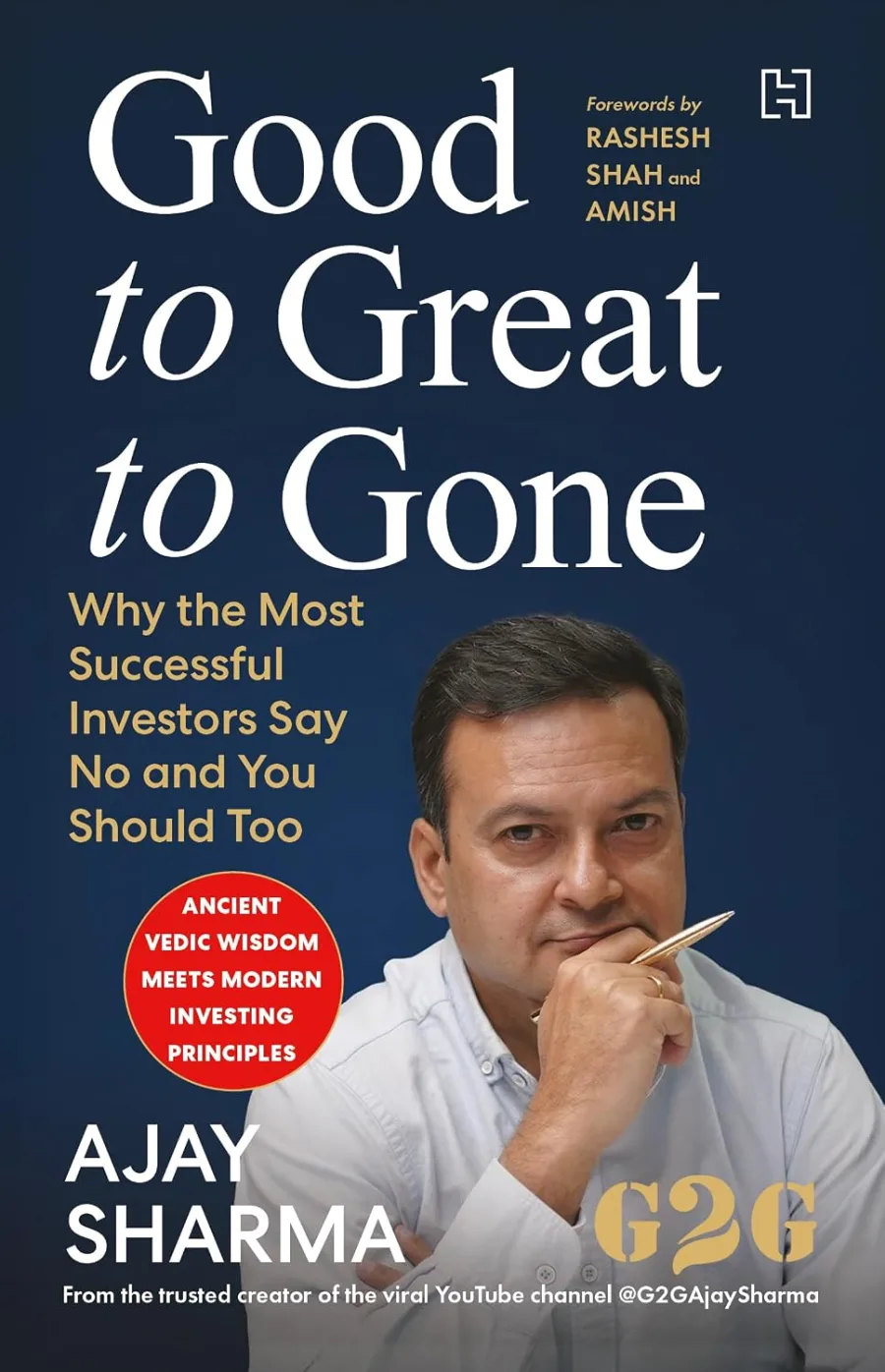
Download Cover Image
Do you want to download the full cover image for Good to Great to Gone: Why the Most Successful Investors Say No and You Should Too?