
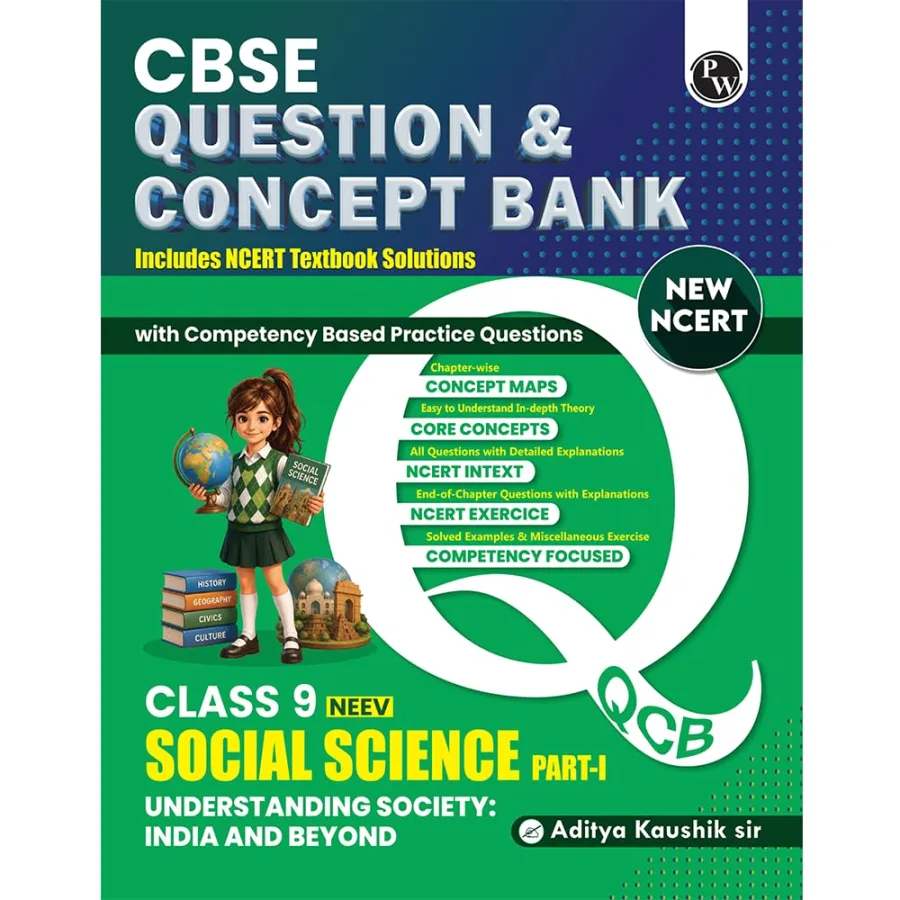
PW CBSE New NCERT Class 9 Social Science 2026-27 Understanding Society: India and Beyond Question
Aditya Kaushik Sir, Physics Wallah
Paperback
• 216 Pages
• ₹ 349.00
• English
• 9789378180965
No ratings yet
| Publisher | Physics Wallah Limited |
|---|---|
| ISBN13 | 9789378180965 |
| ASIN/SKU | 9378180965 |
| Book Format | Paperback |
| Language | English |
| Pages | 216 |
| List Price | ₹ 349.00 |
| Publishing Date | 06/08/2026 |
| Dimensions | 28 x 22 x 1 cm |
| Weight | 404 g |
| Book Code | BD00070423 |
Buy this Book
Amazon Stores
Ebook Stores
Other Stores
Discover PW CBSE New NCERT Class 9 Social Science 2026-27 Understanding Society: India and Beyond Question by Aditya Kaushik Sir. This book is published by Physics Wallah Limited in Paperback format, ISBN 9789378180965, ASIN 9378180965, under School Books, CBSE.
Book Description
PW CBSE New NCERT Class 9 Social Science Understanding Society: India and Beyond Question & Concept Bank by Aditya Kaushik Sir for 2026–27 is a comprehensive learning companion designed to make Social Science simple, engaging, and easy to understand. Based on the latest CBSE and New NCERT curriculum, this book helps students develop conceptual clarity, analytical thinking, and exam readiness through in-depth theory, concept maps, solved NCERT questions, competency-based practice, and structured revision. Whether you're learning new concepts, preparing for school exams, or strengthening your foundation, this book supports confident and effective learning.
Why Choose PhysicsWallah Question & Concept Banks?
PhysicsWallah Question & Concept Banks are thoughtfully designed by experienced educators to simplify learning through concept-focused explanations, structured practice, competency-based questions, and exam-oriented preparation. These books help students strengthen fundamentals, improve problem-solving skills, and perform confidently in school examinations.
What Makes This Book Essential?
🔹 Chapter-wise Concept Maps
Understand and connect important Social Science concepts through visual concept maps for quicker learning, stronger retention, and effective revision.
🔹 Strong Conceptual Understanding
Learn every chapter through easy-to-understand, detailed theory that builds a strong conceptual foundation.
🔹 Master Every Question Type
Practice a wide variety of exam-oriented questions with detailed explanations to improve understanding and answer-writing skills.
🔹 Complete NCERT Preparation
Strengthen your learning through fully solved NCERT exercises and end-of-chapter questions based on the latest textbook.
🔹 Competency-Based Learning
Develop analytical thinking and application skills with competency-focused miscellaneous exercises aligned with the latest CBSE pattern.
🔹 Structured Revision Support
Revise efficiently through an organized chapter-wise approach that reinforces key concepts and improves exam confidence.
Why You Should Buy This Book?
✅ Based on the latest New NCERT & CBSE Class 9 Social Science syllabus (2026–27).
✅ Covers detailed theory, solved NCERT questions, competency-based exercises, and structured practice.
✅ Includes chapter-wise concept maps for faster revision and better concept retention.
✅ Helps improve conceptual clarity, analytical thinking, answer-writing skills, and exam confidence.
✅ Ideal for classroom learning, homework, self-study, revision, and school examination preparation.
Who Is This Book For?
✔ CBSE Class 9 students following the latest New NCERT syllabus.
✔ Students preparing for school examinations and periodic assessments.
✔ Learners seeking stronger conceptual understanding and analytical skills in Social Science.
✔ Students looking for complete NCERT-based learning with competency-focused practice.
✔ Anyone aiming to score higher through systematic learning and effective revision. ```
Why Choose PhysicsWallah Question & Concept Banks?
PhysicsWallah Question & Concept Banks are thoughtfully designed by experienced educators to simplify learning through concept-focused explanations, structured practice, competency-based questions, and exam-oriented preparation. These books help students strengthen fundamentals, improve problem-solving skills, and perform confidently in school examinations.
What Makes This Book Essential?
🔹 Chapter-wise Concept Maps
Understand and connect important Social Science concepts through visual concept maps for quicker learning, stronger retention, and effective revision.
🔹 Strong Conceptual Understanding
Learn every chapter through easy-to-understand, detailed theory that builds a strong conceptual foundation.
🔹 Master Every Question Type
Practice a wide variety of exam-oriented questions with detailed explanations to improve understanding and answer-writing skills.
🔹 Complete NCERT Preparation
Strengthen your learning through fully solved NCERT exercises and end-of-chapter questions based on the latest textbook.
🔹 Competency-Based Learning
Develop analytical thinking and application skills with competency-focused miscellaneous exercises aligned with the latest CBSE pattern.
🔹 Structured Revision Support
Revise efficiently through an organized chapter-wise approach that reinforces key concepts and improves exam confidence.
Why You Should Buy This Book?
✅ Based on the latest New NCERT & CBSE Class 9 Social Science syllabus (2026–27).
✅ Covers detailed theory, solved NCERT questions, competency-based exercises, and structured practice.
✅ Includes chapter-wise concept maps for faster revision and better concept retention.
✅ Helps improve conceptual clarity, analytical thinking, answer-writing skills, and exam confidence.
✅ Ideal for classroom learning, homework, self-study, revision, and school examination preparation.
Who Is This Book For?
✔ CBSE Class 9 students following the latest New NCERT syllabus.
✔ Students preparing for school examinations and periodic assessments.
✔ Learners seeking stronger conceptual understanding and analytical skills in Social Science.
✔ Students looking for complete NCERT-based learning with competency-focused practice.
✔ Anyone aiming to score higher through systematic learning and effective revision. ```
Author Biography
Author Biography will be added soon…
Editorial Reviews
Editorial Reviews will be added soon…
Book Summary
PW CBSE New NCERT Class 9 Social Science 2026–27 Understanding Society: India and Beyond Question and Concept Bank by Aditya Kaushik Sir and Physics Wallah is a comprehensive learning and practice book created for students following the new CBSE Class 9 Social Science curriculum for the 2026–27 academic session. The book is particularly significant because the Class 9 Social Science curriculum has undergone a major redesign. The new NCERT textbook, titled Understanding Society: India and Beyond, brings Social Science together through a more integrated approach rather than treating History, Geography, Political Science, and Economics as completely separate subjects. The PW Question and Concept Bank is designed to help students understand this new structure, revise important ideas, practise different types of questions, and prepare effectively for school examinations.
The main purpose of this book is to bridge the gap between simply reading the NCERT textbook and being able to answer examination questions confidently. Many students understand a chapter while reading it but find it difficult to write complete answers, interpret questions, apply concepts, or deal with competency-based problems. This book addresses those difficulties by combining easy-to-understand theory with concept maps, NCERT questions, detailed solutions, and additional competency-focused exercises. PW describes its Class 9 Question and Concept Bank series as being designed around conceptual clarity, exam-oriented practice, and the latest CBSE pattern.
The new Social Science curriculum itself encourages students to look at society through interconnected ideas. Instead of studying every subject in isolation, students are encouraged to understand how people, places, institutions, economies, cultures, and historical developments influence one another. The title Understanding Society: India and Beyond reflects this broader approach. The new NCERT book is organised around major ideas in Social Science and is being introduced as a redesigned curriculum for Class 9 from 2026–27. The first part of the textbook contains nine chapters and is structured around four broad pillars of Social Science rather than the older four-book arrangement.
The opening portion of the new curriculum introduces students to the meaning and importance of Social Science itself. Students are encouraged to understand why human beings need to study society and how different branches of Social Science help us understand different aspects of human life. Society is presented as something that involves relationships, communities, institutions, environments, cultures, economies, political systems, and historical experiences. This introductory approach helps students realise that Social Science is not simply a collection of dates, definitions, maps, and facts. It is a way of understanding how human beings live together and how societies change over time.
The book's concept maps are particularly useful for this new style of learning. A concept map presents the major ideas of a chapter in a connected visual form. Instead of remembering every paragraph separately, students can see how important terms and ideas are related. This can make revision faster and can help students remember the structure of a chapter before examinations. PW specifically highlights chapterwise concept maps as one of the major features of its Class 9 Question and Concept Bank series.
Another important feature is the detailed theory section. The book does not merely provide answers to questions. It explains the important concepts in student-friendly language so that learners can develop a strong foundation before attempting practice questions. This is important in Social Science because questions are increasingly moving away from pure factual recall. A student may need to explain a reason, interpret a situation, compare two ideas, analyse information, or connect a historical development with a wider social or geographical context. Strong conceptual understanding therefore becomes more useful than memorising isolated lines.
The History-related content in the new curriculum encourages students to look further back into humanity's past and understand how societies developed. One example is the chapter on early humans and the beginning of civilisation. It explores questions about how humans lived before writing, how early people communicated, how archaeology helps us reconstruct the past, and how early civilisations interacted with one another. This expands the student's understanding of history beyond kings and empires and introduces the idea that human history is also the story of ordinary people, technology, migration, food, communication, settlements, and social organisation.
Archaeology becomes particularly important in this approach because much of early human history was created before written records existed. Students therefore learn that historians cannot depend only on written documents. Archaeological remains, tools, settlements, artefacts, monuments, bones, pottery, and other evidence can help researchers understand how earlier communities lived. This develops an important historical skill: interpreting evidence rather than simply memorising information. The new curriculum therefore encourages students to think about how knowledge of the past is constructed.
The Geography component introduces students to the Earth and the relationship between humans and their physical surroundings. Students learn why geography matters and how it helps us understand places, landscapes, resources, climate, human settlements, and the interaction between people and the environment. The subject is presented as more than memorising locations on maps. Geography becomes a way of understanding spatial relationships and explaining why different societies develop particular patterns of settlement, agriculture, trade, and economic activity.
Political Science is similarly presented through the idea of understanding governance. Students begin to explore how societies organise collective life, why institutions are necessary, how governments function, and how citizens relate to political systems. This makes Civics more connected to everyday life. Instead of treating political institutions as distant structures, students can begin to understand why rules, laws, rights, responsibilities, and public institutions matter to communities.
The broader Social Science approach also encourages students to connect these disciplines. For example, a geographical environment can influence settlement patterns; settlement can influence economic activity; economic conditions can influence political decisions; and historical events can shape present-day institutions. This interconnected thinking is one of the most important educational ideas behind the new textbook. The Question and Concept Bank supports this approach by encouraging students to answer conceptual and competency-based questions rather than limiting preparation to straightforward factual questions.
The NCERT exercise and end-of-chapter questions receive special attention in the PW book. Students can use the detailed solutions to understand how textbook questions should be approached and how complete answers can be constructed. This is particularly helpful for students who know the information but struggle to express it properly in written examinations. By studying the structure of good answers, students can learn how to identify the key demand of a question, organise their response, include relevant concepts, and avoid unnecessary information.
Competency-based learning is another major feature. Modern CBSE assessment increasingly expects students to apply knowledge rather than simply reproduce memorised information. Competency-based questions can provide a situation, source, passage, image, data set, map, or statement and then ask students to interpret it using what they have learned. Such questions test whether students genuinely understand the concept. The PW Question and Concept Bank therefore includes competency-focused miscellaneous exercises designed to develop analytical and application skills.
This approach is particularly valuable in Social Science because many concepts become easier when connected to real situations. A student studying governance, for example, should be able to apply the concept to an example of decision-making in a community. Similarly, geographical knowledge becomes more meaningful when students can interpret a map or explain how physical conditions influence human activity. Historical knowledge becomes deeper when students can analyse evidence and understand cause-and-effect relationships. Competency-based practice helps develop precisely these abilities.
The book also functions as a revision tool. Social Science contains a large amount of information, and students often find it difficult to revise an entire syllabus immediately before an examination. The concept maps and concise explanations allow students to revisit major ideas quickly. Students can first use the detailed theory for understanding and then return to the maps and important questions for rapid revision. This two-level approach makes the book useful throughout the academic year rather than only during examination time. PW's separate Social Science textbook-solution resource also emphasises quick revision through chapterwise mind maps and detailed solutions to in-text and end-exercise questions.
Another advantage of the book is that it is closely aligned with the new NCERT curriculum. This is important for the 2026–27 session because students are studying a substantially redesigned Class 9 Social Science textbook. A preparation book based on the older syllabus may contain material arranged according to the previous subject structure and therefore may not be suitable as the primary practice source for the new curriculum. The PW Question and Concept Bank is specifically marketed for the 2026–27 New NCERT syllabus, making it more relevant to students studying the updated textbook.
The book is also designed to support students preparing for school examinations rather than only competitive examinations. Its detailed explanations, NCERT solutions, and competency-based questions are useful for class tests, periodic assessments, half-yearly examinations, and annual examinations. Students can use it alongside the official NCERT textbook, treating NCERT as the primary source and the PW book as a structured companion for explanation and practice.
A sensible way to use the book is to read the corresponding NCERT chapter first. Students should focus on understanding the central idea rather than trying to memorise every sentence immediately. They can then read the concept explanation in the PW book and examine the chapter's concept map. After that, they should attempt the NCERT-based questions without looking at the solutions. Mistakes should be analysed carefully. Once the basic questions are comfortable, students can move to competency-based exercises and application questions. This sequence gradually develops both knowledge and examination skill.
The book is particularly useful for students who find Social Science difficult because of the amount of information involved. Instead of approaching the subject as four disconnected collections of facts, students can use the integrated structure to understand relationships among different areas. History explains change over time, Geography explains space and environment, Political Science explains governance and collective decision-making, and other social-science perspectives help explain how people and institutions interact. Seeing these connections can make the subject more logical and easier to remember.
Overall, PW CBSE New NCERT Class 9 Social Science 2026–27 Understanding Society: India and Beyond Question and Concept Bank is designed as a complete learning companion for the newly introduced Class 9 Social Science curriculum. Its major strengths are its alignment with the new NCERT syllabus, chapterwise concept maps, accessible theory, NCERT-based questions, detailed explanations, and competency-focused practice. The book is not simply intended to provide more questions; its larger purpose is to help students understand the concepts behind those questions and apply their knowledge in different situations.
In simple terms, this book helps a Class 9 student move through three stages of learning: understand the concept, practise the question, and apply the knowledge. The new Social Science curriculum asks students to think about society, history, geography, governance, and human development in connected ways, and this Question and Concept Bank supports that style of learning. For students preparing for the 2026–27 school year, it can serve as a practical companion to the NCERT textbook, helping them build conceptual clarity, improve answer-writing skills, practise competency-based questions, revise efficiently, and approach Social Science examinations with greater confidence.
The main purpose of this book is to bridge the gap between simply reading the NCERT textbook and being able to answer examination questions confidently. Many students understand a chapter while reading it but find it difficult to write complete answers, interpret questions, apply concepts, or deal with competency-based problems. This book addresses those difficulties by combining easy-to-understand theory with concept maps, NCERT questions, detailed solutions, and additional competency-focused exercises. PW describes its Class 9 Question and Concept Bank series as being designed around conceptual clarity, exam-oriented practice, and the latest CBSE pattern.
The new Social Science curriculum itself encourages students to look at society through interconnected ideas. Instead of studying every subject in isolation, students are encouraged to understand how people, places, institutions, economies, cultures, and historical developments influence one another. The title Understanding Society: India and Beyond reflects this broader approach. The new NCERT book is organised around major ideas in Social Science and is being introduced as a redesigned curriculum for Class 9 from 2026–27. The first part of the textbook contains nine chapters and is structured around four broad pillars of Social Science rather than the older four-book arrangement.
The opening portion of the new curriculum introduces students to the meaning and importance of Social Science itself. Students are encouraged to understand why human beings need to study society and how different branches of Social Science help us understand different aspects of human life. Society is presented as something that involves relationships, communities, institutions, environments, cultures, economies, political systems, and historical experiences. This introductory approach helps students realise that Social Science is not simply a collection of dates, definitions, maps, and facts. It is a way of understanding how human beings live together and how societies change over time.
The book's concept maps are particularly useful for this new style of learning. A concept map presents the major ideas of a chapter in a connected visual form. Instead of remembering every paragraph separately, students can see how important terms and ideas are related. This can make revision faster and can help students remember the structure of a chapter before examinations. PW specifically highlights chapterwise concept maps as one of the major features of its Class 9 Question and Concept Bank series.
Another important feature is the detailed theory section. The book does not merely provide answers to questions. It explains the important concepts in student-friendly language so that learners can develop a strong foundation before attempting practice questions. This is important in Social Science because questions are increasingly moving away from pure factual recall. A student may need to explain a reason, interpret a situation, compare two ideas, analyse information, or connect a historical development with a wider social or geographical context. Strong conceptual understanding therefore becomes more useful than memorising isolated lines.
The History-related content in the new curriculum encourages students to look further back into humanity's past and understand how societies developed. One example is the chapter on early humans and the beginning of civilisation. It explores questions about how humans lived before writing, how early people communicated, how archaeology helps us reconstruct the past, and how early civilisations interacted with one another. This expands the student's understanding of history beyond kings and empires and introduces the idea that human history is also the story of ordinary people, technology, migration, food, communication, settlements, and social organisation.
Archaeology becomes particularly important in this approach because much of early human history was created before written records existed. Students therefore learn that historians cannot depend only on written documents. Archaeological remains, tools, settlements, artefacts, monuments, bones, pottery, and other evidence can help researchers understand how earlier communities lived. This develops an important historical skill: interpreting evidence rather than simply memorising information. The new curriculum therefore encourages students to think about how knowledge of the past is constructed.
The Geography component introduces students to the Earth and the relationship between humans and their physical surroundings. Students learn why geography matters and how it helps us understand places, landscapes, resources, climate, human settlements, and the interaction between people and the environment. The subject is presented as more than memorising locations on maps. Geography becomes a way of understanding spatial relationships and explaining why different societies develop particular patterns of settlement, agriculture, trade, and economic activity.
Political Science is similarly presented through the idea of understanding governance. Students begin to explore how societies organise collective life, why institutions are necessary, how governments function, and how citizens relate to political systems. This makes Civics more connected to everyday life. Instead of treating political institutions as distant structures, students can begin to understand why rules, laws, rights, responsibilities, and public institutions matter to communities.
The broader Social Science approach also encourages students to connect these disciplines. For example, a geographical environment can influence settlement patterns; settlement can influence economic activity; economic conditions can influence political decisions; and historical events can shape present-day institutions. This interconnected thinking is one of the most important educational ideas behind the new textbook. The Question and Concept Bank supports this approach by encouraging students to answer conceptual and competency-based questions rather than limiting preparation to straightforward factual questions.
The NCERT exercise and end-of-chapter questions receive special attention in the PW book. Students can use the detailed solutions to understand how textbook questions should be approached and how complete answers can be constructed. This is particularly helpful for students who know the information but struggle to express it properly in written examinations. By studying the structure of good answers, students can learn how to identify the key demand of a question, organise their response, include relevant concepts, and avoid unnecessary information.
Competency-based learning is another major feature. Modern CBSE assessment increasingly expects students to apply knowledge rather than simply reproduce memorised information. Competency-based questions can provide a situation, source, passage, image, data set, map, or statement and then ask students to interpret it using what they have learned. Such questions test whether students genuinely understand the concept. The PW Question and Concept Bank therefore includes competency-focused miscellaneous exercises designed to develop analytical and application skills.
This approach is particularly valuable in Social Science because many concepts become easier when connected to real situations. A student studying governance, for example, should be able to apply the concept to an example of decision-making in a community. Similarly, geographical knowledge becomes more meaningful when students can interpret a map or explain how physical conditions influence human activity. Historical knowledge becomes deeper when students can analyse evidence and understand cause-and-effect relationships. Competency-based practice helps develop precisely these abilities.
The book also functions as a revision tool. Social Science contains a large amount of information, and students often find it difficult to revise an entire syllabus immediately before an examination. The concept maps and concise explanations allow students to revisit major ideas quickly. Students can first use the detailed theory for understanding and then return to the maps and important questions for rapid revision. This two-level approach makes the book useful throughout the academic year rather than only during examination time. PW's separate Social Science textbook-solution resource also emphasises quick revision through chapterwise mind maps and detailed solutions to in-text and end-exercise questions.
Another advantage of the book is that it is closely aligned with the new NCERT curriculum. This is important for the 2026–27 session because students are studying a substantially redesigned Class 9 Social Science textbook. A preparation book based on the older syllabus may contain material arranged according to the previous subject structure and therefore may not be suitable as the primary practice source for the new curriculum. The PW Question and Concept Bank is specifically marketed for the 2026–27 New NCERT syllabus, making it more relevant to students studying the updated textbook.
The book is also designed to support students preparing for school examinations rather than only competitive examinations. Its detailed explanations, NCERT solutions, and competency-based questions are useful for class tests, periodic assessments, half-yearly examinations, and annual examinations. Students can use it alongside the official NCERT textbook, treating NCERT as the primary source and the PW book as a structured companion for explanation and practice.
A sensible way to use the book is to read the corresponding NCERT chapter first. Students should focus on understanding the central idea rather than trying to memorise every sentence immediately. They can then read the concept explanation in the PW book and examine the chapter's concept map. After that, they should attempt the NCERT-based questions without looking at the solutions. Mistakes should be analysed carefully. Once the basic questions are comfortable, students can move to competency-based exercises and application questions. This sequence gradually develops both knowledge and examination skill.
The book is particularly useful for students who find Social Science difficult because of the amount of information involved. Instead of approaching the subject as four disconnected collections of facts, students can use the integrated structure to understand relationships among different areas. History explains change over time, Geography explains space and environment, Political Science explains governance and collective decision-making, and other social-science perspectives help explain how people and institutions interact. Seeing these connections can make the subject more logical and easier to remember.
Overall, PW CBSE New NCERT Class 9 Social Science 2026–27 Understanding Society: India and Beyond Question and Concept Bank is designed as a complete learning companion for the newly introduced Class 9 Social Science curriculum. Its major strengths are its alignment with the new NCERT syllabus, chapterwise concept maps, accessible theory, NCERT-based questions, detailed explanations, and competency-focused practice. The book is not simply intended to provide more questions; its larger purpose is to help students understand the concepts behind those questions and apply their knowledge in different situations.
In simple terms, this book helps a Class 9 student move through three stages of learning: understand the concept, practise the question, and apply the knowledge. The new Social Science curriculum asks students to think about society, history, geography, governance, and human development in connected ways, and this Question and Concept Bank supports that style of learning. For students preparing for the 2026–27 school year, it can serve as a practical companion to the NCERT textbook, helping them build conceptual clarity, improve answer-writing skills, practise competency-based questions, revise efficiently, and approach Social Science examinations with greater confidence.
Sample Chapters
Sample Chapters will be added soon…
Reader Reviews
No reviews yet.
PW CBSE New NCERT Class 9 Social Science 2026-27 Understanding Society: India and Beyond Question
Download Cover Image
Do you want to download the full cover image for PW CBSE New NCERT Class 9 Social Science 2026-27 Understanding Society: India and Beyond Question?