
Your Biggest Enemy Is Your Uncontrolled Mind: Master These 7 Laws Before Your Mind Masters You
Paperback
• 190 Pages
• ₹ 299.00
• English
• 9789359161211
No ratings yet
| Publisher | Sourabh Dubey |
|---|---|
| ISBN13 | 9789359161211 |
| ASIN/SKU | 9359161217 |
| Book Format | Paperback |
| Language | English |
| Pages | 190 |
| List Price | ₹ 299.00 |
| Publishing Date | 15/07/2026 |
| Dimensions | 15.24 x 1.09 x 22.86 cm |
| Weight | 500 g |
| Book Code | BD00070422 |
Buy this Book
Amazon Stores
Ebook Stores
Other Stores
Discover Your Biggest Enemy Is Your Uncontrolled Mind: Master These 7 Laws Before Your Mind Masters You by Sourabh Dubey. This book is published by Sourabh Dubey in Paperback format, ISBN 9789359161211, ASIN 9359161217, under Self-Help, Motivational Self-Help.
Book Description
Most people spend their entire lives fighting their own mind, and losing.
Not because they’re weak. Not because they lack motivation. But because nobody ever taught them how their mind actually works.You’ve tried willpower. You’ve tried motivation.You’ve made promises to yourself every January and broken them by February. You’ve watchedpeople with the same hours, the same opportunities, and the same brain somehow build acompletely different life. This book explains why. And more importantly, what to do about it.
Your Biggest Enemy Is Your Uncontrolled Mind is built around 7 Laws, each one a specific, measurable way your uncontrolled mind is working against you right now, and a practical system for taking it back.
The 7 Laws:
The Law of Perception – Your mind isn’t showing you reality. It’s showing you a construction. And that construction has been running your life.
The Law of Belief – The beliefs you never consciously chose are quietly deciding what you attempt, what you avoid, and what you think is possible for you.
The Law of Focus – In a world engineered to steal your attention, protecting your focus isn’t a productivity hack. It’s survival.
The Law of Self-Discipline – Willpower was never the answer. This chapter tells you what actually is.
The Law of Emotional Regulation – Emotions cannot be controlled. But they can be understood, allowed, and directed. There’s a difference.
The Law of Influence – You are not just the product of your choices. You are the product of every environment, relationship, and piece of content your mind has absorbed.
The Law of Neuroplasticity – Your habits aren’t habits. They’re identity. And identity can be rewritten.
This isn’t a book of quotes and inspiration. It’s a book of mechanisms, backed by research, grounded in real experience, and written by someone who spent years losing the battle with his own mind before he figured out how to stop.
If your mind has been running on autopilot, this book is the manual you were never given.
Not because they’re weak. Not because they lack motivation. But because nobody ever taught them how their mind actually works.You’ve tried willpower. You’ve tried motivation.You’ve made promises to yourself every January and broken them by February. You’ve watchedpeople with the same hours, the same opportunities, and the same brain somehow build acompletely different life. This book explains why. And more importantly, what to do about it.
Your Biggest Enemy Is Your Uncontrolled Mind is built around 7 Laws, each one a specific, measurable way your uncontrolled mind is working against you right now, and a practical system for taking it back.
The 7 Laws:
The Law of Perception – Your mind isn’t showing you reality. It’s showing you a construction. And that construction has been running your life.
The Law of Belief – The beliefs you never consciously chose are quietly deciding what you attempt, what you avoid, and what you think is possible for you.
The Law of Focus – In a world engineered to steal your attention, protecting your focus isn’t a productivity hack. It’s survival.
The Law of Self-Discipline – Willpower was never the answer. This chapter tells you what actually is.
The Law of Emotional Regulation – Emotions cannot be controlled. But they can be understood, allowed, and directed. There’s a difference.
The Law of Influence – You are not just the product of your choices. You are the product of every environment, relationship, and piece of content your mind has absorbed.
The Law of Neuroplasticity – Your habits aren’t habits. They’re identity. And identity can be rewritten.
This isn’t a book of quotes and inspiration. It’s a book of mechanisms, backed by research, grounded in real experience, and written by someone who spent years losing the battle with his own mind before he figured out how to stop.
If your mind has been running on autopilot, this book is the manual you were never given.
Author Biography
Sourabh Dubey spent years losing the same fight every day.
Not dramatically. Quietly. Days disappearing into distraction, no real direction, knowing something was wrong but unable to change it. He tried everything the usual way: motivation, willpower, promises made every morning and broken by noon. Nothing stuck.
The shift came when he stopped trying to fix his habits and started studying his mind. Why it resisted. What it actually responded to. Why people with the same circumstances build completely different lives. He went deep into behavioral psychology, neuroscience, and the science of habit and belief. Not as a researcher, but as someone who genuinely needed the answers.
For the past five years he has built and run his own business, and through that journey has worked closely with people, guiding them through the same mental blocks, patterns, and self-sabotage he once fought himself. That experience taught him something no book could: that most people already know what to do. What stops them is always the mind.
This book is what came out of that process. He started writing it for himself. He finished it because he realized other people were fighting the same battle with the same broken tools. He believes the most important skill a person can build is the ability to understand and direct their own mind, and that most people never get the chance to learn it simply because nobody ever showed them how.
Not dramatically. Quietly. Days disappearing into distraction, no real direction, knowing something was wrong but unable to change it. He tried everything the usual way: motivation, willpower, promises made every morning and broken by noon. Nothing stuck.
The shift came when he stopped trying to fix his habits and started studying his mind. Why it resisted. What it actually responded to. Why people with the same circumstances build completely different lives. He went deep into behavioral psychology, neuroscience, and the science of habit and belief. Not as a researcher, but as someone who genuinely needed the answers.
For the past five years he has built and run his own business, and through that journey has worked closely with people, guiding them through the same mental blocks, patterns, and self-sabotage he once fought himself. That experience taught him something no book could: that most people already know what to do. What stops them is always the mind.
This book is what came out of that process. He started writing it for himself. He finished it because he realized other people were fighting the same battle with the same broken tools. He believes the most important skill a person can build is the ability to understand and direct their own mind, and that most people never get the chance to learn it simply because nobody ever showed them how.
Editorial Reviews
Editorial Reviews will be added soon…
Book Summary
Your Biggest Enemy Is Your Uncontrolled Mind: Master These 7 Laws Before Your Mind Masters You by Sourabh Dubey is a practical self-development book about one of the most important struggles people face every day: the difficulty of managing their own thoughts, emotions, attention, habits, and impulses. The book begins with a powerful idea that many personal problems do not necessarily come from a lack of knowledge or opportunity. Often, people already know what they should do, yet they continue procrastinating, overthinking, becoming distracted, reacting emotionally, comparing themselves with others, or repeating habits they want to change. The book argues that the problem is frequently an uncontrolled mind operating through automatic patterns. Its purpose is to help readers recognise these patterns and become more deliberate about how they think, feel, and act.
The central framework of the book consists of seven interconnected laws: the Law of Perception, the Law of Belief, the Law of Focus, the Law of Self-Discipline, the Law of Emotional Regulation, the Law of Influence, and the Law of Neuroplasticity. Together, these laws explain how the mind interprets reality, forms assumptions, directs attention, creates habits, responds to emotions, absorbs environmental influences, and gradually changes through repetition. The book does not present mental mastery as having complete control over every thought. Instead, it suggests that real control comes from noticing mental patterns earlier, questioning them more carefully, creating space between an impulse and a response, and deliberately choosing what to do next.
The first major idea is the Law of Perception. Human beings do not experience reality in a completely direct or objective way. We interpret what happens through previous experiences, expectations, fears, assumptions, memories, and beliefs. Two people can experience the same event and reach completely different conclusions because their minds interpret the event differently. A difficult situation may appear to one person as proof of failure while another person may see it as an opportunity to learn. The book encourages readers to recognise this difference between what actually happened and the story the mind creates about what happened. This distinction is important because people often react not to reality itself but to their interpretation of reality. Learning to question that interpretation can prevent unnecessary fear, anger, anxiety, or discouragement.
The Law of Perception therefore encourages a pause before reaction. Instead of immediately believing the first interpretation that appears in the mind, readers are encouraged to ask whether their conclusion is supported by facts. A thought can feel convincing without necessarily being accurate. For example, assuming that someone dislikes you because they did not respond immediately may be an interpretation rather than a fact. Similarly, believing that one mistake proves that you are incapable can turn a single event into a much larger personal judgment. By separating facts from assumptions, a person can make calmer and more rational decisions. This does not mean ignoring genuine problems; it means seeing them more clearly.
The second principle, the Law of Belief, examines the ideas people carry about themselves and the world. Many beliefs are formed gradually through childhood experiences, social expectations, criticism, success, failure, family influence, education, and repeated messages from other people. Eventually, these beliefs can feel like facts. A person who repeatedly hears that they are not intelligent, confident, creative, or capable may begin to behave as though those statements are permanently true. The book argues that beliefs influence what people attempt, what they avoid, and what they consider possible.
The important lesson is that readers should examine beliefs rather than automatically obey them. A belief may once have served a purpose but may no longer be useful. Changing a limiting belief does not mean blindly replacing it with an unrealistic positive statement. Instead, the process involves questioning where the belief came from, examining evidence, and developing a more balanced interpretation. When beliefs change, behaviour can also change because people become willing to attempt things they previously avoided. In this sense, the book presents self-development partly as an exercise in discovering which internal rules were consciously chosen and which were simply inherited.
The third law is the Law of Focus. Modern life constantly competes for human attention. Phones, social media, entertainment, notifications, advertisements, messages, and endless streams of information can repeatedly interrupt concentration. The problem is not simply that people waste time; constant switching of attention can make it difficult to engage deeply with meaningful work. The book therefore treats attention as a valuable resource that needs protection.
Focus is presented as more than a productivity technique. What a person repeatedly pays attention to can influence what they think about, what they remember, and what they eventually consider important. Someone who spends hours consuming negative or distracting content may gradually develop a mental environment dominated by those subjects. On the other hand, deliberately protecting attention can create more space for learning, creative work, relationships, and long-term goals. The book encourages readers to become more selective about what they allow into their mental environment and to practise returning their attention when it wanders.
The fourth law, the Law of Self-Discipline, challenges the common belief that successful people simply possess extraordinary willpower. The book argues that relying entirely on motivation or willpower is unreliable because motivation naturally changes. A person may feel highly motivated on one day and completely exhausted or distracted on another. If progress depends entirely on feeling motivated, consistency becomes difficult. Instead, the book emphasises systems, routines, deliberate action, and the ability to continue doing important things even when the emotional desire to do them is absent.
Self-discipline therefore becomes a matter of reducing the distance between intention and action. People frequently know what they should do but negotiate with themselves when the moment arrives. They postpone exercise, delay studying, check their phone during work, or decide to start tomorrow. The book encourages readers to recognise these moments as important points of choice. Discipline grows when people repeatedly make the desired choice, especially when the easier option is available. Each successful action strengthens confidence in one's ability to follow through.
The fifth law is the Law of Emotional Regulation. The book makes an important distinction between experiencing an emotion and allowing that emotion to control behaviour. Anger, fear, sadness, frustration, jealousy, and anxiety are natural human experiences. Trying to eliminate every difficult emotion is neither realistic nor necessary. The more useful goal is to understand emotions, allow them to exist, and choose an appropriate response.
This principle is particularly important because emotional reactions can produce decisions that have long-term consequences. A person may say something hurtful while angry, make an impulsive purchase when upset, abandon an important goal because of temporary discouragement, or send a message that they later regret. Emotional regulation creates a small but important gap between feeling and action. The emotion can be acknowledged without immediately being obeyed. The book's approach is therefore not emotional suppression but emotional awareness and direction.
The sixth law, the Law of Influence, expands the discussion beyond the individual. People are influenced by their surroundings, relationships, conversations, digital content, social groups, and environments. Even when people believe they are making completely independent choices, repeated exposure to certain ideas and behaviours can gradually shape their attitudes and habits. The book argues that understanding this influence is essential for mental control.
This idea encourages readers to examine the environments in which they spend the most time. The people around us can influence our standards, ambitions, habits, language, attitudes, and expectations. Digital environments can have a similar effect. If someone constantly consumes content based on comparison, outrage, fear, or instant gratification, those patterns can become part of their mental world. On the other hand, constructive relationships and environments can encourage learning, discipline, confidence, and healthy behaviour. The book therefore suggests that changing one's environment can sometimes be more effective than repeatedly fighting the same temptation through willpower.
The seventh and final law is the Law of Neuroplasticity. This principle focuses on the brain's capacity to change through experience and repetition. The book connects this idea with habits and identity, suggesting that repeated actions can gradually strengthen particular patterns of behaviour. What someone repeatedly practises can become increasingly automatic. This means that undesirable habits are not necessarily permanent features of personality, but patterns that can potentially be changed through deliberate repetition and replacement.
Neuroplasticity therefore provides the book with an important message of possibility. If repeated behaviour can strengthen patterns, then intentional repetition can also help develop new ones. Someone who repeatedly chooses to return to a task after distraction can gradually become better at maintaining attention. Someone who consistently responds to difficult situations with a pause rather than an immediate reaction can develop a different behavioural pattern. The process is not instant, and the book does not promise effortless transformation. Instead, it emphasises consistent practice.
The seven laws are strongest when considered together rather than as isolated ideas. Perception affects what a person believes about a situation. Beliefs influence attention and behaviour. Focus determines what receives mental energy. Self-discipline determines whether intentions become actions. Emotional regulation affects how a person responds to difficult experiences. Influence shapes the environment in which these patterns develop, while neuroplasticity explains how repeated patterns can become increasingly established. Together, these principles form a cycle in which thoughts, emotions, behaviour, environment, and identity continuously influence one another.
A particularly useful theme running throughout the book is the difference between thought and action. People cannot always choose which thoughts appear in their minds. A fearful thought, negative memory, temptation, or unwanted idea may arise automatically. Mental mastery does not require eliminating such thoughts. Instead, the goal is to stop treating every thought as an instruction. A person can notice a thought without believing it, experience an emotion without acting impulsively, and feel an urge without immediately satisfying it. This distinction gives individuals greater freedom over their behaviour.
The book also addresses procrastination and self-sabotage through this framework. Procrastination is often not simply laziness. It can involve discomfort avoidance, fear of failure, perfectionism, distraction, or the desire for immediate rewards. Understanding the underlying pattern can make it easier to interrupt. Instead of waiting for motivation, a person can begin with a small action. Instead of trying to eliminate all distractions, they can modify their environment. Instead of accepting the thought “I cannot do this,” they can examine the evidence behind it. These small changes can gradually weaken old patterns.
Another major lesson is the importance of self-trust. When people repeatedly promise themselves that they will change and then fail to follow through, they may gradually lose confidence in their own commitments. Discipline can help rebuild that trust. Keeping smaller promises consistently may be more valuable than making dramatic commitments that cannot be maintained. Each completed action becomes evidence that the person can depend on themselves. Over time, this can strengthen both confidence and identity.
Ultimately, Your Biggest Enemy Is Your Uncontrolled Mind is not presented as a book about becoming perfectly positive or controlling every thought. Its message is more practical: become aware of the mental processes that influence your behaviour and gradually become more deliberate about them. The book explicitly rejects the idea that mental mastery means suppressing emotions or pretending that every problem is positive. Instead, it focuses on awareness, questioning, attention, discipline, emotional regulation, environmental influence, and repeated practice.
In simple terms, the book argues that the mind can either become a powerful tool or an automatic source of distraction and self-sabotage. The difference depends largely on whether we learn to observe and train our mental patterns. The seven laws provide a framework for doing that: question your perceptions, examine your beliefs, protect your focus, practise discipline, regulate your emotional responses, choose your influences carefully, and use repetition to build better patterns. The final message is that mental control is not about achieving perfection. It is about noticing sooner, choosing more deliberately, recovering more quickly, and gradually becoming the person whose actions are guided by conscious decisions rather than uncontrolled impulses.
The central framework of the book consists of seven interconnected laws: the Law of Perception, the Law of Belief, the Law of Focus, the Law of Self-Discipline, the Law of Emotional Regulation, the Law of Influence, and the Law of Neuroplasticity. Together, these laws explain how the mind interprets reality, forms assumptions, directs attention, creates habits, responds to emotions, absorbs environmental influences, and gradually changes through repetition. The book does not present mental mastery as having complete control over every thought. Instead, it suggests that real control comes from noticing mental patterns earlier, questioning them more carefully, creating space between an impulse and a response, and deliberately choosing what to do next.
The first major idea is the Law of Perception. Human beings do not experience reality in a completely direct or objective way. We interpret what happens through previous experiences, expectations, fears, assumptions, memories, and beliefs. Two people can experience the same event and reach completely different conclusions because their minds interpret the event differently. A difficult situation may appear to one person as proof of failure while another person may see it as an opportunity to learn. The book encourages readers to recognise this difference between what actually happened and the story the mind creates about what happened. This distinction is important because people often react not to reality itself but to their interpretation of reality. Learning to question that interpretation can prevent unnecessary fear, anger, anxiety, or discouragement.
The Law of Perception therefore encourages a pause before reaction. Instead of immediately believing the first interpretation that appears in the mind, readers are encouraged to ask whether their conclusion is supported by facts. A thought can feel convincing without necessarily being accurate. For example, assuming that someone dislikes you because they did not respond immediately may be an interpretation rather than a fact. Similarly, believing that one mistake proves that you are incapable can turn a single event into a much larger personal judgment. By separating facts from assumptions, a person can make calmer and more rational decisions. This does not mean ignoring genuine problems; it means seeing them more clearly.
The second principle, the Law of Belief, examines the ideas people carry about themselves and the world. Many beliefs are formed gradually through childhood experiences, social expectations, criticism, success, failure, family influence, education, and repeated messages from other people. Eventually, these beliefs can feel like facts. A person who repeatedly hears that they are not intelligent, confident, creative, or capable may begin to behave as though those statements are permanently true. The book argues that beliefs influence what people attempt, what they avoid, and what they consider possible.
The important lesson is that readers should examine beliefs rather than automatically obey them. A belief may once have served a purpose but may no longer be useful. Changing a limiting belief does not mean blindly replacing it with an unrealistic positive statement. Instead, the process involves questioning where the belief came from, examining evidence, and developing a more balanced interpretation. When beliefs change, behaviour can also change because people become willing to attempt things they previously avoided. In this sense, the book presents self-development partly as an exercise in discovering which internal rules were consciously chosen and which were simply inherited.
The third law is the Law of Focus. Modern life constantly competes for human attention. Phones, social media, entertainment, notifications, advertisements, messages, and endless streams of information can repeatedly interrupt concentration. The problem is not simply that people waste time; constant switching of attention can make it difficult to engage deeply with meaningful work. The book therefore treats attention as a valuable resource that needs protection.
Focus is presented as more than a productivity technique. What a person repeatedly pays attention to can influence what they think about, what they remember, and what they eventually consider important. Someone who spends hours consuming negative or distracting content may gradually develop a mental environment dominated by those subjects. On the other hand, deliberately protecting attention can create more space for learning, creative work, relationships, and long-term goals. The book encourages readers to become more selective about what they allow into their mental environment and to practise returning their attention when it wanders.
The fourth law, the Law of Self-Discipline, challenges the common belief that successful people simply possess extraordinary willpower. The book argues that relying entirely on motivation or willpower is unreliable because motivation naturally changes. A person may feel highly motivated on one day and completely exhausted or distracted on another. If progress depends entirely on feeling motivated, consistency becomes difficult. Instead, the book emphasises systems, routines, deliberate action, and the ability to continue doing important things even when the emotional desire to do them is absent.
Self-discipline therefore becomes a matter of reducing the distance between intention and action. People frequently know what they should do but negotiate with themselves when the moment arrives. They postpone exercise, delay studying, check their phone during work, or decide to start tomorrow. The book encourages readers to recognise these moments as important points of choice. Discipline grows when people repeatedly make the desired choice, especially when the easier option is available. Each successful action strengthens confidence in one's ability to follow through.
The fifth law is the Law of Emotional Regulation. The book makes an important distinction between experiencing an emotion and allowing that emotion to control behaviour. Anger, fear, sadness, frustration, jealousy, and anxiety are natural human experiences. Trying to eliminate every difficult emotion is neither realistic nor necessary. The more useful goal is to understand emotions, allow them to exist, and choose an appropriate response.
This principle is particularly important because emotional reactions can produce decisions that have long-term consequences. A person may say something hurtful while angry, make an impulsive purchase when upset, abandon an important goal because of temporary discouragement, or send a message that they later regret. Emotional regulation creates a small but important gap between feeling and action. The emotion can be acknowledged without immediately being obeyed. The book's approach is therefore not emotional suppression but emotional awareness and direction.
The sixth law, the Law of Influence, expands the discussion beyond the individual. People are influenced by their surroundings, relationships, conversations, digital content, social groups, and environments. Even when people believe they are making completely independent choices, repeated exposure to certain ideas and behaviours can gradually shape their attitudes and habits. The book argues that understanding this influence is essential for mental control.
This idea encourages readers to examine the environments in which they spend the most time. The people around us can influence our standards, ambitions, habits, language, attitudes, and expectations. Digital environments can have a similar effect. If someone constantly consumes content based on comparison, outrage, fear, or instant gratification, those patterns can become part of their mental world. On the other hand, constructive relationships and environments can encourage learning, discipline, confidence, and healthy behaviour. The book therefore suggests that changing one's environment can sometimes be more effective than repeatedly fighting the same temptation through willpower.
The seventh and final law is the Law of Neuroplasticity. This principle focuses on the brain's capacity to change through experience and repetition. The book connects this idea with habits and identity, suggesting that repeated actions can gradually strengthen particular patterns of behaviour. What someone repeatedly practises can become increasingly automatic. This means that undesirable habits are not necessarily permanent features of personality, but patterns that can potentially be changed through deliberate repetition and replacement.
Neuroplasticity therefore provides the book with an important message of possibility. If repeated behaviour can strengthen patterns, then intentional repetition can also help develop new ones. Someone who repeatedly chooses to return to a task after distraction can gradually become better at maintaining attention. Someone who consistently responds to difficult situations with a pause rather than an immediate reaction can develop a different behavioural pattern. The process is not instant, and the book does not promise effortless transformation. Instead, it emphasises consistent practice.
The seven laws are strongest when considered together rather than as isolated ideas. Perception affects what a person believes about a situation. Beliefs influence attention and behaviour. Focus determines what receives mental energy. Self-discipline determines whether intentions become actions. Emotional regulation affects how a person responds to difficult experiences. Influence shapes the environment in which these patterns develop, while neuroplasticity explains how repeated patterns can become increasingly established. Together, these principles form a cycle in which thoughts, emotions, behaviour, environment, and identity continuously influence one another.
A particularly useful theme running throughout the book is the difference between thought and action. People cannot always choose which thoughts appear in their minds. A fearful thought, negative memory, temptation, or unwanted idea may arise automatically. Mental mastery does not require eliminating such thoughts. Instead, the goal is to stop treating every thought as an instruction. A person can notice a thought without believing it, experience an emotion without acting impulsively, and feel an urge without immediately satisfying it. This distinction gives individuals greater freedom over their behaviour.
The book also addresses procrastination and self-sabotage through this framework. Procrastination is often not simply laziness. It can involve discomfort avoidance, fear of failure, perfectionism, distraction, or the desire for immediate rewards. Understanding the underlying pattern can make it easier to interrupt. Instead of waiting for motivation, a person can begin with a small action. Instead of trying to eliminate all distractions, they can modify their environment. Instead of accepting the thought “I cannot do this,” they can examine the evidence behind it. These small changes can gradually weaken old patterns.
Another major lesson is the importance of self-trust. When people repeatedly promise themselves that they will change and then fail to follow through, they may gradually lose confidence in their own commitments. Discipline can help rebuild that trust. Keeping smaller promises consistently may be more valuable than making dramatic commitments that cannot be maintained. Each completed action becomes evidence that the person can depend on themselves. Over time, this can strengthen both confidence and identity.
Ultimately, Your Biggest Enemy Is Your Uncontrolled Mind is not presented as a book about becoming perfectly positive or controlling every thought. Its message is more practical: become aware of the mental processes that influence your behaviour and gradually become more deliberate about them. The book explicitly rejects the idea that mental mastery means suppressing emotions or pretending that every problem is positive. Instead, it focuses on awareness, questioning, attention, discipline, emotional regulation, environmental influence, and repeated practice.
In simple terms, the book argues that the mind can either become a powerful tool or an automatic source of distraction and self-sabotage. The difference depends largely on whether we learn to observe and train our mental patterns. The seven laws provide a framework for doing that: question your perceptions, examine your beliefs, protect your focus, practise discipline, regulate your emotional responses, choose your influences carefully, and use repetition to build better patterns. The final message is that mental control is not about achieving perfection. It is about noticing sooner, choosing more deliberately, recovering more quickly, and gradually becoming the person whose actions are guided by conscious decisions rather than uncontrolled impulses.
Sample Chapters
Sample Chapters will be added soon…
Reader Reviews
No reviews yet.
Your Biggest Enemy Is Your Uncontrolled Mind: Master These 7 Laws Before Your Mind Masters You
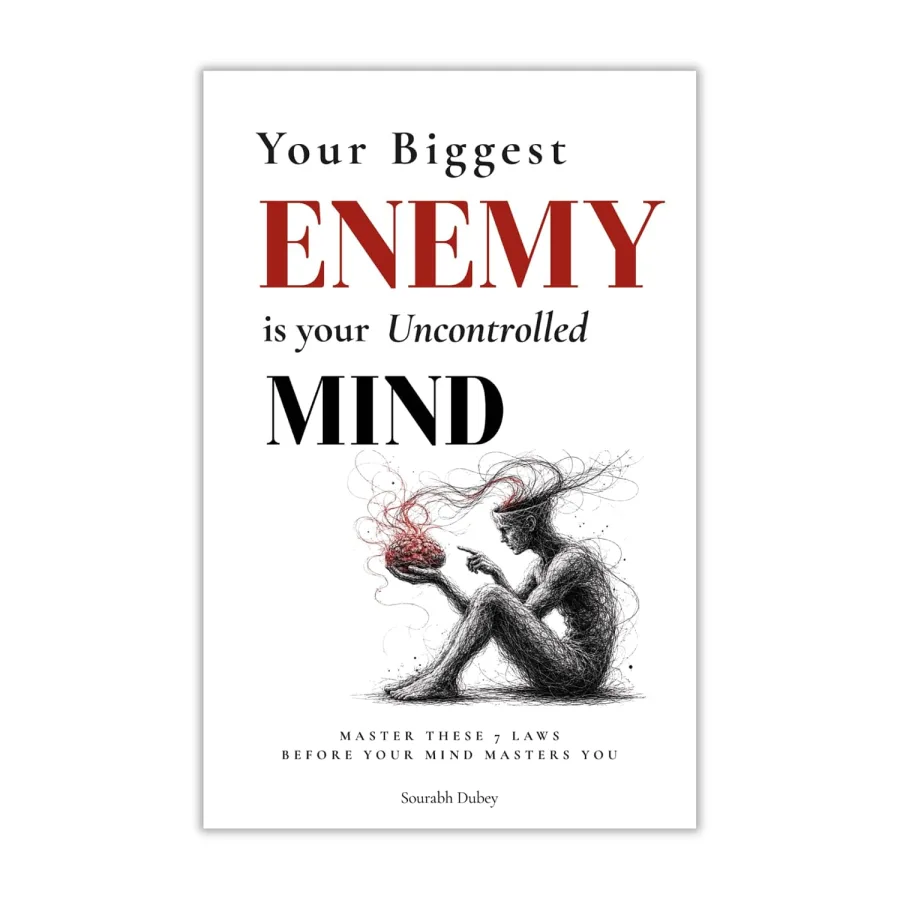
Download Cover Image
Do you want to download the full cover image for Your Biggest Enemy Is Your Uncontrolled Mind: Master These 7 Laws Before Your Mind Masters You?