
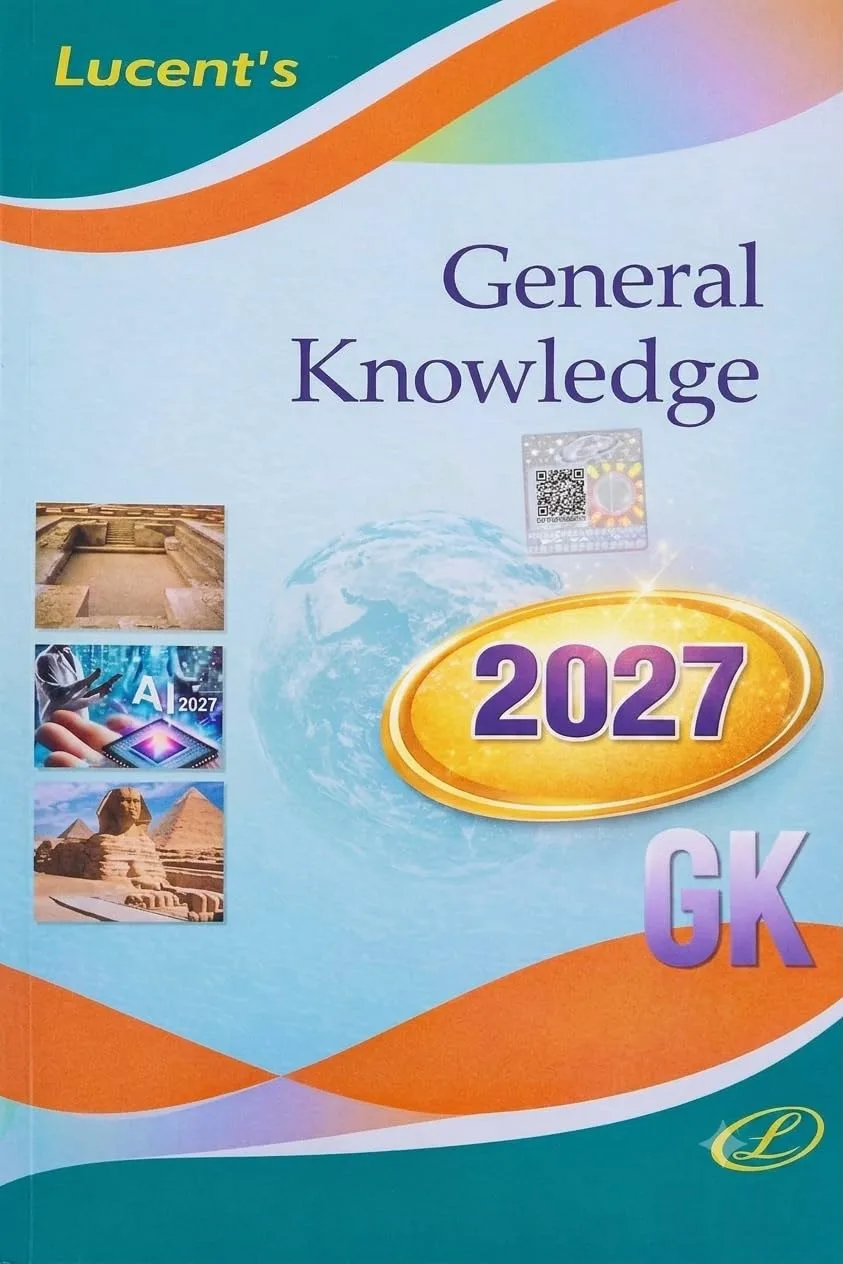
Lucent's General Knowledge 2027 GK Book
Paperback
• 598 Pages
• ₹ 315.00
• English
No ratings yet
| Publisher | Lucent Publication |
|---|---|
| ASIN/SKU | B0H9M4M2LH |
| Book Format | Paperback |
| Language | English |
| Pages | 598 |
| List Price | ₹ 315.00 |
| Publishing Date | 04/08/2026 |
| Dimensions | 24 x 14 x 21 cm |
| Weight | 716 g |
| Book Code | BD00070421 |
Buy this Book
Amazon Stores
Ebook Stores
Other Stores
Discover Lucent's General Knowledge 2027 GK Book by Dr. Binay Karna. This book is published by Lucent Publication in Paperback format, ASIN B0H9M4M2LH, under Exam Preparation.
Book Description
Lucent's General Knowledge 2026 - English | Lucent Gk 2026 New Edition English | 16th Revised Edition | For UPSC, SSC, NDA, CDS, Banking, Railways, Defence & All Competitive Exams (2026-27)
Author Biography
Author Biography will be added soon…
Editorial Reviews
Editorial Reviews will be added soon…
Book Summary
Lucent's General Knowledge 2027 by Dr. Binay Karna is a comprehensive general-knowledge reference book designed primarily for students and candidates preparing for competitive examinations. It is intended to provide a broad foundation in the static knowledge areas that repeatedly appear in examinations such as SSC, banking, railways, defence, state-level examinations, entrance tests, and other government recruitment examinations. The book brings together important information from history, geography, Indian polity, economics, general science, and miscellaneous general knowledge in one organised resource. It is widely treated as a useful reference for candidates who need to revise a large amount of factual information in a concise and examination-oriented format.
The main purpose of the book is to make general knowledge easier to study, revise, and remember. Competitive examinations often contain questions from many different subjects, which makes preparation difficult when students have to use separate sources for every area. A book such as Lucent's General Knowledge solves part of this problem by bringing major GK subjects together. Instead of studying history, geography, science, polity, and economics independently from lengthy academic textbooks, candidates can use the book as a compact reference for the facts and concepts most relevant to objective examinations. Its broad coverage is one of its biggest strengths.
Indian History forms one of the major sections of the book. The subject is generally approached through the major periods of India's past, including ancient, medieval, and modern history. Ancient Indian history introduces important civilizations, archaeological developments, religious traditions, kingdoms, empires, and cultural achievements. Topics associated with the Indus Valley Civilization, the Vedic period, the Mauryan Empire, the Gupta period, and other important developments help candidates create a chronological understanding of India's early history. The purpose is not to provide the depth of a specialised history textbook but to give candidates the important information needed to answer objective questions accurately.
Medieval Indian history shifts attention toward important kingdoms, dynasties, political developments, cultural changes, and rulers of the medieval period. The Delhi Sultanate, Mughal Empire, regional kingdoms, administrative developments, architecture, literature, and religious movements are among the types of information relevant to this section. Candidates preparing for competitive examinations often need to remember names, dates, achievements, administrative systems, battles, monuments, and cultural contributions. Organised revision of these facts can make it easier to distinguish between similar historical events and personalities.
Modern Indian history is especially important for government examinations because questions frequently focus on British rule, colonial policies, social and religious reform movements, important acts, organisations, and the Indian freedom struggle. The book helps candidates revise major developments that eventually led to independence. The national movement is particularly important because it contains numerous leaders, sessions, movements, newspapers, organisations, laws, and events. By presenting these developments in a compact form, the book can help candidates revise a large historical period without repeatedly consulting multiple sources.
World History provides a broader international perspective. It introduces important civilizations and major developments that shaped the modern world. Depending on the examination, candidates may encounter questions concerning ancient civilizations, major political revolutions, industrialisation, world wars, international developments, and important global events. World history is generally less dominant in many entry-level Indian competitive examinations than Indian history, but having a basic understanding of major global events can still be useful, particularly for examinations with a broader general-awareness syllabus.
Geography is another major pillar of the book. It covers both physical and human aspects of geography, with particular attention to India. Physical geography helps candidates understand the Earth, landforms, climate, rivers, oceans, natural resources, atmosphere, and other physical processes. Indian geography focuses on India's mountains, plateaus, plains, rivers, climate, soils, vegetation, agriculture, minerals, industries, transport, and population. Such information is frequently tested in objective examinations, where a single question may require knowledge of a river, mountain range, crop, mineral, climatic feature, or geographical location.
World geography extends this knowledge beyond India. Candidates revise important continents, oceans, countries, physical features, climatic regions, natural resources, and other geographical facts. Geography preparation becomes more useful when students understand relationships instead of merely memorising isolated names. For example, knowing why particular crops grow in certain regions is more useful than memorising crop names alone. Similarly, understanding how climate and relief influence rivers, agriculture, and settlements can help candidates solve conceptual questions.
Indian Polity is one of the most important sections for candidates preparing for government examinations. The book introduces the Indian Constitution, its major features, the political system, government institutions, constitutional bodies, and important terms. Candidates need to understand concepts such as the Preamble, Fundamental Rights, Fundamental Duties, Directive Principles of State Policy, constitutional amendments, citizenship, Parliament, the President, Prime Minister, judiciary, elections, and federal relations. These topics form the foundation for questions about how India's democratic system functions.
The section on Indian government and administration also helps candidates understand the relationship between central and state institutions. Parliament, the executive, judiciary, local government, constitutional authorities, and other institutions can be studied in an organised manner. The book also covers important constitutional and political terminology that frequently appears in multiple-choice questions. This makes it particularly useful for quick revision before examinations.
Indian Economy introduces candidates to fundamental economic concepts and the structure of India's economy. It helps readers understand terms related to national income, agriculture, industry, banking, taxation, economic planning, trade, employment, development, and financial institutions. Candidates who have not studied economics formally can use this section to develop basic familiarity with economic terminology. The objective is to make it easier to understand questions about the Indian economy and recognise the significance of important economic institutions and policies.
General Science is another major component and broadly covers Physics, Chemistry, and Biology. The Physics portion introduces basic principles, laws, units, motion, force, energy, electricity, light, heat, and other fundamental concepts. The Chemistry section deals with atomic structure, elements, compounds, chemical reactions, acids and bases, metals and non-metals, carbon compounds, and other basic areas. Biology introduces the structure and functions of living organisms, cells, human biology, genetics, diseases, classification, plants, and related scientific concepts.
The value of the General Science section lies in its accessibility. Competitive examinations generally do not expect every candidate to have specialised scientific knowledge, but they do test basic scientific awareness. Questions may concern everyday phenomena, scientific discoveries, human biology, common diseases, chemical properties, physical principles, or environmental concepts. Candidates can therefore use this portion of the book to develop a practical level of scientific awareness suitable for objective examinations.
The Biology material goes beyond the human body and includes broader biological concepts. Topics such as classification of organisms, cytology, genetics, evolution, plant classification, plant morphology, and plant tissues are commonly included in the Lucent GK framework. This provides candidates with a foundation that can support questions in general science sections of different examinations.
Chemistry similarly includes fundamental concepts such as atomic structure, periodic classification, chemical bonding, oxidation and reduction, acids, bases and salts, gases, electrolysis, carbon compounds, metals, non-metals, and important alloys. Such topics are useful because objective examinations often ask short factual or conceptual questions that can be answered quickly when the underlying information has been revised properly.
Physics covers basic scientific principles that candidates are expected to understand at a general level. Rather than treating Physics as an advanced mathematical subject, the GK approach focuses on commonly tested laws, concepts, phenomena, units, instruments, and applications. This is particularly useful for examinations where General Science forms one section of a larger paper.
The Miscellaneous General Knowledge section broadens the scope of the book further. It includes the type of information that does not fit neatly into history, geography, polity, economy, or science. Important dates, places, battles, reforms, committees, commissions, famous sayings, important personalities, national symbols, books, authors, awards, and other factual information can fall into this category. Such information is particularly useful for examinations that include one-line general-awareness questions.
Computer awareness is also relevant to many modern competitive examinations. Basic knowledge of computers, hardware, software, internet concepts, networking, and computer security can help candidates answer questions that test digital literacy. The broader Lucent GK coverage is often used alongside dedicated computer-awareness resources when an examination gives significant weight to computer-related questions.
One of the most useful characteristics of a general-knowledge book is its ability to support repeated revision. General knowledge contains a large number of facts that can easily be forgotten if studied only once. Candidates therefore benefit from reading the material multiple times at increasing speed. During the first reading, they can focus on understanding unfamiliar topics. During later readings, they can concentrate on important facts, tables, lists, names, dates, constitutional provisions, scientific terms, and geographical information.
The book is particularly useful as a static-GK foundation, but candidates should understand the difference between static knowledge and current affairs. Static GK includes relatively stable information such as historical events, constitutional provisions, geographical features, scientific principles, and important institutions. Current affairs, in contrast, change continuously. Therefore, a candidate preparing for a 2027 examination should use the book as a foundation and supplement it with current affairs from the relevant examination period. The 2027 edition is useful for the current preparation cycle, but no annual GK book can replace ongoing awareness of new developments.
Another important strength is its usefulness across different examinations. The same basic knowledge of Indian history, polity, geography, economy, and science can appear in SSC, railway, banking, defence, state government, entrance, and other competitive examinations. This makes the book versatile. It does not restrict the learner to one particular examination pattern. Instead, it provides a broad knowledge base that can be adapted to different syllabi.
The book can be particularly effective when combined with question practice. Reading facts repeatedly is useful, but attempting objective questions reveals whether those facts can actually be recalled under pressure. A candidate can study a chapter, make short notes, and then solve questions from that subject. Incorrect answers should be treated as signals of topics that require additional revision. Over time, this process can transform the book from a reference manual into a structured revision tool.
A sensible preparation strategy is to divide the book into subject blocks. Candidates can first complete Indian History, followed by Geography, Polity, Economy, General Science, and Miscellaneous GK. They can then revisit each subject through rapid revision. Instead of attempting to memorise the entire book in one sitting, regular smaller sessions are more practical. Tables, lists, timelines, comparisons, and factual summaries can be especially useful during final revision because they allow large amounts of information to be reviewed quickly.
Overall, Lucent's General Knowledge 2027 by Dr. Binay Karna is best understood as a broad static-GK reference designed for competitive-examination preparation. Its coverage spans the major subjects that repeatedly appear in general-awareness sections, including Indian and world history, geography, Indian polity, economics, Physics, Chemistry, Biology, computer awareness, and miscellaneous factual knowledge.
In simple terms, the book gives candidates a single place to build and revise their general-knowledge foundation. Its greatest value comes from its breadth and compact examination-oriented presentation. Students preparing for SSC, banking, railways, defence, state examinations, entrance tests, and other competitive exams can use it to strengthen their static GK before moving to current affairs and extensive question practice. Used consistently, Lucent's General Knowledge 2027 can help candidates improve factual recall, connect information across subjects, and become more confident when facing the wide range of general-awareness questions found in competitive examinations.
The main purpose of the book is to make general knowledge easier to study, revise, and remember. Competitive examinations often contain questions from many different subjects, which makes preparation difficult when students have to use separate sources for every area. A book such as Lucent's General Knowledge solves part of this problem by bringing major GK subjects together. Instead of studying history, geography, science, polity, and economics independently from lengthy academic textbooks, candidates can use the book as a compact reference for the facts and concepts most relevant to objective examinations. Its broad coverage is one of its biggest strengths.
Indian History forms one of the major sections of the book. The subject is generally approached through the major periods of India's past, including ancient, medieval, and modern history. Ancient Indian history introduces important civilizations, archaeological developments, religious traditions, kingdoms, empires, and cultural achievements. Topics associated with the Indus Valley Civilization, the Vedic period, the Mauryan Empire, the Gupta period, and other important developments help candidates create a chronological understanding of India's early history. The purpose is not to provide the depth of a specialised history textbook but to give candidates the important information needed to answer objective questions accurately.
Medieval Indian history shifts attention toward important kingdoms, dynasties, political developments, cultural changes, and rulers of the medieval period. The Delhi Sultanate, Mughal Empire, regional kingdoms, administrative developments, architecture, literature, and religious movements are among the types of information relevant to this section. Candidates preparing for competitive examinations often need to remember names, dates, achievements, administrative systems, battles, monuments, and cultural contributions. Organised revision of these facts can make it easier to distinguish between similar historical events and personalities.
Modern Indian history is especially important for government examinations because questions frequently focus on British rule, colonial policies, social and religious reform movements, important acts, organisations, and the Indian freedom struggle. The book helps candidates revise major developments that eventually led to independence. The national movement is particularly important because it contains numerous leaders, sessions, movements, newspapers, organisations, laws, and events. By presenting these developments in a compact form, the book can help candidates revise a large historical period without repeatedly consulting multiple sources.
World History provides a broader international perspective. It introduces important civilizations and major developments that shaped the modern world. Depending on the examination, candidates may encounter questions concerning ancient civilizations, major political revolutions, industrialisation, world wars, international developments, and important global events. World history is generally less dominant in many entry-level Indian competitive examinations than Indian history, but having a basic understanding of major global events can still be useful, particularly for examinations with a broader general-awareness syllabus.
Geography is another major pillar of the book. It covers both physical and human aspects of geography, with particular attention to India. Physical geography helps candidates understand the Earth, landforms, climate, rivers, oceans, natural resources, atmosphere, and other physical processes. Indian geography focuses on India's mountains, plateaus, plains, rivers, climate, soils, vegetation, agriculture, minerals, industries, transport, and population. Such information is frequently tested in objective examinations, where a single question may require knowledge of a river, mountain range, crop, mineral, climatic feature, or geographical location.
World geography extends this knowledge beyond India. Candidates revise important continents, oceans, countries, physical features, climatic regions, natural resources, and other geographical facts. Geography preparation becomes more useful when students understand relationships instead of merely memorising isolated names. For example, knowing why particular crops grow in certain regions is more useful than memorising crop names alone. Similarly, understanding how climate and relief influence rivers, agriculture, and settlements can help candidates solve conceptual questions.
Indian Polity is one of the most important sections for candidates preparing for government examinations. The book introduces the Indian Constitution, its major features, the political system, government institutions, constitutional bodies, and important terms. Candidates need to understand concepts such as the Preamble, Fundamental Rights, Fundamental Duties, Directive Principles of State Policy, constitutional amendments, citizenship, Parliament, the President, Prime Minister, judiciary, elections, and federal relations. These topics form the foundation for questions about how India's democratic system functions.
The section on Indian government and administration also helps candidates understand the relationship between central and state institutions. Parliament, the executive, judiciary, local government, constitutional authorities, and other institutions can be studied in an organised manner. The book also covers important constitutional and political terminology that frequently appears in multiple-choice questions. This makes it particularly useful for quick revision before examinations.
Indian Economy introduces candidates to fundamental economic concepts and the structure of India's economy. It helps readers understand terms related to national income, agriculture, industry, banking, taxation, economic planning, trade, employment, development, and financial institutions. Candidates who have not studied economics formally can use this section to develop basic familiarity with economic terminology. The objective is to make it easier to understand questions about the Indian economy and recognise the significance of important economic institutions and policies.
General Science is another major component and broadly covers Physics, Chemistry, and Biology. The Physics portion introduces basic principles, laws, units, motion, force, energy, electricity, light, heat, and other fundamental concepts. The Chemistry section deals with atomic structure, elements, compounds, chemical reactions, acids and bases, metals and non-metals, carbon compounds, and other basic areas. Biology introduces the structure and functions of living organisms, cells, human biology, genetics, diseases, classification, plants, and related scientific concepts.
The value of the General Science section lies in its accessibility. Competitive examinations generally do not expect every candidate to have specialised scientific knowledge, but they do test basic scientific awareness. Questions may concern everyday phenomena, scientific discoveries, human biology, common diseases, chemical properties, physical principles, or environmental concepts. Candidates can therefore use this portion of the book to develop a practical level of scientific awareness suitable for objective examinations.
The Biology material goes beyond the human body and includes broader biological concepts. Topics such as classification of organisms, cytology, genetics, evolution, plant classification, plant morphology, and plant tissues are commonly included in the Lucent GK framework. This provides candidates with a foundation that can support questions in general science sections of different examinations.
Chemistry similarly includes fundamental concepts such as atomic structure, periodic classification, chemical bonding, oxidation and reduction, acids, bases and salts, gases, electrolysis, carbon compounds, metals, non-metals, and important alloys. Such topics are useful because objective examinations often ask short factual or conceptual questions that can be answered quickly when the underlying information has been revised properly.
Physics covers basic scientific principles that candidates are expected to understand at a general level. Rather than treating Physics as an advanced mathematical subject, the GK approach focuses on commonly tested laws, concepts, phenomena, units, instruments, and applications. This is particularly useful for examinations where General Science forms one section of a larger paper.
The Miscellaneous General Knowledge section broadens the scope of the book further. It includes the type of information that does not fit neatly into history, geography, polity, economy, or science. Important dates, places, battles, reforms, committees, commissions, famous sayings, important personalities, national symbols, books, authors, awards, and other factual information can fall into this category. Such information is particularly useful for examinations that include one-line general-awareness questions.
Computer awareness is also relevant to many modern competitive examinations. Basic knowledge of computers, hardware, software, internet concepts, networking, and computer security can help candidates answer questions that test digital literacy. The broader Lucent GK coverage is often used alongside dedicated computer-awareness resources when an examination gives significant weight to computer-related questions.
One of the most useful characteristics of a general-knowledge book is its ability to support repeated revision. General knowledge contains a large number of facts that can easily be forgotten if studied only once. Candidates therefore benefit from reading the material multiple times at increasing speed. During the first reading, they can focus on understanding unfamiliar topics. During later readings, they can concentrate on important facts, tables, lists, names, dates, constitutional provisions, scientific terms, and geographical information.
The book is particularly useful as a static-GK foundation, but candidates should understand the difference between static knowledge and current affairs. Static GK includes relatively stable information such as historical events, constitutional provisions, geographical features, scientific principles, and important institutions. Current affairs, in contrast, change continuously. Therefore, a candidate preparing for a 2027 examination should use the book as a foundation and supplement it with current affairs from the relevant examination period. The 2027 edition is useful for the current preparation cycle, but no annual GK book can replace ongoing awareness of new developments.
Another important strength is its usefulness across different examinations. The same basic knowledge of Indian history, polity, geography, economy, and science can appear in SSC, railway, banking, defence, state government, entrance, and other competitive examinations. This makes the book versatile. It does not restrict the learner to one particular examination pattern. Instead, it provides a broad knowledge base that can be adapted to different syllabi.
The book can be particularly effective when combined with question practice. Reading facts repeatedly is useful, but attempting objective questions reveals whether those facts can actually be recalled under pressure. A candidate can study a chapter, make short notes, and then solve questions from that subject. Incorrect answers should be treated as signals of topics that require additional revision. Over time, this process can transform the book from a reference manual into a structured revision tool.
A sensible preparation strategy is to divide the book into subject blocks. Candidates can first complete Indian History, followed by Geography, Polity, Economy, General Science, and Miscellaneous GK. They can then revisit each subject through rapid revision. Instead of attempting to memorise the entire book in one sitting, regular smaller sessions are more practical. Tables, lists, timelines, comparisons, and factual summaries can be especially useful during final revision because they allow large amounts of information to be reviewed quickly.
Overall, Lucent's General Knowledge 2027 by Dr. Binay Karna is best understood as a broad static-GK reference designed for competitive-examination preparation. Its coverage spans the major subjects that repeatedly appear in general-awareness sections, including Indian and world history, geography, Indian polity, economics, Physics, Chemistry, Biology, computer awareness, and miscellaneous factual knowledge.
In simple terms, the book gives candidates a single place to build and revise their general-knowledge foundation. Its greatest value comes from its breadth and compact examination-oriented presentation. Students preparing for SSC, banking, railways, defence, state examinations, entrance tests, and other competitive exams can use it to strengthen their static GK before moving to current affairs and extensive question practice. Used consistently, Lucent's General Knowledge 2027 can help candidates improve factual recall, connect information across subjects, and become more confident when facing the wide range of general-awareness questions found in competitive examinations.
Sample Chapters
Sample Chapters will be added soon…
Reader Reviews
No reviews yet.
Lucent's General Knowledge 2027 GK Book
Download Cover Image
Do you want to download the full cover image for Lucent's General Knowledge 2027 GK Book?