
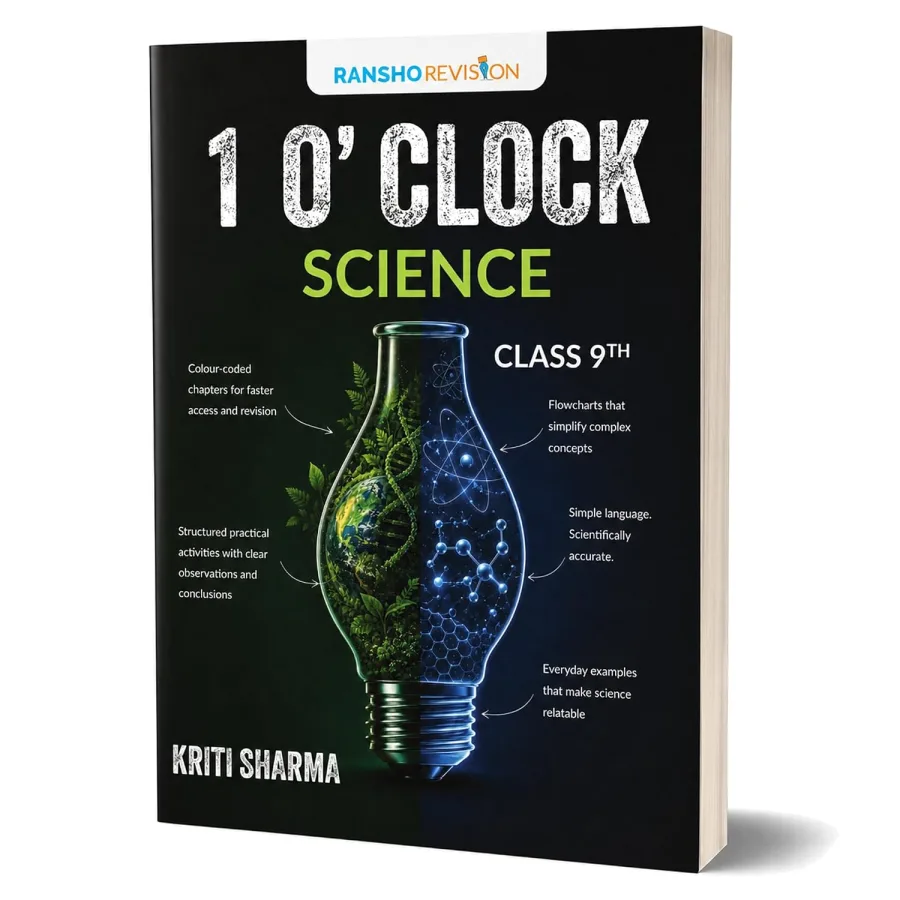
1 O’ Clock Class 9 Science Revision Book | Based on New NCERT Grade 9 Science Syllabus 2026-27
Paperback
• 164 Pages
• ₹ 399.00
• English
No ratings yet
| Publisher | Rancho Chemistry |
|---|---|
| ASIN/SKU | B0HDPBTLV3 |
| Book Format | Paperback |
| Language | English |
| Pages | 164 |
| List Price | ₹ 399.00 |
| Publishing Date | 09/08/2026 |
| Dimensions | 24.13 x 18.42 x 0.64 cm |
| Weight | 350 g |
| Book Code | BD00070419 |
Buy this Book
Amazon Stores
Ebook Stores
Other Stores
Discover 1 O’ Clock Class 9 Science Revision Book | Based on New NCERT Grade 9 Science Syllabus 2026-27 by Kriti Sharma. This book is published by Rancho Chemistry in Paperback format, ASIN B0HDPBTLV3, under School Books, CBSE Textbooks.
Book Description
Revise faster. Understand visually. Remember with confidence.
The 1 O’ Clock Class 9 Science Revision Book is specially developed around the new NCERT Grade 9 Science syllabus for 2026-27, bringing the new 13-chapter Science structure into a quick, visual and revision-friendly format.
Covering 13 Class 9 Science chapters, the book simplifies Physics, Chemistry, Biology and Earth Science through concise explanations, labelled diagrams, flowcharts, tables, comparison charts, graphs, formulae, activities, experiments and real-life examples.
The highly visual layout helps students see the important concept, relationship, formula, diagram or process at a glance—making revision faster and more organised.
Special features such as Beyond Basics, Exam Trap, Safety First and What If? provide deeper understanding, important distinctions, practical precautions and useful concept extensions.
Whether students are revising a chapter after school or preparing before a test or examination, 1 O’ Clock turns large Science topics into clear, visual and revision-friendly learning pages.
WHY CHOOSE 1 O’ CLOCK CLASS 9 SCIENCE?
BASED ON THE NEW CLASS 9 SCIENCE SYLLABUS
1 O’ Clock is developed for the new NCERT Grade 9 Science syllabus for 2026-27. It covers the new 13-chapter structure, helping students study and revise the Science course introduced for the current academic session.
QUICK & VISUAL REVISION
Large chapters are organised into concise, easy-to-scan sections so students can revise important concepts faster.
CONCISE BUT CONCEPT-RICH
The book shortens the presentation without reducing Science to one-line facts. Concepts are supported with explanations, examples, diagrams, experiments and applications.
DIAGRAMS, FLOWCHARTS & TABLES
Labelled diagrams, process flows, comparison tables and visual summaries make information-heavy topics easier to understand and remember.
PHYSICS WITH FORMULAE & GRAPHS
Motion, force, work, energy and sound are explained through formulae, graphs, diagrams and real situations, helping students connect calculations with concepts.
ACTIVITY & EXPERIMENT-BASED LEARNING
Compact experimental setups and investigations are included across topics such as cells, tissues, mixtures, motion, forces, sound and reproduction.
BEYOND BASICS
Special Beyond Basics boxes introduce selected deeper concepts, scientific applications, historical context, Indian contributions and interesting extensions.
EXAM TRAP, WHAT IF? & SAFETY FIRST
Useful callouts highlight commonly confused ideas, encourage students to think about changing conditions and provide precautions for practical activities.
REAL-LIFE SCIENCE
Examples from health, sports, technology, space, environment, agriculture, everyday materials and the human body help connect Science with the real world.
COMPLETE 13-CHAPTER COVERAGE
1. Exploration—Entering the World of Secondary Science
Scientific thinking, observation, questioning, measurement, models, units, laws, theories, prediction, testing and estimation.
2. Cell—The Building Block of Life
Cells, microscopy, membranes, diffusion, osmosis, organelles, prokaryotic and eukaryotic cells, mitosis, meiosis and cell theory.
3. Tissues in Action
Plant and animal tissues, meristems, permanent tissues, xylem, phloem, blood, muscles, nervous tissue, joints and skeletal system.
4. Describing Motion Around Us
Position, distance, displacement, speed, velocity, acceleration, motion graphs, kinematic equations and circular motion.
5. Exploring Mixtures and their Separation
Solutions, concentration, solubility, crystallisation, distillation, chromatography, centrifugation, colloids and separation methods.
6. How Forces Affect Motion
Force, friction, balanced and unbalanced forces, Newton’s laws, mass, weight, acceleration, momentum and force systems.
The 1 O’ Clock Class 9 Science Revision Book is specially developed around the new NCERT Grade 9 Science syllabus for 2026-27, bringing the new 13-chapter Science structure into a quick, visual and revision-friendly format.
Covering 13 Class 9 Science chapters, the book simplifies Physics, Chemistry, Biology and Earth Science through concise explanations, labelled diagrams, flowcharts, tables, comparison charts, graphs, formulae, activities, experiments and real-life examples.
The highly visual layout helps students see the important concept, relationship, formula, diagram or process at a glance—making revision faster and more organised.
Special features such as Beyond Basics, Exam Trap, Safety First and What If? provide deeper understanding, important distinctions, practical precautions and useful concept extensions.
Whether students are revising a chapter after school or preparing before a test or examination, 1 O’ Clock turns large Science topics into clear, visual and revision-friendly learning pages.
WHY CHOOSE 1 O’ CLOCK CLASS 9 SCIENCE?
BASED ON THE NEW CLASS 9 SCIENCE SYLLABUS
1 O’ Clock is developed for the new NCERT Grade 9 Science syllabus for 2026-27. It covers the new 13-chapter structure, helping students study and revise the Science course introduced for the current academic session.
QUICK & VISUAL REVISION
Large chapters are organised into concise, easy-to-scan sections so students can revise important concepts faster.
CONCISE BUT CONCEPT-RICH
The book shortens the presentation without reducing Science to one-line facts. Concepts are supported with explanations, examples, diagrams, experiments and applications.
DIAGRAMS, FLOWCHARTS & TABLES
Labelled diagrams, process flows, comparison tables and visual summaries make information-heavy topics easier to understand and remember.
PHYSICS WITH FORMULAE & GRAPHS
Motion, force, work, energy and sound are explained through formulae, graphs, diagrams and real situations, helping students connect calculations with concepts.
ACTIVITY & EXPERIMENT-BASED LEARNING
Compact experimental setups and investigations are included across topics such as cells, tissues, mixtures, motion, forces, sound and reproduction.
BEYOND BASICS
Special Beyond Basics boxes introduce selected deeper concepts, scientific applications, historical context, Indian contributions and interesting extensions.
EXAM TRAP, WHAT IF? & SAFETY FIRST
Useful callouts highlight commonly confused ideas, encourage students to think about changing conditions and provide precautions for practical activities.
REAL-LIFE SCIENCE
Examples from health, sports, technology, space, environment, agriculture, everyday materials and the human body help connect Science with the real world.
COMPLETE 13-CHAPTER COVERAGE
1. Exploration—Entering the World of Secondary Science
Scientific thinking, observation, questioning, measurement, models, units, laws, theories, prediction, testing and estimation.
2. Cell—The Building Block of Life
Cells, microscopy, membranes, diffusion, osmosis, organelles, prokaryotic and eukaryotic cells, mitosis, meiosis and cell theory.
3. Tissues in Action
Plant and animal tissues, meristems, permanent tissues, xylem, phloem, blood, muscles, nervous tissue, joints and skeletal system.
4. Describing Motion Around Us
Position, distance, displacement, speed, velocity, acceleration, motion graphs, kinematic equations and circular motion.
5. Exploring Mixtures and their Separation
Solutions, concentration, solubility, crystallisation, distillation, chromatography, centrifugation, colloids and separation methods.
6. How Forces Affect Motion
Force, friction, balanced and unbalanced forces, Newton’s laws, mass, weight, acceleration, momentum and force systems.
Author Biography
Author Biography will be added soon…
Editorial Reviews
Editorial Reviews will be added soon…
Book Summary
1 O’ Clock Class 9 Science Revision Book | Based on New NCERT Grade 9 Science Syllabus 2026–27 by Kriti Sharma and Ransho Revision is a student-focused revision guide designed for Class 9 learners following the newly introduced NCERT Science syllabus for the 2026–27 academic session. The main purpose of the book is to make Science revision quicker, more organised, and easier to manage before school tests and examinations. Instead of requiring students to repeatedly read long textbook chapters, the book focuses on important concepts, key facts, definitions, formulas, diagrams, and examination-oriented questions in a compact format. Its approach is especially useful for students who understand a chapter during regular study but struggle to remember everything when an examination is approaching.
The title “1 O’ Clock” reflects the book's emphasis on fast revision. The underlying idea is that students should be able to revise an important portion of the syllabus in a relatively short period rather than spending many hours going through the complete textbook again. This makes the book particularly suitable for last-minute revision, although its usefulness is not limited to the day before an examination. Students can use it throughout the year after completing each NCERT chapter, gradually building a collection of short revision notes that can later be reviewed quickly.
The book is based on the new NCERT Grade 9 Science syllabus for 2026–27, which makes syllabus alignment one of its most important features. Students following the updated curriculum need to be careful when using older reference books because the sequence, emphasis, and content of the new syllabus may differ from previous editions. A revision guide based specifically on the new curriculum can help students concentrate on the material that is relevant to their current academic year rather than spending time on outdated or unnecessary topics.
At the heart of the book is the idea of selective revision. Science textbooks contain explanations, examples, activities, diagrams, observations, and supporting information that are valuable for learning but can be difficult to revise quickly. A revision book condenses this material into the most important learning points. Students can therefore use it to refresh their memory after studying the original NCERT chapter. The book should be viewed as a companion to NCERT rather than a replacement for the textbook. NCERT remains important for detailed understanding, while the revision guide can be used to reinforce and recall what has already been learned.
The Science curriculum requires students to understand concepts rather than simply memorise sentences. This is particularly important because CBSE-style questions increasingly test whether students can apply scientific ideas to situations. The book therefore focuses on the kind of information that students need to remember while also helping them identify the central concept behind a topic. For example, instead of learning a definition in isolation, a student should understand what the concept means, how it works, and where it can be applied. Such preparation makes it easier to answer questions that are worded differently from the textbook.
The Physics-related portions of Class 9 Science introduce students to fundamental ideas about the physical world. Topics involving motion, force, work, energy, sound, and related concepts require students to understand relationships between quantities and, in some cases, use formulas to solve numerical problems. Revision becomes especially important in these areas because students may remember the general idea but forget a formula, unit, symbol, or condition. A compact revision resource can help students repeatedly review these elements until they become familiar.
Numerical practice is an important part of Science preparation. Students often lose marks not because they do not understand the underlying concept but because they make small mistakes while substituting values, choosing units, rearranging formulas, or presenting the final answer. A good revision routine therefore involves reviewing the relevant formula, understanding what each quantity represents, checking units, and practising representative problems. The book's concise approach can help students quickly identify the formulas and concepts that need additional practice.
Chemistry forms another important part of Class 9 Science. Students encounter ideas related to matter, its properties, particles, atoms, molecules, chemical substances, mixtures, and changes in matter. Chemistry can initially seem difficult because it introduces new terminology and microscopic explanations of everyday phenomena. Revision helps students remember the distinctions between important terms and understand how different concepts are related. Clear definitions and organised notes can be particularly helpful for students who tend to confuse closely related ideas.
A major benefit of concise Chemistry revision is that it allows students to compare concepts. For example, students may need to distinguish between physical and chemical changes, elements and compounds, or different types of mixtures. Rather than revising each definition separately, students can use comparison-based learning to remember the characteristics of each category. This approach improves recall and also helps with questions that ask students to identify or classify a substance or process.
The Biology component of Science introduces students to living organisms and the processes that allow them to survive and function. Biology often contains a large amount of terminology, including names of structures, functions, processes, and classifications. Students can find it difficult to retain this information if they study it only once. Revision notes can therefore help by reducing large sections into essential points. Diagrams and labelled structures are especially important because Science examinations may ask students to identify parts, explain functions, or draw and label scientific diagrams.
Diagrams are not merely decorative in Science. They can help students understand relationships between structures and functions. A well-labelled diagram can communicate information quickly and can also improve an answer when a question specifically requires a representation. Students preparing with a revision book should therefore pay attention to important diagrams and practise reproducing them accurately. Repeated visual revision can be particularly effective for Biology topics.
Another important feature of an effective Class 9 revision book is its emphasis on definitions and key terms. Scientific answers often require precise language. A student may understand an idea generally but lose marks if the definition is incomplete or uses an incorrect scientific term. Short revision notes allow students to repeatedly review important terminology and gradually become comfortable using it in written answers. This is especially useful before examinations, when students need to recall precise information quickly.
The book also supports active recall. Simply reading a chapter repeatedly can create a feeling of familiarity without guaranteeing that the information can be recalled independently. A stronger revision method is to read a concept briefly, close the book, and try to explain it from memory. Students can then check their answer against the revision notes. This method helps identify genuine gaps in understanding. Questions and quick exercises can further strengthen this process because they require students to retrieve information rather than merely recognise it.
The compact nature of the book makes it useful for different stages of preparation. Immediately after completing a chapter, students can use it to review the important concepts. Before a class test, they can revisit the relevant section. Before a term examination, they can use it for broader revision. During final examination preparation, the entire book can serve as a rapid refresher. This flexibility makes it more useful than a resource intended only for last-minute study.
The book is also likely to benefit students who feel overwhelmed by the size of the Science syllabus. When students see an entire textbook, they may not know where to begin revision. A concise guide can provide a sense of structure by highlighting the major concepts that deserve attention. Students can then use a simple cycle: study the NCERT chapter, revise the condensed notes, solve questions, identify weaknesses, and return to the textbook when deeper understanding is required.
Another important aspect of Class 9 Science preparation is balancing conceptual learning with examination practice. Students should not treat revision as memorising a list of facts. They should understand why a scientific process occurs and how the concept can be applied. Once the concept is clear, short notes become much more valuable because they act as memory triggers. A few keywords can then remind the student of an entire explanation.
The new CBSE approach also makes competency-based preparation important. Questions may be presented through situations, observations, data, diagrams, or everyday examples. Students therefore need to learn how to use scientific knowledge rather than merely reproduce textbook sentences. A revision book can support this preparation by helping students identify the fundamental principle behind each topic. Once the principle is understood, it becomes easier to apply it to unfamiliar questions.
The book can also help students develop a more efficient revision schedule. Instead of waiting until the examination is very close, students can divide the syllabus into small sections. For example, after completing a chapter at school, they can spend a short period revising its key points. At the end of the week, they can quickly review all the chapters studied during that week. Later, they can repeat the process. This spaced revision reduces the pressure of trying to learn the entire syllabus immediately before the examination.
For students who are preparing for school examinations, the book can also support answer-writing. Science answers require different levels of detail depending on the question. A one-mark question may require a precise term or statement, while a longer question may require an explanation, reasoning, example, equation, or diagram. Students can use revision notes to understand the essential points and then practise expanding those points into complete answers. This helps prevent two common problems: writing too little or filling answers with unnecessary information.
Overall, 1 O’ Clock Class 9 Science Revision Book by Kriti Sharma and Ransho Revision is designed around the practical needs of students who want a faster and more systematic way to revise the new Class 9 Science syllabus. Its greatest value lies in condensation: complicated or lengthy textbook material is transformed into a form that can be reviewed repeatedly. The approach is particularly helpful when students have limited time, need to refresh concepts quickly, or want a final revision resource before a test.
The book's most effective use is alongside the official NCERT textbook. Students should first develop their understanding through NCERT and classroom teaching, then use the revision book to consolidate important concepts. They should combine this with numerical practice, diagrams, written answers, and competency-based questions. Used in this way, the book becomes more than a last-minute guide; it becomes a regular revision tool.
In simple terms, 1 O’ Clock Class 9 Science Revision Book is built around one main idea: good revision should be quick, focused, and repeated. Instead of trying to reread every page before an examination, students can concentrate on the concepts, definitions, formulas, diagrams, and important points that form the foundation of their Science preparation. For Class 9 students following the new NCERT Science syllabus in 2026–27, the book can serve as a convenient companion for chapterwise revision, examination preparation, and last-minute recall, helping them approach Science with greater organisation and confidence.
The title “1 O’ Clock” reflects the book's emphasis on fast revision. The underlying idea is that students should be able to revise an important portion of the syllabus in a relatively short period rather than spending many hours going through the complete textbook again. This makes the book particularly suitable for last-minute revision, although its usefulness is not limited to the day before an examination. Students can use it throughout the year after completing each NCERT chapter, gradually building a collection of short revision notes that can later be reviewed quickly.
The book is based on the new NCERT Grade 9 Science syllabus for 2026–27, which makes syllabus alignment one of its most important features. Students following the updated curriculum need to be careful when using older reference books because the sequence, emphasis, and content of the new syllabus may differ from previous editions. A revision guide based specifically on the new curriculum can help students concentrate on the material that is relevant to their current academic year rather than spending time on outdated or unnecessary topics.
At the heart of the book is the idea of selective revision. Science textbooks contain explanations, examples, activities, diagrams, observations, and supporting information that are valuable for learning but can be difficult to revise quickly. A revision book condenses this material into the most important learning points. Students can therefore use it to refresh their memory after studying the original NCERT chapter. The book should be viewed as a companion to NCERT rather than a replacement for the textbook. NCERT remains important for detailed understanding, while the revision guide can be used to reinforce and recall what has already been learned.
The Science curriculum requires students to understand concepts rather than simply memorise sentences. This is particularly important because CBSE-style questions increasingly test whether students can apply scientific ideas to situations. The book therefore focuses on the kind of information that students need to remember while also helping them identify the central concept behind a topic. For example, instead of learning a definition in isolation, a student should understand what the concept means, how it works, and where it can be applied. Such preparation makes it easier to answer questions that are worded differently from the textbook.
The Physics-related portions of Class 9 Science introduce students to fundamental ideas about the physical world. Topics involving motion, force, work, energy, sound, and related concepts require students to understand relationships between quantities and, in some cases, use formulas to solve numerical problems. Revision becomes especially important in these areas because students may remember the general idea but forget a formula, unit, symbol, or condition. A compact revision resource can help students repeatedly review these elements until they become familiar.
Numerical practice is an important part of Science preparation. Students often lose marks not because they do not understand the underlying concept but because they make small mistakes while substituting values, choosing units, rearranging formulas, or presenting the final answer. A good revision routine therefore involves reviewing the relevant formula, understanding what each quantity represents, checking units, and practising representative problems. The book's concise approach can help students quickly identify the formulas and concepts that need additional practice.
Chemistry forms another important part of Class 9 Science. Students encounter ideas related to matter, its properties, particles, atoms, molecules, chemical substances, mixtures, and changes in matter. Chemistry can initially seem difficult because it introduces new terminology and microscopic explanations of everyday phenomena. Revision helps students remember the distinctions between important terms and understand how different concepts are related. Clear definitions and organised notes can be particularly helpful for students who tend to confuse closely related ideas.
A major benefit of concise Chemistry revision is that it allows students to compare concepts. For example, students may need to distinguish between physical and chemical changes, elements and compounds, or different types of mixtures. Rather than revising each definition separately, students can use comparison-based learning to remember the characteristics of each category. This approach improves recall and also helps with questions that ask students to identify or classify a substance or process.
The Biology component of Science introduces students to living organisms and the processes that allow them to survive and function. Biology often contains a large amount of terminology, including names of structures, functions, processes, and classifications. Students can find it difficult to retain this information if they study it only once. Revision notes can therefore help by reducing large sections into essential points. Diagrams and labelled structures are especially important because Science examinations may ask students to identify parts, explain functions, or draw and label scientific diagrams.
Diagrams are not merely decorative in Science. They can help students understand relationships between structures and functions. A well-labelled diagram can communicate information quickly and can also improve an answer when a question specifically requires a representation. Students preparing with a revision book should therefore pay attention to important diagrams and practise reproducing them accurately. Repeated visual revision can be particularly effective for Biology topics.
Another important feature of an effective Class 9 revision book is its emphasis on definitions and key terms. Scientific answers often require precise language. A student may understand an idea generally but lose marks if the definition is incomplete or uses an incorrect scientific term. Short revision notes allow students to repeatedly review important terminology and gradually become comfortable using it in written answers. This is especially useful before examinations, when students need to recall precise information quickly.
The book also supports active recall. Simply reading a chapter repeatedly can create a feeling of familiarity without guaranteeing that the information can be recalled independently. A stronger revision method is to read a concept briefly, close the book, and try to explain it from memory. Students can then check their answer against the revision notes. This method helps identify genuine gaps in understanding. Questions and quick exercises can further strengthen this process because they require students to retrieve information rather than merely recognise it.
The compact nature of the book makes it useful for different stages of preparation. Immediately after completing a chapter, students can use it to review the important concepts. Before a class test, they can revisit the relevant section. Before a term examination, they can use it for broader revision. During final examination preparation, the entire book can serve as a rapid refresher. This flexibility makes it more useful than a resource intended only for last-minute study.
The book is also likely to benefit students who feel overwhelmed by the size of the Science syllabus. When students see an entire textbook, they may not know where to begin revision. A concise guide can provide a sense of structure by highlighting the major concepts that deserve attention. Students can then use a simple cycle: study the NCERT chapter, revise the condensed notes, solve questions, identify weaknesses, and return to the textbook when deeper understanding is required.
Another important aspect of Class 9 Science preparation is balancing conceptual learning with examination practice. Students should not treat revision as memorising a list of facts. They should understand why a scientific process occurs and how the concept can be applied. Once the concept is clear, short notes become much more valuable because they act as memory triggers. A few keywords can then remind the student of an entire explanation.
The new CBSE approach also makes competency-based preparation important. Questions may be presented through situations, observations, data, diagrams, or everyday examples. Students therefore need to learn how to use scientific knowledge rather than merely reproduce textbook sentences. A revision book can support this preparation by helping students identify the fundamental principle behind each topic. Once the principle is understood, it becomes easier to apply it to unfamiliar questions.
The book can also help students develop a more efficient revision schedule. Instead of waiting until the examination is very close, students can divide the syllabus into small sections. For example, after completing a chapter at school, they can spend a short period revising its key points. At the end of the week, they can quickly review all the chapters studied during that week. Later, they can repeat the process. This spaced revision reduces the pressure of trying to learn the entire syllabus immediately before the examination.
For students who are preparing for school examinations, the book can also support answer-writing. Science answers require different levels of detail depending on the question. A one-mark question may require a precise term or statement, while a longer question may require an explanation, reasoning, example, equation, or diagram. Students can use revision notes to understand the essential points and then practise expanding those points into complete answers. This helps prevent two common problems: writing too little or filling answers with unnecessary information.
Overall, 1 O’ Clock Class 9 Science Revision Book by Kriti Sharma and Ransho Revision is designed around the practical needs of students who want a faster and more systematic way to revise the new Class 9 Science syllabus. Its greatest value lies in condensation: complicated or lengthy textbook material is transformed into a form that can be reviewed repeatedly. The approach is particularly helpful when students have limited time, need to refresh concepts quickly, or want a final revision resource before a test.
The book's most effective use is alongside the official NCERT textbook. Students should first develop their understanding through NCERT and classroom teaching, then use the revision book to consolidate important concepts. They should combine this with numerical practice, diagrams, written answers, and competency-based questions. Used in this way, the book becomes more than a last-minute guide; it becomes a regular revision tool.
In simple terms, 1 O’ Clock Class 9 Science Revision Book is built around one main idea: good revision should be quick, focused, and repeated. Instead of trying to reread every page before an examination, students can concentrate on the concepts, definitions, formulas, diagrams, and important points that form the foundation of their Science preparation. For Class 9 students following the new NCERT Science syllabus in 2026–27, the book can serve as a convenient companion for chapterwise revision, examination preparation, and last-minute recall, helping them approach Science with greater organisation and confidence.
Sample Chapters
Sample Chapters will be added soon…
Reader Reviews
No reviews yet.
1 O’ Clock Class 9 Science Revision Book | Based on New NCERT Grade 9 Science Syllabus 2026-27
Download Cover Image
Do you want to download the full cover image for 1 O’ Clock Class 9 Science Revision Book | Based on New NCERT Grade 9 Science Syllabus 2026-27?