
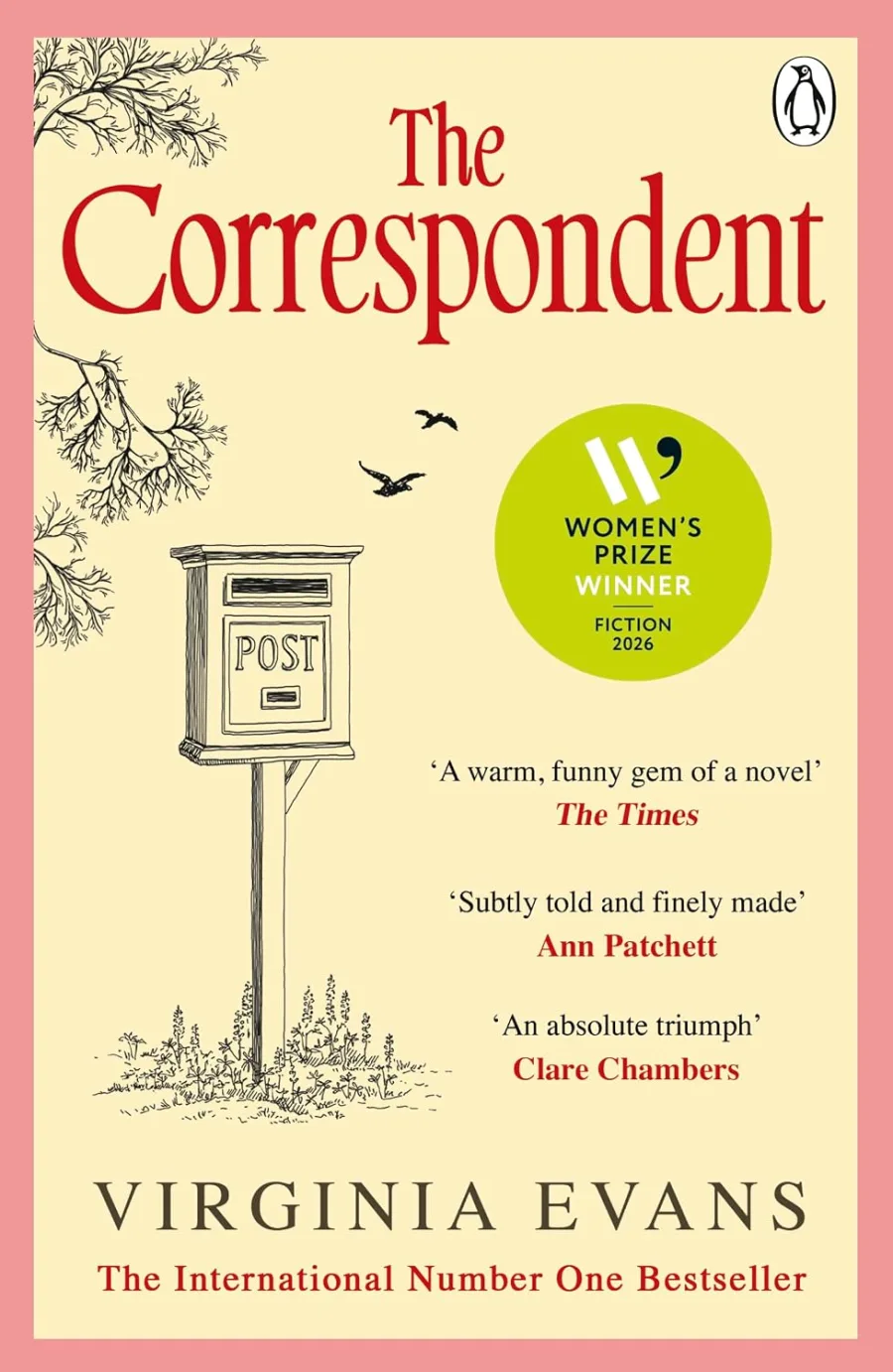
The Correspondent: Winner of the Women’s Prize for Fiction 2026
Paperback
• 320 Pages
• ₹ 599.00
• English
• 9781405971553
No ratings yet
| Publisher | Penguin |
|---|---|
| ISBN13 | 9781405971553 |
| ASIN/SKU | 140597155X |
| Book Format | Paperback |
| Language | English |
| Pages | 320 |
| List Price | ₹ 599.00 |
| Publishing Date | 11/06/2026 |
| Dimensions | 13 x 2.1 x 19.9 cm |
| Weight | 228 g |
| Book Code | BD00070416 |
Buy this Book
Amazon Stores
Ebook Stores
Other Stores
Discover The Correspondent: Winner of the Women’s Prize for Fiction 2026 by Virginia Evans. This book is published by Penguin in Paperback format, ISBN 9781405971553, ASIN 140597155X, under Literature and Fiction, Humour, Contemporary Fiction.
Book Description
WINNER OF THE WOMEN'S PRIZE FOR FICTION 2026
#1SUNDAY TIMES BESTSELLER
#1 NEW YORK TIMES BESTSELLER
OVER TWO MILLION COPIES SOLD WORLDWIDE
A TIMESBOOK OF THE YEAR 2025
AN IRISH TIMES BESTSELLER
A BBC RADIO 2 BOOK CLUB PICK
'A warm, funny gem of a novel'
LAURA HACKETT, THE TIMES
'Masterful . . . I was delighted and moved'
NEW YORK TIMES
'Immensely enjoyable'
GUARDIAN
'I can't praise it enough. It's an absolute triumph'
CLARE CHAMBERS
'What a novel! Tender, dry, sharp...devastating, but still feel good.'
PANDORA SYKES
'Tremendous'
FREDRIK BACKMAN
'Shows us what a glorious thing growing older can be'
FLORENCE KNAPP
'The year's breakout novel no one saw coming'
WALL STREET JOURNAL
–
Sybil Van Antwerp is seventy-three, slowly losing her sight and always writing letters . . .
To her children. Her favourite authors. Her ex-sister-in-law. The journalist poking into her past.
Her doctor. Suitors. Kindly neighbours. The infuriating gardening club.
All receive Sybil’s witty, wise correspondence, rich with everyday concerns.
But there is one letter that she has never sent. It concerns the darkest period of her life. To post it, Sybil must find forgiveness within herself.
The hardest letter to write is the one you’d never dare to send.
#1SUNDAY TIMES BESTSELLER
#1 NEW YORK TIMES BESTSELLER
OVER TWO MILLION COPIES SOLD WORLDWIDE
A TIMESBOOK OF THE YEAR 2025
AN IRISH TIMES BESTSELLER
A BBC RADIO 2 BOOK CLUB PICK
'A warm, funny gem of a novel'
LAURA HACKETT, THE TIMES
'Masterful . . . I was delighted and moved'
NEW YORK TIMES
'Immensely enjoyable'
GUARDIAN
'I can't praise it enough. It's an absolute triumph'
CLARE CHAMBERS
'What a novel! Tender, dry, sharp...devastating, but still feel good.'
PANDORA SYKES
'Tremendous'
FREDRIK BACKMAN
'Shows us what a glorious thing growing older can be'
FLORENCE KNAPP
'The year's breakout novel no one saw coming'
WALL STREET JOURNAL
–
Sybil Van Antwerp is seventy-three, slowly losing her sight and always writing letters . . .
To her children. Her favourite authors. Her ex-sister-in-law. The journalist poking into her past.
Her doctor. Suitors. Kindly neighbours. The infuriating gardening club.
All receive Sybil’s witty, wise correspondence, rich with everyday concerns.
But there is one letter that she has never sent. It concerns the darkest period of her life. To post it, Sybil must find forgiveness within herself.
The hardest letter to write is the one you’d never dare to send.
Author Biography
Virginia Evans is from the east coast of the United States. She attended James Madison University for her bachelor’s in English literature. After starting a family, she went back to school for her master’s of philosophy in creative writing at Trinity College in Dublin, Ireland, where she had the good fortune to study under Carlo Gébler, Eoin McNamee, Claire Keegan, Harry Clifton and Kevin Power. She now lives in Winston-Salem, North Carolina, with her husband, Mark, two children, Jack and Mae, and her Red Labrador, Brigid.
Editorial Reviews
I was delighted and moved . . . Evans does an expert job at making you root for [Sybil] even as you want to give her a timeout . . . Masterful ― New York Times
This is the novel I'm giving to everyone for Christmas...The Correspondent is a delight: melancholy without being sentimental, warm without being cosy, witty without being silly... The comparisons to Strout are accurate but this novel also reminded me of Anne Tyler's ability to make the domestic dramatic... An ode to a dying art form, and proof that your life is never too decided to make a change. -- Laura Hackett ― The Times
A warm, funny gem of a novel . . . It’s a clever conceit, which Virginia Evans uses to great effect in a novel that is melancholic without being sentimental. One for fans of Elizabeth Strout. ― The Times, Best Books of 2025
Subtly told and finely made, The Correspondent is a portrait of a small life expanding. Virginia Evans shows how one woman changes at a point when change had seemed impossible. That change, like this novel, turns out to be a cause for celebration -- Ann Patchett, bestselling author of TOM LAKE
‘A masterclass in how to put words on human frailty. This debut does not put a foot wrong. Smart and clever . . . Evans is a confident, competent author in whom we can trust’ ― Irish Times
This is the novel I'm giving to everyone for Christmas...The Correspondent is a delight: melancholy without being sentimental, warm without being cosy, witty without being silly... The comparisons to Strout are accurate but this novel also reminded me of Anne Tyler's ability to make the domestic dramatic... An ode to a dying art form, and proof that your life is never too decided to make a change. -- Laura Hackett ― The Times
A warm, funny gem of a novel . . . It’s a clever conceit, which Virginia Evans uses to great effect in a novel that is melancholic without being sentimental. One for fans of Elizabeth Strout. ― The Times, Best Books of 2025
Subtly told and finely made, The Correspondent is a portrait of a small life expanding. Virginia Evans shows how one woman changes at a point when change had seemed impossible. That change, like this novel, turns out to be a cause for celebration -- Ann Patchett, bestselling author of TOM LAKE
‘A masterclass in how to put words on human frailty. This debut does not put a foot wrong. Smart and clever . . . Evans is a confident, competent author in whom we can trust’ ― Irish Times
Book Summary
The Correspondent by Virginia Evans is a warm, thoughtful, and deeply emotional novel about aging, family, regret, forgiveness, friendship, love, and the extraordinary power of written words. The story follows Sybil Van Antwerp, a seventy-three-year-old retired lawyer, mother, grandmother, divorcee, gardener, and devoted letter writer. Sybil has spent much of her life using letters to understand people and to make sense of her own experiences. She writes regularly to family members, friends, authors, doctors, neighbours, university officials, and other people who have touched her life. Yet among all the letters she writes, there is one that has remained unsent for decades. That unfinished letter contains the deepest pain of her past, and as Sybil enters a later stage of life, she must finally confront the memories and emotions she has kept hidden.
The novel is told through correspondence, making it an example of epistolary fiction. Instead of following Sybil through a conventional sequence of narrated scenes, readers gradually discover her personality, history, relationships, opinions, humour, disappointments, and fears through the letters she writes. This format is central to the novel because Sybil does not simply communicate through letters; writing letters is the way she thinks. When she cannot easily say something aloud, she can put it on paper. When she wants to understand another person, she writes to them. When she is angry, amused, confused, lonely, or grateful, she turns to correspondence. Her letters therefore become windows into a life that is much more complicated and emotionally rich than it may initially appear.
Sybil is an especially important part of the novel's appeal. She is not presented as a stereotypically gentle or endlessly wise older woman. She can be stubborn, opinionated, impatient, funny, sharp-tongued, and occasionally difficult. She has strong opinions about books, people, manners, institutions, and the way the world works. Yet beneath this confidence is a woman who has accumulated decades of experience, mistakes, disappointments, relationships, and memories. Her personality makes her feel human rather than idealised. The novel's emotional power comes partly from allowing readers to see both her strengths and her flaws. She has lived a full life, but she discovers that having lived for seventy-three years does not mean that every part of that life has been understood or resolved.
Sybil's daily routine initially appears comfortable and predictable. She has retired from a distinguished career in law and has created a life in which correspondence, reading, gardening, and relationships give her a sense of purpose. She expects life to continue in much the same way. But the arrival of letters connected to her past begins to disturb that stability. Someone from an earlier period of her life forces Sybil to reconsider events that she has spent many years trying not to revisit. The past, which she believed she had successfully contained, begins to return to the present. This becomes the emotional engine of the novel.
One of the most important ideas in the novel is that people do not always finish dealing with painful experiences simply because time passes. Sybil has spent approximately thirty years carrying a devastating loss within herself. She has continued with her career, family life, friendships, reading, gardening, and everyday routines, but the unresolved pain has remained beneath the surface. The return of someone or something connected to that past makes it impossible for her to continue avoiding it. The novel therefore explores the difference between moving on and truly healing. A person can continue living while still carrying an old wound. Sometimes genuine peace requires returning to that wound and looking at it honestly.
The unsent letter becomes a powerful symbol of everything Sybil has not been able to say. It represents grief, guilt, regret, memory, and the emotional truth she has kept hidden. For years she has written this letter without sending it, suggesting that writing has allowed her to approach the truth while still protecting herself from its consequences. Eventually, however, she understands that the letter cannot remain unfinished forever. If she wants to move forward, she must confront what it represents and find a way to forgive. The question is not simply whether she will physically mail a letter. The deeper question is whether she can release herself from the emotional burden attached to the past.
Forgiveness is therefore one of the novel's central themes. Evans does not treat forgiveness as something simple or automatic. Sybil must wrestle with difficult memories and conflicting emotions before she can reach a different understanding of what happened. The novel suggests that forgiveness does not necessarily mean saying that something painful was acceptable. It can instead mean refusing to allow an old event to control the rest of one's life. Sometimes forgiveness is directed toward another person; sometimes it involves forgiving oneself for decisions made when one was younger, less experienced, frightened, or unable to understand the consequences. Sybil's journey shows that forgiveness can be an act of freedom.
The contrast between youth and old age is another important theme. Sybil has reached an age when she can look backward with a perspective that was impossible when she was younger. Youth often comes with certainty, ambition, pride, and the belief that there will always be more time. Old age can bring a different kind of knowledge. People begin to see the consequences of earlier choices more clearly, recognise the complexity of relationships, and understand that many conflicts are less simple than they once appeared. The novel explores what happens when a person gains wisdom late in life and realises that some changes are still possible.
Importantly, The Correspondent does not present old age as a period of decline in which meaningful experiences are over. Instead, it suggests that later life can contain new beginnings. Sybil may have already experienced marriage, divorce, motherhood, grandmotherhood, a professional career, friendships, loss, and many other major events, but she is not finished becoming herself. She can still repair relationships, make new connections, consider romance, and change her understanding of the past. The novel's message is therefore hopeful: growing older does not mean that personal growth has to stop.
Sybil's relationships with her children are an important part of this process. Like many family relationships, they are complicated by history, expectations, misunderstandings, and different ideas about what parents and adult children owe one another. Sybil has her own strong personality and is not always easy to live with or understand. Her children also have their own perspectives and emotional needs. As she confronts her past, she begins to recognise that some of her relationships require more attention than she previously gave them. Repairing family relationships becomes part of the larger process of examining her life.
The novel also explores the possibility of romance in later life. Sybil's story does not suggest that love belongs only to the young. Even after divorce and decades of life experience, she can still encounter affection, companionship, attraction, and the possibility of a new relationship. This is significant because popular stories often treat romantic development as something reserved for younger characters. Evans instead presents an older woman whose emotional life remains active and whose future is not completely determined by her past. The possibility of love becomes another example of the book's belief that it is never too late for something new to begin.
Another part of Sybil's transformation involves an old legal case. Her professional history as a lawyer gives her particular knowledge of responsibility, evidence, judgment, and consequences, but the return of an old case forces her to look at her own life through a similarly critical lens. She must confront an aspect of her past that continues to trouble her. This creates an interesting contrast: Sybil has spent her professional life dealing with complicated situations involving other people, yet understanding and judging her own choices proves much more difficult.
Literature itself is another major character in the novel, even though books are not literally characters. Sybil writes to authors such as Joan Didion and Larry McMurtry to tell them what she thinks about their work. These letters show how deeply literature has influenced her inner life. Books have given her companionship, ideas, language, and ways of understanding human behaviour. She is not simply a reader who consumes stories; she feels that books create relationships between people who may never meet. This becomes an important part of the novel's larger argument about connection.
The written word provides Sybil with a special kind of freedom. In ordinary conversation, people often react quickly, misunderstand one another, or become defensive. Writing allows Sybil to slow down. She can think about what she wants to say and choose her words carefully. This is particularly important because the novel itself is about the difficulty of expressing painful truths. Letters can create distance, but they can also create honesty. By writing, Sybil can say things she might never be able to say in person.
At the same time, the letters show that communication is not always straightforward. People can write with confidence while hiding uncertainty. They can explain themselves without fully understanding their own motivations. They can remember events differently from other people. Through Sybil's correspondence, readers therefore learn that every person's version of a relationship is shaped by memory and perspective. A letter can reveal the truth, but it can also reveal how a person chooses to see that truth.
Humour plays an important role in keeping the novel from becoming overwhelmingly sad. Sybil's opinions, observations, complaints, and interactions with other people give the story a lively personality. Her frustrations with institutions, neighbours, family members, and various people in her community often create moments of comedy. This humour is important because the novel deals with grief, regret, and loss. Life itself contains both pain and absurdity, and Sybil's ability to be funny even while carrying deep sadness makes her feel particularly authentic. Readers are allowed to laugh with her even as they gradually understand the emotional weight she carries.
Gardening also contributes to the novel's sense of everyday life. Sybil's attention to ordinary routines gives the story a grounded quality. Her world is not made up entirely of dramatic revelations. It includes plants, correspondence, appointments, neighbours, books, family concerns, and small frustrations. These ordinary details make the larger emotional developments more powerful because they demonstrate how major changes can occur within apparently quiet lives. A person can be dealing with enormous internal questions while continuing to water plants, write letters, attend meetings, and worry about everyday matters.
The novel's title, The Correspondent, is therefore especially appropriate. Sybil is a correspondent in the literal sense because she writes letters, but the word also suggests someone who maintains connections across distance. Her correspondence creates a network of relationships that allows her to remain connected to people, ideas, memories, and literature. In another sense, the title describes the way a life is assembled from relationships. Every letter sent or received becomes part of a larger record of who Sybil has been and who she is becoming.
The novel also makes an important statement about time. At seventy-three, Sybil is conscious that life is finite. This awareness changes the meaning of unresolved problems. Earlier in life, she might have assumed that there would always be another opportunity to apologise, reconnect, explain, or change. Later in life, the urgency becomes stronger. If something matters, perhaps it should not be postponed indefinitely. This does not mean that the novel becomes morbid. Instead, awareness of mortality gives greater value to ordinary moments and relationships.
The story's emotional climax comes from Sybil's recognition that she cannot fully move forward until she confronts the old pain she has kept hidden. The unsent letter becomes a challenge: can she finally say what needs to be said and release herself from the burden? The answer involves forgiveness, but also courage. She must accept that the past cannot be changed. What can change is her relationship to the past. She can decide whether it will continue controlling her emotional life or whether she can carry the memory without allowing it to define her future.
One of the novel's most hopeful messages is that people can change even after many decades. Sybil has spent much of her life developing strong opinions and habits, yet she discovers that she is still capable of reconsidering herself. This is particularly meaningful because personal change is often associated with youth. Evans instead argues that self-discovery can happen at any age. A seventy-three-year-old woman can learn something new about herself, repair relationships, fall in love, make amends, and choose a different emotional future.
Ultimately, The Correspondent is a novel about what remains unsaid and what happens when we finally find the courage to say it. Through Sybil's letters, Virginia Evans explores the complicated relationship between memory and truth, the weight of regret, the possibility of forgiveness, and the importance of human connection. The novel suggests that a life is not simply a sequence of events; it is a collection of relationships, choices, mistakes, acts of kindness, losses, and stories that we tell ourselves about what happened.
The book's greatest strength is perhaps its belief that life can still surprise us. Sybil may believe that she knows what the rest of her life will look like, but the return of the past forces her to reconsider that assumption. She learns that there are still relationships to repair, possibilities to explore, and truths to face. Her story is therefore not only about looking backward. It is also about discovering that the future remains open.
In simple terms, The Correspondent is the story of an older woman who has spent a lifetime writing letters and using words to understand herself and other people. When the past returns and forces her to confront a devastating loss, Sybil must decide whether she is ready to forgive, make amends, and finally let herself move forward. The novel celebrates books, correspondence, friendship, family, humour, love, and the wisdom that can come from living through difficult experiences. Most importantly, it offers a reassuring message: it is never too late to understand yourself better, repair a relationship, forgive someone, seek forgiveness, form a new connection, or begin another chapter of your life.
The novel is told through correspondence, making it an example of epistolary fiction. Instead of following Sybil through a conventional sequence of narrated scenes, readers gradually discover her personality, history, relationships, opinions, humour, disappointments, and fears through the letters she writes. This format is central to the novel because Sybil does not simply communicate through letters; writing letters is the way she thinks. When she cannot easily say something aloud, she can put it on paper. When she wants to understand another person, she writes to them. When she is angry, amused, confused, lonely, or grateful, she turns to correspondence. Her letters therefore become windows into a life that is much more complicated and emotionally rich than it may initially appear.
Sybil is an especially important part of the novel's appeal. She is not presented as a stereotypically gentle or endlessly wise older woman. She can be stubborn, opinionated, impatient, funny, sharp-tongued, and occasionally difficult. She has strong opinions about books, people, manners, institutions, and the way the world works. Yet beneath this confidence is a woman who has accumulated decades of experience, mistakes, disappointments, relationships, and memories. Her personality makes her feel human rather than idealised. The novel's emotional power comes partly from allowing readers to see both her strengths and her flaws. She has lived a full life, but she discovers that having lived for seventy-three years does not mean that every part of that life has been understood or resolved.
Sybil's daily routine initially appears comfortable and predictable. She has retired from a distinguished career in law and has created a life in which correspondence, reading, gardening, and relationships give her a sense of purpose. She expects life to continue in much the same way. But the arrival of letters connected to her past begins to disturb that stability. Someone from an earlier period of her life forces Sybil to reconsider events that she has spent many years trying not to revisit. The past, which she believed she had successfully contained, begins to return to the present. This becomes the emotional engine of the novel.
One of the most important ideas in the novel is that people do not always finish dealing with painful experiences simply because time passes. Sybil has spent approximately thirty years carrying a devastating loss within herself. She has continued with her career, family life, friendships, reading, gardening, and everyday routines, but the unresolved pain has remained beneath the surface. The return of someone or something connected to that past makes it impossible for her to continue avoiding it. The novel therefore explores the difference between moving on and truly healing. A person can continue living while still carrying an old wound. Sometimes genuine peace requires returning to that wound and looking at it honestly.
The unsent letter becomes a powerful symbol of everything Sybil has not been able to say. It represents grief, guilt, regret, memory, and the emotional truth she has kept hidden. For years she has written this letter without sending it, suggesting that writing has allowed her to approach the truth while still protecting herself from its consequences. Eventually, however, she understands that the letter cannot remain unfinished forever. If she wants to move forward, she must confront what it represents and find a way to forgive. The question is not simply whether she will physically mail a letter. The deeper question is whether she can release herself from the emotional burden attached to the past.
Forgiveness is therefore one of the novel's central themes. Evans does not treat forgiveness as something simple or automatic. Sybil must wrestle with difficult memories and conflicting emotions before she can reach a different understanding of what happened. The novel suggests that forgiveness does not necessarily mean saying that something painful was acceptable. It can instead mean refusing to allow an old event to control the rest of one's life. Sometimes forgiveness is directed toward another person; sometimes it involves forgiving oneself for decisions made when one was younger, less experienced, frightened, or unable to understand the consequences. Sybil's journey shows that forgiveness can be an act of freedom.
The contrast between youth and old age is another important theme. Sybil has reached an age when she can look backward with a perspective that was impossible when she was younger. Youth often comes with certainty, ambition, pride, and the belief that there will always be more time. Old age can bring a different kind of knowledge. People begin to see the consequences of earlier choices more clearly, recognise the complexity of relationships, and understand that many conflicts are less simple than they once appeared. The novel explores what happens when a person gains wisdom late in life and realises that some changes are still possible.
Importantly, The Correspondent does not present old age as a period of decline in which meaningful experiences are over. Instead, it suggests that later life can contain new beginnings. Sybil may have already experienced marriage, divorce, motherhood, grandmotherhood, a professional career, friendships, loss, and many other major events, but she is not finished becoming herself. She can still repair relationships, make new connections, consider romance, and change her understanding of the past. The novel's message is therefore hopeful: growing older does not mean that personal growth has to stop.
Sybil's relationships with her children are an important part of this process. Like many family relationships, they are complicated by history, expectations, misunderstandings, and different ideas about what parents and adult children owe one another. Sybil has her own strong personality and is not always easy to live with or understand. Her children also have their own perspectives and emotional needs. As she confronts her past, she begins to recognise that some of her relationships require more attention than she previously gave them. Repairing family relationships becomes part of the larger process of examining her life.
The novel also explores the possibility of romance in later life. Sybil's story does not suggest that love belongs only to the young. Even after divorce and decades of life experience, she can still encounter affection, companionship, attraction, and the possibility of a new relationship. This is significant because popular stories often treat romantic development as something reserved for younger characters. Evans instead presents an older woman whose emotional life remains active and whose future is not completely determined by her past. The possibility of love becomes another example of the book's belief that it is never too late for something new to begin.
Another part of Sybil's transformation involves an old legal case. Her professional history as a lawyer gives her particular knowledge of responsibility, evidence, judgment, and consequences, but the return of an old case forces her to look at her own life through a similarly critical lens. She must confront an aspect of her past that continues to trouble her. This creates an interesting contrast: Sybil has spent her professional life dealing with complicated situations involving other people, yet understanding and judging her own choices proves much more difficult.
Literature itself is another major character in the novel, even though books are not literally characters. Sybil writes to authors such as Joan Didion and Larry McMurtry to tell them what she thinks about their work. These letters show how deeply literature has influenced her inner life. Books have given her companionship, ideas, language, and ways of understanding human behaviour. She is not simply a reader who consumes stories; she feels that books create relationships between people who may never meet. This becomes an important part of the novel's larger argument about connection.
The written word provides Sybil with a special kind of freedom. In ordinary conversation, people often react quickly, misunderstand one another, or become defensive. Writing allows Sybil to slow down. She can think about what she wants to say and choose her words carefully. This is particularly important because the novel itself is about the difficulty of expressing painful truths. Letters can create distance, but they can also create honesty. By writing, Sybil can say things she might never be able to say in person.
At the same time, the letters show that communication is not always straightforward. People can write with confidence while hiding uncertainty. They can explain themselves without fully understanding their own motivations. They can remember events differently from other people. Through Sybil's correspondence, readers therefore learn that every person's version of a relationship is shaped by memory and perspective. A letter can reveal the truth, but it can also reveal how a person chooses to see that truth.
Humour plays an important role in keeping the novel from becoming overwhelmingly sad. Sybil's opinions, observations, complaints, and interactions with other people give the story a lively personality. Her frustrations with institutions, neighbours, family members, and various people in her community often create moments of comedy. This humour is important because the novel deals with grief, regret, and loss. Life itself contains both pain and absurdity, and Sybil's ability to be funny even while carrying deep sadness makes her feel particularly authentic. Readers are allowed to laugh with her even as they gradually understand the emotional weight she carries.
Gardening also contributes to the novel's sense of everyday life. Sybil's attention to ordinary routines gives the story a grounded quality. Her world is not made up entirely of dramatic revelations. It includes plants, correspondence, appointments, neighbours, books, family concerns, and small frustrations. These ordinary details make the larger emotional developments more powerful because they demonstrate how major changes can occur within apparently quiet lives. A person can be dealing with enormous internal questions while continuing to water plants, write letters, attend meetings, and worry about everyday matters.
The novel's title, The Correspondent, is therefore especially appropriate. Sybil is a correspondent in the literal sense because she writes letters, but the word also suggests someone who maintains connections across distance. Her correspondence creates a network of relationships that allows her to remain connected to people, ideas, memories, and literature. In another sense, the title describes the way a life is assembled from relationships. Every letter sent or received becomes part of a larger record of who Sybil has been and who she is becoming.
The novel also makes an important statement about time. At seventy-three, Sybil is conscious that life is finite. This awareness changes the meaning of unresolved problems. Earlier in life, she might have assumed that there would always be another opportunity to apologise, reconnect, explain, or change. Later in life, the urgency becomes stronger. If something matters, perhaps it should not be postponed indefinitely. This does not mean that the novel becomes morbid. Instead, awareness of mortality gives greater value to ordinary moments and relationships.
The story's emotional climax comes from Sybil's recognition that she cannot fully move forward until she confronts the old pain she has kept hidden. The unsent letter becomes a challenge: can she finally say what needs to be said and release herself from the burden? The answer involves forgiveness, but also courage. She must accept that the past cannot be changed. What can change is her relationship to the past. She can decide whether it will continue controlling her emotional life or whether she can carry the memory without allowing it to define her future.
One of the novel's most hopeful messages is that people can change even after many decades. Sybil has spent much of her life developing strong opinions and habits, yet she discovers that she is still capable of reconsidering herself. This is particularly meaningful because personal change is often associated with youth. Evans instead argues that self-discovery can happen at any age. A seventy-three-year-old woman can learn something new about herself, repair relationships, fall in love, make amends, and choose a different emotional future.
Ultimately, The Correspondent is a novel about what remains unsaid and what happens when we finally find the courage to say it. Through Sybil's letters, Virginia Evans explores the complicated relationship between memory and truth, the weight of regret, the possibility of forgiveness, and the importance of human connection. The novel suggests that a life is not simply a sequence of events; it is a collection of relationships, choices, mistakes, acts of kindness, losses, and stories that we tell ourselves about what happened.
The book's greatest strength is perhaps its belief that life can still surprise us. Sybil may believe that she knows what the rest of her life will look like, but the return of the past forces her to reconsider that assumption. She learns that there are still relationships to repair, possibilities to explore, and truths to face. Her story is therefore not only about looking backward. It is also about discovering that the future remains open.
In simple terms, The Correspondent is the story of an older woman who has spent a lifetime writing letters and using words to understand herself and other people. When the past returns and forces her to confront a devastating loss, Sybil must decide whether she is ready to forgive, make amends, and finally let herself move forward. The novel celebrates books, correspondence, friendship, family, humour, love, and the wisdom that can come from living through difficult experiences. Most importantly, it offers a reassuring message: it is never too late to understand yourself better, repair a relationship, forgive someone, seek forgiveness, form a new connection, or begin another chapter of your life.
Sample Chapters
Sample Chapters will be added soon…
Reader Reviews
No reviews yet.
The Correspondent: Winner of the Women’s Prize for Fiction 2026
Download Cover Image
Do you want to download the full cover image for The Correspondent: Winner of the Women’s Prize for Fiction 2026?