
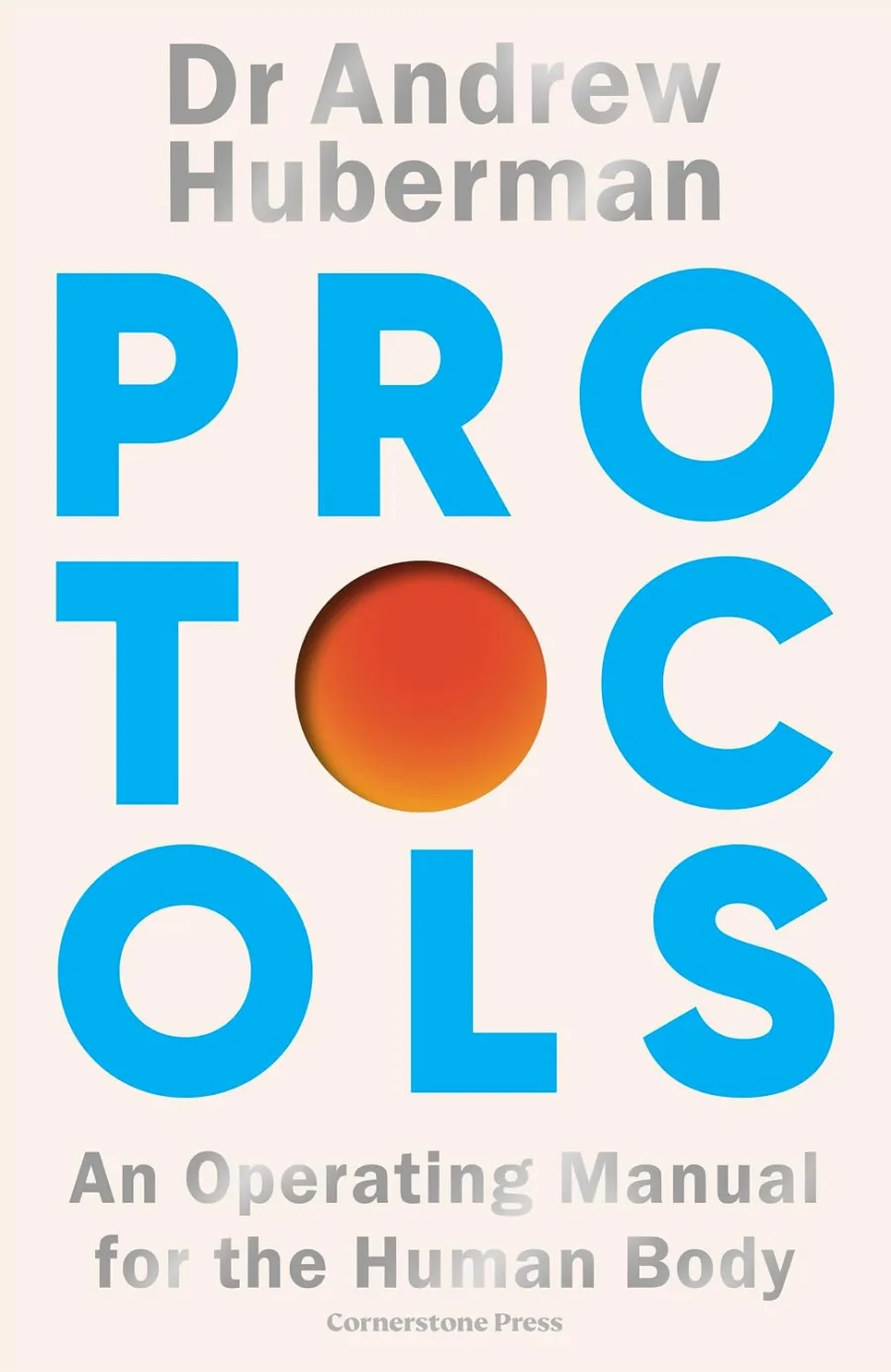
Protocols: An Operating Manual for the Human Body
Hardcover
• 688 Pages
• ₹ 1999.00
• English
• 9781529921281
No ratings yet
| Publisher | Cornerstone Press |
|---|---|
| ISBN13 | 9781529921281 |
| ASIN/SKU | 1529921287 |
| Book Format | Hardcover |
| Language | English |
| Pages | 688 |
| List Price | ₹ 1999.00 |
| Publishing Date | 15/10/2026 |
| Dimensions | 16.5 x 5.7 x 24.2 cm |
| Weight | 750 g |
| Book Code | BD00070414 |
Buy this Book
Amazon Stores
Ebook Stores
Other Stores
Discover Protocols: An Operating Manual for the Human Body by Andrew Huberman. This book is published by Cornerstone Press in Hardcover format, ISBN 9781529921281, ASIN 1529921287, under Health, Fitness and Dieting, Health, Fitness and Nutrition.
Book Description
Dr Andrew Huberman, host of the world’s leading health podcast, Huberman Lab, and neuroscientist and tenured professor at Stanford School of Medicine, introduces Protocols, an essential guide to improving brain function, enhancing mood and energy, optimising bodily health and physical performance, and rewiring your nervous system to learn new skills and behaviours that can transform your life.
Protocols provides simple, powerful and evidence-based solutions to life’s most common challenges. Designed to improve your mental health, physical health and performance, these guidelines are customisable, allowing you to adapt them to your specific needs. With his clear and engaging style, Dr Huberman explains the scientific principles behind each protocol and how they can deliver immediate, effective results. Protocols is your essential road map for achieving optimal health.
Protocols provides simple, powerful and evidence-based solutions to life’s most common challenges. Designed to improve your mental health, physical health and performance, these guidelines are customisable, allowing you to adapt them to your specific needs. With his clear and engaging style, Dr Huberman explains the scientific principles behind each protocol and how they can deliver immediate, effective results. Protocols is your essential road map for achieving optimal health.
Author Biography
Andrew Huberman, Ph.D., is a neuroscientist and tenured professor in the department of neurobiology, ophthalmology, and, by courtesy, psychiatry and behavioral sciences at Stanford School of Medicine. He has made numerous significant contributions to the fields of brain development, brain function, and neural plasticity. His laboratory at Stanford School of Medicine has published work in top journals such as Nature, Science, and Cell and in top media outlets like the BBC, Time, Scientific American, and Discover.
Dr. Huberman is a McKnight Foundation and Pew Foundation Fellow and was awarded the Association for Research in Vision and Ophthalmology’s Cogan Award in 2017, given to the scientist making the most significant discoveries in the study of vision.
In 2021, Dr. Huberman launched the Huberman Lab podcast. The podcast is often ranked in the global top ten and regularly ranks #1 in the categories of Science, Education, and Health & Fitness.
Dr. Huberman is a McKnight Foundation and Pew Foundation Fellow and was awarded the Association for Research in Vision and Ophthalmology’s Cogan Award in 2017, given to the scientist making the most significant discoveries in the study of vision.
In 2021, Dr. Huberman launched the Huberman Lab podcast. The podcast is often ranked in the global top ten and regularly ranks #1 in the categories of Science, Education, and Health & Fitness.
Editorial Reviews
Editorial Reviews will be added soon…
Book Summary
Protocols: An Operating Manual for the Human Body by Andrew D. Huberman is presented as a practical guide to understanding how the human brain and body work and, more importantly, how everyday habits can be used to improve them. Huberman, a neuroscientist and professor at Stanford School of Medicine and the creator of the Huberman Lab podcast, approaches health and performance through the language of science, physiology, and behavior. Rather than presenting health as a collection of vague motivational ideas, the book organizes useful practices into what he calls “protocols”—specific, evidence-based ways of using the body's natural systems to improve sleep, physical health, mood, energy, focus, learning, and performance. The central idea is that people can influence many aspects of their physical and mental state by understanding the biological mechanisms behind their behavior.
The most important idea in the book is that there is no single perfect routine that works for everybody. Huberman's protocols are designed to be customized according to a person's goals, circumstances, and needs. He divides them broadly into foundational behaviors and targeted tools. Foundational behaviors are the basic practices that support good health every day, while targeted tools are used when someone wants to solve a particular problem or improve a specific ability. This distinction is important because the book is not intended to be a rigid schedule that every reader must follow. Instead, it functions more like an operating manual or toolkit. A person can identify a particular challenge, understand the biological system involved, and then select the practices that are most appropriate.
Sleep is one of the major areas of focus. Huberman treats sleep as a fundamental part of physical and mental health rather than simply a period when the body is inactive. Good sleep affects mood, concentration, learning, recovery, metabolism, and overall performance. One example highlighted in the book's official description is the practice of getting sunlight soon after waking. This connects environmental light with the body's internal timing system and helps establish a more stable daily rhythm. The broader message is that improving sleep is not necessarily about finding a single magic product or supplement. It begins with understanding the biological signals that tell the brain when to be awake and when to sleep.
Exercise is another major part of the book's approach. Huberman presents physical activity not merely as a way to change appearance but as an important tool for maintaining brain and body function. Exercise can influence strength, body composition, cardiovascular health, energy, mood, and long-term physical performance. The book promises protocols designed to help people become stronger and leaner at different ages. This reflects a broader principle running through the book: physical health and mental health are deeply connected. The brain is not separate from the body, and improving physical systems can also support psychological and cognitive performance.
Stress control is another important area. Instead of suggesting that stress can simply be eliminated, Huberman focuses on learning how to regulate the body's response to stressful situations. One example described in the published material is a specific breathing pattern that can be used to reduce stress in the moment. This illustrates what makes a protocol different from general advice. Rather than merely saying “try to relax,” the approach identifies a physiological mechanism and provides a practical behavior intended to influence it. The goal is to give people tools that they can actually use when they feel overwhelmed, anxious, or under pressure.
Nutrition is treated as another important foundation for health and performance. The book does not appear to present nutrition as one universal diet that everybody should follow. Instead, its larger framework emphasizes understanding how food affects energy, physical health, and the systems that support the brain and body. The published descriptions also indicate attention to areas such as the oral and gut microbiome. This reflects Huberman's broader attempt to connect everyday behaviors with underlying biological processes. Food is therefore considered not simply in terms of calories or weight, but as one component of a larger physiological system.
Light is given special importance because it is one of the strongest environmental signals affecting human biology. Natural light, particularly at appropriate times of day, can influence circadian timing, alertness, sleep, and daily energy patterns. The morning-light example demonstrates Huberman's general philosophy: relatively simple environmental interventions can sometimes have significant effects because they work through powerful biological systems. The book therefore encourages readers to consider their surroundings—not just supplements, exercise equipment, or technology—as tools for improving health.
Another major subject is focus, motivation, learning, and neuroplasticity. Huberman's background in neuroscience gives this section particular importance. The brain is capable of changing through experience, practice, attention, and behavior, a property often described as neuroplasticity. The book applies this principle to learning new skills and developing new behaviors. Rather than treating concentration and motivation as fixed personality traits, Huberman presents them as functions that can be influenced by the nervous system and by the conditions in which people work and learn. The goal is to help readers understand how to create circumstances that support deeper focus, better learning, and more effective skill development.
Personal growth forms the seventh broad area of the book. Here the scientific approach is connected to behavior change. Knowing what is healthy is not enough; people must also be able to turn knowledge into consistent action. This is where the idea of protocols becomes especially useful. Instead of relying entirely on willpower, a person can create repeatable behaviors connected to specific goals. A protocol can therefore serve as a bridge between scientific knowledge and ordinary life. It gives the reader something concrete to try, observe, and adjust.
A particularly important message is that the book's recommendations should not be viewed as isolated tricks. Sleep, light, exercise, nutrition, stress, learning, and behavior are interconnected. Poor sleep can affect concentration and mood; stress can interfere with sleep; exercise can influence mood and energy; environmental light can affect sleep timing; and consistent habits can make learning and behavioral change easier. The book's “operating manual” metaphor therefore suggests that the human body is best understood as an interconnected system rather than a collection of separate parts.
Ultimately, Protocols is designed to give readers a practical framework for taking greater responsibility for their health and performance. Its purpose is not simply to provide a long list of things to do. Instead, Huberman explains the scientific reasoning behind the practices so that readers can understand why a particular protocol may be useful and how it can be adapted. The book brings together decades of scientific research, Huberman's own research experience, and material drawn from experts he has interviewed over the years.
The larger lesson of Protocols: An Operating Manual for the Human Body is that improving health does not necessarily require extreme changes. Small, well-chosen behaviors can influence powerful biological systems when they are applied consistently and at the appropriate time. The book encourages readers to become more informed about their own physiology and to treat health improvement as an ongoing process of understanding, experimenting, and adapting. Its seven major areas—sleep, exercise, stress control, nutrition, light, focus and learning, and personal growth—come together to form a broad approach to improving both mental and physical performance. In this sense, Huberman's “operating manual” is less about creating a perfect lifestyle and more about giving people a set of practical tools with which they can better understand and work with their own biology.
The most important idea in the book is that there is no single perfect routine that works for everybody. Huberman's protocols are designed to be customized according to a person's goals, circumstances, and needs. He divides them broadly into foundational behaviors and targeted tools. Foundational behaviors are the basic practices that support good health every day, while targeted tools are used when someone wants to solve a particular problem or improve a specific ability. This distinction is important because the book is not intended to be a rigid schedule that every reader must follow. Instead, it functions more like an operating manual or toolkit. A person can identify a particular challenge, understand the biological system involved, and then select the practices that are most appropriate.
Sleep is one of the major areas of focus. Huberman treats sleep as a fundamental part of physical and mental health rather than simply a period when the body is inactive. Good sleep affects mood, concentration, learning, recovery, metabolism, and overall performance. One example highlighted in the book's official description is the practice of getting sunlight soon after waking. This connects environmental light with the body's internal timing system and helps establish a more stable daily rhythm. The broader message is that improving sleep is not necessarily about finding a single magic product or supplement. It begins with understanding the biological signals that tell the brain when to be awake and when to sleep.
Exercise is another major part of the book's approach. Huberman presents physical activity not merely as a way to change appearance but as an important tool for maintaining brain and body function. Exercise can influence strength, body composition, cardiovascular health, energy, mood, and long-term physical performance. The book promises protocols designed to help people become stronger and leaner at different ages. This reflects a broader principle running through the book: physical health and mental health are deeply connected. The brain is not separate from the body, and improving physical systems can also support psychological and cognitive performance.
Stress control is another important area. Instead of suggesting that stress can simply be eliminated, Huberman focuses on learning how to regulate the body's response to stressful situations. One example described in the published material is a specific breathing pattern that can be used to reduce stress in the moment. This illustrates what makes a protocol different from general advice. Rather than merely saying “try to relax,” the approach identifies a physiological mechanism and provides a practical behavior intended to influence it. The goal is to give people tools that they can actually use when they feel overwhelmed, anxious, or under pressure.
Nutrition is treated as another important foundation for health and performance. The book does not appear to present nutrition as one universal diet that everybody should follow. Instead, its larger framework emphasizes understanding how food affects energy, physical health, and the systems that support the brain and body. The published descriptions also indicate attention to areas such as the oral and gut microbiome. This reflects Huberman's broader attempt to connect everyday behaviors with underlying biological processes. Food is therefore considered not simply in terms of calories or weight, but as one component of a larger physiological system.
Light is given special importance because it is one of the strongest environmental signals affecting human biology. Natural light, particularly at appropriate times of day, can influence circadian timing, alertness, sleep, and daily energy patterns. The morning-light example demonstrates Huberman's general philosophy: relatively simple environmental interventions can sometimes have significant effects because they work through powerful biological systems. The book therefore encourages readers to consider their surroundings—not just supplements, exercise equipment, or technology—as tools for improving health.
Another major subject is focus, motivation, learning, and neuroplasticity. Huberman's background in neuroscience gives this section particular importance. The brain is capable of changing through experience, practice, attention, and behavior, a property often described as neuroplasticity. The book applies this principle to learning new skills and developing new behaviors. Rather than treating concentration and motivation as fixed personality traits, Huberman presents them as functions that can be influenced by the nervous system and by the conditions in which people work and learn. The goal is to help readers understand how to create circumstances that support deeper focus, better learning, and more effective skill development.
Personal growth forms the seventh broad area of the book. Here the scientific approach is connected to behavior change. Knowing what is healthy is not enough; people must also be able to turn knowledge into consistent action. This is where the idea of protocols becomes especially useful. Instead of relying entirely on willpower, a person can create repeatable behaviors connected to specific goals. A protocol can therefore serve as a bridge between scientific knowledge and ordinary life. It gives the reader something concrete to try, observe, and adjust.
A particularly important message is that the book's recommendations should not be viewed as isolated tricks. Sleep, light, exercise, nutrition, stress, learning, and behavior are interconnected. Poor sleep can affect concentration and mood; stress can interfere with sleep; exercise can influence mood and energy; environmental light can affect sleep timing; and consistent habits can make learning and behavioral change easier. The book's “operating manual” metaphor therefore suggests that the human body is best understood as an interconnected system rather than a collection of separate parts.
Ultimately, Protocols is designed to give readers a practical framework for taking greater responsibility for their health and performance. Its purpose is not simply to provide a long list of things to do. Instead, Huberman explains the scientific reasoning behind the practices so that readers can understand why a particular protocol may be useful and how it can be adapted. The book brings together decades of scientific research, Huberman's own research experience, and material drawn from experts he has interviewed over the years.
The larger lesson of Protocols: An Operating Manual for the Human Body is that improving health does not necessarily require extreme changes. Small, well-chosen behaviors can influence powerful biological systems when they are applied consistently and at the appropriate time. The book encourages readers to become more informed about their own physiology and to treat health improvement as an ongoing process of understanding, experimenting, and adapting. Its seven major areas—sleep, exercise, stress control, nutrition, light, focus and learning, and personal growth—come together to form a broad approach to improving both mental and physical performance. In this sense, Huberman's “operating manual” is less about creating a perfect lifestyle and more about giving people a set of practical tools with which they can better understand and work with their own biology.
Sample Chapters
Sample Chapters will be added soon…
Reader Reviews
No reviews yet.
Protocols: An Operating Manual for the Human Body
Download Cover Image
Do you want to download the full cover image for Protocols: An Operating Manual for the Human Body?