
The Chanakya Diaries | India’s Premier Magazine on Geopolitics, Defence & Foreign Affairs
Paperback
• 228 Pages
• ₹ 800.00
• English
No ratings yet
| Publisher | The Chanakya Diaries |
|---|---|
| ASIN/SKU | B0HFW2J3JX |
| Book Format | Paperback |
| Language | English |
| Pages | 228 |
| List Price | ₹ 800.00 |
| Publishing Date | 19/08/2026 |
| Dimensions | 29.7 x 21 x 3 cm |
| Weight | 900 g |
| Book Code | BD00070408 |
Buy this Book
Amazon Stores
Ebook Stores
Other Stores
Discover The Chanakya Diaries | India’s Premier Magazine on Geopolitics, Defence and Foreign Affairs by Major Gaurav Arya (Retd.). This book is published by The Chanakya Diaries in Paperback format, ASIN B0HFW2J3JX, under Politics and Social Sciences, International Relations and Globalization.
Book Description
The Chanakya Diaries is India’s Premier Magazine on Geopolitics, Defence & Foreign Affairs. With the 4th edition featuring contributions from some of the finest minds and subject matter experts, this magazine is an essential read for anyone keen on understanding the intricate dynamics of global politics, defence and security issues. Designed for readers who crave in-depth analyses and expert opinions, this magazine brings to light the most pressing global issues, offering fresh insights and perspectives. With contributions from esteemed scholars, analysts, and policymakers, each edition delves into the geopolitical, economic, and military challenges shaping our world today. If you are preparing for competitive exams or are simply a defence, national security and geopolitics aficionado, The Chanakya Diaries is perfect for you.
Author Biography
Author Biography will be added soon…
Editorial Reviews
Editorial Reviews will be added soon…
Book Summary
The Chanakya Diaries is a strategic affairs magazine focused on geopolitics, defence, national security, international relations, and foreign affairs, with a strong India-centered perspective. Associated with Major Gaurav Arya (Retd.), the publication seeks to examine the forces shaping India's security environment and its position in the wider world. Rather than treating international events as isolated political developments, its approach connects geography, military power, diplomacy, economics, technology, intelligence, and national interest. The name “Chanakya” itself reflects the publication's emphasis on strategic thinking, statecraft, realism, and the long-term interests of the Indian state.
At the heart of The Chanakya Diaries is the idea of geopolitics. Geopolitics is not simply about relations between countries; it is about how geography, natural resources, borders, trade routes, oceans, population, economic strength, and military capabilities influence the behavior of states. For India, geography is particularly important. The country occupies a strategically significant position between the Middle East, Central Asia, Southeast Asia, and the Indian Ocean. It shares sensitive land borders with major powers and has an enormous coastline connected to vital international sea routes. Understanding India's foreign policy therefore requires understanding the geographical and strategic environment in which the country operates.
One of the major strategic questions surrounding India is its relationship with China. China's economic expansion, military modernization, technological capabilities, and growing influence across Asia have transformed the regional balance of power. India and China have economic ties, but they also face strategic competition and unresolved border issues. The Himalayan frontier, infrastructure development, military deployments, the Indian Ocean, trade, technology, and regional influence all contribute to the complexity of the relationship. From a strategic perspective, the challenge for India is not simply to respond to individual developments but to build long-term military, economic, technological, and diplomatic capabilities that protect its national interests.
India-Pakistan relations and cross-border terrorism form another important part of India's national-security environment. India's security challenges on its western border cannot be understood solely through conventional military power. Terrorism, infiltration, intelligence, border security, diplomacy, and international pressure all form part of the larger security equation. Modern national security requires coordination between armed forces, intelligence agencies, diplomatic institutions, technology systems, and political leadership. The publication's broader strategic approach encourages readers to look beyond individual incidents and consider the larger objectives and consequences behind security policies.
Defence is another central pillar of The Chanakya Diaries. Modern warfare has changed dramatically. Military power is no longer measured simply by the number of soldiers, tanks, aircraft, or ships a country possesses. Drones, satellites, artificial intelligence, cyber warfare, electronic warfare, precision weapons, surveillance systems, and space-based capabilities increasingly determine how conflicts are fought. A modern military must therefore combine traditional combat capabilities with advanced technology, information systems, intelligence, and rapid decision-making.
For India, defence modernization and indigenous production have particular strategic significance. A country that depends heavily on foreign suppliers for critical weapons and military technologies can face vulnerabilities during a prolonged crisis. Domestic defence manufacturing, research and development, advanced engineering, and resilient supply chains can increase strategic autonomy. The broader lesson is that national security and industrial capability are closely connected. A strong defence ecosystem requires not only armed forces but also scientists, engineers, manufacturers, technology companies, universities, and research institutions.
The publication also emphasizes the importance of India's Army, Navy, and Air Force as parts of an integrated security system. India's difficult land borders make the Army indispensable, particularly in mountainous and high-altitude regions. At the same time, India's location in the Indian Ocean gives the Navy an important strategic role. Much of the world's trade and energy movement depends on secure maritime routes, making sea-lane security essential for India's economy. The Air Force provides air superiority, surveillance, mobility, and precision capabilities. Future military effectiveness will increasingly depend on how well these services operate together rather than functioning as completely separate organizations.
Maritime security and the Indo-Pacific are therefore important elements of India's strategic outlook. The Indian Ocean is central to India's economic and security interests, while the broader Indo-Pacific has become an area of intense strategic competition. Shipping lanes, ports, energy supplies, undersea infrastructure, and freedom of navigation have implications far beyond naval affairs. India's relationships with countries such as the United States, Japan, Australia, and other regional partners reflect its interest in maintaining a stable and open regional environment. Multilateral arrangements such as the QUAD are consequently relevant not only from a military perspective but also in areas such as technology, maritime awareness, supply-chain resilience, and diplomatic cooperation.
Another major theme is Indian foreign policy. In an increasingly multipolar world, India has to maintain relationships with multiple centers of power simultaneously. Its partnerships with the United States, Russia, European countries, Japan, Australia, Gulf nations, Southeast Asian countries, and others are shaped by different economic and strategic interests. India generally seeks sufficient strategic autonomy to make decisions according to its own national priorities rather than becoming completely dependent on any single power bloc. This makes Indian diplomacy a balancing exercise in which cooperation and competition can exist at the same time.
The concept of national interest is central to this strategic worldview. Countries ultimately seek to protect their sovereignty, security, economic prosperity, and influence. Diplomatic friendships can be valuable, but strategic relationships are also shaped by interests. A country may cooperate with another nation on one issue while disagreeing with it on another. Understanding this reality helps readers move beyond simplistic ideas of permanent friends and permanent enemies. International relations are constantly changing as national interests evolve.
The magazine's focus on intelligence and information warfare is equally relevant to the modern security environment. Traditional warfare takes place on physical battlefields, but modern competition also occurs through information networks, cyberspace, media platforms, satellites, and digital infrastructure. Cyberattacks can disrupt financial systems, communications, energy networks, government institutions, and military infrastructure. Misinformation and influence operations can also shape public perceptions and political decision-making. Consequently, national security increasingly requires the ability to protect both physical territory and digital systems.
The relationship between economic strength and military power is another important lesson. A powerful military requires a strong economic foundation. Defence equipment, research laboratories, infrastructure, training, technology, and logistics all require substantial resources. At the same time, a strong economy can be vulnerable if its energy supplies, trade routes, financial systems, or critical technologies are insecure. Economic security and national security are therefore closely interconnected. India's ambition to become a major global power depends not only on military modernization but also on sustained economic growth, industrial development, technological innovation, and human capital.
The reference to Chanakya provides the publication with a historical and philosophical dimension. Chanakya, traditionally associated with the Arthashastra, is remembered for his thinking on statecraft, diplomacy, intelligence, economics, alliances, and the use of power. Although the modern international system is vastly different from the world of ancient India, some fundamental strategic questions remain remarkably familiar: How should a state protect itself? How should it identify threats? How should it use alliances? How can economic strength support political power? And how should leaders respond when national interests conflict?
The publication's overall approach is therefore best understood as strategic rather than merely political. Political news often focuses on what happened today, while strategic analysis asks why it happened, what interests are involved, how different actors may respond, and what the long-term consequences could be. This distinction is particularly useful for understanding defence and international affairs, where decisions made today can influence a country's security for decades.
Overall, The Chanakya Diaries presents an India-focused way of examining the rapidly changing international environment. Its major themes—geopolitics, defence, foreign policy, national security, China, Pakistan, terrorism, maritime security, military modernization, technology, intelligence, economic power, and strategic autonomy—are interconnected rather than separate subjects. The publication encourages readers to understand India's challenges through a broader strategic lens and to recognize that national power depends on much more than military strength alone.
The central message can be summarized simply: a nation's security depends on its ability to understand the world, anticipate threats, build strength, and protect its national interests. In the 21st century, that strength comes from a combination of military preparedness, economic resilience, technological capability, diplomatic influence, intelligence, secure borders, and strategic vision. The Chanakya Diaries seeks to bring these elements together so that readers can look beyond headlines and develop a deeper understanding of India's place in an increasingly competitive and multipolar world.
At the heart of The Chanakya Diaries is the idea of geopolitics. Geopolitics is not simply about relations between countries; it is about how geography, natural resources, borders, trade routes, oceans, population, economic strength, and military capabilities influence the behavior of states. For India, geography is particularly important. The country occupies a strategically significant position between the Middle East, Central Asia, Southeast Asia, and the Indian Ocean. It shares sensitive land borders with major powers and has an enormous coastline connected to vital international sea routes. Understanding India's foreign policy therefore requires understanding the geographical and strategic environment in which the country operates.
One of the major strategic questions surrounding India is its relationship with China. China's economic expansion, military modernization, technological capabilities, and growing influence across Asia have transformed the regional balance of power. India and China have economic ties, but they also face strategic competition and unresolved border issues. The Himalayan frontier, infrastructure development, military deployments, the Indian Ocean, trade, technology, and regional influence all contribute to the complexity of the relationship. From a strategic perspective, the challenge for India is not simply to respond to individual developments but to build long-term military, economic, technological, and diplomatic capabilities that protect its national interests.
India-Pakistan relations and cross-border terrorism form another important part of India's national-security environment. India's security challenges on its western border cannot be understood solely through conventional military power. Terrorism, infiltration, intelligence, border security, diplomacy, and international pressure all form part of the larger security equation. Modern national security requires coordination between armed forces, intelligence agencies, diplomatic institutions, technology systems, and political leadership. The publication's broader strategic approach encourages readers to look beyond individual incidents and consider the larger objectives and consequences behind security policies.
Defence is another central pillar of The Chanakya Diaries. Modern warfare has changed dramatically. Military power is no longer measured simply by the number of soldiers, tanks, aircraft, or ships a country possesses. Drones, satellites, artificial intelligence, cyber warfare, electronic warfare, precision weapons, surveillance systems, and space-based capabilities increasingly determine how conflicts are fought. A modern military must therefore combine traditional combat capabilities with advanced technology, information systems, intelligence, and rapid decision-making.
For India, defence modernization and indigenous production have particular strategic significance. A country that depends heavily on foreign suppliers for critical weapons and military technologies can face vulnerabilities during a prolonged crisis. Domestic defence manufacturing, research and development, advanced engineering, and resilient supply chains can increase strategic autonomy. The broader lesson is that national security and industrial capability are closely connected. A strong defence ecosystem requires not only armed forces but also scientists, engineers, manufacturers, technology companies, universities, and research institutions.
The publication also emphasizes the importance of India's Army, Navy, and Air Force as parts of an integrated security system. India's difficult land borders make the Army indispensable, particularly in mountainous and high-altitude regions. At the same time, India's location in the Indian Ocean gives the Navy an important strategic role. Much of the world's trade and energy movement depends on secure maritime routes, making sea-lane security essential for India's economy. The Air Force provides air superiority, surveillance, mobility, and precision capabilities. Future military effectiveness will increasingly depend on how well these services operate together rather than functioning as completely separate organizations.
Maritime security and the Indo-Pacific are therefore important elements of India's strategic outlook. The Indian Ocean is central to India's economic and security interests, while the broader Indo-Pacific has become an area of intense strategic competition. Shipping lanes, ports, energy supplies, undersea infrastructure, and freedom of navigation have implications far beyond naval affairs. India's relationships with countries such as the United States, Japan, Australia, and other regional partners reflect its interest in maintaining a stable and open regional environment. Multilateral arrangements such as the QUAD are consequently relevant not only from a military perspective but also in areas such as technology, maritime awareness, supply-chain resilience, and diplomatic cooperation.
Another major theme is Indian foreign policy. In an increasingly multipolar world, India has to maintain relationships with multiple centers of power simultaneously. Its partnerships with the United States, Russia, European countries, Japan, Australia, Gulf nations, Southeast Asian countries, and others are shaped by different economic and strategic interests. India generally seeks sufficient strategic autonomy to make decisions according to its own national priorities rather than becoming completely dependent on any single power bloc. This makes Indian diplomacy a balancing exercise in which cooperation and competition can exist at the same time.
The concept of national interest is central to this strategic worldview. Countries ultimately seek to protect their sovereignty, security, economic prosperity, and influence. Diplomatic friendships can be valuable, but strategic relationships are also shaped by interests. A country may cooperate with another nation on one issue while disagreeing with it on another. Understanding this reality helps readers move beyond simplistic ideas of permanent friends and permanent enemies. International relations are constantly changing as national interests evolve.
The magazine's focus on intelligence and information warfare is equally relevant to the modern security environment. Traditional warfare takes place on physical battlefields, but modern competition also occurs through information networks, cyberspace, media platforms, satellites, and digital infrastructure. Cyberattacks can disrupt financial systems, communications, energy networks, government institutions, and military infrastructure. Misinformation and influence operations can also shape public perceptions and political decision-making. Consequently, national security increasingly requires the ability to protect both physical territory and digital systems.
The relationship between economic strength and military power is another important lesson. A powerful military requires a strong economic foundation. Defence equipment, research laboratories, infrastructure, training, technology, and logistics all require substantial resources. At the same time, a strong economy can be vulnerable if its energy supplies, trade routes, financial systems, or critical technologies are insecure. Economic security and national security are therefore closely interconnected. India's ambition to become a major global power depends not only on military modernization but also on sustained economic growth, industrial development, technological innovation, and human capital.
The reference to Chanakya provides the publication with a historical and philosophical dimension. Chanakya, traditionally associated with the Arthashastra, is remembered for his thinking on statecraft, diplomacy, intelligence, economics, alliances, and the use of power. Although the modern international system is vastly different from the world of ancient India, some fundamental strategic questions remain remarkably familiar: How should a state protect itself? How should it identify threats? How should it use alliances? How can economic strength support political power? And how should leaders respond when national interests conflict?
The publication's overall approach is therefore best understood as strategic rather than merely political. Political news often focuses on what happened today, while strategic analysis asks why it happened, what interests are involved, how different actors may respond, and what the long-term consequences could be. This distinction is particularly useful for understanding defence and international affairs, where decisions made today can influence a country's security for decades.
Overall, The Chanakya Diaries presents an India-focused way of examining the rapidly changing international environment. Its major themes—geopolitics, defence, foreign policy, national security, China, Pakistan, terrorism, maritime security, military modernization, technology, intelligence, economic power, and strategic autonomy—are interconnected rather than separate subjects. The publication encourages readers to understand India's challenges through a broader strategic lens and to recognize that national power depends on much more than military strength alone.
The central message can be summarized simply: a nation's security depends on its ability to understand the world, anticipate threats, build strength, and protect its national interests. In the 21st century, that strength comes from a combination of military preparedness, economic resilience, technological capability, diplomatic influence, intelligence, secure borders, and strategic vision. The Chanakya Diaries seeks to bring these elements together so that readers can look beyond headlines and develop a deeper understanding of India's place in an increasingly competitive and multipolar world.
Sample Chapters
Sample Chapters will be added soon…
Reader Reviews
No reviews yet.
The Chanakya Diaries | India’s Premier Magazine on Geopolitics, Defence & Foreign Affairs
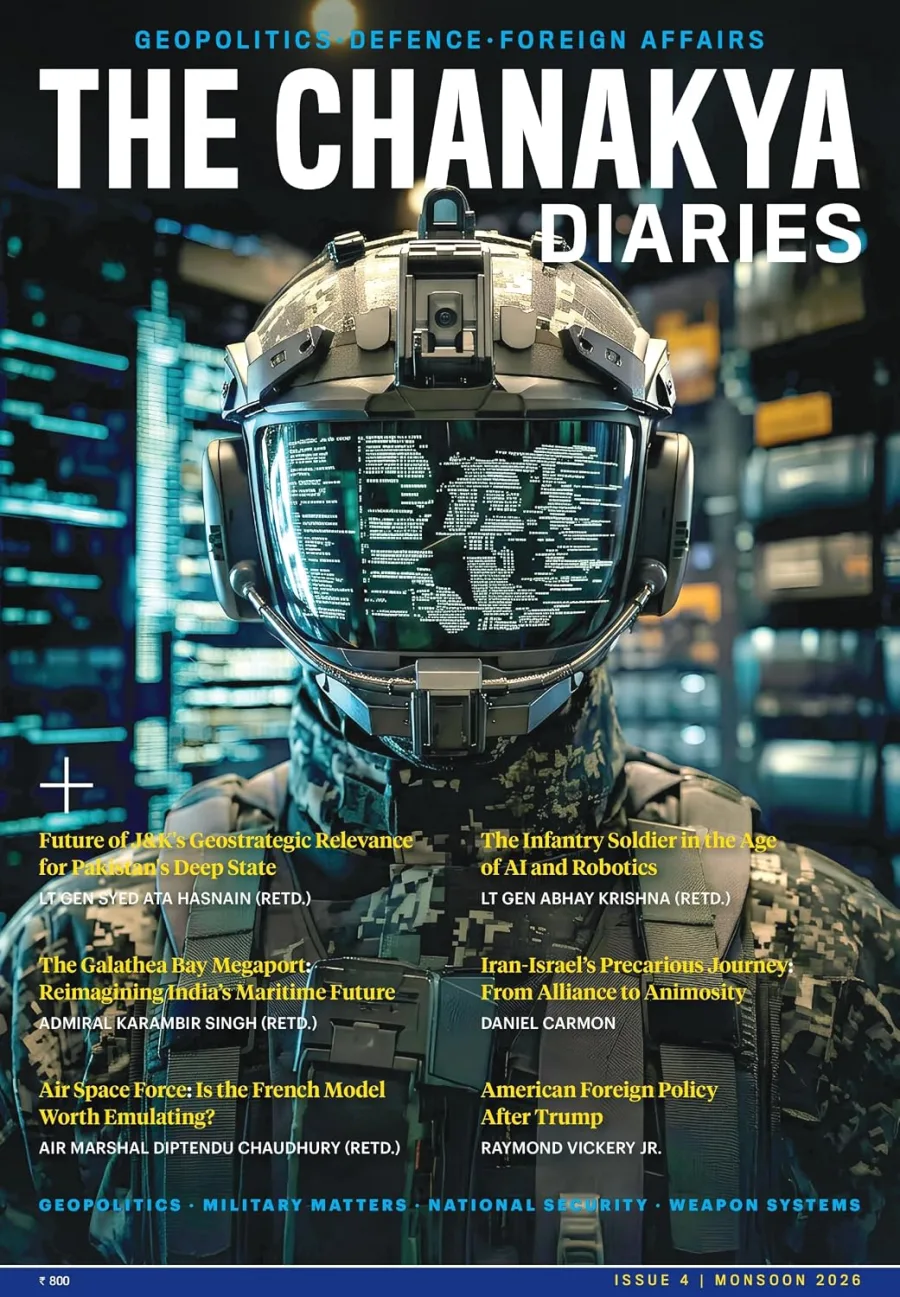
Download Cover Image
Do you want to download the full cover image for The Chanakya Diaries | India’s Premier Magazine on Geopolitics, Defence & Foreign Affairs?