
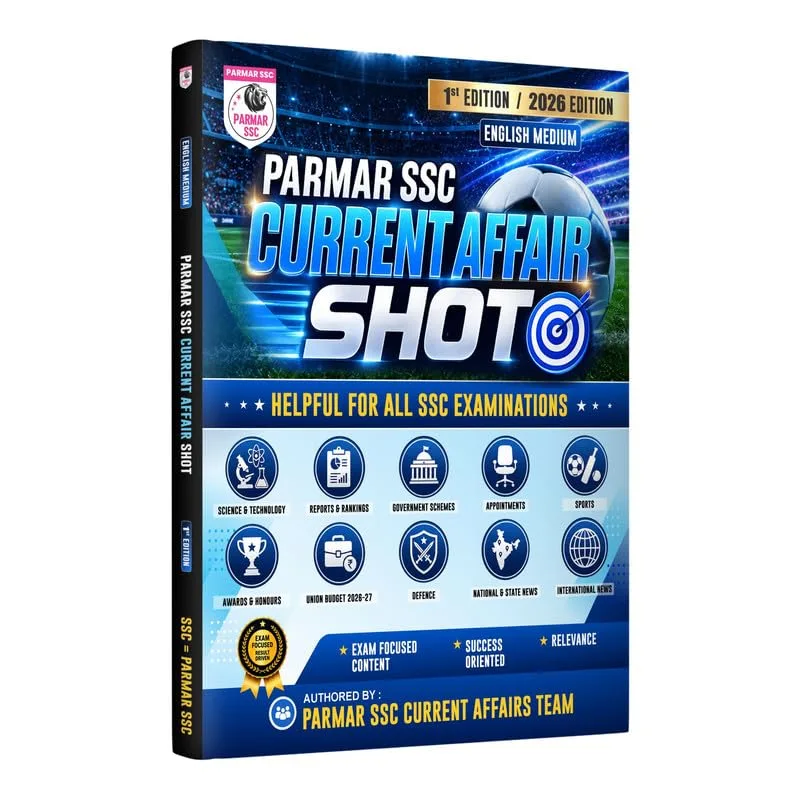
Parmar SSC Current Affair Shot | English Medium | 1st Edition, 2026 Edition | Helpful For All SSC Ex
Paperback
• 224 Pages
• ₹ 199.00
• English
• 9789358860658
No ratings yet
| Publisher | Invincible Publication Pvt Ltd |
|---|---|
| ISBN13 | 9789358860658 |
| ASIN/SKU | 9358860650 |
| Book Format | Paperback |
| Language | English |
| Pages | 224 |
| List Price | ₹ 199.00 |
| Publishing Date | 20/08/2026 |
| Dimensions | 28 x 22 x 3 cm |
| Weight | 350 g |
| Book Code | BD00070407 |
Buy this Book
Amazon Stores
Ebook Stores
Other Stores
Discover Parmar SSC Current Affair Shot | English Medium | 1st Edition, 2026 Edition | Helpful For All SSC Ex by Parmar SSC. This book is published by Invincible Publication Pvt Ltd in Paperback format, ISBN 9789358860658, ASIN 9358860650, under Exam Preparation, SSC Exam.
Book Description
Parmar SSC Current Affair Shot (English Medium) – 2026 Edition is a concise and exam-oriented current affairs guide for SSC and other government exam aspirants. It covers the latest national and international events, including Science & Technology, Government Schemes, Reports & Rankings, Sports, Defence, Awards, Budget, Appointments, and Current News in a simple, easy-to-revise format. Perfect for SSC CGL, CHSL, CPO, MTS, GD, Stenographer, Railway, and other competitive examinations.
Author Biography
Author Biography will be added soon…
Editorial Reviews
Editorial Reviews will be added soon…
Book Summary
Parmar SSC Current Affair Shot | English Medium | 1st Edition, 2026 Edition is a competitive-examination preparation book designed to help students prepare for the current affairs section of SSC examinations. Published by Parmar SSC, the book is intended for candidates appearing in examinations such as SSC CGL, CHSL, MTS, GD, CPO and other SSC-related recruitment tests. Its main purpose is to convert a large amount of constantly changing current-affairs information into a compact and exam-oriented study resource. Instead of requiring aspirants to follow newspapers, websites, magazines and daily current-affairs videos separately, the book brings important information together in a format that can be revised repeatedly before an examination.
The central idea behind Parmar SSC Current Affair Shot is that current affairs preparation should be focused on examination relevance rather than unlimited information collection. SSC examinations can ask questions from a wide range of areas, including national events, international developments, government schemes, appointments, awards, sports, science and technology, defence, economy, important days, books and authors, reports, rankings and various government initiatives. Because the volume of information generated every month is enormous, students often find it difficult to decide what they should study and what they can safely ignore. A current-affairs book such as this attempts to solve that problem by selecting information that is more likely to be useful for competitive examinations.
The book is particularly useful for students who want a one-source revision strategy. Current affairs are different from subjects such as mathematics or reasoning because the information changes continuously. A fact that is important today may become less relevant after several months, while an event that occurred months earlier can suddenly become important in an examination. Therefore, revision is one of the most important parts of current-affairs preparation. The compact nature of Current Affair Shot makes it suitable for repeated reading. Students can first study the material in detail and later use the same book for quick revision during the final stages of preparation.
One of the major areas covered in SSC current affairs is national news and government developments. Candidates need to remain aware of important decisions taken by the central government, major initiatives, new policies, infrastructure projects, national campaigns and significant institutional developments. Government schemes are particularly important because examination questions can ask about their objectives, ministries, target groups, launch years or important features. A well-organized current-affairs resource helps students remember these details without having to search through multiple sources.
International affairs also form an important part of competitive-examination preparation. Major international meetings, summits, agreements, diplomatic developments, organizations, global initiatives and important appointments can become objective questions. Students preparing for SSC examinations therefore need a basic understanding of significant developments outside India as well. The purpose is not to study international relations at an advanced academic level, but to remember the key facts associated with important global events.
Another important section of current affairs is awards and honours. National and international awards are frequently used for general-awareness questions. Candidates may be expected to remember who received a particular award, the field in which the award was given, the organization responsible for it, or why the recipient was recognized. Similarly, important books, authors and literary awards can appear in examinations. Such information is often difficult to remember because many names and events can seem similar, which is why repeated revision becomes essential.
Appointments and important personalities are another recurring category. Competitive examinations may ask about newly appointed heads of institutions, organizations, commissions, banks, regulatory bodies, international organizations, armed forces positions or other important offices. Questions may also involve prominent personalities associated with sports, science, administration, business or public life. The value of an exam-oriented current-affairs book lies in presenting these facts in a concise form so that students can revise names and positions efficiently.
Sports current affairs are equally significant. Major tournaments, championships, winners, runners-up, records, host countries or cities, important sporting personalities and national achievements can all become examination questions. Sports information can be especially difficult because many competitions take place throughout the year. Students therefore benefit from having important sports events collected in one place rather than attempting to remember them from scattered news sources.
The book's current-affairs coverage also has relevance for science and technology. Modern competitive examinations increasingly include questions related to space missions, scientific discoveries, new technologies, artificial intelligence, biotechnology, defence technology and major research developments. For SSC aspirants, the objective is generally to understand the basic identity and significance of an event rather than study its technical details at an advanced level. Concise explanations and factual presentation can therefore make this category easier to revise.
Defence and national security are additional areas that can generate questions. Important military exercises, defence agreements, new weapons or platforms, military appointments, indigenous defence developments and major security-related developments can be relevant to SSC examinations. Students need to remember the names of exercises, participating countries, organizations and important defence-related achievements. These facts may appear straightforward, but their large number makes systematic revision important.
The economy and financial sector also contribute substantially to general awareness. Important economic developments, banking-related news, financial institutions, government economic initiatives, major reports, indexes and significant policy decisions can be relevant. Aspirants do not necessarily need the depth expected from an economics student; instead, they need to understand the basic facts and terminology that can be converted into objective questions. This makes an exam-focused current-affairs source particularly useful.
Another useful category is reports, rankings and indexes. International organizations and research institutions regularly publish reports comparing countries on subjects such as development, competitiveness, education, health, environment, technology and economic performance. SSC questions can ask about the organization that published a report, India's position, the top-ranked country or the purpose of the index. Because these details are easy to confuse, students should revise them systematically and pay attention to the organization, ranking and subject associated with each report.
Important days and themes are also common in general-awareness preparation. International and national days, their dates, themes and historical significance can be converted into direct factual questions. Although individual facts may appear simple, there are many such observances throughout the year. A consolidated current-affairs resource can therefore save considerable preparation time.
The strongest practical feature of this type of book is its usefulness for last-minute revision. SSC aspirants typically have several subjects to prepare, including quantitative aptitude, reasoning, English and general awareness. Current affairs should therefore not consume disproportionate amounts of study time. A concise resource allows students to divide their preparation into manageable revision cycles. For example, an aspirant can study a month's current affairs, revise them after a week, revisit them after another few weeks and finally conduct a rapid revision before the examination.
However, students should not treat current-affairs books as a substitute for static General Knowledge. Current affairs and static GK complement each other. If a question mentions an organization, award, country, river, national park, constitutional institution or historical event, understanding the underlying static information can make it easier to remember the current-affairs fact. Therefore, the most effective strategy is to use the book alongside standard SSC General Knowledge preparation.
The book can also be useful for mock-test preparation and self-assessment. After completing a section, students should attempt objective questions based on the information they have studied. The goal should not simply be to memorize answers but to identify which categories repeatedly cause mistakes. If an aspirant consistently forgets appointments, international organizations or reports, those areas can receive additional revision time. This turns the book into part of a larger preparation cycle rather than something that is read only once.
Overall, Parmar SSC Current Affair Shot, English Medium, 1st Edition, 2026 Edition is best understood as a focused current-affairs resource for SSC aspirants who want to organize their preparation around important, examination-oriented information. Its value lies in reducing information overload, bringing important categories together and supporting repeated revision. National and international affairs, government schemes, awards, appointments, sports, science and technology, defence, economy, reports, rankings and important days collectively provide the kind of factual coverage required for general-awareness preparation.
The most effective way to use the book is to combine first reading, active note-making, repeated revision and question practice. Students should avoid trying to memorize everything in one sitting. Instead, they can divide the material into smaller sections, identify important facts, connect current events with static GK and repeatedly test their memory. For SSC aspirants preparing for examinations in 2026 and beyond, the book can therefore serve as a practical revision companion—especially for candidates who want a structured and relatively concise way to stay updated without becoming overwhelmed by the enormous amount of daily news.
The central idea behind Parmar SSC Current Affair Shot is that current affairs preparation should be focused on examination relevance rather than unlimited information collection. SSC examinations can ask questions from a wide range of areas, including national events, international developments, government schemes, appointments, awards, sports, science and technology, defence, economy, important days, books and authors, reports, rankings and various government initiatives. Because the volume of information generated every month is enormous, students often find it difficult to decide what they should study and what they can safely ignore. A current-affairs book such as this attempts to solve that problem by selecting information that is more likely to be useful for competitive examinations.
The book is particularly useful for students who want a one-source revision strategy. Current affairs are different from subjects such as mathematics or reasoning because the information changes continuously. A fact that is important today may become less relevant after several months, while an event that occurred months earlier can suddenly become important in an examination. Therefore, revision is one of the most important parts of current-affairs preparation. The compact nature of Current Affair Shot makes it suitable for repeated reading. Students can first study the material in detail and later use the same book for quick revision during the final stages of preparation.
One of the major areas covered in SSC current affairs is national news and government developments. Candidates need to remain aware of important decisions taken by the central government, major initiatives, new policies, infrastructure projects, national campaigns and significant institutional developments. Government schemes are particularly important because examination questions can ask about their objectives, ministries, target groups, launch years or important features. A well-organized current-affairs resource helps students remember these details without having to search through multiple sources.
International affairs also form an important part of competitive-examination preparation. Major international meetings, summits, agreements, diplomatic developments, organizations, global initiatives and important appointments can become objective questions. Students preparing for SSC examinations therefore need a basic understanding of significant developments outside India as well. The purpose is not to study international relations at an advanced academic level, but to remember the key facts associated with important global events.
Another important section of current affairs is awards and honours. National and international awards are frequently used for general-awareness questions. Candidates may be expected to remember who received a particular award, the field in which the award was given, the organization responsible for it, or why the recipient was recognized. Similarly, important books, authors and literary awards can appear in examinations. Such information is often difficult to remember because many names and events can seem similar, which is why repeated revision becomes essential.
Appointments and important personalities are another recurring category. Competitive examinations may ask about newly appointed heads of institutions, organizations, commissions, banks, regulatory bodies, international organizations, armed forces positions or other important offices. Questions may also involve prominent personalities associated with sports, science, administration, business or public life. The value of an exam-oriented current-affairs book lies in presenting these facts in a concise form so that students can revise names and positions efficiently.
Sports current affairs are equally significant. Major tournaments, championships, winners, runners-up, records, host countries or cities, important sporting personalities and national achievements can all become examination questions. Sports information can be especially difficult because many competitions take place throughout the year. Students therefore benefit from having important sports events collected in one place rather than attempting to remember them from scattered news sources.
The book's current-affairs coverage also has relevance for science and technology. Modern competitive examinations increasingly include questions related to space missions, scientific discoveries, new technologies, artificial intelligence, biotechnology, defence technology and major research developments. For SSC aspirants, the objective is generally to understand the basic identity and significance of an event rather than study its technical details at an advanced level. Concise explanations and factual presentation can therefore make this category easier to revise.
Defence and national security are additional areas that can generate questions. Important military exercises, defence agreements, new weapons or platforms, military appointments, indigenous defence developments and major security-related developments can be relevant to SSC examinations. Students need to remember the names of exercises, participating countries, organizations and important defence-related achievements. These facts may appear straightforward, but their large number makes systematic revision important.
The economy and financial sector also contribute substantially to general awareness. Important economic developments, banking-related news, financial institutions, government economic initiatives, major reports, indexes and significant policy decisions can be relevant. Aspirants do not necessarily need the depth expected from an economics student; instead, they need to understand the basic facts and terminology that can be converted into objective questions. This makes an exam-focused current-affairs source particularly useful.
Another useful category is reports, rankings and indexes. International organizations and research institutions regularly publish reports comparing countries on subjects such as development, competitiveness, education, health, environment, technology and economic performance. SSC questions can ask about the organization that published a report, India's position, the top-ranked country or the purpose of the index. Because these details are easy to confuse, students should revise them systematically and pay attention to the organization, ranking and subject associated with each report.
Important days and themes are also common in general-awareness preparation. International and national days, their dates, themes and historical significance can be converted into direct factual questions. Although individual facts may appear simple, there are many such observances throughout the year. A consolidated current-affairs resource can therefore save considerable preparation time.
The strongest practical feature of this type of book is its usefulness for last-minute revision. SSC aspirants typically have several subjects to prepare, including quantitative aptitude, reasoning, English and general awareness. Current affairs should therefore not consume disproportionate amounts of study time. A concise resource allows students to divide their preparation into manageable revision cycles. For example, an aspirant can study a month's current affairs, revise them after a week, revisit them after another few weeks and finally conduct a rapid revision before the examination.
However, students should not treat current-affairs books as a substitute for static General Knowledge. Current affairs and static GK complement each other. If a question mentions an organization, award, country, river, national park, constitutional institution or historical event, understanding the underlying static information can make it easier to remember the current-affairs fact. Therefore, the most effective strategy is to use the book alongside standard SSC General Knowledge preparation.
The book can also be useful for mock-test preparation and self-assessment. After completing a section, students should attempt objective questions based on the information they have studied. The goal should not simply be to memorize answers but to identify which categories repeatedly cause mistakes. If an aspirant consistently forgets appointments, international organizations or reports, those areas can receive additional revision time. This turns the book into part of a larger preparation cycle rather than something that is read only once.
Overall, Parmar SSC Current Affair Shot, English Medium, 1st Edition, 2026 Edition is best understood as a focused current-affairs resource for SSC aspirants who want to organize their preparation around important, examination-oriented information. Its value lies in reducing information overload, bringing important categories together and supporting repeated revision. National and international affairs, government schemes, awards, appointments, sports, science and technology, defence, economy, reports, rankings and important days collectively provide the kind of factual coverage required for general-awareness preparation.
The most effective way to use the book is to combine first reading, active note-making, repeated revision and question practice. Students should avoid trying to memorize everything in one sitting. Instead, they can divide the material into smaller sections, identify important facts, connect current events with static GK and repeatedly test their memory. For SSC aspirants preparing for examinations in 2026 and beyond, the book can therefore serve as a practical revision companion—especially for candidates who want a structured and relatively concise way to stay updated without becoming overwhelmed by the enormous amount of daily news.
Sample Chapters
Sample Chapters will be added soon…
Reader Reviews
No reviews yet.
Parmar SSC Current Affair Shot | English Medium | 1st Edition, 2026 Edition | Helpful For All SSC Ex
Download Cover Image
Do you want to download the full cover image for Parmar SSC Current Affair Shot | English Medium | 1st Edition, 2026 Edition | Helpful For All SSC Ex?