
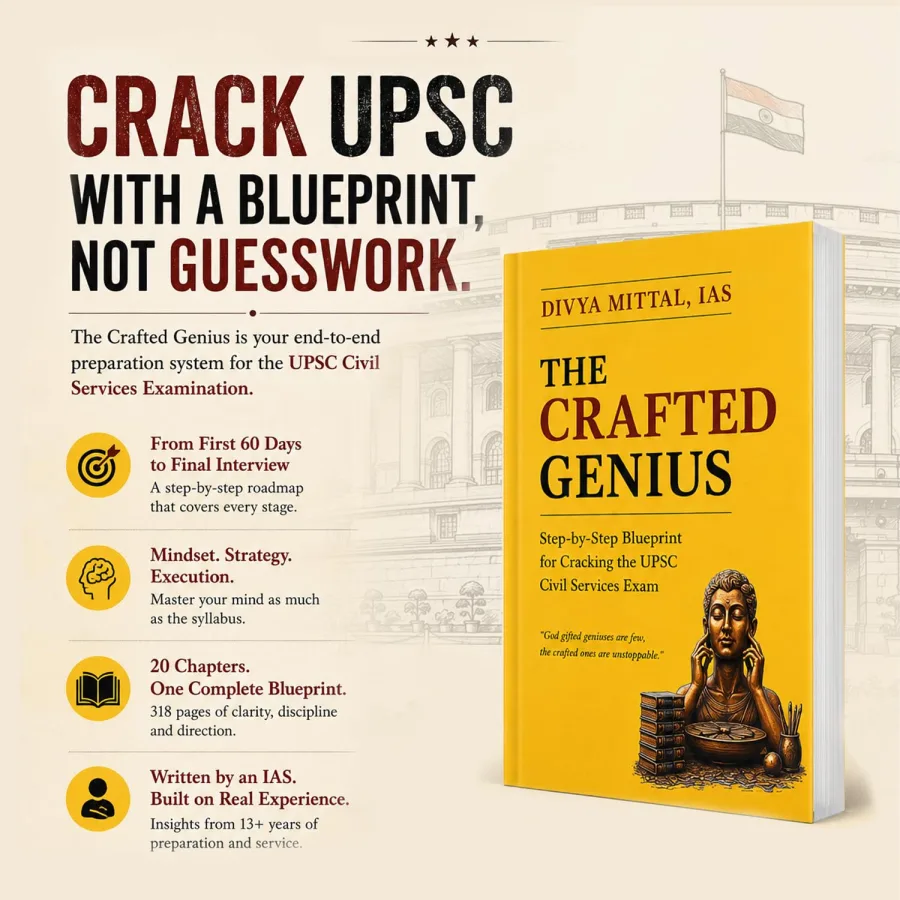
The Crafted Genius | Step-By-Step Blueprint For Cracking UPSC Civil Services Exam | Master Prelims
Paperback
• 320 Pages
• ₹ 450.00
• English
No ratings yet
| Publisher | Nageen Prakashan Private Limited |
|---|---|
| ASIN/SKU | B0H7JD29DR |
| Book Format | Paperback |
| Language | English |
| Pages | 320 |
| List Price | ₹ 450.00 |
| Publishing Date | 06/06/2026 |
| Dimensions | 23 x 15 x 2 cm |
| Weight | 300 g |
| Book Code | BD00070406 |
Buy this Book
Amazon Stores
Ebook Stores
Other Stores
Discover The Crafted Genius | Step-By-Step Blueprint For Cracking UPSC Civil Services Exam | Master Prelims by Divya Mittal. This book is published by Nageen Prakashan Private Limited in Paperback format, ASIN B0H7JD29DR, under Exam Preparation, UPSC Civil Services Mains, Indian Engineering Service Exams.
Book Description
The Crafted Genius is more than a UPSC preparation guide. It is a complete blueprint for mastering the mindset, habits, and execution strategies required to excel in one of the world's toughest competitive examinations. Success in the Civil Services Examination is not built on talent alone. It is crafted through discipline, consistency, and a well-designed system. Written by Divya Mittal, IAS, who cleared the UPSC Civil Services Examination three times through self-study, this book distils her experience into one structured blueprint. She secured the IRS, IPS, and IAS in three consecutive years, proving that genius is not born, it is built. The discipline that built her success can build yours too. This book is for anyone at any stage of the UPSC journey. Whether you are a school or college student looking to build the right foundation, an active aspirant feeling lost in the daily grind, or a veteran candidate preparing for one final attempt, this book provides a practical roadmap to success. Inside, you will learn how to: Understand what the UPSC is really testing and build a 60-day launch plan. Master Prelims, decode CSAT, and write high-scoring Mains answers across GS Papers I to IV, Ethics, and Essay. Choose the right Optional subject and prepare confidently for the Personality Test. Build strong foundations early if you are a school or college student. Manage your time effectively, stay focused, and protect your mental well-being throughout the preparation journey. The Crafted Genius is the perfect companion for India's most demanding competitive examination. It serves as a complete operating system for your entire UPSC journey, from the first day of preparation to the interview room. About the Author Divya Mittal, IAS is an Indian Administrative Service officer, an alumnus of IIT Delhi and IIM Bangalore, and a former corporate professional who worked in London before pursuing civil services. Through dedicated self-study, she cleared the UPSC Civil Services Examination three times, securing the IRS, IPS, and finally the IAS in three consecutive years. Drawing from her personal journey and administrative experience, she shares practical strategies, proven methods, and actionable insights to help aspirants prepare with clarity, discipline, and confidence.
Author Biography
Author Biography will be added soon…
Editorial Reviews
Editorial Reviews will be added soon…
Book Summary
The Crafted Genius: Step-By-Step Blueprint for Cracking UPSC Civil Services Exam | Master Prelims by Divya Mittal is a practical and strategy-oriented guide for aspirants preparing for the UPSC Civil Services Examination, with particular emphasis on mastering the Preliminary Examination. Rather than treating UPSC preparation as a competition based only on intelligence or the number of hours spent studying, the book presents success as something that can be deliberately built through the right strategy, disciplined practice, effective revision, and careful analysis of the examination pattern. Its central message is encouraging: a UPSC aspirant does not necessarily need to be a “genius” from the beginning; with a structured approach, ordinary abilities can be developed into exceptional examination performance.
The title The Crafted Genius captures this philosophy. UPSC Civil Services is often described as one of India's most difficult examinations, and many students assume that only exceptionally intelligent people can clear it. The book challenges this assumption by shifting attention from natural brilliance to systematic preparation. A candidate's performance can improve significantly when study material is selected carefully, concepts are understood rather than memorized mechanically, previous-year questions are analyzed, mistakes are tracked, and revision is planned in advance. In this sense, “genius” is not presented as something a person either possesses or lacks; it is something that can be crafted through deliberate effort and the right methods.
The Preliminary Examination deserves special attention because it is the first major elimination stage of the UPSC process. Many candidates possess substantial knowledge but still struggle in Prelims because knowing facts is only one part of the challenge. The examination also tests conceptual understanding, elimination skills, accuracy, time management, risk-taking ability and the ability to remain calm when faced with unfamiliar questions. The book's approach therefore focuses on developing an examination mindset rather than simply increasing the amount of information a student studies.
One of the fundamental principles of effective UPSC preparation is understanding the syllabus. The UPSC syllabus should not be treated as a formal document that is read once and forgotten. It acts as a map for the entire preparation process. Every book, newspaper article, coaching material and test should ultimately be evaluated according to whether it contributes to a topic mentioned in the syllabus or helps develop a relevant skill. A focused aspirant can avoid spending excessive time on information that looks interesting but has little examination value. Understanding the syllabus also helps students connect seemingly separate subjects and recognize recurring themes.
Another essential component is analysis of previous-year questions, commonly known as PYQs. UPSC questions reveal how the Commission converts broad syllabus topics into actual examination problems. By examining several years of questions, students can identify recurring concepts, changing trends, common traps and the level of conceptual depth expected. PYQs should therefore not be treated merely as practice questions to solve at the end of preparation. They can be used at the beginning of preparation to understand what UPSC actually asks. This approach allows aspirants to study with a clearer sense of direction.
The book's strategy also emphasizes the difference between reading and learning. UPSC preparation can easily become an endless cycle of collecting books, PDFs, notes, videos and current-affairs material. Having more resources does not automatically result in better preparation. In fact, excessive sources can create confusion and reduce revision time. A more effective approach is to identify a limited set of reliable resources and revise them repeatedly. The aim should be to develop mastery over important material rather than maintain a huge but poorly remembered collection of information.
Revision is consequently one of the most important elements of the preparation strategy. Students frequently underestimate how quickly information disappears from memory after a single reading. Effective revision brings previously learned information back into active memory and gradually makes recall faster and more reliable. For a UPSC aspirant, repeated revision is particularly important because the examination covers an enormous syllabus. The objective is not to remember every sentence ever read but to develop strong command over high-value concepts and facts.
A strong Prelims strategy also requires learning how to approach multiple-choice questions intelligently. UPSC questions are often designed so that several options appear plausible. The candidate may not always know the answer directly. In such situations, elimination becomes a powerful skill. Understanding how statements are framed, identifying absolute words, recognizing conceptual inconsistencies, connecting facts across subjects and using partial knowledge can help reduce the number of possible answers. However, elimination should be based on reasoning rather than random guessing. The book's broader examination-oriented philosophy encourages aspirants to develop this skill through repeated practice.
Accuracy and risk management are equally important because the Civil Services Preliminary Examination includes negative marking. Attempting every question without considering the probability of being correct can reduce an otherwise strong score. At the same time, excessive caution can leave too many marks unattempted. The ideal strategy therefore requires a balance between knowledge, confidence and calculated risk. Students should use mock tests to understand their own attempt patterns and determine which kinds of questions they should attempt, leave or revisit.
Mock tests have value beyond simply predicting a possible score. They can function as diagnostic tools. After taking a test, an aspirant should examine not only incorrect answers but also questions that were guessed correctly, questions that consumed too much time and questions where the student changed a correct answer into an incorrect one. This type of analysis can reveal weaknesses that ordinary studying may not expose. Over time, a student can develop an error log containing recurring mistakes and use it as a targeted revision resource.
The book's approach also recognizes the importance of current affairs, but effective current-affairs preparation requires selection and integration. Reading every major news story every day is neither necessary nor sustainable. The better strategy is to connect current events with the static syllabus. For example, an environmental development can be connected with ecology and international conventions; a Supreme Court judgment can be connected with constitutional provisions; an economic policy can be connected with basic economic concepts; and an international event can be connected with India's foreign-policy interests. This makes current affairs more meaningful and easier to remember.
Time management is another major challenge for UPSC aspirants. Because the syllabus is vast, students can easily spend too much time perfecting one subject while neglecting others. A successful preparation plan must therefore balance coverage and depth. Early preparation can focus on building conceptual foundations, while later stages should increasingly emphasize revision, PYQs and test practice. The closer the examination comes, the less useful it becomes to continuously add new material. At that stage, strengthening existing knowledge and improving recall become more important.
The book also encourages an important psychological shift: aspirants should focus on measurable improvement rather than comparison with others. UPSC preparation can become mentally exhausting when students constantly compare their study hours, test scores, coaching material or progress with other candidates. A more productive approach is to track personal performance. If accuracy improves, revision becomes faster, weak subjects become stronger and mock-test mistakes decrease, the preparation is moving in the right direction even if another student appears to be progressing faster.
Another valuable lesson is the importance of consistency over short bursts of motivation. UPSC preparation often lasts for many months or even years. No student can remain highly motivated every day. A sustainable routine therefore depends on systems rather than mood. Fixed study periods, realistic daily targets, scheduled revision and regular testing can keep preparation moving even when motivation is low. The concept of a “crafted genius” fits naturally into this idea: excellence is created through repeated actions rather than occasional heroic efforts.
The book's larger message is that UPSC preparation should be treated almost like a skill-building project. The aspirant begins by understanding the examination, then develops subject knowledge, learns how UPSC frames questions, practices application, analyzes mistakes, improves speed and accuracy, and repeatedly refines the strategy. Each stage contributes to the final result. Failure in a mock test is not necessarily a setback if the student understands why the mistakes occurred and changes the preparation accordingly.
Ultimately, The Crafted Genius presents UPSC Prelims preparation as a combination of knowledge, strategy, practice, revision, analysis and mental discipline. Intelligence certainly has a role, but it is not the only determinant of success. A student who studies randomly can waste enormous amounts of effort, while a student who follows a focused and analytical system can make much greater progress with the same amount of time. The book's fundamental lesson is therefore empowering: cracking UPSC is not simply about studying more; it is about studying with greater clarity, practicing deliberately, learning from mistakes and continuously improving the way one prepares.
For an aspirant, the most useful takeaway is to stop viewing UPSC as an unlimited mountain of information and instead treat it as a structured examination with identifiable demands. Understand the syllabus, study limited and reliable sources, analyze PYQs, revise repeatedly, practice elimination, take mock tests, examine errors, manage time carefully and maintain consistency. By following such a process, the “genius” required for the examination can be gradually developed. That is the central philosophy suggested by the title: success is not merely inherited as talent—it can be crafted through intelligent preparation.
The title The Crafted Genius captures this philosophy. UPSC Civil Services is often described as one of India's most difficult examinations, and many students assume that only exceptionally intelligent people can clear it. The book challenges this assumption by shifting attention from natural brilliance to systematic preparation. A candidate's performance can improve significantly when study material is selected carefully, concepts are understood rather than memorized mechanically, previous-year questions are analyzed, mistakes are tracked, and revision is planned in advance. In this sense, “genius” is not presented as something a person either possesses or lacks; it is something that can be crafted through deliberate effort and the right methods.
The Preliminary Examination deserves special attention because it is the first major elimination stage of the UPSC process. Many candidates possess substantial knowledge but still struggle in Prelims because knowing facts is only one part of the challenge. The examination also tests conceptual understanding, elimination skills, accuracy, time management, risk-taking ability and the ability to remain calm when faced with unfamiliar questions. The book's approach therefore focuses on developing an examination mindset rather than simply increasing the amount of information a student studies.
One of the fundamental principles of effective UPSC preparation is understanding the syllabus. The UPSC syllabus should not be treated as a formal document that is read once and forgotten. It acts as a map for the entire preparation process. Every book, newspaper article, coaching material and test should ultimately be evaluated according to whether it contributes to a topic mentioned in the syllabus or helps develop a relevant skill. A focused aspirant can avoid spending excessive time on information that looks interesting but has little examination value. Understanding the syllabus also helps students connect seemingly separate subjects and recognize recurring themes.
Another essential component is analysis of previous-year questions, commonly known as PYQs. UPSC questions reveal how the Commission converts broad syllabus topics into actual examination problems. By examining several years of questions, students can identify recurring concepts, changing trends, common traps and the level of conceptual depth expected. PYQs should therefore not be treated merely as practice questions to solve at the end of preparation. They can be used at the beginning of preparation to understand what UPSC actually asks. This approach allows aspirants to study with a clearer sense of direction.
The book's strategy also emphasizes the difference between reading and learning. UPSC preparation can easily become an endless cycle of collecting books, PDFs, notes, videos and current-affairs material. Having more resources does not automatically result in better preparation. In fact, excessive sources can create confusion and reduce revision time. A more effective approach is to identify a limited set of reliable resources and revise them repeatedly. The aim should be to develop mastery over important material rather than maintain a huge but poorly remembered collection of information.
Revision is consequently one of the most important elements of the preparation strategy. Students frequently underestimate how quickly information disappears from memory after a single reading. Effective revision brings previously learned information back into active memory and gradually makes recall faster and more reliable. For a UPSC aspirant, repeated revision is particularly important because the examination covers an enormous syllabus. The objective is not to remember every sentence ever read but to develop strong command over high-value concepts and facts.
A strong Prelims strategy also requires learning how to approach multiple-choice questions intelligently. UPSC questions are often designed so that several options appear plausible. The candidate may not always know the answer directly. In such situations, elimination becomes a powerful skill. Understanding how statements are framed, identifying absolute words, recognizing conceptual inconsistencies, connecting facts across subjects and using partial knowledge can help reduce the number of possible answers. However, elimination should be based on reasoning rather than random guessing. The book's broader examination-oriented philosophy encourages aspirants to develop this skill through repeated practice.
Accuracy and risk management are equally important because the Civil Services Preliminary Examination includes negative marking. Attempting every question without considering the probability of being correct can reduce an otherwise strong score. At the same time, excessive caution can leave too many marks unattempted. The ideal strategy therefore requires a balance between knowledge, confidence and calculated risk. Students should use mock tests to understand their own attempt patterns and determine which kinds of questions they should attempt, leave or revisit.
Mock tests have value beyond simply predicting a possible score. They can function as diagnostic tools. After taking a test, an aspirant should examine not only incorrect answers but also questions that were guessed correctly, questions that consumed too much time and questions where the student changed a correct answer into an incorrect one. This type of analysis can reveal weaknesses that ordinary studying may not expose. Over time, a student can develop an error log containing recurring mistakes and use it as a targeted revision resource.
The book's approach also recognizes the importance of current affairs, but effective current-affairs preparation requires selection and integration. Reading every major news story every day is neither necessary nor sustainable. The better strategy is to connect current events with the static syllabus. For example, an environmental development can be connected with ecology and international conventions; a Supreme Court judgment can be connected with constitutional provisions; an economic policy can be connected with basic economic concepts; and an international event can be connected with India's foreign-policy interests. This makes current affairs more meaningful and easier to remember.
Time management is another major challenge for UPSC aspirants. Because the syllabus is vast, students can easily spend too much time perfecting one subject while neglecting others. A successful preparation plan must therefore balance coverage and depth. Early preparation can focus on building conceptual foundations, while later stages should increasingly emphasize revision, PYQs and test practice. The closer the examination comes, the less useful it becomes to continuously add new material. At that stage, strengthening existing knowledge and improving recall become more important.
The book also encourages an important psychological shift: aspirants should focus on measurable improvement rather than comparison with others. UPSC preparation can become mentally exhausting when students constantly compare their study hours, test scores, coaching material or progress with other candidates. A more productive approach is to track personal performance. If accuracy improves, revision becomes faster, weak subjects become stronger and mock-test mistakes decrease, the preparation is moving in the right direction even if another student appears to be progressing faster.
Another valuable lesson is the importance of consistency over short bursts of motivation. UPSC preparation often lasts for many months or even years. No student can remain highly motivated every day. A sustainable routine therefore depends on systems rather than mood. Fixed study periods, realistic daily targets, scheduled revision and regular testing can keep preparation moving even when motivation is low. The concept of a “crafted genius” fits naturally into this idea: excellence is created through repeated actions rather than occasional heroic efforts.
The book's larger message is that UPSC preparation should be treated almost like a skill-building project. The aspirant begins by understanding the examination, then develops subject knowledge, learns how UPSC frames questions, practices application, analyzes mistakes, improves speed and accuracy, and repeatedly refines the strategy. Each stage contributes to the final result. Failure in a mock test is not necessarily a setback if the student understands why the mistakes occurred and changes the preparation accordingly.
Ultimately, The Crafted Genius presents UPSC Prelims preparation as a combination of knowledge, strategy, practice, revision, analysis and mental discipline. Intelligence certainly has a role, but it is not the only determinant of success. A student who studies randomly can waste enormous amounts of effort, while a student who follows a focused and analytical system can make much greater progress with the same amount of time. The book's fundamental lesson is therefore empowering: cracking UPSC is not simply about studying more; it is about studying with greater clarity, practicing deliberately, learning from mistakes and continuously improving the way one prepares.
For an aspirant, the most useful takeaway is to stop viewing UPSC as an unlimited mountain of information and instead treat it as a structured examination with identifiable demands. Understand the syllabus, study limited and reliable sources, analyze PYQs, revise repeatedly, practice elimination, take mock tests, examine errors, manage time carefully and maintain consistency. By following such a process, the “genius” required for the examination can be gradually developed. That is the central philosophy suggested by the title: success is not merely inherited as talent—it can be crafted through intelligent preparation.
Sample Chapters
Sample Chapters will be added soon…
Reader Reviews
No reviews yet.
The Crafted Genius | Step-By-Step Blueprint For Cracking UPSC Civil Services Exam | Master Prelims
Download Cover Image
Do you want to download the full cover image for The Crafted Genius | Step-By-Step Blueprint For Cracking UPSC Civil Services Exam | Master Prelims?