
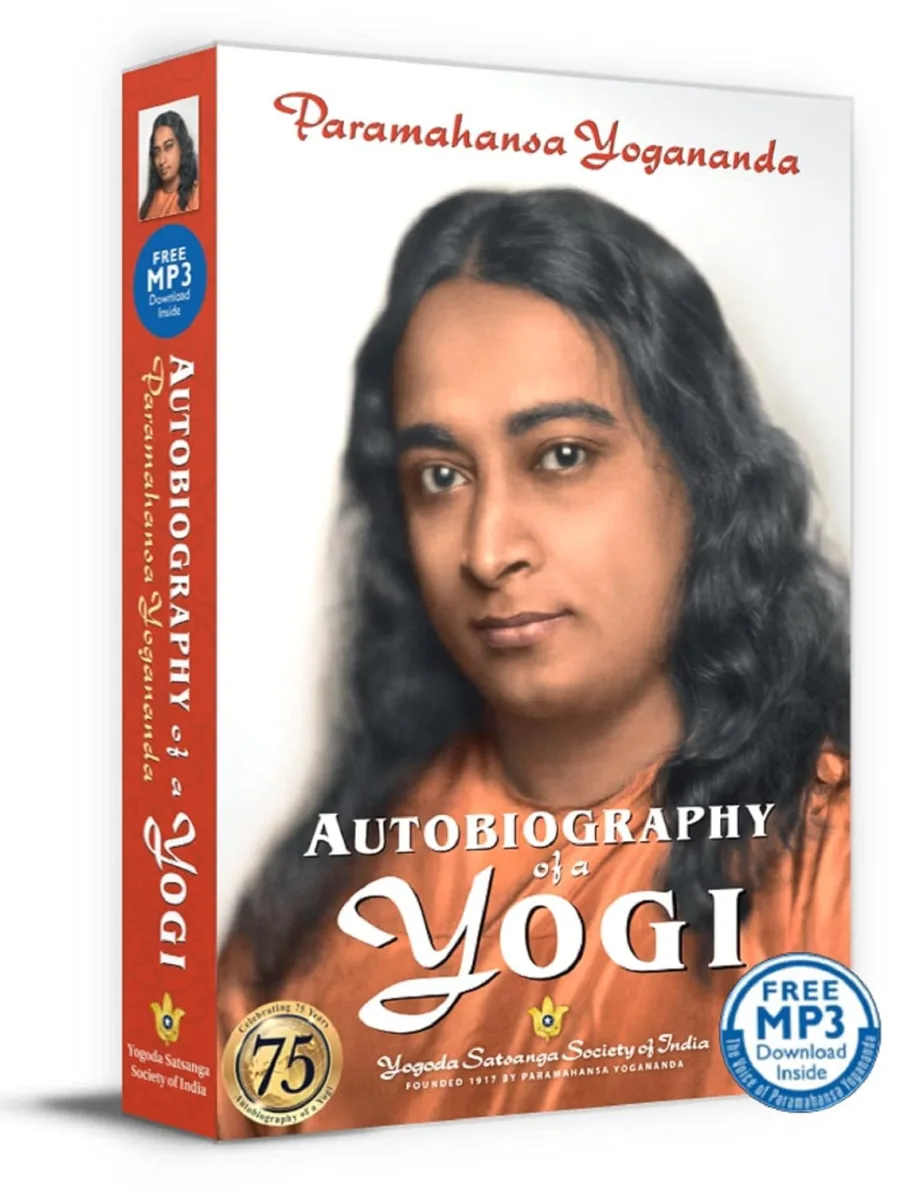
Autobiography of a Yogi (Complete Original Edition)
Paperback
• 510 Pages
• ₹ 179.00
• English
• 9788189535513
No ratings yet
| Publisher | Yogoda Satsanga Society of India |
|---|---|
| ISBN13 | 9788189535513 |
| ASIN/SKU | 818953551X |
| Book Format | Paperback |
| Language | English |
| Pages | 510 |
| List Price | ₹ 179.00 |
| Publishing Date | 09/02/1998 |
| Dimensions | 12.7 x 2.5 x 18.3 cm |
| Weight | 430 g |
| Book Code | BD00070197 |
Buy this Book
Amazon Stores
Ebook Stores
Other Stores
Discover Autobiography of a Yogi (Complete Original Edition) by Paramahansa Yogananda. This book is published by Yogoda Satsanga Society of India in Paperback format, ISBN 9788189535513, ASIN 818953551X, under Literature and Fiction, Indian Writing, Hinduism.
Book Description
Autobiography of a Yogi is one of the famous Spiritual Book of the Twentieth Century which is written by Paramahansa Yogananda. In this book he explained memorable findings of the world of saints and yogis and also explained science and miracles, death and resurgence. With soul-satisfying consciousness and endearing wit, he lightens the hidden secrets of life and the world opening our hearts and minds to the happiness, splendour and limitless spiritual capacities that last in the lives of every human being. This edition has been offered specially from Yogoda Satsanga Society of India, the association established by the writer. The book containing extensive content about all of his desires. Moreover, the book has several high definition pictures. It is a spiritual treasury that will make you understand the meaning of life. Hence this book is real treasure for people who are on a spiritual quest. You can easily get this book on Amazon India. About the Author Paramahansa Yoganandaborn is not only famous among the Indians but also popular among the westerners as a great Yogi. He teaches millions of people mediation and Kriya Yoga through his master piece Autobiography of a Yogi.
Author Biography
1893 – 1952 Hailed as the “father of Yoga in the West,” Paramahansa Yogananda is regarded as one of the great spiritual figures of our time. Born in northern India, he came to the United States in 1920, where he founded Self-Realization Fellowship, to disseminate his writings and teachings worldwide. Through his best-selling classic, Autobiography of a Yogi, and his numerous other books, he has introduced millions throughout the world to the spiritual principles of yoga meditation and the universal truths underlying all world religions.
Editorial Reviews
Editorial Reviews will be added soon…
Book Summary
Paramahansa Yogananda’s Autobiography of a Yogi is one of the most influential spiritual autobiographies of the twentieth century and remains an extraordinary introduction to yoga, meditation, Indian philosophy, and the guru-disciple tradition. First published in 1946, the book presents Yogananda’s life as a spiritual journey rather than a conventional autobiography. Instead of concentrating mainly on worldly achievements, family history, or personal success, Yogananda tells the story of his lifelong search for God, his encounters with saints and yogis, his training under his guru Sri Yukteswar, his discovery of Kriya Yoga, and his eventual mission to bring India’s spiritual teachings to the West. The result is a book that combines memoir, philosophy, religious history, travel narrative, mystical experience, and stories of miracles. The original 1946 edition contains a sequence of chapters that moves from Yogananda’s childhood through his years with Sri Yukteswar and his work in India and America, while the later complete editions preserve additional material associated with the author’s final revisions.
At the heart of Autobiography of a Yogi is the question that dominates Yogananda’s entire life: Is spiritual truth something that can actually be experienced, or is it merely a matter of belief? From childhood, Yogananda is portrayed as unusually drawn toward the divine. He describes memories and intuitions that seem to reach beyond ordinary childhood experience, along with an intense longing for the Himalayan yogis whom he imagines as living examples of higher consciousness. His spiritual hunger is not presented as an abstract interest in religion. He wants direct experience of God. This distinction becomes essential to understanding the book. Yogananda is not satisfied with accepting religious ideas simply because they have been handed down through tradition. He repeatedly seeks teachers who can demonstrate through their lives that spiritual realization is possible. The early chapters therefore establish the central theme of the entire autobiography: the human being possesses a deeper spiritual potential, and disciplined inner practice can awaken it.
Yogananda’s childhood is also shaped by family love, grief, and the influence of his parents. His mother’s death when he is still young becomes one of the formative emotional experiences of his life. The story of the mystic amulet given to him after her death introduces another recurring element of the book: the mysterious relationship between ordinary events and the unseen spiritual world. Yogananda does not separate family life from spirituality. His father, siblings, teachers, friends, and household experiences all become part of the larger journey that eventually leads him toward his guru. This makes the autobiography more human than a simple collection of miraculous stories. Behind the yogic philosophy is a young person experiencing loss, impatience, affection, rebellion, humor, ambition, and uncertainty.
As Yogananda grows older, his desire to find enlightened teachers becomes increasingly powerful. He encounters numerous saints and spiritual figures, each representing a different aspect of India’s religious tradition. The early chapters include stories of Swami Pranabananda, the “saint with two bodies,” a mysterious perfume saint, the Tiger Swami, the levitating saint Nagendra Nath Bhaduri, the scientist Jagadis Chandra Bose, and Master Mahasaya, whose devotional life leaves a particularly strong impression on Yogananda. These episodes are among the most memorable parts of the book because they challenge conventional assumptions about what is possible. Yogananda recounts extraordinary phenomena such as bilocation, unusual control of the body, spiritual healing, and other miraculous events. Yet the deeper purpose of these stories is not simply to entertain the reader with supernatural events. Again and again, Yogananda suggests that the miracle itself is less important than the spiritual law behind it. The book asks readers to consider whether reality may be far larger than what the ordinary senses reveal.
The decisive turning point arrives when Yogananda meets Swami Sri Yukteswar. This meeting is the emotional and spiritual center of the autobiography. Yogananda has spent years searching for his teacher, and when he finally encounters Sri Yukteswar, he immediately recognizes him as the guru he has been seeking. Sri Yukteswar is very different from the sentimental image of a spiritual teacher. He is disciplined, intellectually rigorous, direct, and sometimes severe. He does not encourage Yogananda’s romantic ideas about spirituality; instead, he demands self-control, discrimination, humility, and disciplined practice. Their relationship becomes the foundation of Yogananda’s spiritual development. The official table of contents places “I Meet My Master, Sri Yukteswar” at Chapter 10, followed by the chapters describing Yogananda’s years in his master’s hermitage.
The years spent with Sri Yukteswar show that spiritual growth is not simply a matter of having mystical experiences. Yogananda must learn to overcome impatience, pride, emotional reactions, and attachment to his own ideas. Sri Yukteswar’s teaching gradually changes his understanding of what it means to be a yogi. A true spiritual life requires balance. Education, work, responsibility, physical health, devotion, meditation, and intellectual understanding must not be treated as enemies. This is particularly important because Yogananda himself is not portrayed as perfectly disciplined from the beginning. His youthful adventures, comic mistakes, and occasional attempts to escape ordinary responsibilities give the narrative warmth. The autobiography repeatedly reminds the reader that spiritual seekers are still human beings who must grow through experience.
One of the book’s most important philosophical ideas is that yoga is presented as a practical science of inner realization. Yogananda explains that yoga, in its deeper sense, is not merely physical exercise. It is a systematic method for directing consciousness inward and ultimately experiencing union with the divine. Kriya Yoga becomes especially important in this discussion. Yogananda describes it as an ancient spiritual technique transmitted through a lineage of teachers and emphasizes its role in accelerating spiritual development. His explanation of Kriya Yoga is connected with the teachings of Lahiri Mahasaya, Sri Yukteswar, and the mysterious Himalayan master Babaji. The autobiography therefore functions partly as a history of the spiritual lineage through which Yogananda understood his own mission.
The chapters concerning Lahiri Mahasaya and Babaji expand the story beyond Yogananda’s personal biography. Lahiri Mahasaya is presented as a spiritually realized householder who demonstrated that profound realization need not require withdrawal from ordinary family life. This is one of the book’s most significant messages because it challenges the assumption that spirituality belongs only to monks or people who abandon worldly responsibilities. Babaji, meanwhile, appears as a nearly legendary figure whom Yogananda describes as a Himalayan master whose influence extends far beyond ordinary historical boundaries. The chapter titles include “Babaji, the Yogi-Christ of Modern India,” “Materializing a Palace in the Himalayas,” “The Christlike Life of Lahiri Mahasaya,” and “Babaji’s Interest in the West.” Through these stories, Yogananda presents a vision of spiritual history in which great teachers appear when humanity needs their influence.
Another major theme is Yogananda’s interpretation of miracles. The chapter “The Law of Miracles” is particularly important because it attempts to explain extraordinary events within a broader spiritual philosophy. Yogananda does not simply ask readers to accept miracles blindly. Instead, he argues that what people call miraculous may be natural when viewed from a deeper understanding of consciousness and the laws governing the universe. This idea connects the autobiography with one of its most distinctive characteristics: Yogananda constantly tries to bring together spirituality and reason. He discusses consciousness, energy, matter, karma, reincarnation, meditation, and cosmic law while also showing an interest in modern science. His encounter with Jagadis Chandra Bose, for example, reflects his fascination with scientific investigation and the possibility of dialogue between scientific and spiritual approaches to reality.
The book also explores the relationship between destiny and free will. Yogananda describes karma as a law of cause and effect that shapes human circumstances, but he does not present individuals as helpless prisoners of fate. Spiritual practice, right understanding, and divine grace can transform the way a person relates to karmic patterns. This gives the autobiography an optimistic quality. Human beings may carry habits, desires, and consequences from the past, but they are not condemned to remain exactly as they are. Through meditation, self-discipline, devotion, and conscious living, they can gradually free themselves from limiting patterns. In this sense, the book’s philosophy is ultimately about liberation: liberation from fear, ignorance, attachment, and the mistaken belief that the physical personality represents the whole of human existence.
Yogananda’s educational work in India provides another important dimension to the narrative. He does not view spirituality as something that should remain isolated from practical life. His founding of a school at Ranchi reflects his desire to combine education with physical development, character building, and spiritual awareness. His meeting with Rabindranath Tagore further illustrates his interest in alternative approaches to education. The autobiography consequently contains a social vision as well as a mystical one. Yogananda wants spiritual principles to influence how people learn, work, relate to others, and understand themselves. His spirituality is therefore not simply about escaping the world but about transforming one’s relationship with it.
A major transition occurs when Yogananda leaves India for America. This part of the book is essential for understanding his historical significance. He becomes one of the Indian spiritual teachers who helped introduce yoga and meditation to Western audiences at a time when such ideas were still unfamiliar to many Americans. His journey to the United States is not presented merely as personal travel. Yogananda sees it as part of his guru’s larger mission to bring Eastern spiritual teachings into dialogue with the West. His encounters with figures such as Luther Burbank and Therese Neumann demonstrate his willingness to recognize spiritual qualities outside his own religious tradition. Burbank, an American horticulturist, is affectionately described as a saint amidst the roses, while Therese Neumann, a Catholic stigmatist, becomes an example of mystical devotion within Christianity. These encounters support Yogananda’s belief that genuine spiritual realization cannot be confined to one culture or religious label.
The meeting with Mahatma Gandhi is another notable episode because it shows Yogananda engaging with one of India’s most important modern figures. Gandhi’s disciplined life and commitment to nonviolence provide a practical example of spiritual principles expressed through social action. Yogananda also describes his meeting with Ananda Moyi Ma and his encounter with Giri Bala, a woman reputed to live without ordinary food. Whether readers accept every supernatural claim in the book or approach these stories symbolically, they reveal the breadth of Yogananda’s spiritual curiosity. He is interested in people whose lives appear to challenge conventional ideas about consciousness, devotion, the body, and the limits of human potential.
The most emotionally powerful section comes with the death of Sri Yukteswar. For Yogananda, losing his guru is not simply the loss of a beloved teacher; it is a profound confrontation with death itself. Yet the story continues into the extraordinary chapter “The Resurrection of Sri Yukteswar,” in which Yogananda describes a visionary or mystical encounter with his departed guru. The experience allows him to explore ideas about the afterlife, subtle worlds, reincarnation, karma, and the continuing relationship between guru and disciple. The episode captures one of the book’s central promises: physical death may not represent the final end of consciousness. For Yogananda, spiritual realization changes the meaning of death because the soul is understood as something deeper than the temporary body and personality.
The later chapters bring the narrative toward Yogananda’s mature years in the West, including his life at Encinitas in California and the continuation of his spiritual mission. The chapter sequence in the original text culminates in “The Years 1940–1951,” while modern complete editions incorporate additional material and describe themselves as preserving the author’s final wishes and later additions. This distinction is useful for readers searching specifically for the “Autobiography of a Yogi Complete Original Edition,” because different editions can contain different editorial histories. The 1946 first edition was published by the Philosophical Library in New York, while later complete editions incorporate material added by Yogananda after the first publication.
Ultimately, Autobiography of a Yogi is not merely a book about Paramahansa Yogananda. It is a book about the possibility of spiritual transformation. Its deepest message is that human consciousness may be capable of far more than ordinary life suggests. The guru-disciple relationship, meditation, Kriya Yoga, devotion, karma, reincarnation, divine grace, and the unity underlying different religions all contribute to this central vision. Yogananda repeatedly encourages readers to move beyond secondhand belief and seek direct experience. His famous stories of saints and miracles may fascinate readers, but the lasting power of the book lies in the invitation behind them: look inward, question deeply, discipline the mind, cultivate love, and discover whether the divine is something that can be experienced rather than merely discussed.
For readers looking for an Autobiography of a Yogi summary, the book can therefore be understood on several levels. As a biography, it traces Yogananda’s journey from a spiritually hungry child in India to a monk, teacher, and international ambassador of yoga. As a spiritual book, it explains a vision of God, consciousness, karma, reincarnation, meditation, and liberation. As a work of Indian philosophy, it introduces Western readers to the guru tradition and to a lineage associated with Kriya Yoga. As a memoir, it is unusually intimate, humorous, adventurous, and emotionally open. And as a historical document, it records an important moment in the meeting of Indian spirituality and twentieth-century America. The book’s enduring appeal comes from this unusual combination of the cosmic and the personal. Yogananda can discuss the nature of the universe in one passage and tell a funny story about his youthful mistakes in another.
The ultimate lesson of Autobiography of a Yogi is one of possibility. Yogananda asks the reader to reconsider what it means to be human. We may identify ourselves with our bodies, careers, worries, memories, and social roles, but according to his spiritual philosophy, these represent only the surface of existence. Beneath them lies a deeper consciousness capable of peace, wisdom, love, and communion with the divine. The journey toward that realization is not necessarily easy, and Yogananda never suggests that spiritual life eliminates ordinary difficulties. Instead, he presents disciplined inner practice as a way of discovering a deeper center that remains available even amid change and suffering. That is why Autobiography of a Yogi continues to attract readers interested in yoga, meditation, Hindu philosophy, spirituality, mysticism, consciousness, and personal transformation. More than a record of one man’s unusual life, it is an invitation to explore the unexplored possibilities of one’s own inner life.
At the heart of Autobiography of a Yogi is the question that dominates Yogananda’s entire life: Is spiritual truth something that can actually be experienced, or is it merely a matter of belief? From childhood, Yogananda is portrayed as unusually drawn toward the divine. He describes memories and intuitions that seem to reach beyond ordinary childhood experience, along with an intense longing for the Himalayan yogis whom he imagines as living examples of higher consciousness. His spiritual hunger is not presented as an abstract interest in religion. He wants direct experience of God. This distinction becomes essential to understanding the book. Yogananda is not satisfied with accepting religious ideas simply because they have been handed down through tradition. He repeatedly seeks teachers who can demonstrate through their lives that spiritual realization is possible. The early chapters therefore establish the central theme of the entire autobiography: the human being possesses a deeper spiritual potential, and disciplined inner practice can awaken it.
Yogananda’s childhood is also shaped by family love, grief, and the influence of his parents. His mother’s death when he is still young becomes one of the formative emotional experiences of his life. The story of the mystic amulet given to him after her death introduces another recurring element of the book: the mysterious relationship between ordinary events and the unseen spiritual world. Yogananda does not separate family life from spirituality. His father, siblings, teachers, friends, and household experiences all become part of the larger journey that eventually leads him toward his guru. This makes the autobiography more human than a simple collection of miraculous stories. Behind the yogic philosophy is a young person experiencing loss, impatience, affection, rebellion, humor, ambition, and uncertainty.
As Yogananda grows older, his desire to find enlightened teachers becomes increasingly powerful. He encounters numerous saints and spiritual figures, each representing a different aspect of India’s religious tradition. The early chapters include stories of Swami Pranabananda, the “saint with two bodies,” a mysterious perfume saint, the Tiger Swami, the levitating saint Nagendra Nath Bhaduri, the scientist Jagadis Chandra Bose, and Master Mahasaya, whose devotional life leaves a particularly strong impression on Yogananda. These episodes are among the most memorable parts of the book because they challenge conventional assumptions about what is possible. Yogananda recounts extraordinary phenomena such as bilocation, unusual control of the body, spiritual healing, and other miraculous events. Yet the deeper purpose of these stories is not simply to entertain the reader with supernatural events. Again and again, Yogananda suggests that the miracle itself is less important than the spiritual law behind it. The book asks readers to consider whether reality may be far larger than what the ordinary senses reveal.
The decisive turning point arrives when Yogananda meets Swami Sri Yukteswar. This meeting is the emotional and spiritual center of the autobiography. Yogananda has spent years searching for his teacher, and when he finally encounters Sri Yukteswar, he immediately recognizes him as the guru he has been seeking. Sri Yukteswar is very different from the sentimental image of a spiritual teacher. He is disciplined, intellectually rigorous, direct, and sometimes severe. He does not encourage Yogananda’s romantic ideas about spirituality; instead, he demands self-control, discrimination, humility, and disciplined practice. Their relationship becomes the foundation of Yogananda’s spiritual development. The official table of contents places “I Meet My Master, Sri Yukteswar” at Chapter 10, followed by the chapters describing Yogananda’s years in his master’s hermitage.
The years spent with Sri Yukteswar show that spiritual growth is not simply a matter of having mystical experiences. Yogananda must learn to overcome impatience, pride, emotional reactions, and attachment to his own ideas. Sri Yukteswar’s teaching gradually changes his understanding of what it means to be a yogi. A true spiritual life requires balance. Education, work, responsibility, physical health, devotion, meditation, and intellectual understanding must not be treated as enemies. This is particularly important because Yogananda himself is not portrayed as perfectly disciplined from the beginning. His youthful adventures, comic mistakes, and occasional attempts to escape ordinary responsibilities give the narrative warmth. The autobiography repeatedly reminds the reader that spiritual seekers are still human beings who must grow through experience.
One of the book’s most important philosophical ideas is that yoga is presented as a practical science of inner realization. Yogananda explains that yoga, in its deeper sense, is not merely physical exercise. It is a systematic method for directing consciousness inward and ultimately experiencing union with the divine. Kriya Yoga becomes especially important in this discussion. Yogananda describes it as an ancient spiritual technique transmitted through a lineage of teachers and emphasizes its role in accelerating spiritual development. His explanation of Kriya Yoga is connected with the teachings of Lahiri Mahasaya, Sri Yukteswar, and the mysterious Himalayan master Babaji. The autobiography therefore functions partly as a history of the spiritual lineage through which Yogananda understood his own mission.
The chapters concerning Lahiri Mahasaya and Babaji expand the story beyond Yogananda’s personal biography. Lahiri Mahasaya is presented as a spiritually realized householder who demonstrated that profound realization need not require withdrawal from ordinary family life. This is one of the book’s most significant messages because it challenges the assumption that spirituality belongs only to monks or people who abandon worldly responsibilities. Babaji, meanwhile, appears as a nearly legendary figure whom Yogananda describes as a Himalayan master whose influence extends far beyond ordinary historical boundaries. The chapter titles include “Babaji, the Yogi-Christ of Modern India,” “Materializing a Palace in the Himalayas,” “The Christlike Life of Lahiri Mahasaya,” and “Babaji’s Interest in the West.” Through these stories, Yogananda presents a vision of spiritual history in which great teachers appear when humanity needs their influence.
Another major theme is Yogananda’s interpretation of miracles. The chapter “The Law of Miracles” is particularly important because it attempts to explain extraordinary events within a broader spiritual philosophy. Yogananda does not simply ask readers to accept miracles blindly. Instead, he argues that what people call miraculous may be natural when viewed from a deeper understanding of consciousness and the laws governing the universe. This idea connects the autobiography with one of its most distinctive characteristics: Yogananda constantly tries to bring together spirituality and reason. He discusses consciousness, energy, matter, karma, reincarnation, meditation, and cosmic law while also showing an interest in modern science. His encounter with Jagadis Chandra Bose, for example, reflects his fascination with scientific investigation and the possibility of dialogue between scientific and spiritual approaches to reality.
The book also explores the relationship between destiny and free will. Yogananda describes karma as a law of cause and effect that shapes human circumstances, but he does not present individuals as helpless prisoners of fate. Spiritual practice, right understanding, and divine grace can transform the way a person relates to karmic patterns. This gives the autobiography an optimistic quality. Human beings may carry habits, desires, and consequences from the past, but they are not condemned to remain exactly as they are. Through meditation, self-discipline, devotion, and conscious living, they can gradually free themselves from limiting patterns. In this sense, the book’s philosophy is ultimately about liberation: liberation from fear, ignorance, attachment, and the mistaken belief that the physical personality represents the whole of human existence.
Yogananda’s educational work in India provides another important dimension to the narrative. He does not view spirituality as something that should remain isolated from practical life. His founding of a school at Ranchi reflects his desire to combine education with physical development, character building, and spiritual awareness. His meeting with Rabindranath Tagore further illustrates his interest in alternative approaches to education. The autobiography consequently contains a social vision as well as a mystical one. Yogananda wants spiritual principles to influence how people learn, work, relate to others, and understand themselves. His spirituality is therefore not simply about escaping the world but about transforming one’s relationship with it.
A major transition occurs when Yogananda leaves India for America. This part of the book is essential for understanding his historical significance. He becomes one of the Indian spiritual teachers who helped introduce yoga and meditation to Western audiences at a time when such ideas were still unfamiliar to many Americans. His journey to the United States is not presented merely as personal travel. Yogananda sees it as part of his guru’s larger mission to bring Eastern spiritual teachings into dialogue with the West. His encounters with figures such as Luther Burbank and Therese Neumann demonstrate his willingness to recognize spiritual qualities outside his own religious tradition. Burbank, an American horticulturist, is affectionately described as a saint amidst the roses, while Therese Neumann, a Catholic stigmatist, becomes an example of mystical devotion within Christianity. These encounters support Yogananda’s belief that genuine spiritual realization cannot be confined to one culture or religious label.
The meeting with Mahatma Gandhi is another notable episode because it shows Yogananda engaging with one of India’s most important modern figures. Gandhi’s disciplined life and commitment to nonviolence provide a practical example of spiritual principles expressed through social action. Yogananda also describes his meeting with Ananda Moyi Ma and his encounter with Giri Bala, a woman reputed to live without ordinary food. Whether readers accept every supernatural claim in the book or approach these stories symbolically, they reveal the breadth of Yogananda’s spiritual curiosity. He is interested in people whose lives appear to challenge conventional ideas about consciousness, devotion, the body, and the limits of human potential.
The most emotionally powerful section comes with the death of Sri Yukteswar. For Yogananda, losing his guru is not simply the loss of a beloved teacher; it is a profound confrontation with death itself. Yet the story continues into the extraordinary chapter “The Resurrection of Sri Yukteswar,” in which Yogananda describes a visionary or mystical encounter with his departed guru. The experience allows him to explore ideas about the afterlife, subtle worlds, reincarnation, karma, and the continuing relationship between guru and disciple. The episode captures one of the book’s central promises: physical death may not represent the final end of consciousness. For Yogananda, spiritual realization changes the meaning of death because the soul is understood as something deeper than the temporary body and personality.
The later chapters bring the narrative toward Yogananda’s mature years in the West, including his life at Encinitas in California and the continuation of his spiritual mission. The chapter sequence in the original text culminates in “The Years 1940–1951,” while modern complete editions incorporate additional material and describe themselves as preserving the author’s final wishes and later additions. This distinction is useful for readers searching specifically for the “Autobiography of a Yogi Complete Original Edition,” because different editions can contain different editorial histories. The 1946 first edition was published by the Philosophical Library in New York, while later complete editions incorporate material added by Yogananda after the first publication.
Ultimately, Autobiography of a Yogi is not merely a book about Paramahansa Yogananda. It is a book about the possibility of spiritual transformation. Its deepest message is that human consciousness may be capable of far more than ordinary life suggests. The guru-disciple relationship, meditation, Kriya Yoga, devotion, karma, reincarnation, divine grace, and the unity underlying different religions all contribute to this central vision. Yogananda repeatedly encourages readers to move beyond secondhand belief and seek direct experience. His famous stories of saints and miracles may fascinate readers, but the lasting power of the book lies in the invitation behind them: look inward, question deeply, discipline the mind, cultivate love, and discover whether the divine is something that can be experienced rather than merely discussed.
For readers looking for an Autobiography of a Yogi summary, the book can therefore be understood on several levels. As a biography, it traces Yogananda’s journey from a spiritually hungry child in India to a monk, teacher, and international ambassador of yoga. As a spiritual book, it explains a vision of God, consciousness, karma, reincarnation, meditation, and liberation. As a work of Indian philosophy, it introduces Western readers to the guru tradition and to a lineage associated with Kriya Yoga. As a memoir, it is unusually intimate, humorous, adventurous, and emotionally open. And as a historical document, it records an important moment in the meeting of Indian spirituality and twentieth-century America. The book’s enduring appeal comes from this unusual combination of the cosmic and the personal. Yogananda can discuss the nature of the universe in one passage and tell a funny story about his youthful mistakes in another.
The ultimate lesson of Autobiography of a Yogi is one of possibility. Yogananda asks the reader to reconsider what it means to be human. We may identify ourselves with our bodies, careers, worries, memories, and social roles, but according to his spiritual philosophy, these represent only the surface of existence. Beneath them lies a deeper consciousness capable of peace, wisdom, love, and communion with the divine. The journey toward that realization is not necessarily easy, and Yogananda never suggests that spiritual life eliminates ordinary difficulties. Instead, he presents disciplined inner practice as a way of discovering a deeper center that remains available even amid change and suffering. That is why Autobiography of a Yogi continues to attract readers interested in yoga, meditation, Hindu philosophy, spirituality, mysticism, consciousness, and personal transformation. More than a record of one man’s unusual life, it is an invitation to explore the unexplored possibilities of one’s own inner life.
Sample Chapters
Sample Chapters will be added soon…
Reader Reviews
No reviews yet.
Autobiography of a Yogi (Complete Original Edition)
Download Cover Image
Do you want to download the full cover image for Autobiography of a Yogi (Complete Original Edition)?