
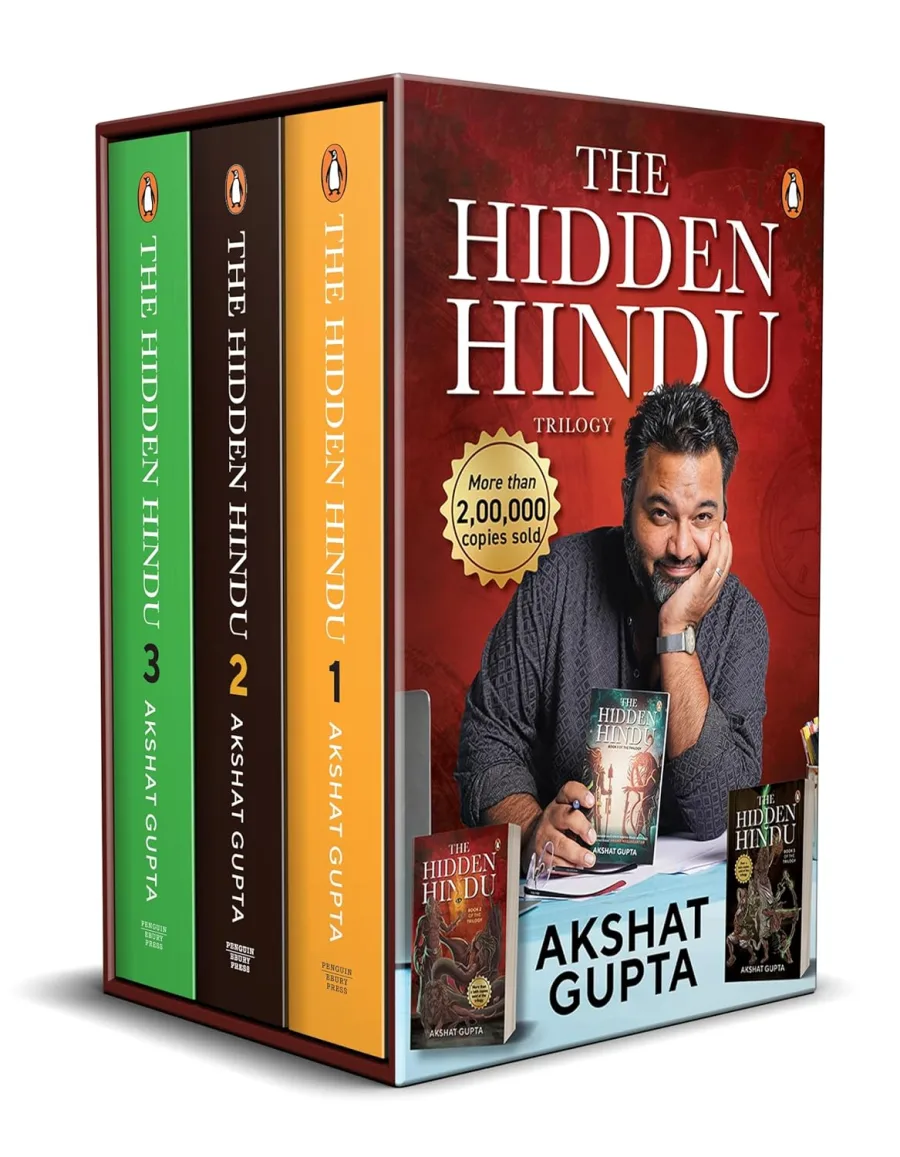
The Hidden Hindu Boxset
Paperback
• 762 Pages
• ₹ 799.00
• English
• 9780143467359
No ratings yet
| Publisher | Penguin eBury Press |
|---|---|
| ISBN13 | 9780143467359 |
| ASIN/SKU | 0143467352 |
| Book Format | Paperback |
| Language | English |
| Pages | 762 |
| List Price | ₹ 799.00 |
| Publishing Date | 25/03/2024 |
| Dimensions | 4.5 x 12.9 x 19.8 cm |
| Weight | 520 g |
| Book Code | BD00070196 |
Buy this Book
Amazon Stores
Ebook Stores
Other Stores
Discover The Hidden Hindu Boxset by Akshat Gupta. This book is published by Penguin eBury Press in Paperback format, ISBN 9780143467359, ASIN 0143467352, under Science Fiction and Fantasy, Science Fiction Adventures, Action and Adventure Fantasy.
Book Description
Prithvi, a twenty-one-year-old, is searching for a mysterious middle-aged Aghori―a Shiva devotee―Om
Shastri, who was last traced more than 200 years ago before he was captured and sent to a high-tech facility.
When a team of specialists drugged and hypnotized the Aghori for interrogation, he claimed to have witnessed all the four yugas (epochs in Hinduism) and to have even
played a part in the Ramayana and the Mahabharata.
Who is Om Shastri?
Why was he captured?
Board the boat of Om Shastri’s secrets, Prithvi’s pursuit and adventures of other enigmatic immortals of Hindu mythology in this exciting and revealing journey.
The first battle is lost. What seemed to be the end of all wars was just the beginning of an incredible journey in search of a hidden verse.
Who are LSD and Parimal? Will Om finally know about
his past?
Tighten your seat belts for an adventure in search of words that hold a bigger purpose than even immortality for divinities and demons.
Who is Devdhwaja: Nagendra or Om? Where are the remaining words hidden? Will Nagendra fifind them all and complete the verse, or will the immortals be able to stop him?
Unravel the unexpected mystery of the doomed immortals running out of time.
Embark on a nail-biting adventure into mythology, epics and science
with this unputdownable series!
Shastri, who was last traced more than 200 years ago before he was captured and sent to a high-tech facility.
When a team of specialists drugged and hypnotized the Aghori for interrogation, he claimed to have witnessed all the four yugas (epochs in Hinduism) and to have even
played a part in the Ramayana and the Mahabharata.
Who is Om Shastri?
Why was he captured?
Board the boat of Om Shastri’s secrets, Prithvi’s pursuit and adventures of other enigmatic immortals of Hindu mythology in this exciting and revealing journey.
The first battle is lost. What seemed to be the end of all wars was just the beginning of an incredible journey in search of a hidden verse.
Who are LSD and Parimal? Will Om finally know about
his past?
Tighten your seat belts for an adventure in search of words that hold a bigger purpose than even immortality for divinities and demons.
Who is Devdhwaja: Nagendra or Om? Where are the remaining words hidden? Will Nagendra fifind them all and complete the verse, or will the immortals be able to stop him?
Unravel the unexpected mystery of the doomed immortals running out of time.
Embark on a nail-biting adventure into mythology, epics and science
with this unputdownable series!
Author Biography
Akshat Gupta is a national bestselling author, a TEDx speaker and an excelling screenwriter and dialogue writer in the Indian film industry. The Hidden Hindu series, authored by him, has sold over 1 lakh copies, with each book a national bestseller. Akshat is well known in the publishing industry, as well as in the Indian film industry, with a number of films and web-series signed on his name.
Editorial Reviews
Editorial Reviews will be added soon…
Book Summary
Akshat Gupta’s The Hidden Hindu Boxset brings together the complete three-book Hidden Hindu trilogy, a fast-paced mythology thriller that combines Hindu mythology, science fiction, mystery, action, immortality, and modern Indian settings. The trilogy follows a young man named Prithvi as he becomes involved in an extraordinary mystery surrounding Om Shastri, a mysterious Aghori who appears to possess knowledge of multiple Hindu yugas and claims to have witnessed events from the Ramayana and Mahabharata. What begins as an investigation into one apparently immortal man gradually expands into a much larger story involving the legendary immortals of Hindu tradition, ancient secrets, hidden identities, powerful enemies, and a battle whose consequences reach across thousands of years. Penguin Random House describes the series as a fusion of Indian mythology and science fiction, while Gupta himself has characterized it as an amalgamation of science fiction, mythology, and thriller.
The central appeal of The Hidden Hindu trilogy is its unusual premise: what if some of the figures described in Hindu traditions as immortals were not merely characters from ancient stories, but living beings who had survived through different ages of human history? Gupta builds his fictional universe around this question. Instead of placing mythology entirely in a distant legendary past, he brings it into contemporary India, where modern technology, intelligence agencies, scientific investigation, and ancient spiritual traditions collide. The first book is set in the modern era and begins with twenty-one-year-old Prithvi searching for Om Shastri, a middle-aged Aghori devotee of Shiva. Om had reportedly been traced more than two centuries earlier before being captured and transported to a highly advanced facility on an isolated Indian island. His apparent age, extraordinary knowledge, and mysterious history immediately make him a subject of intense investigation.
Prithvi is an important entry point into this strange world because he initially approaches the mystery from a relatively modern perspective. He is not simply presented as someone who already understands every secret of Hindu mythology. His investigation allows the reader to discover the truth alongside him. The story therefore moves between skepticism and belief, between scientific interrogation and ancient wisdom. When Om Shastri is drugged and hypnotized by specialists attempting to discover his identity and origins, his answers transform the entire investigation. He claims to have lived through all four yugas—Satya Yuga, Treta Yuga, Dvapara Yuga, and Kali Yuga—and even says that he participated in events associated with the Ramayana and Mahabharata. The official description emphasizes that his revelations challenge ordinary ideas about mortality and lead investigators toward the existence of other immortals.
This interrogation becomes the narrative doorway into the first book’s greatest mystery: who exactly is Om Shastri? His identity is more complicated than his appearance suggests, and every answer produces another question. If he has genuinely lived for centuries, how has he survived? Why has he remained hidden? What has he been doing across different ages? Why has he been searching for other immortals? And, most importantly, what connection does he have with the larger conflict that is slowly beginning to emerge? Gupta uses these questions to keep the story moving at a rapid pace. Rather than explaining the mythology all at once, he reveals it through discoveries, flashbacks, interrogations, clues, and increasingly dangerous encounters.
The first volume is therefore as much a mystery thriller as it is a mythological novel. The reader is encouraged to keep questioning the apparent truth of every character and event. Ancient names and stories are introduced in a modern context, creating a deliberate tension between familiar mythology and unfamiliar possibilities. The idea that ancient legends may conceal historical or supernatural realities becomes one of the trilogy’s defining narrative devices. Gupta’s official description of the series specifically emphasizes the way ancient secrets can shake contemporary beliefs and alter the course of the future.
As the first book develops, the concept of the immortals becomes increasingly important. Hindu tradition contains several figures popularly associated with immortality or exceptionally long life, and Gupta incorporates these legendary beings into his fictional universe. The story asks what their existence would mean in a modern world. Would they live peacefully among ordinary people? Would they protect humanity? Would they compete with one another? Could they possess knowledge or abilities that modern civilization cannot understand? And could an ancient conflict still be active beneath the surface of contemporary life? These questions allow Gupta to transform familiar mythological material into a modern adventure narrative.
One of the trilogy’s strongest ideas is the contrast between ancient knowledge and modern technology. The setting is not an imaginary kingdom separated from the world readers know. Instead, laboratories, interrogation rooms, modern cities, intelligence operations, scientific techniques, and advanced facilities exist alongside Aghoris, ancient warriors, spiritual traditions, and legendary immortals. This mixture gives the trilogy its distinctive identity. It is neither a straightforward retelling of Hindu mythology nor conventional science fiction. Instead, it imagines a world in which both systems of knowledge might be describing different aspects of the same reality.
The second book, The Hidden Hindu 2, begins from the consequences of the first book’s revelations. Penguin’s announcement of the sequel describes it as continuing from the first volume’s cliffhanger, with further revelations and twists and with a story in which what seemed to be the end of a conflict becomes the beginning of another. The scope of the narrative consequently becomes much larger. The mystery is no longer limited to understanding Om Shastri. The fate of multiple immortals, the significance of ancient knowledge, and the search for a hidden verse become central to the continuing conflict.
At this point, the trilogy becomes increasingly concerned with the relationship between identity and destiny. Om is still incomplete without a full understanding of his past, while other characters have their own motives and secrets. The second book expands the mythology while also increasing the number of alliances and rivalries. Characters who appear to be allies may have hidden agendas, and the reader is repeatedly encouraged to reconsider who can be trusted. This creates a thriller-like atmosphere in which knowledge itself becomes a form of power. Knowing the past can determine the future, and possessing one missing piece of information can change the balance between the opposing sides.
The hidden verse becomes particularly important because it gives the trilogy a concrete objective around which its supernatural conflict can revolve. The search for its remaining words transforms the story into a race. Whoever discovers the complete verse may gain enormous power or unlock a secret capable of changing the fate of the immortals and humanity. The narrative therefore shifts between personal mysteries and a much larger struggle. The question “Who is Om?” gradually becomes only one part of a broader question: what exactly is happening to the world, and what will happen if the ancient forces involved finally complete what they began?
Among the trilogy’s major characters are Parimal and LSD, whose relationship becomes increasingly significant as the story progresses. Their partnership is not simple because trust is constantly under pressure. The characters are caught in circumstances where personal loyalty can conflict with survival, and where an apparently obvious alliance may conceal another purpose. Their journeys also help humanize the larger mythology. Although the story features immortals and legendary warriors, the emotional tension often comes from ordinary human qualities such as fear, doubt, loyalty, jealousy, courage, and the desire to understand one’s own identity.
The third volume, The Hidden Hindu 3, brings the mythology and thriller elements to their most intense point. The official synopsis introduces the central questions directly: Who is Devdhwaja—Nagendra or Om? What will happen when Nagendra is resurrected? Where are the remaining words of the verse? And can the immortals stop Nagendra before he completes it? These questions turn the finale into a race against time. The earlier mystery surrounding Om’s identity is now connected to a much more dangerous conflict involving the fate of multiple immortals.
Nagendra becomes one of the trilogy’s most important sources of danger. His resurrection changes the balance of power because he returns apparently unharmed and more powerful than before. Meanwhile, the other immortals are divided and placed under extraordinary pressure. Parashurama and Kripacharya become trapped within Om’s past, Vrishkapi faces deadly circumstances, and Milarepa has already been consumed by the unfolding threat. Ashwatthama, another immensely powerful figure from Hindu tradition, is left struggling to understand the rapidly changing situation. The official description presents these developments as a crisis in which the immortals are being attacked from multiple directions while time is running out.
The title The Hidden Hindu ultimately reflects one of the trilogy’s central narrative ideas: hidden histories exist beneath the visible surface of the modern world. The characters repeatedly encounter secrets that have been concealed for centuries. Ancient identities appear in new forms, familiar myths acquire unexpected explanations, and legendary events become pieces of a much larger puzzle. The trilogy plays deliberately with the boundary between mythology and history. Rather than treating ancient Indian stories simply as distant tales, Gupta imagines them as fragments of a hidden reality whose consequences remain active.
This approach also explains why the series appeals strongly to readers interested in Indian mythology but looking for something different from traditional retellings. The Ramayana, Mahabharata, yugas, immortals, Aghoris, ancient warriors, and spiritual concepts are not presented in the conventional form of a religious narrative. They are incorporated into a contemporary fictional thriller. Penguin describes the first book as “science-fiction meets Indian mythology” and explicitly positions it as a thriller set in 2020. The result is a cinematic reading experience built around mysteries, revelations, action sequences, supernatural abilities, and rapidly changing stakes.
At the same time, the trilogy is fundamentally concerned with the human desire to understand the unknown. Prithvi’s journey is important because his search begins with curiosity but develops into something much larger. The deeper he goes into the mystery, the more he realizes that knowledge can be dangerous. Understanding the past does not necessarily make the present easier. Sometimes it creates responsibilities that a person never expected to carry. The trilogy therefore repeatedly connects knowledge with choice: once a character discovers the truth, what will that character do with it?
Immortality itself is another major theme. At first, living forever might sound like the ultimate blessing, but Gupta’s story presents immortality as something much more complicated. To survive across centuries means witnessing civilizations rise and fall, carrying memories that no ordinary human being can share, and living with consequences that never disappear. The immortals are not simply superheroes who happen to be unable to die. Their long existence gives them history, burdens, relationships, rivalries, and unresolved conflicts. Immortality becomes both power and imprisonment.
The trilogy also repeatedly explores the idea that appearances can be deceptive. An Aghori may turn out to be something far more mysterious than expected. A historical figure may have a hidden identity. An ally may possess another agenda. A villain may have connections to the heroes that are not immediately visible. This constant uncertainty is one reason the books work effectively as page-turning thrillers. The reader is not merely waiting to discover what happens next; the reader is repeatedly forced to reconsider what has already happened.
By the finale, the narrative has moved far beyond Prithvi’s original search. The story has become an enormous confrontation involving ancient identities, immortals, hidden knowledge, resurrection, and the possibility of catastrophic consequences. Yet the trilogy’s central mystery remains surprisingly consistent from beginning to end: the past is not really past. It continues to shape the present, and the secrets hidden within ancient history may determine the future.
For readers searching for The Hidden Hindu Boxset summary, the complete trilogy can therefore be understood as a mythology-driven science-fiction thriller about immortality, identity, ancient secrets, and the collision of modern India with the legendary past. Book One establishes the mystery of Om Shastri and introduces the possibility that the immortals of Hindu tradition are real. Book Two expands the conflict, introduces deeper revelations and alliances, and turns the search for the hidden verse into a dangerous race. Book Three brings the major mysteries to a climax as Nagendra returns, identities become increasingly uncertain, and the remaining immortals struggle to prevent the completion of the verse. The official Penguin synopsis confirms that the third book centers on these final questions of identity, resurrection, the missing words, and the survival of the immortals.
What makes The Hidden Hindu Boxset particularly accessible is its storytelling style. Akshat Gupta approaches mythology through the language of popular thriller fiction rather than through a purely traditional or scholarly presentation. The narrative is designed around suspense and discovery, so readers encounter mythological concepts as part of the plot rather than as separate lessons. This makes the trilogy especially appealing to readers who enjoy Indian mythology, Hindu mythology fiction, fantasy thrillers, science fiction, mystery novels, supernatural adventures, and stories about immortality but want these elements combined in a distinctly contemporary Indian setting.
Ultimately, The Hidden Hindu is a story about the secrets that survive when civilizations change. Gupta imagines a world where ancient warriors still walk among humanity, where legends may contain hidden historical truths, and where the battles of previous ages have consequences for the present. Beneath the action and mystery is a larger fascination with Indian civilization and its enormous reservoir of myths, characters, symbols, and philosophical ideas. The trilogy does not attempt to provide a conventional interpretation of Hindu mythology; instead, it transforms those materials into a fictional universe built for suspense and adventure. Penguin describes the series as a work that interlinks technology and Hindu mythology, while Gupta has emphasized the combination of science fiction, mythology, thriller elements, conspiracy, immortality, and Indian history.
The Hidden Hindu Boxset is therefore best understood not simply as three connected adventure novels, but as one extended mystery whose scale grows dramatically from book to book. It begins with one young seeker and one mysterious Aghori, then opens into a world of immortals, ancient wars, secret identities, hidden verses, supernatural powers, and battles spanning the boundaries between past and present. For readers who enjoy mythology retold through modern fiction, the trilogy offers an imaginative answer to a fascinating question: what if the stories we call myths were only fragments of a much larger story—and what if that story were still unfolding today?
The central appeal of The Hidden Hindu trilogy is its unusual premise: what if some of the figures described in Hindu traditions as immortals were not merely characters from ancient stories, but living beings who had survived through different ages of human history? Gupta builds his fictional universe around this question. Instead of placing mythology entirely in a distant legendary past, he brings it into contemporary India, where modern technology, intelligence agencies, scientific investigation, and ancient spiritual traditions collide. The first book is set in the modern era and begins with twenty-one-year-old Prithvi searching for Om Shastri, a middle-aged Aghori devotee of Shiva. Om had reportedly been traced more than two centuries earlier before being captured and transported to a highly advanced facility on an isolated Indian island. His apparent age, extraordinary knowledge, and mysterious history immediately make him a subject of intense investigation.
Prithvi is an important entry point into this strange world because he initially approaches the mystery from a relatively modern perspective. He is not simply presented as someone who already understands every secret of Hindu mythology. His investigation allows the reader to discover the truth alongside him. The story therefore moves between skepticism and belief, between scientific interrogation and ancient wisdom. When Om Shastri is drugged and hypnotized by specialists attempting to discover his identity and origins, his answers transform the entire investigation. He claims to have lived through all four yugas—Satya Yuga, Treta Yuga, Dvapara Yuga, and Kali Yuga—and even says that he participated in events associated with the Ramayana and Mahabharata. The official description emphasizes that his revelations challenge ordinary ideas about mortality and lead investigators toward the existence of other immortals.
This interrogation becomes the narrative doorway into the first book’s greatest mystery: who exactly is Om Shastri? His identity is more complicated than his appearance suggests, and every answer produces another question. If he has genuinely lived for centuries, how has he survived? Why has he remained hidden? What has he been doing across different ages? Why has he been searching for other immortals? And, most importantly, what connection does he have with the larger conflict that is slowly beginning to emerge? Gupta uses these questions to keep the story moving at a rapid pace. Rather than explaining the mythology all at once, he reveals it through discoveries, flashbacks, interrogations, clues, and increasingly dangerous encounters.
The first volume is therefore as much a mystery thriller as it is a mythological novel. The reader is encouraged to keep questioning the apparent truth of every character and event. Ancient names and stories are introduced in a modern context, creating a deliberate tension between familiar mythology and unfamiliar possibilities. The idea that ancient legends may conceal historical or supernatural realities becomes one of the trilogy’s defining narrative devices. Gupta’s official description of the series specifically emphasizes the way ancient secrets can shake contemporary beliefs and alter the course of the future.
As the first book develops, the concept of the immortals becomes increasingly important. Hindu tradition contains several figures popularly associated with immortality or exceptionally long life, and Gupta incorporates these legendary beings into his fictional universe. The story asks what their existence would mean in a modern world. Would they live peacefully among ordinary people? Would they protect humanity? Would they compete with one another? Could they possess knowledge or abilities that modern civilization cannot understand? And could an ancient conflict still be active beneath the surface of contemporary life? These questions allow Gupta to transform familiar mythological material into a modern adventure narrative.
One of the trilogy’s strongest ideas is the contrast between ancient knowledge and modern technology. The setting is not an imaginary kingdom separated from the world readers know. Instead, laboratories, interrogation rooms, modern cities, intelligence operations, scientific techniques, and advanced facilities exist alongside Aghoris, ancient warriors, spiritual traditions, and legendary immortals. This mixture gives the trilogy its distinctive identity. It is neither a straightforward retelling of Hindu mythology nor conventional science fiction. Instead, it imagines a world in which both systems of knowledge might be describing different aspects of the same reality.
The second book, The Hidden Hindu 2, begins from the consequences of the first book’s revelations. Penguin’s announcement of the sequel describes it as continuing from the first volume’s cliffhanger, with further revelations and twists and with a story in which what seemed to be the end of a conflict becomes the beginning of another. The scope of the narrative consequently becomes much larger. The mystery is no longer limited to understanding Om Shastri. The fate of multiple immortals, the significance of ancient knowledge, and the search for a hidden verse become central to the continuing conflict.
At this point, the trilogy becomes increasingly concerned with the relationship between identity and destiny. Om is still incomplete without a full understanding of his past, while other characters have their own motives and secrets. The second book expands the mythology while also increasing the number of alliances and rivalries. Characters who appear to be allies may have hidden agendas, and the reader is repeatedly encouraged to reconsider who can be trusted. This creates a thriller-like atmosphere in which knowledge itself becomes a form of power. Knowing the past can determine the future, and possessing one missing piece of information can change the balance between the opposing sides.
The hidden verse becomes particularly important because it gives the trilogy a concrete objective around which its supernatural conflict can revolve. The search for its remaining words transforms the story into a race. Whoever discovers the complete verse may gain enormous power or unlock a secret capable of changing the fate of the immortals and humanity. The narrative therefore shifts between personal mysteries and a much larger struggle. The question “Who is Om?” gradually becomes only one part of a broader question: what exactly is happening to the world, and what will happen if the ancient forces involved finally complete what they began?
Among the trilogy’s major characters are Parimal and LSD, whose relationship becomes increasingly significant as the story progresses. Their partnership is not simple because trust is constantly under pressure. The characters are caught in circumstances where personal loyalty can conflict with survival, and where an apparently obvious alliance may conceal another purpose. Their journeys also help humanize the larger mythology. Although the story features immortals and legendary warriors, the emotional tension often comes from ordinary human qualities such as fear, doubt, loyalty, jealousy, courage, and the desire to understand one’s own identity.
The third volume, The Hidden Hindu 3, brings the mythology and thriller elements to their most intense point. The official synopsis introduces the central questions directly: Who is Devdhwaja—Nagendra or Om? What will happen when Nagendra is resurrected? Where are the remaining words of the verse? And can the immortals stop Nagendra before he completes it? These questions turn the finale into a race against time. The earlier mystery surrounding Om’s identity is now connected to a much more dangerous conflict involving the fate of multiple immortals.
Nagendra becomes one of the trilogy’s most important sources of danger. His resurrection changes the balance of power because he returns apparently unharmed and more powerful than before. Meanwhile, the other immortals are divided and placed under extraordinary pressure. Parashurama and Kripacharya become trapped within Om’s past, Vrishkapi faces deadly circumstances, and Milarepa has already been consumed by the unfolding threat. Ashwatthama, another immensely powerful figure from Hindu tradition, is left struggling to understand the rapidly changing situation. The official description presents these developments as a crisis in which the immortals are being attacked from multiple directions while time is running out.
The title The Hidden Hindu ultimately reflects one of the trilogy’s central narrative ideas: hidden histories exist beneath the visible surface of the modern world. The characters repeatedly encounter secrets that have been concealed for centuries. Ancient identities appear in new forms, familiar myths acquire unexpected explanations, and legendary events become pieces of a much larger puzzle. The trilogy plays deliberately with the boundary between mythology and history. Rather than treating ancient Indian stories simply as distant tales, Gupta imagines them as fragments of a hidden reality whose consequences remain active.
This approach also explains why the series appeals strongly to readers interested in Indian mythology but looking for something different from traditional retellings. The Ramayana, Mahabharata, yugas, immortals, Aghoris, ancient warriors, and spiritual concepts are not presented in the conventional form of a religious narrative. They are incorporated into a contemporary fictional thriller. Penguin describes the first book as “science-fiction meets Indian mythology” and explicitly positions it as a thriller set in 2020. The result is a cinematic reading experience built around mysteries, revelations, action sequences, supernatural abilities, and rapidly changing stakes.
At the same time, the trilogy is fundamentally concerned with the human desire to understand the unknown. Prithvi’s journey is important because his search begins with curiosity but develops into something much larger. The deeper he goes into the mystery, the more he realizes that knowledge can be dangerous. Understanding the past does not necessarily make the present easier. Sometimes it creates responsibilities that a person never expected to carry. The trilogy therefore repeatedly connects knowledge with choice: once a character discovers the truth, what will that character do with it?
Immortality itself is another major theme. At first, living forever might sound like the ultimate blessing, but Gupta’s story presents immortality as something much more complicated. To survive across centuries means witnessing civilizations rise and fall, carrying memories that no ordinary human being can share, and living with consequences that never disappear. The immortals are not simply superheroes who happen to be unable to die. Their long existence gives them history, burdens, relationships, rivalries, and unresolved conflicts. Immortality becomes both power and imprisonment.
The trilogy also repeatedly explores the idea that appearances can be deceptive. An Aghori may turn out to be something far more mysterious than expected. A historical figure may have a hidden identity. An ally may possess another agenda. A villain may have connections to the heroes that are not immediately visible. This constant uncertainty is one reason the books work effectively as page-turning thrillers. The reader is not merely waiting to discover what happens next; the reader is repeatedly forced to reconsider what has already happened.
By the finale, the narrative has moved far beyond Prithvi’s original search. The story has become an enormous confrontation involving ancient identities, immortals, hidden knowledge, resurrection, and the possibility of catastrophic consequences. Yet the trilogy’s central mystery remains surprisingly consistent from beginning to end: the past is not really past. It continues to shape the present, and the secrets hidden within ancient history may determine the future.
For readers searching for The Hidden Hindu Boxset summary, the complete trilogy can therefore be understood as a mythology-driven science-fiction thriller about immortality, identity, ancient secrets, and the collision of modern India with the legendary past. Book One establishes the mystery of Om Shastri and introduces the possibility that the immortals of Hindu tradition are real. Book Two expands the conflict, introduces deeper revelations and alliances, and turns the search for the hidden verse into a dangerous race. Book Three brings the major mysteries to a climax as Nagendra returns, identities become increasingly uncertain, and the remaining immortals struggle to prevent the completion of the verse. The official Penguin synopsis confirms that the third book centers on these final questions of identity, resurrection, the missing words, and the survival of the immortals.
What makes The Hidden Hindu Boxset particularly accessible is its storytelling style. Akshat Gupta approaches mythology through the language of popular thriller fiction rather than through a purely traditional or scholarly presentation. The narrative is designed around suspense and discovery, so readers encounter mythological concepts as part of the plot rather than as separate lessons. This makes the trilogy especially appealing to readers who enjoy Indian mythology, Hindu mythology fiction, fantasy thrillers, science fiction, mystery novels, supernatural adventures, and stories about immortality but want these elements combined in a distinctly contemporary Indian setting.
Ultimately, The Hidden Hindu is a story about the secrets that survive when civilizations change. Gupta imagines a world where ancient warriors still walk among humanity, where legends may contain hidden historical truths, and where the battles of previous ages have consequences for the present. Beneath the action and mystery is a larger fascination with Indian civilization and its enormous reservoir of myths, characters, symbols, and philosophical ideas. The trilogy does not attempt to provide a conventional interpretation of Hindu mythology; instead, it transforms those materials into a fictional universe built for suspense and adventure. Penguin describes the series as a work that interlinks technology and Hindu mythology, while Gupta has emphasized the combination of science fiction, mythology, thriller elements, conspiracy, immortality, and Indian history.
The Hidden Hindu Boxset is therefore best understood not simply as three connected adventure novels, but as one extended mystery whose scale grows dramatically from book to book. It begins with one young seeker and one mysterious Aghori, then opens into a world of immortals, ancient wars, secret identities, hidden verses, supernatural powers, and battles spanning the boundaries between past and present. For readers who enjoy mythology retold through modern fiction, the trilogy offers an imaginative answer to a fascinating question: what if the stories we call myths were only fragments of a much larger story—and what if that story were still unfolding today?
Sample Chapters
Sample Chapters will be added soon…
Reader Reviews
No reviews yet.
The Hidden Hindu Boxset
Download Cover Image
Do you want to download the full cover image for The Hidden Hindu Boxset?